Tuesday, August 30, 2011

Breaking Dawn

It came as a shock that Avian Influenza was back in the breaking news.  It was the day I made a visit to the National Gallery not far from where I lived in London.  I wasn’t entirely sure whether it housed ‘The Laughing Cavalier’ and, if I had a computer, a computer that actually worked, I could have looked it up I suppose before I went.  One fact of which I was sure, however, was that ‘The Laughing Cavalier’ was not the painting’s correct title; it had been christened that by some future Victorian lady.  Its eyes (or, rather, his eyes) not only follow you around the room, they also follow you, perhaps, through time itself.  A knowing, smirking look that told each one of us something. Something like: trust in me and I’ll save you. Or: I am nothing but chemical pigments, so despair!

Dawn was breaking, like a Turner, before I reached Trafalgar Square. The taxis looked as if yellow yolk had spilled all over them. It made me think this wasn’t London at all, but a  different city that did not otherwise exist. I was driven by some unknown purpose. Taken a sickie from work. It was almost as if I then thought that ‘The Laughing Cavalier’ was a form of lucky charm, a talisman in tangible form, to ward off the onset of doom.  Whatever else it might have said with its eyes. 

I imagined a chicken soul. A tiny spirit of existence that was obsessed with eggs.  The dawn by now had become slugs of orange marmalade crawling along the roof-ridges and draping the top of Nelson’s Column (i.e. Nelson himself) with pithy residue from God’s lemon-squeezer.

I cursed. I could see the Gallery was not yet open. Foolishly, I imagined everyone else had, like me, been up for hours.  It felt like lunchtime to me.  I asked a passer-by whether the Gallery contained ‘The Laughing Cavalier’ because, if not, I would be able to kill time with a task satisfyingly useful: like tracking it down elsewhere. I was ignored as if I were considered 'persona non grata'.  With some dismay, I suddenly realised the painting might not be in London at all. But in some upstart city like Amsterdam or Madrid. Upstart. The word had ‘art’ in it! I laughed with self-mockery as I opened my earlier packed lunchbox while sitting near the stone lions and the fountains.

Swarms of pigeon-life swooped around in synchronised patterns because some tourists illegally scattered breadcrumbs for them in the square. That reminded me that the news had only broken late yesterday, the news about the re-awakening of Avian Influenza or H5N1 as some called it. Many of these torurists may not even have heard about it. I liked the expression Bird Flew. I laughed again. This was no laughing matter. When you eventually read this and see how I spelt ‘Flew’, you won’t laugh, either. Unless you never  get to read this...

Eventually, I saw the doors of the National Gallery being opened. Dawn, had, by now, finally broken.  And the oranges and yellows were slowly fading to grey.  Like a painting that had sat too long in the sun. Hung in a window that got too much exposure to the prevailing heat of a long hot summer. I replaced the uneaten Marmite sandwich in my box and I called across to one of the Gallery wardens standing on the outside with a cigarette in his mouth.

“The Laughing Cavalier?”

“Wallace Collection,” he shouted back.

I shrugged.  At least the wings’ communal shadow might protect this painting of the city from the desiccations of light. Its moving column of darkness following wherever I looked.

(written today and first published here)

Wednesday, August 17, 2011

The Pilot Looked Round

The stiff key – or what I thought to be a stiff key – became sticky in the lock and bent out of true as I tried to turn it.  The place I was trying to unlock seemed more like a barn than a cottage but I had already convinced myself – based on earlier-read literature – that it was comfortable inside. Well, as a cheap place for a weekend break, pretty basic, but still acceptable with a real bed.  No need for heating at this sticky time of the year, I thought, as, despite having bent out of true, the key released the tumblers one by one in slow motion sound. 

Inside was dark. No lights.  I cursed as the switch by the door made no difference at all – not even a short-circuit flash. Despite the lateness of the hour, there was still enough natural vision to read the notice just inside the door: “The pilot is under the sink in the kitchen”. This was the shorter of two notices. The other one was full of small print relating to the temporary tenancy. 

I presumed it meant the pilot light. 

I lingered for a while looking back through the open door at the wonderful view of rolling hills. I found the key still in my hand – strangely in two bits, as if I had just carried out, absent-mindedly, my own version of a Uri Geller trick of softening metal with the will-power of my tender fingertips.   I’d better find the pilot light under the kitchen sink before it was too dark even to find the kitchen.

The rolling hills had merged with the twilit sky even as I gazed at them back through the open door. The moon had carved its horn-shape into Heaven’s ebony under-roof. Words that had taken over my mind, as if I were a poet, not someone who had very little vocabulary before entering this edifice of text, let alone the holiday cottage or pitch-black barn. 

I felt my way along the wall, meeting protuberances that I would not care to describe or guess their nature despite my increased word-power to do so.  I desperately tried to stop my new gift of imagination running away with itself.  Normally, I could not even imagine anything beyond my immediate selfish needs. 

Eventually, I found what I guessed to be the kitchen – judging by the smell of rank food. But then I stumbled into what could only be described as a bed. Soft covers – too soft – my fingers going through the material and its under-stuffing with uncomfortable ease.  But then I found the sink – drip, drip, drip, said the tap – so loudly I wondered how I hadn’t heard it before now. Gurgle, gurgle, gurgle, said the drain beneath the open plug. I bent down to open the cupboard where I imagined the u-bend to be.  Even if I found the pilot-light, how would I ignite it? With a hiss of flame or the mere click of a switch – as the whole place would hopefully, at best or at worst, spring into flumes of gaseous gloom, a gloom capable of outshining the darkness that had by now set in with an impenetrable shroud, thick enough to touch. 

I saw the back of someone’s head under the sink, strangely luminous with smooth brylcreemed hair glistening off the reflection from my eyes, eyes still storing depletions of hillside sun that I had kept inside the hump of my own head.  Slowly, that head looked round – as if on a revolving plinth like one of a seaside array of novelty clowns. 

I struck a sudden match, snapping this unexpected find in two, but not before allowing the flame to ignite one of the nostrils – and bright red eyes broke open not only from the head in question but from scores of other heads around the walls like Hallowe’en pumpkins.

This was not going to be a holiday easy to forget, I thought, my absent mind now returned to simple words and simple thoughts. I was ever the simple soul...


In the glowing blood-light, he staggered back to the disintegrating plumpness of the bed-covers – tired of the dreams. He twisted the key in the lock and let sleep do the rest.

Sunday, July 31, 2011

Shifting Sands

When the sands started shifting I knew it was the end.  But to know anything is an end one needs to exist beyond that end to be able to see it for what it is – or was.  That day I met Edna was one such end – as well as beginning. Beginnings and ends can be very close indeed and still keep their identities either as a beginning or an end. Beginning: the sight of a vehicle looming from the corner of your eye – middle: collision – end: death.  All in a few seconds. Except, from what I said earlier, death as an end is not an end in itself unless you view it from afterwards as an end.  Therefore, death is not an end.  It’s something else altogether. An end’s end, perhaps. But not the end.  Not an end in itself.  Not an end you saw as a whole process of a verifiable end after it has ended. And only you can verify it. Anyone else verifying it is merely hearsay.

Before I get you too confused, I’d better tell you more about Edna.   She was sitting on one of those many back-support bench-type seating-arrangements of ribbed solid plank-wood that are plentiful along the promenade looking out to sea. Not that the bench itself looks out to sea, but the people sitting on them.  The protruding pier just off to the right. 

A middle-aged woman (with no name at that stage). Too young for me, and I didn’t really think it appropriate for me to engage her in talking so I prepared to walk on. But then I heard a helicopter off to the left – outlandish clattering growing louder and louder – presumably the air ambulance or a coastguard patrol. It was so low I feared it was going to ditch, but it eventually clattered off towards Jaywick, with no obvious reason for its manoeuvres in hindsight.  I looked back to the bench and Edna had vanished, presumably lost forever in the ocean of strangers with which the world is mainly populated. Some of that ocean is close by in your own neighbourhood, the rest in far reaches of the world you will never ... reach.  A literally man-made ocean with its own inexplicable, often dangerous, tides across cockle-beds or shingle or ribbed beach or sieved granulations or rocky coral.  

But in addition to that ocean of strangers there are usually local inlets or lakes or rivers of non-strangers. Friends or lovers. Colleagues or drinking pals. People you know or have met however briefly  – even just seen in the distance.  Like Edna.  

Thinking about her, Edna probably doesn’t count as a real meeting or encounter, because she would have had to look at me, too. Just an exchange of passing glances would have sufficed for it to have been qualified as a proper encounter. But, as far as I was aware, I had looked at Edna, but she had not turned to look at me. 

As I continued my walk along the promenade towards the pier, I started musing again about Edna. Suppose she had looked at me while I was preoccupied by the noisy manoeuvres of the helicopter? I can’t imagine that would have been the case as I guess everyone was looking at the helicopter at that stage rather than at each other. But that is only a guess. Edna may have scrutinised me closely, even at some length. The incident with the helicopter, I now recalled, lasted at least a few minutes.  Time enough for Edna to get as close as a couple of dancers about to embark on a waltz at the local palais. Skin-pore close. 

I shook my head and shrugged.  I was getting carried away.  The relationship with Edna had begun and ended with my pointless glance of appraisal at a nameless middle-aged woman sitting alone on a bench looking out at sea.  There I go again. A bench doesn’t look out at sea. It’s the people sitting on it that look out at sea. Watching the tide come in and out across the rattly shingle. Wondering which tide would be the last one. Which cloud in the sky the last one that you would ever see skimming above? Feeling eyes boring into your back, and not daring to look round. 

Shingle isn’t like shifting sands. But my lap rucks oh too easily without even daring to move the bent knees within it.  Not daring to move is equivalent to being on the brink of it being impossible to move.  To move or turn. Ever upon the quicksand of hesitation. Ever on the benchmark of differentiating trial and error. Ever upon each edge of the end.   

The tide faintly sweeps in like some soft machine.

Monday, July 25, 2011

A Vignellarette

A Vignellearette is a short prose fiction exhumed and /or edited from the past by the serendipitous / synchronous needs of the present.

Thursday, July 21, 2011

Haunted Manor

They lived here for real many centuries ago. Today, they are ghosts. Right now, under my nose. Or, rather, if the truth is known, they live for real today and many centuries ago their ghosts lived here. Real people as the eventual fulfilment-in-flesh of their earlier ghosts. In many ways, that seems to be the most logical order of things. For centuries, people have believed we precede our ghosts, while all along ghosts preceded us.  But that begs a question – where is here? It is Haunted Manor on the road between Colchester and Chelmsford – once well known for receiving visitors on day trips, but, today, a near-forgotten hulk where the old family – now on hard times – manages to cling on. I am their only member of staff: a man-with-many-tricks-of-the-trade, they call me. A do-it-all who haunts the Manor in body, mending broken things and, if the truth be known, breaking things so that I can mend them again. Indeed, I do jobs not only for the old family but also for the even older one – trying to match up the old with the less old when and where they happy to coincide in the same part of the Manor. That’s what I call mending things: introducing people to themselves – across time. 

You may wonder whether I have managed to coincide with myself across the centuries in the Manor that haunts the older version of itself. Except when it was older, it was, of course, newer. Which goes for us all, I guess. And tonight is the night when I shall mend myself. I shall discover the broken body with the knife I placed into its chest so very long ago. And then I shall slowly, ever so slowly, withdraw the knife – trying not to hurt him, watching the smile return to his mouth before I can even realise he is trying to smile – trying to smile at me. And as he does so, I feel tears arrive in my eyes – and I plunge the same knife into my own chest. And the noise of traffic from the A12 slowly fades.

(Unaltered off-the-cuff speed-writing exercise at the Clacton Writers Group tonight.)

Wednesday, July 20, 2011

Two Cans of Lager and a Packet of Crisps - II

The man walked into the pub. It was just an ordinary day and he had no reason to think otherwise. To be called ‘the man’ rather than by his own name was rather extraordinary, however. Not that he felt himself to be part of a story as an anonymous man. He felt real. He wanted a drink. Felt it in his undeniably long unquenched thirst. The person he was with wanted a drink, too, the man somehow knew. And a few crisps wouldn’t go amiss. A foregone conclusion that they’d share a single packet with their drinks. He walked to the bar and asked for two cans of lager and, of course, a packet of crisps.  Except he garbled ‘lager’ and it came out as some other word closer to another word for a secret or private language. 

“Cans?” queried the pub landlord. “What do you mean, cans?” 

The man was stumped. He had not expected such a reply. It seemed very important, indeed life and death, to receive cans of lager that they could pour for themselves into empty glasses.  The precision dismantling of each tab with a ‘sizzz – sizzz’ was something almost ritualistic.  Something that they had already done and here they were  - purely to fulfil having already done it. So watching lager being served in any other way was like an act that would likely cause the world to end. 

Another man – during all these singular thoughts from the man already thinking them – had by now arrived at the bar, not the now missing person whom the first man had originally been accompanying, but someone else altogether, someone utterly new, someone with a badge indicating he was a lover of - if not an expert on - real ale. A CAMRA member, in fact.  He already had his own clean empty glass, with a design on it from some beer festival.  In fact, given the absolute truth, this was not a pub at all but a beer festival in a church hall.  The first man had assumed it was a pub because there were all these people – mainly other men – standing around gripping straight glasses swilling with all manner of room-temperature strains of brown, tan and near-black.

Our first man wanted a dimpled glass anyway. One with a handle.  Life and death.  The world would stop spinning if he was forced to drink from a straight glass. 

“What’s CAMRA mean?” he asked the other man, while inspecting his badge. 

“It’s a word meaning a room you can’t get out of. You must have heard of Jean-Paul Sartre’s play IN CAMRA?”

At that point, the person who had arrived with the first man was suddenly aware of his own existence in a room full of others he did not recognise and who stared at him upon him suddenly appearing as if out of nowhere where nobody had stood beforehand.  

He wanted to know what possibilities there were.  What choices he had.  What he could do.  He assumed he must know who he was but if he’d thought hard about it he would have realised he had no idea who he was at all.  Who am I?  A question he did not even begin to ask. 

But what could he do?  That was a question he felt potentially able to ask. In the jargon, what could he accomplish – going forward? 

“Can...?” he began to ask with a deceptive feeling of filling out his existence with a full body. “Can...?” he began to repeat. But he never finished his empty question even on the second attempt as he vanished as fast as he had appeared. With a singular double-sizzz. 

Someone else altogether, someone utterly new, mischievously blew up an empty crisp bag and popped it.  The room, meanwhile, remained at room temperature.

Friday, July 15, 2011

Endless Chronicles

An excerpt from my review of 'The Exorcist's Travelogue' by George Berguño (Passport Levant / Ex Occidente Press) HERE:


A Chronicle of Repentance

“…, and disrobed me with invisible fingers.”

A chronicle can never begin or end, I sense, as someone needs to tell a chronicle, and its beginning and its end are only restricted by what that teller can tell by dint of knowledge or his/her own finite life being within rather than overlapping the period in question of which he tells. But can a chronicle fill in its own gaps (such gaps being at either end as well as partway through) by dint of parthenogenetic imagination. But to save one’s body from ultimate torture in Hell by giving it just a part of that ultimate torture in life is a fool’s errand, a misguided absolution by either one’s self or chronicle of self. And the carnal needs of one person are often simply satisfied by fulfilling the carnal needs of another. But all humanity is connected by desire – for, without desire, they may not have existed in the first place. Eternity through desire, each of us passing the baton of life to another. But, one day, you may give birth to an invisible body on an empty stage rather than just a body, say, with its fingers invisible by having been burnt off in that partial attempt to avoid Hell’s torture. That ultimate creation of invisibility in the guise of something that you deem as real: a creation by those creatures one hated in life, those Pigeons from Hell flying across your last balcony. This is not what I found in this story. This is what this story found in me. (14 Jul 11 – another ten hours later)

Wednesday, July 13, 2011

Defragging the Past

An excerpt from my review of 'The Bestiary of Communion' by Stephen J Clark (Ex Occidente Press) HERE.

IX. “…the audience were the true source of the illusion.”

Forced to return tonight by the need to fulfil some renewed urge to read before going to bed - it is as if the foundling House has leaves of Vegetation towards a snowy Narnia – but here a filmic, painterly, weird, East European, self-contained, undidactic ambiance of fantasy not a Christian Allegory - a fantasy that reminds me of the day as a youth I always visited the cinema and they customarily had ‘continuous performances’, where the section of the film you watch after being shown to your seat by the usherette’s beaming torch is what you end watching just before you leave, say, from film’s midddle to middle, and you have had to work backwards to visualise the film in the correct order, by changing things, skipping motives, forgetting sadnesses, ditching happinesses, defragging politics and logic and history and desecration and holocaust … in some strange ritual of half-shafting screen-lit darkness, red embers and billowing cigarette smoke – and blindly snogging couples. (My erstwhile vision, not the book’s, but uncannily it is this book’s vision …later, perhaps. But tomorrow never has today’s vision.) (12 Jul 11 – another 3 hours later)

Wednesday, June 29, 2011

Death and the...

Nobody can barter with Death.

Johnny tried his hardest: giving his own Death all sorts of options as to how to kill him but with the only proviso that if the option that Death chose turned out to be wrong then Death would leave him alone forever. Death thought it was on to a winner. It had never tried to barter with a human subject before and found it an amusing game. Why not give this Johnny-me-lad a bit of fun, too, just a chance of avoiding Death and befriending an Impossibility called Immortality? Give him this fun, and then snatch it away, with Death ever having the trump card: because only Death could choose how a human died and therefore it would choose an option that would later be fulfilled by the destiny of certainty. Johnny believed in free will, however, even in Death’s free will and consequent fallibility.

Johnny’s wife – Dymphna – was not kept in the loop. Johnny’s big mistake and Death’s good fortune. Johhny had not shared secrets with Dymphna for many years – and a habit extended forever is a habit that by-passes Death – or so went the religious tracts in the only water-tight religion that existed among the gullible race of humans. Not telling Dymphna about his pact with Death was all part of the scheme he hatched. Because he knew Death was a blabber-mouth and would itself tell Dymphna – thus breaking the vicious circle that kept that Impossibility called Immortality at bay. All manner of cause-and-effect and virtuous or vicious circles were at play here. Johnny was no fool. But Death, reading this, had got more and more confused. Until one night – a lucky break for Death – Johnny had a dream that he told Dymphna everything, i.e. that he had bartered with Death and that Death had chosen Mental Breakdown as the cause of Johnny’s own death: a strange choice to make, but Death liked to give itself challenges.

“You can’t die from Mental Breakdown,” said Dymphna in the dream.

“What if I top myself?” said Johnny – in the same dream.

The logic of it was that Suicide was the real cause of death, while the Mental Breakdown itself was merely the Proximate Cause, a term used in Insurance Law.

This put at least nine cats among the proverbial pigeons.

Death did not approve of Euthanasia, of course. And that, coincidentally, was Dymphna’s second name.

Johhny’s still dreaming. A different dream now, with an easy entry doorway from the previous dream that had contained Dymphna, but now a dream with no exit doorway. Perhaps, a prolonged dream of being dead – stretching towards forever forever: a sort of dream that only a rare form of Mental Breakdown in alliance with Sleep could cause. A concept beyond the scope of any religion ... or political correctness regarding insanity ... or the necessity of Pascal’s wager.

This left Death in the doldrums and Dymphna both married to and widowed by the same man. And me left with no real ending, the worst fate of all.

Death and the Lost Gambit. Titles are always best last.

Monday, June 27, 2011

The Stereograph

An extract from my real-time review of 'The Mauve Embellishments' by Charles Schneider (Passport Levant 2011) here.

The Stereograph

“Yes. He had heard a fragment of a rumour many years ago at a slide collectors convention in Blackpool.”

Blackpool, or Menton? Seriously, I’m sure I’ve now reached a genuine Weird fiction classic, as if I’ve been led craftily towards this story by the previous ones so the shock is processed to the fullest. The obsession of collecting, to the point of not even sharing the primest item in the collection with oneself! Collecting and death in symbiosis. The secret of parthenogenesis reached but only for those of us who can ‘gestalt’ the twin paintings or illustrative leitmotifs affixed-within-white-space to this text. A rorschach of extreme identical opposites. Clark Ashton Smith eat your heart out. (27 Jun 11)

TO BE CONTINUED

Castle Cesare

An extract from my real-time review of 'Link Arms With Toads!' by Rhys Hughes (Chomu Press 2011) here.

Castle Cesare

“From the balconies of our highest turrets the entire firmament was accessible to our curiosity…”

But do we ever reach the last balcony? Not according to this story, as the hero protagonist – in a 2oth century East European literature flavour of a mediaeval fable – becomes a cross between the ‘Russian Doll’ hero (my expression not the story’s) from ’333 and a Third’, plus Robinson Crusoe, Lemuel Gulliver, Doctor Who and a solar-systemic Phileas Fogg and ‘you’ or ‘me’ by fictionatronic empathy with an orrery degree in endless imagination…… Indeed, I can’t imagine how big Rhys’ imagination must be to create this insular-picaresque fiction (seriously), but it seems central to some fabrication ‘magic fiction’ that I shall christen here, officially for the first time, ‘fictionatronics’. A fabrication that only Rhys can bring off. Ever chasing the noumenon but thankfully never reaching it because, if reached, it would become less than its unreachable essence. (27 Jun 11)

Sunday, June 26, 2011

Draugr

"There are things that have to exist but cannot." - from 'The Mauve Embellishments' by Charles Schneider (Ex Occidente Press).

The Horror Anthology of Horror Anthologies

The Book’s Title…


…is The Horror Anthology of Horror Anthologies so as to describe the plots of the Horror Stories that all centre around unreal Horror Anthologies that are real books for the unreal protagonists in the stories.
It is not intended to portray grandeur as a Horror Anthology in itself. If there is a double resonance, it is meant to be a playful one.
With due respect here to the noted Horror anthologists who have served our contemporary Horror genre community so well, like Peter Crowther, Ellen Datlow, Stephen Jones, Karl Edward Wagner …. not forgettting also all the Small Press editors and publishers of varying muscular reach towards the genre’s readership.

Wednesday, June 15, 2011

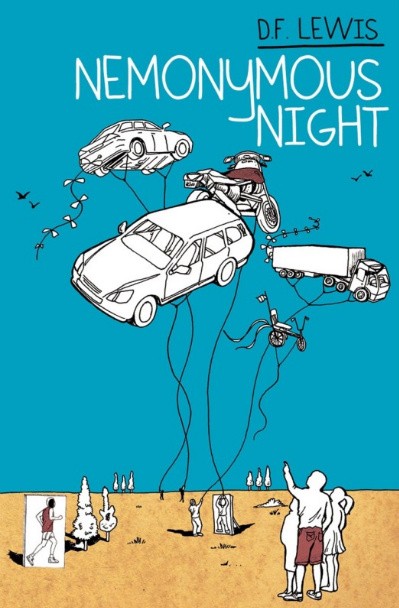
Nemonymous Night

Publication Date – 15 June 2011

Nemonymous Night is not an easy read; however—and here’s the rub—it’s entirely readable.
NEW YORK JOURNAL OF BOOKS (today)

Chomu Press: Prize Draw:-
Are you nemonymous?
“It’s the kind of work you’d like to put in the water supply of a major city, just to see what would happen.”
Publication Date of NEMONYMOUS NIGHT (Chomu Press) 15 June 2011
www.nemonymous.com
===============================

Tuesday, May 31, 2011

The Hummum


TO BE PUBLISHED IN 2012 - 'THE LAST BALCONY' COLLECTION (The InkerMen Press)

Whirlygig (2)


“I see the sea, but can the sea see me?” 


The voice sounds physically close to my ear but, when I turn to see who whispers such sweet nothings, nobody is there.


I turn the other way in case the voice’s owner has gone behind my back.


A stranger stands there with a glass of water in his hand, holding it out to me.  I know it is water because strangers can only offer water to other strangers to drink.  This to avoid skullduggery.  Filtered clear, spring-like, untampered with.


I take the glass.  He smiles as he nods me to quench my thirst.  I surreptitiously sniff it a split second before I sip it.  Then a gulp as the next mode of intake.  Lastly, a long, breath-held quaffing. Until the glass is emptied to its last drop.


I smack my lips in satisfaction.  The stranger smiles. We seem no longer strangers to each other.  But friends of recent making.


He takes me by the hand towards the edge of the sea, where it can see me.  The sea is short-sighted. The sand starts hard-ribbed as left by the tides, but it is soon pulpy enough to make footprints.  I throw the glass into the sea.


He shouts. He is angry.


“The sea’s monocle!” I shout back, stork-legging like a latter-day Jacques Tati, as the ground surrounds me with its dizzying whirlygig of horizons, some man-made, others sea-edged. 


The man makes me dig where the sand is pulpiest.  Despite the light-headedness, I reach the finger-holes of a human skull.


I shrug my shoulders and try to throw this into the sea, too.  But the whirlygig has made me throw it back not forward.  Straight at the man’s caved-in face.


A groundswell of mixed emotions.  The sea is the only witness.  Unreliable, of course.  The shattered ribs of a wreck poking through. History is a series of challenges and responses via a filter whose lens-baffles allow a two-way flow.  Tides ebbing and flowing into each other.


I sip suspiciously, then hold my breath ready to quaff a million million spinning strangers.

Monday, May 30, 2011

The House of Mr Moses


Strange characters - Mr Superbus, Mr Bermuda, and others without names - sit around a communal lounge swallowing various tablets, comparing them, exchanging ... until someone brings a new and bigger supply. Some are pure white with designs on them, others are capsules with multicoloured contents, yet others are huge unswallowable things that have to be inserted elsewhere...


One man seems to grind various sorts into a crunchy paste... Another seems to be satisfied with a simple nose-spray. They look forward to the arrival of Mr Superbus's daughter who always visits on Thursdays. She is bosomy and chiffony but they have to refuse her gifts as they are not prescribed ones. Tablets lent and borrowed, yes, but the tablets need to be officially prescribed in the first place at least to someone in the lounge. Well, that’s the story being stuck to, despite what comes later.


You must just concentrate hard on not annoying Mr Moses (who's in charge) and await  the arrival of Superbus's daughter any time soon.


****


The big problem is that by telling you about the house of Mr Moses at all, I am certain to annoy him.  I am one of those to whom I’ve given no name sitting around the lounge with Mr Superbus and Mr Bermuda.  My own tablet chart is kept religiously and I very rarely dabble in the medicine chests of others who live here.  In fact, we rarely have access even to our own chests, because Mr Moses has the only keys.  It’s just his lax care policy that allows us to picnic on stuff Mr Bermuda orders from abroad, brought here by men in hoods. 


I keep telling Mr Bermuda that such tablets are not prescribed ones.  But he assures us all that we are merely supplementing/mixing our official prescriptions with creative ones, home-cured ones - a bit like with the old-fashioned toy chemistry-sets that we all so much enjoyed during our childhood in the Fifties... and I suppose it’s this sort of information that would get Mr Moses into trouble, should it get out.  He should have a more rigorous hands-on policy for one so much in charge of things.


Oh, I’d better shut up.  Here comes Mr Moses right now.  Judging by his look, he is the bearer of bad news.  I watch him whisper something into Mr Superbus’s ear.  I reckon Mr Superbus is his favourite here.  Oh dear, Mr Superbus’s skin has gone deathly white.  As Mr Moses slouches from the room, I watch Mr Superbus literally cram his mouth with a handful of ready-mulched tablets, to such an extent its surplus amounts become tantamount to a facepack.


Mr busy-body Bermuda strolls over. Trust him. He’s probably got a really special tablet or two for Mr Superbus to swallow.  Yes, I can see one of them is bigger than a horse-pill.  Bloody hell, I couldn’t even take that one up my back passage by the look of it!


***


Tonight, I dream about Mr Superbus’s daughter.  Mr Superbus himself, I understand was once a Member of Parliament ... or have I got that wrong?  Perhaps he was only a Council representative in Hastings town where we live.  She often told me about how her father was big on conservation and had arranged the recycling of recent years, rather than depending on landfills.  I used to work on the rubbish dump in Hastings in the Sixties when all the Mods and Rockers were about.


In the dream, I see that Mr Superbus’s daughter is in trouble.  Quite nude, too, but, for shame, I can’t see her clearly enough because the whole dream itself seems choked with the chiffon blouse she usually wears on Thursdays when visiting us at Mr Moses’.


I now dream of standing on the hill looking right down over the sloping expanse of houses reaching distantly towards the sea below.  The nearest house is the blue one, the House of Mr Moses.  But I haven’t seen it for many years from the outside as I don’t walk about so much these days.  I’m usually housebound for medicinal purposes.  My whole prescription regime is strict for almost each minute of the day.  My neighbours in the lounge, similarly.  Only Mr Bermuda and Mr Superbus usually have the width needed to get out for breathers.  They go to the pier, they say, to play on the Amusements, gawping from side to side like the clowns’ heads whose yawning mouths we once aimed balls into for cheap prizes.


I suddenly see an insect-sized speck in the distant sea.  It is intuitively Mr Superbus’s daughter. She’s screaming. I’m sure she’s drowning.  But I can’t do anything about it, because I know that I’m still in the blue-painted house below me, and this is only a dream of me standing above it in the open air.  But how can I hear her screams?  Even in real life, I wouldn’t be able to hear the screams from up here.  In the old days, I couldn’t even hear the Mods and Rockers motor-biking or scootering along the prom from up here.


***


“You should keep taking the tablets,” said Mr Moses with a jokey laugh.  I had evidently woken the whole house with my screams.  I looked up at his benighted face.  He didn’t often joke.


“How’s Mr Superbus ... after the news?” I asked.  It was uncharacteristic of me to think of others before thinking of myself.  But here I was showing concern for someone else.  I secretly admired Mr Superbus and all he had done for the local council.


“He’s taken a sedative,” said Mr Moses.  “He’ll be OK.”


Despite his earlier jokey comment, I could see he was annoyed about having to get up in the middle of night.


He lifted a glass to my lips after crushing the multicoloued contents of at least six capsules into it.  I swallowed like a gurgling baby, plaintively smiling to assuage any further annoyance.


I wanted to get back to my dreams of mermaids with rocket salad.


***


Strange characters - Mr Superbus, Mr Bermuda, and others without names - sit around a communal lounge swallowing various tablets, comparing them, exchanging...


 The men in hoods haven’t been here for ages.  They’ll be running out of tablets soon.  Even Mr Moses is taking a low profile these days.  It’s Thursday again.  This is a nice day.  Mr Superbus’s daughter usually visits on Thursdays.  She always has a kiss for each of them. Dreams are quickly forgotten. One unnamed lounge-lizard hopes to be off medication altogether soon and then – who knows? – they may allow him out for walks on the cliff.  He looks through the window and sees a figure looking down at the house of Mr Moses.  Oh, to be like him.  He looks even older.  Sixty is no age at all.  Some people start a new life at sixty. Never too late.


He simply needs a suppository or enema to get him fighting fit.  One that can clear his whole system out, hoover out all life’s discards.  Shoot him up with a motor-bike to the upper bowels.


He watches Messrs. Bermuda and Superbus look into their pill-boxes with consternation.  And then he hears the gentle flip-flop of footsteps outside the lounge door.