Rita Kendall, scream queen of schlock horror films of times past, is perhaps past her prime herself, and she now spends her halcyon days languishing in front of a swimming pool with strong drink at her side. Expecting to recount juicy details of her days in the film business, and eager for an extended modicum of fame, she accepts an offer to have an in-depth piece written about her by a visiting writer in residence. Martin Smart (Smartin), the ‘writer in residence’, has been commissioned to write an in-depth piece on her by a mysterious patron, a horror aficionado, who wishes to remain anonymous and assemble a collection to be titled: The Horror of Horrors Anthology- the HOHA. In the space of the story AJ Kirby draws what feels like an effective in-depth portrait of his heroine, using flashbacks, psychological fugues, fragmentary well chosen observations- all infused with rich film imagery that increasingly draws into question Rita Kendall’s fragile mental condition.
------------------------
Common Myths and Misconceptions Regarding Rita Kendall by AJ Kirby. Is an account of past her prime horror actress Rita Kendall, who is recounting her life for a reporter commissioned to write an article for The Horror of Horrors anthology. This is a well written, story, that draws you in with some excellent use of flashback story telling.
-----------------------
This is an ingenious exploration of identity, with a protagonist we empathise with from the start, even as we gradually realise how little she is in touch with reality. There is a tragic past, some things we are all actually afraid of, and a proper horror story moment.
-------------------------
Werner Herzog said that the thing to be avoided at all costs, in cinematic terms, is the clichéd image, as presented through the lens of any Hollywood movie. The stories in this anthology avoid the clichés of horror, either by creating fresh sources of disturbance or by getting inside the horror image to dissect its psychological power. In “Common Myths and Misconceptions Regarding Rita Kendall”, A.J. Kirby exposes the world of an aging horror starlet whose famous scream is subjected to analysis by a bored magazine writer who thereby uncovers the star’s secret source of guilt. As Rita Kendall’s shadowy doppelganger is slowly and clumsily sleuthed out by the hack we slowly witness the pain behind the melodrama and the emptiness of the celebrity life that conceals it.
Any further reviews after 20 Jan 12 will appear in the comments below.
My own views: http://horroranthology.wordpress.com/editors-story-by-story-commentary/
www.nemonymous.com
Des Lewis - GESTALT REAL-TIME BOOK REVIEWS
A FEARLESS FAITH IN FICTION — THE PASSION OF THE READING MOMENT CRYSTALLISED — Empirical literary critiques from 2008 as based on purchased books.
Friday, January 20, 2012

Horror Stories FOR Boys - Rachel Kendall
Despite a series of powerful and caustic flashbacks spurred by the discovery of an anthology in his childhood home, Gary, the story’s anguished, melancholic protagonist, reluctantly decides to make the two hundred mile drive to visit his dying father in hospital. Perhaps due to the main character’s first name, I was reminded in moments of the writing of Gary McMahon, particularly in its unflinching honest portrayals of often grim existences. Rachel Kendall’s writing voice is her own however, and the power in the story lies in the hard and bitter decisions that Gary has to make, but you have to read the tale to find out exactly what those choices are.
--------------------
In “Horror Stories for Boys” Rachel Kendall presents a powerful story of a man suffering from migraines who must visit his dying father and face an abusive past. The author managed to make me feel that bitter-sweetness of nostalgia – even though the past evoked isn’t mine – and although light on plot, this is mature and emotional writing. Of a similar calibre is “Midnight Flight” by Joel Lane about an old man losing his memory, searching for a book he recalls from childhood. Both these tales satisfy with very brittle emotions and atmopshere.
--------------------
...an excellent examination of the consequences of childhood trauma.
----------------------
Horror Stories For Boys by Rachel Kendall revisits an abusive childhood and the escape offered by a much loved book, it’s a rich and emotionally powerful story.
--------------------
Horror Stories For Boys, by Rachel Kendall, has Gary a migraine sufferer having to make a journey to visit his dying dad, a journey that throws up old memories, and decisions that Gary must make. This is a grim and melancholic story that works very well.
-----------------------
“Horror Stories for Boys” by Rachel Kendall is a gloomy tale of hate and pain, featuring a man visiting his dying father and bringing back grim childhood memories.
--------------------
"The emotions are keenly felt,..." (Black Static #25 - TTA Press)
---------------------
At the heart of this story is a rather implausible incident, but Ms Kendall writes so nicely we have to forgive her. A story firmly rooted in reality, and the banal everyday horrors of troubled families everywhere. She just pushes it a little further and skews the point of view enough to make this a compelling read.
-------------
Rachel Kendall’s “Horror Stories For Boys” shows no restraint in revealing the brutality of an abusive father and the traumatic effects of his up-bringing on the son who returns to his childhood home to remember, with the aid of a book of horror stories, and rekindle his hatred of his father. But it’s the final scene, as he visits his dying father in hospital which carries the full sting of this powerful narrative. This is a story full of light and darkness and a terrifying realism.
Any further reviews after 20 Jan 12 will appear in the comments below.
My own views: http://horroranthology.wordpress.com/editors-story-by-story-commentary/
--------------------
In “Horror Stories for Boys” Rachel Kendall presents a powerful story of a man suffering from migraines who must visit his dying father and face an abusive past. The author managed to make me feel that bitter-sweetness of nostalgia – even though the past evoked isn’t mine – and although light on plot, this is mature and emotional writing. Of a similar calibre is “Midnight Flight” by Joel Lane about an old man losing his memory, searching for a book he recalls from childhood. Both these tales satisfy with very brittle emotions and atmopshere.
--------------------
...an excellent examination of the consequences of childhood trauma.
----------------------
Horror Stories For Boys by Rachel Kendall revisits an abusive childhood and the escape offered by a much loved book, it’s a rich and emotionally powerful story.
--------------------
Horror Stories For Boys, by Rachel Kendall, has Gary a migraine sufferer having to make a journey to visit his dying dad, a journey that throws up old memories, and decisions that Gary must make. This is a grim and melancholic story that works very well.
-----------------------
“Horror Stories for Boys” by Rachel Kendall is a gloomy tale of hate and pain, featuring a man visiting his dying father and bringing back grim childhood memories.
--------------------
"The emotions are keenly felt,..." (Black Static #25 - TTA Press)
---------------------
At the heart of this story is a rather implausible incident, but Ms Kendall writes so nicely we have to forgive her. A story firmly rooted in reality, and the banal everyday horrors of troubled families everywhere. She just pushes it a little further and skews the point of view enough to make this a compelling read.
-------------
Rachel Kendall’s “Horror Stories For Boys” shows no restraint in revealing the brutality of an abusive father and the traumatic effects of his up-bringing on the son who returns to his childhood home to remember, with the aid of a book of horror stories, and rekindle his hatred of his father. But it’s the final scene, as he visits his dying father in hospital which carries the full sting of this powerful narrative. This is a story full of light and darkness and a terrifying realism.
Any further reviews after 20 Jan 12 will appear in the comments below.
My own views: http://horroranthology.wordpress.com/editors-story-by-story-commentary/
Paper Cuts - Nick Jackson
Mr. Volpius, a writer of horror stories, is bitten one morning by a serpent coiled around the thorny stem of a rose bush in his front garden. Panicked, he quickly instructs his wife Eva to call upon a doctor, who soon turns out to be of dubious intent. The story takes off from here and revealing more would spoil this entertaining tale. As in Rhys Hughes’s previous story, some absurdist and comic elements are incorporated into the narrative to great effect. The story explores ideas concerning poetic inspiration, the solitary nature perhaps of the writer’s life and his imagination- and particularly, the role of his muse (and her infidelities, also to great and grotesque effect.) The tale moves beyond its boundaries in its final act, contrasting nicely with the well handled claustrophobic parameters in the first half of the story.
----------------
Paper Cuts, by Nick Jackson, one morning horror writer Mr Volpis is bitten by a serpent hiding in his rose bushes. Is a fine story that mix the comedic elements of the story well with the more tenser moments.
-----------------
In this collection, the theme of circularity crops up several times. Here, a writer writes about a writer, and the words bite back. Every writer will recognise the feeling of digging as deep as you can inside yourself, laying your soul on the page and still only seeing a poor shadow of better writers' work. Sometimes your own words come back and mock you - here they do worse than that. Ironically, this is a highly original piece, and often quite beautiful, in a red, squishy and dripping sort of way.
Any further reviews after 20 Jan 12 will appear in the comments below.
My own views: http://horroranthology.wordpress.com/editors-story-by-story-commentary/
----------------
Paper Cuts, by Nick Jackson, one morning horror writer Mr Volpis is bitten by a serpent hiding in his rose bushes. Is a fine story that mix the comedic elements of the story well with the more tenser moments.
-----------------
In this collection, the theme of circularity crops up several times. Here, a writer writes about a writer, and the words bite back. Every writer will recognise the feeling of digging as deep as you can inside yourself, laying your soul on the page and still only seeing a poor shadow of better writers' work. Sometimes your own words come back and mock you - here they do worse than that. Ironically, this is a highly original piece, and often quite beautiful, in a red, squishy and dripping sort of way.
Any further reviews after 20 Jan 12 will appear in the comments below.
My own views: http://horroranthology.wordpress.com/editors-story-by-story-commentary/
Tears of the Mutant Jesters - Rhys Hughes
Books, in Rhys Hughes’s absurdist horror story, can be fastidious things. They can make noises in the middle of the night, they can howl and cry out in pain, they can wail and wince, they can groan and eject weird vomit, they can sob and shiver and even shift position and mess up even the most careful bibliophile’s regimented collection of books. The book in question, an anthology of one hundred surreal and fantastical horror stories, can even suffer from appendicitis! (Nearby volumes have other ailments: Athlete’s footnotes, allergic reactions to bookmarks, and my favorite, particularly relevant to anthologies: the loss of consciousness.) Such is the absurdist mode in this comic and disturbing tale, rich with anthropomorphic literary devices. The story seems to want to perhaps challenge the idea that there is no place for comedy, surrealism or satire in the weird tale of terror. It is very much welcomed here.
-------------------
Rhys Hughes’ “Tears of the Mutant Jesters” is a pleasant diversion from the more serious material involving a book with appendicitis (a vestigial echo of the time when books ate grass). A short tale, it brims with clever wordplay and wry humour.
--------------------
It’s not all darkness, there is humour, of a sort, in Rhys Hughes’ Tears Of The Mutant Jesters a typically Hughesean bizarre tale which bends, warps and twists the English language into a remarkable story about sick books.
--------------------
Next up is a humorous tale by Rhys Hughes, where an avid book collector has to deal witrh a book that is suffering from appendicitis, yes Mr Hughes loves a pun, and story is filled with puns. It is a lightweight tale that after three very heavy and serious tales brought a nice bit of light relief to the collection
----------------------
One of the contemporary horror writers whose name O'Driscoll drops is Rhys Hughes, and Hughes just happens to have his own story in The Horror Anthology of Horror Anthologies. It's a short one, six pages, called "Tears of the Mutant Jesters", and while laziness played a role, I did choose two very short stories to follow up O'Driscoll's long-ish (not very, though) story because I wondered how the premise inherent to the whole anthology could be gotten across, while still leaving room for anything else, in a six or seven page story. Plus, one of those stories was called "Tears of the Mutant Jesters", and I'm not made of stone. Well, in Hughes's case, it doesn't matter, because "Tears of the Mutant Jesters" plays more like an advertisement for surreal horror than anything else, and a pretty low brand of surrealism, at that. "Tears of the Mutant Jesters" is the title of a horror anthology beloved by Thornton Excelsior. It is a collection of surreal horror, "a somewhat sidelined subgenre." The six pages of the story mainly consist of the book needing readjustment on the shelf, the book weeping, Excelsior's attempt to help the book, his various conversations, which are basically each exactly the same, with his housekeepers -- none of whom he hired which is pretty surreal when you think about it -- named Dawn, Midday and Dusk. So you'll have lines like "Dusk was sweeping the land", which is a pun, but also she really is sweeping the land -- sweeping up mountains. Anyway, I guess I missed the thing where everybody likes puns again, but I still don't. Hughes features them prominently, and makes me very much against the idea of partaking in his brand of surreal horror.
------------------
There is a tightrope between intelligent wordplay and groan-inducing puns, and this story strides along it with confidence, with a couple of minor slips. A short and amusing piece, it plays with deep existential themes but doesn't properly explore them. Shades of both Terry Pratchett and Jasper Fforde. Fun.
-----------------
In “Tears of the Mutant Jester”, the books themselves become sick, vomiting indigestible words and having to be relieved of their unnecessary appendices. Rhys Hughes’ brightly punning narrative transforms the darker subtext of horror like a breath of fresh air. Where other authors see an opportunity for expressing angst, Hughes seizes the chance to make us laugh at this literary conceit – books have feelings too!
Thornton Excelsior, Rhys Hughes’, character understands the power of books and the words they contain as much as any of this collection’s authors. We spend so much time in the company of printed words that we know their power: their ability to create or destroy, to provoke wars and reduce men to quivering wrecks, to inspire love and devotion and to raise our eyes to beauty. Books are the driving force of many of the characters’ lives.
Any further reviews after 20 Jan 12 will appear in the comments below.
My own views: http://horroranthology.wordpress.com/editors-story-by-story-commentary/
Further Thornton Excelsior stories have appeared since the HA of HA here: http://nullimmortalis.wordpress.com/2012/01/06/real-time-review-of-tqf-39/
-------------------
Rhys Hughes’ “Tears of the Mutant Jesters” is a pleasant diversion from the more serious material involving a book with appendicitis (a vestigial echo of the time when books ate grass). A short tale, it brims with clever wordplay and wry humour.
--------------------
It’s not all darkness, there is humour, of a sort, in Rhys Hughes’ Tears Of The Mutant Jesters a typically Hughesean bizarre tale which bends, warps and twists the English language into a remarkable story about sick books.
--------------------
Next up is a humorous tale by Rhys Hughes, where an avid book collector has to deal witrh a book that is suffering from appendicitis, yes Mr Hughes loves a pun, and story is filled with puns. It is a lightweight tale that after three very heavy and serious tales brought a nice bit of light relief to the collection
----------------------
One of the contemporary horror writers whose name O'Driscoll drops is Rhys Hughes, and Hughes just happens to have his own story in The Horror Anthology of Horror Anthologies. It's a short one, six pages, called "Tears of the Mutant Jesters", and while laziness played a role, I did choose two very short stories to follow up O'Driscoll's long-ish (not very, though) story because I wondered how the premise inherent to the whole anthology could be gotten across, while still leaving room for anything else, in a six or seven page story. Plus, one of those stories was called "Tears of the Mutant Jesters", and I'm not made of stone. Well, in Hughes's case, it doesn't matter, because "Tears of the Mutant Jesters" plays more like an advertisement for surreal horror than anything else, and a pretty low brand of surrealism, at that. "Tears of the Mutant Jesters" is the title of a horror anthology beloved by Thornton Excelsior. It is a collection of surreal horror, "a somewhat sidelined subgenre." The six pages of the story mainly consist of the book needing readjustment on the shelf, the book weeping, Excelsior's attempt to help the book, his various conversations, which are basically each exactly the same, with his housekeepers -- none of whom he hired which is pretty surreal when you think about it -- named Dawn, Midday and Dusk. So you'll have lines like "Dusk was sweeping the land", which is a pun, but also she really is sweeping the land -- sweeping up mountains. Anyway, I guess I missed the thing where everybody likes puns again, but I still don't. Hughes features them prominently, and makes me very much against the idea of partaking in his brand of surreal horror.
------------------
There is a tightrope between intelligent wordplay and groan-inducing puns, and this story strides along it with confidence, with a couple of minor slips. A short and amusing piece, it plays with deep existential themes but doesn't properly explore them. Shades of both Terry Pratchett and Jasper Fforde. Fun.
-----------------
In “Tears of the Mutant Jester”, the books themselves become sick, vomiting indigestible words and having to be relieved of their unnecessary appendices. Rhys Hughes’ brightly punning narrative transforms the darker subtext of horror like a breath of fresh air. Where other authors see an opportunity for expressing angst, Hughes seizes the chance to make us laugh at this literary conceit – books have feelings too!
Thornton Excelsior, Rhys Hughes’, character understands the power of books and the words they contain as much as any of this collection’s authors. We spend so much time in the company of printed words that we know their power: their ability to create or destroy, to provoke wars and reduce men to quivering wrecks, to inspire love and devotion and to raise our eyes to beauty. Books are the driving force of many of the characters’ lives.
Any further reviews after 20 Jan 12 will appear in the comments below.
My own views: http://horroranthology.wordpress.com/editors-story-by-story-commentary/
Further Thornton Excelsior stories have appeared since the HA of HA here: http://nullimmortalis.wordpress.com/2012/01/06/real-time-review-of-tqf-39/
The Useless - Dominy Clements
As in the opening tale, Dominy Clements explores the idea of a text spreading or infecting those that come into contact with it, willingly or otherwise. Daniel Ausema’s story similarly employs the image of the severed tree to paint a larger canvas, a synecdoche of the condition of the surrounding landscape. This tale incorporates both of these elements whilst raising questions as to the reliability of the narrator’s perceptions. Dominy Clements’s main character, the wife of a university lecturer, finds herself stranded alone in the desert after she and her husband’s car has run out of gas. In a memorable early scene where she awaits her husband’s return on foot from a nearby gas station, her eyes fall upon a strange figure lying on the side of the road. ‘For some reason, my brain has been accepting that everything is as normal as the situation allows, and I fall back into a more relaxed state on seeing the return of my better half.’ The better half however turns out not to be her husband but a stranger, a man who introduces himself as Bob. Her husband he informs her, is unwell, and waiting for her in the nearby town. Revealing more of the story would spoil any surprises. The tale has a nice twist, and several memorable weird scenes. It also provides an additional interesting variation on the relationship between the body and text, and those perceptions that bind them.
----------------------
The Useless by Dominy Clements starts out as a cliche, a breakdown in the dusty west, but soon moves beyond that into a nightmarish exploration of the power of words
------------------------
----------------------
The Useless by Dominy Clements starts out as a cliche, a breakdown in the dusty west, but soon moves beyond that into a nightmarish exploration of the power of words
------------------------
--------------------
"The events described are weird and disturbing,..." (Black Static #25 - TTA Press)
--------------------
--------------------
Any further reviews after 20 Jan 12 will appear in the comments below.
My own views: http://horroranthology.wordpress.com/editors-story-by-story-commentary/
My own views: http://horroranthology.wordpress.com/editors-story-by-story-commentary/
“Can you recall the lasting effect of the most deeply disturbing collection of horror stories you’ve ever encountered? The narratives join hands…” — From THE USELESS by Dominy Clements
Colleen Anderson - It's Only Words
Colleen Anderson’s opening story of shifting malleable identities, temporary unsatisfied catharsis, exorcism and infection (of the body and of actual texts) opens this DF Lewis edited anthology of horror stories. Kudos must go to Tony Lovell’s excellent cover artwork and photography which already seems to perfectly complement Colleen Anderson’s opening tale. Lloyd, the tale’s protagonist we discover, is plagued by some form of personality disorder or schizophrenia. He might also be haunted by the stories he has been reading since he was a boy. It is a strength of the story that this disparity remains unclear-his thoughts and mind however are certainly subject to a cacophony of voices. A seemingly banal incident involving the protagonist’s car being unjustly towed away has harrowing consequences. Revealing more would spoil this excellent tale. Colleen Anderson incorporates elements of body horror and intertextuality in an effective and original way.
---------------------
Curtain-raiser “It’s Only Words” by Colleen Anderson is a muscular start with the tale of Lloyd, a frustrated and unhappy man who collects horror anthologies. He finally snaps and kidnaps a smug wheel-clamper, but rather than the murderous revenge-against-society one might expect, the results are much more memorable and interesting. I won’t spoil it by revealing the moody sting in the tail of this original piece.
----------------------
The opener, It’s Only Words by Colleen Anderson is a “chronicle of pain and lonliness” where a library of horror anthologies is used to teach others life lessons in a variety of splendidly gruesome ways.
---------------------
Kicking of the anthology is It’s Only Words by Colleen Anderson. In it Lloyd, who is an avid collector of horror stories, struggles with everyday life, he finds it hard to interact with people, and thinks that everyone is out to get him. One day he finally snaps, and kidnaps a smug smart arsed traffuc warden. Once he is bound and gagged in Lloyds house, Lloyd dsecides to tell his story to the traffic warden in a very unusual way. Soon Lloyd embarks on a quest top get his story told to all those who deems have wronged him. Colleen Anderson kicks off the anthology in a stunning fashion, this is a moving tale, tat shows there is a power in words and stories
-----------------
"...the tale providing a tasty sampler of what is to come." (Black Static #25 - TTA Press)
-----------------
There is a grand metaphor at the heart of this short piece, about the power of words to remake an individual. Ms Anderson handles it quite deftly overall, her high poetic language beautiful and emotive, though some of the more prosaic sections seem a bit dull by comparison. A good idea, well executed, which is as much as one can ask from a piece this length. I might have preferred it without the last paragraph, which more or less explains it all - I was enjoying the uncertainty.
----------------
In “It’s Only Words”, the fine first piece in the anthology, the protagonist uses fragments of texts to cocoon his victims, thereby relieving the thunderous discourse of the inner voices that poison his existence but, as people around him begin to lose their ability to communicate, he fears he has become the agent of this linguistic decay and the final impression is of a world spiralling into chaos.
Any further reviews after 20 Jan 12 will appear in the comments below.
My own views: http://horroranthology.wordpress.com/editors-story-by-story-commentary/
---------------------
Curtain-raiser “It’s Only Words” by Colleen Anderson is a muscular start with the tale of Lloyd, a frustrated and unhappy man who collects horror anthologies. He finally snaps and kidnaps a smug wheel-clamper, but rather than the murderous revenge-against-society one might expect, the results are much more memorable and interesting. I won’t spoil it by revealing the moody sting in the tail of this original piece.
----------------------
The opener, It’s Only Words by Colleen Anderson is a “chronicle of pain and lonliness” where a library of horror anthologies is used to teach others life lessons in a variety of splendidly gruesome ways.
---------------------
Kicking of the anthology is It’s Only Words by Colleen Anderson. In it Lloyd, who is an avid collector of horror stories, struggles with everyday life, he finds it hard to interact with people, and thinks that everyone is out to get him. One day he finally snaps, and kidnaps a smug smart arsed traffuc warden. Once he is bound and gagged in Lloyds house, Lloyd dsecides to tell his story to the traffic warden in a very unusual way. Soon Lloyd embarks on a quest top get his story told to all those who deems have wronged him. Colleen Anderson kicks off the anthology in a stunning fashion, this is a moving tale, tat shows there is a power in words and stories
-----------------
"...the tale providing a tasty sampler of what is to come." (Black Static #25 - TTA Press)
-----------------
There is a grand metaphor at the heart of this short piece, about the power of words to remake an individual. Ms Anderson handles it quite deftly overall, her high poetic language beautiful and emotive, though some of the more prosaic sections seem a bit dull by comparison. A good idea, well executed, which is as much as one can ask from a piece this length. I might have preferred it without the last paragraph, which more or less explains it all - I was enjoying the uncertainty.
----------------
In “It’s Only Words”, the fine first piece in the anthology, the protagonist uses fragments of texts to cocoon his victims, thereby relieving the thunderous discourse of the inner voices that poison his existence but, as people around him begin to lose their ability to communicate, he fears he has become the agent of this linguistic decay and the final impression is of a world spiralling into chaos.
Any further reviews after 20 Jan 12 will appear in the comments below.
My own views: http://horroranthology.wordpress.com/editors-story-by-story-commentary/
Friday, January 13, 2012
DFL’s Best Four for fiction published in 2011
Best Novel: HERE COMES THE NICE – Jeremy Reed
Best Anthology: The VanderMeers’ massive ‘The WEIRD’
Best Collection: ‘Allurements of Cabochon’ by John Gale
Best story or novella: ‘Suburbs of the Black Lyre’ by Ron Weighell
Best Anthology: The VanderMeers’ massive ‘The WEIRD’
Best Collection: ‘Allurements of Cabochon’ by John Gale
Best story or novella: ‘Suburbs of the Black Lyre’ by Ron Weighell
Plastic Scab
Cosmetic surgery has been in the news recently and, with some of the problems attached to it, one has to ask: WHY DO THEY BOTHER?
Anyway, that’s beside the point. Opinion is never a question of absolute truth. Opinion is another form of story-telling. However, what I have to tell you about is the absolute truth: a backstreet in an out-of-season seaside resort (I won’t say exactly where because I don’t want anyone going there to check). I stumble across a building that looks as if it was once a bijou cinema from before the days of déjà vu or dvds. Along its frontage, there are the words SCAR MUSEUM. It isn’t as derelict as I at first imagined. I can still hear the sea from across the roof: beckoning me. I wish to heed its beckoning. But I am beckoned instead by an actual human shape – from a dilapidated kiosk at the front of the so-called SCAR MUSEUM. It’s as if I’m being hypnotised. I feel my cheeks being visually scoured for scars.
I pay over a £5 note. The only one I have. I see a notice that no change is given: just like on carpark ticket-dispensers, a fact that seems strange with a human ticket-dispenser in a kiosk.
“What am I paying to see?” I ask. A little too late to ask.
“Don’t the name give it away?” the individual sneers rhetorically with a backward click.
“You have exhibits then that are ... scars. Body scars.”
“Yes.” The final s of Yes is certainly a hiss and a half.
I feel drawn within. There are cases with sloping glass covers and inside them things that – if I hadn’t already seen the name of the place – I might assume are damp disfigured postage stamps or crumpled bits of beige carpet or torn bits of old parchment.
I feel followed.
Not by the ticket-dispenser but by someone else covered in a huge pair of tights through the legs of which I vaguely glimpse bones. And a face, through the gusset.
And that face seems to have right in the middle of its forehead a mystic Third Eye or, on closer scrutiny, an oriental cosmetic mark or, on even closer scrutiny, a patch torn from a 1950s toy. A reddy brown piece of Bakelite or synthetic flashing that a toddler child might have torn from an Airfix model he had got fed up with glueing soon after receiving it at Christmas.
“I’m starting to heal, you see,” a voice tells me: pointing to the forehead with the reddy brown thing there. “All of me will be healed soon,” it adds.
I think to myself with a mode of story-telling needed during these days of Credit Crunch and Eurozone Crisis – that one can now never depend on demand streams, even supply ones, to process the end products of what one needs to manufacture for mere subsistence if not, one hopes, for entrepreneurial greed or financial gain.
I leave the building with a sense of downbeat silence unredeemed even by the one huge tidal teardrop that is the sea. Everything mends in the end, though. Sort of.
Sunday, January 08, 2012
Thursday, January 05, 2012
The Dark Damp Corner
It wasn’t always dark, it wasn’t always damp. Or should I have said that the corner was never only dark, it was never only damp. It seemed to go in cycles. It was a top corner of one of the second floor chalet-bungalow bedrooms; near its chimney flue and where the severely sloping ceiling met the outside wall. The cycles comprised periods of not being damp or dark at all. For months on end, and going back in history, for years on end, I suspect. Neither damp nor dark. Then cycles comprising periods of being both damp and dark at once. Never one condition without the other. Darkness and dampness as a tug of war: a host in creative or destructive battle with its parasite, but I was never sure which was which. Darkness or dampness as the cause or effect? How could I tell? I am not a surveyor or professional builder. I was simply sure that you always needed both dampness and darkness for each to exist.
Meanwhile, it was a mystery in other ways, too. There seemed no obvious reason for it. The roof in the corner’s vicinity had been repaired (and eventually the whole roof was replaced as just one repercussion), various other pointing or structural jobs done, chemical treatments given to the wall, even prayers given up to whatever gods controlled dry rot or whatever the condition was called. When in a whimsical mood, I often compared the phenomenon of that corner’s characteristics to those of a real person, someone with moods. Body as well as outer personality and inner mentality.
Someone like Charlie.
Or someone like Mary-Ann.
Both with their own moods and cycles that coincided. A marital pitch-battle that thrived as a battle for its own sake rather than a battle that exacted its climactic defeats or victories. For them, darkness and dampness were called by different names. Only one memory away from a false future.
Charlie and Mary-Ann had lived together in the chalet bungalow for many years. I lived there, too, but they never saw me. I was usually where they were not. Except on the rare occasion when the three of us attended the same room; I would hide behind something in the room, made myself as small as possible, climbing in, for example, behind a book on the bookshelf. Of course, today, with E-books no such hiding-places for me. Not the dampness aura of old books nor the clinging darkness that one imagined littering their fiction plots in the shape of words. Most books had unhappy endings in my experience. Or perhaps that was because I only read books with unhappy endings?
“What’s that noise?” Charlie asked.
They were sitting together in the centrally-heated lounge that stretched from back garden to frontward street. The lounge, being downstairs, was naturally longer than the combined width and length of the two bedrooms, even though one of them was above the stairs-area and the kitchen. Both bedrooms, though, were kept centrally heated, too, in this modern age. I think I was the only one who had got to grips with the logistics of this place where we lived. Its spaces and margins, and its accoutrements or aids of comforting existence that swelled and unswelled with the seasons. Neither Charlie or Mary-Ann gave the impression of ever even thinking about such matters. Mysteries for them were never mysteries. Unless you consider something to be mysterious, it never becomes a mystery.
“It’s the wind,” Mary-Ann replied.
But, upon thinking about it, I am possibly just as unthinking as they are. I never questioned their existence, never thought about how old they must be now, never wondered what I was doing there and why there was a purpose in me being there. Doing and being, different words meaning the same thing perhaps. What and why. What doing? Why being? I knew it was not the wind. I knew it was me they had heard. That was the ‘what’ at least? The ‘why’ remained beyond my reach to know. Beyond, indeed, my reach to be.
I scuttled from the lounge as soundlessly as possible and then up the stairs on all fours, on all my tip-toes. My favourite lurking-hole was in one of the bedrooms beneath the roof. Yes, you guessed it. That corner. That dark damp corner. That damp dark corner. Each room normally has eight corners, half of them ceiling level, the other half floor level. I kept repeating “dark damp corner, damp dark corner” in some form of incantation. Not with words aloud, but from thoughts inside. Thoughts are always silent. Even when you come to speak thoughts, they turn out to be quite different thoughts from the thoughts you thought you were thinking before you spoke them or they are not your thoughts at all!
Perhaps my presence explained everything about that corner. Explained everything that did or didn’t do; was or wouldn’t be. Eventually, I hear the whispering Charlie and Mary-Ann coming upstairs with their light bedtime reading. The days are closing in, growing shorter, during this time, of course. Autumn: the only season I know for certain. For me, mysteriously never-ending. Ever dry-leafing, ever wet-rotting. Very little kindling. Reason unknown.
Friday, December 30, 2011
“TARSHISHIM – boxed limited edition” by Ron Weighell
Real-time review continued from HERE

The Voice of the Silence
“Adam Weishaupt’s ultimate secret was that the secret that there was no secret has served to conceal the secret.”
With “Wax candles spread their golden light” and “teachers who have been busy lighting candles”, the ‘Illuminatus!’ of this accretion-cage of meanings grows with both political contraptivity and mystical glowing: here a 19th century scenario hinting at a great female Theosophical thinker who also seems embroiled with this book’s ‘co-spiricy’ of or with Angels and Demons. Despite some false starts in my gathering leitmotifs from this Classical Weird of symphonic proportions towards a gestalt, I am now much more confident about my own abilities to ‘bottom-fish’ fundamentals (as well as trawling any ‘synchronised shards of random truth and fiction’) from the ‘decks’ of the literary vessel that is the Box. [Any faulty gaps between the book's own seams are taken as read particularly in the light cast by the still ribboned pack of loose-leaf yellow journal notes yet to be investigated after finishing the book. Meanwhile, still no sign of those apparently missing items I mentioned at the beginning of this review.] (30 Dec 11 – another 90 minutes later)
The Law of Unintended Consequences
“In his long experience the unexpected arrival of an expensively dressed, arrogant looking civilian in the heart of a military operation heralds nothing good.”
…like a presumptuous real-time reviewer seeking the heart of a book but trampling – as well as stumbling on – precious vessels and veins as a result like a bull in a china-shop? Meanwhile, this story has a neat equinish conceit involving the Veterinary Surgeon being presented by the civilian to “the unstoppable future of our Nation’s Cavalry.” Causing, end-interpolatively, many real horses to act like lemmings. Sad, yet stirring. Rhys Hughes-ian. The law of averages is not an average law, I say. One wonders whether the Eastern-looking tent or pavilion was more of a ‘contraption’ in keeping with this book’s dutiful thread? (30 Dec 11 – another hour later)
[I quoted "the anatomy of the whale" earlier. I'm sure - in the light of my review techniques - I misread this as "the anatomy of the whole"...] (30 Dec 11 – another 30 minutes later)
The Lion Serpent Begets Gods
“The music, by the way, was superb. I congratulate you, Scriabin.”
If this book previously went into ‘overdrive’, it is now in overdrive’s overdrive! Gorgeous things (both decadent and undecadent depending on your point of view) embodied in sumptuous, Galean prose: depicting a new Bayreuth or Rutland Boughton Glastonbury (my inferences, not the book’s) – while tying up the book’s ’dutiful thread’ with Classical Music and other previous theosophical and “qliphothic” matters, Historical, (here) Russianised, Engravured, Empyrean, Close-Closeted or Universal. [I brought this real-time review to my surrounding 'Classical Horror' website before I realised the book was here to extrapolate on Classical Music at all. My family actually discovered Scriabin for BBC Radio 3 in the 1970s, by requesting his music.] A Panoply of Human Gods. Listed, like buildings. [I wish this book would get its internal hyphens sorted out as in 'frost- etched' and "white - veiled".] Eyes Wide Shut. Kubrickian, too, by inference of wide-eyed deliverance of the Reader to these ‘secret’ scenes (albeit non-sexual, so far). (31 Dec 11)
THIS REAL-TIME REVIEW IS NOW CONTINUED IN 2012: HERE
The Voice of the Silence
“Adam Weishaupt’s ultimate secret was that the secret that there was no secret has served to conceal the secret.”
With “Wax candles spread their golden light” and “teachers who have been busy lighting candles”, the ‘Illuminatus!’ of this accretion-cage of meanings grows with both political contraptivity and mystical glowing: here a 19th century scenario hinting at a great female Theosophical thinker who also seems embroiled with this book’s ‘co-spiricy’ of or with Angels and Demons. Despite some false starts in my gathering leitmotifs from this Classical Weird of symphonic proportions towards a gestalt, I am now much more confident about my own abilities to ‘bottom-fish’ fundamentals (as well as trawling any ‘synchronised shards of random truth and fiction’) from the ‘decks’ of the literary vessel that is the Box. [Any faulty gaps between the book's own seams are taken as read particularly in the light cast by the still ribboned pack of loose-leaf yellow journal notes yet to be investigated after finishing the book. Meanwhile, still no sign of those apparently missing items I mentioned at the beginning of this review.] (30 Dec 11 – another 90 minutes later)
The Law of Unintended Consequences
“In his long experience the unexpected arrival of an expensively dressed, arrogant looking civilian in the heart of a military operation heralds nothing good.”
…like a presumptuous real-time reviewer seeking the heart of a book but trampling – as well as stumbling on – precious vessels and veins as a result like a bull in a china-shop? Meanwhile, this story has a neat equinish conceit involving the Veterinary Surgeon being presented by the civilian to “the unstoppable future of our Nation’s Cavalry.” Causing, end-interpolatively, many real horses to act like lemmings. Sad, yet stirring. Rhys Hughes-ian. The law of averages is not an average law, I say. One wonders whether the Eastern-looking tent or pavilion was more of a ‘contraption’ in keeping with this book’s dutiful thread? (30 Dec 11 – another hour later)
[I quoted "the anatomy of the whale" earlier. I'm sure - in the light of my review techniques - I misread this as "the anatomy of the whole"...] (30 Dec 11 – another 30 minutes later)
The Lion Serpent Begets Gods
“The music, by the way, was superb. I congratulate you, Scriabin.”
If this book previously went into ‘overdrive’, it is now in overdrive’s overdrive! Gorgeous things (both decadent and undecadent depending on your point of view) embodied in sumptuous, Galean prose: depicting a new Bayreuth or Rutland Boughton Glastonbury (my inferences, not the book’s) – while tying up the book’s ’dutiful thread’ with Classical Music and other previous theosophical and “qliphothic” matters, Historical, (here) Russianised, Engravured, Empyrean, Close-Closeted or Universal. [I brought this real-time review to my surrounding 'Classical Horror' website before I realised the book was here to extrapolate on Classical Music at all. My family actually discovered Scriabin for BBC Radio 3 in the 1970s, by requesting his music.] A Panoply of Human Gods. Listed, like buildings. [I wish this book would get its internal hyphens sorted out as in 'frost- etched' and "white - veiled".] Eyes Wide Shut. Kubrickian, too, by inference of wide-eyed deliverance of the Reader to these ‘secret’ scenes (albeit non-sexual, so far). (31 Dec 11)
On the Side of the Angels
“In fifteen sixty six, when Suleiman’s Sorceror called up demons to fight alongside the Ottoman army, an Angelic Host led by the Archangel Gabriel was summoned to oppose them.”
Felicitously, amid the book’s dutifulness towards its own Angelic thread, there is much synergy not only with my own long-term definition of ‘magic fiction’ as a real power in human affairs but also with the use made of it in warfare as described by the masterpiece ‘Jonathan Strange & Mr Norrell’ in the name of Susanna Clarke. Also, arguably, a textual hint here of the internet as part of these processes, which my real-time reviewing also taps into, I suggest. “I take it you are not well read in the works of the master, Edgar Allan Poe? I thought not. It was his belief that if you wish to hide something, the best place is in full view.” This book is fast becoming, in full public view, an important part of my life, retrocausally as well as linearly forward in time. Remarkably, it mentions in this section today “Marston Moor” as one of the battles where “Beings” were sent, i.e. a battle which, synchronously, only yesterday was mentioned independently to me on a semi-public internet forum (here) as being a battle that (with right or wrong on my side, angels or demons?) I am currently fighting on behalf of real books against ebooks. (31 Dec 11 – four hours later)
Control
“…and flickering firelight, full of the smells of old books…”
A scholarly meeting in tune with M.R. James but, refreshingly (with scholars worth their salt), leading not to a plot-sized populist ghost story but to implications of more ‘musical’ interactions of Fine Art (fine as well as foul?) and Philosophy within the book’s Angels & Demons thread / Rationalisation and Magic / Control and Totalitariansim - and how each of us – however firm we are in our beliefs and in our own hard-won goodness – teeters in the grey area between such pairs of ‘similar opposites’, such Ewers-Spider symbioses or host/parasite-uncertainties-of-which-is-which — {Swedenborg or Blake?} [The paragraphing and speech-marks at one point in this section made it difficult to differentiate speakers]. (31 Dec 11 – another 90 minutes later)
Satyrs Gathering
“…the magic that could be wrought by the decoration of books.”
A short telling Coda to the previous story, regarding Chaos Theory (butterfly effect between earthly things and Angels) and much else contained within its Tardis of words. Serendipitously, Blake figures here (Hitler again, too): and the cats and other creatures from the VanderMeers’ massive ‘The WEIRD’, and the London Stone ley-lines from Ackroyd – and the oxymorons within salvation… And it also reminds me that Caruso’s decorations are suffused with Blake’s, in a good original way. Another symbiosis. (31 Dec 11 – another hour later)
THIS REAL-TIME REVIEW IS NOW CONTINUED IN 2012: HERE
Monday, December 26, 2011
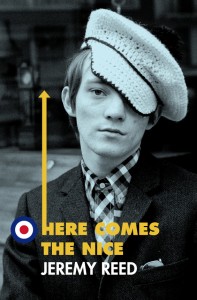
Here Comes The Nice
Real-Time Review continued from HERE.
Here Comes The Nice – Jeremy Reed
Chômu Press 2011
Chapter 10
“Paul looked out into the street again, confused by the Face’s weird crossover from style completist to gene-hacker, and the putative correlation of the two into a Mod aesthetic.”
Paths cross, tomorrow not necessarily a legacy of today, and, amid the mind- (sometimes glove-neat sex)-resonating page-text, I’ve come to this new review page to stop others googling ’Tony Blair’ or ‘Dominic Sandbrook’ – and a ’2011′ conspiracy to punish the former for war crimes. Meanwhile, SF tropes mingle with the intertwining ley-line audit-trails of Paul and John Stephen (via Max who knew JS in his hey-day of real-time and via the Face who supposedly knows JS today despite JS dying in 2004), of Paul and the Face himself head-to-head, similarly Paul and his ‘Suzie Q’. Apparently, as I infer, TB and JS had one thing in common – committing deliberate crimes to test the alertness of those who should prevent such crimes. Suzie Q, too, in her way. I feel sorry for Alex. This book is now at “full tilt”. Unmissable. (26 Dec 11)
Chapter 11
“…Pete Townshend typically burying his guitar neck in a Marshall speaker, like a Boeing thrusting its nose cone through a mirrored tower,…”
It was ‘full tilt’, in hindsight of this new chapter, just on the point when entropy began within the ‘Mod aesthetic’ and developed (Ready Steady Go!) a submission to an image-veneer. In spite of this (or accentuating such a contrast), The Who now take centre stage; you just have to listen to, as well as read, this book to believe its conjuring-up of this Hoovian anti-destructive vacuuming into tangibility and then out of it, then back to it, time and time again, a strobing that’s always had a place in life despite sometimes being imperceptible. Just try, please, even if you know nothing directly about the Mod and/or Modern worlds this book depicts. Empathise with the Face, even if your Liberation front-to-come or beach-head is not the same as his: give your own slant to the “retrovirus” of this book. When I watched ‘Ready Steady Go!’ on the TV in real monochrome time, I never realised how this ‘programme’ of gene or virus or atom particle could now be brought back into my life in 2011 so meaningfully. Nor the fact that, today, I happen, by chance, to live in Clacton, not Hastings! (27 Dec 11)
Chapter 12
“…his own preferred method of time-travel, writing.”
Paul, in our own real-time today, is in “asymmetric warfare” regarding, against or along with ”the quantum weird”: a fashion statement, a physical book to carry around with you like Catcher in The Rye, but now it’s a book called HERE COMES THE NICE. But when it’s just one of a million ebooks on an ipad, you can carry a million books around with you and assassinate a million John Lennons. Each Mata Hari “infatuation” just another of those ‘synchronised shards of random truth and fiction’ or “filleted wallets” scattered upon the Barbara Vine trackside. Blair as “viral glue“. I’ve given up logically reviewing this book, but am just enjoying being infatuated with it. The Dead and Living cancelling out each other’s context within a palimpsest of nostalgia and retro-dread. Of “confectionary” and ‘confectionery’. "Writing about the dead was like Pirate Radio..." (27 Dec 11 – three hours later)
Chapter 13
“Death to him represented the absence of shopping and music.”
As the potentially ”disempowered” Face fears the loss of, inter alia, “Jacob’s cream crackers, four-finger Kit Kats,..”, his desire to optimise a fashion-eschatology for his own immortality takes on practical possibilities; meanwhile mingling with aircraft imagery, the gayrisk of the still elapsing or entropic 1960s (beyond their ‘full tilt’), and, above all, a SF-surrounded Music Hall (Jeremy Reed as Leonard Sachs?) starring brilliantly evoked and contextualised acts-of-the-day as they take on, in turn, each Face-centred chapter’s centre stage: here The Small Faces with ‘Here Comes the Nice’ parts one and two. (28 Dec 11)
Chapter 14
“The Face came back downstairs adroitly, on springy feet, every movement an economic fit with the clean line of Mod ethics.”
Paul, two-timing (in more than one sense!), in our own “real-time“ of Alternate-World-Blair-baiting-and-inner-terrorism-masquerading-cinematically-as-suicide-bombers-while-the-gene-rejigged-Face-as-unsuicide-bomber-in-present-day London, now hits the crux facing him not only by the Face but also by a ‘rejigged’ John Stephen himself fresh from pre-Death. You know, this book, somehow, makes all this feel not only real-time but real. And not only seeming real, but being real. That’s its skill. ‘Magic Fiction’ as I have defined it publicly for several years, and, now, due to this book, a feat managed by a form of hawling. Yes, that’s what the Face is doing: hawling. (My expression not the book’s). The art of the “off-message weird“, too, as co-sponsor. Additionally, I feel, Peter Ackroyd lends weight to to the book’s Magic Fiction by dint of his ley-lines and London Stone, I guess. All hands to the real-wheel. Meanwhile, towards the end of this chapter, the book takes me into its underground toilet. The book‘s underground toilet, not the plot’s underground toilet into which Paul wanders… (28 Dec 11 – another 3 hours later)
Chapter 15
“…but still he knew Mods were essentially over, the corrupted strain diffused into skinhead revivalists with their raw fuckedness quotient of sham.”
1969 and a poignant description of the Stones concert in the heat of Hyde Park following the death of laconic Jones. And an almost unbearable mini-sketch of Marianne Faithful. This chapter is the Face’s ‘dying fall’ within real real-time and it is to this book’s credit that the real Reader cannot yet tell where it’s yet to go and where it’s all going to end, despite there being now only two chapters to read. Marc Bolan taking up the baton…? (28 Dec 11 – another 3 hours later)
Chapter 16
Pages 239 – 250
“…brands sold over the counter like Yacon, Yohimex and Viritab, and wanted to explore its libidinal increase further as part of his own self-regulated programme of sexual gratification.”
Paul’s own ‘dying fall’ now in less real real-time? Amid a Spitting-Image ballooning (I infer) Tony Blair as part of a an economic seedbed culture of decay, diaspora … and fractious guerilla warfare in London as Lebanon. Meanwhile, Paul speculates on his own two-timing! And sexual Zencore-ism (my expression not the book’s). Earth’s Core-ism (ditto). Max provides (tellingly in the context of this book) ”a memory of a memory” concerning John Stephen; as fictional-truth perspectives continue to both lock together and diverge… (29 Dec 11)
Pages 250 – 267
“…then you can join us in the sixties – the orange sunshine decade. You can cross the time-barrier.”
The time barrier? With this world of aircraft imagery and music, I’d say the sound-barrier, myself! — Meanwhile, this is a stunning chapter where the Face and Paul have their Shakespearean face-off (with Olivier playing one of the parts). There is one clincher fact I had not realised before in the emotions lying behind what Paul sees as the Face’s Time-stalking of him – and to reveal anything about it to anyone who has not yet read this far would be a spoiler. But rest assured you will not be disappointed by this book’s ‘dying fall’ of nostalgia and retro-dread, as I put it. Both sad and uplifting, where ‘aloofly’ has become “blankly“, yet a multi-charged two-timing sex / sf romp which creates truths rather than fictionalising them – incredibly so. Truths about the reported facts and sounds and senses of, I’ll say it again, nostalgia and retro-dread. It bears repeating, like a sonic boom or a “dirty bomb” in Canary Wharf or physically / mentally explosive Viagra / Zencore / Bombay Mix. And, here, for the first time (at least for me), ‘The Look’, central to this book’s fashion statement, is in fact an other-worldly literary term about making fiction LOOK as if it is non-fiction or, if not non-fiction, being injected straight into the underground toilets of your veins. This Book is the Look. It all comes home to roost for me. I only hope the protagonists receive their own fair share of credit amid the ‘dying falls’ – not only the author and publisher, although they deserve credit, too. There is more value in being a “deluded Mod impersonator” (the jury is out on that, anyway) than being an ex Prime Minister on the lucrative head-Talks circuit or a real-time reviewer like me (“I’m always one step ahead of my upcoming thought“) or a mere Reader like you with your life’s “weirdly counterintuitive events“. (29 Dec 11 – another 4 hours later)
Chapter 17
” – nobody, he realised, listened to the language of madness.”
A ‘dying fall’ is one thing, a Coda another.This is the perfect Coda. One where you can even hope with some conviction that Looks never blur into each other. Books, neither. Despite a retro-dread that they did, still do and will do. But, for me, the end fire and/or crystal ice in the drugs are provided by the real stiff-to-and-from-soft book in your hands: supplied to the Face, Paul, Alex, Semra, Suzie, John Stephen, Terry, all the Groups from the Ham Yard Scene, then towards BowieBolanRoxymusic and beyond… feeding off the words provided by the Book’s Look at them and, through Magic Fiction rather than Magic Reality, allowing them to exist for real rather than via the fictional drugs they think they put in their veins (dirty bombs and/or clean shafts of orange sunshine). … I recommend this truly stunning book unhesitatingly and I recommend it unconditionally, even if you’ve never heard of Mods in Sixties Britain. Or especially so. (Meanwhile, hoping with some studied aloofness to counter any suspicion of exaggerated enthusiasm.) (29 Dec 11 – another 90 minutes later) END
Monday, December 19, 2011
Encounters with Terror
"There can be no past without a future and, of course, neither without the way station of the present." Rachel Mildeyes.
The little boy, in short grey flannel trousers, was on all fours upon the Persian carpet, watching a clockwork train that couldn't escape from its rails. He laughed to himself, trying to imagine a real steam train chasing its own guard's van, with a huge heavy-duty key turning round and round in the side of its boiler.
A large mother loomed at the door, spoke words that were below the hearing threshold and retreated with a wave of the hand. The boy squinted along the line of tin soldiers that filed from the velveteen foot-stool towards the glinting rocking-horse in the dim corner. The fire suddenly spurted, as a coal dropped, causing red sparks to march up the back of the chimney, and he shivered to think how cold this room would become once he had tucked himself into the cot (which already had its barred side down for him). The fire would cease to be a friend, when the last glow died - but, in sleep, you needed no friends other than those you met in the dream, who would take you by your tiny hand and show you a path between the monstrous shapes that haunted the dream's edges...
The world is full of terror. It stares from every corner, impends from clear and gloomy skies alike, follows its subject like an invisible shadow, waits in the wings for situations and moods to develop.
Francis first came across terror when he was a new born baby in his mother's arms, gazing up for the first time into her beautiful face and watching her red lips move in tune with some meaningful sounds. Terror stamps this memory upon his mind like a photograph blown up out of all proportion, since terror knows no boundaries, sometimes reaching into the womb and, at others, into the grave.
He thus saw terror reflected in his mother's eyes: a baby with birth scars fit to frighten a seasoned surgeon. It leered at him from her eyes, as if it were the evil changeling he could have become if different circumstances had prevailed. And so, in her bed of confinement, his mother cast Francis away to protect him from the creature in her eyes, but his umbilical cord became entangled with her diamante lizard brooch. For a few seconds, he simply hung there like a lump of dripping butcher's meat.
He did not feel like mounting the rocking-horse. But there was a long time to pass, almost a lifetime to someone of his age, before the little boy would feel sufficiently tired to crawl into the cot. The clock on the mantelpiece which he was prevented from reaching (if not by the heat of the fire or the anger of his mother but certainly by the shortcomings of his height) turned over its workings as if it were about to strike - but it never did.
He was tired of playing with with his toys. He needed a pee badly, so he wandered out into the long landing, lined with paintings on one side that were too high up for him to make out their faces clearly in the half-darkness. His little feet padded on the thick pile, before he reached the blue door marked "Necessarium".
His mother had tried to teach him to unbutton the front of his trousers, but he always used the side of the leg-hole. If he had only known all boys of his age did this little contortion, it would have made him feel less guilty.
The hiss of the stream against the side of the bowl had a temporary calming effect - but he never relished venturing far from his room at this time, when evening was putting on its night clothes. He frequently feared that a red-hot coal might drop from the fire, in his absence, and burn a hole in the Persian weave - then bore straight through the floorboards, right down into the kitchen, only to kill his favourite servant, Nancy, dead in the top of her head!
Terror can have no diary, since there are no words to describe it. However extreme and specific the event that engenders this orgasm of the soul, it will remain unwritten and vague, despite the vivid scars it leaves.
The next time he recalls truly making the acquaintanceship of terror, however, was in his teens, although he knew that it was there all the time, whether seen or unseen. Parts of wall, insides of wardrobe doors, in most bathrooms: he tried not to look directly at it, but he knew it was there out of the corner of his eye.
Then, whilst at school, he was snatched from the changing-room shower one day by his sweaty peers, who proceeded to rumble him, frogged him to the cricket-gear cupboard and forced him to look terror in its one eye.
"Hello, Francis," it droned drearily.
"Hello," he replied through gritted teeth.
"I'm glad you've grown up like me, son..."
He managed to claw himself from his captors: most were helpless with cruel laughter, but some with kind tears.
As the little boy slipped back along the cold landing, he noted it had grown darker even in the short while he had been in the bathroom. He arrived at the door of his nursery bedroom and listened at the keyhole, a ritual he often enacted, for no evident reason. Except this time, the breathing was louder, deeper, longer in its rhythm. He entered, heart in mouth, and saw the horse in the corner rocking in the same rhythm as the breathing. The cot covers had been moved, he was sure, while he had been away, tucked tighter, neater, with a sheet lip where the silk pillow glistened. Nancy must have been in already - or it was another servant, the one with the big teeth and and long red tongue whom he always tried to put out of his mind.
He knew he would keep awake as long as possible, hurting his own tongue with his first childhood teeth to do so - in order that the day could be sealed with a goodnight kiss from his mother. But he felt tired enough to get into the cot. So, without clearing up the tin soldiers or retrieving the clockwork train from beside the jack-in-the-box where it had derailed itself, he climbed, with difficulty, between the taut covers that pinioned his body, whilst springs prodded his back. He stared up at the ceiling, ill-lit by the fire, and discovered a new crack. There seemed to be a new crack each time he studied its wicklow crazing. There were worlds up there ... vast continents, warring nations, endless oceans and archipelagos ... where Nancy and he lived happily ever after.
Then comes his third and final encounter with terror. It was a war that he'd been told needed to be fought, since causes were everything: he was not exactly a mercenary, but more one of those innocently caught up in the onrush of hostilities. A tri-cornered affair with no causes other than hate. The last battle had been fought and he was the only one left alive.
His own bravery disgusted him: he had fought as man would if possessed by a ravening beast. He wept cruel tears, as he tried to prize his swollen hands from the blood-grimed rifle.
The corpse of the soldier Francis had just killed groaned in death as if it were a fitful nightmare he sleeped. The belly gaped upon wriggling innards as if these were new sexual organs the corpse wanted to be fondled and loved.
Then Francis dreaded that terror was the sky itself, staring down at him with one searing eye.
"Our Father up in Heaven..."
Except he knew it was a mother, not a father.
Francis muttered a nursery rhyme he had nearly forgotten from his mother's red lips. And by smearing the changeling soldier's blood and guts over his own life-long ugliness, he prepared himself for healing reunion with the extreme of terror itself: the unsurvivable past.
As the fire began to settle in the grate, the ceiling cracks faded. Just before sleep took purchase, the little boy managed to turn on his side within the tight covers and was sure he saw another little boy on all fours tidying up his toy soldiers in front of the fire and through whom could still faintly be seen the stunted flickering of the fire's one solitary flame. The last thing the real Francis ever yearned for was the approach of his long-awaited mother's goodnight kiss, which would further ease him into deepest slumber - but he felt someone's big tongue and, then, the long teeth, instead.
"Terror has no diary, since Terror cannot write."
Charles Maturin 'Melmoth The Wanderer'
Story Published: Dark Horizons #34 (1993)
Sunday, December 11, 2011
Born From Night - Talkback - Ogthrod Ai'f Geb'l
Born From Night
"Nothing to suck."
The voice filled the room, despite being no more than an infant's - or so it seemed. The darkness hid the true identity. In fact, he imagined he was dreaming. Maybe he dreamed he was imagining. Whatever the case, he slapped his head back into the pillow as if that were the secret of sleep.
"I can't suck straight."
This time, a mistake was impossible. He sat propped against the headboard, listening with more than half an ear. In fact, even his heart had heard - beating twenty to the dozen, as it was. Yet the lungs were quiet, daring not to disrupt any possibility of silence - for which their owner yearned - with the faux pas of breath.
If only an untimely dawn would now soak the curtains in a spillage of orange light. He might have excused this mistake in the course of nature, in order to camouflage an even greater and more frightful hitch such as the voice which spoke of sucking as well as sounding as if the words themselves were syphonned up from a sump that had sucking as its second nature.
He could have felt for the light switch as second best. But manmade illumination was far from dependable. He did not know that. There was little else, however, in the midst of night. Even if the lamp broke into that yellow incontinence which was its shade's habit of casting after the dull click of the switch, it owed him nothing and, furthermore, felt no need to have truck with a ghost. He had sensed many such facts following the arrival in his new home. In any case, the ghost (or whatever it was) might be a chameleon and only the changing hues of daylight could throw up any figment of its presence...
He had no purchase on such considerations. He dabbed at the switch in his side and recognised the dull pin-click with a sigh.
"And now my teeth are cast crooked."
There, etched against the wallpaper, were two swelling tusks of black light, snagged one upon the other.
Silence was deeper than the empty space that quickly filled with a crumpled edge of cot-blanket.
Only with a blotted moon, of course, and the least tenable permutation of nature's secondary quirks, could vampires strut and stalk - freshly born from teething babies such as him.
Published 'Roisin Dubh' 1994
The voice filled the room, despite being no more than an infant's - or so it seemed. The darkness hid the true identity. In fact, he imagined he was dreaming. Maybe he dreamed he was imagining. Whatever the case, he slapped his head back into the pillow as if that were the secret of sleep.
"I can't suck straight."
This time, a mistake was impossible. He sat propped against the headboard, listening with more than half an ear. In fact, even his heart had heard - beating twenty to the dozen, as it was. Yet the lungs were quiet, daring not to disrupt any possibility of silence - for which their owner yearned - with the faux pas of breath.
If only an untimely dawn would now soak the curtains in a spillage of orange light. He might have excused this mistake in the course of nature, in order to camouflage an even greater and more frightful hitch such as the voice which spoke of sucking as well as sounding as if the words themselves were syphonned up from a sump that had sucking as its second nature.
He could have felt for the light switch as second best. But manmade illumination was far from dependable. He did not know that. There was little else, however, in the midst of night. Even if the lamp broke into that yellow incontinence which was its shade's habit of casting after the dull click of the switch, it owed him nothing and, furthermore, felt no need to have truck with a ghost. He had sensed many such facts following the arrival in his new home. In any case, the ghost (or whatever it was) might be a chameleon and only the changing hues of daylight could throw up any figment of its presence...
He had no purchase on such considerations. He dabbed at the switch in his side and recognised the dull pin-click with a sigh.
"And now my teeth are cast crooked."
There, etched against the wallpaper, were two swelling tusks of black light, snagged one upon the other.
Silence was deeper than the empty space that quickly filled with a crumpled edge of cot-blanket.
Only with a blotted moon, of course, and the least tenable permutation of nature's secondary quirks, could vampires strut and stalk - freshly born from teething babies such as him.
Published 'Roisin Dubh' 1994
----------------------------
Talkback
He stored up words for future use. Relished insults aimed at himself. Nurtured slips of the tongue. Incubated resentments in the actual shape of glib sound-bites.
And then, at the optimum moment, he would tighten the key and take careful aim at the unsuspecting victim, a victim who, more often than not, had earlier acted as the very source of the barb's power.
Until, one day, there was a ricochet.
And the poisoned dart he had himself blowpiped did pierce his vocal screen-bytes with a bit of his own viral medicine.
Published 'Braquemard' 1996
And then, at the optimum moment, he would tighten the key and take careful aim at the unsuspecting victim, a victim who, more often than not, had earlier acted as the very source of the barb's power.
Until, one day, there was a ricochet.
And the poisoned dart he had himself blowpiped did pierce his vocal screen-bytes with a bit of his own viral medicine.
Published 'Braquemard' 1996
---------------------
Ogthrod Ai'f Geb'l
(Dedicated to Rachel Mildeyes who stayed in the ladies only carriage forever.)
Each morning, Michael had to change at Clapham Junction for Victoria.
It was well known that Victoria had been the last station to welcome steam trains into their platforms, when all the other terminals worth their salt had banned them, following the influx of diesel and electric. But Michael knew that there was still a station at least somewhere which allowed in steam trains at the dead of night, so that they could shunt quietly to their heart's content . . . as long as they kept their funnel-smoke to a minimum, gagged their hissing, deepened their whistles and coupled on tiptoes.
Day-dreaming can be a disease. Michael tried to shake it off as he crossed from platform to platform. But, then, the tannoys would take up their cries, in a language far beyond the comprehension of the common-or-garden commuter.
It often sounded like:
"OGTHROD AI'F GEB'L - EE'H YOG SOTHOTH 'NGAH'NG AI'Y ZHRO!"
Or worse.
Michael seemed to be the only one to understand the messages; the others, clasping their cases and umbrellas for grim life, followed him across the foot-bridge so that they could catch the correct train. And it always came in disguise: bearing the strange Network South logo and, of all things, sliding doors, as if it were an underground train! Where were the leather tongues on the windows? The corridors? The third class carriages? The green sticker denoting the ladies only carriage? And where was the steam billowing into his face like curdling mists of coal-dust becoming forgotten fulsome night?
Day-dreaming again? He shrugged, stepped off the platform and settled into the smoking section. Except the train was only just arriving, and his bones would soon crunch upon the long teeth of the silver runners and upon the brown gums of the sleepers, his flesh to bed red between.
He heard the tannoy:
"This is Clapham Junction, This is Clapham Junction, Gateway to the North, This train is for Victoria own-le..." And so on, interminably, becoming shriller and shriller.
Pity none of the words made sense to him. So, having abandoned day-dreaming for good (or ill), he shrugged with a shudder and travelled on to his office job further north.
Published 'Crypt of Cthulhu' 1992
Each morning, Michael had to change at Clapham Junction for Victoria.
It was well known that Victoria had been the last station to welcome steam trains into their platforms, when all the other terminals worth their salt had banned them, following the influx of diesel and electric. But Michael knew that there was still a station at least somewhere which allowed in steam trains at the dead of night, so that they could shunt quietly to their heart's content . . . as long as they kept their funnel-smoke to a minimum, gagged their hissing, deepened their whistles and coupled on tiptoes.
Day-dreaming can be a disease. Michael tried to shake it off as he crossed from platform to platform. But, then, the tannoys would take up their cries, in a language far beyond the comprehension of the common-or-garden commuter.
It often sounded like:
"OGTHROD AI'F GEB'L - EE'H YOG SOTHOTH 'NGAH'NG AI'Y ZHRO!"
Or worse.
Michael seemed to be the only one to understand the messages; the others, clasping their cases and umbrellas for grim life, followed him across the foot-bridge so that they could catch the correct train. And it always came in disguise: bearing the strange Network South logo and, of all things, sliding doors, as if it were an underground train! Where were the leather tongues on the windows? The corridors? The third class carriages? The green sticker denoting the ladies only carriage? And where was the steam billowing into his face like curdling mists of coal-dust becoming forgotten fulsome night?
Day-dreaming again? He shrugged, stepped off the platform and settled into the smoking section. Except the train was only just arriving, and his bones would soon crunch upon the long teeth of the silver runners and upon the brown gums of the sleepers, his flesh to bed red between.
He heard the tannoy:
"This is Clapham Junction, This is Clapham Junction, Gateway to the North, This train is for Victoria own-le..." And so on, interminably, becoming shriller and shriller.
Pity none of the words made sense to him. So, having abandoned day-dreaming for good (or ill), he shrugged with a shudder and travelled on to his office job further north.
Published 'Crypt of Cthulhu' 1992
Notes From A Dream - Foxflesh
Notes From A Dream
He woke with a start, scribbled a few notes from his dream. He had been sitting on a hillside, the climb to which had been through steep woodland, at the bottom of which he had left his children in the park, playing on the witch's hat, in the care of someone he could recall neither in the dream nor now. He watched the gliders taking off and landing on a raised airstrip across the valley. Each soared into the sky like an angel in splints, crested the thermals, as it dropped the winch line and circled above the model town in the valley.
His note. did not attempt to cover the precise nature of the town below him nor the whys and wherefores of the before/after of the precise moment in dream time. But, in writing the notes at all (which he often did after dreams he at least recalled having, if not their actual content), new visions came, ideas for future dreams and undercurrents of old ones that would otherwise have never seen the light of the day.
The sky soon filled with the gliders, the sunlight sparkling off their wings like stars on a clear night. He was horrified to see that two had collided and cartwheeled down.
That's when he woke, or so the notes said, when he read them that night before retiring. He was worried about the children he had apparently left unattended in the park. His own children were too old to be concerned about them in such a way. But he had a sneaking feeling that those in his dream were much younger.
He looked across at his wife who was knitting in front of the gas fire. He was horrified. It was not his wife at all. He looked down at his notes for clarification - for comfort - for some clue as to whether he was now embroiled in a new dream without the prior warning of going to bed and falling asleep.
The woman seemed to be knitting her own brain as it coiled from her revolving ear as if from a spindle. The white glistening wormthread was still clotted with her headblood. The finished product flowed over her lap and became the white grid of the gas fire which glowed ever upward nearer to its source. She smiled and said: "Time for bed, George."
His name, was it George? He could not even remember. The notes he had just been writing were now just marks on the paper in a language too unwieldy for translation.
A paper aeroplane flew past his nose, obviously constructed and launched by the creature with the brain knitting who was now staring imbecilically with a smile on quivering lips.
It flew into the next dream, where he was still sitting on the familiar hillside. He picked it up and read its message: "Your children have broken backs - unless you hurry down." Some gliders still hung in the sky, hovering like humming dragons. They were so close, he could actually see the dream aviators, smiling, waving - at him.
The distant airstrip bore the glistening groundling craft, and men as small as insects darted hither and thither, busy rewinding the various winches. An arc of a new moon rose early above this scene of activity.
George felt he must really hurry down to the park - he had ignored the message on the paper dart for at least half an hour.
But he woke before he could start off on the wooded slope - which he was suddenly desperate to scale down; for he feared that those he most loved in the real world were in the direst danger.
The utter frustration of waking from a dream too early...
The sky was below, the ground was above and he soared speedily towards two small children being weighed on a see-saw by a strange woman in a red felt hat.
Published 'Skeleton Crew' 1988
His note. did not attempt to cover the precise nature of the town below him nor the whys and wherefores of the before/after of the precise moment in dream time. But, in writing the notes at all (which he often did after dreams he at least recalled having, if not their actual content), new visions came, ideas for future dreams and undercurrents of old ones that would otherwise have never seen the light of the day.
The sky soon filled with the gliders, the sunlight sparkling off their wings like stars on a clear night. He was horrified to see that two had collided and cartwheeled down.
That's when he woke, or so the notes said, when he read them that night before retiring. He was worried about the children he had apparently left unattended in the park. His own children were too old to be concerned about them in such a way. But he had a sneaking feeling that those in his dream were much younger.
He looked across at his wife who was knitting in front of the gas fire. He was horrified. It was not his wife at all. He looked down at his notes for clarification - for comfort - for some clue as to whether he was now embroiled in a new dream without the prior warning of going to bed and falling asleep.
The woman seemed to be knitting her own brain as it coiled from her revolving ear as if from a spindle. The white glistening wormthread was still clotted with her headblood. The finished product flowed over her lap and became the white grid of the gas fire which glowed ever upward nearer to its source. She smiled and said: "Time for bed, George."
His name, was it George? He could not even remember. The notes he had just been writing were now just marks on the paper in a language too unwieldy for translation.
A paper aeroplane flew past his nose, obviously constructed and launched by the creature with the brain knitting who was now staring imbecilically with a smile on quivering lips.
It flew into the next dream, where he was still sitting on the familiar hillside. He picked it up and read its message: "Your children have broken backs - unless you hurry down." Some gliders still hung in the sky, hovering like humming dragons. They were so close, he could actually see the dream aviators, smiling, waving - at him.
The distant airstrip bore the glistening groundling craft, and men as small as insects darted hither and thither, busy rewinding the various winches. An arc of a new moon rose early above this scene of activity.
George felt he must really hurry down to the park - he had ignored the message on the paper dart for at least half an hour.
But he woke before he could start off on the wooded slope - which he was suddenly desperate to scale down; for he feared that those he most loved in the real world were in the direst danger.
The utter frustration of waking from a dream too early...
The sky was below, the ground was above and he soared speedily towards two small children being weighed on a see-saw by a strange woman in a red felt hat.
Published 'Skeleton Crew' 1988
---------------------------
Foxflesh
I must tell you of the time that I first came to the Clockhouse Mount - a year last Spring, I think it was, friend. Do you know the place? Yes, it's in the outer South London suberbs, in Surrey really, but you have to climb along a very long hill out of Cullesdon and when you get there, you see the Green, fronting a run-down parade of shops and, further over, the "Pail of Water". Mrs. Dobb, the landlady of the Pail, she knows all the gossip of the Mount. About the Sawdusts of Number 4 Rich Land: Jackie Sawdust once blew his nose, you know, in public view, he blew it so hard that he just stared into his handkerchief not knowing it was his brain wriggling there, he stared just a few moments, yep, before he dropped down dead. About the Clerkes of Long Land: their younger son was levanted by the Surrey press gangs for labour in far off spice fields. About the losers and the winners of the terrible family feuds. About this and about that...
There is a golf-course on one side, some other cul-de-sacs leading to small-holdings and desolate fields of staring horses, tangled woods and deadfalls, overgrown bomb-holes and the rusty discards of shortly forgotten squabbles. You know, they say that the clouds swag and belly heavier over the council roofs of Clockhouse Mount... and, as I plodded up, that day, in the hope of my first homely tankard at the Pail, large drops spattered from a previously clear sky. Even at noon, dusk was gathering itself and some laggard golfers were standing along the side of the road holding their clubs like spears, making funny faces beneath their tartan berets and wriggling their chequered trousers as if in some crazy fashion show. They would soon be off, no doubt, before the light had finally disappeared.
I looked across at the downbeat parade and saw that the shops had shut, not for lunch as I had thought, but because I, a stranger, had loomed up from Cullesdon and they feared what they considered to be my unwholesome custom. I shivered for had the Pail, too, locked its lounge and saloon doors? The locals were inside, apparently persuading Mrs. Dobb to let them have further illicit flagons of the home-made brew, as I forced an entry through an unoiled latch-door. The bobbled heads looked up, scowls muttering across their faces, and one signalled for me to sheer off.
"Dear Sackalive!" cried Mrs. Dobb, from behind the bar, a friendlier aspect indeed appearing to fleet across her countenance. "I didn't think you'd make it".
"By Cock!" I replied, banging my feet on the floor, "That was a long walk up from the town."
Meantime the locals gathered closer to me and one even fingered my turn-ups in some strange rite of inspection. I looked at the posters and the customary wall-scrawl, to see if this was indeed the day of the darts match that I had been promised. But, no - imagine my despondency, when I saw incomprehensible messages pertaining to a Wicca Meet, destined for that very night ... and further bills bearing such things I cannot now spell - Cuthloo, Shib-Shubbing in the snug, Yogger-Nogging in the saloon and, what was it, an outing at the weekend to the Goat of a Thousand Young for a turdle-eating competition.
I skipped pretty niftily from the pub, for, as they say, you shouldn't turn a heavy stone if something's moving it from underneath.
I ran ... but it was difficult, for what I had thought originally to be rain was in fact now great bulbs of bursting liquid cascading from, not clouds, but shifting, floating monsters in the sky. They extended and retracted, in turn, long arms of blackness, from several interlocked central bodies and, if I were religious, the nearest I could get to describing them would be a hell's brood, an overnourished confluxion of sky and foxflesh betokening the fall of old disgraced gods ... and several smaller versions were creeping over the brims of council roofs...
I ran ... but golfers and pub locals surrounded me. One, of the name Tokkmaster Clerke, as he later told me, wielded a massive rutted file, its frightful crenellations glinting in the flashing of the wings in the sky. I was held fast by one whose nose dripped as Tokkmaster moved the file across my skull. At first, my hair fell away in lumps and dropped to the ground, followed by my skin. He grated it up and down, scratched, sawed, and ground. I could feel the hideous vibrations, reverberations stunning and splitting my head. My skull scrunched. My teeth were on edge, as the grating continued, as he honed my bone. The file stropped and serrated my pure white skull. It ground and rasped. Against the grain. Gashed and scored. Etched and furrowed. Rutted. Fretted and chafed. Scrubbed and gnawed. Eroded and Kneaded.......
* * * *
I ill recall must of that but I live now with the Sawdusts of Clockhouse Mount, and they call me Jackie... They make me worship the great old gods of the Surrey Badlands and the Southern Mysteries... The top of my head is like the skin of cold stew, so I now always have to wear a hat: Mrs. Dobb made it, kindly, out of vinegar & brown paper... and the filing Clerke, he says he's my pal now.
Published 'Dagon' 1987
There is a golf-course on one side, some other cul-de-sacs leading to small-holdings and desolate fields of staring horses, tangled woods and deadfalls, overgrown bomb-holes and the rusty discards of shortly forgotten squabbles. You know, they say that the clouds swag and belly heavier over the council roofs of Clockhouse Mount... and, as I plodded up, that day, in the hope of my first homely tankard at the Pail, large drops spattered from a previously clear sky. Even at noon, dusk was gathering itself and some laggard golfers were standing along the side of the road holding their clubs like spears, making funny faces beneath their tartan berets and wriggling their chequered trousers as if in some crazy fashion show. They would soon be off, no doubt, before the light had finally disappeared.
I looked across at the downbeat parade and saw that the shops had shut, not for lunch as I had thought, but because I, a stranger, had loomed up from Cullesdon and they feared what they considered to be my unwholesome custom. I shivered for had the Pail, too, locked its lounge and saloon doors? The locals were inside, apparently persuading Mrs. Dobb to let them have further illicit flagons of the home-made brew, as I forced an entry through an unoiled latch-door. The bobbled heads looked up, scowls muttering across their faces, and one signalled for me to sheer off.
"Dear Sackalive!" cried Mrs. Dobb, from behind the bar, a friendlier aspect indeed appearing to fleet across her countenance. "I didn't think you'd make it".
"By Cock!" I replied, banging my feet on the floor, "That was a long walk up from the town."
Meantime the locals gathered closer to me and one even fingered my turn-ups in some strange rite of inspection. I looked at the posters and the customary wall-scrawl, to see if this was indeed the day of the darts match that I had been promised. But, no - imagine my despondency, when I saw incomprehensible messages pertaining to a Wicca Meet, destined for that very night ... and further bills bearing such things I cannot now spell - Cuthloo, Shib-Shubbing in the snug, Yogger-Nogging in the saloon and, what was it, an outing at the weekend to the Goat of a Thousand Young for a turdle-eating competition.
I skipped pretty niftily from the pub, for, as they say, you shouldn't turn a heavy stone if something's moving it from underneath.
I ran ... but it was difficult, for what I had thought originally to be rain was in fact now great bulbs of bursting liquid cascading from, not clouds, but shifting, floating monsters in the sky. They extended and retracted, in turn, long arms of blackness, from several interlocked central bodies and, if I were religious, the nearest I could get to describing them would be a hell's brood, an overnourished confluxion of sky and foxflesh betokening the fall of old disgraced gods ... and several smaller versions were creeping over the brims of council roofs...
I ran ... but golfers and pub locals surrounded me. One, of the name Tokkmaster Clerke, as he later told me, wielded a massive rutted file, its frightful crenellations glinting in the flashing of the wings in the sky. I was held fast by one whose nose dripped as Tokkmaster moved the file across my skull. At first, my hair fell away in lumps and dropped to the ground, followed by my skin. He grated it up and down, scratched, sawed, and ground. I could feel the hideous vibrations, reverberations stunning and splitting my head. My skull scrunched. My teeth were on edge, as the grating continued, as he honed my bone. The file stropped and serrated my pure white skull. It ground and rasped. Against the grain. Gashed and scored. Etched and furrowed. Rutted. Fretted and chafed. Scrubbed and gnawed. Eroded and Kneaded.......
* * * *
I ill recall must of that but I live now with the Sawdusts of Clockhouse Mount, and they call me Jackie... They make me worship the great old gods of the Surrey Badlands and the Southern Mysteries... The top of my head is like the skin of cold stew, so I now always have to wear a hat: Mrs. Dobb made it, kindly, out of vinegar & brown paper... and the filing Clerke, he says he's my pal now.
Published 'Dagon' 1987
Subscribe to:
Posts (Atom)