Friday, December 14, 2012

John Cowper Powys' premonition of the Internet

After my reading yesterday of Sam Dekker's high mystic encounter with the Grail in the remarkable 'Is it a Tench?' scene, today's quoted passage from 'The Glastonbury Romance' (1933) by John Cowper Powys brings us down to earth - or does it? 

 "Poor old Abel had been suffering of late from two most vexing physical maladies, either of which would have rendered him miserable, but which together broke down his spirit. One was his villainous constipation, and the other a still worse attack of piles. With the utmost difficulty, under the encouragement of his faithful crony Number Two, the old man had been persuaded to go to the hospital clinic; but the slap-dash methods of the internes, and an interview, in an ether-smelling corridor, with the competent Aunt Laura, had sent him home trembling with nervous indignation, and resolute to confine himself henceforward to his own private remedies -- Beecham's Pills for the first trouble and copious Vaseline for the second."

'internes' is sic. A vague premonition of 'internet'?


PS: One wonders if the tench was meant to relate to the stench (!) that must have accompanied Sam's application of the enema on Abel Twig and the conveyance away of the then full chamber pot past the stew cooking in the kitchen. The two events: the enema and the grail are more or less connected explicitly by Powys in this section. Or was it the chamber pot and the grail?

All my previous quotes linked from here: http://weirdtongue.wordpress.com/quotations-from-the-glastonbury-romance-by-john-cowper-powys/

Some later comments on my Facebook: IS IT A TENCH?
 
DB: Des indeed... one of the weightiest, most profound questions in all fiction.
 
JBC: Is that a fish? 

Des Lewis Yes, but David is right.
 
JBC: To sum up. In this fiction either the narrator or a character asks the reader or another character of a tench, asumed to be such in the fiction, is it a tench and that's the weightiest question in all fiction? I'd ask David to expatiate but he might and it might be lengthy and I'd have to wait till he finished while all the time believing otherwise and not expecting my mind to be changed by him. Oh! he's being ironic. Is he being ironic? You don't hink he is. I'm throwing this fish back.
 
Des Lewis This is another Facebook post by DB on a different thread: [[hmmm...... I've always thought the repeated "is it a tench?" question was emblematic of the tendency to respond in an almost ridiculously matter-of-fact way to something absolutely transcendent; and the conjunction of the grail scene with the enema scene a parallel but not exactly comparable pairing of the most elevated with the most base. Both seem to me to embody profound truths about human experience and reaction. I'd not matched "tench" and "stench" though... that's interesting too.]]

Des Lewis I then added a linkage between the Holy Grail scene (is it a tench?) and the Chamber Pot scene (where the results of an enema are put).

JBC: The question's repeated? The author was imputing to the character doubt of his eyes and understanding of the obvious (though one fish might look much like another, but not if he's repeating the question). Something's being imputed. It can't be a matter-of-fact way, because of the repetition. Could be a neurotic tic. How the fuck's a tench transcendent? of fishy Xianity? Oh well, it would, in Glastonbury and that myth of Joseph Arimathea, and the grail, but only if you're predisposed yourself to invest with transcendence (which I wouldn't be). But the author presumably is, so might be pairing what he thinks most elevated with the base (though I might make a closer pairing that the grail itself or at least its contents are emetic.) Is it David not matching tench with stench or the author? Matching fish with cunt, perhaps? intentionally or unconsciously?
 
Des Lewis I think I am the only one linking tench and stench, grail and chamber pot, although Powys seems to indicate in the text some form of linkage. I read this book first in 1976 and again this year(am still reading its 1200 close-printed pages). If you're not mystical or of a transcendent frame of mind before you start it, I 'Pascal's wager' that you will be by the time you finish it?
 
Des Lewis Someone seems to have asked the same question - quite innocently? - on this cooking forum here: http://playstuff.net/showthread.php/3756-Cooking-(not-a-nVidia-graphics)-thread/page3
  •  
tench
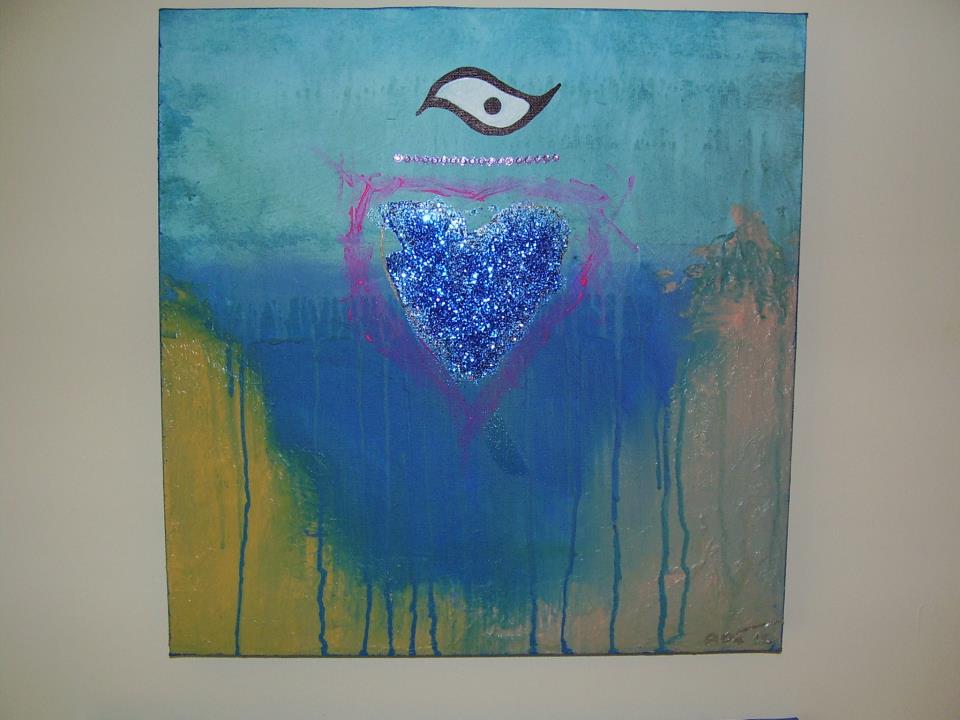
Untitled Painting by Ade Hodges

Thursday, December 13, 2012

"'IS IT A TENCH?'"

------------

My other quotes from 'A Glastonbury Romance' by John Cowper Powys:
http://weirdtongue.wordpress.com/quotations-from-the-glastonbury-romance-by-john-cowper-powys/

Wednesday, December 12, 2012

animula, vagula, blandula


Today's quoted passage from 'A Glastonbury Romance' (1933) by John Cowper Powys. [I've today realised that I've got the title wrong in all my recent posts about this book. It should be 'A Glastonbury Romance' not 'The Glastonbury Romance'!]

"His father's hands came out of his pockets now and one of them was thrust into the aquarium! He had caught sight of something there that Sam, at any rate, ha
d never seen in the aquarium; no! not since as a small child, he had watched his father changing its water and its weeds.
There were now three kinds of weeds in the aquarium, two of them river-weeds, and one of them a pond-weed; and it was in an entanglement of this pond-weed that Mat Dekker had found what was such a shock to him and what, at any other time, would have been an event of the first importance in Glastonbury Vicarage. He had found a dead fish.
'Dead! One of the Meare-Rhyne ones!' muttered Mat Dekker now, holding out the tiny little corpse for Sam to see.
It looked very small indeed in the priest's great brown palm -- very small and silvery -- like an 'animula, vagula, blandula' in the hand of God.
'That's what it is -- one of the Meare-Rhyne ones!' echoed Sam."

My other quotes from this book: http://weirdtongue.wordpress.com/quotations-from-the-glastonbury-romance-by-john-cowper-powys/

Saturday, December 08, 2012

Picturesquey and Deboshed

Today's quoted passage from 'The Glastonbury Romance' (1933) by John Cowper Powys:

"...the Protagonist and Antagonist of this memorable occasion. Never had the contrast between the two men been more marked.
Philip was dressed in a fawn-coloured overcoat and light soft grey hat. He wore spats beneath his blue-serge trousers and in his hand he carried a cane with a round jasper knob that Persephone
had given him. He had a red camellia in his buttonhole and his whole demeanour was composed, debonair, alert.
Bloody Johnny, on the contrary, was really scandalously attired. He had dodged, as his custom was, on public occasions, all attempts of his family to groom him. He was not even picturesquey untidy. He looked like a deboshed verger who had turned billiard-marker in some fifth-rate club."
 

Sunday, December 02, 2012

Nietzsche's Braces

Today's quoted passage from 'The Glastonbury Romance' (1933) by John Cowper Powys:

"Furtively in the darkness she allowed herself to fondle the man's muscular wrist; and then from his wrist her long slim hand slipped down to his great swaying hips. Here, as her fingers strayed, she found one of the leather straps of his braces hanging loose; for when he had been buying that set of heavy tea-cups at Wollop's, he had been persuaded to purchase a new pair of braces for himself by the youth who read Nietzsche and these articles his powerful fingers found it very difficult to button. When he felt her knuckles against his side the spontaneous intimacy of the gesture tickled his fancy as much as her actual touch tickled his ribs; and with a deep-drawn chuckle he stopped dead.
'Do it up, if you can, kid!' he laughed. 'It's beaten *me*, that bit of leather.'
She put both her hands to it and finally -- though not without an effort -- she got it fastened. This was the first time in Persephone's whole life that she had buttoned a man's button."

Other quotes: http://weirdtongue.wordpress.com/quotations-from-the-glastonbury-romance-by-john-cowper-powys/

Saturday, December 01, 2012

The Candy Ion

It was a Biblical mote that caused a negative electrical charge via the optic fuse -- becoming the increasingly searing pain of the mysterious iritis disease, a disease intermittently besetting Desmond's eyes since he was a young man in the early 1970s, till treated, each time, with special steroid drops. Without such treatment, an inner-beam of agonising blindness would parthenogenetically ensue.

Desmond's wife -- for whom he had a choice of affectionate epithets amid the general condition of marriage that, at its optimum, provided a powerfully mutual I.O.U. -- oscillated, like most wives, between pity and scorn. After all these years she no longer claimed to be his youthful 'eye candy' but she nevertheless retained a seasoned charm: a bespoke spell that could elicit a miracle cure from the least likely of sources... A kickstart from despair. A remedial, if rogue, ricochet from the interface of negative and positive.

Desmond had long surrendered any chance of ever ridding himself of chronic iritis, but he suddenly wondered if crying with the right sort of tears might cleanse for good the organic roots within the optic labyrinth, just as syringing by a nurse could spirit away earwax in a different bodily organ. And a wife, if nobody else, had the power, he thought, to synergise her twin natures as nurse and aggravant with electrically emotional charges at each end of the marital spectrum induced at the precise magical moment of serendipitous catalysing.

But those charges had to be sincerely experienced, by both of them as inducer and recipient. He had to stir the mixed feelings that marriage often made into the most powerful of palliatives. He had to ignite the greatest sweetness within the greatest rancour by means of the greatest skilfully synchronised co-incidence.

He stared at his wife and uttered the most annoying of husbandly nonsenses with the most disarming charm. And the consequent tussle of mutual accusation and forgiveness brought irrigating tears of both laughter and sadness to their eyes as syphoned by the accompanying contrast of deep sincerity and alter-cation, resulting in the greatest surge of emotion that had ever been induced by the iconic magic of marriage.

"Thanks, sugar," Desmond softly said, as his iritic orbs were assuaged by the delicately balanced sight of the spirit summoned between them. But do Biblical miracles ever really take hold? Through a veil of tears, each face faced the other face with a sense of seasoned love coupled with a paradoxical pang of both certainty and misplaced hope. For ever or never, amen. Ion or Eon.

Thursday, November 29, 2012

Monday, November 26, 2012

The Malebolge

"All human minds, as they move about over the face of the earth, are in touch with a dark reservoir of our race’s psychic garbage. Just as all the thrilling and vibrating thoughts that have animated human organisms survive the deaths of those organisms, so all the heavy, cloddish, murderous, desolate thoughts, in which free will and faith and happiness perish like asphyxiated gnats, roll themselves in a foul torrent into a great invisible planetary Malebolge. This Malebolge is always present and near, a little way below the surface, for all our human minds; and it only needs certain occurrences, or certain arrangements of matter, to cause an odious and devastating effluvia from its surface-scum to invade the arteries of our consciousness."
-- today's quoted passage from 'The Glastonbury Romance' (1933) by John Cowper Powys

My other favourite quotes from this book: http://weirdtongue.wordpress.com/quotations-from-the-glastonbury-romance-by-john-cowper-powys/

Sunday, November 18, 2012

Crow's Tin


Today's quoted passage (about hawling?) from 'The Glastonbury Romance' (1933) by John Cowper Powys: 

 "For the last month the tin had been pouring forth with such a steady flow that Philip's spirits had mounted up to a pitch of excitement that was like a kind of diurnal drunkenness. He dreamed of tin every night. The metal in all its stages began to obsess him. He collected specimens of it, of ever
y degree of weight, integrity, purity. He carried bits of it about with him in his pocket. All manner of quaint fancies -- not so much imaginative ones as purely childish ones -- connected with tin, kept entering and leaving his mind, and he began to feel as if a portion of his innermost being were the actual magnet that drew this long-neglected element out of abysses of prehistoric darkness into the light of day.
Philip got into the habit of walking every day up the steep overgrown hillside above Wookey and posting himself in the heart of a small grove of Scotch firs from which he could observe, without anyone detecting his presence, the lively transactions at the mouth of the big orifice in the earth, where the trees had been cut away and where the cranes and pulleys stood out in such startling relief against the ancient sepia-coloured clumps of hazel and sycamore, still growing around them upon the leafy slopes. Here he would devour the spectacle of all this activity he had set in motion, until he longed to share the physical exertions of every one of his labourers, diggers, machinists, truckmen, carters, stokers, miners, and haulers."

Wednesday, November 07, 2012

The World-Snake


From 'The Glastonbury Romance' (1933) by John Cowper Powys:

"The man rubbed his shins meditatively and leaning forward in his low arm-chair, pulled with both hands the shiny black material of one of his trousers close round his leg. This action seemed to give him some kind of spiritual comfort and he continued to enjoy the warmth, gazing into the fire with a curious film over his black eyes, the sort of film that might have covered the ophidian stare of the world-snake, at the bottom of the Northern Sea."

Sunday, November 04, 2012

Nancy Stickles and the Blue Mist

 A favourite passage from 'The Glastonbury Romance' (1933) by John Cowper Powys:

"This particular day was indeed as characteristic of autumn in Somerset as any day could be. A blue haze was over everything, so thick and intense, that it was as if the blueness in the sky had fallen upon the earth, leaving only a vague grey hollowness in the upper air. The blue haze invaded everything. It crept through gaps in hedges; it floated over old crumbling walls; it slipped into open stickhouses and haysheds. And though it was blue in colour, it smelled strongly of brown mud and of yellow apples. The blue mist, reeking of cider-juice and ditches, seems to possess a peculiar somnolent power. Travellers from the north, or from the east, coming into Glastonbury by train through Wareham, may be sitting erect and alert as they pass Stalbridge and Templecombe but they will find it difficult to keep their eyes on the landscape when the train has carried them beyond Evercreech and they come into the purlieus of Avalon.
Sleep seems to emanate from this district like a thin, penetrating anaesthetic, possessed of a definite healing power, and it is a sleep full of dreams; not of the gross, violent, repulsive dreams of the night, but of lovely, floating, evasive day-dreams, lighter, more voluptuous, nearer the heart's desire, than the raw, crude, violent visions of the bed.
Nancy Stickles felt a wave of delicious languor steal over her as she contemplated the Glover family enjoying themselves on the little lawn and as she watched the blue mists floating over the old walls and lying in hollows between the narrow alleys, and hovering in pigsty doors, and privy doors and fowl-run doors, and flowing like the vaporous essence of some great blue apple  of the orchards of space over everything she could see." 


More of my favourite passages from this book: HERE

Wednesday, October 31, 2012

Horror Without Victims

After joking around at the end of October with Hallowe'en, tomorrow marks: NoV - No Victims.

Sunday, October 28, 2012

Premonday-ition

The Antiques Roadshow - since it was shown regularly on Sunday evenings - has been direly known as the PreMonday-ition.

Thursday, October 25, 2012

The Pantomimic Cock

From 'The Glastonbury Romance' (1933) by John Cowper Powys:

"Thus, in immediate juxtaposition with Pilate's prolonged soliloquy and also with the pantomimic fooling of Capporelli, as the clown moved from group to group, Christ was led before Caiaphas and Peter denied Christ. The part of the  cock was introduced. This was a too dangerous experiment even for the two Dubliners. They maintained that there was such a deep and primordial poetry about the crowing of cocks, drenched in the dews of ten thousand dawns of human suffering, full of such equivocal, treacherous, and yet Homeric braggadocio, carrying memories of women in travail, of dying soldiers, of millions of tortured, imprisoned and executed victims of Society, -- that it would be vulgar, sacrilegious, a blasphemy against the dignity of the human spirit, impious, gross, offensive, ridiculous to introduce a pantomimic cock upon the stage. Besides -- the two Dubliners had argued -- no human eye ever actually sees the cock that makes its eyelids open. The crowing of the cock brings with it the passionate revolt of all the desperate lovers who like Romeo and Juliet would fain, if they could, hold back the coming of the dawn! It has become -- so the Dubliners protested -- one of the eternal symbols of the human race, recognised from Ultima Thule to Thibet, from Greenland to the Cape of Good Hope; and to introduce a *visual mockery* of such a thing in any performance would not be merely Aristophanic. It would be diabolic."

More favourite quotes of mine from this book: HERE.

Tuesday, October 16, 2012

Terror Tales of East Anglia

Real-Time Review continued from HERE
———————-

Wicken Fen - Paul Finch
"They oozed sexiness..."
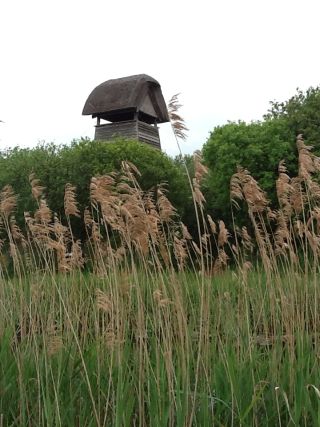
Another worthy story, this time written by the anthology's editor. Here, now, aptly,  we have a riparian reality, or in other words, a waterway, one with locks, called a 'lode' in the Wicken Fen area near Ely and the other Fens, where I myself enjoyed a holiday a number of months ago. The photo to the left is one I took in Wicken Fen. This is a come-uppance story (to match the Johnson story, because any robbery or disloyalty or conceded-to temptation by Man is a common  (Shucks!) mis-symbiosis).  This Finch story is a skilful suspenseful page-turner, with very evocative, often darkly poetic conveyance of the 'genius loci' (to which I can testify from my own experience of the place), possessing that delightfully disturbing, acute, yet textured, horror prose of the horror genre, as our two male narrow-boaters, 'suffering' this book's many earlier marital strains, meet shape-shifters that, here, are "perfectly shaped". So sexily described, I fell for them, myself. At one moment 'Warm and Comfortable Terror' with its satisfying echoes of 'Three Miles Up' (cf: the pair's fatal 'three point turn' of the narrow boat) and of 'The Willows', both classic ghost stories, yet all such great stories, including the Finch, contain real uncomfortably chilling Terror, too, amid the sodden greens and 'crimson cavities'. A fuckerlode of a story. (16 Oct 12 - 4.20 pm bst)

Sunday, October 14, 2012

Dementia

An extract from my real-time review of THE SCREAMING BOOK OF HORROR here.

Dementia – Charlie Higson.
“She said there wasn’t any problem in the world that couldn’t be fixed by having a nice hot bath. A nice long soak.”
Not a bonus track at all, not even just a perfect coda (which it is), this in many ways, for me, is this screaming book’s raison d’être, both in itself as a free-standing story and in the context of the book’s found gestalt. Something you NEED to read, combining the pervasive HORROR and the earlier recognised HOPE of the Littlewood ‘Swarm’ and the phrase ‘Horror without Victims’ — the onset of the ‘Deads’: that plague of dementia as we all grow older. Reminds me too of Reggie Oliver’s great story: ‘Flowers of the Sea’: there a wife (and people of my age have ‘wives’ (or as the Higson story tellingly has it: ‘partners’)), and here in this story: a mother. Her dementia makes Higson’s narrator seem to her to be forever her baby, left behind. And she becomes his ‘giant baby’. And, thus, the book’s main ‘infanticide’ leitmotif takes on a new light here, from Probert’s fatal christening onward. Hot bath or washing-machine to washing-line. The narrator, too, is imbued with the Taborska and Hughes film director and celebrity slant, and the hint in the Fowler of today’s concerns regarding this slant, as explicitly recorded by the narrator in ‘Dementia’: “Starlets, make up girls, continuity girls. I was never short. Had plenty of affairs, relationships, long and short, one-night stands. I was never lacking on the sex front.” This seems to add a pathos to an already deep pathos of the Deads, such HORROR stigmata, paradoxically, not without HOPE. His mother ever moulding clay like pottery – or poetry. A major story in a major book. “Screaming and screaming.”

Thursday, October 04, 2012

Horror Without Victims

I am *intending* to issue submission guidelines shortly for next year's Megazanthus Press short story anthology: HORROR WITHOUT VICTIMS. A paying market, as before. In the meantime, please feel free to start thinking about your submission to suit an anthology with that title. The guidelines are likely to be simply that - with a maximum of, say, 10000 words. Please don't send me anything yet. For the style of fiction I favour please read some of the reviews of the nine issues of NEMONYMOUS, ‘The Horror Anthology of Horror Anthologies’ and ‘The First Book of Classical Horror Stories'. UPDATE 5 Oct 12: GUIDELINES: http://howivi.wordpress.com/