My gestalt real-time review will take place in the comment stream below as I happen to re-read this book in the normal course of my life.
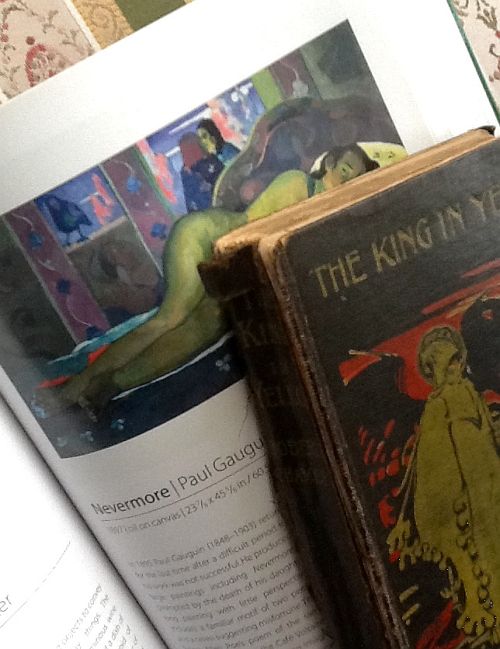
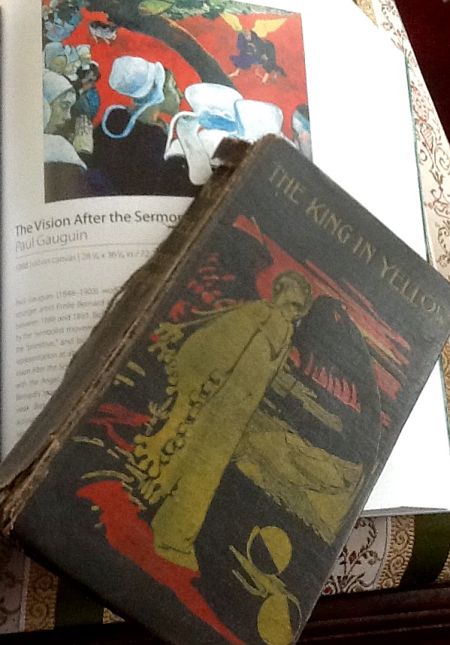 THE KING IN YELLOW by Robert W. Chambers
London: Chatto & Windus, Piccadilly (1895)
Like this:
Like Loading...
-
-
The Prophets’ Paradise
“‘If it is true,’ she sighed, ‘that you find in me a friend, let us turn back together.'”
I really love this series of incantatory refrains in prose, prophetic of a resonance with Dylan Thomas if you imagine his voice reading them or with Schoenberg casting them for Pierrot Lunaire. Oblique references to the requitable loves of this book, and to pallid masks … while prophetic of Lethal Chambers, perhaps those of the Second World War, and with glass ceilings… And clowns and jesters, to boot.
“…I read a thousand names, while from within the fresh blood bubbled to the brim.”
-
-
The Street of the Four Winds
“The name Elven has a charm for me. It tells me of meadows and clear rivers. The name of Sylvia troubles me like perfume from dead flowers.”
This is a meticulous and haunting study of a man with a stray cat he has befriended, a cat with a remarkable garter, that causes the man to fantasise about the cat’s owner with, later, a deliciously open-ended scene when he returns the cat to her owner. It is so meticulous and methodical, this prose could have been written by Robbe-Grillet. Its floridly Proustian, yet ‘anti-novel’ or deadpan, approach opens like a dead flower suddenly come to life.
[There is one strangely isolated reference by the protagonist to the cat that haunts me more than any other, perhaps unsurprisingly: "At the sound of his voice she broke into a harsh rumbling which he recognized as an attempt to purr. He bent over to rub her cheek and she mewed again, an amiable inquiring little mew, to which he replied: 'Certainly, you are greatly improved, and when you recover your plumage you will be a gorgeous bird.'"]
-
-
The Street of the First Shell
“The wounded man rummaged in his haversack and produced a crust of black bread. / ‘He can’t eat it, his jaw is smashed, and he wants you to chew it for him,’ said the soldier next to him. / Trent took the the crust, and grinding it in his teeth, morsel by morsel, passed it back to the starving man.”
And I feel like I have just chewed this lengthy story of the Siege of Paris during the Winter of 1870, chewed it for you, digested the reputed unfantastical dryness of its plot and prose and turned it into what it has always been: a wonderfully evocative vision of a time and a place – with the rat-killer gamins selling rat as food, the rumours, the snow and ice, the conspiracies, the unrequited and requited loves (“And a young Moon requite us by and by”), the interaction between artists, the bombardment over the city roofs with shells, the protagonist’s foray into the fight through perceived shame and disgrace… I felt that, in the context of this review, it was significant that it was a young Bretonne girl who helped him toward the battle, and that it was the rat-killer who enacted the title of this story with a poster outside the protagonist’s house where he had left his loved one. And I imagined a vision of pallid masks as squadrons of soldiers appeared like ghosts through the fog (“A pallor crept above the horizon…”)… And the ostensibly happy ending also made me think that the baby would grow up to be a parent of someone who’d likely die in an even greater war in this story’s future…
Yet, that baby at one point is referred to in an oblique context as ‘the other’ – and I was wondering whether Chambers is implying a new Messiahship?
“…the bookstore tottered, ripped from roof to basement,…”
-
-
Street of Our Lady of The Fields
This novelette is Paris again – but later, around the time of this book’s publication. And, as if denying the gloomy contention in my review above of the previous story, this is an engaging social flirtation of artist students whose etiquette is fluid; birds tweet, and fish are fished, but it is a text textured enough to remind me of Proust and of Elizabeth Bowen (the pallid squadrons in the fog of the previous story reminding me of her ‘shoals of the dead’ in a Wartime Blitzed London …. but lightly reflected by the itemised crowds in this novelette that stroll between the Odeon and the Fountain)…
This novelette has a fine finale on a Paris train as Valentine Tissot, considering herself too Bohemian and unworthy of our hero Mr Hastings, hangs from the train window…
An engaging frivolity, with an artist author who does “pick out the lights in his sketch with a bit of bread” and one liaison or tryst does duly take place “under the shadow of a winged god” (but a cherub as it turns out!) and it has, inter alia, a wonderful literary adumbration of a drummer and of bayonets marching…
The novelette’s last line, though, brings us subtly back to KiY, I feel. As if this slice of social media in 19th century print is again overseen by our Lady Bretonne, the one who was seen as a girl in the previous story…
-
-
Rue Barrée
“‘Name, Yvette; nationality Breton–’ / ‘Wrong,’ replied Clifford blandly, “its Rue Barrée.’”
Well, this is arguably the most powerful story in the book, in itself as well as in the book’s context. Would it surprise you then if I tell you that it is a sequel to the social flirtation in the previous story, even to the extent of carrying over some of the same characters? Yet, this one is, by contrast, hilarious with flowers and wooing, yet filled with obsessively unrequited love, including rivalry among the artist students for a girl called Rue Barrée, named after where she lives in the Latin Quarter (tellingly a barricaded road in the Court of the Dragon) and, presumably, because of her unapproachability of purity and beauty.
“Out of the throng of passers by, out of the world of yesterday, out of the millions passing, one has turned aside to me.” That shoal of the dead, recurring? And indeed, here, birds still tweet and fly, but now we have mention of one bird in a cage. And among those wooing bouquets of flowers, there is a single cactus. Objective Correlatives that resonate with a ”dangerous sweetness”.
Meanwhile, the most obvious connection with the rest of the book is where one of the protagonists, unaccountably, has “…a nightmare about a river of yellow ochre in which he was drowning.” And, like Wilde with the ‘wax ears’ earlier, the love-pursuing protagonist has his real ears removed – now replaced with his eyes like a bird’s.
The story’s obsession is tangible when, in the final scene, a single rose acts as the strongest symbol of unrequited love between two human beings but, upon its very brink of requital, there is separation from each other. To love nevermore.
Like Man and his God. Their reputations irreparable.
end
- end
-
-
All pointing towards the easy artistic flow that would allow Chambers to produce the string of successful popular novels, “romances,” composed with such artistic sharpness, that would subsume him while the illustrative work for journals would be given up — no more the Gibson Girls for him, except by word alone in his stories, rich in historical detail, still worth the reading.
-
-




“One cannot convince typhoid that it is mistaken in its actions.”
Or ebola, bird flu, isis, economic implosion…?
As in his other books, this starts with those Samuels objective correlatives of cigarette and ashtrays in a cafe scenario; this is a textual primary source 1921 oriental against occident fight against Bolshevism, a story within a story, giving both told and telling credence, despite or, even, because of the brilliant deadpan, absurd ending. I don’t know why, but I thought of Ligotti’s Grossvogel from The Shadow, The Darkness and Blackwood’s ‘The Russian’ from The Centaur. The character of this Russian is a force against the crass city-ridden societies of European Union and fast information – and I am inspired by the thought of the ascetic spirituality with which the author has ostensibly invested this story. A story by one of those “Hidden Masters of the World”?
“His huge overcoat was as huge as a bear’s hide.”
Another Russian Russian, if he is indeed Russian, even as this book’s previous Russian was perhaps not Russian at all but, say, Chinese or an esoteric Buddhist? This ‘Russian’ is an essentially British man, terminally ill, gauche, seedily apartmented with thin walls between each apartment, creating his own inversion of a saintly hermitage of spirit, someone on the other side of the emotional Berlin Wall to the previous ‘Russian’. And if I told you who the other tenant turns out to be that would spoil this story for you, and the narrated act of taking things into his own hands is genuinely suspenseful and eventually horrific. Another recurrent Samuels objective correlative, from my previous inexpert observation of his work, is one of analogue static interference on old TV sets. And here it is a form of crude neighbourly ear-worms, then stigmata. A self crucified upon self. But that is only inference on my part. Or interference? Then the recurrent tenant comes in to replace the previous tenant, striving to create truth from fiction, if not sustenance. A story that somehow makes me keep thinking about it, as you can tell from this particular rambling review entry. So, there, I’ll leave it till tomorrow evening, at the earliest.
“He lent towards the small window at his side and watched the snow covered wastes of Russia passing below.”
Not sure yet what to make of this quirky ‘mad scientist’ tale, but it seems highly apt that the Samuels protagonist now travels to Mongolia from England, across Russia, whereby the self-crucified-on-self trope is by needles (like those earlier nails) into a human organ within a bowl of blood that is central to the digital ‘cloud’?
A sort of Ligottian Corporate horror channelled through this DF Lewis gestalt real-time review toward a fast depleting Absurdist vision that becomes the fleeting central white dot on an old-fashioned TV screen?
“…tonnes of sand, in endless grains,…”
“…tree branches, nailed together to form an inverted crucifix, at which conjunction there had been hammered into place a piss-coloured parchment…”
A powerful threnody on the Corporate Horror of the previous story, oversized computer terminals, ‘cosmic blight’, ‘dead dreamers’, visionary towers containing the negative symbiosis of those providing work for ostensible positive reasons and of the negative results of such work (Cf Orwell, Huxley, Kafka…), and something that has fascinated me for most of my life, something I have portrayed in my own mind and in my own work as encroaching ‘dream sickness’…and I hope, but do not really expect, that the ‘N Factory’ in this story intends its N to represent the word Nemonymous…
“He ran his fingers across the bottom of the coats hung up in the hallway, enjoying the feel of his mother’s faux-fur.”
Saving this from much of the danger of being just a run-of-the-mill weird tale of spiritual miscegenation around the environs of the Highgate Cemetery, there is a striking vision of the creatures living beneath the tombs and a reprise of Amelia (the title of the published forerunner of ‘The White Hands’) who inherits the Absurdistly named Gryme House: strangely thus couched in the singular despite the family name being (Ezekiel) Grymes. This house itself helps widen the ‘psychological gap’ between her studiously unsuccessful writer of a husband and their son Alistair… This story starts with the husband’s point of view and ends with that of Alistair, as if the latter gradually subsumes the former by the intrinsic machinations of an autonomous text.
“…flowers rising from a watery abyss, whose filaments oozed black ink…”
…to write not in darkness but upon the surface of the sea, evoking the ultimate ‘at sea’ amnesia about the past and about the self, shipwrecked, if not crucified, upon that unknown self, with vague echoes of Reggie Oliver’s mind-draining flowers of the sea…but I wonder if Oliver’s own reference in this book’s introduction to a ‘frightful sea-change’ is not the whole of the story. I get the sense from this Samuels story, that there is something emerging, more than just frightfulness per se but a renewed budding of a Samuels creativity to awaken an old form of frightfulness to fight another newer tawdrier worldly frightfulness that the book’s other stories so far have adumbrated and now brought to this otherwise plainly traditional Poesque tale, shaping up to each other, face to face, self to self.
“…vague images were on the verge of being manifested via the fuzzy interference,…”
This is a raging culmination – in which the words admirably revel in traditional tropes of thrilling weird and bouts of missing time and suspenseful journeys in the office lift – whereby there reach apotheosis the Samuels screen static and cigarette smoking (page 101) tropes that I identified at the outset of this review (even to the extent, now, of blood being filled with ‘bubbles of black and white static’ and the smoke revealing its own burning) and these two tropes thread through a ‘Corporate Horror’ high rise brutalist office building on its last legs … while its small residue of employees, amid a confining blizzard outside, work on the transfer of the firm’s work elsewhere….
The ending, for me, bolsters the ‘renewed budding’ – as a Samuels symbiotically visionary irony – that I observed about the previous story.
“…utilising limbs that mimicked those of man but which had not been designed for movement at all.”
A shorter, more densely textured and, for me, more satisfying story where it is as if self now faces self as a stiff marionette or mannequin fighting to control the other, while nursed by the idealised loved one. Two worlds, fiction and worldly reality, not only overlapping but fighting to shake off the other, testing one’s limbs, like a baby growing into toddlerhood, perhaps. Which the heresy, which the faith?
Above is based on my rereading of this story today but below is my previous review of it over two years ago (subsequently checked out, then copied and pasted from here):
My Heretical Existence – Mark Samuels
“This is a subject upon which I am the sole authority, for no one else has taken any interest in it.”
This Weird classic-honed tale is paradoxically both loose-limbed and hardening into a traditional shape it can’t seem to shake off. It is ripe with a city that is capable of having parts that cannot be reached by any form of intoxicant or topographical research. Here we have this book’s ‘Adela’ (cf Aleda and Adele separately earlier in this book) about whom our protagonist suffers unrequited love … as well that aforementioned ‘Terra Incognita’ now made patent, if echoic, archaic. I will need to let this potentially haunting tale steep and fecundate, to see if I, too, am infected by something I can’t shake off. A love of this author’s writing heretofore …. and towards renewal? Or simply a love of a memory. And whether self-heresy is my own lot in the autumn of my life: an autumn beyond the reach of anyone younger than me, as their world closes in on them all with an unwelcome hardening. Each of them thinks, surely, that they’re alone or uniquely susceptible. ['The Child is Father of the Man.' (Wordsworth).] (20 June 2012 – 9.00 pm bst)
“Time had ceased to exist and my perceptions formed part of an indeterminate totality rather than part of a sequential process.”
And indeed I feel like that when conducting a gestalt real-time review, a process of which Mark’s fiction work itself aptly set me on the path in November 2008.
After the cleansing of static and smoke in the foregoing stories, the facing of self with self, we have here a Fragment of Life finally become Whole, a holy grail where the vision is so powerful that it almost aches in the reader’s soul. It tells of a man who takes over a flat from someone else who has disappeared and the new tenant gradually becomes subsumed in the other tenant’s ways and abandoned possessions.
I brought this book back into the living world from a dream.
——————————-
This luxurious book is beautifully produced by Egaeus with 128 pages.
“This edition of Written in Darkness is limited to 275 copies”.
May 704 be with it.