Saturday, December 13, 2014

BFS Journal #13

BFS Journal #13

bfs13My real-time review of the fiction and poetry in the British Fantasy Society Journal – issue 13 (2014, arriving with me today)
Fiction and poetry writers are: Suzanne J. Willis, Tina Rath, Allen Ashley, David Gullen, Robin Hickson, Sarah Doyle, S. Marcus Jones, Rachel Coles, Noeleen Kavanagh, Roy Gill, Marion Pitman, Rebecca Lloyd, Clifford Beal, Zoe F. Gilbert, Deborah Walker.
Editors: Sarah Newton, Ian Hunter
Typesetter: Stephen Theaker
Cover illustration: Howard Watts
This book was received as part of my membership of the BFS. As well as the fiction and poetry, there are several articles of interest to BFS members, and this paperback book comprises 192 pages.
My previous reviews of BFS publications are linked from HERE.
MY REVIEW WILL TAKE PLACE IN THE COMMENT STREAM BELOW AS AND WHEN I READ EACH WORK:-
Filed under Uncategorized

19 responses to “BFS Journal #13

  1. Sundark and Winterling by Suzanne J. Willis
    “…words are always enthralled by a good story.”
    …and that about sums this story up in such an amazing retrocausally shape-shifting way! An enchanted text soaring into a mind-shimmering, faerie-meticulous fabric of words (‘forgotten words’ as well as ‘language reformed’) actually to conjure this retributive sibling world surrounding a loved dragon turned into, for me, a sort of ‘[House] of Leaves’ as his past lover tries to exhume her love, with some hope, and with some help from wonderfully conceived ‘erutisi’ “small as children and nebulous as mist” and a ‘memory-box’.
    • Another quote from the above story, one that significantly resonates with one of the stories below, now having read that story:
      ” Forgotten language, muscular and elegant, rippled under her skin.”
      But if I tell you which story that may be a spoiler!
  2. The Unicorn Girl by Tina Rath
    A sharply evocative sonnet about unicorns in woodland, then in city, one that serendipitously echoes the previous story, especially in its last line, in its retrocausality as well as hope of words. A sonnet that has a horn sticking out typographically in that same last line, I sense. Or maybe not.
  3. William Etty 1837
    William Etty 1837
    Life on the Rocks by Allen Ashley
    “‘And you’re telling me this in Poundland,’ she mutters, departing.”
    This is an entertainingly amusing tale of a Siren called Dora who inhabits a sort of rocky outcrop on the North Sea, not dissimilar to those outcrops where I live on the Essex coast by the same North Sea, except there are more such outcrops now with all the new fishtail groynes currently being rocked-up as coastal defences.
    John William Waterhouse 1891
    John William Waterhouse 1891
    Dora is on the Internet and emails her sororal Sirens and visits Poundland as well as a shop with which she barters pearls in Ruskin Street. But, incredibly, this story is touchingly poignant, too – no mean feat – with her preserving her dead loved one in her cave, a painter called William. Serendipitously, again, this preservation closely echoes the preservation by a Siren-like female protagonist of a loved one in this journal’s first story!
  4. Schenectady by David Gullen
    “Dora had been pleased with her story when she first wrote it.”
    Believe it or not, a story featuring another Dora, to follow the previous one!
    While reading it, I believed this to be a plain, if well-written, story of a writer’s group, its rivalries, its writing jealousies, its romances, then introducing a gruesome monster in its latter stages… until I came to its absolutely brilliant last line that took it beyond the run-of-the-mill.
  5. The Apothecary’s Tale by Robin Hickson
    “For the letters, unlike their frosted surround, are transparent; carved like a stream across a beach.”
    This is a stunning piece of prose and it is written by an author whose name is new to me. I can only compare it to stories by Colin Insole (one of my favourite writers ever), and if you already enjoy one of these two authors, I am confident you will enjoy the other, well, certainly this story, at least, as I have no experience of other stories by Hickson. I shall certainly be seeking them out. Having said all that, I am not sure I am on safe ground plotwise, but yet, in a way, I am, because it has left many questions in my mind, which is probably its purpose.
    There was a ‘dodgy doctor’ in the Allen Ashley story above, one who prescribed medicines or drugs for Dora. Here he is called an Apothecary or, I infer, a chemist. The story’s ending significantly adds two letters to that latter word by which action it links much together in my mind. The fact that there is a recurring reincarnation of the Apothecary’s cat, there is, too, of the Apothecary himself, I guess, who calls himself ‘you’, when referring to an earlier self, or a later one? There is an element of guilt or shame at his sexual longings, and there is a gritty and/or phlegmy watermark threading or seeping through, like an inner palimpsest, the past and destiny and other characters in the Apothecary’s shop.
    The guilt and shame lead to the inevitable, perhaps. The prose is full of the viscous, the vicious, the crepitating of smoke and fire, as well as an incredible scene involving ice-making for sodas that the Apothecary sells. The words in fact act in the way that this Journal’s first story stated that words can act, as more than just meaning, but also physically and spiritually. Do read this story and tell me what you think. Am I on the right lines?
  6. image
    Precursor by Sarah Doyle
    “A beauty, yes — but shackled to the past.”
    This Journal’s second sonnet, another sharp one, there the unicorn’s horn, here the spinning-wheel… There retrocausal, here, equally exquisitely, precausal in the ironic sense of a death of sleep, like birth, prefiguring a yearning for life itself…?
  7. imageSummertime in Paris by S. Marcus Jones
    “I watch as the needlepoint pushes… […] The mother-of pearl spiral tip of its horn…”
    I am enthralled as this vividly myth-of-myth story (in a believable Parisian park) not only explicitly, if accidentally, conveys a tapestry of my nemonymal expression ‘veils and piques’ of yore but also undeniably blends this Journal’s previous two sonnets into one story deploying a filmic tableau or vision. Whether that was intentional or not, with the Journal’s poetry and fiction being edited by two different people, I am doubtful, but it is certainly a treat. In itself, without these connections, the story is a compellingly expressed enticement of a unicorn through a veil into our reality, with convincing girl characters as deliberate or inadvertent bait, one spread out like sleeping beauty, and the other as a jaunty modern scanty, with the intention of putting it to sleep with a needle-like dart. Sharp-things and Sorcery, with an end battle.
  8. Hell Is the Cooking Channel by Rachel Coles
    “The branches gouged into him and trapped his arms while their sweet fruit budded and grew next to his nose,…”
    Another piercing of the veil of myth, here with the sheer thrusting appetites of a god among many of us, I infer, and the main protagonist here suffers a lust for fast food, even for the flesh of his girl friend, as dream-clotted visions intrude from beyond that veil. I don’t think I have ever read such a substantive series of food descriptions and hunger for such food that concurrently make you feel very hungry and very sick. Amazing stuff.
    On a tangent, there is a very interesting and illuminating contrast between the ice-making and soda in the Hickson story with the description of the greasy fast food here, yet tantalisingly revealing something about the pure water later in the Coles story.
  9. imageStep Sisters by Allen Ashley
    From Sleeping Beauty to Cinderella, this is an engaging poem of five rhyming or assonant stanzas of five lines each. I wonder if one of the stepsisters is Dora the Siren as she has a “voice of an expired seagull” and also “She snores just like a dinosaur…”, with ‘dinosaur’ being one of this author’s favourite tropes (see my 2009 real-time review of a story collection by this author here).
  10. A Year in the Country by Noeleen Kavanagh
    “A spiked potato is not good to eat but sometimes when there’s nothing else you have to.”
    A sixteen year old in 2048 keeps a journal, her entries simply narrating a post-Collapse dystopia, with desolation, cold, fellow feeling, illness and finally death of loved ones, with a sense of fairies just beyond the most tenuous veil. It did not really enthrall me, but that’s probably just me.
  11. Parallel Prelude: Paw Prints in the Snow by Roy Gill
    I just tried to get into this, but I couldn’t. Maybe because it’s the middle part of a fantasy series. But I sense it was not something written for me, and it would be unfair to review it. I did exactly this once before in a BFS Journal real-time review, so this story shouldn’t take it personally!
  12. Night Out by Marion Pitman
    A stirring piece in free verse – that echoes some of this Journal’s earlier shape-shifting, but also seems to encapsulate the transcendence of such shape-shifting through the veil of myth as shown by the Rachel Coles ‘appetite’ story, particularly when the poem reaches its ending with such effective down-to-earth bathos.
  13. The Pantun Burden by Rebecca Lloyd
    “‘There are curtains still,’ she said, ‘but since Gloria died, he doesn’t use them; the chicken shit all over the windows is good enough for him.'”
    I loved this story of a curse-filter working both ways! You’ll know what I mean when you read it. This story of a simple youth being bitten with marks that turn to scabs when helping at the chicken farm, his mother, the woman they ask to help, is extremely haunting. Not haunting in the usual sense with veils and apparitions with round corners, but haunting in a more sharp-pointed way like the sharper stories and poems earlier in this Journal, making you want to itch, to look out for bodily incisions or cracks with seepage, to think of H5N1 and to want to see a Tod Browning film again, against all better judgement!
    (My previous review of a Rebecca Lloyd story here.)
  14. Cast Iron by Clifford Beal
    “…as if he was peering through gossamer…”
    A couple, through an estate agent, take over a possibly to-be-listed, 300 year old property, one with huge ancient cast iron oven, and they live there with their two year old son. The ending is creepy in a creditably striking way, but overall, for me, there was little that stood out to keep the momentum going through a number of pages of run-of-the-mill ominousness towards that ending. A story about a haunting, if not always a haunting story.
  15. The Manhattan Room by Zoe F. Gilbert
    “There was a yellow square, far too small to be a projection…”
    This is a truly classic haunting and moving story, of promised ‘connection’ for a girl with her mother after the latter’s death, the object cross-pollennation between a model railway in one room and a huge wallpaper photograph in another room depicting a Manhattan skyscape of apartment windows… If I tell you too much about it, it would be spoilt for you. It just is. Simply splendid. Personally, I thought of Proust’s famous little yellow patch on a wall in Vermeer’s painting of Delft, a remembrance of things past, a search for lost time, via the veils of object correlatives. A blend of Cinderella and Sleeping Beauty in Sundark’s house: a gestalt from the light-motifs conjured through this real-time spy-hole into the book?
  16. Aunty Merkel by Deborah Walker
    “The multiverse is so very, very large, and because of chaotic inflation it’s always stretching, like a loaf of bread, forever baking in the oven of eternity.”
    And this short short coda, with that, not only harks back to the huge oven in the Beal story (its oven as a separate entity) but also to the tenor of all the fiction and (multi)verses in this Journal. A tale of a wedding and an Aunty that goes to all of them… it’s not the doubtful people who say things that count but it’s the things they say that can bring ‘enduring love’. Words outlast whoever speaks them and little matters it whether we fully appreciate these words’ meanings, as long as we do speak them – from a book to the congregation of each other.
    end
  17. I have now also read most of the non-fiction in this Journal, too. An achievement for Stephen Theaker in very speedily recouping someone else’s delay and I now discover on page 191 that he was the overall editor as well as typesetter. The Fiction and Poetry editors are named at the start of this review.
    Mr Theaker also interpreted and transcribed much BFS revealingly political and news stuff in the interesting articles that filled many of the non-fiction pages.

Thursday, December 11, 2014

BFS Journal #12

BFS Journal #12

bfs12
My real-time review of the fiction and poetry in the British Fantasy Society Journal – issue 12 (dated October 2014)

Fiction and poetry writers are: Beatrix M.G. Nielsen, Nigel Wilson, Deborah Walker, Stewart Horn, Jonathan Service, Lea Fletcher, James Dorr, Damien Kelly, Elaine Gallagher, Sarah Newton.
Editors: Sarah Newton, Stuart Douglas, Ian Hunter, Max Edwards
Snark Herder: Phil Lunt
Cover illustration: Howard Hardiman
This book was received as part of my membership of the BFS. As well as the fiction and poetry, there are several articles of interest to BFS members, and this paperback book comprises 137 pages.
My previous reviews of BFS publications are linked from HERE.
MY REVIEW WILL TAKE PLACE IN THE COMMENT STREAM BELOW AS AND WHEN I READ EACH WORK:-
Filed under Uncategorized

10 responses to “BFS Journal #12

  1. There Is Nothing Keeping You by Beatrix M.G. Nielsen
    “If you don’t stop keeping me back then I’m leaving.”
    And beyond back, there is bark. This starts at Triss’s unequal partnership with oddly named Oddmund, but she suddenly enters a wonderland or chequered architecture of Alice, beyond another bark, where thankfully I cannot fathom the symbolism of the nice and nasty things discovered or the narrative purpose of the characters met. They just are. As in mathematics, there are relationships that hold a complexity that gradually comes out naturally as if it were simple from the start. Like human relationships, too. Especially the ideal one found in some fairyland beyond the sewer tunnel. A perfect equation. Eventually satisfying. Odd then even.
  2. The Allotment by Nigel Wilson
    And from the previous story’s Beyond the Bark, we have appropriately this one’s “Narnia is the watchword”, and a similar satisfying endgame resolution when the relationship equation is solved. Yet, there is a much more down-to-earth element (or ‘down–to–earth’ as the typesetting would have had it) to most of this story. And I am pleased to see that – surrounded as we are in our world (literally with the story’s allotment contiguous to a notorious park) by modern crimes, illegal highs and other ills – we have here something old-fashioned and artisan or working-class and good-hearted like growing vegetables (some explicitly called ‘phallic’ in the text), to cultivate one’s garden and so forth. The prose style is like that, too. And what is found under the allotment’s ground (like that smelly object found in the previous story) turns eventually, by some indirect serendipity, into an effective spectral resolution of a whodunnit murder as well as into that endgame resolution towards a finer future for those left living it. The perfect allotting.
  3. Looking Good by Deborah Walker
    “Attractiveness is a big industry with too many contradictory theories for me to understand.”
    As an engagingly oblique variation upon an Ishiguro ‘Never Let Me Go’ theme, this tale of a girls’ school and a sort of religious genetic engineering is an effective satire featuring the ever-tweaking of some Facebook of the real face by ‘click-DNA’, here toward an extreme form of hologrammatic air-borne infection (or contagion by intimate contact alone?) as retributive sabotage. It is a ‘fabber’ fable with a moral, but one is left questioning whether the orientation of the central relationship is significant or a passing crush? I managed to ask that with a straight face. An unadulterated one.
    (cf ‘The Armless Lady’ in the first story and her dealings with Triss).
  4. Hell Bent – A Villanelle by Stewart Horn
    A very powerful work in the strict obsessive Villanelle poetic form with a recurrently incantatory couplet of lines that, on their own at least, should make this become a famous poem. Very impressed. The straightened or straitened apotheosis of love being Hell Bent?
  5. The Last Will of the Tyrant Rusana’a by Jonathan Service
    “Rusana’a was magnificent, astride his horse, his lacquered armour burnished gold and black, the patterned green and white of the silk beneath peaking through the joins,..”
    The word ‘peaking’ used instead of ‘peeking’ seems to indicate an act of tenting the material by something rising beneath? This is a horny story indeed, as thigh wounds are tended man on man, and conflict, almost ‘friendly fire’, ensues amid confused but redolent conspiracy, clear loyalty and a feel of Lord Dunsany (a review finished only yesterday).
    “…particularising infinite potentialities into a single, rough, reality.”
  6. The Last Man of Rowandale by Lea Fletcher
    “‘Don’t be daft,’ Irin told him. ‘Your fight is my fight.'”
    Resonant with swords and light sorcery, and with the previous story, as wounds are tended man on man, this is a touching, compelling ploy-for-good tale of assassination by spell as well as by destiny, as two men trick themselves beyond barriers to reach their target, to reach even beyond the barriers of each other, in the sense of a kiss of friendly fire amid a gender spell, too?… As Irin strives to “give Hanith that vital opening,…”
  7. Flute and Harp by James Dorr
    “Playing together, they syncopated, their melodies weaving. Trading crescendoes.”
    …not exactly the duelling banjos in ‘Deliverance’ or the clinching love between fist-tapping warriors amid this journal’s earlier fiction, but more a feminine symbiosis of ‘augmenting rhythms’ within music and gentle love’s passion. This is a major work of some sumptuous substance that I enjoyed, combining previous Dunsanyan elements and, inter alia, the honest-to-goodness tunnelling of culverts reminding me of similar in The Allotment and Nielsens’s version of Wonderland, all from the point of view of a ratcatcher in this tractably believable fantasy world, where ghouls and tombs are the effectively gruesome backdrop to the two women’s love and sacrifice, and, yes, the music of words themselves as well as the conjured music that I believe I can actually hear within what the words describe.
    My enjoyment of the language flow in this journal has so far been quite disrupted by the text’s en dashes being used both as hyphens and as en dashes themselves. This sounds like a minor point and I know that I shouldn’t be as irritated as I am, but it has become rather haltingly off-putting, particularly in this latest story I have just read.
  8. The God Within by Damien Kelly
    “You shouldn’t need a star to start the day, nor the moon to start a month. / You shouldn’t need a fire to start your life.”
    I’m not sure I am on safe ground here, amid a confusing Confucian galaxy of names vis-a-vis the ancient Samurai and the natural love between such men, and the intertwining philosophies of fate and life’s purpose and personal responsibility (God within or without?) – and potential conspiracies of alignment and heritage. Suffice to say that I was inspired from absorbing this text, interested as I have been since the 1960s in the study of astrological harmonics and whether this derives from ’cause-and-effect’ or ‘as above, so below synchronicities’. Or, judging by this story, both?
    I loved the precisely numbered fires (arson or otherwise) and the corresponding meteors in the sky, and I thought back to the mathematics I distilled from this journal’s first story and the subsequent ‘allotting’ and ‘click-DNA’ where such scientific strictnesses are synchronous paramours of love itself.
  9. Rose by Elaine Gallagher
    This beautiful threnody by enjambment evokes a tellingly broken slant on this Journal’s deliberate fiction gestalt, odd or even, even after death the male becomes female by blooming up from within the tomb in symbiosis with the bloom created out of a mourning above and, by inference, vice versa toward eternal life. (Cf the similar processes of Flute and Harp, Gina and Triss).
  10. The Treeleaper by Sarah Newton
    “The next time I saw the Treeleaper was the solstice at Yule.”
    This exquisitely crafted work blends with the Dunsanyan quality of some of this Journal’s fiction, and then seasoned with sex. It is quite an array of winter chill and hermitage loneliness in the crux of ruggedness – a tale of this woman who almost meets herself as another discrete woman, a meeting as the culmination of her earlier thrusting cloven-man / woman relationship, a love that is preordained by some natural force not dissimilar to the earlier astrological harmonics…but now it is a new culminating ‘even’ love affair, I infer, without belittling the old ‘odd’ one. Because both loves are destined to remain, in different forms, but never surrogate. A perfect coda of orientation, by leaping between.
    Leaping between distant words, bringing them close.
    end

Monday, December 08, 2014

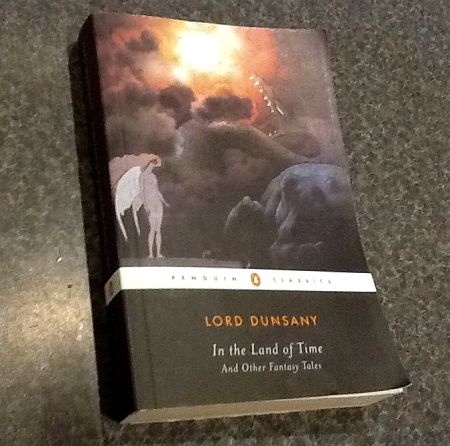
Our Distant Cousins - by Lord Dunsany

An  excerpt from my review of IN THE LAND OF TIME (Penguin Classics) Edited by ST Joshi...

dunsany

Our Distant Cousins“There certainly had been an outbreak of disbelief.”
Another story about Jorkens via the narrator but the tale itself is told by a third party as brokered by Jorkens (cf: the brokering of evils to be bartered between customers in an earlier story). I have long seen fiction making as a pecking order: freehold author – leasehold narrator – sub-leasehold characters etc. The fiction maker (travelling to Mars by aeroplane partially dependent on the Earth going a thousand miles an hour as we stand on it and then many outlandish events with human-like people (one of whom the traveller from Earth fancies) kept in a chicken-run and octopoid beasts that eat them and then the traveller making a half stop on the way home on the asteroid Eros and much else) is called Terner, or as the freeholder probably intended to indicate, by anagram: re-rent
And that’s what we do, rent the story at each remove to enhance truth at or from a distance. But there is an elephant in the room about this story. Or should I say ‘an elephant bursting out of a matchbox’. The sub-leased Narrator’s silent collusion with the reader beyond the whole pecking-order that he finds himself in. A fine mesh.

Saturday, December 06, 2014

DREAMS of OURSELVES

Dreams of Ourselves

pess2
I have just received my purchased copy of this luxurious, richly artworked book…
288 pages – No. 31 of 110 numbered copies
DREAMS of OURSELVES
Stories and novellas from Quentin S. Crisp, Jonathan Wood, Colin Insole, Andrew Condous, Mark Valentine, Damian Murphy, John Howard, Rhys Hughes, Adam S. Cantwell, D.P. Watt, Avalon Brantley.
Les Editions de L’Oubli MMXIV
Zagava / Ex Occidente Press
I am particularly intrigued by the prospect of this book as it seems to be operating a form of Nemonymity (author late-labelling) that was operated in NEMONYMOUS 2001 – 2010.
My previous reviews of this publisher’s books linked from HERE
LOOK THEE TO THE COMMENT STREAM BELOW FOR MY REAL-TIME REVIEW
pess1
Filed under Uncategorized

13 responses to “Dreams of Ourselves

  1. imageThis anthology is edited by Adolph Moscow as an Appreciation of Fernando Asspoe.
    That Nothing Human Scorn by RAPHAEL BALDAYA
    “The dust-motes in their miniature asterets could no longer be seen. The ochre had grown deeper. But really, I was looking within.”
    This is a story that ‘unites beauty, intelligence and grace’ – well, it certainly is what I consider to be an engaging opener to this book and to my review (which may take months to complete given the balanced state of myself, either going one of two ways, but yet unsure which) – an immaculate story portraying a gentleman’s discussion that takes place between the two wars about a quest for ‘the perfect being’…and then as to the results of their quest, I am delighted not only that this whole book seems to be echoing previous Nemonymous-like late-labelling methods but also that this first story taps my methods of leitmotifs-into-a-gestalt real-time reviewing that have been demonstrated since 2008, thus giving you at least some clue as to the gentlemanly quest’s optimum, almost parthenogenetic, outcome.
  2. Petseta by SEBASTIAN KNIGHT
    “‘It’s all become a little Caspar David Friedrich,’ I said.”
    Don’t get me wrong, I absolutely love this work. After an essay on déjà vu that reads like a highly polished version of a Thomas Ligotti Online Forum post published on one of its more philosophical threads concerning Anti-Natalism or personal views of Religion, it enters what I would call (you heard it here first) the Literature of Wilful Bewilderment. It is honed and ached through and debated as to holiday motivations culinary or positional, telling of a coach journey in Crete, and ending up at a dubious feeding place that has a side exhibition into which we are inveigled, featuring local ghosts and a form of eponymous lace handiwork. We end up “sensitive to every knot”… And there is nothing much else to say, give or take the odd embarrassed laughing at the nature of laughter if I ever meet its author and embark upon a discussion with him about eternity and dream.
    Seriously superb. I think it will haunt me forever.
  3. Under Different Stars by NAVAS
    “There lay a skeletal covering of cutwork lace on the table, under my hands. I looked at it.”
    Stemming from the previous story’s sensitivised knots of lace, a séance in this meticulously woven story is an ultra-rarefied treatment of words themselves as heteronymised stigmata of identity. A ‘demiurge’ as a dare-me-urge?
  4. We Are All Words by BURTON DONALD-WICKHAM HALLAM [past President of The Provincialist Society for the Promulgation of Thought]
    “Every season becomes the eternal autumn of the soul, battling with the disturbing chaos of the future…”
    That author by-line above does not do justice to this long inverted paean to self when seeing oneself as a young boy crossing the road near to the large spectacles sign of the optician shop opposite — and, ending with the previous story’s séance, one can imagine that this is the narrator of the book’s second story agonising again in such a wilful unbewildering of self, in the ‘pitted mirror’ of the ideally fixed Past, the Past as an old companion or curmudgeonly Whovian refuge, and then in the exploration of Thought as a series of ‘thoughtogravures’ and ‘thoughtographs’, and later aspiring to share a cognac with Death.
    And that partial description of mine above does no justice to this work, either! This work is well-honed and sumptuously prosed, but it is also a manically interjectory and vocative monologue, with haiku-like ornamentation and epistolary interludes with the optician. It is relentless and wearing as well as inspiring and accommodating to my own late autumn of life. It conveys nemonyms and heteronyms within another stigmata of words. A soaring Oblation or Ode to the Outlier.
  5. imageMr S. And Dr S. by HORACE JAMES FABER
    Is it any accident that Faber is often seen as Faber & Faber, a fact that is at least half germane to this story, I propose? Seriously, if I have guessed correctly as to the true identity of Faber’s double or mimic (also see VanderMeer’s ‘Area X’) as author of this story, this is another of that author’s masterpieces. Incredibly impressive.
    “A handwritten manuscript is another matter entirely. Within certain bounds they are as personal as fingerprints.”
    Fingerprints as another form of this book’s second story’s ‘finger-lace’? And there are many considerations within the lead-in of this S. story that, for me, addresses Nemonymity as well as Heteronymity and Proustian selves. I love the expression, embedded in the text, of “immortal anonymity.”
    This story is a story of Portugal in the 1930s, being a travelogue of a would-be boulevardier and journalist, one who usefully here compares the coastal and weather similarities of London and Lisbon. He actually meets dignitaries such as the President and Prime Minister, the latter being, on the face of it, a sort of Prince and the Pauper character, our protagonist meeting him again synchronously in a common tavern. Or does he? A highly tantalising treatment of those doubles and mimics as originals and fakes. This story seems like strolling, but it must have taken much exertion to bring this off. “…the fine art of wandering.”
  6. The Apostatical Ascetic by ALEXANDER SEARCH
    “In the early morning of Lisbon, I feel as though I’m nothing more than a spec of living dust upon the vast face of the earth; alone, yet cast among the multitudes.”
    A series of episodic monologues that remind me of the constitution of the ‘supreme being’ in the first story, Proustian selves as doppelgängers and the heteronyms of the other stories, ravelled through with Hallam’s rite of a rant. It becomes a gestalt of the nature of self and selflessness in interface with cosmic and theosophical influences, topping and tailing with such angels as the ‘angel of ambiguity’ and the ‘Angel of Annihilation’…
    The gestalt of these individually titled episodes flows mellifluously with complex undercurrents that paradoxically “nourish me with their simplicity”, touching upon destiny, the nature of perfection, incompletion against completion, the telling hindsight of misinterpretations about exiled prophets like Christ and Mohammed, the maze of the city streets wherein there is the tedium of the monologist’s office job, and, finally, those ‘fingerprints’ again, each of us leaving such prints in whorled lacework as a mappa mundi, I assume, upon all surfaces, even a surface such as this.
    “…the perfect combination of greatness and anonymity.”
  7. Le Panopticon de le Chevalier de Pas by CHEVALIER DE PAS
    “…and it was a complex combination of four languages producing new words and grammatical structures, yet without any effort we always knew exactly what they were saying at any time.”
    …and if a fiction work has a self that self-describes it, that is it. The four languages ostensibly include what those not suffering from“some exotic form of insanity” would include as words that are neologisms. Yet, I would prefer to call them: neonyms – and I might ever use this fiction work’s suggestion: ‘cryptonyms’. This magnificent mind-masque of a text indeed flows in inverse proportion to this book’s previous story’s simplicity to complexity, here more with the ease of reading something like Finnegans Wake, and if you then later merge this with Area X and [House of Leaves] and some works of Borges, and then merge these again with this book’s main Fernando Asspoe author-being-appreciated (from whose work there are here in the de Pas fiction some fragments shown with the by-line Fernando Pessoa) then you might have some idea of this work’s experience waiting for you. It is, on another level, a collage of verse and extracts and narration generated by a ‘force de tour’ — of the literary-living rooms in the de Pas house — a guided accompaniment and lecture of and to a friend by this friend’s friend the latter of whom seems to be having some trouble with his complexion and identity and, by entering the house, he becomes the by-line of this story shown above (a by-line that hides another by-line that I will not discover until I have opened the sealed black envelope that arrived with this book, the contents of which envelope, I infer, will reveal to me the ‘real’ names of each author in an act of Nemonymous-of-yore late-labelling, by attaching authors to stories). By entering this house yourself, what or who will you become?
  8. A Sea Sorrow In Triptych by A.A. CROSSE
    “…one of the most beautiful buildings in our city. Its delicate stonework shines white, like lace, beguiling and subtle;”
    I don’t think anyone will have EVER read a story quite like this substantive work, until they read it in this book, with its title like a movement in a contemporary classical music concert of last song cycles… I know that I have never read a story like this story. It is impossible to review. Suffice to say I feel it is exceeding its already carefully composed words as, easily, one sinks even deeper or rises even higher into its texture with more and more ravelling skeins of matchless prose, even while it progresses from Lisbon and its marriage of hopes, to the reality of the puzzle enthusiast back in, say, Hastings, and their resentful son who I sense goes off at the end to a New Crusade as a version of the same radicalisation of his enemies, and the moving borders of memory and truth, as well as of false states. There are states of being in this story, too, that plumb the very depths and I found myself weeping at how it is possible for anyone to write anything quite like some of the passages in this story. I am sorry. This is not a review. It is a single reaction among many reactions that I feel but cannot express. The self as past hope and the same self as present despair. Somehow, such utterness, though, gives me a modicum of hope from the fact that human literary expression can reach such awesome levels. I hope this does not sound over the top, but it is how I feel. And puzzles, riddles on large stiff white paper pages amid talk of tiny books with codes.
  9. …and after that almost unbearable emotional experience we are, with effective editorial positioning, now offered a romantic ‘fictionatron’ the airily provocative nature of which I have seen successfully expressed before but only by one particular unique author – until now…
    The Sublime Voyage of Ariana Aragão by EFBEEDEE PASHA
    “…it is a fallacy to assume that ghosts are always older than those they haunt.”
    This is a haunting time-threaded transportation (by conceit as well as by tram and ship) of seeing a balcony, from that ship approaching the harbour, a balcony on the skyline of the city of Lisbon and a glimpse of a beautiful woman upon that balcony, or a black box that seems to be a camera…
    It is impossible to itemise here all the details of this romance, its ‘photon’ palimpsests of time, a crew’s scrimshaw upon sail canvas, altered ambitions or sensibilities of the well-characterised individuals, but I can assure that you will not forget the ‘perfect being’ (prefigured in this book’s first story and jammed upon by its other stories) that is woven like lace by all these characters and their yearnings and ‘palpable aches’, including yours, upon the very ‘Sighday’ upon which you read this story, mine being today. It is an inspiring fantasy that builds tracks (diaphanous as well as real) ahead of itself at will.
  10. …from romance to sex…
    A Body of Nostalgia with a Soul of Foam by DARIUS BLOCKHART
    “Lust — sitting in careless judgement on another flesh — is my surest guarantee of continuity within self.”
    Although this is not up my street as much as the stories so far, its monologue upon grinding loveplay, pervasive lust and other sexual fantasisation has moments of sheer linguistic brilliance within the themes of this book.
    One theme deriving from Asspoe, with much talk of a woman’s ‘ass’!
  11. The Man We All Imagined I Might Have Been by EMMANUEL GOLDING
    “After a day spent contemplating the catalogue of my previous selves I saw that there were few hours remaining into which to achieve a credible mode of existence,…”
    An engaging coda to this book, and that quote tells you as much as you need to know before you read it, as read it you must. The leitmotifs of the story will relate to us all equally, our own modes of existence, particularly current modes, even all modes as a gestalt of readers of this book, all 110 of us, but individually to each of us, such as the fear expressed in my review above of the first story, now at least partially and, no doubt, temporarily resolved, “my head ringing with a choir of angelic voices” amid life’s ‘funeral cortege’ and ‘anonymity of mud’, and the balloon sculptures in this story resonating with those in two casual short short fictions I wrote for TLO a few days ago here… Optimised by an amazing quote towards the end of this story, that ends my wonderful experience with the whole book: “…and startling connections, but it is crafted on a paper as thin as thought itself and when you try — concentrating desperately and with a trembling hand — to find the edges of its surface and unlock its mysteries, it has vanished into scars that hide within the whorls of your fingerprints…”
    The paper of this book is not thin but it does think.
    A book that is arguably this publisher’s greatest multi-authored anthology so far, one fitting to follow these worthy forerunners….
    Cinnabar’s Gnosis
    The Master in Café Morphine
    This Hermetic Legislature
    INFRA NOIR
    Among 64 priceless books in total so far since 2009.
    end