Thursday, December 10, 2015

Jottings From A Far Away Place


15 thoughts on “Jottings From A Far Away Place”

  1. imageOBSERVATIONS
    “It was like a man throwing away pearls, so as not to be robbed.”
    Just as if the author of this book is jotting here in four numbered movements some wildly amazing and original conceits so that nobody can rob him of them first!
    The third movement is an oriental theme and variations on Hank Williams, this and the rest still percolating in my mind.
    Oriental, I Ching, Dadaoist…Apollinaire? Ezra Pound? Ferlinghetti?

  2. HABITUALLY DANCING
    Eleven numbered movements. About someone called ELON — LONE (as the Christian Name of someone called RANGER) or someone mucho called LEON? — or plainly ELON, the Biblical Judge from Israel? This is sumptuously and horrifically Eucharistic prose.
    [My reference below plus an invitation to seek out its full context, not this book’s reference: From Hank Williams: “Deck of Cards” – “I think of the Blessed Virgin Mary…”]

  3. SHOWING THE WORLD
    Here, within the numbered movements, there is a long one depicting a sort of fable or fairy story about a Prince-elector getting a Castle Builder to build a splendid Castle, but when he looks through the window of his new Castle, what does he see? This story feels like an archetypal tale that has sat within my head for years and when I look out from my head, what do I see?
    I loved it.
    This now brings me back to my interpretation of the pearls in the first section of my review above.
    There is perhaps something building up here, a gestalt, an archetype, a migrancy of themes across Schengen borders, all waiting to be drowned in the intervening Jungian seas, and I am only beginning to feel something working, perhaps even beyond the control of the author himself.

  4. ENTRUSTING
    A RAMSHACKLE VILLAGE
    GHOST CAVE
    “Words aren’t precious, but nothing is.”
    Three sections, each with their numbered movements. I originally used the word ‘movement’ because I initially saw these as musical symphonies. But now I see them more as a scrying devices like I Ching but disguised as fables or proverbs used by beings visiting our planet and still learning our words, striving to extract hidden stories already ours, so as to fool us or to entertain us with a deadpan tantalisation just beyond our grasp – tutoring us piecemeal to become more like whoever these storytellers happen to be.
    The next, as yet unread, section is entitled ‘Gradual Activity’ beginning, I glimpse, with: “People love to be distracted.”

  5. GRADUAL ACTIVITY
    UNCOMMON
    Uncommon seems to be a word contrary to the Schengen or the Jungian, creating uncommonland across several borders with a new antistate (ironically like the male prostate!) disguised as a unified state where some of the searing brutality is expressed by Connell’s sinuously resonant language, with its aesthetic, yet cruel, edges of phonetics, semantics and graphology, massed then into sharply forged syntax.
    It is as if an Old Testament State has here replaced the so-called Islamic one or vice versa, then a Judaic one or Gnostic. Vying with each other, then even becoming each other in uncommon fashion.
    ESHAI
    I AM WHO I AM
    SARIEL
    ORNAN
    BRENDAN
    ET AL

  6. DEFILEMENTS
    GESTURE OF BOWING
    MANY-COLORED EYEBROWS
    ENTITIES
    These further politically incorrect, fulsomely adumbrated sections presented some hilariously bawdy Catholic concupiscence, plus the concept of crushing some sort of slithy tove with a dictionary making me think that, with the Internet and other ebookery, we are increasingly unable to wield books as heavy weaponry against things that crawl out of those very books!
    In this book, most of the words themselves seem to suppurate before applying their meanings to the already busy text.

  7. MALADJUSTMENT
    NOTHING TO HIDE
    SLOW AMULETS
    “‘What is the project at hand?’ he wondered.”
    From a Picnic at Hanging Rock scenario with historical outcomes towards a thread I denote of words as foodstuffs around a central character as an impossible literary project who has not yet fully appeared. One just needs to ride the elisions, elusions, delusions, allusions, illusions, of a Lawrence Durrell writing a Finnegans Wake through the medium of a John Barth.

  8. IRREVERSIBILITY
    “…a bit better than Voltaire and, in my estimation, equal to Diderot.”
    Diderot, in my estimation, is more equal than most.
    My real-time reviews of two of his works HERE and HERE.
    Meanwhile, the no. 4 jotting of this section is an engaging portrait of meeting an old friend and, later, this friend’s wife, with startling results.
    Full of maximal maxims for life. With cocktail words as small talk to match.
    (As an aside, earlier today, I had significant business dealings with a firm called Connells. I had been reading this book while waiting to meet them. Talk about synchronicity! But, even stranger, it was only just a few minutes ago that I suddenly realised this coincidental fact.)

  9. EMERGING FROM A TRANCE
    Two longer pieces among this section’s psalms (perhaps a better word for the numbered subsections than musical movements or I Ching psammomancies or, even, jottings) – the first one feral and transformative, just like the language expressing it (it is too easy to take this for granted, i.e. Connell’s trademark strength of style), the second one seemingly Rhys-Hughesian or archetypical, about being reincarnated as a spoon.


  10. CONSTANT PRINCIPLE
    HOLDING UP THE SKY
    RED DALMATICS
    BEWILDERMENT
    SACRED CONTOURS
    GIGGLING FLUTES
    WORN-OUT STRAW SANDALS
    GENERATING WORLDS
    I have read the rest of the book in one sitting as if in a single osmotic orgasm of words, this being my attempt at automatic reading like a reversed version of Andre Breton’s automatic writing. And it works, I feel. Think Salman Rushdie (a long-term favourite writer of mine) and his latest novel that I recently reviewed HERE.
    I wrote there:
    “Sometimes with fiction the reader needs to remain passive and not worry about actively seeking messages from the unfolding events, a sensibility which is part of the usual nature of my dreamcatching of books, I hope. This book needs an even more passive, non-preemptive approach, allowing the messages, after finishing the reading of the work, to create their own tapestry, before you even stand back to look at any gestalt.”
    That applies to this Connell book, but even more so! I mean that as a compliment.
    This is probably the most experimental book I have ever read. [And I am someone who has read (and reviewed HERE) FINNEGANS WAKE!]
    A psalmistry supreme. Sentences that are whole mind-culinary recipes. A Jackson Pollock picture of words, painted by numbers.


  11. “There was a man who painted a very beautiful picture.
    ‘That is awful,’ said his friend.”


Sunday, December 06, 2015

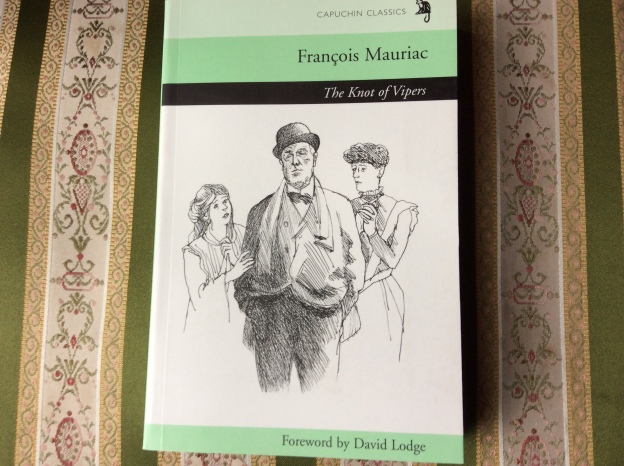
The Knot of Vipers – François Mauriac

The Knot of Vipers – François Mauriac

image

I shall real-time review this 1932 novel in due course.

My comments will be found in the thought stream below or by clicking on this post’s title above.

13 thoughts on “The Knot of Vipers – François Mauriac

  1. PART ONE
    I – II
    “Why should I have felt the itch to scribble on my birthday? I am entering on my sixty-eighth year,…”
    I hope this coincidence of age is the only similarity that I have with this narrator!
    I say ‘narrator’, but, in fact, this book so far, and probably all of it, is a letter written in real-time (how appropriate I am due to review it in real-time alongside him) by a man to his wife (and his children and grandchildren?) that he intends to be read by her after his death. It is incredibly obsessive, relentless, bitter, densely packed with over-brimming resentment with a prose to match – evidently seeking revenge for a loveless marriage and life. He wants this to be a rounded portrayal of himself so that she can bear the brunt of the whole context of his life within hers and she within his, and he starts off with his relationship with his mother, the affluence of his childhood, eventual hatred of the Jesuits and all religion. It is both searing and pitiful. I can’t bear to predict where this letter may lead him… And how certain he can be that one day it will be read. His death having more power than his life upon her, as a result.
    He talks, inter alia, of his ‘blood-spitting’ ailment as a child, the choice of ties and the tying of them.
    “When, as a child, I used to pass priests in the street, I always thought of them as of people wearing a disguise, as a species of maskers.”
  2. III
    “I started this as a letter, but it’s a letter no longer. It has become a diary, now and then broken off, now and then resumed . . .”
    What are those whispers he hears whispered about him by his family downstairs as he writes this? Paranoia, as well as bitterness, as he resumes by addressing ‘you’ — you, his wife, in the near future when you read this search as a real-time review of the past, this partial dreamcatching, this Proustian remembrance of lost time – a text with an intermittent Proustian style to match. Bitterness does not preclude poetry or a talent with words, it seems.
    He also recounts, more baldly, the time when he first met you, the merceneray context or your family’s debt with interest, and how marriages are either a pay-off or a moment of additional loan, loan as money as well as false emotion.
    A telling comparison of the two mothers. Also he recounts the brief glimpse of there seeming to be more to this world than material matters, an epiphany that barely brushes against a sense of faith or religion, having previously found nothing metaphysical in the Mass…
  3. IV – VI
    “What is it that I dread about death? – physical pain? the awful struggle at the end? – no, not that, but the feeling that to die is to become nothing, that our state in the grave can only be expressed by the symbol – ”
    That’s sicnificant (sic)? Chapter VI indeed ends with an en dash.
    These three chapters trace his real-time confessional ‘diary’ as ‘letter to his wife to be forwarded into the future’ like leaving centuries later a bomb on a blog, with its URL and password secreted about his dead body? We learn now, and she WILL eventually learn, how he has incubated a lethal seed of recrimination upon his explicit tides of anger when, after a few reasonable years of marriage, she lets slip that he was second best, because of her true love Rodolphe resisting marriage with her because of rumours of there being a health weakness in her family line… We also learn of the letter-writer’s disappointments with his own mercenary children and grandchildren, despite his own mercenary attitude to money. And that he is tantamount to a nobody to his wife ever since she had children by him, his sole purpose having been as stud or sire, I infer. He had a legal case that gave him fame as a lawyer, but that meant nothing to her. He now rather resents that they now have no sympathy with the true nature of his old age. Old? 68!
    Another of his wife’s bombshells was a simple statement but a loaded one in view of his erstwhile scorn for religion, when she once said: “I fell in love with you from the moment we met. We had said many, many prayers at Lourdes before going to Luchon, and as soon as I set eyes on you I knew they had been answered.”
    I may leave a bomb on THIS blog, having now been given the idea… “But if I go on mixing present and past like this, I shall never get to the end of my confession.” And me, of this review.
  4. VII
    “You took root in my soil, but our roots never met.”
    The deepest comment upon his marriage witnessed by his ‘letter-confession-diary’ in hindsight but spoken into the future, as Louis looks back at the the Dreyfus era of late 19th century France, at his own OCD and ownership of people almost like a slave owner, he says of himself. The death of Marie, one of his daughters, a moment of touching memory in his case but maudlin remembrance in his wife’s case. The young priest who liked music too much. Something Stendhal going on there, I ask myself. Louis taunting Isa with her own literal religious beliefs, tying her in Socratic knots.
    The tension between his non-belief and an envy of a belief beyond his ability to acknowledge needing? A relationship with his children that belied his unspoken wish that they had never been born, or so I infer.
    I have never read anything before that so embitters a kindred spirit or a reader like me or anyone else it touches. I must bear in mind that I am effectively reading it in real-time before Isa his wife has had a chance to read it. Something feels wrong about that.
    “It was on lines strung to the apple trees that Marie’s tiny dresses were hung out to dry, and a long sequence of innocent garments.”
  5. VIII – IX
    “Your faith was useless to you. You had thoughts for nothing but that flesh of your flesh which was going to be laid in the earth and would soon know corruption. It was I, the unbeliever, who realised, as I looked at what remained of Marie, the full meaning of ‘remains’. I was overwhelmed by a sense of departure, of absence.”
    From the earlier roots we now have the the branches of the trees interlacing as Louis talks of himself and Isa’s sister, Marinette….
    Life as a ‘mortgage on expectations’? – as we read cinematic scenes about his encounters with Marinette, and the death of Marie. Importantly a death to be seen as if by typhoid not by consumption, for the sake of the bloodline.
    A mercenary morass, mulching the family tree?
    “‘Oh, nothing,’ I said. It was a kind of private language of our own.”
    Always, ‘0 nothing.’
  6. X – XI
    “And yet, how different they were! She [Marie], you will remember could never bear to see an insect crushed, and loved to line a hollow tree with moss, and set in it a statue to the Virgin. All the same, in Marinette’s son [Luc], in the boy you used to call ‘a little animal,’ I seemed to see Marie again:…”
    Threaded through Louis’s pessimism and resignation, was this sense of Marie and Luc, both cut short, the first by illness, the second by the entrammels of the Great War. Life itself seems to be a Great War for Louis, and this text is its dark testament, a grappling with a promise now not to succumb to wanting a priest at his last rites and with a dread that that is exactly to what he will succumb. This section of text, I sense, embraces the Ligottian NOEUD itself, now out in the open and expressed upon the page, the prayer or ‘prie’ not to need to pray at all.
    To pray to the Virgin or a Viper for some kind of retrocausal reprieve?
    (Just because this is a translation, doesn’t mean to say that it wasn’t meant to be translated. A filter can work both ways.)
  7. XII
    “- if you read of it in a novel you wouldn’t believe it!”
    I’ll have to be careful I don’t give away plot spoilers as we reach a watershed in the letter-confession-diary’s narrator’s real-time about his own past retrocausal (literally!) real-time – over-hearing in the second half of this chapter the various members of his estranged family plotting against him and conniving to get his money, resulting in his later visit to Paris (to ensure his advance revenge on them) but told at the beginning of this chapter!
    “For the first time in my life I felt the satisfaction of being outdone in malevolence.”
  8. XIII – XV
    “Their slime was still visible on the ground.”
    Revenge and treachery of treachery as a suppurating mass or Mass, one now wonders whether the NOEUD is inside or outside oneself, and who crawls their way to a nightmare vision of one’s offspring as an excessive caricature of oneself or as a miraculous vision of the Blessed Virgin ‘Marie’ within the church where earlier others of (or close to) one’s own flesh had crawled to dip within a holy water stoup…
    Only the palimpsest of time can solve? To solve the polarisation or the symbiosis between (a) a literary hoax (treachery) and (b) a fiction vision as religious truth (whether it be a vision of effulgent miracle or of deathly nightmare – or more probably both of them at once).
    My personal thoughts.
  9. XVI – XVII
    “Probably, in the whole course of their lives, they had never seen me cry. The old surly, terrifying face, the Medusa’s head at which they had none of them been able to look, had undergone a metamorphosis, had become simply that of a human being.”
    For your own real-time appreciation of events, given the nature of non-received telegrams in the preterite of the preinternet, I cannot tell you how events have turned out, plot and counterplot, here recorded within this once intended cruelty of a diary, still apparently being written, even as I talk about it, but now written for whom, if not you? A Möbius strip of recriminations and misintention, as the narrator becomes onlooker with detached indifference, having “squat down on a ‘prie-Dieu'”, but still busily scribbling angry words into this meticulous crafting of something else – something already due to be turned into this book, a book to earn money? Father and children – a knot of mercenary machinations for this book to be written at all? Their fortune expresed in words.
    “‘All right then, open it,’ I said, ‘open it and read what’s inside.'”
    “We do not know what we desire: we do not love those whom we think we love.”
  10. XVIII – XX
    “Fancy waking up at sixty-eight. Fancy being reborn at the very moment of my death.”
    “I thought of my life and saw what it had been. No one could swim against such a current of mud. I had been a man so horrible that he could have no friend.”
    I can’t believe I am myself 68 in about a month’s time, as I finish reading this momentous book. While looking back proudly at my own creative life (creative latterly with these real-time reviews I have been conducting) – my three ages – but what happened before 1986? I proudly look to my business and family life. My loving wife and unmercenary children. My prevailing love for them. My need for a faith in literature, if not in some ostensible fiction called God.
    But Louis in this HIS book is torn between several other polarities, too, while producing this literature almost in spite of himself. His bitterly mercenary children (“They would prefer to see everything spoiled than get unequal shares.”)
    When we see other points-of-view (his son’s and granddaughter’s) on his book but paradoxically seen from within the same book, we the readers wonder at his partial reporting, his thoughts here and there of ‘scratching out a sentence.’ Real-time reviewing of his own life with a changeling audience, amid dust as ‘that last remains of utter nothingness.’ The nest of ‘swarming reptiles.’ His wandering through vines, vine-shoots that later provide burning fuel for his fire. Finally, cutting through that knot of vipers, finding himself – but finding God? A ‘monster of solitude and indifference.’ The impulse that might have been another form of prayer? Or a ‘sheer love of mischief.’
    We readers meld into a swarm of points-of-view from within and without like the snakes themselves, like that earlier medusa, pre-echoing a horror that is psycho-spiritual, pitting showman hoax against faith-healing. Perhaps predicting those Ligottian Doctors who in turn botch up rather than heal the ‘lump of humanity’, treating them with the trappings of the ultimate nonsense?
    Publishing this text as a temporary obeisance to mercenary goods, to earn a living or a death. Is it any coincidence that LOUIS is a name of a coin and ISA a latter-day, very well-known modern British acronym for an untaxed savings scheme? Is it a surprise that synchronicity is thus translated? A hybrid Ligotti-Mauriac as despair versus legacy, deep thought versus smug pretence, catholic versus narrow, Catholic versus CATHRian…those melting oxymorons of a ‘vague and morbid religiosity’. In the words of Louis’ own son as written by the freehold author if not by Louis himself:-
    “If he indulged in a murky mysticism, it was only that he might use it as a stick to beat that rational and moderate faith which has always held a place of honour in our family. Truth is poise … but I will not plunge deeper into those regions of abstract thought where you would have difficulty in following me. I have said enough. Read the document for yourself.”
    end


Wednesday, December 02, 2015

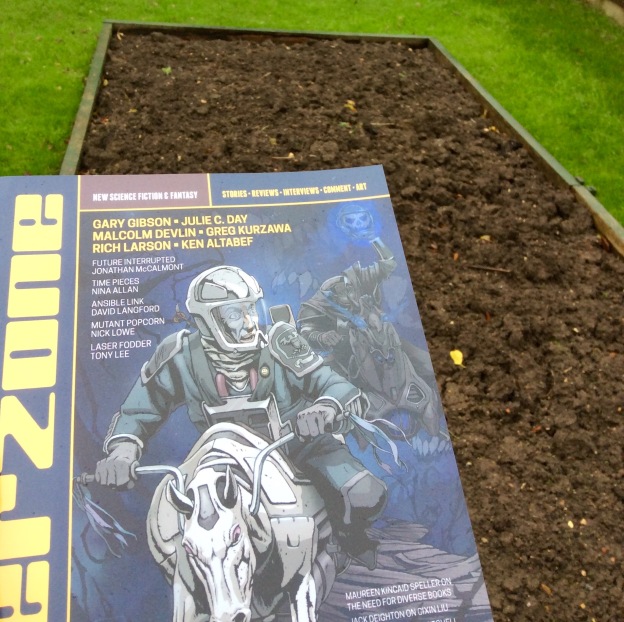
Interzone #261

Interzone #261

image

Stories by Malcolm Devlin, Rich Larson, Greg Kurzawa, Julie C. Day, Gary Gibson, Ken Altabef.

My previous reviews of TTA Press publications linked from HERE.

When I real-time review the fiction in this edition of INTERZONE, my comments will be found in the thought stream below or by clicking on this post’s title above…

10 thoughts on “Interzone #261

  1. FIVE CONVERSATIONS WITH MY DAUGHTER (WHO TRAVELS IN TIME) by Malcolm Devlin
    “Six across, see fifteen down. Fifteen down, see six across.”
    A revelatorily absorbing, simply narrated, account of five interactions across the coordinates of time till the truth can be triangulated, a triangulation much like my own real-time dreamcatching over the last few years, if I may say so. The crossword analogy embodied in that quote is not only a brilliant one regarding the constraints of time travel, but the numbers involved there also possibly relate to the ages of the narrator’s daughter. She first told him she could time travel when she returned to her six year old self. We begin to understand the fallible nature of the narrator (a motorbike courier) as father and husband – and the walking-upon-eggshells nature of what is really going on between father and daughter across their cross-section, but we finally do believe in the integrity of both characters, and their need to optimise but not change the rules of time. “After all, who do we pray to, if not the future…”
  2. WE MIGHT BE SIMS by Rich Larson
    “If it was real, there’d be stars.”
    Or reality is 2/3. A triangulating ratio that reminds me of the numbered coordinates of reality during time travel in the Devlin. But there the similarity ends!
    Here, we enter ‘2001, Obscene Odyssey’ except that year’s number is just a guess – on my own part from my own past.
    Vilely tongued, and an old codger witnesses a younger couple’s attempts to make things real through sex, plus a muted abstract painting splattered on a pod’s wall for three palm prints to be impressed as a collusive code needed to open the pod’s door to see how real that black sky REALLY is. Three convicts on their way to a prison in Europa? Or a virtual experiment on sims or expendable humans who feel they are real but sense they are sims, or feel they are sims but sense they are real. Or other permutations. My mind was blasted by this text. It whittled my margins. Guided by a Joycean joystick.
    Fiction with characters who believe they are believable.
    “Reality is whatever hurts most,…”
  3. HEARTSICK by Greg Kurzawa
    “It certainly occurred to Martin that there was something obscene in his handling of a strange woman’s heart. Or if not obscene, at least intimate.”
    Thus, this remarkable work demonstrates, in its own more gentle, yet heart-rending, way, the obscene intimacy of the Larson. But it also blends with that same story’s sense of doubtful self-reality as sims bearing in mind his own preternatural ability to survive without his heart after being treated on a paper-covered surgical table, like the paper of these pages where it is actually portrayed.
    Strikingly, too, it blends with the poignant reunion of a father-daughter relationship from the Devlin, not exactly here through time-travel but by the transport (in more ways than one) of an excisable and, eventually, partially replaceable heart.
    As a work that stands on its own, it is one to treasure, with the contrast of the gruesome meaty similes used here vividly to describe the residual heart after the body’s deadpan and ready acceptance to survive without it, even if the person himself is emotionally changed as a result. The fact that a bit of a heart, the bit that you want to keep, will recharge certain emotions or even to transcend bereavement, makes this story, as I said before, heart-rending (literally and figuratively) with regard to the believability of the residual guitar-playing father-husband protagonist.
  4. FLORIDA MIRACLES by Julie C. Day
    “I can see Dad’s face reflected in the monitors. No matter which version I look at, his expression doesn’t change: starman lost, starman lonely. That’s my dad, all right.”
    Another father-daughter relationship coupled with the earlier Space Odyssey feel I got with the Larson, plus that sense of being a sim or being possessed, very little difference felt by the host, I guess, if you are this magazine’s previous sim with a human mind, or, as here, a human with an alien mind. Also, this seeming alien parasite or Masker, Mrs Henry, is at first like Kurzawa’s detachable heart, i.e. a tangible bodily organ blended with bits of its host’s mind, then a monstrous creature, then more like a soaring soul reaching toward space travel, an odyssey of dragons.
    On this first reading, I got a great feeling from this story’s complex and mature vision masked initially as a tale about young people self-harming with knives – possibly to unmask the miracle from the monster-masked soul.
    [As an aside, I had a ‘short short’ published in ‘Cerebretron’ in 1989 entitled ‘I’ll Take Them On A Dream Ride’ which I very vaguely recall resonating with above. Not read it for years. Looking for a copy of it now. If I find it, I’ll post it here as a comment to the comment.]
  5. SCIENCEVILLE by Gary Gibson
    “But if what you’re saying is true, what doe it matter if there’s a map or not? It’s just paper and ink. What the hell does it matter if we believe it or not.”
    …and that seems to relate to what I said about the paper used for the heart surgery in the Kurzawa… A belief system, here, too, akin to that of the humans as sims or sims as humans in the reality panoply of the Larson. The explosion of belief from within as in the Day, the preternaturally connective bereavement in the Devilin, while, in the Gibson itself, “he saw the whole town laid out before them as night descended.”
    This Gibson, as a story that stands on its own, is an intriguing extrapolation of an imaginary SimCity into reality or at least into the realms of what I call the synchronised shards of random truth and fiction, a Möbius strip of territories and alternate worlds, where arguably territorialists, after the brutal change of point of view in the last section, become terrorists.
    I was captivated, too, by the vision of SCIENCEVILLE itself through Gibson’s otherwise plain words on important paper…but less convinced by the interaction of the ‘real’ characters by email, snail mail and eventually in the melodramatic real-time meeting of each other. Enjoyed Milan’s abstract painting, though (cf the abstract painting in the Larson.)
    All in all, I enjoyed this compelling SF concept.
  6. From territorialists and terrorists to a terrier…
    LAIKA by Ken Altabef
    “The song was like a hairball building up and burning and irritating till it had to be coughed up.”
    And the narrator’s aged, dying, Russian uncle had eventually to cough up (literally and figuratively) the mongrel terrier he had kept by him for sixty years, that LAIKA whom I remember personally from the news reports in 1958…
    This is an ingenious and compelling extrapolation of an alternate world or the revelation of a hidden truth (here about the unknown outcome of Laika’s momentous trip into space) or a blend of the two as in the Gibson.
    A ‘coughing up’ of, say, another ‘Mrs Henry’, with a poignant excising of tantamount to a long trapped canine hairball heart as well as the exorcising of an alien soul for its own good. Tantalisingly leaving us with a question of exactly who was being cruel to be kind or kind to be cruel in exercising this famous dog one last time.
    A fine coda to this symphony of fiction stories.