www.nemonymous.com
Des Lewis - GESTALT REAL-TIME BOOK REVIEWS
A FEARLESS FAITH IN FICTION — THE PASSION OF THE READING MOMENT CRYSTALLISED — Empirical literary critiques from 2008 as based on purchased books.
Thursday, December 17, 2015

Wednesday, December 16, 2015
Blue on Blue - Quentin S. Crisp
Blue on Blue – Quentin S. Crisp
A SNUGGLY BOOK 2015
My previous reviews of Quentin S. Crisp works HERE
When I real-time review this book, my comments will be found in the thought stream below or by clicking on this post’s title above.
THEBOYWHOplayedWITHSHADOWSIn "ex occidente press"
WRAITHS and ERITHIn "Erith"
DEFEATED DOGS - by Quentin S. CrispIn "broadsands eyrie"
14 thoughts on “Blue on Blue – Quentin S. Crisp”
- I. OVERTURE
Pages 3 – 15
“…this town, like many others throughout the ASAF, was a centre of wonders, though there have sometimes been complaints that individual aviation now constitutes a traffic that half-obliterates, for the simple pedestrian, the periwinkle sky…”
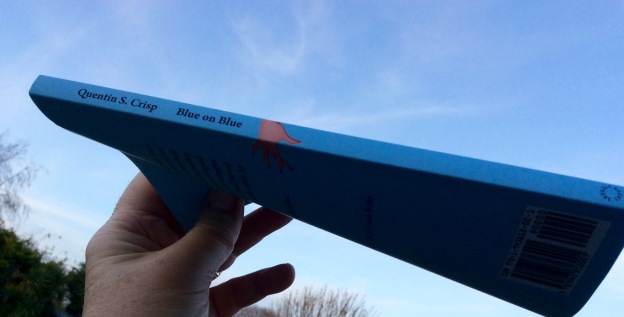
I don’t think it is a spoiler to tell you that ASAF (as embellished by the book’s first footnote) is The Alternative States of the American Fifties. The narrator – who couches his, for me, beautifully textured Erithian style in a compellingly page-turning quality – is Victor Winton who lives in Brookdale. A style that describes being between a rock and a hard place of eternity and individualistic modernity, or, on better days, between blue and blue. Reading art books, visiting a museum, castanetting his steps along the pavements, working in a tedious office, writing flyers for Sea Monkey Kingdom, telling us about a slap-happy craze for X Ray Specs… (I had already placed a temporary opaque paper cover upon the outside of this book before reading about the X Ray Specs!)
I am still feeling my way, but I already have good vibes about this book.- When I first saw the acronym ASAF, I immediately thougt aircraft and that matched my stealth book in the sky at the top of this page!
- Pages 15 – 27
“In our lives, does not the resonance of antiquity, as manifest in an ancient statue, meet its equal, at least, in the trivial, immediate resonance of the familiar, as manifest in the cartoon character?”
As an ‘old’ reader of this book, I can safely say that I have now been mind-boggled by it! There are some very strong colour-synaesthesic and Kabbalistic things going on here. And sexual-gender themes, obsessions and coloured gussets or thongs (my expression, not the book’s), that may infuriate some new-born Facebookers of our world, I guess.
And the most bizarre interface of ‘analyse’ and ‘anal-eyes’, and a stylistic study of the word ‘between’, that I can only admire. This brought me back to the 1960s when I was taught to do these stylistic studies of words on a daily basis.
Victor appears to make a study of his passionate interest in comics and cartoon characters, e.g. Snow White v. a Bablyonian statue, individualism v. eternity, and I can only hint at what some of these remarkable passages convey – insofar, anyway, as I understand them myself!
(A ‘nameless faith’ that SEEMS to approximate my own Nemonymity?)
“The blue was the principle that transcended principles.” - II. BUENA VISTA
Pages 28 – 36
This book takes off in a wonderfully resplendent cinematic lucid-manga, I guess, with Victor’s after office hours spent drawing the comic book heroine, Lara Lovelily (a sort of alternate world Betty Boopty-Boop?) to whom he introduced himself in the previous section of this book, a book that he writes evoking such a cartoon or comic book creation on his part, agonising over the words to describe this activity, no doubt, as he must in turn agonise (WITHIN that agonising) in his styling itself of, say, the image of Lara’s knee with obsession – an obsession once needed by the director of the cinema film Claire’s Knee (my observation, not the book’s).
All this is coupled with Victor’s lucid environs of Brookdale that surely strengthen in the reader’s mind with the narrator-writer’s own transportation there, a place not only of, inter alia, X Ray Specs but also the invention of that very transportation as copy-original teleporting, in turn strengthening Victor’s theories of copy-original comic book styling, all to the exquisite sensation of his spreading out a crisp new newspaper about all of this on a cafe table!
That’s me rambling on about something that is much tighter and mind-fantasy meaningful in the book itself, about which book this is my own spontaneous news report spread out in my reading-room mind with its own instilled lucid dream of what is radiating from the book.
I do not intend to go on at such length as I read on, but who knows! Whatever the case, I know already this is a book that is rather special. - Pages 37 – 52
“What, in establishing connections and correspondences between the multiplicitous nodes of existence, could make those nodes effloresce unimaginably…”
Em dashes, here in this book, not en dashes, and no spaces ‘between’.
Victor’s visit to the museum outside of office hours brings his chicklit encounter with someone called Jenny, and the altered marks around her lips change how she briefly at first seemed like Lara into eventually not seeming like her at all. A sense of truancy, and foreign memory, not my expressions, but the book’s. Whistling as innocence. Recurrent reflections of re-living a conversation as dream-bubble or a form of trampolining…sans serif. - Pages 52 – 59
“The air itself—void—is easier to describe, though notoriously ineffable,…”
For any text to agonise—as much as this one appears to agonise upon its own emerging heuristic hesitancy or (to quote this author from elsewhere, yes, from elsewhere) upon the ‘preternaturally secular’—would seem off-putting at least.
Yet, both his simply ‘seeing’ Jenny Mills (put thus literally in the text, but with the double meaning of ‘seeing’ as ‘going out with’ or, possibly, ‘having sex with’) and his tentative engagement with putting his hand just above her knee (cf my earlier reference to Claire’s Knee) seem to summon such a powerful fascination of projection (hologrammatisation) and subtle plot-advancement, the type of reader attracted to this book actually learns much from—and is entertained by—such obsessive agonising in literary print.
The guitar and its soundbox, too.
(The Literature of a Samson Agonising?) - Pages 59 – 74
“It is a strange thing to feel connected to a person by warmly linked hands, but to feel your two heads are compartmentally separated—yet in their isolation immersed in the same world.”
There are some truly astonishing passages describing a visit to a Sea Monkey Show by Jenny (a lip-synch short of a connection with Lara who, in turn, has some frame-link with Superman?) and Victor, whereby the audience members are helmeted up to the aquarium itself. Some extended stylistic flair here about sea anemones et al, that is seriously mind-blowing.
But all this is (deliberately?) offset by some rather wooden speeches by a sea monkey itself who seems to be intent on mouthing a series of statements from Twin Peaks a bit like “the Owls are not what they seem.”
The mental and physical relationship between Jenny and Victor is one of “transparent sincerity”? This phrase is also how I see the whole book so far… Transparent and transporting. Limpid as well as lucid but, paradoxically, transported by an em-rich text that is not always thus.
“…an eerie transport in the heart and mind of the watching periphonaut.” - Pages 74 – 86
“One has to decide either to live with flaws or to hold out for perfection.”
A möbius non-choice, I suggest. Now Victor (probably given that name by parents who settled for his perfection on day one!) is optimising (settling for flaws but whittling them away one by one in bouts of heuristic artistry?) his professional image of Lara in the plot scenarios that he hopes to sell for cinematic usage, based in some aspects of Sea-Monkery. He almost issues the literary equivalent of a social media vaguebooking post after getting a promising letter about it —– all this in interface with visiting the Buena Vista Castle with Jenny.
You need to take a breath here as reader, because, from my studied instinct based on long experience, this text takes fantasy into realms where fantasy has not gone before – when establishing the margins between where Victor and Jenny are and where they are about to go, together with the concept of the castle itself from this unique standpoint and of the standpoints of those who built it. And that is where I leave it, all of us straddling this pathway in-media-res, between here (their here not ours) and there on page 86.
That castle’s “blue room”, notwithstanding.
“The general public perception is of a benign fog of wonder, promise and hinted wish-come-true.”- I had reason today to cross-reference this book with another that I happen to be concurrently reviewing here: https://dflewisreviews.wordpress.com/2015/12/10/animal-money-michael-cisco/#comment-5988
- Pages 86 – 102
“People who reflect, struggle all their lives to put things into words.”
And I am struggling to put into words what I feel about some of these passages, as Victor and Jenny cross the various margins through a distance that kept the Buena Vista castle ever a vista. I could, easily say: Wow! But that seems a cop-out, even if it is justified. For example, I get the feeling this is not predominantly an epiphany towards holding hands and a kiss in a romantic setting (although it is that as well), perhaps not even an ‘optimisation of “crucial loci”‘ (that is called to mind in another coincidentally concurrent real-time review of a book (‘The Siren of Montmartre’) here), but rather its otherwise ungraspable essence is crystallised here in Blue on Blue by, for me, a convincing reference to Dennis Potter’s “blossomest blossom” speech during a now famous TV interview with Melvyn Bragg shortly before Potter passed (I usually say ‘died’, but ‘passed’ seems more appropriate in the context of Blue on Blue.)
You need to read these passages to get what you happen to get out of them. You may get different things. I was simply left with an impression of the area around a Zoo that is close to my heart where dream is recognised as dream, even it is a dream, rather than, elsewhere, where dream is impossible to differentiate from reality.
The exact moment when a cinema film becomes iconic rather than a fabrication of cameras and actors?
Meanwhile, this ‘II. Buena Vista’ section ends with a beautiful, o so poignantly true, word-musical ‘dying fall.’ - III. MONTAGE
“I don’t know who will be reading this, and under what circumstances, or if I shall ever find out who and under what circumstances, but I feel now, before I continue, that I would like to ask the reader a question.”
Well, unlike this author’s lack of knowledge regarding the Nemonymous reader, I think I know something about the nature of the author, one that colours my view of this book. I feel authors as well as readers should be Nemonymous to isolate the book as an item of study.
What is the difference between a montage and a palimpsest? I have used the latter word in connection with this author’s previous works. I sense ‘montage’ is more in tune with Victor’s artistic work in comic strips and cartoons when laying one transparent thing over another, and palimpsest more in tune with what seems to be his ‘real-time’ at such creative work layered upon his inscrutable day job in an office. Many of us have this palimpsest if we are creative beings who cannot make a living through such creativity. Still I am procrastinating in rambling in this way. Indeed the author or his narrator Victor seem to be procrastinating with their heuristic artistry as if they are ever on the brink of going off on some errand that will delay the writing of this book or continuing to address us as readers. Each page becoming its own trampoline like a bendy tracing-paper skin…
This chapter is full of such trampolining empiricism, a transparent sincerity, as he bounces off his relationship with Jenny on buses and her partially lip-synched montage of Lola in comic strip creation, Lara being someone who, Victor tells us, Jenny denies being. Jenny’s elided ‘old’ tells a whole backscript to her own existence in this book as opposed to that of Lara in this book’s second skin of conceptual creation of the comic strip that in turn creates her?
The montaged layers of blue in rain. The cliche of ‘coming out of the blue’.
The Dao as non-interference: another form of the habit of vanishing off on errands in case one disrupts, by staying, the set course of events – or in case one inadvertently unpeels, by compulsive toying with them, the natural tracing-paper skins of the living and the dead? - IV. STRIKING IT LUCKY
“I think we wandered right through from one night’s dream to the next, though I am not sure exactly where the boundary or turnstile might have been.”
The day job diminishes like a dot on an old TV just switched off? Meanwhile, the teleportation volunteering and Victor’s Lara Lovelily comic strip success entailing his working on a sequel are themselves, for me, another montage, but the need to create the reallest Lara possible entails probably the most incredible passages in this book that you are ever likely to read in any literature, as his studio becomes more of a science lab, with the use of grids for, inter alia, multiple palimpsests of Lara’s own quimmish ‘Origin of the World’, as if Victor is virtually painting-by-numbers alongside the painter Courbet himself when teleported to 1866 (Wikipedia link here but not for those easily offended – and it may also be a spoiler?)
Function and form, “…you shall be born, but always that you shall be born again.”
I can now possibly see why I mentioned ‘gusset’ etc. earlier in this review without realising then why I did so. And Betty-Boopty-Boop. Betty Boo or Blue. All a bit ‘squishily personal.’ Each crevice unbridged or scooped free of its troll within or under its uncrossed lips and folds. And tracing-paper skin.
Any snow, notwithstanding – whether officially vaporised or malignly / haphazardly so. Erased or pointillisted.
Brainstorming, not rambling. - V. CODA
In my reviews, I often find myself seeing the last story in an anthology or collection, or the last chapter in a novel or novella, a CODA.
But, for the first time, the job is done for me here already!
I note the middle name of Victor Winton is Sernik. Inkers? Cartoonists and diarists et al. We creationists at the Origin of the World are all such, and ink I assume is expressed from their nipples by sea monkeys and other marine life, I guess. To complement or supplement the white as snow milk of ordinary mothers.
This Coda Is expressly not an obituary but a hindsight view by the editor of Lara Lovelily who’d asked for her sequel. (Jenny?)
‘Transposition intervals’ as interferences parked elsewhere to allow a smooth daoism or dadaoism.
This is a remarkable book where I have only scratched its upper surface. And that’s surely an understatement.
You need the book’s own X Ray Specs, provided at the beginning almost in passing, to be able to see deeper.
“Outside is inside now. We have our own land and the branch blossoms outside the window.”
Potter as pilot. In the wide blue.- Those blue remembered hills?
Tuesday, December 15, 2015
The Siren of Montmartre – Leopold Nacht
The Siren of Montmartre – Leopold Nacht


L’HOMME RECENT 2015
My previous reviews of this publisher HERE
When I real-time review this book, my comments will be found in the thought stream below or by clicking on this post’s title above.
Golem of BucharestIn "Andrew condous"
THEBOYWHOplayedWITHSHADOWSIn "ex occidente press"
Ruination in Bloom - Charles SchneiderIn "Charles Schneider"
12 thoughts on “The Siren of Montmartre – Leopold Nacht”
- About 130 pages, a highly luxurious and stylishly designed book that I estimate to be five inches square.
My copy numbered 5/85.
It appears to have seven stories that I intend to comment on as and when I read them. - AN ORDEAL IN THE HOUSE OF ILL REPUTE
Toyed with by one of feminine knowing, young Emile, in Paris after the Great War (before cruder Assassins polluted it in our own time), jumps in and, later, out of the sash window having played a game with Tarot cards inside, led astray into a musical ‘dying fall.’ I shall follow him, I guess, with my broom, having glimpsed ahead his name in this engagingly knowing prose of place and person. - LES ENFANTS INFERNALES
“By acts of transgression, by a crossing of boundaries, by the penetration into places forbidden, let us raise the sunken streets of Golgonooza,…”
Indeed, using the Siren tarot card he picked up in the previous review above as entrance ticket, I follow Emile into an evocatively deadpan template of an initiation into the secrets of some sacred order where a brother and sister submit him to rites you need to see written down here in this book.
I just wonder if I am a mere observer, one of three Gongoozlers…. - THE KABBALIST
Pages 31 – 40 (first half)
“We may delude ourselves, but that’s hardly the point. We must give voice to the irrational as an act of conscience. It’s the closest thing we have to prayer.”
That somehow inspires me, seems to sum up something important in my life of 68 years so far, and I think I shall quote it (attributed to this book) in a prominent position on my website.
Meanwhile, I am intrigued by my pursuance of Emile in forward time as well as his explicatory backstory with the brother and sister, the reason for the Tarot ‘entrance’ card, and, now, the prestidigitation of switched items, the ‘as above, so below’ aspirations and machinations of this threesome… Speaking in “alternating maxims”… Too much to report on here. You will know what I mean when you read it for yourself.
Just one item – less obvious and probably unimportant in the still unfolding scheme of this book – the mention of a ‘discreet cafe’ from where watch can be kept discreetly, I assume, rather than the cafe itself being discreet. A truly discreet cafe would never attract paying customers, I suggest. Perhaps, it is just that the character is discreet, making the cafe as discreet as that character, at least for a while. The power of fiction’s leasehold characters autonomously to imbue that very fiction with themselves, even beyond the control of that fiction’s freehold author? Or ‘as above, so below’, again?
“They rule in secret, unbeknownst even to themselves.”
Finally, today, I was somehow reminded of a verselet that I myself wrote in the mid-1960s, one that has haunted me ever since (shown at the top of the page here).
“The myths we build around our obsessions are more real than the mere facts of the matter.” - THE KABBALIST
Pages 40 – 50 (2nd half)
“Several of the books featured no title at all upon the spine.”
Our initiates are noble intruders to a room where you won’t believe the quietly transgressive art and books they lovingly rifle (including, it seems, this very book, one that only has initials on its spine, I notice). The belongings of an occultist or a pervert? There is something special going on here. Only reading the immaculate and tantalising text will help you towards understanding what I mean.
I slipped in with the groceries woman, too, and slipped out, without the text even noticing. - THE GATE OF ETHER
Pages 52 – 62
“‘The pages are crammed with handwritten segments divided by elegant fluer-di-lis,’ she said, as she created tiny whirlpools in her coffee with a long, thin stirring spoon.”
This is fluently SICnificant, I guess, as the three of them compare notes. But the rest of this first half of ‘The Gate of Ether’ reaches the point of Emile’s entry into that gate (with which event I will tantalise myself by means of a delay before reading it the next time I pick up this book) – all this following Emile’s retreat to his bedroom, his dwelling on his family backstory, his reading a truncated page about drowning in oceanic knowledge amid the Siren’s call, and our learning of his methods of astral etherisation with the Mansion card.
The prose still teems with dark sumptuousness. - THE GATE OF ETHER
Pages 63 – 69
“By strength of will, he attempted to shift the point of view within the image such that he might be enabled to peer beyond the threshold of the open door.”
Indeed, I have that control over my own point of view as a reader, bending round the words to espy, for example, the two versions of the Kabbalist – both of them being within Emile’s vision of visiting the mansion of his dream, a vision sometimes like a cross between a computer game and a vista of a house FROM this side of the CS Lewis wardrobe not INTO it, although those analogies of mine demean the actual vision that is couched here so well – a Kabbalist who, with his bearded face, looks a bit like me? There is much else in this vision that will haunt you, for example Emile seeing an image of two children who look like younger versions of the brother and sister… - SERAFINA
Pages 71 – 83
“…the extravagant angels of the avant garde.”
A wonderful description of Montmartre that, for me, feels like a version of Area X with its own Kabbalistic heart, followed by haunting machinations concerning a new tarot card (the Lighthouse) and the prospect of Emile’s visiting an earlier character, the prostitute – which he does – and possibly meeting the woman in her painting…
I should not itemise the exact plot for you, but just these my own adumbrations as limned for my readership of a text by its exquisite aura, one that makes you feel that more is hidden than revealed. Just like in this review of it?
The optimisation of ‘crucial loci’.
“One orients, the other disorients.” - Pages 83 – 98
“She smelled of sapphire, ambergris, extravagance.”
This is surely a reading experience not be missed, the second half of Serafina, pages read, for initial gratuitous reasons, during this evening, instead of tomorrow morning, while synchronously listening to dark and deep music by Sofia Gubaidulina, interspersed with JS Bach and Arvo Part, being broadcast as a live performance from Dundee on BBC Radio 3 at this very time of reading it and writing about it. A perfect match, a magical transformation to the accompanying prestidigitation of devilish cigarettes and mirrors, of recurrently sensuous inhale and released exhale to another perfect match of words, to the revealed backdrop of the book’s recent backstory of Montmartre’s Wartime occupation, towards the appearance of the woman herself, whence she who first invited Emile to meet her, she who came only when the other woman was not. An experience of reading and seemingly seeing what I am reading, plus a chance real-time listening within the room where I sit alone with this book. A further optimisation of crucial loci? Or as this text has just explicitly said…
“I’m pulled along by influences that don’t seem to be under my control.”- I had reason today to cross-reference this book to a coincidentally concurrent real-time review here: https://dflewisreviews.wordpress.com/2015/12/09/blue-on-blue-quentin-s-crisp/#comment-5993
- THE GATE OF OBLIVION
“The world had come together to compose for him a symphony as intricate as it was perplexing,…”
This is powerful stuff, and perhaps made even more powerful by my again serendipitously switching on BBC Radio 3 this afternoon as I read this section and being suffused with the sounds of Ruud Langgaard’s ‘Music of the Spheres’ that happened to be on their playing schedule, another perfect match for the words. I somehow feel myself blessed. Yet, blessings are often mixed, and I felt both suffused and subsumed, no doubt the text’s intention, as Emile, following the abandonment of the Order by the brother and sister, dares to place his own self in a form of abandonment to the silken ties, tethers, loops, and inferred knots or ligotti – and, by his infused vein, transporting this self, as it were, into the ruined balconies and other derelictions of the once occupied city and then into his own transvestal transfiguration as beckoned by the Siren’s call, a Siren Risen…
There are many such rhapsodically syntactical meanings in the text. You will be overcome either by its florid extravagance or by its perfect epiphany, depending on your own temperament. - THE LABYRINTH OF LUSTRAL WATERS
Ruins are a sort of stone made fluid, I sense, and Emile is borne upon it from the previous flow, just like one more orphan of war sinking like Elizabeth Bowen’s dead shoals of the blitzed dead, drowning with and sinking through all the famous artists of Montmartre. Emile ends up as a sort of sewer residue – faced by another character who I sense is blended, too, from the wasted human residue, perhaps making all of us characters, too, part of an undifferentiable ruin-sown morass, scatological as well as eschatological?
Or this is Emile in the real undifferentiable, mysteriously and confusingly light-sourced and unbound bowels of a still living city that is slowly absorbing the occupied as well as the occupiers. Each street labelled below in this catacomb of catacombs whereto each street’s effluence flows.
A mighty vision that is quite stunning, blending Blake with Baudelaire, the only
anthem to be sung in such depths being one towards, I feel, where the axis mundi, the once Mount of Mars, has become a dead monument to once ancient hope. Ruination in bloom.
This section of the book read and reviewed while listening, by chance, to Elgar’s Enigma Variations, particularly the anthemic Nimrod.
This physical book’s sumptuous design and artwork is also a perfect match.
“There’s a price to pay for the attainment of forbidden knowledge, and I’ve paid with interest. I can assure you that it’s well worth it.”
Part of me is still sweeping leaves with a broom, though, back on page 19.
end
Subscribe to:
Posts (Atom)
I often fail to read book introductions for fear any introduction may over-influence me in my exploration of the body of the book (and here over-influence paradoxically entails under-influence, of course) but I somehow knew I had to read this introduction; it was a preternatural influence on me to read it, in the same way as this introduction’s effulgent treatment of book-collecting in bookshops is similarly preternatural as my need to have read it, as I have now done.
When I read something great I feel magnetised towards uncovering a leitmotif, and then linking that leitmotif to another leitmotif, and so on – those ‘synchronised shards of random truth and fiction’ so seasoned within me.
Meanwhile, here, these are similar effects of book-hunting within the undergrowth of books. You will never read anything else so wonderfully TRUE about book collecting. It surely must be worth the price of this book just to experience this introduction, with its various real book references, its sense of wonder, its other world just a side-step away from ours.
ROBERT AICKMAN, PHILIP STEEGMAN & ARTHINGTON WORSLEY
“I don’t think we need to go so far as those critics who would separate the book entirely from the author, but it’s certainly true that to appreciate a literary work we do not necessarily need to know very much about the author’s life.”
And that seems coincidentally relevant to what I was saying above about ‘introductions’ and to my publication of Nemonymous during the whole of the noughties.
Here, Valentine treats interestingly and stylishly (all of Valentine is stylish so I won’t use that word again during this review) of the partial nature of Aickman’s portraits of people he knew. Concentrating seemingly on the trivial rather than the important. People are undergrowth, too, as well as books?
“…and thus are lives condensed to a mingling of the obvious, the unexplained, the odd and the overlooked.”
Relevant to gestalt real-time reviewing, I’d say. A “semi-fiction”, a crucial term used in this text. Survivor guilt. The Intentional Fallacy: the questions at the top of page 8.
A “gong-snuffler”and a “hocus pocus husband”. Lives ‘solved” by dying. RA’s soul as a poeticised elusiveness and luminosity. Talk of Monism. This essay that is a cornucopia.
Talk, too, of Germanising names that end in -Man with -Mann, or unGermanising vice versa. See HERE my earlier article AICKMANN.
“A coincidence? Philip thought it suggested forces working in his life which he could not know.”
MICHAEL ARLEN
“Armenian refugees had been the object of pity in Britain, as a Christian people cruelly persecuted by Muslim Turks, but Arlen knew that this pity was mixed with liberal doses of condescension…”
Arlen, travestied, it says here, by Aldous Huxley, travestied as ‘the swarthy Syrian with the blue jowl and the silver monocle…’
This is an eye-opening, informatively-and-evocatively-in-period, portrait of the author of THE GREEN HAT (1924). A social media star and bestseller, now mostly forgotten.
[Some writers are nowadays more often forgotten in their own times, swamped, even drowned, as electronic dandies by a modern mutation of old-fashioned social media, hoping later to become bestsellers and post-media stars – Arlen’s process in reverse? The massed migrants between time periods, rather than between nations. My thoughts, not necessarily this essay’s.]
THE MYSTICAL FICTION OF MARY BUTTS
A fascinating and, for me, revelatory essay upon this writer who mingled (as I often find myself doing) tradition with the avant garde, mingling, too, Machen, Blake, Crowley, MR James, and others, and her various husbands. I am particularly intrigued by the reference to Philip Heseltine (aka Warlock) the classical composer who produced, I feel, the saddest music in the world, with his The Curlew…evoking Butts’s own seeming division and then connection between this world and another world that transcends the time whenever one happens to live, the early 20th century in her own case.
Please forgive me quoting, for my own ‘Dreamcatching’ reasons, this passage from the essay:
“She thought one could see ‘signatures’ of the beyond here in this world, the imprints of the unseen, elusive, oblique, sometimes in nature, sometimes in art: ‘hints, coincidences, prophetic or retrospective of a significant event. To try & describe them is delicate work.’ […] The plenitude of the other realm she sometimes glimpsed through a sequence of strange connexions, where apparently unrelated things seemed to mesh, to belong together.”
SEATON’S AUNT
“…dark hair, dark eyes, dark cloud, dark night, dark vision, dark death, dark grave, dark, DARK!”
A story in four movements, each a repercussion of the previous one, the four being school, the first arranged visit, the second semi-arranged visit, the third random visit, getting darker and darker, as Smithers, Withers, Wither, Johnson, by which surnames Seaton’s Aunt randomly calls her nephew’s adopted friend (as in my own schooldays, boys called each other by surname when at school in those days, and my best friend was called by his surname for many years into his adulthood by my own mother) and there are rumours back and forth in time about what constituted this Aunt’s darkness, the ghosts that the two boys themselves infer in varying degrees of belief, and Seaton tries to break out by courting his future bride, but we sense how the four movements affected each other back as well as forward, and we will go far to find a more frightening eponymous monster subtly told, if less subtly spoken herself. A classic tale that prefigures and is prefigured by Aickman. Another surname.
And a filter, like God’s eye, that works both ways.
WITH WHISPERINGS AND MUMBLINGS:
WALTER DE LA MARE’S ‘SEATON’S AUNT’
An essay setting out some of the past theories about this story, and then giving its own fascinatingly detailed and interpretative critique, much longer than mine above!
I value all these views of this elusively and allusively subtle tale. We are on all fours, me included. Which for me is another view of the sentence none of us have yet quoted from it: “Mankind has simply become a tailless host of uninstinctive animals.” Fitting with the abstemious use of Christian Names. The rhythmic incantation of ‘dark’, the giant bed in which the Aunt sleeps, Seaton’s “night-suit”, the monstrous salad, a theme and variations upon two growing boys till one (“THAT disgusting man!”) eats the other.
Buried, yes, but not necessarily in the mind?
“Immense veal and ham pie farced with eggs, truffles, and numberless delicious flavours;…”
Farced: SICnificant?
THE NOVELS OF CLAUDE HOUGHTON
“We hear about the title character from many people, but never directly see him.”
… as Valentine does about Houghton himself (in a compellingly informative essay dealing with the pros and cons of Houghton’s fiction works), about an author who in turn creates these central characters in most of his fiction works, characters solely triangulated by the coordinates of the views of other characters. [I feel I OFFER to do similarly with my real-time reviews, each review of a particular book being just one triangulation to add to the dreamcatching triangulations of however many other reviewers are willing to join in to create the communal essence of literature’s Schengen conduits…]
I sense that many of the lost authors in this book, with whom we are now haunted from the early 20th century, have come back, indeed, into their own triangulated prominence as a result. However, they also have the tantalising aura of being fiction characters themselves merely with black and white photographic mementoes scattered about the pages, mementoes almost (!) making us believe these authors, with their carefully constructed lives and creativities, once existed in their own real-time. For some of these authors, though, I, for one, need more than just photos to FULLY believe!
JAMES HILTON’S ‘KNIGHT WITHOUT ARMOUR’
A neat summary of this book by the author of two much more famous books; it is an essay with interesting details about the Russian Revolution, convincingly making the case that this novel is an equally worthy book for fame and posterity, a spy story where the spy is diffident, prefiguring more modern spies. Some interesting glosses on the history of spy fiction, too.
The essay also has some wordplay after my own heart, with AMOUR being equally at home in the title as ARMOUR!
Its benign version.
COSNAHAN’s MAGICAL INFLUENCES
You can read that title as the influences working either way, or both ways at once, like that filter of which I spoke earlier in this review..
Except Cosnahan is not a real writer but possibly a straddling hub for several writers, all writers of the hyper-imaginative, a dreamcatcher in the form of a fiction character created altruistically by Malcolm Lowry when in his cups, little knowing that one day his secret would be half-blown by this Valentine essay then fully blown by my taking that a stage further.
Most of this Valentine book, so far, deals with another world beyond the one we know, a mystic plane that literature and only literature conveys. (Obscure literature by once famous but now obscure writers, particularly?)
Not even music can truly tap into where certain patterns of words can. Well, some music taps into different, even more rarefied realms that I dare not attempt to describe. I have been there.
Meanwhile, I seem to recall (with no hard evidence to back up my memory) that I read THE CENTAUR by Algernon Blackwood and UNDER THE VOLCANO (a REreading of the latter) in relatively close time proximity several years ago. I then knew not why, I guess.
THE FANTASIES OF VERNON KNOWLES
And enthrallingly knowledgeable essay on an early twentieth century Australian writer, his life and his works influenced by Lord Dunsany and other writers of that era. With certain reservations, these are shown to be strong fantasy fiction works, and he does not deserve his relative obscurity. Dealing, inter alia, with “separate selves” and a fiction soul influenced by having to leave his homeland, a sort of ‘lost paradise’, that fits in with my earlier thoughts about Hilton’s Shangri-la.
THE WRITER IN THE RAILWAY CARRIAGE:
H.A. MANHOOD
“Whereas one look at Coppard revealed the canny and cocksure, a glance at Manhood suggested the contemplative: in every picture of him the gaze is within.”
A very engaging account of Manhood’s life and works, his early success, where his publishers actually paid him a salary so as to allow him to produce his fiction. We’re told that he combined page-turning stories with finer literary nuances. There are wonderful analogies used here to compare his fiction with the fine nuances or rough qualities of his cider-making. He used railways carriages as part of his living quarters. Perhaps a symbol of these carriages made for transport but going nowhere? Through his idleness, or the inability to turn the success of his short fiction into a novel, or simply because times changed, Manhood himself more or less went nowhere, and once famous, he is now forgotten.
I have been trying to imagine an account of my own life by a future version of Valentine, telling of my becoming a writer called DF Lewis who was never famous and thus he stayed! But he had a certain claim to fame or infame with his 1500 short stories (so-called) in print towards the end of the 20th century. At the beginning of the next century, his crackpot theories emerged, one that produced the Nemonymous fiction journal – and another that resulted in Dreamcatchers real-time book reviews like this review itself…. And he once tried to convert his meagre skills at short fiction into a novel called Nemonymous Night that was never read in the first place, let alone forgotten!
I had to smile when writing all that down just now. If this were the Internet, I’d add a smiley.
The end of the Manhood essay mentions some of his manuscripts being “bound in a series of magnificent vellum bindings”, which brings me to the next Valentine essay in this book….
AND I’D BE THE KING OF CHINA:
THE STRANGE LIFE OF CHARLES WELSH MASON
…which was previously bound in a luxurious edition and I reviewed it HERE.
MAJOR MORRIS’ LOST CLASSIC
“I invite you to try ‘Bretherton’ by Major W.F. Morris, and help that good book come through again.”
Another fascinating account of a lost author and a celebration of one of his books and an informative account of his life and other books. BRETHERTON (KHAKI OR FIELD-GREY?) sounds absolutely wonderful, with its haunting mystery and ‘unflinching’ account of trench-warfare. And one also gets a strong image of the author himself. I am conscious that I have not stressed enough the engaging quality of these Valentine essays, a style to die for, and an ability to uncover entertainingly these lost treasures and their creators from around the first half of the 20th century. I hope Valentine is never ‘lost’ himself in the decades ahead and we must fix his status now indelibly.
“If these titles did not assuage the adventurous reader enough, I find also an advertisement offering Count Byron de Prorok’s ‘In Quest of Lost Worlds’,…”
This is a a remarkably entertaining run through of the April 1935 issue of THE LONDON MERCURY, a favourite inter-war literary journal of this book’s author, I infer. Ranging from ER Eddison – whose work I myself once read with great interest – to any number of works, including then modernistic as well as traditional poems… A catholic organ.
And then literally summing up one’s pocket money to buy the books mentioned at that time and figuratively summing up the journal’s contents, both the literally and figuratively coming together neatly in the last sentence. Bravo!
And, as a bonus, this essay gave me a nice new word to use in my real-time reviewing: agglomerative.
THE NOVELS OF L.H. MYERS
I am amazed as well as feeling slightly guilty at this book’s growing panoply of authors, some of whom I have read, some just heard of, others never heard of, who were well known earlier last century. LHM’s quadriptych THE NEAR AND THE FAR is fascinatingly adumbrated here as is the author’s life and coincidences of temperament, friends, fellow authors, lovers and perception of personal achievements that can result in a deliberately aborted legacy as well as life itself. THE NEAR AND THE FAR seems to encompass such an inevitability of personal co-incidence, where the the near and far can never meet for a particular individual, with a summation of a prevailing theme, in this whole book, of this perceived WORLD of ours in interface with not necessarily the NEXT world but the CONTIGUOUS one.
THE FICTION OF LEWIS GRASSIC GIBSON
An informative disquisition on James Leslie Mitchell, aka Lewis Grassic Gibson, a Scottish author who shares the glory and the dimming of many of this book’s subjects, but I sense this one is so far possibly the most worthy of posterity’s attention, sharing the skills of Wells, Haggard, Lawrence, Blackwood, Hodgson et al, as sought out by Gawsworth.
This teller of Grassic grittiness, of adventure with sensitivity for nuance and humanity, this SCOTS QUAIR now residing among an aesthetic sheaf of Tartarus pages,
A NOTE ON THE WORK OF L. FURZE-MORRISH
“; and the evidence for vast symbolical patterns in the ordering of human affairs.”
An absolutely fascinating essay on the nature of theosophy and esoteric elements in all religions and their secret initiates. Particularly here concerning Christianity. Everyone should read this essay without fail, and don’t be left out! (I exhort that quasi-seriously, a fact that relates to the report here of Furze-Morrish’s ‘quasi-scientific’ approach to astrological harmonics; I’d rather call this discipline empirically synchronous as opposed to scientifically cause-and-effect, and such a sensibility underpins, I feel, all my dreamcatching real-time reviews such as this one.)
Another synchronicity with this essay is that earlier today on Facebook I had cause to link to my trawled quotations (here) from The Glastonbury Romance by John Cowper Powys.
THE WRITINGS OF GEOFFREY POLLETT
A newly researched essay about a wanderer-, peddler-, tramp-, vagabond-poet, both stirring and sad. He was a vigorous man, by all accounts, confident in his poetry, and from the sample at the end, so he should be. Another co-incidence of fallibilities and strengths (falling in love being a combination of both, I guess) – leading to the ultimate self-sacrifice, a sacrifice independently shared, it seems, by someone disconnected – possibly the saddest synchronicity of all because this someone also made the same sacrifice a few floors below the poet’s because of mixing up two deaths with two magpies.
Many such people live again because of being brought back to life in this book, arguably for as long as our planet exists. If only they had known.
Perhaps, they DO know – by the magic of this substantive Tartarus sheaf of print if not by the ‘mad scientist’ electronic ether upon which my own words about them do float.
This essay, for once, is not about a fine but perhaps slightly obscure twentieth century writer. But it is one that I find engaging about an early nineteenth century writer seeming to ‘suppose’ himself into the writing-shoes of the Bard for Facebook-type self-promotion purposes – to write a didactic anti-Catholic play that, by this account, was not too bad as plays go.
I cannot empathise, however, with the thought that there should be more plays rather than less by this boring over-rated Elizabethan playwright called Shakespeare. The polarised opposite to those others in this book who should have been MORE famous!
From the previous essay about a hoax, to an essay that is perhaps a hoax in itself. An anonymously unaccompanied and untitled submission of some fine fiction to the publisher John Lane in 1903. A very interesting supposed account of its nature, the circumstances of its history, and all this seems to be an extreme form of this book’s panoply of now mostly unheard of writers from early last century, except this one was unheard of right from day one! Also this situation is bound to appeal to the likes of me who once published the Nemonymous journal, wherein there was a (still anonymous) story in its 2002 edition (the edition that also contained the world’s first blank story) and the anonymous story has become a now increasingly famous story – ‘The Vanishing Life and Films of Emmanuel Escobada’ – one which is likely to remain a mystery for ever more.
So, I wouldn’t be surprised if all the on-line records of THE MS IN A RED BOX have been elaborately concocted to fit this scenario, including a related fiction story in hard print entitled THE AXHOLME TOLL (by Mark Valentine) that I real-time reviewed a few years ago HERE?
THE MYSTERIES OF THE POMEGRANATE
SAX ROHMER’S ‘THE ORCHARD OF TEARS’
This time it is an essay upon a lesser known work of a relatively famous writer of the early 20th century, famous for his books featuring Fu Manchu.
This is possibly the most academically detailed essay in the book so far, respectfully dealing with possibly a flawed masterpiece combining Rohmer’s page-turning skills of a thriller with his knowledge of Theosophy and the esoteric cores of religion (cf Furze-Morrish) and his apparent need to impart that knowledge to as wide an audience as possible.
He apparently creates characters of greater depth than in his thrillers – and I am pleased to have been informed of this book’s existence. And its nature. And this impels me to state that I bought ‘Haunted by Books’ and started keenly reviewing it because it is written by one of my all-time favourite writers (Mark Valentine) and not because I necessarily wanted to read a book of non-fiction. I, however, knew it would be conveyed by beautiful prose about various authors’ books, but also books that would now be haunted by Valentine himself. Having said that, I have so far been absolutely fascinated by the various items of subject matter and I feel duly edified.
But who is Rchard?
THE NOVELS OF J.C. SNAITH
“The uniquely frustrating situation for him was that critics and eminent literary figures were always telling him they were almost sure he had written a masterpiece, or that they thought he very nearly had done so: but they never quite committed their reputations to such acclaim;…”
Maybe I am too easy with issuing my own description of ‘masterpiece’ for various books when reviewing them. But it is not my reputation that is important but the books themselves. Filters can work both ways.
This is an interesting essay upon this novelist who is ever on the brink of being great. Maybe he has become his own favourite fiction theme about a Messiah ever upon the point of returning? Returning to a world he has never been before! The sainted Mark his first of many disciples?
‘A BOOK OF WHIMSIES’
For someone who was once called The Wizard of Odd in the early 1990s, it seems strange that I have never before heard of this 1909 book by Geoffrey Whitworth and Keith Henderson. I assume this essay itself is not a whimsy in itself in making up its existence, and I feel it is just such a book as I ought to know about, judging by the wildly odd nature of some of Valentine’s summaries of its plots. A cross between the Father Brown and Rhys Hughes stories (links to my reviews), I would say, plus, as this essay propounds, some aspects of Saki, Wodehouse, Dunsany, Lear, Carroll, early surrealism, even Machen!
Combining the Near and the Far in Stoke Newington as well as in the mind and in the contiguous worlds that abound about us.
The plots are brilliantly described in this essay, a real cornucopia of disarming strangenesses (an expression I once reserve for the stories of Aickman), incredibly odd and close-to-the-bone plots that I cannot really believe exist while I really WANT to believe that they do.
The bottom line, happily, is that this essay exists at least.
THE HERMETIC FICTION OF PETER VANSITTART
A writer of historical fiction and born in 1920 and writing into the 21st century. I sense paradoxically that his work IS famous in the real world as you and I live in an alternate one where it remains sadly and inexplicably under-rated. In any sane world, the nature of those luminaries who admired Vansittart and the book reviews that are reported upon in this essay would mean that he is a household name. The nature of his approach to history is made intellectually knotty and the ultimate comparison here, among others, to Ackroyd clinches it for me, despite my otherwise being averse normally to historical fiction. This essay is intellectually knotty, too, and passionate, an essay worth reading (like many of the others) purely for its own sake as well as for its subject matter, and I wouldn’t be surprised if this is the first author in the book whom MV has himself met personally?
(But why ‘secret names’? And why ‘Hermetic’ (sealed) other than because PV wrote a novel about Hermes?)
‘OR OPALINE ALGOL’:
A LOST EDWARDIAN POET
“The book is anonymous, and there is no introductory matter, nor are there any notes to give any clue as to who wrote it.”
Another essay after my own heart, talking of obscure printers (like one in Chelmsford, Essex) who preserved obscure, but fine, works, even more obscure than themselves. Including this one engagingly described here, where astronomy and astrology are somehow, if unusually, linked (linked as I feel they should be by some preternaturally secular influence). How many other such books are still lying latent somewhere even as we speak? Allowing us one day to photo its contents of its contents like, for me, some avant garde happening?
THE LAST OF THE JOHNSONIANS
“…a taste for old things and forlorn things.”
I share that taste with this essay and indeed this book, especially when some of the forlorn things when permeated through Valentine become less so through the beauty of their forlornless, as we explore every ‘jitty’ and wayside of literature, history and religion.
Here, the author’s boyhood’s ordinance map sect of secrecy seeking other sects and chapels, amid ‘extra parochial districts’ beyond the reach of common law – and this essay has more of an ambiance of fiction to it, even though paradoxically I sense it is not fiction at all. Having said that, I feel there does exist a real fiction work I have read about such districts (it may even be a story I cannot yet relocate by MV himself? Perhaps I shall never find it.)
The old sect discovered here depends on salvation purely by dint of the grace of God rather than by dint of their doing good works themselves. Mad hatters, notwithstanding.
ERNEST DOWSON & ARTHUR MOORE’S LOST SHOCKER
WRAITHS:
SOME LOST POETS OF THE 1890s
These two essays have very recently appeared together in two (!) separate, luxurious, slim, still relatively obscure volumes – and I picture them HERE whence there is another link to my reviews of both essays.
This represents either a belt-and-braces OPALINE ALGOL phenomenon for such legacy’s posterity or another fine avant garde happening for its own sake.
Searching as this ‘book’ often does in the bookish undergrowth of wayside bookshops, our author discovers some old editions of John O’London’s Weekly where he finds reference to a goat in Piccadilly in the city of London, a symbol of some past rural ethos to these streets – and then more and more references in other books. A haunting mystery attaches to this prevailing goat, I sense, a poignancy and an affection, too.
I also sense that perhaps the answer appears HERE – the coincidence of my simultaneous real-time review of a book called ‘Animal Money’.
Four miscellaneous reviews of books by Hugo Schumpeter, John Meade Falkner, Father Frederick Rolfe and Sir Aleister Crowley.
Read but with my own reviews of these reviews left unwritten.
Overall, simply a book to treasure.
end