Saturday, January 16, 2016

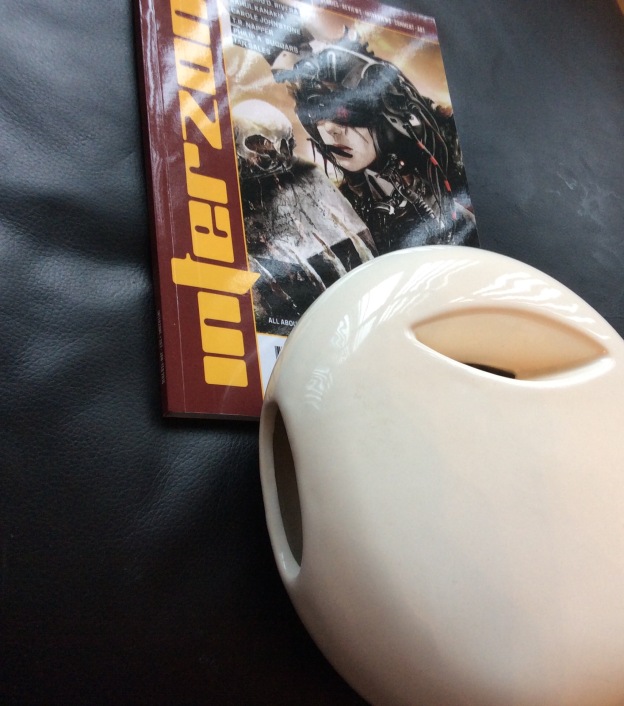
Interzone #262


INTERZONE #262

image
My previous reviews of TTA Press publications HERE
Stories by Mercurio D Rivera, Rahul Kanakia, Ian Sales, Carole Johnstone, T.R. Napper, Philip A. Suggars.
When I real-time review the stories in this magazine, my comments will be found in the thought stream below or by clicking on this post’s title above.

7 thoughts on “INTERZONE #262”


  1. THE WATER-WALLS OF ENCELDALUS by Mercurio D. Rivera
    “They understood that without the illusion of some productive task, the human mind tended to veer from complacency to depression.”
    I suppose the operative words there are ‘the illusion of’, and my productive task in my retirement is supplied, since 2008, by my doing real-time reviews of fiction works such as this one. And the fiction works themselves are written by Wergens. Their words themselves the bots who help me on with my literary snowboots. And Sancho is the tussling, trusting digger into text that lives in my brain. The water-walls the intervening dreams I hope to catch where others who guide me live. The far future solar system my sandbox.
    As in this story, however, my interpretation of these roles – and the trust and lines of communication between parties – perhaps rests on a lie or a misunderstanding. Despite its sometimes obsessive, close-ordered, typographically straitened description of details of the lady human protagonist’s task in this world near Saturn by singular narrative first personhood, one satisfyingly senses the poignant relationships, the only too human-like ploys and deceptions, till a chance rocket crash-lands allowing the possibility of her escape. But the sense of human ploys and deceptions extends also to her human ex boyfriend whom she sees through, with his eventually knowing that the cysts that weighed her down and took her to this forgotten outpost were curable. Those cysts were symbolic of burdens that made humans use others as well be used themselves. Sancho eventually sloughed off, as well as, hopefully, those cysts.
    This is a deep story that needs a defiant approach towards reaching its enticing snowy terrains to allow getting through the dry text to reach the water-walls of dream – then learning about us and about others who are not us. Pets we control and pets that control us. Pets as cysts and aliens as well as a trusting Sancho Panza soul that is yourself. (See my concurrent review of Doña Quixote by Leena Krohn here.)
    I am the naivety in the middle, between story and those who read it. Not a filter, but a wayward interpreter hoping to have caught some ricochets of dream in it.
    “Do you study my brain patterns when I sleep?”

  2. EMPTY PLANETS by Rahul Kanakia
    “Human society is the same you know: the Machine always says that it’s just the sum total of the actions of all the people who’ve ever lived.”
    One far future solar system sandbox in the previous story replaced by another here. Also another story that deals with your purpose in life and how that develops, how you affect its repercussions, how it affects you.
    This story is also equally as deep as the first one, with relentless meticulousness, an easily assimilable but a dry and otherwise complex text, leading to a myriad thoughts upon God as Machine, often an arbitrary Machine, with humanity’s Shares and Bounties in its Trust Fund coalesced by marriages as affected by the ratcheting tontines of altruistic discovery for others as well as selfishly for oneself. Playing with planets or solar systems themselves, or reprogramming your love of music. Questioning one’s commitment to the Machine. Accepting the mortality of all those around you as well as the Machine’s colonisations and colorizations.
    “‘Life is extremely simple, David,’ she said: ‘You can either attempt to propagate yourself or you can pursue hedonic satisfaction or you can sublimate those urges into some arbitrarily-defined substitution activity.”
    I do not know where to start, other than perhaps, as above, with my own real-time reviewing, my own backdrop purpose in life, relating it to a preternatural secularism (to borrow a phrase from a recent Quentin S Crisp book), here portrayed as foreground against the backdrop of humanity (here depicted with their in-depth thoughts as well as their almost chicklit romances and arguments) rather than that foreground-backdrop being the other way round as in most other fiction!
    The woman Captain who believed that the green clouds had eyes or souls on Altair III, I think. [Also I noted the Jungian plagiaristic SEEMING non-plagiarism of like themes discovered by my dreamcatching is here exemplified by findings about those Altairean clouds?] But the real truth pans out by its own real-time volition I propose and that is what I believe this complex and absorbing text points towards. Needs to be read more than once, but abiding by my own reviewing rules, I always comment upon the first reading or impression, and this is it!
    I sense this story is an important one if we could but recognise it. And continue working with it. Empty planets or empty heads?
    “I wasn’t sure she was talking about the same thing I was talking about, but since I wasn’t really sure what I was talking about it was hard to respond to her.”

  3. GEOLOGIC by Ian Sales
    “His umbilical lies coiled beside him: it is two hundred metres long and gives him complete freedom of movement…”
    There is perhaps some preterlogic if not geo-, that today is the historic day when a British astronaut, by the name of Tim Peake, spacewalks for the first time, a day when I read this far future and far distant version of that spacewalk by a man called Keller, whose job and existence subdivides humanity by the acclimatisation of squeaky-voiced atmospheres or the distances travelled by insulation from ambiance, leading to another purpose in life, exemplified here by a pioneering discovery of a Rock, a potentially alien Space Odyssey artefact with exterior designs, interior ‘chambers’ and ‘statues’. But like the Machine in the previous story’, it is all perhaps created by us, subdivided from each other, as we are, alien each to each?
    Each also a King or Queen in Yellow? “Rapture of the deep.” A pareidolia.
    This story is pulling at you, intriguing and haunting, together with colours like the Yeller of Keller, ‘vibrant yellow’, ‘apricot’, ‘orange’, ‘saffron’, ‘sienna’, ‘peach’, ‘salmon’ and, yes, its internal Chambers. And that vital yellow crack.

  4. CIRCA DIEM by Carole Johnstone
    “…a preternatural tundra that I alone ruled,…”
    Two previous stories actually took place upon a far future Moon or Luna, that yellow companion of ours, and now we have this memorably standpoint-oscillating far future romance story on Earth, oscillating between figurative chronobio-logics of, effectively, Montagues and Capulets… Two separate-leaning acclimatised worlds on one world, due to ‘a damaged moon’. A scenario in serendipitous symbiosis with what I called ‘the alien each to each’ syndrome of the Sales story.
    There are beautiful passages in Johnstone’s circadian story and the indefinable yearning that results.
    It also makes me think not only of the direct effects of a damaged moon on tides, habitats, habits and its ‘Clock Mutants’, but also of what I have often called astrological harmonics (the moon being one part among many parts of the machine of synchronicity known as astrology), harmonics that in turn affect humanity, harmonics, therefore, of the erstwhile ‘Machine’ in this resonating set of stories (so far) about humanity’s sporadically cohesive and divisive purpose in our far future.

  5. A STRANGE LOOP by T.R. Napper
    Another substantively complex story, one that slips down easily, though, as one regathers the forgotten memories necessary to encapsulate it. Ranging from a reference to a Magritte painting to this own author’s own mythos (as I fallibly remember it?) of the Omissioner. As with the first two stories, I can also relate this one to my own real-time reviewing or dreamcatching…
    “Memory is an act of creativity – the ability to form connections between disparate memories, build something new from them and hurl it into the future so it become a poem or a dance,…”
    …and relevant to the first two stories’ ‘illusion’ of a purpose in life…
    “It was about ambition, Irving. We used to dream and plan together, about our family, our careers. But you fell into this rut…”
    …and, in turn, this dual acclimatisation of memory with his wife, his need to recoup some incident with his daughter from some forbidden memory of a visit to Luna Park, relates to the insulated acclimatisations in the Sales and Johnstone stories. His way of sorting out his marital difficulties, being at a meal with regathered memories, but making it too obvious. I chuckled, as an aside, when learning about the distractive ‘on-retina’ device that his wife Ondine suspected him using while on-dining together!
    But it is more than all that, something you need to get your head around concerning memory, the ability to sell it as part of the world’s economic cycles for other people’s synaptic life satisfactions, the risk of being punished for retrieving memories that have been sold for others to have, selling them, if futilely, as part of that life purpose or career, plus Alzheimer’s, exo-memories, the in-denial or post-edited life narratives we all have, mnemonic servitude as loops or copyrights, hard truths…
    Irving made a dog’s breakfast of the inside of his head, and the Omissioner’s hilarious character, and the outcome, all consuming as you gradually – you may remember the eventual gestalt wrongly? – get your head round this ever-resonating tale.
    “Let’s not get metaphysical here, Omissioner. The tree still falls in the forest. The world still exists outside the boundaries of my skull. And if I make these motherfuckers pay, well they are going to pay.”

  6. DEPENDENT ASSEMBLIES by Philip A. Suggars
    (Previous review of a story by this author HERE)
    image
    “It was always Alfonso’s job to make the faces, the hands and the eyes. He stood in his studio and worked the clay now, his fingers teasing the material, inviting it to tell him what it wanted to be.”
    That again feels like my process of dreamcatching fiction works… and ‘dependent assemblies’ when seen as a phrase in itself rather than this story’s title are in fact what the Machine in this set of stories is all about. Here, that Machine centres on an alternate world Argentina – and alternate worlds are perhaps farther future than the farthest future itself.
    A story punctuated by this alternate history’s punchlines of illiberal politics, where the two male protagonists tango with each other every night, a touching relationship of striving for life’s purpose as workers or lovers with progeny as their legacy, against all the illiberal strictures, and they fight against the watching ornithopteron-moths, and other honey traps. Meanwhile, there are some amazingly hard-sensuous passages of bodily-machine-creating of their girl ‘children’, with a blend of cyborgisation, steampunk, Frankenstein (but none of these essentially), by using a material like prehensile putty called lux. The trouble is if you use too much lux…
    A moving and superbly envisioned story. A fine climax.
    There are other items in Interzone to interest SF enthusiasts in addition to the above fiction.
         

Friday, January 15, 2016

Doña Quixote and Other Citizens. Portrait

31 thoughts on “Collected Fiction of Leena Krohn


  1. Doña Quixote and Other Citizens. Portrait


    (Tales of the citizens of an unusual city)
    SPARROW
    I wonder if it is significant that ‘sparrow’ in English is a Sp(anish) Arrow, using its own beak as an arrow into the feathers of its wounded self, before I mercifully crushed it with my foot to help the arrow bury deeper.
    DQ then does the same for me with her cruel-to-be-kind barb of naive wisdom? Spreading the deadly focus point with her pluralist width of foot.
  2. THE DARKNESS OF MIRRORS
    “I thought that if I were to spend longer with my reflections, I would become confused with them, and no one would be able to say any longer where they had their origin.”
    A chilling and freshly angled account of what is tantamount to a visit with one’s children to a funfair mirror maze…
    Ending with a coda of all lights being switched on together and not one by one (like those days in SPARROW switching on as years again, or vice versa?)
  3. STRAW
    “The ice had just melted and the sea was breaking up into the year’s first white horses.”
    Is it a significant self-evident truth that both Sparrow and Straw are vaguely similar looking words? It would be if this were not a translation!
    It does mean, meanwhile, that we are now beginning to get our first real impression of DQ herself.
  4. THE PLACE WHERE YOU STAND
    I now see more clearly that these are sections rather than discrete stories. And there accretes a version of the city where we live within these leitmotifs growing as gestalt, from the end stepping-stone of ‘Straw’ to the ‘stet’ (my word, not this section’s) of prevailing stone here, stone in varying moods, as blended with space, and people’s softness. And other sporadic city factors.
    After what I said above about Sibelius, I couldn’t quite believe my luck when I discovered a reference to Tuonela in this section!
  5. THE BRIGHTNESS OF GLASS
    “At night, these small green towers are the lighthouses of the city.”
    A brilliant vision of this city with small glass towers erected throughout.
    Making eventually the gestalt of Sibelius Hall in Lahti?
    Or because Sibelius was a forerunner of Glass?
  6. CRO MAGNON BOY
    “…a lovely creature or something matter is perhaps intended to be, but that it always betrays and forgets -”
    A comparison between a pantomime dwarf and an Indian dancer. A reality rope-trick of a tale, one that starts with a school bus and a forehead bust..
    Coincidentally a Cro Magnon that I just read about today alongside reading about a Mornoloc elsewhere.
  7. THE TOWER
    “But don’t you believe in something like reconciliation? Or if not reconciliation, then oblivion or – perhaps grace?”
    DQ and I gradually emerging as characters, in a conversation featuring a deeply angled child-like poignancy, as we are walking around a brick tower in a well-imagined or real park. Death deemed as a part of pretending not to be there. This reconciliation now seeming to be part of the concept of reva-mending whereby I first encountered and reviewed Krohn fiction in 2011.
    Dragonfly and tower, like music trying to be nothing and something at once.
  8. THE MUMMY
    The narrator seems to share an inter-narrative way station with us, sharing, too, a seedy hotel room with a stranger. The contrast of a sheet-wrapped mummy and Hokusai’s wave makes grief seem tangible. This author – or her narrator become myself – seems to have a unique knack of eclectic images to convey universal emotions.
    (I use the word ‘unique’ advisedly, and I – a blend of my real self and someone I see as narrating my own life – have read a lot of literature in my 68 years. I am in there somewhere, beneath the healing bandages of coming sleep.)
  9. MOZART CHEATED US!
    “…a hatred so bitter it would be enough to burn the entire city to ruins.”
    DQ extols The Magic Flute, but thankfully also mentions the far superior String Quintets (that I have on my iPod).
    I hope I haven’t angered her by saying that.
    “…put his cap on his head and left.”
  10. THE ROOM OF CHANGE
    I hope it is not a spoiler to remark on a room with its moving population to something that it is a room that itself moves.
    The routes of towns listed and linked in the mind and later listed and linked on the ground – an interface that could only happen in Literature, making you think of life in quite a different way from what it would have been without Literature.
  11. THE ROOM OF TIME
    “Tick-Tock.”
    I think a tapiola would be an apt name for a sort of watch or clock?
    Here, aptly, too, we learn that DQ, seeking a new watch strap in a clock-shop, sees herself as old. I have gone with her to the shop, but I am not sure she is right, but what do I know? I only know that I liked the concept of a digital watch showing only the moment – not the passage of time that DQ rightly calls elastic.
    But I am left with a question: is a twinkling of an eye an idiom for a moment or for a barely hidden sense of humour. Ah, the latter is a twinkle IN an eye, not OF an eye, but I noticed BOTH at least implied by the ending of this still ticking story.
    (Time: defined as the previous section’s room that BOTH moves (or changes position) itself AND has things move or change or swap over within it?)
  12. PATROCLUS, TOO, IS DEAD
    “…the kind of day when all that is old seems to be disappearing and there is not yet anything new to take its place.”
    This the perfect piece to read on New Year’s Eve, as I have just done.
    Something that inspires me after a personally bad year when, at times, I assumed I was this – then as yet unseen – text’s ‘Incurable One’…. DQ to the rescue, today, as it were.
    Also this piece seems to convey to me the essence of the music of Sibelius that I have been revisiting more and more in recent days.
  13. THE SUN-CYPRESS
    A tactile communion with a compass-ionate tree, echoing a stoical speech from Uncle Vanya.
    [ Chronology – 1889: Bergson, Time and Free Will – Hauptmann, Before Sunrise – 1890: Frazer, The Golden Bough – Van Gogh, Road with Cypress Trees – Guyau, The Origin of the Idea of Time […] 1900: Freud, The Interpretation of Dreams – Chekhov, Uncle Vanya – Husserl, Logical Investigations – Mahler, Fourth Symphony – Sibelius, Finlandia – ]
  14. THE PEACOCK
    “‘How could anyone be mistaken about a peacock?’ she asked in turn. ‘Especially if you see it spread its tail.'”
    This tale spreads its own tail in the last magnificent paragraph, to obviate its earlier deadpan-narrated betrayal.
  15. NIGHT AND THE OTHER
    A haunting piece into which one can imagine the sculpted bodies of a couple on the lid of the stone coffin tomb – within which their real bodies had been buried in ancient times – still continuing to talk to each other.
    Room of change within, room of time on top? Or vice versa?
  16. THE CHAMBER
    “I look at the tuft of grass that swayed all summer in the cleft in the stone step outside Doña Quixote’s front door. Now it is only yellowed straw, but to me it still looks as if it split the stone.”
    It is as if it is myself as well as the reader who accompanies DQ on the normal business of her life, i.e. not a separate character within the stories that tell of this business of her life. A myself of time and a myself of change. Like this chamber of time and chamber of change (the latter via an estate agent), both chambers potentially carrying her same sad memories.
    Fill one chamber, like this particular story’s fable of a clay goblet, then the other chamber empties?
    Which the lethal chamber, which the yellowed straw, though?
  17. THE POPLARS
    “‘No, no, no,’ said Deska. ‘Look!'”
    What she pointed to was not the poplars that prefigured, even when this book was written, the onset of climate change.
    No, it was the idyllic girlish things of love. Who can blame them? Except they may be reading this today, much older and wiser than they were then?
    In honour of this book, yesterday, I bought, with a Christmas gift token, some string quartets and piano quintets by Joonas Kokkonen and Jean Sibelius on two albums.
  18. A SPRING EVENING
    “I wanted to turn on the standard lamp, but it was behind him, and I could not get up and cross the floor while he watched.”
    A striking depiction of a meeting going well but suddenly turning awkward for no obvious reason. I hope this does not happen to my meeting with this book. A spring sprung wrong.
  19. THE MEMORY OF OUR DEEDS
    “‘Tell me who you are,’ she said slowly. It was an aggravating question. I wish she had not asked it.”
    I have already referred a few times above to my identity in interface with Doña Quixote as ‘I’, reader or narrator or author.
    Remarkably, only an hour ago or so I read and reviewed (here) a story entitled ‘The Portrayed Man’ that coincidentally resonates perfectly with the seed of ‘The Memory of Our Deeds’. Real-time reviewing or dreamcatching often produces, for me, such astonishing synchronicities.
  20. THE LOOKING-GLASS BOY
    I note the phrase “the ineluctability of chance”, i.e. that each of us is born.
    Growing in our own eyes to the perfect size, but a mirror is so slippy, difficult to stop growing. Reaching up to BE the kite.
    This intangible text could be read and read again forever without fully growing into it, leaving no time for reading the rest of the book.
    Anyone who reads this book without giving full growth to each section of each work is not reading it at all. To give full growth to a text, one needs to dreamcatch it, too. How can you summarise the unsummarisable? Hence, I wonder if I should stop here and merely read the rest without dreamcatching it, without responsibility for it? But to read anything properly you need publicly to dreamcatch it, especially this book. And then each of all the dreamcatchers can then together triangulate its coordinates towards the optimum meaning, the optimum appreciation.
  21. THE AQUARIUM LIGHT
    “Don’t you recognise an ordinary goldfish?”
    The sometimes meticulously visionary duties in looking after someone else’s aquarium and its fish, produces another sudden dislocation of intentions between two people. Another strikingly dissprung spring.
    It is as if deadpan ‘Objective Correlatives’ can be counterproductively divisive as well as sharply assonant, consonant, allusive, elusive, disarmingly so.
    Depending on the context.
  22. THE REMOTENESS OF ALL GLORY
    “But whatever does not stir, remains.”
    A powerful piece, an already dreaded nub of this reading experience, as DQ grows not only old but also ill, and the last paragraph is a poignant premonition of something we see on the news every night in 2016.
  23. A ROOM OF ONE’S OWN
    “The comb lies on the table before me between the pen and the book.”
    Sweetly, the ‘room of change’ and the ‘room of time’ now come together in an apotheosis of life being present in anything.
    But are we acting out a child’s philosophy by believing that the seeing of life there makes it life when we see it there but not believing life is there when we turn our eyes away? But as with a finger’s exfoliation perhaps our eyes leave life behind with a now ownerless, but lasting, residual vision of it?
  24. LOST
    “There was something I absolutely had to tell her. What was it? What was it? I forget so much every time I step into this room.
    When I look at Doña Quixote, she seems suddenly to have shrunk,…”
    Room as aquarium, because water shrinks?
    One doesn’t get used to living, it says, but it’s relatively easy to get used to dying, I guess.
    But that presupposes knowing when living ends and dying starts
    – even though living is part of dying? or vice versa?
  25. THE MEASURING LINE OF ZERUBBABEL
    “Jerusalem shall be inhabited as villages without walls, because of the multitude of men and cattle in it.”
    That inverse ‘en saga’ of a diaspora seems to symbolise the drowning tides of migrants today, those Oceanides or the Tower of Babel where Zerubbabel is mispronounced Sibelius?
    DQ’s Asshammers-induced vision of men measuring a roof is poignant, as now she is not only old and dying but also confused? Except she’s none of these things, with MY eyes ever upon her from within, her Sancho Panza soul. (Links are to two of my concurrent preternaturally-relevant Dreamcatchers).
    END
    I shall be continuing with a re-read and re-review of TAINARON soon, and a link will be shown below in due course.
    https://dflewisreviews.wordpress.com/2016/01/19/tainaron-mail-from-another-city/