Monday, July 18, 2016

The Daughters of Lilith and Other Tales
 

6 thoughts on “The Daughters of Lilith and Other Tales

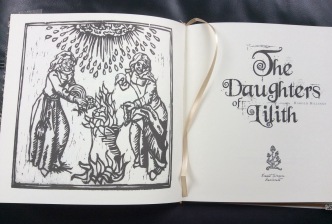
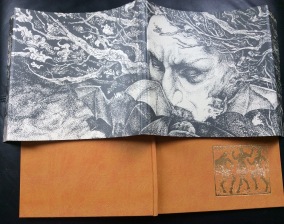
  1. Copy numbered 28/77. Luxuriously upholstered book with quality materials, about 10 inches square, 60 pages, marker ribbon, all generously designed with much artwork etc, dust jacket, embossed hardback cover and amber endpapers.
    My previous reviews of Harold Billings’ work HERE.
    My previous reviews of this publisher’s books HERE.
  2. image
    .
    THE DAUGHTERS OF LILITH
    The first story that is its own “spoor”, one that builds the truth-beyond-legend and beyond-inbreeding of Adam’s first wife before Eve, since Satan, and the crevices his sons sought, the writhings threaded, the cocks and screech-owls of our progenitors and how they sensuously managed, from the land of Sumer to that of Onan, their sparse, but rich-when-come couplings to further our race beyond race, a race or competition as inverse tontine that still subsists, I feel, today.
    A luxuriant text beyond fiction that will stir you in more ways than one. Highly recommended.
  3. THE WITCH OF MOUNT CHIPINQUE
    “…and you will remember that I have told you so.”
    There surely can be no bigger contrast between the first story’s myth-textured eroticism and this refreshing romance between two young people on a group coach trip to the Mexican plains, along with other young people, escorted and being provided with a real witch to tell them of legends and collusive premonitions. Touching, almost naive.
  4. WHERE SATYRS SLEPT
    “…but ragged dreams filled their minds.”
    And the apparent naivety of the previous story becomes less apparent – where several modern young people socialise and play the mating game with, now in hindsight, a hint of forced sex within a pair of them now taking on a stronger import – and taking a new slant when seen in tune with this third story that makes its own turn in tune with the first story’s gamesmanship and inverse tontine, of its own gamut of humankind’s Genesis of inbreeding, outbreeding and cross-breeding. And now that inbreeding takes on a new darker turn with the onset of satyrs as part of a cross-breeding process, an onset that appeared for the sons and daughters of Eve, Adam and Lilith, where ‘love’ and siring matches are made by result of shinbone or of the St Eve races, races for a race of people? And the stoical love of Nathan and Naomi for each other, and for their dog Jess, and the visitation of an old satyr by the name of Lexxie, a creature as old as some authors who have since become even older. And the ruthlessness needed against their progenitors, with the help of their dog, to ensure the loving couple’s full onward game of fate in breeding scions…to the further tune of the Stars’ swathe, path or pattern of astrologically harmonic destiny in the sky, I feel.
  5. THE GAMES OF ST. EVE
    “There was even attention paid to improving the intellectual attributes of the physically endowed virgins.”
    This story is a delight, especially in the context of the whole book so far. From under the shadow of the Adam-Fallen, a gentle amoral sexuality and apolitical considerations of gender now prevail, with the previous hints of races and games take full sway, and even the satyrs’ involvement now non-inimical and collusive with split-hoofed races and consensual cross-generativeness. We follow Nate (the younger brother of Nathan whose own path we are relieved to hear news of) and Nate’s meeting with Glenda and we also follow the book’s own games and tontines now made manifest in an enthralling archery competition (a companion to the other races and naive bouts of naughts and crosses) – the result being a telling parallel with the fated happy ending of this book’s earlier modern story in Mexico.
    I am worried that only 77 people are due to enjoy this important book and understandably pleased that I am one of those 77!
    I already feel that I am a winner of one of those St Eve’s games. And there is still one more story to read…
  6. COSMOS ENOUGH AND TIME
    “I would lay rich land upon books, and books from words that cascaded from the madness and holy dreams of men,…”
    This book becomes even more important, I suggest, as we negotiate this final work which, by its own terms, for me, represents an apocryphal coda, one where the sexual yearnings – yearnings for their own as well as for any resultant scions’ sake – blend with a Jewish diaspora across Europe from Spain, via a later pursuing evil nearer Bavaria or Transylvania, with darker lycanthropic cross-breeding than that with satyrs earlier in this book turned out to be, towards the Holy Land, now intervened or cross-triangulated by this work’s narrator as a trainee priest, in a soon to be snow-locked inn, a priest with his own naive sexual yearnings… but someone with sufficient wisdom, having read Browne and Shakespeare, a wisdom with which I trust the reader also becomes imbued so as to know what might lurk in the would-have-been virgin’s womb, and the honest ambitions of her companion family, a self-fulfilling premonition issued by the earlier witch in Mexico for a happier mating with the eventual fruition of further issue, an eventuality which brings tears of joy to any reader of this book worth his or her salt. Thereafter, this important book’s tontine now renamed by this final story as an “inverse crusade.”
    end
     

Cat-At-The-Window

One thought on “Cat-At-The-Window by Mark Valentine

  1. “, and their were higher rewards for rarities in shape,…”
    A highly delightful fiction about a real historical competitive game of passing time by counting cats in Victorian times, and extrapolated later, and variated, with “eminencies” who once played it. Or a non-fiction truth about an imaginary game? Or simply a truth.
    Produced in a beautifully handmade format with loose scoreboard for playing the game in its end pocket.


Wednesday, July 13, 2016

butterfly dream - Kristine Ong Muslim


10 thoughts on “butterfly dream”


  1. ARTIFICIAL LIFE
    “We walk into any room…”
    Except this is the book’s first room, not just ANY room. This a one-pager, a child trying to revive her doll. No longer a child, but still trying.
    A message for futilely trying to better humanity with all its “cogs and fallen machinery”…? Misplaced hope and false beginnings.
    A telling metaphor to be massaged, too, I say.

  2. THE SIX MUTATIONS OF JEROME
    “There are many stories that are not supposed to be told. Not because they have nothing new to say, but because they were designed to unfold in their own time.”
    There’s something of an entrancingly transgressive gospel tone to these six mutations of JEROME, something of the earlier unrevivable doll but here the unkillable dead.
    Much material to relish and pick over. Just to give you a taste of two of the mutations (things that, by dint of this text’s last sentence, I here transform for and by my own personal use) – JEROME K. JEROME where K stands for the KETTLE mutation … and his MULTIPLE PERSONALITY DISORDER mutation, the Three Men in a Boat (the Jerome boat): old Carl, young angry Gene and silent Matthew. His gospel’s three apostles in a dream-wet bed?
    “You know Jerome as Jerome, who is fragmented.”

  3. IN THE EYE OF THE BEHOLDER
    “He did not want to hear anyone say that it was only a dream. He did not want anyone to comfort or pity him.”
    Patty’s doll as an emblem from earlier in this book now as this narrative’s protagonist point-of-view boy called Jimmy who wants to fly his dragon kite to replace his mother’s rancid cigarette air with the fresher sort outside, I guess. This relatively short work is crammed with Jimmy’s character and body features, a perception, through him, of allusions and illusions, even possibly delusions, elusions and elisions, all eventually trapped by each reader’s own dreamcatcher or butterfly-net as a shockingly perfect storm of subtleties.

  4. THE GIRL WHO DID NOT EXIST
    The story that did not exist, the one that’s blocked, having looped the loop beyond my butterfly-net? Perhaps it’s where Patty’s doll came alive at last. Or like blocking people on-line, as if they no longer exist, inside the head of that doll – with news reports of supposed abuse streaming as lurid backstory – as well as her becoming an unrevivable surrogate outside the doll’s head, now complete and ready for autopsy, with her clinically searchable or plastic parts? Eventually blocked by an all-singing, all-dancing cartoon?

  5. WRECK, SLASH, BURN
    “When machines talk metaphysics, it means that their logic circuits are a little blumpy.”
    A crystallised theme-and-variations of Bob Lock’s Cone Zero Ultimatum, my own Cone Zero and Cern Zoo combined, where a toilet cleaner is more revivable than a small girl’s doll, perhaps. Machines exasperated with the vulnerability of humans, in seeming rebellion, but who’s rebelling against whom?.

  6. THE LONELY PEOPLE
    “The sky was the only thing that was left unchanged.”
    Life has now become real-time, too! Everyone is running about with butterfly nets. And here, in this amazing quilt of characters, a scenario as if inspired by the Cone Zero ultimatum of the previous story, literally synchronised shards of random truth and fiction, where ordinary things come alive, here partitions and wiring and drains, ordinary objects conjoined with and enabling ways through for these new seeking aspiring humans – where brexit is said actually to mean brexit – a sort of maddening loop or leap – all striving to find those sunny uplands beyond such barriers, and some pretty nifty SF conceits in a uniquely evocative language. Unmissable. And important for our times. No irony intended.

  7. LETTER TO A CERTAIN DR. BILL
    “Sadness is something that you just bottle up, Jack, because it doesn’t really last.”
    From the ‘happiness bottle’ of the previous work, to this Outerbridge where I imagine the loneliness works out as a pre-coda to the whole of this book, partly truncated, partly perfectly quilted.
    The house (of Jack) as objective correlative in the previous work is transposed here together with an Oliver Sacks-like ironing board.

  8. THE PSYCHOPOMPS
    The short coda proper. That world beyond the ironing-board or kettle or drain or partition of wiring, where it is more of a coach party than a singular rite of passage. None of us are important. Irony or ironing-board intended.
    This chapbook has been an inspiring experience, a sort of object lesson. A book to be revived whenever it seems dead.
         

Tuesday, July 12, 2016

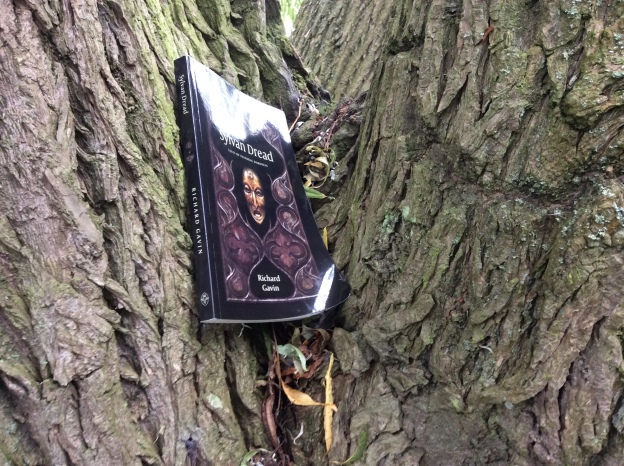
Sylvan Dread – Richard Gavin


14 thoughts on “Sylvan Dread – Richard Gavin”

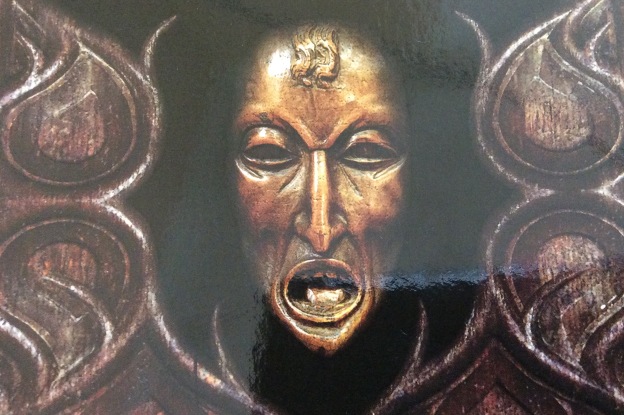
  1. image
    THISTLE LATCH
    “But I cannot remotely recollect his face, though I am certain that he had one.”
    It is as if the Thistle Latch allows you through the door into this book itself and then out of it again to see the world differently, to see a ravine revelling…
    For me, this is an intensely haunting form of sylvan nature’s all-embracing pareidolia, where the shapes are not only visual mirages but also bodily ones whereby they make you, as a physical as well as a mental being, part of the pastoral pareidolia itself, and the mirages become the truth and the clear sight some form of hoax.
    You reach into the future when you are older, more achy and less athletic and you renew your acquaintance with the owner of the latch… A latch to something thistly within the reader – as happened last year, and still may be growing there, depending on who is asked to help, the occultist or the medical.

  2. I read and reviewed the next work in July 2009 here and this is what I wrote about it then:
    ——————————
    Primeval Wood
    Having real-time reviewed Richard Gavin’s collection OMENS (HERE), I couldn’t wait till I entered that ‘often parish’ again … so the arrival of my purchase of this novelette in my bungalow-house today was timely in order to quench such cravings.
    As well as being a fan of Gavinostic fiction, I am a lover of Proustian works, too… and here we have a concept of Proustian weekends, whereby the protagonist, Neil, spent self-indulgent decadent periods insulated within his bed pigging, tripping and reading…
    No wonder that another point-of-view (his girl friend Kate) left him for yet another point-of-view (Darren) – and Neil goes to the holiday cottage alone instead of with Kate. So, Neil, upon this voyage of discovery towards consciousness (as tutored by a believable discussion forum on the internet) … to become what? A spoiler in himself for other points-of-view to suffer? A muse that is the actual author rather than an external force? An Aickmanesque ‘fetish’ of textured Wood? He is all these these things and more. Leaving the reader himself literally growing out of Primeval Wood or even, perhaps, being sodomised by the wooden soul within its pages’ paper?
    [Kate left Neil a note early on saying ‘We’re Done‘ on the medicine chest mirror. NightSun on the internet forum may also notice that the holiday cottage had a note faded out into: WE___ME.]
    ————————

  3. A CAVERN OF REDBRICK
    “If you want to know the truth about something you have to do the same thing more than once.”
    That quote was indeed a sudden dawning truth, as I found out that I had read this story before and reviewed it here in 2014. You see, the text is identical but this is no longer a run-of-the-mill ghost story, but a great hauntingly recurrent experience of a boy’s encounter with a ghost of a girl of his own age during a summer ‘elation’, while staying with his grandparents. As enhanced by a comparison of the genius loci of the ‘revelling ravine’ with the gravel pit and by remembering this book’s earlier Thistle Latch of which this ghost now reminds me with incremental force and telling poignancy, upon the brink of fallible trust and danger. Ice and fire.
    Ice thistle as thistly ice.
    And a cancerous fire within.
    Rayburn. Redbrick.

  4. TENDING THE MISTS
    “A pillow of fog swayed lazily over the seam where island and sea intersected.”
    Twin sisters, one the narrative viewpoint, the other seemingly having enticed that narrative viewpoint to this wedding group, where all the guests appear to be women in a face-fronted community of possibly abandoned buildings and the inn where they stay…
    There is something missing or lost about this darkly florid text, something that is found wanting, but later replaced under the cover of mist. Replaced by what? By a part belonging to the narrative viewpoint? Or by a huge engorged part too big for where it needs to be replaced? A choice of two groups, the first supplementing the other with part of itself and the second removing something from the other as self-fulfilment, but chosen as used or user?
    This story, too, attempts to entice us all, but some of us may wish not to have gone there, whilst others like you will relish it and decide to join the others already there. Which of the two groups chosen depends on the one you naturally orientate towards and finally join, finally fuse with.

  5. FUME
    “Whatever was filling him now was something foreign, something incorrect and offensive.” …bearing in mind that this story’s officious, small-minded male protagonist has always enjoyed ‘corrected coffee’, and the mind boggles, as it boggles at the whole of this in-your-face horror, at this obnoxiously pungent ‘fume’ that besets him from the swaddled object in the ravine that first meets his obsessive meddling and clearing-up scrutiny after the ‘summer people’ have left the community, a place where he lives all year round.
    That ‘fume’ is boggling enough, with its ability not only to exist in a sane world but also to be described in such a floridly escaping gas-like way, with all its effulgent, spiritual nastiness laid bare, making you wonder whether this is a fable with a moral or a sheer iconoclastic horror for its own sake. You decide.
    Meanwhile, a horror even worse than the ‘fume’ itself is the male protagonist whom this horror attacks! A man whose impotence and dowdy life cannot be revived even by arrayed women (perhaps recruited to stir his loins from the previous story at various age-stages of their fusion with fuming).
    But sometimes even a standalone potency, especially for such a man, cannot be re-ignited or sufficiently have its clogged conduits fumigated. And that is the case whether his impotence was induced by bodily disease as trailed earlier in ‘Thistle Latch’ or whether it was infused by some mental stagnation of self-corruption. You again decide. You should know.

  6. GOATSBRIDE
    “Although only her lungs and eyelids were moving, and, even then, scarcely, Marietta nonetheless felt as though she were cart-wheeling forward, spinning through the borderless country inside herself.”
    …as if ‘country’, by dint of its pure sound of phonemes without seeing the word itself, is something laid open, un-latched…the girlish self as physical as well spiritual ‘country’ or receptacle, a sumptuous sump welcoming something at first like the swaddled ‘fume’ creature now evolving as another version of the appendaged feral creature of ‘Tending the Mists’….
    Those jigsaw patterns of mutuality, with the ending indicating that the horror between rider and ridden continues to be frighteningly mutual.
    The actual text is a special unswaddling creature, with its words actually BEING the ‘ichor’ of which they often speak while fulfilling the apotheosis of, say, Clark Ashton Smith and MP Shiel within its own ‘country’ of style.

  7. WEANED ON BLOOD
    “The architected silence of the two monks was suddenly broken by a susurrus that echoed up from the cleft.”
    Cleaved or again ravelled from a ravine as an inverse holy mother’s birthing cleft, this is a darkly intense cross-breeding between eucharist and lithopædion – telling of a new monk at the Trappist community witnessing other monks’ rites with birdbath and blood by wood’s side. Cardin-al as well as uniquely Gavinostic, heretically or aspirationally Gnostic, a horror that seems so real coming out of the page’s own envisioned cleft, the horror indeed so utterly real by its ability to horrify, a horror from the Christian religion by which it is birthed, so that that horror makes even the unbeliever like me somehow believe, at least for an ecstatic moment, in that otherwise personally eschewed religion. Somehow makes me want to pray that the moment lasts no longer than a moment.


  8. imageTINDER ROW
    “: the sweet, almost inviting scent sat heavy in the blackened tunnel, clinging as surely as stale cigar smoke, or the funk of sex on motel room sheets.”
    A swarm of insects towards or from a hive, to the accompaniment of vanilla, this pungent tale of rediscovering a woman called Agnes from your past and taking her from under the boardwalk to where her makeshift sign points, an exercise in body-moulding sac or clinging forest-clearing, in moulting soul, in sacrifice and guilt for taking her where she simply wanted to go.
    This is the breaking genre of hedonist horror. The unforgettable genius loci of Tinder Row is a masterclass in such an oxymoron of dark spirit and elation. image
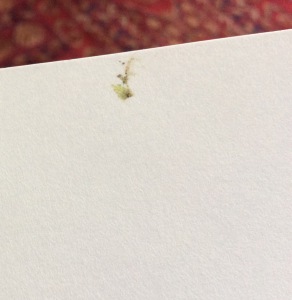
    Unforgettable, I say, but how can anyone logically know whether anything is unforgettable? You won’t believe this but it is absolutely true – when I finished this story I noticed a squashed flying-insect upon the inside of this book’s back cover. The stain is still there after spontaneously, in disgust and shock, scraping it off with my fingernail. It must have found its way there during this morning’s photographic session at the Yieldingtree. That is why it is unforgettable – till, at least, my own death’s hiving? The winter or l’hiver…
           “Open thine eyes, for meek St. Agnes’ sake,
    Or I shall drowse beside thee, so my soul doth ache.”
    — John Keats
    As a child in winter, I often remembered endless summer elation by the squashed fly or stain of picnic food inside a favourite book….

  9. WORMWOOD VOTARIES
    “He could see hairs from the painter’s brush lying trapped within the smears,…”
    This is a story of a man ‘between’, a hypnotically deadpan, yet sumptuously florid, portrait (a masterful bridging of such styles in narration), a story and backstory of a man with flu just as I was yesterday a man with fly. I feel, as a result of this new text today that I am ever hovering between.
    This between is a balance of my dreamcatching obsessions demonstrated by this website (a personal subsumption as a votary of bookish truth disguised as fiction) and my ordinary life with its duties and other realities. This text bridges that ‘between’ by means of various ‘objective correlatives’ such as ash faggots and an aunt named Thora within which name is a votary’s oath, a highly textured tapestry of words that not only rarefies a creative fever within me but also underpins an unshakeable belief regarding forces that truly live within that tapestry. A new state of being. A ‘fey radiance.’

  10. THE OLD PAGEANT
    “Buoyed by his petit mal, he lay back in the humidity, hoping that the encroaching dusk would cool him.”
    … as if the previous story is instrumental in buoying this one?
    A richly haunting tale of an about-to-be engaged heterosexual couple arriving at the distaff’s cabin of her childhood when grownups told her and her sister scary stories as well as stories told between herself and her sister themselves – and the would-be spear-carrier listens to her stories of these stories, until are switched changelings as well as engagement rings.
    And another vision or apparition of a Yieldingtree for this real-time review, I feel, after a story of a story of trees – “We mimic them, they mimic us.”

  11. I previously read this story and reviewed it in the Autumn Cthulhu anthology…and this is what I wrote about it then.
    ————————-
    The Stiles of Palemarsh
    “The openness of the lane, the visibility of the cloudless sky was too immense, too open.”
    This is an honest horror story with its exponential openness, honest inasmuch as its horrors are perfectly pitched to cause terror, and any literary nuances are in the darkly evocative turns of phrase and the sense of love for horror words and soundfest constructions for their own sake, and honest in the sense that the reader is not fingerposted through this outlandish Welsh village, as the Canadian protagonist named Ian is both confused by this place and squeezed by a remarkable concept of a squeeze-stile, crossing a step-stile, too, via the various styles of squeezed fear and missed steps. Honest, too, in that we cannot have sympathy with this protagonist, based on the implications of HIS words, that he had jilted his own stile-squeezed bi-polar fiancee at the altar, with him now come to Wales whence her family derives and unforgivably attending the planned honeymoon holiday alone, the honeymoon he alone aborted. And no wonder the demons that pursue him are inchoate as all fears are, as all squeezed depressions are, and we admire his honesty at admitting by clear implication that he is no horror story character with whom to empathise or sympathise or cheer on towards safety, a safety, without dishonest fear of a plot spoiler, he does, however, reach, despite our not caring whether he did so. And the one he abandoned at the altar, as it were, is now possibly just one of several monsters (so utterly nightmarish in themselves) shambling after him in an honest horror story. And I let out a deep sigh as the two sides of a story’s character are finally brought together by his own vice. But none of that takes account of what is envisaged transpiring in the possibly on-going plot after its claustrophobic text releases us from its captivating style, releasing us into the open. Unspoilt and endless.
    “…and though their thick eyelids remained closed, Ian was sure they were seeing him.”

  12. MARE’S NEST
    “And if they stall the growths a bit, they consider themselves heroes. If I die in the meantime, well, then it was bound to happen either way is probably what they’d tell you.”
    And this work chimes perfectly with my own personal take upon the Thistle Latch. And here that Latch is a husband’s exploiting of his own sculptural work with found objects, found triangulations of love’s coordinates of location, black granite, and shapes not unlike my own Yieldingtree.
    All of this to forge a shell or clinging clearing or other well-fitting force (of pastoral radiotherapy?), a force by mysticism more than by physics or botany, to encase and hopefully cure the cancerous growth of his growth-dying wife, and eventually to create some union beyond their two human souls and their two human bodies, using prize pieces of each as found art, a ready-made precisely made as well as haphazardly constructed…. A horror without victims.
    This is a substantive and raw masterpiece, I feel, transcending the previous works in this book but enhancing them retrocausally, too, and then apotheosising the work of another sylvan dread’s John Cowper Powys (such as his ‘The Glastonbury Romance’ and ‘The Inmates’). And that is a huge compliment from me. The ultimate ‘found art’. A ‘ready-made’ both ready and yet to be made. Crazy with the intelligence of sublime instinct.
    Intense but relaxed in its syncopation of synchronicities. The fleshing of dream.
    Of willow leaves and stout wood configured. Self and other.
    “in the Grotesque, as the Grotesque”
    “She no longer triangulates the poem’s inspiration with words on paper, She is the living language of the Poem.”
    “Hunched within the unyielding shell…”
    “; perhaps not quite sacraments but certainly a fledgling gestalt, the seeds for an object that would be greater than the sum of its parts.”
    end
     

    Saturday, July 02, 2016

    Flannery O’Connor: Complete Stories


    5 thoughts on “Flannery O’Connor: Complete Stories”


    1. THE GERANIUM
      “His throat was going to pop on account of a nigger – a damn nigger that patted him on the back and called him ‘old-timer’.”
      A pungent, abrasive period-text that really bites your eye-dust, as this old-timer from possum country needs to live with his daughter in New York, as he tries to acclimatise himself to the endless buildings and the new peckiing orders, eased at least by the habitual appearance of a geranium in the opposite apartment each day between certain hours… Until even that crashes to the ground.
      The sound of the word ‘geranium’ sounds to me like a word for a comfort stop for an old-timer’s frequently loose urinations like mine?

    2. THE BARBER
      “They couldn’t say Negro–nigger–colored–black. Jacobs said he had come home every night and shouted, ‘NIGGER NIGGER NIGGER’ out the back window.”
      My reading today this story from the 1940s for the first time has amazingly come at the exact triangulation of the Brexit coordinates in 2016 – and Brexit’s hindsight racist raison d’etre. Foresight, too, no doubt.
      Here a customer has passing time’s recurring argument with a barber about voting for a then current election’s progressive candidate, an argument in the hearing of the black boy who sweeps up after each shave. And the bitter confused emotions where the lathered bib is not removed when the progressive customer leaves amid the sound of society’s blades sharpening, I imagine. I feel this story was uncannily written, in prophecy, for the time of Brexit…for my eyes and this opportune real-time review.
      Brexit as a word sounds like a blade snagging on a whisker…a faltering gash.

      • Flannery O’Connor (1925 – 1964) – from back cover:
        “She is a modern writer in the widest sense, in that her stories are all preoccupied with obsessions at the heart of our modern world.”

    3. WILDCAT
      “Old Gabriel shuffled across the room waving his stick slowly sideways in front of him.”
      [Yesterday I had not read any of these stories when I instinctively set up that art installation of a photo for this book’s review, and I had no idea that quote was coming up in this story!]
      This is a story of a blind old man mainly in a rexited dialect of abrasive dialogue layered with similar in rooted prose, with his remembering a boyhood when a wildcat killed someone (tellingly a ‘nigger’ in the old man’s amoral parlance but moral in retributive hindsight), and now — in a Poe-like ‘Tell-Tale Heart’ type of suspense – he awaits his own similar destiny. A striking portrait of growing death-dementia.