Flannery O’Connor: Complete Stories

faber & faber 2009
Sky-blue thinking, dirty yellow literary gold and an old timer’s lost geranium….
When I review this book, my comments will appear in the thought stream below.
www.nemonymous.com
Des Lewis - GESTALT REAL-TIME BOOK REVIEWS
A FEARLESS FAITH IN FICTION — THE PASSION OF THE READING MOMENT CRYSTALLISED — Empirical literary critiques from 2008 as based on purchased books.


“His throat was going to pop on account of a nigger – a damn nigger that patted him on the back and called him ‘old-timer’.”
A pungent, abrasive period-text that really bites your eye-dust, as this old-timer from possum country needs to live with his daughter in New York, as he tries to acclimatise himself to the endless buildings and the new peckiing orders, eased at least by the habitual appearance of a geranium in the opposite apartment each day between certain hours… Until even that crashes to the ground.
The sound of the word ‘geranium’ sounds to me like a word for a comfort stop for an old-timer’s frequently loose urinations like mine?
“They couldn’t say Negro–nigger–colored–black. Jacobs said he had come home every night and shouted, ‘NIGGER NIGGER NIGGER’ out the back window.”
My reading today this story from the 1940s for the first time has amazingly come at the exact triangulation of the Brexit coordinates in 2016 – and Brexit’s hindsight racist raison d’etre. Foresight, too, no doubt.
Here a customer has passing time’s recurring argument with a barber about voting for a then current election’s progressive candidate, an argument in the hearing of the black boy who sweeps up after each shave. And the bitter confused emotions where the lathered bib is not removed when the progressive customer leaves amid the sound of society’s blades sharpening, I imagine. I feel this story was uncannily written, in prophecy, for the time of Brexit…for my eyes and this opportune real-time review.
Brexit as a word sounds like a blade snagging on a whisker…a faltering gash.
“She is a modern writer in the widest sense, in that her stories are all preoccupied with obsessions at the heart of our modern world.”
“Old Gabriel shuffled across the room waving his stick slowly sideways in front of him.”
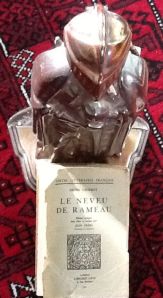
[Yesterday I had not read any of these stories when I instinctively set up that art installation of a photo above for this book’s review, and I had no idea that quote was coming up in this story!]
This is a story of a blind old man mainly in a rexited dialect of abrasive dialogue layered with similar in rooted prose, with his remembering a boyhood when a wildcat killed someone (tellingly a ‘nigger’ in the old man’s amoral parlance but moral in retributive hindsight), and now — in a Poe-like ‘Tell-Tale Heart’ type of suspense – he awaits his own similar destiny. A striking portrait of growing death-dementia.
“Miss Willerton always crumbed the table.” – the story’s first sentence.
Later: “‘First sentences,’she always said, ‘came to her — like a flash! Just like a flash!’ she would say and snap her fingers, ‘like a flash!’ And she built her story up from them.”
With the opening post-breakfast scene, I thought I was in a story by my favourite writer Elizabeth Bowen. (Why do I now always think of Brexit every time I hear the word ‘breakfast’?) A truly writerly, fascinatingly experimental, story, where Miss Willerton starts her story of the sharecropper with hookworm, and his wife, on her typewriter and it is as if the text enfolds her and she herself becomes the wife for real. A remarkable story, well before its time. Words as phonemes as well as a crop of crumbs. When you are a God of a story you sometimes have to roll around in its mud yourself like a Dog.
“He remembered the minister had said young men were going to the devil by the dozens these day and age; forsaking gentle ways; walking in the tracks of Satan.”
Living-shooting games, as our 12 year old boy hero wants to outdo his older brother by proudly bringing home the Turkey he bags, creaturification as told by another set of abrasive phonemes in the form of story text while he dares the act of blasphemy with various spoken words, and finds himself kidded by those devil-boys out of his Turkey prey – as well as kidded out of prayer or hope itself against such devils? Told and very telling.
“The turn of his head was like and the back of his neck was like and the short reach of his arm.”
A hypnotic shorthand prose with vivid exegetic energetic syntax and longhand breathers between, as the train endlessly winds from beginning to end to beginning again, in 19 year old Haze’s haze of memories, of places, of his mother (structured in dream-like thought like the bed berth in the train ceiling and like something else) and the ‘gulch nigger’ porter who opens that berth or birth and who looks like.
Amazing mind-glitching stuff, nightmarish like the Horror genre but much more like.
“Haze’s shadow was now behind him and now before him and now and then broken up by other people’s shadows, but when it was by itself, stretching behind him, it was a thin nervous shadow walking backwards.”
Another Haze, this one Haze Motes, not the previous Haze Wickers on the train, here in town, clumsily servicing a woman named Leora Watts, sees and interacts with a man selling potato peelers, and he sees and interacts with a blind man called Asa Shrike and his girl in “men’s shoes”, “men’s shoes”, “men’s shoes”, a sound like a religion if you repeat the words enough (my observation, not the story’s), a blind man giving out Jesus Loves You paper tracts, and there is also a boy called Enoch Emory of the same age who tries to befriend Haze Motes. I know exactly what this story means, because it means so many different things from which you can choose in a bespoke fashion.
It is a very disturbing, amazingly evocative, idiosyncratically well-written, eventually Aickman-like story and people who know my taste in literature will surely follow me to this story if they know what is good for them. What’s bad for them, too. Maybe the peeler is to be used to skin off the nude white woman in the casket that men stare down at (not a ‘nigger’, as it happens, in this story’s parlance) and her moving moles – or motes?
And in this story’s later end scene, after his obsessively routine ritual route via the FROSTY BOTTLE and the (‘Nemonymous Night’-like) ZOO, we now encounter again the earlier Enoch Emery who eventually reaches the Museum, thus bringing the above conceit to devastating full circle. And the deadpan goal of sighting the shrunken man.
Enoch had been obsessively spying on scantily clad women at the swimming pool but then he meets Haze again (now Hazel Weaver, not Hazel Wickens or Hazel Motes), a Haze who wants to find the couple who sold the previous story’s peeler, now named Asa and Sabbath Moats. Moats rather than Shrike.
This is amazing material, with many startling awakenings towards – if not fully reaching – the text’s ‘dark secret center.’ All expressed, perhaps, through an Enochian brain divided into two parts…
“The part in communication with his blood did the figuring but it never said anything in words. The other part was stocked up with all kinds of words and phrases.”
.
“They had been the dried-up type, dried up and Pitman dried into them, them and Pitman shrunk down into something all dried and puckered up.”
Thank shrunken museum man again?
Meanwhile, this is a heart-rending, incantatory rite of passage in a place called Pitman, up the possibly significant mole-coloured carpeted stairs, climbed by a woman called Ruby who is ‘only’ 34 years old. Breathless and seemingly fat? her heart troubling her? Her projected fortitude and worth compared to her younger brother Rufus who has ‘as much get as a floor mop.’
When you learn the implications that what must have passed through her head (literally) at the end after learning that her fatness may be more from seeding than from a lardy heart. Makes it even more heart-rending. Shocking, too. And ironic. Powerful.
The power is conveyed by the mind-glitching style as well as by the obliquely outlying objective-correlatives that here are not objects but the other people that populate this climbing mole-coloured land of tenement stairs. People. Like Bill Hill, Ruby’s husband, who was supposed to be careful when shafting HER stairway, I guess – and the plot-significant pistol she stumbles upon belonging to the boy Hartley Gilfeet (feet with shoes, here women’s shoes, compare the men’s shoes I mentioned earlier), Mr clever clever Jerger, Madam Zoleeda, and Laverne Watts (cf Leora Watts earlier in this book).
“…all she could do was look at her feet and shoe em to Rufus, shoe em to Rufus and he was an enfant and she was thirty-four years old. ‘Rufus is an enfant!’ she wailed.”
“His brain, both parts, was completely empty.”
Enoch Emery now grapples with an unfit umbrella and later changes places with a movie-house gorilla. Is it a coincidence that both umbrella and gorilla end with rella and rilla respectively?
“A NUTTY SURPRISE!”
I know what this enjoyable, but otherwise inscrutable, story means but only knowing what it means from within the gestalt or umbrella of the book itself, rather than from any overriding movie-house hindsight.
“He discovered while he did this that he still had his shoes on,”
“In case of an accident, anyone seeing her dead on the highway would know at once that she was a lady.”
The nameless grandmother of this family, made up of Bailey her son, his nameless wife, their two children John Wesley and June Star, is the jinx that tries to prevent the jinx by bringing them closer to the jinx. A fated car journey weekend break, if such a thing as a break existed in those far-off United Sates days where one could say, as she did: “Little niggers in the country don’t have things like we do. If I could paint, I’d paint that picture,” she said, Flannery said, a United States where one could write for different reasons: “…Europe was entirely to blame for the way things were now.” Where one could play pareidolia with clouds to while away a car journey. Where this story’s Misfit has the access to guns to do what other misfits in the United States do today. A sharply characterful journey through those States as long as you keep clear which state is which! A journey to a clearing out of souls that accidents can’t do. Including that grandmother left like a lady who had once been courted by Mr. Edgar Atkins Teagarden, with the initials EAT. Just turn off onto a dirt road, doesn’t matter which one, the result would have been the same. “The Misfit pointed the toe of his shoe into the ground and made a little hole and then covered it up again.” Just what these stories manage to do, but you know where to find those holes again, or think you do before you forget they even existed. Each review of mine a misfit for the foot it shods. You just need reminding every day, shot through with memory of what you’ve done, good or bad. A story that made me think. Entertaining, page-turning, too.
“‘I call myself The Misfit,’ he said, ‘because I can’t make what all I done wrong fit what all I gone through in punishment.”
“Living had got to be such a habit with him that he couldn’t conceive of any other condition.”
A touching, sometimes hilarious, account of 104 year old General Sash and his 62 year old granddaughter Sally Poker Sash… As if she took that very poker to open further the trepanned hole in his head. A very engaging pair of characters, with him on the brink of dementia transcending his pride and memory of beautiful girls (“guls”)… And she on some brink, too, when found wearing the wrong shoes for her graduation ceremony, an occasion which she so very much wants her grandfather to last out to attend and to witness.
The portrait of words, as portrayed by words, the words entering his head, is one of the great moments of literature, I would guess. As is that sudden brink between something and nothing, with only confusion between.
“Then he took a box of wooden matches from his pocket and struck one on his shoe.”
A trampish one-armed toolbox-carrying handyman named Tom T. Shiftlet aka Aaron Sparks or George Speeds or Thompson Bright — with a thing about extracting and studying a heart but not being able to know anything about the person from whom the heart has been extracted — arrives at the house of mother Lucynell Crater and her special-needs daughter also named Lucynell Crater…and Lucynell Snr’s automobile that hasn’t worked since her husband died….
Well, things pan out, under configurations of sun and moon and planets and a turnip, not unlike the cranking of astrological disharmony, and those name aliases I donated above to Shiftlet, because someone like him simply must have had aliases, with our having learnt more about him while he gets thicker with the Craters and then abandons them…
Instead of our watching words entering the earlier General’s head, we have Shiftlet’s heart ever popping in and out.
A clogging cog of a story with sparks and speeds that it will be hard to forget!
“‘That’s Bevel,’ Mrs. Connin said, taking off her coat. ‘It’s a co-incident he’s named the same as the preacher. These boys are J.C., Spivey, and Sinclair, and that’s Sarah Mildred on the porch. Take off that coat and hang it on the bed post, Bevel.'”
Except the boy’s real name is not Bevel Summers but Harry Ashfield, and gratuitously he said he had the same name as the healing preacher down by the river, the River of Blood, the River of Christ, and this story is imbued with the gratuitousness of objects and motivations like the other stories, now with skeletons, pigs, the sun balanced in the sky, and names like Emma Stevens Oakley…a random gratuitousness that somehow makes more sense than sensible deliberation. And the healing of a hangover as well as of a purple lump on a left temple or of cancer itself, by gratuitously baptising oneself in that River of Life while chased by a salacious long-pig, I guess.
To bevel: to reduce a square edge on an object to a sloping edge.
“‘Why, think of all those poor Europeans,’ Mrs. Cope went on, ‘that they put in boxcars like cattle and rode them to Siberia. Lord,’ she said, ‘we ought to spend half our time on our knees.'”
And her Negroes, too, who spend their time stretching necks forward to make appear they are going faster than they are. And her twelve year old daughter, Sally Virginia. And her friend, Mrs. Pritchard who relished talk of a woman who gave birth while in an iron lung, or even cuddling it in a coffin. And the three boys, Powell Boyd, Garfield Smith and W. T. Harper who come to her farm with one of them having lived there before while his father worked for Mrs. Cope. But CAN she cope, I ask? Well, this book’s holy and unholy gratuitousness prevails and boys will be boys, nasty and nude, as Sally Virginia finds out. Rude, too. And the fire they set in a circle – round them? One wonders, as this book continues to set fires upon the winds of wonder, haunting the backbrain recluse of the reader’s head. But then I recall an earlier sentence in this masochistic abrasive story –
“The sun burned so fast that it seemed to be trying to set everything in sight on fire.”
A direct astrology of its spirit?
“…piled high with bodies of dead naked people…”
As a monument beside the Judge’s grave in the woman farm owner’s own image? The cherubim of war. This is a major work in the canon of all literature, I am sure. So important, I will not, in due respect to the nameless dead in my photograph, quote the names of any of this novelette’s characters – as has been my wont so far in this review – and I will only mention that this is a very disturbing horror story to out-horror works that call themselves horror works as a genre. It is the tale of the balance of people – on a mid twentieth century farm in America – being broken by the arrival of one of those migrants that have hit the news in our present day as I write this. The pecking order balance at its tipping point, that foodline of farm owner, white trash, negroes and now displaced persons, here a Pole from the European war. The priest and the peacock, being just one devastating part of this rejigged jigsaw. And the woman, the dead Judge’s wife, her being inveigled into things, a new map being drawn of human contact. Absolutely staggering how a work like this subsisting all these years without my knowledge. So many quotable quotes. The honesty of labour, the dishonesty of motives, the economics of human vulnerability to scarcity. The synchronous tractor part, the spontaneity of trying to rejig that jigsaw to its previous state by the gabble of words fighting words entering this book’s trepanned head, memory of a grenade, body parts grappling with other body parts, the ruthless gratuitous act for l’étranger, while vast visionary panoplies of text upon the page, made into what they actually are, stay in the head. No review can do justice to it. An apocalyptic apocrypha for our times.
“‘God could strike you deaf dumb and blind,’ the cook said, ‘and then you wouldn’t be as smart as you is.’
‘I would still be smarter than some,’ the child said.”
As we have seen child girls before in this book surveying the antics of others, others often older than the child is, a child with some inferred condescension, and I suspect this character is how the author remembers herself to have been? Here, she becomes involved with the two slightly older boy-crazy fourteen year old girls come to stay for a couple of days from their convent school in their convent clothes, then effectively matchmaked by the child, and when they come back from being taken to the fair by a couple of ‘men’, they tell the child stories of a special discomforting freak they’d seen there, and the child inveigles them into a form of collusive self-confession, and there ensues a whole unfolding panoply of ‘hep’ from God and a rabbit spitting out its new young…
“A fair lasted five or six days and there was a special afternoon for school children and a special night for niggers.”
A telling precocious vision of that era’s educational, sexual and religious mores. All very well characterised. And this book’s sun now “like an elevated Host drenched in blood…”
“He knew that now he was wandering into a black strange place where nothing was like it had ever been before, a long old age without respect and an end that would be welcome because it would be the end.”
That means a lot to me.
This is the story of old Mr Head and his grandson Nelson, a young boy, a naive and forthright boy, who insists – when Mr Head takes him on a train trip to the city where Nelson was born – that he had visited there twice, even if it was once when a baby.
The wide-eyed, trusting boy has not seen ‘niggers’ before and the whole trip becomes ike Dante’s trip into Hell, symbolised directly by the sewers under ground and the almost human moon looking down, and it all begins to be more about Mr Head’s shame and mercy, guilt and grace, as at one point he disowns Nelson. As with AIckman, there are disarming strangenesses, like an artificial ‘nigger’ in a garden that also has a birdbath, a telling ‘objective correlative’, as this story continues to resonate with much dark innuendo and with lessons for all times, not only theirs.
Synchronously, I read this morning an academic essay on HP Lovecraft’s attitude to race as seen in his fiction, from the book I am currently reviewing HERE, where this quote from HPL’s article on his love for cats is given: “I have no active dislike for dogs, any more than I have for monkeys, human beings, negroes, cows, sheep, or pterodactyls.” (‘Cats and Dogs’) I cannot help but think again of Enoch and the Gorilla…
“If science is right, then one thing stands firm: science wishes to know nothing of nothing.”
And even those of us who say they believe, believe in nothing, I guess. One of the most horrific stories I have ever read. The ending is of hindsight horror and of what names and intentions truly hide. An absolutely devastating scene. Begins as a story of gradually well-characterised Joy/Hulga Hopewell. With a wooden leg, about thirty years old, with a degree. Meets the Bible Salesman, Manley Pointer. A story about names and aliases. And alliances of trust and incipient, almost child-like beginnings of sex between adults. And the ultimate chat-up line: where does the wooden leg join to you? About innocence and knowingness. A bit of both in each of them. I expect this story will resonate with me for years to come, assuming I still have such years to come between the two nothingnesses that are not me.
Young Francis Marion Tarwater buries someone important to Francis, an old great uncle who took him away from some under uncle or his nephew who once made. secret ‘peeping tom’ study paper upon the old uncle. Yes, it’s complicated, but so simple, too, utterly poignant and naive and strangely disarming, with ever-developing characterisations, tensions and ties, and a stranger who is Francis’ new-born interlocutor of a self when he digs deeper and deeper but not deep enough, until he finds the old man’s liquor (elsewhere) and leaves him half-unburied for some passing Negro to bury instead.
So simple, yet full of complex wisdom – or vice versa.
Don’t lose your hat to the traffic of sadness and stoicism flowing below somewhere…
another reluctant visit to the city, this time finding no ‘artificial nigger’? Just finding himself at last, these few unburied years later.
To the sound of ‘screaking’ words…
“I never ast for no fill. I never ast to come at all. I’m here before I knew this here was here.”
“‘I’m going to move that fence,’ Tarwater said. ‘I ain’t going to have my fence in the middle of a field.'”
“His cheekbones protruded, narrow and thin like the arms of a cross, and the hollows under them had an ancient look as if the child’s skeleton beneath were as old as the world.”
“…you couldn’t sell a copper flue to a man you didn’t love.”
Like that salesman I mark these stories with my own versions of ‘cancer’ and ‘dead’ appended as aide-mémoires or real-time reviews.
“The sky was crossed with thin red and purple bars and behind them the sun was moving down slowly as if it were descending a ladder.”
I was destined to read for the first time, I guess, this story about a Mrs May a few days after another Mrs May was made Prime Minister of my country. This story’s Mrs May is a farmer. I ain’t going to work on Maggie’s Farm No More. Maggie May. She has dreams of being eaten from the farm outside, through the wall, towards her own heart, as a precursor of something else entering her heart at the end, when someone speaks into an ear that is not her ear, but which ear was which, I ask! Those the eating never reaches are the Greenleaf family, Mr Greenleaf who has worked for her with the cattle some time, but she merely puts up with his inefficiency as a habit, and Mrs Greenleaf who does prayer healing with scandal newspaper clippings she buries in the ground, his five daughters, and his two sons ET and OT Greenleaf (“‘They never quarls,’ the boy said. ‘They like one man in two skins.'”), and the Greenleafs’ Negro who buys insurance, I guess, from one of Mrs May’s own two sons, sons whom she knows will marry trash, and she almost wishes they’d been switched for the Greenleaf boys. Anyway, a stray bull needs getting rid of, but this is something never got rid of till the end, a prevailing bullicose force that typifies the inchoate jigsaw of emotions of raw humanity that also prevails. The sun becomes a burning bullet…
[I sense this whole book has that stray bull roaming throughout it, out to eat its way towards the author.]
“Every morning since she had been able to climb, he had waked up to find her either on his bed or underneath it. It was apparent that this morning she preferred the sight of the woods.”
I think it is safe to say that this story has the most shocking ending I have ever encountered. it is a striking portrait of the relationship between his nine year old granddaughter and himself the old man – his need for his Fortune name to hers, too, to bear out her resemblance to him.
He witnesses her father, his son-in-law, a man who is the Pitts not the Fortune, beating her with a belt. But who truly betrays whom? No town planning those days allows the granddad to plan for a filling station on the front lawn where she and the other children usually play. His motives are fine, he feels. but it will affect the view, she says, her view of the woods. What’s a tree, what’s a pine? A moral: that importance to a feisty girl is not necessarily important to her granndad, who has a belt round his waist, too. A digger in the clay pits. Some fine characterisations of relationship, and the sun as blood drenching the trees, inchoate and often gratuitous. Utterly, utterly devastating. Strangely uplifting, too?
“All the way into town, she sat looking at her feet, which stuck out in front of her, encased in heavy brown school shoes. The old man had often sneaked up on her and found her alone in conversation with her feet and he thought she was speaking with them silently now.”
“…a death whose meaning had been far beyond the twittering group around them.”
“‘Here’s Doctor Block,’ she said as if she had captured the angel on the rooftop and brought him to her little boy.”
Asbury Porter Fox, once her little boy, now in his early twenties, returns home in ill health and ill-spoken – says he’s dying – his sister is scornful, his well-intentioned mother bringing in, against his wishes, his childhood Doctor called Block, a version of a Ligottian Doctor, I feel, but Asbury has outgrown him.
This is an extremely powerful story of Asbury’s thrashing around figuratively and mentally – not necessarily to prevent his own death but to fulfil it, meeting those Negroes again with whom he used to smoke and drink unpasteurised milk, also appealing to the saviour power of Literature and Art with specific reference to Kafka, Yeats and Joyce, but then relenting against his own atheism to call in priests, then leaving a recriminatory letter for his mother as a posthumous revenge… And we wonder if the huge bird with the icicle is a gestalt of all these things and more, as he meets the end of this story, perhaps of himself. Utterly life-changing stuff for the reader.
“It was an inheritance from the old man, whose opinion it had been that every house should contain a loaded gun.”
And so it was, and so it still is.
The relentlessly grinding presence of the gobby slut, called Star Drake aka Sarah Ham, brought into the house by his do-gooding mother, pervades this story of Thomas as ill-spoken to his mother as Asbury was in the previous story,,,,
The slut squats in the house as much as his own father squats inside Thomas himself.
Sheriff Farebrother is called in to deal with the final nightmarish tableau that ensues, even if he gets the wrong end of the plot’s stick. LIfe is never fair, life has forces that grow twisted.
“‘With the world in the mess it’s in,’ she said, ‘it’s a wonder we can enjoy anything. I tell you, the bottom rail is on the top.'”
A combination hilarity and a serious reflection of the times are a changing with regard to race relations in America (1961 when this story was published). Another son and mother relationship, so utterly flannery, here with mutual embarrassment and feisty conflict of outdoing each other, and he escorts her in her truly outlandish hat on the bus to her reducing class, with all her prejudices shown to the negroes on the way, including a black woman in not a similar hat but an identical one! But the mother’s condescending over-compensation transpires, something which seems worse than the original prejudice. A switching of sons, seats and hats and a crosswire of eyes that goggle bigger than the text, bulging out, one of them lying on the page like a cancer, or is that my imagination over-compensating for the onset of social justice warriors that followed on in our own equally messy world? We ever should strive to strike exactly the right note. And this story’s title, the mother’s ab reductio class notwithstanding, is exactly that well-tempered note, I suggest.
And don’t ask to borrow an ice-breaking match from your match-in-humanity especially when both these things apply: you don’t smoke and you are in a no smoking area.
“Feature by feature, he brought the face together in his mind and each time he had it almost constructed, it fell apart and he was left with nothing.”
A man, called a boy, called Calhoun, in his early twenties, visits his two aunts for the Azalea Festival. Gun crime prevailed then as now, a serial killing in one fell swoop by a man called Singleton, having been imprisoned for not buying a Festival badge, he shoots dead six of those who put him away, including someone unworthy of being buried with the other five. Calhoun and a girl called Mary Elizabeth blow up the image of Singleton into one worthy of almost idolising as a victim, made to do what he did, like today’s Jihadists, half foreign, it is mooted, half Christian, as a surrogate Muslim for their day? Locked up with a goat. They want to write him up, actually see him…size him up for heroism.
The ending is shocking when they do see him in the prison, a madman’s crude exposure as a message for our times? No, it is something far more oblique and ungraspable. You may need to remember this story and see that Singleton’s seeds grow backward in time from now? Calhoun’s barber’s now on Facebook.
The relationship, meanwhile, between Calhoun and Mary Elizabeth is memorably etched. No beauty contest.
Feature by feature, a gestalt that is Trump?
“‘Your shoe,’ he said eagerly, ‘today is the day to get your shoe!’ Thanks God for the shoe!”
This probably is the most wedged-together outcome of a plot’s leitmotifs – with the telescope, the imminent moon travel by humanity at the time it was written, the microscope, too, as well as the father’s wife, his boy’s mother, dead and up amid the stars somewhere on some freak of religion or falsehood – the most inevitable outcome into which this book’s leitmotifs have so far cohered. And it becomes even more devastating as a result. This book has a number of no-gooders that people care for, while hoping to make life better for these no-gooders, as well as a sense of self-satisfaction for the do-gooders themselves.
The father, here, do-gooding to the detriment of his own son, brings in a difficult, garbage-eating youth, a youth who admits to being controlled by Satan in an attempt to prove his right to be what he is, a youth with a club foot. Kindness is cruel, and events fall out of shape amid a complexity of motives, of guilt, shame, yearning, a perfect storm of emotions that you will find nowhere but in Flannery.
Reaching from the end of the story, retrocausally: an eye that lists, a first and final flight into space by the father’s son to hang by a star, the youth’s accusations of immoral attentions from the father, “the halt’ll be gathered together”, the pink can, Leola’s corset, Noah’s ark, the flower seeds that started it all…
This is another major example of the short story form, one that is gathered and honed to cut you deep.
A four page story, the shortest Flannery story by a long way. Yet, it has defeated me, with its complexity of resonances. I feel I am both the father who has suffered the stroke as well as his son Walter, as a palimpsest. This large section from it seems to encapsulate today’s social media and my religion of literature, to encapsulate this dreamcatching itself… and, for once, you need to read the story as a whole, to see the gestalt for yourself. It will only take you ten minutes to read, but last a lifetime in afterthought.
“‘They ought to send all them niggers back to Africa,’ the white-trash woman said. ‘That’s wher they come from in the first place.'”
Mrs Turpin and her Jesus-given husband Claud in a doctor’s waiting-room, a room too small for those waiting. We are all waiting I guess. Where I live on the coast of North East Essex is called God’s waiting-room… But, back then, in the Flannery day, people spoke out to each other about the various classes and colours, a complexity that was developing between trash and good, bad and black, or other permutations, and the hair-trigger emotions of the mad and the ugly. One girl calls Mrs T a wart-hog and later Mrs T tends to her pigs, and a vision of all the bad and the good, the pretty and the ugly, the white and the black, reach up to Heaven from where Jesus, if you dare speak it aloud, first created us as what we are, either making us what we are gratuitously or by deliberation of love He felt and/or didn’t feel?
I then thought that, when sculpted in raw grey stone, white trash is the same colour as black goodness, ugly or pretty, mad or sane, or any permutations to that effect.
“Amen! You des as sweet and pretty as you can be.”
“The first thing Parker saw were his shoes, quickly being eaten by the fire; one was caught under the tractor, the other was some distance away, burning by itself.”
The story of Obadiah Elihue Parker and Sarah Ruth Cates, the former who crams his body with arabesques of tattoos, panthers, hawks, cobras et al. An obsession but only when he can see them without a mirror, until, to transcend a tractor accident and regain the love of Sarah, he obtains a meticulously detailed Byzantine Christ on his back… Idolatry or sheer bravado? You will see. A vanity of vanities or an act of being marked to die? This is a powerful burning vision stymied between the inchoate emotions of human beings in love and in hate, beings adrift in some motive force, be it God’s or that of something even worse. A ‘rapture’ “as transparent as the wing of a fly.”
Another waiting-room. Another burning shoe. A burning ark that holds us all, of whatever breed?
This father was not so much a Robinson Crusoe in his Southern shack with a Man Friday, but also with some version of not Friday but Flannery, a woman writer, of course. Her character is this father, a grizzled oldster taken to New York after whittling bark into glassless spectacles for his Man Friday, just for that honest connection between human and human, whatever the colour, whatever the pecking order. And then the feisty father and daughter relationship, like those earlier ones between other pecking orders, like mother and son several times over. The daughter imports him to New York in some misplaced duty of care. He wants to be buried back where he came from, and now eventually stuck in the New York banisters, he dreams of Judgement day, upon the opening of his box forwarded by train to the station back south, except he sees, not Man Friday, but the black actor preaching nothing but nothing beyond death. Utterly poignant, utterly telling, oblique as well as clear. Every move we make in life just a click away from the wrong one – or from the right one. This last story should have ended with a musical ‘dying fall’, but instead it was a rare ‘dying rise’.
A perfect book, one to resurrect from.
end