Year’s Best Weird Fiction – Vol. 3
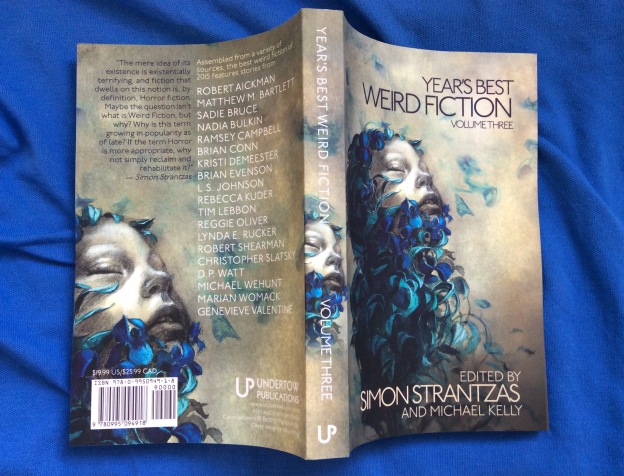
UNDERTOW PUBLICATIONS 2016
Guest Editor: Simon Strantzas — Series Editor: Michael Kelly
Stories by Rebecca Kuder, Nadia Bulkin, Robert Shearman, Christopher Slatsky, Marian Womack, Brian Evenson, D.P. Watt, Kristi DeMeester, Robert Aickman, Brian Conn, L.S. Johnson, Michael Wehunt, Ramsey Campbell, Matthew M. Bartlett, Genevieve Valentine, Reggie Oliver, Tim Lebbon, Lynda E. Rucker, Sadie Bruce.
(To see any of my previous reviews of above authors, please click on the tags below.)
My previous Undertow Publications reviews HERE.
When I review this latest Year’s Best Weird, my comments will appear in the thought stream below.


 THE SIX
“We will have no autumn this year. The season has been stolen, replaced by perpetual summer.”
…which, on its own, came as a big shock to me, as when I conducted a story by story real-time review in 2011 of the VanderMeers’ massive THE WEIRD anthology (containing chosen stories of Weird Fiction to represent the last 100 years), I came eventually to the conclusion that these stories’ ultimate gestalt was Perpetual Autumn… so this is nothing but refreshing, a new page to turn, a clipped poetic prose, with self-admitted gaps, each a gap like that around the Cheshire Cat’s smile, of a narrator who seems to have returned in body or soul to a childhood rabbit, cats dead or not, having dowsed to find their burial spot — and spiders and the nature of the colour of fire, and what really did happen and whether a bigger burial spot needs dowsing. Dowsing is, for me, a bit like dreamcatching. But I will not dig, only dowse or hawl; I never properly dig in books or stories. for fear of spoilers beneath my spade.
“–tiny shriveled kernels bounded their grotesquely swollen cousins like rings of baby teeth–”
This second story has cats gone missing early on, too. Then, dogs. And the cob’s teeth. A meteor, a colour out of space, a genetic engineered sowing of the field, and I have never seen a marriage and its family disintegrate so successfully, all with literally gut-wrenching implications that cannot be told here. This is fast food narrative. It eats how it tells it as if it surprises itself with what it serves up. It left me quite devastated how I had not noticed its joins and how quickly it went. If a ten page tightly texted story is a sudden meteor itself, then this is it. Dare dig its ground no further.
“So long as he brushed his teeth before he kissed her, just in case any scraps of dead animal were sticking to them.”
Somewhere in this story, I recall, the couple go to see some worthy film at a Paris cinema but ended up, by force of the story’s striking plot, with a romcom. I thought this otherwise well-written work in its first few pages felt like a romcom itself, but when I first learned the nature of the relationship between Donald and Chrissie, it became far more provocative for the likes of me. Then I thought that this page-turner (a bit crass to call anything a page-turner but this story genuinely is a page-turner) was becoming more like a very well-written version of a Pan Book of Horror Stories of the old school, not Weird Fiction as I understand it. But, by the end, I was convinced it is Weird Fiction after all and a gem of that genre to boot.
————————
[[ LOVELINESS LIKE A SHADOW by Christopher Slatsky
“She’d been rash enough to enter a stranger’s home—she simply didn’t have her head screwed on right at the moment.”
A thirty something woman sculptor, wrapped by a telling genius loci of cosmopolitan London, put her dog out of the boyfriend manger because he refused her a child even if perhaps she didn’t want one anyway. Create one. Bit like Duchamp out of the walls, the Jungianism of heads, the cosmopolitanship of veils as if beneath we are all one person, moulded from wordclay, as this story is. Impressed. Yes, definitely impressed like a connecting passage between walls. Why have I not got to this author before now? Now he’s got to me.
“Simply the slight tweak of the predetermined. All set in stone.” ]]
“And then came the eternal autumn,…”
A darkly rhapsodic tale of what I take to be a future Cambridge, with its backs and colleges, one that tells of a form of climate change, flooding, and swollen insects as a result, orange dogs being huge butterflies to match the colour of the man’s marmalade he barters for information as to their whereabouts, and swollen bellies of the pregnant, well, one in particular woman to whom the man, her husband, tends, with paid help, as he maps the swollen rivers as part of his job. The words, too, are swollen with poignant meaning, of his previous lost baby son, and now, I sense the hint that reality has more than just reality in it in these future days, the whimper of that previous loss still kept by the orange dogs? But whimper or not, the waters swell again and he bikes home to cultivate his own garden, or at least tend to his wife and a real son, I hope. Haunting and half-engorged, a tale to savour.
————————
[[ SEASIDE TOWN by Brian Evenson
When Miss Pickaver said to Hovell, “I catch the train in an hour,” I somehow received a jolt that was bigger than when something more overtly horrific happens in some other stories, which I suppose is a compliment to this otherwise simply told story. Actually, I empathised with the male stick-in-the-mud protagonist, with a flighty female partner, each of whom called the other by surname. I sensed his humiliation as part of the horror accreting…
The French town, the creepy hostelry, the dark shape seen from the balcony, the half-seen resemblances, the cinematic ‘Death-in-Venice’ like solitude he found himself enduring in face of the strange, half- or non-dressed other holidaymakers… Well, it somehow worked for me. ]]
———————–
[[ HONEY MOON by D.P. Watt
“She leapt upon him from behind,…”
A mildly amusing, but ultimately uninspiring, honeymoon story. A honeymoon to an outlying part of Scotland in a cronk of a car, where they plan to first consummate their marriage. ]]
“Violet woke up with the bruises.”
This inchoate spasm is almost as if an unintentional coda or supplement to Abigail in the previous ‘Violet’ story above, a girl, then woman, with transcendental visions of what lies behind the blood mapping her body, a shocking sacrifice by her own mother, perhaps, to expose her daughter to an even greater, seemingly inimical Mother that is at least part of herself (of themselves). A ‘demisting’ or demystifying of the man, father or ‘mister’ often portrayed as the stalker…?
I imagine there are lots of these affecting personal-seeming spasms encouraged by the acceptance of exponentially emergent Weird literature these days, and this one happens to be the one that was chosen for this book. Not a random choice, but preternaturally meant to be.
—————–
[[ Date unknown, fifty-eight pages
THE STRANGERS by Robert Aickman
Pages 48 – 65
“I set about the task of making everything more accurate, more coherent. / After all, the whole business goes far to explain the pattern of my life.”
I know I said earlier above that I thought that an Aickman fan seeking in this book a new classic strange story by him would be disappointed. Well, I think I may have to eat my words. This is vintage Aickman, to my eyes, SO FAR, building up from a typically wondrously ‘dry’ formal meeting, laced with offish male friendship and tentative girl-hunting, and nice details (e.g. a tramcar with unique brakes). They arrive at a musical piano recital all so wonderfully foreshadowed and then further adumbrated with an Aickmanesquely diffident audience and eccentric hosts including a dumpy ‘girl’ called Vera out for the narrator’s friend. I’ve just reached the end of the interval and am poised for the second half of the recital by a pianist who, for me, may be based on a mutant version of John Ogdon, depending on when this story was written. The low girl count in the audience and the narrator’s crushed feet are bonus hootful moments for me. It is an absolutely perfect Aickman opening to this long story and I have high hopes for the rest. To be eked out and savoured.
*
Page 66 – Actually, I’ve just been reminded that the piano recital was the first half, and a new act with conjuring tricks is about to start in the second half of the show.
*
Pages 66 – 86
“Most of the audience seemed still to be wiping their mouths very steadily and systematically after the refreshments, as older people do. One could see their arms moving rhythmically back and forth, when precious little else could be seen.”
Shades of ‘The Hospice’ or its forebear: Mann’s ‘Magic Mountain’? Indeed, as we delve further into the middle pages of this discovered text, there are also shades of John Cowper Powys’ ‘Inmates’ that I have noticed in Aickman before, as we glimpse awkwardly disturbing scenes at the conjuring show and later backstage involving the narrator’s friend and the Vera person. Two scenes that will haunt you, I suggest, long after you finish with this text. And haunting, too, how they have awkward repercussions on the narrator’s love life thereafter, and the re-conflux of certain characters in an Italian Restaurant near Charlotte Street, I recall. At one moment strangely even naively disarming, at the next nightmarish, like vomit rising? A Sickman. Meanwhile, if Proust deals with a form of unrequited love, here Aickman deals with a version of it that somehow cloys rather than gives romantic pangs. This middle section also has more nice details, like the popcorn-eaters, as well as holding the promise of the first section.
*
Pages 87 – 106
“The crenellations were crumbling, and the elaborate stackpipes parting from their ornamental cramps.”
I know the feeling! Anyway, as you can probably observe, I could not eke out nor savour slowly this work by Aickman. I was driven to read it in tantamount to one sitting, other than these intervals of writing about what I had read just after reading each section, including this final section. You will be relieved to hear, too, that it definitely fulfils its initial promise as a major Aickman work and I feel privileged to have read it before casting off my own shroud! It is definitely Powys influenced, Proustian, too, now with the simpering relationship with the narrator’s mother. The no man’s land between dream and non-dream is also conveyed brilliantly, as is revisited upon him his unrequited love, with a later final nightmarish vision of the two scenes – the ones that had disturbed him at the conjuring show and its aftermath – by following up the hearing of that pianist again in a building that is characterised so well by the stackpipes etc and its suburban ambiance. Further nice touches, too, of multi-paned sash-windows, his Dad’s clattering calculator, his own striped pyjamas and reading the whole of Sir Walter Scott in relation to this narration (except for the possible tiny bit of ‘text missing’ earlier on)!
Please do not be put off by my puckish humour about ‘The Strangers’, for it is genuinely disturbing despite or because of its own strange puckish slants.
*
I have placed myself on the line by writing this on my Facebook and elsewhere:
Pleased to report that ‘The Strangers’ as a separate story within the new Tartarus Press book of the same name is a genuine major ‘strange story’ classic by Robert Aickman. Fifty-eight pages of it. ]]
————–
My previous on-line references to Aickman: https://dflewisreviews.wordpress.com/robert-aickman/
“: how long it has been since you have had anything worth failing to express!”
This is an example of literary absurdism, one where there is almost a feel of word association – and synchronous cause and effect (in one respect retrocausal and often of global extent away from the claustrophobic house’s glamour dust and its officially pre-announced guest in writing), a creditable example of what I have long called ‘the synchronised shards of random truth and fiction’.
I enjoyed it, a best of something, but the Best of a Year’s Weird Fiction? A broad church, indeed, so broad in this book it ceases to be a thing-in-itself at all? But a worthy book, one that wouldn’t have existed at all without being part of such a competitive eclectic ‘church’?
——————-
JULIE by L.S. Johnson
“You profane me by loving me too much. Your virtues are the last refuge of my innocence.”
This 18th century tale, replacing sorrow with ‘hot, dark fury’, both in its central character and in its writing, as if Lyssa is L.S. herself, running not only with the pack of dogs but also with that of the ‘sisters’, against those who use them.
This is indeed a remarkable and furious tale, of Julie used as, inter alia, brothel bait, then by a real Jean-Jacques Rousseau both in Julie-body and Julie-book (the latter: The New Heloise). A lycanthropic rage that becomes the Noble Savage (or destroys him or her in the confessional process?) This is a Julie-story about a Julie-book. Endlessly scryable.
———————–
THE DEVIL UNDER THE MAISON BLUE by Michael Wehunt
“Green growing on everything.”
Not necessarily here the best green that nature can supply? This is another mighty text, as powerful as hell. A story of two oscillating halves in tentative synergy. Do not go lightly into this story. An ingeniously numinous poetic allusive elusive texture hiding hard nuggets of existence within it. A woman hears the atmospherics, as in Greener, of the ghost of the old black man opposite, his horn-playing jazz, his wife and a rite of passage when beaten himself till seeking refuge into the crawlspace of a square hole – with a tabby cat, perhaps. Or something else like a grave. Nothing will explain what I mean because nothing within it will explain what IT means. But you do simply KNOW it. As with the woman’s own rite of passage with her father’s real, life’s hard-knocks of a Faustian visit or another ghostly atmospheric visit as foil to the other more kindly one? Whatever the case, the ways her father once had with her echo on, almost now welcomed against the grain, it seems. Until both halves of the heart of this story slowly join together…till something living from it, a softer nugget, suddenly twitches inside you. Sometime you have to trust a reviewer not to spoil things or make them better than they are.
Some stories have hidden stories inside, like cars.
“Most folks wouldn’t have gone hauling themselves through the dirt toward that hole,…”
FETCHED by Ramsey Campbell
“Was this an accusation or a question that didn’t bother sounding like one?”
As if this story is accusing me with that question. Calling ME ‘Pet’ because I’m getting old, already retired, but not as old, I reckon, as REAL old people who outcrowd hotels with their coach parties? This story is a hybrid in more ways than one, about a gradual Kafkaesque metamorphosis into a lost dog called Fetcher, AND a mixture of Conn’s earlier literary absurdism (with the deadpan acceptance, via a deadpan narrative of Horror tropes, like that of becoming lost and threatened, lost here among inimical bungalows and threatened by bungalow owners, a retired man and wife, looking for a lost countryside view that he once saw during his childhood – yes, a deadpan acceptance of preternatural patterns, like this story being the third ‘violet’ story in this book, Vio-let, let rhyming with pet, Val-LEY, “dogged resolve”, “stray”, “let it go” and more such patterns, plus an insidiousness and attrition of soul that heads towards an early “senility”), yes, a mixture of that Aickman-like deadpannness of disarming strangeness and literary absurdism WITH a traditional horror story that this work struggles through the gap in the fence to become.
Treated in that way, it definitely morphs into a gem of Weird Fiction. Fetched from contriving into originality.
———————
RANGEL by Matthew M. Bartlett
“What Gaspar had lost was not as much a person as a mystery—the full person his sister was going to be… or, if she was alive somewhere, was.”
This is a tour de force, worth the admission price alone, your joining Gaspar on his return trip to Leeds, Mass., where wxxt broadcasts with goats and other suppurations: a place that will figure like Lilliput, Barchester and Cranford will figure in your literary memories. He lost his sister Rangel one Halloween in Leeds where Halloween really WAS Halloween, or at lest it is NOW, you can imagine, but now he is a married man elsewhere, but goes back to Leeds to find his sister – and finds new Halloween nightmares and visions that will stay with you, and a ‘woman costume’ that those two words alone do nothing to convey what it is, and how easy or difficult it is to climb out of it, or climb out of this story. Thankfully a new channel is tuned into when this one slips its hold on the transmission band, upon your hearing a conversation through the static about sloppy noises at a funeral which may or may not be connected with Rangel, more a phone-in than anything else that I may have dreamt or thought I once heard read aloud in two different voices or one voice pretending to be two different voices. Enough to send you mad.
“One of the dolls had violet eyes that have turned unnervingly pale. She can’t remember the colour of the doll’s eyes in the train car, long ago, no matter how hard she tries.”
At least the fourth story in this book with ‘violet’ – but that is almost beside the point, with the intense entrancement that this work worked upon me, a quilt of encounters along a stitched track of rail towards its terminus by the sea as some blurred audit trail (including war bonds) of transformation or hauntedness, 20th century period encounters over years with a presumably unaccompanied small girl and her doll on a train, with fatalistic repercussions to those who encounter her, including eventually herself. Two of those encounters, as examples, feature the ‘common’ wife of a professor who needs to improve her vowels to match those of his posh family, and a door to door salesman who needs to disembowel his vowels in order to make his sales. This story, meanwhile, has the aura of Elizabeth Bowen (including wartime London) and I can give it no greater compliment. A major reading experience.
“, the sea pale blue; the whole suggested the delicate, light tones and meticulous detail of a Victorian watercolour.”
The seaside town almost unchanged since you were at school there decades ago. A ‘Tales of the Unexpected’ type encounter with a Bed & Breakfast place (reputed to have ‘high rooms’, whatever that means), a traditional old-fashioned establishment with a dinner gong, a dowdy landlady or her daughter, and a single fixed resident, other than you. You who have recently finished suffering a prolonged and painful widowering, just getting over it. You were at school in this seaside town all those years ago, and one of the teachers, believe it or not, is still alive, a teacher the boys called Hoppy. (The B&B is called Happydene.) An unwelcome return of memories as you talk to Hoppy about what he used to do in those politically incorrect times of yore. And, later that night, potentially catching up, since your unmindful loss of it, with the sex you prefer, but with a nightmarishness that makes this story, in spite or because of its engagingly bespoke dark humour of occasion and place, seem both intensely felt and felt to be believable.
———————-
“True beauty lives on high.” – George Herbert
“In reality, the sea was a living thing, clasping the fixed continents in its smooth embrace and curling, twisting, abrading them over eons too vast for the human mind to contemplate.”
From the traditional seaside land side, in the previous story, we have here the pure seaside, a man lifeboated as sole survivor after his ship went down with his wife still trapped in the cabin aboard…. his backstory also involving an ‘adoptive father’ that may be relevant to his eventual fate? After much time, he sees two birds that might betoken nearby land and, thus, hope. The land-side toward which he strives, after sensing huge things present below his lifeboat. This story should not work, but it does. it works with a simplicity and an old-fashioned narrativeness. It also works, because it subverts expectations then suddenly fulfils them, but with dread. This story should not be in a book of Weird Fiction, but how do I know that for certain? (Perhaps check where it was first published?)
“I wonder how different humans might be if we wrote history as a chronicle of significant orgasms rather than political intrigues,…”
These days, the two seem to go together! But that isolated quote gives a wrong impression of this story, one that is emotionally compelling, but not at all weird nor even Weird with a capital letter. It is a heart-rending life story of a woman, now old, one beset by attritional ‘love’ affairs, although producing three children from a dull marriage as part of one of them.
It is the fourth story in a row in this book that features different sides of the sea, and like the first one of these is a journey towards some significant culmination at the edge of the sea, although the Rucker is effectively imbued with the sea throughout.
It is an ominous imbual, and one the reader feels through cleverly communicated empathy with the woman. The retrospective inevitability of the ending is well conveyed, tragic, yet resurrectional in a way, and still, today, unwinding as a sort of haunting by earlier actual or potential sacrifices to – or by malevolent (?) transcendence by – the sea.
There are seven numbered chapters to this story.
“‘I think I would enjoy being a bone knot,’ the girl said. ‘I imagine I would be good at it and I would love it.'”
This is a very striking story, a consuming word portrait of a state of existence as a bone knot (or, for me, as ‘ligottus’, three such ligotti in this museum that the little girl emulates) – it reminds me of the broad tenor of some SF stories that appear over the years in Interzone, and this state of existence is almost between states as that title pertains. The contortion that is made for Piedra, then as a sculpture hung from the ceiling for her Baron. The depiction of the knotting of this particular ligottus, to which I can do no justice here, is utterly beautiful, effete, fey – ultimately cruel, but an apotheosis of some need one can even empathise with. Or is it an ironic view of gender politics in a Swiftian Modest Proposal mould? Whatever the case, it is a very fine culmination of this equally fine eclectic book as a whole.
end