Tuesday, January 10, 2017

After Me Comes The Flood – Sarah Perry


15 thoughts on “After Me Comes The Flood – Sarah Perry

  1. WEDNESDAY
    I
    Pages 1 – 11
    “…as if they were practising a signature. It’s a strange name and I know it though I can’t remember why: EADWACER, EADWACER, EADWACER.
    Underneath it I’ve written my own name down,…”
    I can’t remember an opening few pages which have drawn me so strongly into a novel, and a novel, it already seems, ideal for my personal tastes. Thanks to the kind friend who recommended it, well, gifted it, to me (they know who they are.)
    John Cole, whom I shall call a routine man, one who works in his snailshell bookshop, breaks down in his car and, like Aickman’s Maybury, ends up at a strange house. But perhaps there the similarity ends. They seem to be expecting him…
    A bit like a Brian Evenson or Samuel Beckett hero combined, adding a soupçon of Finnegans Wake (my three reviews linked), a so-called hero waking up, trying to fit together the Gestalt of his new situation and perhaps his identity itself…?
  2. Pages 11 – 23
    “The.table was covered with far more food than they could possibly have needed, on chipped platters showing blurred flowers like old stains,…”
    I feel I have been drawn into this book, as John Cole has been drawn into this scenario of place and people. I would do you a disservice to describe things in detail and the self-betrayal he eventually accomplishes so as to stay there for a while longer among such people, but why would he want to do so? Because it is entrancing for all of us, me included, I can’t wait to read the next bit but am determined to eke it out over a much longer period of real-time reviewing.
    But, meantime, I am not clear whether the infectious Mann’s Magic Mountain and/or Aickman’s Hospice ‘feel’ stems from an authorial ‘intentional fallacy’, or whether, in our own day, Maybury will bury May.
  3. II
    “Alex set a penny spinning on its edge; the fabric of his T-shirt moved in folds and the painted eyes shifted anxiously to the door.”
    I feel as If I am in the house, too, having heard its distant piano playing earlier. Threaded with its secret dramas to which I pretend to be privy. It’s as if the house has a hand of cards just as the three men, among the other house residents, whom John now meets together, do, too. But whose the trump card? Which the foreordained path is mine? Which side will the penny fall? A sense of God and Godlessness. A gestalt is slowly being formed between the place and the people I meet there.
    “; and if no-one’s watching, who’s to say what’s sane, and what isn’t?”
  4. THURSDAY
    I
    What now, he thought,…”
    John feels his way, not towards a ha-ha in the garden so much as the lip of a pent-up reservoir (for a forthcoming Powysian Flood?), as all the characters whom he meets also seem pent-up, so pent-up they can’t hear birdsong, or there is no birdsong to hear? Might have started in the city, not in the countryside, I guess, this silence. John knows somehow he must confess to the man whose place he has inadvertently taken in this house party or is impersonating, a confession not by writing this novel about himself in the third person singular, but writing the other rightful man a personal letter. They write letters, you see, in this book, although a mobile phone was mentioned earlier, I recall. Write letters, and give household objects inscrutable airings outside. Even one of John’s books from his bookshop turns up, unless it is a different copy? The nature of the piano and its playing by one of the characters make me think I am, too, a copy of the reader reading about it, someone other than myself, or do I induce myself to think that for the sake of stating it for this real-time review?
    “The strings came untied easily, as if it had been recently opened and they’d lost the habit of their knot.”
  5. II, III & IV
    “…he wished the arms of the chair would draw him in until he seeped into the wood.
    ‘So easily done,’ said the other man, benevolently. ‘Wide is the gate, and broad is the way…'”
    The more I gather of the sometimes vague backstories of the people, the place and its reservoir, the more I feel I have been given the chance of entering this book itself at the optimum momentary time of my life, a time when I have already sensed a slippage in myself… something building a crack somewhere that I need to find before it grows beyond the whole’s integrity, whatever is buried beneath such integrity.
    I also sense a permeating feminal aura, a different point of view creating things around me, different to my own re-creating vantage point as ‘valve tower’ or Dreamcatcher, myself alongside John, feeling an aura where self- and body-worth are questioned as part of some process entailing the act of our, yes, all we readers, being chosen to be here in the first place.
  6. FRIDAY
    “He found the sight of his own bare arm peculiarly unsettling, noticing for the first time how the dark hairs clustered at the bones of his wrists.”
    So, John is not me after all?
    Hester casts her sewing-net, though, as I cast my own dreamcatcher upon the people and events in this novel.
    And a new invasive force, a short woman, visits briefly. And although this is a not a stream of consciousness novel in itself — like Finnegans Wake, or Omensetter’s Luck that I happen to be reviewing at that link simultaneously (about a preacher like but unlike Elijah) — Clare seems to talk in this section to John in a stream of consciousness!
  7. SATURDAY
    “…we all saw at once how to touch could be worse than to hurt.”
    …just as a smirk could be seen to be worse than anything else that was feared to have happened.
    This chapter, for me, is a very telling moment in literature, one of those not easily forgotten, a visit by some of the house residents, including John as John and then as first person narrator, to the curlews and sea lavender and crucial tides of salt marshes, a sort of Eastern England scenario with which I am very familiar, and here it is spot on. Spot on, too, are the events that transpire, an occasion I somehow saw as a sort of ‘Picnic at Hanging Rock’ outing, except the headmistress went, too. At one moment shapeless, the next differently shaped, according to her mood or the mood of the observer. And the aftermath, inscrutable, too. Eventually an outing that needs viewpoints or coordinates to triangulate as the Hanging Rock Picnic did elsewhere in a mathematical conflux of otherwise raw and misunderstood emotions. But who or what went missing?
  8. SUNDAY
    I
    “…but instead developed headaches and fits of breathless anxiety in car parks and long dull parties, and spent her wages on a man who cleansed her spleen through the soles of her small high-arched feet.”
    I know the feeling, with my having the male version of such. This book, too, takes on an (inwardly constructive?) increased desultoriness, as we switch between points of view and places, i.e. the intriguing backstory of ‘preacher’ Elijah’s previous St. Jude’s versionary site of Maybury’s Hospice or Mann’s Magic Mountain sanatorium (or retreat) and the circumstances of the project’s own desultory financial (etc.) attrition and its ‘childish’ patterns of piano music, and the unexplained comings and goings of visitors, now transposed to the house near the reservoir, where we listen to conversations in the glasshouse, and worry about whether Alex actually ‘touched’ during the trip yesterday to the salt marshes. That ‘touch’ now magnified by the thought of the cactus and the synaesthesia of feeling cracks in the pavement via treading upon them and “each ridge and groove in the whorl of his fingertips?”
  9. II, III & IV
    “The world ending because its Maker has decided it’s high time is one thing. It collapsing without purpose or meaning is quite another.”
    That dichotomy, in hindsight, is central to the patterns sought by my gestalt reveal-time reviewing since I started it in 2008, a sort of religion of Preternaturalism. Just like discovering a reassuring phrase in the Bible repeated 365 times (for every day of the year), and I hope my own erstwhile Leap Year syndrome will at least be cured by reading this book! One about ‘reassembling’ as a way of reassuring.
    Meanwhile, John beats himself up for being a Peeping Tom, and later prevents Alex from beating himself up about reassembling a moth.
    Many interpersonal tensions and misunderstood subtleties are reassembled during our communal Sunday together with all these characters … by reading this book, setting store by picking it up again hopefully tomorrow.
  10. (Monday)
    MONDAY
    I
    “…’after a while our troubles are the only things we have that never change and we wouldn’t lose them, even if we could.'”
    It seems strange how serendipitously connective my labyrinth of gestalt real-time book reviews has become over the years. Increasingly so. I happen to be simultaneously reviewing here an anthology of stories all of which feature mysterious letters and mis-delivered missives and mis-directed or anonymous packages etc,, and here in this book, such items have become more and more significant, with culmination in this section.
    The interaction between the characters builds and builds with addictive nuances, and I feel the shape and substance of the Hester character by dint of her body and mind is a major literary figure to cherish, to dally or conjure with, until this embryo becomes full-fledged within the collective consciousness.
    A book not only of reassembling but here in this chapter ‘dissembling’ – and resembling?
    In this section, an overt reference to David Hume, and three less overt ones to John Milton and Shakespeare (Hamlet and Macbeth).
    Boiling glue and a papier mâché mask…
  11. (Still Monday)
    MONDAY
    II & III
    “I’ll go on trying to write this down, though I’m all in the dark, a character at someone else’s mercy. Sometimes I imagine Tolstoy sitting at his desk with his notebooks […] always knowing what was coming next.”
    Ever since entering this house, I think of the characters’ nuances (including my own) in terms of the cadences from the pervasive piano played by Eve. Objective-correlative or native drum? I wonder if Hester’s forthcoming birthday tomorrow is a story of a John Cowper Powys type finale, a sort of epochal pageant? Probably much lower-key.
    And there transpires a night’s manoeuvres, mistaken identities of visitor, a possible duet earlier but now asexual ‘touching’ equivalent to the power of ‘touch’ touched upon before in this book. Such manoeuvres remind me of those night ones in Maybury’s Hospice and Castorp’s sanatorium. Except the Eadwacer tale of an island reminds me not of Earwicker (HCE) in Finnegans Wake but the climax of a Ishiguro.
  12. (Tuesday)
    TUESDAY
    “On the surface of the rising reservoir, the water moved in eddies as though just beneath large fish waited patiently,…,”
    Is it a Tench? John Cowper Powys’s crucial question (perhaps the most important question in all literature) in the Flood-presaged, Grail-Golgotha, pageant-ended ‘Glastonbury Romance’. Here a birthday party, without candles on the cake, set amid an encroaching storm, after a letter was buried like the buried giant, then other papers were scattered to the wind.
    “…aprés-moi, le déluge.” A translation of this book’s title? Or a reference to Louis XV? Or, tellingly, the motto of the RAF Dambusters? But after all, it was not ‘moi’, but ‘nous’, wasn’t it? And we are all responsible for this book, because we are all in it. Sorry to judge you by me, but did you notice that Alex is referred to as ‘boy’ towards the end, that boy from the salt marshes? Was that you?
    Too many cadences, too many nuances, to be able to tell you what happens in this still-resonating book. Forever resonating, perhaps. A bit like piano music. If Debussy, was it le faune or la cathédrale? Or a bit of both?
    I now leave the book as well as the house, along with John. But what comes after us?
    end
        

Friday, January 06, 2017

Human Maps – by Andrew Hook


23 thoughts on “Human Maps – by Andrew Hook

  1. The first story is one I read and reviewed here and below is what I said about it at that time:-
    ———————————
    Tetsudo Fan
    “We would be like Godzilla…”
    I have always enjoyed fiction by Andrew Hook, but this is genuinely the most powerful I’ve ever read of his. It tells, with remarkable detail of empathy, a Japanese scenario of railway involving a young male train-spotter (my term not the story’s, but significantly more noble than the reputed geekdom we often think of with that term, thus setting the tone, perhaps, for this whole book). It is a story of a rite of passage, sexual, role-model soulful, where we readers can look down like Godzilla (or like my own ‘gestalt’ of this book?) upon a real railway and an imaginary railway paradoxically as one. This is unquestionably one helluva stunning story, with an amazing Japanese feel.
  2. THE PERFECTION OF SYMMETRY
    “Preserving her image preserved her image.”
    A telling fable, for today when Brexit means Brexit.
    A fabulous fable about a perfectly symmetrical female model called Vermillion, a work I read while listening to Bach played immaculately on the piano by a Chinese lady. A model in any art form is nothing unless it is perfect, I guess.
    But while the world cracks up like an egg around us today, what is inside that egg is sure to be a shock when it exits, a “pavement Picasso” rather than a breakfast omelette. The fable’s moral is cracked, too, and resonates on and on with the synergy of perfection and imperfection. Be it sex, dream or eating out, her body is Vermillion’s raison d’être. But upon a Cartesian ricochet against mirror or window, the truth breaks it.
    “Vermillion’s nose looked like Vermillion’s nose.”
  3. THE HUMAN MAP
    “I’ve been dissected, bisected.”
    This crucial Hook story — of a journey between foreign places and home and towards one’s lover, this vice versa or synergistic or mutual apotheosis of an Evenson-type self-discovery from scratch, or of cut circles in the ground upon which we walk, or of the names of those countries and places as new meaningful acronyms or regathered dreams towards a hopeful gestalt by clinching it in retrocausal hindsight — was, according to this book’s copyright notice, first published in 2012 in a book entitled ‘Where Are We Going?’….
    For me, like the previous (equally 2012 published) story, it can be read usefully in the light of many circumstances surrounding Brexit, but to tell you why and to what purpose, whether you be a leaver or remainer, may be as arguably pointless as taking a photograph of seaside binoculars.
  4. BLUE SKY WORLD
    “Her irises were the colour of a marble that I once smashed in half as a child, returning eyes to my teddy bear by affixing with superglue the pale twist of green.”
    I like to think of my gestalt dreamcatching as a non-commercial version of ‘blue-sky thinking’. The previous story ends with “the human race viewed from above.”
    And this story is of a hitchhiker girl with a singing voice so beautiful her host male driver wants to harness its alien qualities – and he takes home for other reasons, too.
    There is a sort of symmetry with the model in “The Perfection of Symmetry”…
    And the circles of the human map. And the ocular breaks-it as distortions embedded in this book already.
    I keep my powder dry as to the nature of this book. It so far feels as if its gestalt, once clinched by eventual hindsight, will have been mapped by a blue-sky alien, whilst each individual story was written down here on a human level, written piecemeal, over years of tutelary guidance, only now to be crystallised by this book?
  5. BOTHERSOME
    “Full circle then, full square. I’m lost.”
    A staccato grappling by someone to find their female self, a tussling with and against imperfection, as a scientist, the most obvious way to defeat wrong angles, I guess. Experiences of pareidolia, synaesthesia, seeing anagrams in words, a battle against entropy. A full circle from birth to death, a globalisation – and back again to complete the symmetry or gestalt?
    The bother in brother.
  6. VULVERT
    “Her expression was unreadable which meant unreadable was her expression.”
    Vulvert – her name a body part or a body covering?
    This is told from the point of view of a male student linguist in a castlegarret overlooking a funfair where a Ferris Wheel falls over and lands like a crippled UFO on the ground. His backstory is “dissected.”
    His relationship with Vulvert cloned by words, cloned like the buildings around his garret. This story contains the book’s second time with the double meaning of ‘tear’, and another ‘crop circle’ as another circle.
    It factors into a gestalt of phonemes, together with a green bulb from the funfair as an express Katherine Mansfield type objective-correlative. And an ending that refers to this book’s earlier acronymic placenames, now without the need for express spoon-feeding.
    This book tells stories more like cerebral music than escapist fiction. Expression is expression. Reviewing can be a conscious stream of consciousness in a choreography dictated by Joyce … or via ‘Omensetter’s Luck’, a book I am concurrently reviewing wherein I think I might have found the model for the phenomenon that is Donald Trump, to go with Vulvert’s symmetrexit is symmetrexit.
    Meanwhile, the culvert?
  7. THE PERISCOPE
    “The parallel mountain ranges appeared ridged at dawn and dusk. During the height of the day they shimmered, were ephemeral: appeared transient.”
    A story of another omen-setter, a Chinese man and his lover, he with valuable rights to the periscope instrument he invented, an instrument of which he himself was, is, would be a vital component, one that could see the future, but not the future’s context to make sense of what he saw.
    It also depended on the hindsight gestalt crystallisation of an infinite number of possibilities. Thoughtful, human, engrossing, compromising, exploitative, revolutionary, possibly bordering on shamanism. Word-immaculately, crisply “a delicate balance of semantics.” Eventually this story is the instrument itself, by creating it in real-time? It came at me from a blue sky on this gloomy January morning. To help me see above the clouds.
  8. MONSTER GIRL
    “He was an outsider here, kept himself to himself. He didn’t like attention for attention’ sake.”
    Kept his sex doll for a sex doll’s sake, except sex dolls have gradations of imprint. Here he has one (a love doll) without any crevices at all, another (a sex doll) with some crevices of yearning, and another a real woman with every crevice known to man, all in a Japanese scenario.
    Human maps, notwithstanding.
    But which the monster? Monster means monster, I guess.
    A hyper-modern provocative tale of sex and relationship, in Hook’s trademark immaculate quilt of Escher words, disguised as ranks of holo-imaginaria shaped like variegated prose and dialogue.
  9. img_2669BEYOND THE ISLAND OF THE DOLLS
    “But the girl was just a girl,…”
    A telling portrait of bereavement and guilt and another self-discovery – all regarding a man losing his young daughter by accident while he was in charge of her, in charge of her and her doll (in telling contrast to the dolls in the previous story), a doll he subsequently takes – as some sort of what I shall call a hopeful talischild – on a worldwide trip to forget … and to remember. And to transcend. As part of this human map, we get a strong sense of Mexico and its people and beliefs, during which he visits an island with many such talischildren strung from trees. A gruesome, but ultimately inspiring vision, a horror without victims. A culvert between.
  10. I read and reviewed the next story here and below is what I wrote about it then….
    ——————-
    tta2
    It was thus overnight – and, via this morning’s early reading, Casson’s crusading understory perhaps dovetails with the previous trip on the Pakistani border by the adventurous characters (as they dovetail further with the earlier living body that vanished from its boots) in…
    Rain From A Clear Blue Sky – Andrew Hook
    “The world became monochrome, our shadows became ourselves.”
    At first I thought this was merely a run-of-the-mill, if very well-written, adventure story of risk-taking trippers who regularly travel the world exploring together for individual personal excitement, all planned in the Cittie of Yorke pub in High Holborn, sown with talk of ominous ghostly legends about the area to which they are travelling (here a snowy pass near Russia). But it is insidiously built up, including a ‘third man syndrome’ amid coldness (to contrast with this magazine’s earlier warm-blooded Renfield syndrome) and with a crisis of self-identity that is masterfully done as a discrete element of this story, but also significantly resonating with Cooper’s earlier ‘copying machine’/’conjuror’s box’ experiment. A third alternative indeed.
    ———————
    A perfect ingredient for the gestalt of Human Maps. Below is part of what I originally wrote about the ‘copying machine’ in the Cooper story referenced above:
    “All I know is that the experimental ‘copying machine’ or ‘conjuror’s box’, as this story has it, causes me to believe that the real toy and the copied toy respectively represent the reality of felt reality and the sheer text that conveys that reality while in synergy with it…i.e. the copy ironically comes first.”
    It is what it is?
  11. CLING
    “…viewed just as we were viewing.”
    “we cling to each other as though tomorrow has yet to be written”
    A variegated collage and/or patterned Escher quilt of this book so far, involving a cinema-à-trois, two men and a woman, that ends up in a Greek shower room. Several surfaces penetrated like a screen of cling film so that the starring couple can couple while existing between fiction and consensus reality, as underscored by music. The two of them are controlled by the author together with the other of the author’s three characters all of whom truly live and/or act as pre-emotive, pre-emptive trailers for truth.
    While one of them writes an obscure poem.
    “The windows are open and the sky is blue.”
    “Honest words falling out of her head like tears onto the page.”
    “…he wouldn’t get funding by lying back and waiting for it to fall out of the sky…”
    “Dissecting” as editing.
    “you’ll simply be the conduit”
    “Still, I hankered after continuity […] would read collections of short stories as they came rather than dipping in and out.”
    That need for symmetry, too?
  12. WOUNDER
    “‘Because everything means everything,’ I say.”
    This story is a ‘bonus’ about ‘wounder’, and you will understand those pet words between a couple, and the third side of their triangle called Drew named after the actress in ET, equivalent to the movie-à-trois, in the previous story. Here, though, more digital photography than movies. A choreography of self and unself filtering through you and your partner, where demon is dream, dream demon. A “tenuous membrane” like cling-film and a need for perfection.
    It all ends in a tear.
    “…I regulate my breathing until it matches hers. Only it doesn’t: she is always one breath ahead or one breath behind.”
  13. THE QUICKENING
    “Benedict unwrapped his sandwiches at lunchtime from their Clingfilm straightjackets.”
    Clingfilm with a capital C makes me think of a movie or photographic company with this trade name, as established by the previous two stories…
    Benedict has a downbeat office job where he is even more downbeat than the other employees. He gradually notices the world going off kilter around him, like people limping – and dissected parts of bodies still where there home was, like a whole foot neatly in a loose single shoe, or a head in a helmet.
    I’ll leave it at that.
    “Sometimes it was all too easy to attribute meaning to everything, whereas in fact there was no reasoning to be had.”
    That’ll teach me!
  14. I previously read and reviewed the next story here and below is what I wrote about it then:
    ————————————
    Flytrap by Andrew Hook
    “…he found at the age of forty-seven that he could look at his wife and three children and not recognise anything of himself in them.”
    As above, so below; as below, so above; the regrouping of astrological influences, via three sketched characters, family man with dog, another obsessed by a flytrap plant or planet, and a woman always reading Finney’s Body Snatchers. This collage fits the amount of brainspace of thinking power you have available for it: little such space and you’ll get little from it but still be satisfied by it; a big space and it will keep on filling it forever if need be…
  15. I previously read and reviewed the next story here and below is what I wrote about it then:
    ————————————
    Black Lung by Andrew Hook
    “The decorator went mad with the aertex in this room. I was forever finding patterns and swirls unknown to me.”
    I am usually a fan of Andrew Hook’s fiction but I’m afraid this one didn’t work with me. It has some striking moments like the elephant tissues and the Dream Archipelago-like theme and variations, but the info dump or two in dialogue and the confused imagery of The Engineer, coal mining and Black Lung from smoking et al only served to irritate me. Oh, but I did like the encroaching blend of dream and reality to parallel that of Malik above, and the concept of dreams of happiness but knowing that the happiness was to end… Does that make them nightmares not dreams?
  16. ON THE BEACH
    “…but either way…well, either way is neither way.”
    When I cast my eyes over this story after reading it, it looks like a TS Eliot poem or ‘Snake’ by DH Lawrence…
    It is a tale of a young man who has rented a room at the boarding house, one who knows he is not quite right, but works as a lifeguard, but he also needs to check in at the Job centre. Images move like a poem, too, although being a narrated story, writing in dust or writing in the sand. A symphony of death by bath, some famous deaths. But which way does the water spin down the plug hole. Which way does the sea?
    His nose like this book’s periscope.
    I loved it, but can’t tell you why.
    All these stories, I guess, had a different context on their first outing, a context where they had to fight their corner. Now they have found their home together. Each working for the other. If I now re-read, say, ‘Black Lung’, it would seem to be a different story altogether – a ‘bonus’ not a ‘wounder’, I wonder?
    But I rarely real-time review a work unless it is upon the instinct of my first reading it.
  17. OLD FACTORY MEMORIES
    “What was clear was that the meadow wasn’t always as it seemed to be.”
    This, for me, is a Hook classic, one that is essential reading. The scenario at first reminded me of the closed community at Maybury’s Hospice or Mann’s sanatorium combined perhaps even with Evenson’s Warren ….. a combination of a civilised or curative gathering and a captivation for the residents’ own good. The backdrop to this ‘civilisation’ is one where the hard core world we once knew of factories, cogs, bottle-ends and bricks has been replaced by a more what I shall call clingy-film type containing abode, and when a well-characterised group of the residents, on leave outside that abode, beyond their doorless rooms, discover such artefacts in the meadow, this book’s accretive holo-imaginarium of arguably ‘copy first / reality second’ then affording what we at first assume to be a glimpse of a reality where the factories etc. grow back…
    The ending is a master-stroke.
  18. I previously read and reviewed the next story here and the context of stories described below is that in Black Static #26 at that time:
    ————————————–
    Dizzy Land – Andrew Hook
    “Funfairs and the promise of something illicit always went hand in hand, despite the Hook the Duck attractions for the little ones.”
    This story’s California Sands, Norfolk, I imagine, is a ‘genius loci’ similar to Jaywick Sands, Essex, near where I live – so I can fully empathise with the nature of a new funfair being built there. The story conveys this brilliantly (in and out of the cold desolate seasons) with a number of strident ‘funfair’ similes or analogies of its own (like the breakfast fried-egg: the eye in Un Chien Andalou…) — I can’t quite believe, also – in addition to its own stand-alone memorability – the strength of its synergy with the previous stories, particularly the first one. The Lethal-Chamber, now spinning; the Bends of the Heart both physically and romantically (cf the previous ‘female’ back-stories, here more in tune with the Rigney one); sinking or being sucked down towards this story’s version of Mermaids… A truly great story, made even greater by its surroundings in this magazine. Well, I’m a sucker for seaside funfairs, anyway. Especially those that truly live, like this one, a fixture as brash symbiosis between the local council’s needs for local empolyment etc and the protagonist’s needs, inter alia, to fill the holes in his heart. By contrast, travelling funfairs are here also explicitly related to the solar system: giving me a hint of astrological harmonics underlying all these stories, Hand of God or not. A fixture like the Sun or those spinning round it. (21 Dec 11)
  19. I previously read and reviewed the next story here and the context of stories described below is that in Horror Uncut at that time:
    —————————————–
    The Opaque District by Andrew Hook
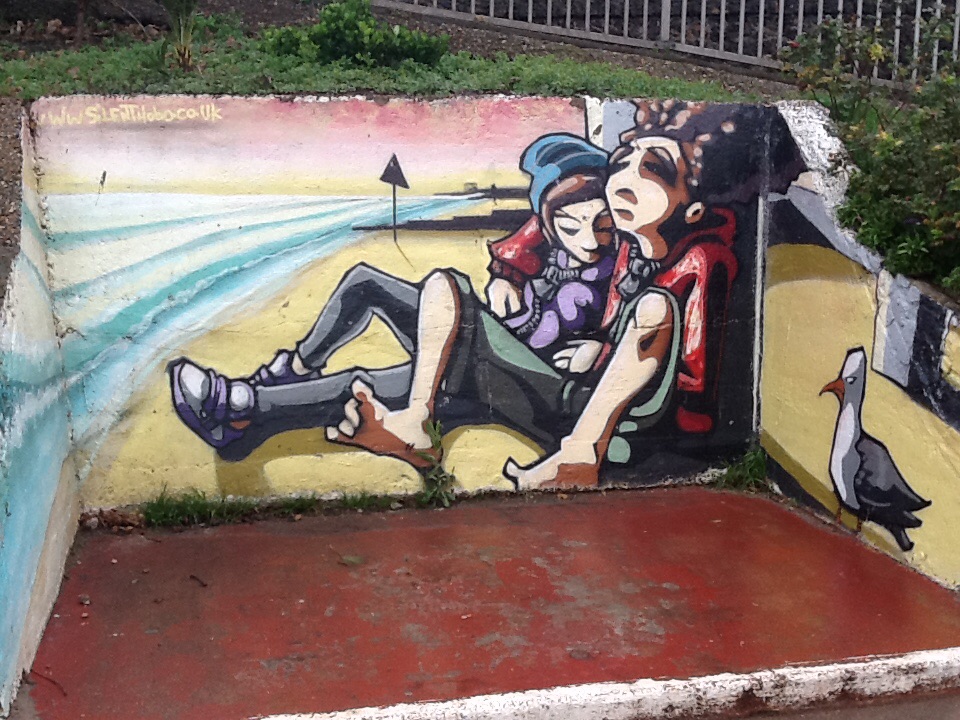
    Another inscrutably beautiful treat to follow that of Littlewood, the two stories’ endings perfectly complementing each other. This one is a classic of our downtrod times, with its living prehensile queues (negatively symbiotic queues queuing queues) along rejigged shopping parades mentioned earlier in this review, all pared – like Rabinowitz’s skeins of skin – ‘back to basics’. Yet there is the metaphor beyond the graffiti mural, one that resonates with the impermeable stone of this book’s gestalt but also with its Exodus gulf, with the initial promise of light and freedom from the ‘shuffling’ and the “threadbare ‘bag for life'”. Whether or not a false promise, it is for you to decide if this protagonist ever left the queue.
    A graffiti mural I photographed in the opaque ukipness of Clactonia a week or so ago:
    image
    —————————–
    Queues mean queues, and queues joining queues?
  20. THINGS THAT ARE HERE NOW, THINGS THAT WERE THERE THEN
    if this were the last story in the book, I would say it’s the perfect ending to the book, if not a perfect story in itself, but then that would indeed be appropriate when regarding the foregoing treatment of symmetry and nihilistic paradoxes as themes. The book’s defiance to be categorised other than what it is or what it is not. Leaving the story after this one as a booby trap of an ending or a coda to the foregoing symphony of works. We shall see when I get it to it in a moment.
    This story, meanwhile, deals with the holo-imaginarium again, the “negating the negation” of the Factory Meadow et al. Constancy by a fabrication or dream by opticon, here of and by photographs. Sex and identity by getting inside but still being outside. Photographs, like the Periscope’s earlier ‘tap’ image, an example of a part not revealing the whole. The gestalt equally not becoming clinched in hindsight but avoided, just to spite a gestalt real-time reviewer like me! ‘No’ as the password from nothing to something or vice versa. A “blank correction.”
    “Neither expecting anything nor nothing.”
    “…anticipating the advent of yet another day. A day which never comes.”
    “We were living inside a house inside a house.”
    “…the corner of the bedroom ceiling which was simply a photograph of the corner of the bedroom ceiling.”
    “…the world and its meanings can be exactly what anyone wants them to be.”
    This story draws me towards re-reading the Crow sequence of poems by Ted Hughes.
  21. I previously read and reviewed the next story here and the context of stories described below is that in Black Static #48 at that time:
    —————————————–
    BLOOD FOR YOUR MOTHER by Andrew Hook
    “Latterly I came to understand what pareidolia meant, but even so it remained a comfort.”
    I, too, am haunted by the meaning of that word as a running theme within my ‘dreamcatching’ book commentaries, aka ‘gestalt real-time reviewing’, another of my possible obsessions to match the one I described in my review above of ‘Distinguished Mole’. It is almost as if these leitmotifs have been planted in these stories to make pareidoliac patterns…or I have imagined them for my own purposes?
    The fifties-something woman narrator who works as a radiographer visits her father, someone currently needing the care of an elderly neighbour but is on the brink of being a social services case. The narrator’s own gestalt from what she sees is absolutely heart-rending, creating a gestalt from the current awful state of her father’s physical and mental existence and from her own exiled or estranged relationship since childhood with both her parents (carrying the spiritual and visceral auras of the previous stories). This leads to some of the most horrific scenes that I have ever experienced from this author. A tour de force. Perfectly judged. The doubt is whether her gestalt is pareidoliac or real. That doubt in the dream she seems to ‘catch’.
    ———————————
    A perfectly judged book, not in spite but because.
    end
        

Wednesday, January 04, 2017

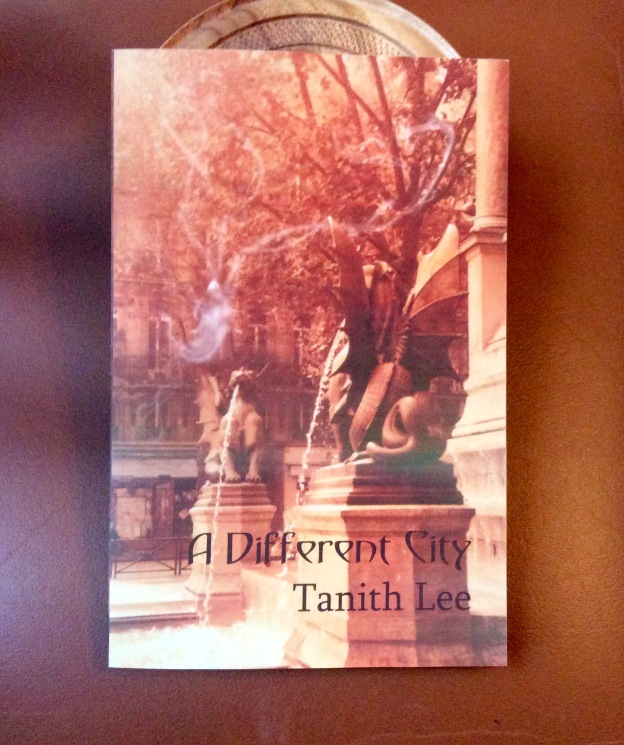
A Different City - Tanith Lee


9 thoughts on “A Different City – Tanith Lee

  1. NOT STOPPING AT HEAVEN
    Act One
    Scene 1
    “And the yellow gown, catching in the mirror a tinge of pink and emerald fire, charmed her back to soft expectant joy.”
    An intriguingly off-kilter Marseilles-type genius loci, it seems so far, called Marcheval. A wedding, with Lucide at 38, older than her husband Guillaume (Billy) by ten of those years, their characters and financial circumstances established in what the reader fears may become an abortive marital consummation night in her close-to-attic chamber…
    The delicately snagged style is like her yellow gown.
  2. Scenes 2 & 3
    “It might still be 1680, and in some of the bleaker holes, it was.”
    From the Avenue of Aviaries to the Avenue of Opened Cages, this is a dire dystopia that only a slant of some past era can contain, worse even than our own future today, an anachronistic Proustian past where its version of Proust is a rat-infested darkness, but there are colours and textures remaining from better eras, alternate, parallel or real-time, despite Billy’s lust for forced defiant spiteful drunken targeted spewing upon such coloured textures, after ranging between resentful lover and his new wife, a wife who knows which of her slices is better buttered, which beast is best, her husband or someone even worse than him.
  3. ACT TWO
    Scene 1
    There is starting to be something disturbingly or structurally aberrant about this work, whether authorially intentional or not. You see, Lucide’s brother’s private narration to her new husband Gui-Billy of his sister’s childhood, is either a fabrication as an excuse for financial strictures or the plot’s truth about girlish bullying etc., where kohl and rouge inexplicably led to Lucide’s indelibly grey complexion. While Lucide’s brother’s own wife – Grete or Gretel – is described as an “atrocious dyed wife.”
  4. Scene 2
    ACT THREE
    Scene 1
    “…the house had become a syrupy yellow.”
    Mercenary melodrama, not only Queen-In-Yellow, but various other colours from the original kohl and rouge, a monstrous angel-bird evolved from the opened cages to wreak vengeance woman to woman, both women in the shadow of cruelly cynical man. Names liberally used both as diminutive and whole, often together.
    This rich text, sometimes clumsy, is both so strange and so awful, it almost becomes greater than it really is. Something untoward or darkly idiosyncratic transcends this text; it is a question of discovering it.
    The nipper-spectacles, notwithstanding.
  5. Scene 2
    Scene 3
    Final Scene
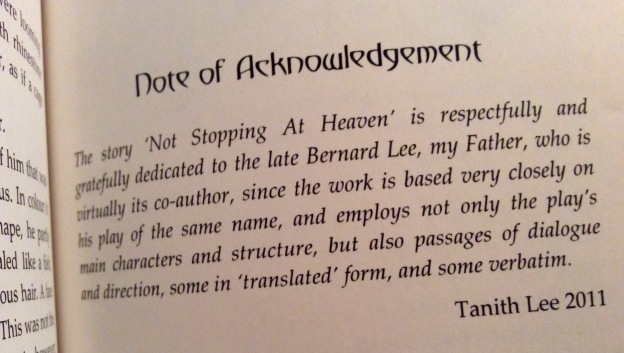
    Note of Acknowledgement
    “‘Not without your nippers on. Just a minute.’
    Holding the skirt of the yellow gown…”
    As strange and clumsy and lethal as Chambers, chambers with cages (& a whole life’s oblique retribution?)
    img_2745
  6. IDOLL
    Chapters One to Eight
    “I, Dolfi, was brought to the Horrible House, in a covered carriage with two horses (of which I was frightened), when I was six years old.”
    …whence flows the narration of this abandoned orphan girl, thus building the redolent strength — inadvertently perhaps (because why should she care?) — of the genius loci of Marcheval from the previous work, its cathedral, its customs, its ambiance. Of the family, too, of which she is now part. And when she is ten, she is old enough to accompany the rest of them on a ‘pilgrimage’ to the house’s Attic where is met something or someone that would be a spoiler should I divulge it.
    If I say so, against my expectations, I easily made myself, for sake of this review, feel fearful and entranced by the work’s feminal Ligottiana. It holds a promise for more of such in its second half as yet to be read…
  7. Chapters Nine to Sixteen
    Dolfi, our feisty, impetuous, stoical, almost reluctant narrator of her own growing-up does not seem to suffer fools gladly, or to suffer easily curses from her own body or those cousins around her who supposedly had rescued her from the streets. She takes to visiting the Attic on her own, having been able to pick locks from the age of four. When the machinations behind her grown-up fate eventually become clear, she reaches an apotheosis with the Attic or what the Attic holds, one that is intrinsic to the freehold author as well as to the author’s leasehold narrator, whereby Dolfi and I merge…in a coming gestalt greater than death…a different city to the one outside.
    So much more expected to be memorable than ever was expected.
  8. THE PORTRAIT IN GRAY
    Prologue, One, Two & Three
    “From our youth our own ghosts already live in us.”
    A story of the painter Alice Pender (aka Alice Pen-Devon) aka M’Alice, and her younger brother Robert Pen-Devon, friar whom in childhood and in adulthood, she seeks to avenge against others their cruelty upon him. This is a story of Aesthetics, together with a soupçon of Dorian Gray, and of Alice’s travels from England to the still accretive genius-loci of Marcheval where Alice defies her legendary beauty of a sitter to see the work-in-progress portrait before it is completed, the sitter who had been proximate cause of Robert’s seeming suicide….
    It is as if I will not see the complete story till it is complete, a clinching of a gestalt in hindsight, like most of my reviews, here ideally suited. But who knows? (I feel sometimes that I doff and don nipper-specs each time I put down or pick up this book.)
    I sense again the blend of Dolfi and what resided in the Attic, as painting and subject? Or Painter and subject?
    This particular text has some tricks and surprises in striking turns of phrase that seem to define or demarcate Tanith Lee herself.
  9. Four, Five & Epilogue
    “One lynx may always detect the darling, dangerous patterns of a fellow lynx.”
    And I sense that with this review, somehow. A shape of Tanith looking from her Attic, an Absence that is a Presence, looking at what I write about those patterns, their gestalt. Most real-time reviews I write are designed not only for the book’s readers past and future but also, and perhaps predominantly, for its author. No less here.
    The close of this masterwork is a Whistler-and-I-shall-come-to-you, a study in grey as well as Gray. Its description of the central painting is probably one of the best I have ever read, and I should have guessed, since its sitter wore grey when sitting for it, subject and painter, story and author, become one, by the end, and reader taken up, too, as part of the print that finally slips off the page like melting ink and into sweet nothingness.
    The painting itself is strikingly both grotesquely avant garde and traditionally representational, a powerful force that comes off the page at you, in more ways than one. The side-issues of the woman painter’s brother and the gay art dealers are spear carriers for that culmination, the power of sibling love, feminal vengeance and the art business, all grist to the mill of ageing, rejuvenation, death and resurrection, not necessarily in that order. With oblique gender concerns that transcend feminism.
    With a sense of something else, something Ligottian, not quite grasped…
    “…like the sinking ship abandoning its single giant rat.”
    end