Saturday, January 14, 2017

Dark Gods – T.E.D. Klein
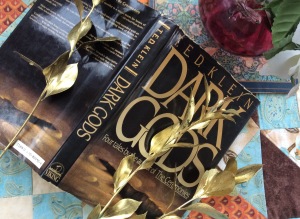


Dark Gods – T.E.D. Klein

img_2768


DARK GODS – Four Tales:-
Children of the Kingdom
Petey
Black Man with a Horn
Nadelman’s God

Viking Penguin Inc. 1985

My real-time review here of TED Klein’s THE CEREMONIES.

I intend to review this book during 2017 and, when I do, my comments will appear in the thought stream below…….


12 thoughts on “Dark Gods – T.E.D. Klein”


  1. CHILDREN OF THE KINGDOM
    Pages 3 – 23
    “Less than half a block can make a difference in New York.”
    We are enticed in 1977 by immaculately and evocative prose scenario following the narrator – who seems a trifle xenophobic and nervous of others threatening his life(style) – suffering a bus journey through the more unsalubrious parts of New York to where he lives with his wife Karen in the more salubrious. And getting his feisty Grandfather into an old people’s home that is reminiscent of a slightly seedy version of Aickman’s Hospice, two of the women residents at least being “well-fed-looking”.
    Granddad spends his time outside on stoops with types (including loose or inscrutable children coming and going to school) in the more downtrodden vicinity of New York, sitting with Father Pistachio who is translating his own book on the Gospel According to Thomas and other (Indian-Jewish?) theories that the narrator relates to a Hollow Earth.
    This Thomas, either a look back at Thomas Mann’s sanatorium or a preternatural prophecy of Thomas Ligotti’s scenarios — or, more likely, an apocrypha’s Doubting Thomas, I ask myself, doubting.

  2. Pages 23 – 47
    “…a neighbourhood can change in half an hour as assuredly as it can change in half a block.”
    The adjoining parts of this novella, too.
    From one moment dealing with his Grandfather, helping paint his room in the rest home, taking him for a haircut, but also upon the edge of Father Pistachio’s theories of Fortean diaspora of tribes. I sense hints, too, of ‘niños’ – as part of these diaspora and the hair-trigger city itself – giving abuse or, even, inviting abuse upon themselves to incriminate grown-ups or to echo civilisations doing this in serial numbers as part of their future? Upon the edge, too, of pools below basement washrooms, pools full of tapeworms and other creatures too dire to describe? Who knows? I feel infiltrated. Or about to be so.

  3. Page 47 till end of CHILDREN OF THE KINGDOM on page 71
    “Well, well, I thought. The Machine Stops.”
    Only connect.
    Except when the connections cease and all is black, a blackout when the “blacks” are out and about – and some “white’ scrawny creature, too, if you can but see them.
    I confirm that, just as with ‘The Ceremonies’ earlier (Rosie as a version of a hybrid-blighted Grandfather-Pistachio-thing under the drain grate?), I have never read this book before, so this is a genuine real-time review. So when I called it the hair-trigger city above, I had no idea. This is a very powerful powercut of a finale, details of which would spoil it. I sense from my memory that there really was a blackout in New York in 1977. And pistachio nuts to tread upon in 1979. And Young Ones that have come out since to tempt or taunt or taint some members, I’m told, of our humankind. Old Ones, too, one in particular.

  4. PETEY
    Pages 75 – 98
    “First the effect, then the cause — as if his mind held so many unexplored levels, mystery upon mystery, that he never knew the things it contained…”
    Arrival, Story of Your Life…?
    This first half — topped, tailed and intermitted by italicised inscrutability of illness and suicide of as yet unknown person(s) — builds from an engagingly theatrical social comedy of a house-warming party of a sizeable number of American middle-aged couples whom I, from Britain, would today call Republican voters (even Trumpists?), the house being very large, rambling and miles-from-anywhere, also like a stately home. Accretively, though, we learn of its decor and furnishings and items of fine art (more recondite than fine) and gradually we learn of the darkly strange backstory of the house and its owner. Tapestries of the grotesque and arabesque. And people drifting off from the main group. Readers, let’s keep together.

  5. Page 98 to the end of PETEY on page 128
    “Nothing about an extra trump, a spare, a bonus, a joker…”
    Things at the party later take the turn of archetypes and rituals, e.g. tarot cards or astrology, as the guests explore the books that came with the House, its cluttered Attic, the host spending most of his time on the toilet, and another guest sleeping and having a nightmare. It appears that the house was purchased relatively cheaply by means of a trick or Trumpery of dodgy capitalism, pretending there was a high road coming through the house when, in fact, it wasn’t.
    As to the ‘Petey’ undercurrents, is this a version of ‘piety’, and indeed there is a ‘DIETY’, not ‘deity’, on page 121. Or is it a reference to ‘pets’? Or things like the previous story’s ‘children of the kingdom’ now pickled in jars? Or is this word Petey a garbling of Party as a prediction of this very house-warming? Hints, half-hints, and an eerie sense of a scarecrow outside, things haunting this text with more weird and wonderful glitches that one can imagine literally coming out of the text itself. I wonder what that grey shape arriving at the end turns out to be? “He turned over several minor trumps,…”

  6. BLACK MAN WITH A HORN
    Pages 131 – 156
    “Ah, Howard, your triumph was complete the moment your name became an adjective.”
    …which is ironic when many HPL fans today in 2017 are being led against their previous idol through political correctness.
    This story is told as if for me – with a conscious overt decision to write it in real-time, by the what might be seen as a politically incorrect narrator, with the story’s gestalt clincher as yet unknown even by him.
    Judging by the current age this narrator gives for himself — and I assume this narrator is E. Hoffman Price (known as a real-time HPL disciple) — he is telling of events from 1974 onward? The plane journey where he meets the missionary fresh from Malaysia, the connections he makes with Tcho-Tcho, the Coltrane LP cover, and the blacks and other races and a telling mention of a “Negro child” and “a rowdy group of half-naked teenagers” and other Puerto Rican children playing truant, even a mention somewhere of Sunni, and the central theme of a black man with a horn, involving coughed-up lung-tissue…all these things (and more) are entrammelling.
    I am eager to read more later about this Case of the Mysterious Missing Missionary. And to enjoy the engaging humour, too, earlier exemplified by EHP’s stated rivalry with a posthumous HPL, and his account of the incidents on the plane.
    Everyone is guilty till they are proved innocent, I guess.
    “It was, in fact, a thorny problem: forced to choose between whites whom I despised and blacks whom I feared,…”

    • I also enjoyed the easy chat between EHP and the posthumous HPL … and the intermittent HPL quotations as illuminators.
      And is the ‘CHarlie CHan’ character on the plane anything to do with the Tcho-Tcho. We deserve to know.

  7. Page.156 till end of BLACK MAN WITH A HORN on page 173
    “With Howard gone these more than forty years I still lived out my life in his shadow; certainly his tales had overshadowed my own. Now I found myself trapped within one of them. Here, miles above the earth, I felt great gods warring; below, the war was already lost.”
    But is it ever lost, till it is lost? I continue to relish the narrator EHP’s engaging old age and his relationship with his sister and nephew, in this unfolding scenario, that may never be resolved. The Jewish ‘shofar’ possibly as black phallus – and the Malaysian bogeyman for children called ‘shugoran’ as something fishy lurking in this book’s earlier pools under New York. All parts of a pattern of library research to solve the mystery and whether HPL’s own black face will turn up, pressed against your own window, although the story only implies that fear or, rather, hope. Perhaps you will not even see anything like that in it. And what about that man with a naked child or child-like thing lurking in his vicinity of the hotel, reminding me of ‘The Ceremonies’ and that book’s own library’s under-age acts witnessed by an adult. Was Carol’s dance a cha cha?
    ‘Death’s Herald’ and the ‘scuba’ theory, notwithstanding.
    Literature’s unique quest for xenophilia by aversion therapy, from HPL and his disciples EHP, TEDK et al, onward? The choice between fearing and despising resolved?
    Meanwhile, EHP still moulders away in a Florida bungalow? How will we know, unless he tells us?
    “The calendar on the wall tells me it’s been almost three months since I moved in. Somewhere in its remaining pages you will find the date of my death.”

  8. NADELMAN’S GOD
    Pages 177 – 202
    “…creator, almost singled-handed, of the highly successful Nobanana campaign…”
    My children in the 1970s once referred to a shopkeeper as the NOBANANA man because he often shouted at them when they entered NO BANANA MEN (they liked the sweets called banana men but such were often out of stock and he knew what they were coming in for!)
    Nadelman when he grew up to be a proper grown-up he worked for an advertising agency, and he was responsible for the NOBANANA drink campaign that made his name. But before that in his mad 1970s student days of occult interests…
    “The seventies were still young and Nadelman not widely traveled; this was the first man he’d ever seen wearing an earring, outside a pirate movie.”
    He visited a S&M club full of satantists et al. He believed in “ceremonies”, “preternatural power”, “Lovecraft, that sort of thing.” He now sees such obsessives as CREEPS. Read the paragraph about CREEPS, you won’t forget it, Well, I believed in those sort of things in the sixties as a student CREEP, and I’ve since grown up, too, I guess, but I still believe in preternatural powers embodied by my gestalt real-time reviews, beyond my control, almost writing themselves…..? Anyway, Nadelman did grow up, sort of, too, with his girl friend who went to that club with him back in the day, now his wife, himself a successful advertising man, but one of his student occult poems is rediscovered and used as lyrics by a rock band. And it entails someone called Huntoon, a fan of those lyrics, writing to Nadelman, inspired by them to erect the most outlandish and foul-looking sculpture on his mother’s rooftop, not ‘found art’ so much but a new god or God? An avant garde installation, too, as part of its look, I guess. But I have not seen the very worrying photograph of it that was sent to Nadelman, so what do I know?
    What I do know now, however, is that I ought to worry if anything equally outlandish has been manufactured by modern CREEPS out of DF Lewis’ 1000+ published weird and sometimes off-the-wall stories in the 80s and 90s…
    I guess this TEDK story takes place in the 80s…
    “guarded nihilism” seems “le mot juste” or deux mots. “a furtive god.” “pious do-gooders!” That piety, diety, petey…? A dictionary as a “bar mitzvah present from Aunt Lottie.” “Reality is never enough for some people.” CREEPS “In The Know.”

  9. Pages 202 – 229
    “Nadelman felt himself sliding further down the feathery slope to the land of unreason. First the creep believed the Rival God was actually real; now he claimed he’d talked to him.”
    In these later days of Trumpery, this text tells me “The lie had become real.”
    Huntoon haunts (stalks, in modern terminology) this novella’s family man Nadelman, as also does Nadelman’s past, but he can’t find his actual goto home, but, from his shorter-term past, he recognises on a train the girl from the erstwhile S&M club. And talking about longer- and shorter-term pasts, I have remembered that in the 1960s I created the long epic poem about the god Etepsed-Egnis in the collaborative ‘The Egnisomicon.’
    Snopake or Tippex needed to cover my tracks or mistakes?
    And there was a story entitled ‘The Hungerers’ in my Prime Books reprise collection ‘Weirdmonger’…
    “From the street came a squeal of brakes and, with it, the blare of a horn.”
    Nadelman’s own extensive scrutiny of his then real-time notes for his student poem actually frightens me, as does his need to hunt down the Huntoon haunting to its lair.
    “Grant the reality of a single spirit and you found yourself faced with an entire cosmos of them.”

  10. Page 229 till the end of NADELMAN’s GOD and of the whole book on page 559
    img_2783
    We see a line of sad old men on the boardwalk at the end, and they must once have been children, I guess. But which the Old One? Which the child it once was? Where its home?
    I needed at least a bit of the real me shown. But where else would I have found sanctuary? Probably not in a synagogue or even in any other church of god or God.
    Nadelman’s meeting with the Huntoons is CREEPy in its true sense. Including the backwards gramophone for hidden messages.
    Telling, too, are the feelings of guilt thereafter as to what Nadelman thinks he had brought into being, what he had brought into our world by the “Naming of Names.”
    I often feel the same about my own past work, except my guilt is less, I hope, because fewer people have seen it.
    Judging by what is happening today in our world — as I finish reading this book, this great book, this culmination of ceremonies and dark gods — the sense of the book’s guilt is felt even more strongly. And there is some incredible writing you will never forget scattered throughout, but specially that shown in the pages around page 244.
    Perhaps that’s why TEDK has had his literary version of the Silence of Sibelius (the latter lasting 30 years after his final composition.)
    He is still staying put, I suggest, “till morning.”
    “Today the world was changed, or rather, it was he who had changed; he felt as if everything he gazed upon […] were doomed to pass away with the dying light, and that the passing would be bitter.”
    end
        

Tuesday, January 10, 2017

Omensetter’s Luck – William H. Gass


24 thoughts on “Omensetter’s Luck – William H. Gass

  1. This novel was first published in 1966.
    THE TRIUMPH OF ISRABESTIS TOTT
    “Israbestis felt his stomach tumble. Gas.”
    A Ohio township called Gilean (just finished a book called ‘The Ceremonies’ by TED Klein, one that took place in Gilead!), this Gass one being in the late 19th century, its narration Joycean, real-time consciousness in a stream, a house sale, all the characters building up madly by instinct of Gestalt-building, by a scenario where an earlier Trump might have lived? Also a vivid conjuration of sailing the world among the cracks and crannies of a wall! And the rambling adventures of a cat. And the deadly nature of fences.
    Where on Earth have I landed by picking up this book? Do you call that LUCK!
    A tale of Brackett Omensetter. But he’s not the main character, I infer. That’s someone called Furber (an earlier version of Trump as a Reverend, who knows yet?)…
    “the passage of blood through the house,”
    • Don’t ask me how I already know, but I think Furber, later in the book, grabs for a woman’s bodily private parts on a train…
      “His fingers startled, then burrowed toward her privacy.”
      I already have the theory, yet to be fleshed out, that Jethro Furber is the retrocausal premonition of Donald Trump.
  2. THE LOVE AND SORROW OF HENRY PIMBER
    This is the Flood of John Cowper Powys before he had first thought to ask the question about a tench. This is Omensetter who creates a Gestalt of the book around him, a well of water to be made safe by his landlord Pimber, whose wife has the same name, I guess, then a fox as objective-correlative, Omensetter arrived with wife and children, at Gilean with his goods piled high on his cart, “high-lashed swaying cradle” at the top…
    Pimber (timber?) counts trees as part of his quest for fulfilment like Mr Ramsay in Virginia Woolf ever tries to reach Q in the alphabet? Pimber ends up comparing himself with Omensetter, to Pimber’s detriment, and the Powysian climax of Flood and inferred pageant reaches such sad sorrow for Pimber… and Omensetter, before Pimber left, “had hid behind his face and made his back a wall.”
    The lucky essence of Brackett Omensetter is, for me, like the instinctive act of dreamcatching or hawling …..”What Omensetter did he did so simply that it seems a miracle. It eased from him, his life did, like the smooth broad crayon line of the man who drew your cartoon at the fair.”
    ‘Leaky bag of potatoes’ Reverend Jethro Furber, meanwhile, in fleeting preparation for arguably becoming a knotted string version of Donald Trump, “….was murmuring, immure him, cure him or immure him — some such thing — if he were really in the corner like a clothes tree, was he? was it Watson where the walls were willowing?”
    Some can make do with trees, or those earlier deadly fences in Tott’s story, instead of walls?
  3. THE REVEREND JETHRO FURBER’S CHANGE OF HEART
    Page 75 to 91
    Furber resents Omensetter, take it as read, and has his stream of consciousness ignited – his thoughts, each an impulsive tweet, a mounting mountain of tweets, like Hamlet on Twitter to Yorick. Beyond the concupiscence of even Molly’s Monologue in Joyce, it seems, so far. They called such literary devices a stream of consciousness in Joyce’s day, which this is, but now it’s called Twitter. Tweets, and longer passages, too…
    “The land fell and the trees parted so that seated where he was the Ohio might have made his eyes blink, but the wall was eight feet high…”
    “…a liar; how far was he from the conscience of his people?”
    “There was privet still alive from a feeble attempt before his time to divide the garden with hedges, and a rose which the wind burned to the ground every winter sprawled over a rotting willow stump, its canes nearly leafless from disease, struggling through bloom. Chafers would feed upon the buds, yet he would stay his hand, verifying, once again, the destructive course of nature. Orange yellow when it flowered, it was a Climber, and he thought he recognized its fragrance.”
    “Though she wriggled suggestively, hand to her mouth, she had no points to her chest, and Furber decided she still had a glabrous cleft.”
    And Furber becomes a JC Powys tench, too?
    “Fish in the skywater, a glint of gold as he passed through the limbs of the seatrees, deeply voyaging even to the purple shadows along the bottom where he lay on his side to wait for seamice, small luminous shrimps, and butterflies.”
  4. Pages 91 – 109
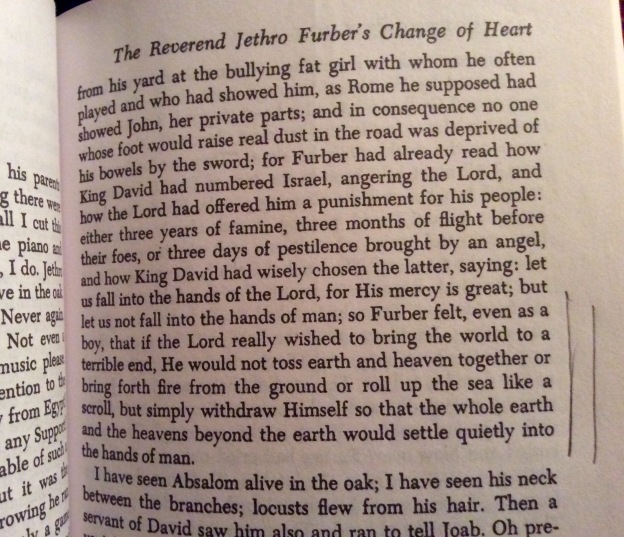
    img_2748
    My underlining.
    “; so Furber felt, even as boy, that if the Lord really wished to bring the world to a terrible end, he would not toss earth and heaven together […] but simply withdraw Himself so that the whole earth and the heavens beyond the earth would settle quietly into the hands of man.”
    This book should be studied, and studied quick! I have not the energy or heart for more. At least today.
  5. Quotes from pages 109 – 133
    “Quarckaling? Sull Yully? Nannerbantandan? TuK? Too rooky, won’t reply, all tweetered up…”
    “Sin first and saint later. Cruel to be kind, of course, and the hurt’s in the hurter — that’s what they say — a lot of blap. That’s my name, my nomination.”
    “Love, hate. Kiss, kill. In, out, up, down, start, stop. Ah … from pleasure, pain. Like circumcision of the heart. Judgment and mercy. Sin and grace. It little mattered; everything seemed to Furber to be magically right, and his heart grew fat with satisfaction. Therefore there is good in every evil; one must lower away to raise; seek what’s found to mourn its loss; conceive in stone and execute in water; turn profound and obvious, miraculous and commonplace, around; sin to save; destroy in order to create; live in the sun, though underground. Yes. Doubt in order to believe –”
    img_2751
    “That steeple didn’t look any more than elm high to me and just a little shovel-nosed.”
    “There was a little embarrassment at the platform when he went so briskly off to pee but really it was all right because he was in a sweat to see the tower of God — the spike that was to spit him.”
    img_2752“Call it Furber’s fiddling finger.”
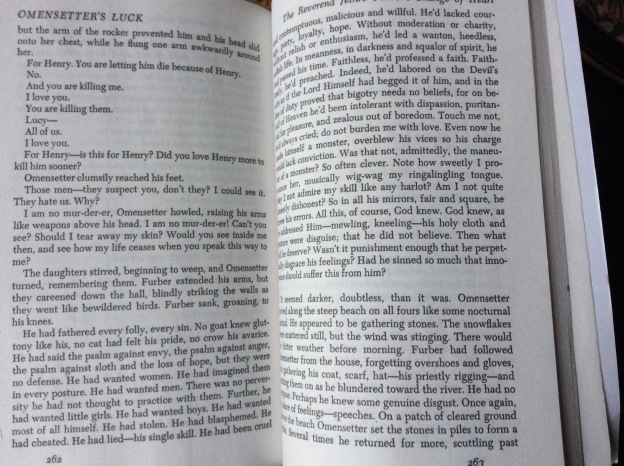
    “Pretty pudcums. She stirred; her legs moved lightly under his fingertips, down tickling, and his undulating flower bird settled in the hollow of her lap. Pet my bunny. Eee, sweet fig.”
  6. Pages 133 – 138
    More quotes about and from Furber.
    “What good was a wall that didn’t blind and deafen?”
    i.e. the wall Furber had set between himself and Brackett Omensetter.
    “…in the flower decked pavilion of his dreams, he’d made love too – to handsome monsters virtuous as witches, their bodies flung full length upon divans, rows of mouths along their limbs beseeching kisses, bald vaginas drawing wind;”
    “Like a schoolboy released to his summer, he capered in the garden. He knew how the orator, the actor, felt; what they sought in their success. He could tickle them and they would laugh; he could spank them and they’d howl; he could caress . . . and sighing, they’d respond. He was an honest preacher at last.”
    And there is much other evidence so far in this book that Furber is a preternatural forerunner of Trump, if Trump had become a preaching sermoniser instead of an entertainer, apprentice businessman and eventual president-elect of the USA. And I have about 200 pages more still to read and real-time review (later, below) about Furber’s tweets and sermons and other streams of conscious first Gassed out in 1966!!!!
    The jury is out, however, on whether Furber or Trump, one or both or neither, has a conscience about their behaviour.
  7. Pages 138 – 156 (ending section 1 of ‘The Reverend Jethro Furber’s Change of Heart’)
    img_2757
    “Furber is a sticky pill
    he will make you sick
    he will”
    “It’s then I think I recognize the nature of his magic. For whatever Omensetter does he does without desire in the ordinary sense with a kind of abandon, a stony mindlessness… […] Yet Omensetter doesn’t seem to be. He does not seem. Seem. Is this correct, this — seem? Oh you’re cows! Is this the feeling? I require an answer not a hiccough. Nannerbantan? TuK? Well he does. He does, doesn’t he? Well? Well? And what? And what shall we conclude from all this then?
    We must conclude he is the worst.
    He is the worst.
    Therefore.”
  8. “In order to survive the silence he would have to think of darkly distant and dissimilar things: the Antarctic, camels, Bogota.”
    “…Backett–
    Brr-ackett.
    Oh? Brackett?
    Really? Well, I’m happy to know. A thing like that.”
    Up to page 198, the end of section 3.
  9. Up to page 209 (end of Furber section 4.)
    “He could have cried piss at the steeple and been applauded during tea.”
    There is much strong sexual content in this section that I will not show here, but what I have shown above and below typifies the surprising nature of Furber-Trump’s success with the people WHATEVER he says or does.
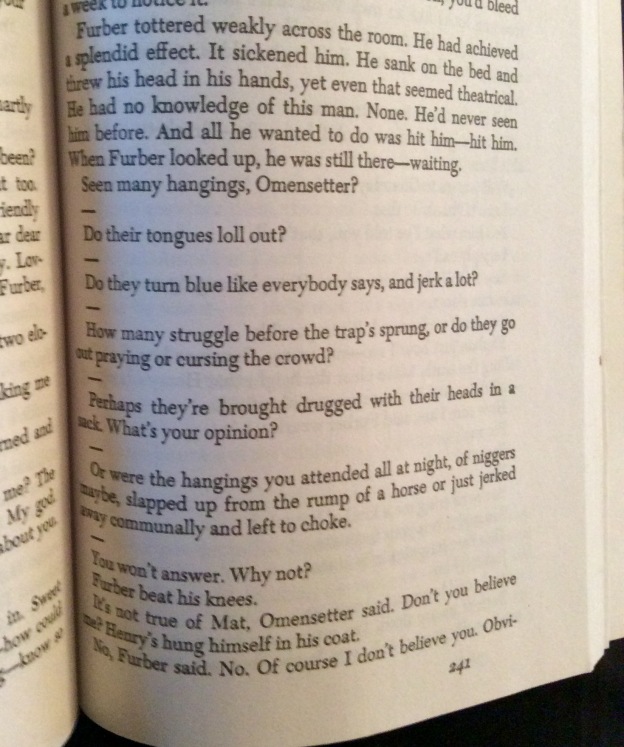
    img_2769
  10. Page 210 – 212
    “There was no way to call back the words as they rushed out, he’d never remember them […] yet he meant, nevertheless, to try to fill their ears with fire. […] There’d be land in the shape of his syllables, a sea singing, sky like an echo, plants in bloom burning with speech, animals with yellow answering eyes, and finally men taking form from the chant of their names and gathering in crowds to enlarge their reply to the laments which had created them. […] To find and utter the proper words, the logoi spermatakoi… […] Then — full furious Jerome: ‘I am prepared to cut a foul-smelling nose.’ Tight down. Nevertheless his eyes buzzed in their ears and bit their ankles. […] Furber’s right arm sailed. He watched it in surprise. His voice, when it began, was calm and light, smooth and precise…”
    A perfect description of what I have seen of Trump’s preaching style.
  11. Up to page 245 (end of Furber section 7)
    “It was his opinion that he had been a boy already, a girl, a plant in the wood, an eagle hunting in the mountains, and had spent, in the ocean, the glancing life of a fish. All the elements, he says, were united in rejecting him. The air had chased him to the sea, and the sea had spat him out on the earth’s edge, and the earth had flung him toward the sun.”
    Above, more John Cowper Powys? Compare Mr. Geard with Furber and Trump? All my chosen quotes from JCP’s Glastonbury Romance novel are shown here: https://weirdtongue.wordpress.com/quotations-from-the-glastonbury-romance-by-john-cowper-powys/
    “Wasn’t it wonderful how easily the words came. Just lies upon lies on the cooling paper, the faint, faint odor of leather, the darkened heart behind his eyes … envy and envy and envy and anger … envy and anger and aching desire … here — here — I shall raffle off my penis as a prize …”
    Attendance at Mrs Omensetter breast-feeding Amos and gazing at the Omensetter daughters, and later told by Omensetter of Henry Pimber’s suicide (prefigured earlier in this book) – an obsessive telling and listening, with recurring images of Henry hanging from a tree limb if one but looked up… one wonders how Furber himself will end up? Is this a premonition about Furber or his alter ego Trump?
    img_2773
  12. Up to page 273 (end of Furber section 9)
    “Conscience? conscience?”
    This marks the point where I instinctively (preternaturally?) feel that my comparison between Trump and Furber, Brackett O and Barack O, ceases at the point where we are in political history TODAY. Before Obama’s farewell speech due TONIGHT. The rest of this 1966 book is either fiction or prophecy. We shall see.
    The rest of this review below this point is speculation.
    There are meanwhile more telling and graphic scenes here, including Furber turning against himself in the quotes at the foot of this entry below. He has never believed in God, or in Trump’s terms, in what he has been preaching to the electorate; he has been playing a reality game and never expected to win but now he is RESPONSIBLE, after acting out his own base passions under the guise of the locker room. Now he sees the corpse of Henry P as the death symbol of the unrevivable old USA as well as the new one under Obama (Omensetter’s sick new-born son as symbol of the current USA), where Obama’s laid-back sense of LUCKNESS removes the need to fetch the doctor and rely solely on Obamacare, his own care, in other words.
    Conscience besets them both?
    —————————-
    “His whole life, he’d meant to preach, to preach … Where was his preaching and his preachment now? Would Henry’s body, hanging in its tree, be dreaming? Would it be casting in itself another kind of shadow, a goblin shadow, to be feared?”
    “He [Furber] would whirl and whirl and slowly mount toward the ceiling — whirling. Too bad he’d never made a study of ballet.”
    img_2775
  13. Up to page 304 (end of Furber section 12 and end of novel)
    “Then Furber’s body shook with the spasms of uncontrollable laughter, his mouth gaped and his chest heaved as if he were Brackett Omensetter himself in the deep bend of his luck, though not a sound emerged, only the whistle of his breath, and a few tears squeezed from the corners of his eyes.”
    Perfect.
    This book was a preternatural, unintended (perhaps pre-causal!) prophecy that only a fiction could supply and that only a gestalt real-time review many years later could have unlocked. That’s my contention.
    It’s no coincidence that Henry’s and Brackett’s wives were both called Lucy, and that Henry could not have hung himself so high without help, and that he was carrying Brackett’s rent money.
    No coincidence, too, that, in all likelihood, Trump is to be Obama’s only legacy…..
    An omen-setter.
    end