Tuesday, September 12, 2017

Worming The Harpy - Rhys Hughes


The Three Rhysian Tartari of the Nineties 

 
IMG_3534

WORMING THE HARPY AND OTHER BITTER PILLS 1995
THE SMELL OF TELESCOPES MM
STORIES FROM A LOST ANTHOLOGY MMII
My previous reviews of Rhys Hughes HERE
My previous reviews of Tartarus Press HERE
When I finally dreamcatch these books via a re-reading of them, my thoughts will appear in the comment stream below…

33 thoughts on “The Three Rhysian Tartari of the Nineties and Noughties”

  1. WORMING THE HARPY AND OTHER BITTER PILLS
    To Jilly
    CAT O’ NINE TAILS
    “They are slimy scoundrels to a man and woman; swarthy, bristly, leering and jeering rogues, scourges of obscure compass-points, bright blue with lewd tattoos.”
    A cat called Herodotus tells of his nine lives to the narrator, while he washes, up, the narrator not the cat. But there seems to be a sort of washing up by both of them, the beginning of a writing career and its end. Beset by rogues.
    A tale that, in already perfect Rhysian style, excels some of the best of this author’s later work that is still ensuing nearer towards the end of his life. This story itself, as it turns out in retrospect, is the cat’s own tale of its ninth life and first death. Its combined recounting and cause, via a möbius absurdism. And all of us who will one day fall into our own soup from the top of the crockery we have stacked.

  2. WORMING THE HARPY
    There is a quality about this that seems more wild, more mosaical, than this author’s later work. It has the readerly quality of not understanding it all but knowing that one does understand it deep down. Maybe it has a vintage wine quality when decanted from this old book. I dread to think what an ebook reprint will do to it, other than dilute it, EVEN if the ebook text is completely unchanged from the old book, which naturally it will be/is. The Jazz player called Dizzy where constructive improvisation depends on entering an alternate world – and a father and toy-maker daughter – a place called UmberScone. The two villains on giblbets. It all SEEMS like real long-lasting literature. It has the bespoke hang of good style that only old books can have, in a time before we were politically correct. Books that are rare and hard to find.
    Reprinting destroys them.
    “You remember the outcry last year, after that spate of attacks on children. “


  3. Thanks Des! The story ‘Worming the Harpy’ in this hardback edition has a crucial scene missing that was reinstated in the paperback edition. The paperback edition also has an extra story that should have been in the original hardback. Plus some other mistakes have been corrected there too. It was so long ago (almost quarter of a century) that I wrote this story and the others in the book that it feels almost as if they are no longer mine…
    The signature and dedication is interesting. I had never signed books before. I didn’t have a proper signature. It was many years before I developed an ‘authorial’ signature. On this book I just wrote my name because I was taken by surprise. I never imagined I was supposed to sign books…

  4. THE FALLING STAR
    “Plodders with the pallor and ambitions of tadpoles attempted to outvomit pretentious book-reviewers and voluptuous editors from Sidcup.”
    Rhys Hughes was ridiculing me for my reviewing even before I became a reviewer. As to the voluptuous editors…?
    I am glad to see that Rhys was just as intent on wild conceits and madcap connections to the nth power even in those early days. He has ever been optimally consistent in writerly fictionatronic excellence if not evolutionary in it. A story of the narrator’s battle with the park keeper over the Star Pearls of a meteorite falling in the park. A battle of words. Well, that was unavoidable. But also of body-parts and paradox. Ending with the truth of the pearls’ ownership.
    As an aside, the park-keeper is called Mellors. Is this the same man as the one in Lady Chatterley’s Lover? Only clue is his “thrusting hips”.
    “There would be yoghurt and honey, moons and daffodils, chimes and rhymes.”

  5. Mellors is definitely the same Mellors as in the Lawrence novel…
    I loved intertextuality back then (as I still do).
    The tadpole was you (someone absurdly once compared you to a tadpole); the pretentious reviewer was me; and the editor from Sidcup was Pam Creais, I can’t remember why I put us in this particular story, other than because I have always liked Tuckerization…
    I missed the meteor shower last night because I live in Wales where it is always cloudy. I will try to view it tonight instead…

  6. QUASIMODULUS
    “The drone has resolved itself into a little boat with an outboard motor.”
    No wonder the boat could enter the Opera House’s attic, being a drone. Of course, drones did not exist when this was written.
    Quasi modulated like one of my favourite operas mentioned in this story: Moses and Aaron by Schoenberg. The first time I have seen it mentioned anywhere! Moses was borne on water. And this is a prophetic tale of global warming and flooding, where the Phantom of the Opera meets Quasimodo who is in post-alchemical beautification, as we can all be, given the transcendence of fiction, if not of Dr Dee. A nifty conceit that flooding does entail the world being left to only those who happened to be living in Ivory towers and other high places, when the flooding came. And there is a beautiful joke in its last sentence…

  7. THE GOOD NEWS GRIMOIRE
    “But I am digressing.”
    There are too many things I can tell you about what this substantive story contains, the story I can foresee this author having worked towards as the future end goal of all his writing. It has a madness that is smooth and raw at the same time, with apposite and conflicting similes galore teeming through your brain. Names taken from famous and not so famous Gothic Horror novels and long-chinned fiends and a grimoire with inbuilt flask and mixed methods of use, and a truth that shines out through all the fictional lies and various machinations and characters. How can I do justice to it? It seems to be a ready-made like one of Duchamp’s, a ready-made in the form of a complex moving dream that was meant to exist even before it existed. A rightness of expression filled with manifold wrongnesses, and vice versa, making you think you are dreaming the reading of it, a notch clicked into a new reading dimension that both makes you sleep and makes you wake at the same time. I felt all these things genuinely and I am trying to express what I felt in the best way. The thin man put in a wishing well, just as one example, escapes but then escapes back to it. But I am digressing. I’ll leave you to read it.

  8. Written in early 1995 when I was the poorest I have ever been. I literally had no money at all and no food. I knew I had to survive a week without eating. I decided to write a story and try extra-hard at making it better than my previous work. ‘The Good News Grimoire’ was the moment when I *consciously* decided to attempt to take my work to the next level. This doesn’t mean it actually turned out better than all my earlier stories, but the determination that generated it has stayed with me ever after. That’s why this story is a watershed for me.

  9. FLINTLOCK JAW
    “The true art of disguise, he maintains, is more a matter of poise than looks.”
    A telling tale of the highwayman Robin Darktree who keeps up a denial about all the increasingly modern things happening around him to change the braggadocio of the road and, thus, changing his job – things such as railways.
    Telling and poignant. A prophetic portrait of self? I would have said pathetic as well as prophetic, but the former word doesn’t seem to fit. Pathos, the root of ‘pathetic’, is paradoxically not so pathetic in itself.
    “: foolishly romantic, arrogant, profoundly sad and almost comic.”
    (Perhaps ‘sad’ has also changed its meaning since 1995?)


  10. I am sporadically breaking my reviewing sabbatical by dint of a brief nonce…
    VELOCITY ORANGES
    “My lusts are stubborn barges on a curry-sauce river: they pole their gondolas upstream, against variety’s spicy currents.”
    That perhaps should be ‘bargees’ not ‘barges’?
    A story that leaves a bad taste in my mouth, as if the narrator, if not author, has plugged the reader onto the end of his penis and used the result to mount his bicycle from the rear. A Cheating-Box as tank-engine in word form; a Beckettian nightmare which Beckett would disown. Perhaps this author’s greatest story. Or his worst. The fact that I can’t decide which – and that I have discounted anything between those polarities – must mean something. It is strangely Rhysian and not-Rhysian all at once.


  11. A CARPET SELDOM FOUND
    “Please do not take my head. I work with my head.”
    A substantive, arguably important Rhysian work. Found art as a Turkish holiday and a handkerchief sized carpet taken back by Lawrence to England where his girl friend had left him and he and his co-workers in a boring job, a carpet taken back along with the carpetseller’s curse, a curse that cursed itself, it eventually seems, by the labyrinthine autism of limbs of the nightmarish loom rooms in Turkey, with the later expanding carpet and invoice and Lawrence’s own threatened limbs and dreams, including his head as another limb, all this turning out, for me, with the carpetseller’s own concomitant dream now today explicitly a then prophetic symbol of the IS state or Isis or Daesh…
    Spontaneous Deconstruction, with dreamcatcher and hawler built in.
    And one of the best Rhysian jokes ever, using the word ‘stumped’ … and the most telling Rhysian view of a relationship as an extension to his ego being denied planning permission! Gulp!
    “There scarcely seemed to be an area that was not a means of access to somewhere else.”

  12. THE CHIMNEY
    “But I was helpless, as weak as a fly in a web; as utterly doomed as a snowflake in a female undergraduate’s first toaster.”
    A sad man, seeking his first woman, mistakes a chimney on a Jersey beach for one. But not before kissing ‘her’ and falling down its flue or channel towards what he takes to be the sounds of Hell. Some theological quandaries …. as well as a few silly jokes in this work, even laugh out loud ones against my better judgement, except nobody laughed out loud when this story was first written, I guess. Now, twenty odd years later, we have to laugh out loud to dissipate the world’s misery. Joyce and Julie Andrews, too. And a chimney-brush to die for. A sort of throwaway happy ending when he becomes a “soot fairy.” Throwaway is not a million miles from what you should do with this story.


  13. THE MAN WHO MISTOOK HIS WIFE’S HAT FOR THE MAD HATTER’S WIFE
    IMG_3637
    As variations on Oliver Sacks and Lewis Carroll, this is probably the author’s strangest ever story, under the influence of influence itself I guess, in tune with “Observing the observer of the observer.”
    I am not sure I remember whether I accepted the invitation to the banquet. I suppose I would I have remembered if I had. Or whether I indeed received an invitation before reading about the event in this story. I cannot indeed remember reading it before. I wonder if the influence of that volcano was what Lowry was under?
    “Alice is playing the harpsichord, to calm her nerves. Her fingers fly over the keys, building up a dress of notes which cling to her naked body.”

  14. CELLO I LOVE YOU
    “During the Schoenberg – played to appease the mob – I began to dismantle my adapted umbrella.”
    A most touching paean of love to the cello and not to the woman who exploits it with her bowing and scraping.
    This is one of Rhys Hughes’ greatest works and has stood the test of time and memory. The green hams, notwithstanding.

  15. WHAT TO DO WHEN THE DEVIL COMES ROUND TO TEA
    “There is a smörgasboard of suppositions; a veritable goulash of guesses.”
    The devil comes round if the plates are round, I guess.
    A very telling piece of advice that continues to resonate with meaning upon meaning – amid this beginning back in the early 1990s to this author’s now seasoned delight in an ever-teeming fictionatronic sandbox filled with literary ‘sand’ from even longer-seasoned legends, a menu of legendary creatures and fairy stories. Here the Devil who I suspect has gout.

  16. ARQUEBUS FOR HARLEQUIN
    “This was a terrible mistake, I know; the world requires no more fiction. Motion, the breath of engines, is more important than emotion, the mist of maturity. I have entered wordy swamps crowded with fools,”
    Crowded with fools, indeed: a telling prophecy of the more shallow swamps today. This nagging debate with self regarding choosing writing over engineering is couched in a beautiful, yet constructively resistant, texture of thesaurian prose. The tale of Diggory who admits he cannot write of relationships – until he wrote The Black Dog of Zero? Hah, that is my version of Harlequin’s spurring arquebus today, by saying that and thus retrocausating the handwritten dedication shown above!
    “Will the stories be sufficiently different from each other or will I be harping on the same theme? An interesting question.”

  17. ÉCLAIR DE LUNE
    “At once I picked myself up and became stoutly pragmatic — burning my poems and finding profitable employment selling life-insurance to the employees of the Kingdom Noisette Engineering Co.”
    Of course, I was fighting this battle with myself in 1995. Seeking the same insulating-cable that would take me from one to another. Still the rest of this story – that I have just meticulously re-read without previously remembering anything in it – has nothing to do with me. The tensions between the polarities of the soul, however, are also mine. But I already had my cakes and eating them, just like Brexit has become. And I also noticed the subtle reference to Stockhausen and the more obvious one to Satie. And that Éclair’s sponge in the bath had a filling! And that it was not a bath at all. The tensions between being a ghost (and thus dead) and being alive were also not lost on me. But the raisin d’Éclair of this long work was completely lost on me, otherwise. But I loved the killer pun at the end. And music as the rhythms of cell division. And, oh yes, the strict rules of duelling, not forgetting the real people in it like Mark Xeethra Samuels and Rosemary Gibbet-Pardoe.

  18. GRINDING THE GOBLIN
    “Women no longer wore undergarments? Then the gates of Heaven were always open!”
    Ending with the cat from Cat o’ Nine Tails, this Chaud-Mellé story (if a city’s mad, it can die, if it can die, it can become a ghost) seems a sort of sequel – Mark Xeethra in common – to the previous story, also with the Udolpho patisserie. But it’s more like the Paris of the King in Yellow, with communes and agents, except here it is in Austria. I do not pretend to have mastered this story, but luckily I am also mad can die or become a ghost, too, like this whole book that has instead become a cult classic. But how many readers make a cult? Eliza Pippins or Mary Poppins, notwithstanding. Her umbrella adapted like the one in Cello I Love You? And the sewers in this mad city rife with harpies. Turmeric as ground goblin for the Devil to take?
    “The anarchist himself was kneeling in front of the hearth, feeding papers into the grate. But there was no fire to receive them. The leaves were sucked up the chimney with great force. I rushed to his side. ‘But these pages are blank!’ I protested.”

    Friday, September 08, 2017

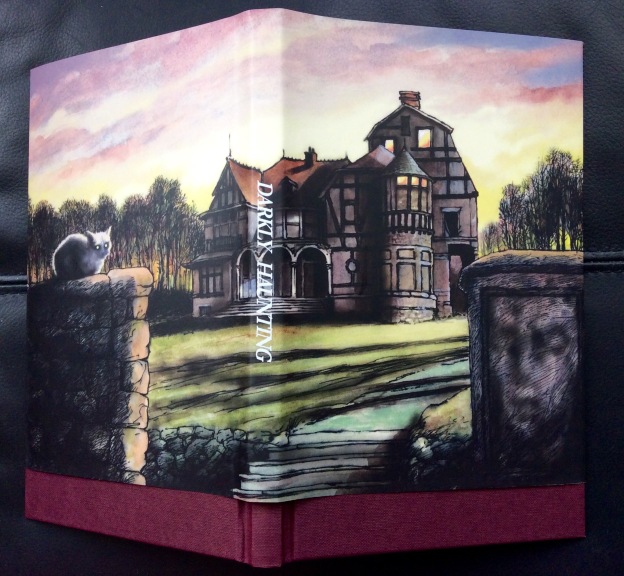
    Darkly Haunting

    Darkly Haunting

    IMG_3593

    SAROB PRESS 2017

    Stories by James Doig, Colin Insole, Rhys Hughes, Peter Holman, D.P. Watt.

    Edited by Robert Morgan

    My previous reviews of this publisher HERE

    I shll be reviewing this book in a few weeks and, when I do, my thoughts will appear in the comment stream below…

    6 thoughts on “Darkly Haunting”

    1. EARLY STAGES by James Doig
      “, and in the exaggerated lens of nightmare…”
      At first, I was worried this would be too traditional for my tastes, even if it is an adequately accomplished sense of a place, a tragic event and a haunting, and it is. But it gradually took a decided grip on me, the ‘found’-telling by gent to gent in civilised trappings of actually being brought to come there and then the trappings of cordial whiskey, and all this is true, but there is also a strong sense of Norfolk, its stretching back to the Middle Ages, its follies around a large house, the faltering sense of scions and their heritage, the fallibility of lineage and intention, the Christian mythos that underlies us all on this side of England by the North Sea, the ‘early stages’ and ‘chosen fragments’ of Medieval and Elizabethan drama, the early BBC radio documentaries that I recall, and wonderful reel to reel tape recorders, and, yes, that lens of nightmare that this polished text successfully manages to wield.
    2. BLUEBELLS I’LL GATHER by Colin Insole
      “It was his land of lost content.”
      A land of the past – in rapturous rapport with Fournier’s Grand Meaulnes – with Joan Lindsay’s Picnic at Hanging Rock – with H.E. Bates’ nature and war – with the shoals of the dead from Elizabeth Bowen’s blitzed London …. but this is Colin Insole supreme, and those hasty rapports of mine are to just give a hint as to this monumental and momentous work of fiction that is uniquely in-soul. Nobody can really describe this series of cross-sections of Proustian time, as told from various points of view, flirtations as flirtations and flirtations with death, and a recurrent unrequited love circling the cricket field of England’s past pastures and linked railtrack halts or junctions, now a lost domain. The two wars of the 20th century, and those doomed and those still living by haunting each other as told by matchless unforgettable prose with embedded items of verse and resplendent tropes of emotion. This is a genuine classic work to go with Insole’s other fictions (long among my handful of favourite writers), particularly with his other wartime rhapsody of lost time: ‘The Hill of Cinders.’
      I can only be grateful I lived long enough to read another Insole work, thanks to this book. This is his newest classic, if not THE Insole classic, even or especially with its haw haws, and its tough cheddar, old cock.
      “And she marvelled at how the living and the dead lay down to sleep and rest together, and how their dreams must merge and blur.”
    3. THE BLACK DOG OF ZERO by Rhys Hughes
      “I just wanted to rebel against insignificance.”
      Two consecutive stories in this book where two of my handful of favourite writers appear to produce their potential life classic to date. Both stories with a cricket match. This substantive story is, for me, the culmination of what I have been expecting from Rhys Hughes for over twenty years of reading him (see my reviews in the above by-line link.) It is a work that is recognisably RhysHughesian but with no self-referential authorial metafictions nor constructively child-like items of wordplay. However, there are still many brilliant inbuilt conceits. A story of Colin who is a person himself distinct from the author but with perceived Rhysian autobiographical elements (like a beach party and a dancing club.) It is the telling treatment of someone’s life, its ambitions and its nagging sense of dissatisfaction here in the shape of a recurrently haunting black dog (almost, for me, a kindred spirit of Churchill’s ‘black dog’ syndrome), a beast that turns up every ten years upon each Birthday-Eve’s turn of the numbers of Colin’s age towards something-zero. This is amazingly strong material that will set you thinking, make you reassess your own life, a phenomenon, for me, allied with Zeno’s Paradox. Here Zero’s Paradox? Some strongly depicted characters, too, in his life. And visionary concerns with, say, a snowy avalanche and a cellar trap, plus hair-trigger moments that seem to last forever. The ending is genius.
      A telling tale for me personally as I wait patiently for the turning from 69 to 70.
      This is major unmissable stuff. No mistake.
    4. NO SURRENDER. by Peter Holman
      “Islanders that end in rebellion (8).”
      A very well-characterised, well-written and compellingly believable portrait of an elderly ex serviceman and his friend from the old days, having served in the Irish Troubles of the 1970s, now beset by a haunting paranoia of being pursued by individuals from that past. Including being ambushed in one of today’s supermarkets. Some beautiful turns of phrase: “a face like a clenched fist”, “moping around in a black dress with her hair scraped back like she was dead already.”
      A sense of either senile dementia or a retrieved reality as a sign that modernity no long engages him as much as reading John Buchan books once did, and his need to go back to the past even if that past has more dangers to his body if not to his soul.

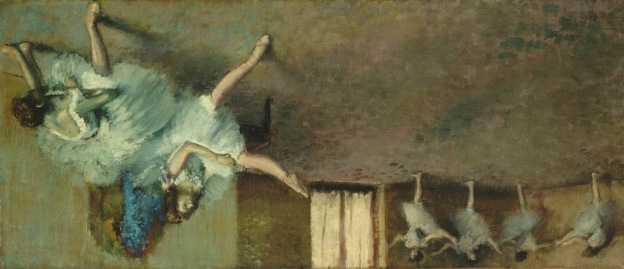
    5.  Now for what was found in the Ballet Case…
       
    6. THE ENGLISH HOUSE by D.P. Watt
      “, like I was in a cupboard while Europe falls apart…”
      In some ways, a post-Brexit SF story depicting the foul and fell repercussions some 30 years hence, without using the word Brexit at all.
      In another way, an extension of this book’s nostalgia gent-to-gent over cordial whisky factored into by the thwarted ambitions of Hughes in the form of a recurrent Zeno’s Paradox, the haunting of them like the past wars in Holman, then Insole’s cross-sections of war and Meaulnes-type literature and Fern Hill or H.E. Bates type gaia, growing into more of this book’s nagging or sometimes gossamer gestalt.
      But in essence, this is a work-on-its-own, a mesmerising tryst with the oblique power of fantasy that is generously dream-like or Sarban-like, even Blakean or Carcosan (a King in a yellow robe) so as to conjure the past and the future’s attempts to transcend it. Despite the strictures of historic Brexit, Englishman Michael lives in Dinan, in a house overlooking the mysterious, seemingly untenanted, ironically-named Maison Anglaise, a vaguely perceived house that seems to haunt him (following the telling departure of his visiting, whisky-sharing old friend David), and somehow, based on the evidence of the diary in his daughter’s Ballet Case, haunting her with its lasting, literally long-standing visions, and his wife, too. It will be hard to forget this moving and gradually grasping work. We shall all need to stand and wait.
      ————————-
      “In the pebbles of the holy streams.”
      Fern Hill, Dylan Thomas
      end


      Wednesday, September 06, 2017

      Abyssinia – Damian Murphy

      Abyssinia – Damian Murphy

      aug4

      MOUNT ABRAXAS MMXVII, Numbered 13/107

      previous reviews of this author HERE and of this publisher HERE

      I should be reviewing this book in a few weeks and, when I do, my thoughts will appear in the comment stream below…

      aug7

      6 thoughts on “Abyssinia – Damian Murphy”

      1. I am sporadically breaking my reviewing sabbatical by dint of a brief nonce…
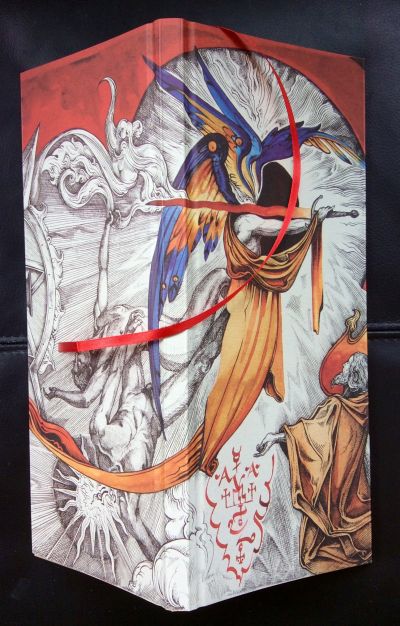
        Luxuriously upholstered book with quality materials, guessing about 13 inches by four, marker ribbon, all generously designed with artwork etc, stiff paper and even stiffer dust jacket, and illustrated endpapers.
        Pages 7 – 10
        “The lingering scent of tobacco suffused her senses as if it were a holy incense.”
        That unspecifying-specifying ‘a’ seems significant in that initial quote from this book. Also the fact that there are several lower case letters on the first page that one might expect to be upper case makes it seem this was deliberate, not accidental?
        This is Petra — during her stay at this well-characterised, Poliakoff-like hotel with her husband Dominik, note the k instead of c — crudely surveilling the guests list (even scrying the hotel’s walls with her fingers as to a map of locations within the hotel grounds) with regard to finding more about a woman whom she had seen at dinner sitting opposite “an oversized doll attired in antiquated military regalia.” (Synchronous that I read this morning here about a ‘ceremonial military uniform’ walking without a body in it!)
        I am already captivated – as, from experience, I expect to be – by a new Damian work.
        • “It was reported in Broadway yesterday that the new production of “Abyssinia,” in which Williams and Walker … Augustus Pitou has renewed his contract Chauncey Olcott for a term of two years.”
          Re: The Worm Has Feathers
      2. Pages 10 – 16
        Piers like barges, a ‘found’ book with lemniscate dividers, a tacit complicity with the hotel, Fiore / Fiume, D’Annunzio …… Petra and DominiK — (cf (Detective) DenmarK elsewhere in EUROPA and Golgonooza where European areas are being traduced?) — continue their incredibly intriguing surveillance in real-time of Celia and her cracked (ventriloquist? ) doll now called not Olcott but Karl Reginald von Lobkowicz, and the ‘exalted wine’ of combining “an authority higher than one’s own, and […] a tendency toward personal autonomy.”
        Gestalt real-time book reviews are made for books like this one.
        Or, conversely, books like this one, these days, are now being made simply for being gestalt real-time reviewed?
      3. Pages 16 – 28
        “The blemish burrowed like a seed into the rich soil of history, lying unseen for several decades and fully coming to fruition…”
        Comparisons, balances and tensions between the portraits in the hotel rooms, say, the white and black horse, and more – the hotel representing a telling structure of historical Europe in these days, I guess, when we read this book, these days of potentially renewed European mania. Instead of rooms with colours as in Poe’s Red Masque, we have European themes. Blended with dark plum smoking aromas, Damianish bureaucracy as an elemental force, the Damianish delicacy of touch on meaningful pages and omens, that ‘blemish seed’ above “a potent lamentation”, a gazebo, a thought on comedy, and a bowl of figs …each fig as if a cig shared between potential lovers…
        But the mind-drilling remembrances of these pages are the man about whom Petra has an Abyssinia instinct (presumably the country not the title of the first Broadway production only involving black performers), and above all the perceived relationship between Celia and her doll ‘husband.’ The latter relationship represents a seismic literary event which must one day be filmed for the cinema, I reckon, scenes that are breathtakingly special.
      4. Pages 28 – 37
        “The vision hovered on the edge of comprehension; faint, tenuous, yet accompanied by an inexplicable certainty.”
        …as, via Petra’s own sensitivity, I touch the hotel and its accoutrements, running my reading finger, as she does her real finger, down a random page toward its significant find of homily or wise saw or arcane message. And with this method I land my finger on a page in this section, finding by chance the words “lent a vaudeville character to his narration.” Meanwhile, I watch the incident with the magnificent beastliness of a real horse in the hotel, listen to the doll’s account of an amorous affair, follow the game Petra, Dominik, Celia and the doll play with cards and matchsticks, and learn, through the doll’s words, about the Thomas-Mann-like sanatorium where he was a patient,
      5. IMG_3620Pages 37 – 51
        “It vacillated between the attractive and repulsive forces of two opposing stars, the white horse and the black horse, The Apostate and his wife, and a host of other influences as yet unknown to her.”
        …and between the miscegenative sides of incest, and, eventually, between the competing black and white pieces of a farewell game of chess. But not before, our act of following Petra in her guided administration of sacred rites, involving the key to Abyssinia, whereby hotel portraits seem to activate as real entities in the intricately perfected intensity of a Damianish benighted quest through the threatened no-return of the hotel’s inner and outer pathways. With, in these final pages, the blatant heresy, twice, of it’s instead of its, in a careless token rebellion against the otherwise tightly bureaucratic rules of this book’s entrancing game. But above all the poetry of ‘holy blood’ in one’s reading veins.
        “, never failing to grasp the finer points of a given proviso or subclause.”
        end


        Tuesday, September 05, 2017

        Europa – Karim Ghahwagi


        Europa – Karim Ghahwagi

        aug9

        MOUNT ABRAXAS MMXVII, Numbered 13/93

        My previous reviews of this author HERE (plus HERE and HERE) and of this publisher HERE

        I should be reviewing this book in a few weeks and, when I do, my thoughts will appear in the comment stream below…

        aug6

        13 thoughts on “Europa – Karim Ghahwagi”

        1. IMG_3608I am sporadically breaking my reviewing sabbatical by dint of a brief nonce…
          Luxuriously upholstered book with quality materials, guessing about 13 inches by four, marker ribbon, all generously designed with artwork etc, stiff paper and even stiffer dust jacket, and illustrated endpapers.
          EUROPA
          Up to page 26
          I note that the dust jacket has arguably a vague image of Amerika? Which is ironic as this book, judging by the first 26 pages, may well be a whodunnit and ‘where have these pages been printed before’ as investigated by Detective Isle Denmark about the vanishing of Amerika (especially in the new light of Trumk there and Breksit in Europa?)…further themes and variations on this authors’s own work that I have reviewed before (as linked in the heading of this review), Blakean and Bulgakovian, as well as uniquely and sublimely Ghahwagian,
          For this book’s pages 9 to 26, please see my review of Wollstonecraft here: https://dflewisreviews.wordpress.com/2017/06/08/all-is-full-of-hell-a-panegyric-for-william-blake/#comment-10012 … The interesting footnote on page 10, notwithstanding. And that Karim is tantamount to an anagram of Amerika, if you use the E of Europa and its extra A.
        2. Pages 26 – 32
          “‘A coincidence.’
          ‘A COINCIDENCE!'”
          I think Mr Sweden, when faced with the Senior Censor, is a projected version of the author himself, or a character between a real writer of fiction’s ultimate truth and a ghost writer for an empire’s supremo, between epic poet and pamphleteer, between himself and Emanuel Swedenborg / or Immanuel Kant.
          Between writing sequels for William Blake or Mikhail Bulgakov.
          Between a hyphen (with no spaces) and an en dash (with spaces either side); and I already publicly warned those connected with this book about it here in 2012:
          “(with typographically conjoined hyphens liberally peppered instead of ‘loose’ en-dashes as some sort of symbol that towns and text are also mis-conjoined)” which now seems even more relevant… Between borders-or-nations and human beings as the Empire, for the Supreme of which he is to ghost-write an autobiography.
          And, to give us some further clue, this is what he currently says on his own website about the book we are reading:
          “Travel writers, detectives, bureaucrats, epic poets, underground pamphleteers, and other general practitioners of the Dark Arts, and connoisseurs of the Fifth Dimension, please take note: Albion’s Ancient Forges are once more alight with infernal fire. In bold newspaper headlines it is writ: AMERIKA HAS DISAPPEARED AND EUROPA IS NEXT“
        3. Pages 32 – 41
          “‘It is just one word,’ Mr. Cro corrects him, ‘without a hyphen.'”
          A compound word with or without one of this book’s brexited ‘Gaps’ to neutralise one or more of this book’s trumpish ‘Walls’, & I feel I am in a blend of the Milligan 1969 film ‘The Bed-Sitting Room’ and Oliver Smith’s ‘Burnt the Fire of Thine Eyes’ and DP Watt’s ‘Conflagration’ and Malcolm ‘Volcano’ Lowry’s or James ‘Quarantined City’ Everington’s Carousel, here complete on top with a chimney-sweep boy singing Parry’s and Blake’s ‘Jerusalem’, plus a reference to Blake’s ‘Milton’ or is that Milton’s ‘Blake’s Seven’? Other than all that, I don’t know where I am!
          CAPITAL LETTERS, galore!
        4. Pages 41 – 54
          “Europa, a jigsaw of states enclosed at every border and crossing by the Great Walls…”
          I am going mad or this book is, in a good way, because any book with a passing reference to a character called Mr Brexit must be one of *constructive* madness. An inversion of an inversion, where hyphens are argued about by characters (the book itself also having arguments with its own hyphens and dashes) and a London waxwork museum has a classload of kids visiting, as led by their teacher Mrs Oslo, spies and things, plus an invasion of mannequins or mimes to replace the museum’s official effigies of the Supreme Chancellor of Europa, who has just announced his own visit to the museum, plus reference to a secret entrance, at Buckingham Palace, to Chicago in the missing Amerika… Inter alia, inter alios.
          This is a book of collaged cabinets. Inside my brain. To the musical backdrop of Ligeti, not Ligotti. And other footnotes.
        5. Pages 54 – 69
          “Send the mime to the oven.”
          … to forge Amerika from the Fires of Europa by absurdist literary-Blakean-Bulgakovian means (‘Amerika is already here’), where the k is a reference to KoreA? Whatever, the case there are mind-blowing mannekin-mimes and puppet-baboon-sculpture effigies as an orgy of memes, where the arrival of the real Supreme at the Albion waxworks seems to be only his empty ceremonial military uniform walking! A mosaic of Polaroids, endless tiers of adolescent biographies, a brief mention of David Bowie and Nigel Farage, and the earlier glimpse of Mr Brexit fleshed out, leaving “twenty-seven layers of opaqueness” as the residual Europa?
          And my review’s now apparent prophetic reference above from a passing footnote indicates music and literature also forging each other: “The Ligetti opera continued to play…” SIC
        6. Pages 69 – 77
          “I know how it works, I know how Gaps think.”
          A talking smile, robins arising like smoke from a phantom limousine towards the erstwhile mutual Sistine ceiling, I am guessing, a whole panoply of agents, double agents, triple, agents, to trap those who resist or encourage immigrants. A mad novella even madder than our own mad world makes our world seem sane! Twenty-seven names, twenty-seven years, four zoas. And Berlioz. What more could you want? Only this purest beauty of literature as its whole contextual paragraph wherein it appears –
          IMG_3618
        7. Pages 77 – 86
          “‘The story has been etched and bound in the events that have shaped it,'”
          Indeed. Handle this book and you will know what that means.
          Here, I feel — via a blend of crossing between and over various Great Walls of Europa and rebound Amerika and via Stephen-Kingian dark-tower ‘doors’ or gaps and through Bish-Bosch’s famous garden-of-earthly-delights without hyphens where I sense Trump, amid orange forges, will be eating all the mannequins, skeletons, gorillas and disfigurettes in zombie hordes — the Mistral Express train (cf King again) reaches Brooklyn where Denmark seeks his Margarita (Ms Thel?). And I feel a lot more in this Spinradian apocalypse and eventual resolution, we hope, including the start of EPILOGUE: THE DEVIL IN GOLGONOOZA, but feeling is not enough with this book. You have to absorb it to your and its bottom bone. Pistons of Or-Ulro, American refugees, blackened giants, a legless old man, et al.
        8. Pages 86 – 98
          “Outside, the Great Train came to a stop at Gara de Nord, in Bucharest, Romania.”
          This book itself is indeed a euROpa mania – “HOLLYWOOD, GOLGOTHA, MOUNT ABRAXAS…” And now (with the end of the EPILOGUE and the whole of the POSTSCRIPT) shades of Marienbad … or ‘Parsifal’ with Siegfried Jerusalem (the opera version I know best), Knights Templar, other literary references galore, too numerous to mention, and a culmination of quest in Margarita-Denmark (Master and Margarita), Katerina-Sweden, and, for me, a sort of Spot the Trump game – the Devil, the Supreme Chancellor, the Dragon, or even the Travel Writer himself, with Russian help? Even if I could give the game away, I wouldn’t. Serpent ‘slug’ over his shoulders and he ‘excites’ the tunnel, even a tiny few alleged typos meaning something important along with the dashes and hyphens? The Dirge of Eno, too, as Pope’s bathos. A truly mammoth masterpiece for our times in 90 pages.
          end