Monday, November 13, 2017

Stars Beneath The Ships – Oliver Smith
11 thoughts on “Stars Beneath The Ships – Oliver Smith

  1. “These stories contain sailors marooned, or exiled on islands; boats afloat, adrift, beached, or wrecked.”
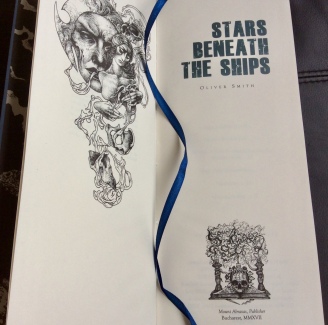
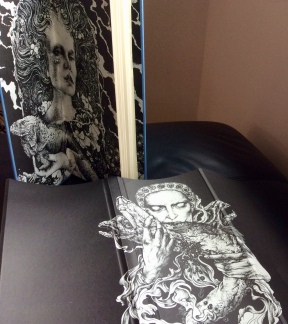
    A luxurious, very tall, slender, hard-shouldered, stiff-paged turning, bending back with swellings of paper and wonderful noises in the spine, split-spar-sharp dust-jacket, ocean-blue marker ribbon, decorated with artwork at either end, 90 pages, 101 copies, six titles, the first one being poetry…
    Deeper Flowers Thrive
    First published in Spectral Realms 4, edited by S.T. Joshi.
    A fine poem with the Swinburning or swimming of the firstborn Eve “Among the wrecks, sponges, and sulphur worms” et al.
    It also contains the word ‘dehiscent’ that I first learnt a few years ago from the writer D.P. Watt.
  2. CROCODILES IN THE SUGAR
    “Among green shrub leaves weeping into the water the remains of a boat half submerged in the dark waters.”
    …giving credence to this book’s earlier promise of a shipwreck gestalt, together here with a character’s having mistakenly (and temporarily?) grounded his boat on a mudbank. But the thrust of this Carib story of an island, when, near the Prohibition, perhaps, where an Englishman called Mulbey enjoys a lazy life but needed to investigate ducal accounts at an old colonial house in the wilds, and eventually in interface with an albino crocodile and Voodoo possession, possession not only of people but also of Christianity itself. It is a well-written yarn, highly entertaining, if melodramatic. And it didn’t seem to matter that there were a noticeable few minor typos in it. Around the mulberry bush of swampy voices, the art of butchery pitched against that of chefdom, a priest on a bike and the geographical name Merdemal. (Mer de Mal, or Merde Mal?)
  3. THE VOICE OF YOUR REDEEMER, THE SONGFUL MORNING NEAR
    “‘You know each day a memory leaks from my head,’ he says, ‘it is carried away like a page caught in the sea.’”
    Not melodramatic as the first story was, in fact not a yarn at all. No gestalt for this book, so far, other than its own pre-advertised one of wrecks and beachings. This is a rhapsody, a rapture, ABOUT a gestalt, the pages and flotsam gathered together from the broken pieces of text at the beginning. “…the flotsam and fragments of a million books.” An incantatory refrain of a few words that need to be fitted back into the meaning of a trillion others? It is an apotheosis of many dreams and fictions, uniquely and paradoxically tempestuous yet smoothly beautiful palimpsests of the island’s Cal, Miranda and Will of Shakespeare, Tv’s ‘Lost’, cinema’s ‘Forbidden Planet’, Borges, Clark Ashton Smith (any relation?), together with various mutant forces intervening, but eventually the main force, for me, is Krohn’s Pelican.
  4. BLOOD, DARK RAINBOW BLISS
    “It’d be ok if the soup would stay still.”
    The previous story is remarkable in an often experimentally narrative way, one worthy as a potential major work for further study. This story now, a Moby-Dickian epic, is also remarkable but in a different way. It FEELS like a major classic if indeed what happens in it is to be believed as breaking new ground in literature’s visions. A sea story in which I literally felt sea-sick as it conjures up this whaler ship’s outward journey with grog and turtle soup, a well-characterised cast of sailors in a pecking-order that becomes subject to mutiny, and a vision of the nature of God, the various denominations that worship Him, a painting of His supposed true image, et al. The evocatively descriptive concept of the huge whale that they end up violating and hauling back with their hawsers to their home port in the light of that vision of the nature of God and his angels is too inspirational to spoil by describing it here. I was mightily affected by this yarn’s overall vision. I would be interested to hear others’ views about it. It arguably takes the Eucharist to new levels! Or a massive possession similar to that in the first story?
  5. MAGDALENE
    First published Land’s End, InkerMen Press 2008
    “; you cling to my hand as pale as a funery lily.”
    …which is perhaps appropriate, as this evocative vignette of the eponymous feminine visitation to the narrator with her own sea-wrack, replete with images from this book that the text illustrates, is also funerary with eels and a World City of “senile eccentricity”, her lying in the bath smoking Gitanes, the tension between a yearned-for fun or funery visit to the seaside where I live. Seaside and suicide are only a few plankton short of each other, I guess.
    “Why, Magdalene? Why is the fridge full of tropical fish?”
  6. A GARLAND OF RUE
    “…wheat-coloured hair framing the ocean and sky reflections in her eyes.”
    Young Gabriel is tempted into skiving from school with slightly older Jemma, into the derelict aerodrome area , along the Hawsbrook Stream et al. Gabriel worries that her official boy friend might object…
    Despite some more minor typos, this is exquisite material, it really is, and I was utterly captivated by its style’s vessel of words alongside the scabby vessel co-opted along the stream. Requited and unrequited in one gulp, I guess.
    A perfect ending to this whole gestalt package of words and book. The grotesque and rhapsodic wrackery of its currents. Visionary and narratively grabbing.
    Possibly the perfect blend, too, of any book’s design and its words, even among similar such blends belonging to this publisher’s books. Must be around a hundred of them so far?
    end


Saturday, November 11, 2017

GAS – Eric Stener Carlson


4 thoughts on “GAS – Eric Stener Carlson

  1. Luxurious, very tall, slender, hard-shouldered, stiff-pages bending back with swellings of paper and wonderful noises in the spine, razor-sharp dust-jacket, pure red marker ribbon, decorated with artwork at either end, 48 pages, 115 copies, three stories, the first one being…

    gas

    “When they’d fed out all the string, they’d held onto the end of it, the little kite invisible above them,”
    A deeply poignant story of a man doing his best for his daughter, a rarefiction during an indeterminate period of mass poverty and ruthless landlords in Buenos Aires, comprising lengths of string for both playful kites and rituals of messages from the dead. To put the warmth from gas back in the pipes at least for a day. Gas and, with it, whose guilt? Only gradually do we realise his full circumstances and the even fuller circle of one razor blade out of two … a reading experience and a half, one that will surely tug at your heartstrings. And I don’t mean that lightly.
  2. Children’s Hospital

    “It don’t matter if they’re sellin’ a kilo of tomatoes from a wooden crate or a bunch of stolen lingerie spread out on a woolen blanket, they’re always shoutin’ , ‘Everything’ for a pee-soo!’”
    …which makes a telling link of a peso between the previous Buenos Aires story and this one. This second work is a very poignant told tale within a tale by a blind old man, about his blindness’ smell of things such as a children’s cancer ward and about the incomparability of mother love, perhaps questionable mother love under the blindness of natural darkness but utterly meaningful mother love nevertheless. Another tale that induces on-going emotional post-appraisal.
  3. CITY OF GOD
    “There was a smell of fresh baked bread in the air and a little rain.”
    In the context of this gestalt’s tall, hard, slender book of pages, ‘City of God’, a seeming random marginalia, is a short story — starting with a sort of ad-hoc-interruptus of a Socratic Dialogue in Buenos Aires between the instinctive, but seemingly glib, modernspeak of a young student and his Professor of some maturity and distinction who also happens to be father of a young baby — a story that ends up as a genuinely and seriously startling literary classic that, if I here told you why it is, would spoil it. Rest assured, though, I will be behind you invisibly as you read it so as to watch your reaction.
    Meanwhile, as an aside. I hope this Gestalt review website of mine will soon become the centre of the web itself.
    end


    Thursday, November 09, 2017

    Hawlism

    C3236D50-0BD4-4B66-8369-2B0EBC50E5A9

    HAWLISM: the gestalt of gestalt.
    (Scientology, literally the knowledge of knowledge...)

    Among many many others, the gestalt or holism of Flannery O'Connor, Steve Rasnic Tem, Melanie Tem, Truman Capote, Thomas Ligotti, Malcolm Lowry, HP Lovecraft, Robert Aickman, John Cowper Powys, GK Chesterton, Paul Auster, Brian Aldiss, Silvina Ocampo, Avalon Brantley, Quentin S. Crisp, Brian Howell, Damian Murphy, Alisdair Gray, Denis Diderot, Kazuo Ishiguro, Thomas Mann, John Howard, Joel Lane, Stephen King, Rhys Hughes, Mark Valentine, Jeff VanderMeer, Leena Krohn, Elizabeth Bowen, Clarice Lispector, Virginia Woolf, the current contemporary Weird writers of USA and UK, the important press output of TTA, Ex Occidente, Sarob, Egaeus, Swan River, Undertow, Zagava, Tartarus....
    Just search on red banner HERE. Very easy.

    Wednesday, November 08, 2017

    Year’s Best Weird Fiction: Vol. 4

    Year’s Best Weird Fiction: Vol. 4

    IMG_3916
    My previous reviews of UNDERTOW PUBLICATIONS are linked from HERE
    Edited by Helen Marshall and Michael Kelly
    Stories by Aki Schilz, Katie Knoll, Jeffrey Ford, Irenosen Okojie, Sarah Tolmie, Dale Bailey, Usman T. Malik, Daisy Johnson, Octavia Cade, Sam J. Miller, Indrapramit Das, Johanna Sinisalo, Camilla Grudova, Gary Budden, Malcolm Devlin.
    When I review this anthology, my thoughts will appear in the comment stream below…
    20 thoughts on “Year’s Best Weird Fiction: Vol. 4

    1. BEATING THE BOUNDS by Aki Schilz
      “At some point, the old men disappear, but their stories hang around at the cemetery…”
      A psychogeographical portrait of Hanwell that acts so crazy, I hoped that Elizabeth Bowen would arrive to give it some gravity and to experience alongside me a new blitz of London, particularly of this part of London near Ealing, or is it Ely? Starts with the derivation of Hanwell’s name and then with concupiscent outbreaks by the canal, and continues with connections of various people, some of them famous, and buildings, legends, and much else.
      An amazing sort of Q & A to Z.
      How this will eventually fit into the book’s gestalt, I am intrigued to discover. And if not to discover, for me to create.
      I shall keep my powder dry.
      • As an old man myself, whose stories hang around at the cemetery, I note Harlington is mentioned in this story, and in the last few days I observed the coincidence in a book review here where Lucy Harington became a major protagonist while I was staying on holiday in a place called Hartington.
    2. RED by Katie Knoll
      “They started as a sewing circle, when they were only wives.”
      I read this story upstairs this morning, as my wife’s sewing circle was meeting downstairs. I thought that highly appropriate. I know about such things, I thought, without doing them myself, even while I go hunting in books of literature. This is a rhapsodic story told by ‘us girls’ about their mothers and a group decision on the latest colour; after blue, it is now red, and this story gives you an apotheosis of red, keeping my powder dry as I said above, here a dye powder, and the construction of dress fabric from a manipulation of such powder and sewing. The girls morph into antlered deers, or at least one of them does, the others being jealous of her, part of some menstruating process, perhaps, then helping the brothers and fathers hunt for real deer. There seems to be a skein or umbrella of antlers on this book’s cover’s head, I thought. And there is much play with this concept, a slight ghost of an Ishiguro Never Let Me Go ambiance. All watched and judged by the blind boy, a sort of representative of the reader who cannot see these things except through the story’s words that help to create him. To see things. Small breasts down to their bony nubs.
    3. I have already read the next story and I show my thoughts below as copy and pasted from my earlier review of a Jeffrey Ford collection HERE.
      ——————————
      THE BLAMELESS
      “Tom spotted a guy holding a beer, and went in search of.”
      The unspoken elision is perfect not only in the context but also for a book published by Small Beer, especially when Tom is told later by his wife, as mine often does, to go slow on it.
      Having felt a tinge of Updike, I suggest, from my berth reading this in the UK, that this is a fine satire upon American suburban people who, here, have rites-of-passage exorcism social occasions for their older children as they are shriven of what older children are often cursed with as far as behaviour is concerned, whether it is the devil’s doing or just plain nature. But is it a satire at all or a glimpse of some intrinsic truth demonstrated by its absurdism and stage religiosity and gibberese? I wish I had thought of exorcism parties for my own children all those years back. It may have absolved a lot of trouble.
      The story itself has an often dangerously near the bone hilarity of an exorcism party in this very enjoyable romp involving devilish extrusions from the daughter’s bodily parts, and a word-musically ‘dying fall’ ending to die for.
    4. OUTTAKES by Irenosen Okojie
      “Apparently Balthazar had had so many different types of girlfriends; he referred to them by country.”
      …not completely dissimilar to another author’s itemised loved women whom he calls World Muses (a book called World Muses I happen to be concurrently real-time reviewing here alongside this anthology.) This story is the narration of a sort of black and female Jonathan Coe called Desi, at first a seeming mainstream literary comedy, that later disarmingly touches absurdism, not surrealism. A work that morphs itself just as easily as the Schilz, if it does it here more linearly. Also morphing easily like the deer girls in the Knoll, the dear girl here being ten year old Alice, daughter of Balthazar, a girl who can easily speak like a chipmunk needing exorcism… Balthazar seems to me to be a sort of Boris Johnson amid a world of idiosyncratically described restaurants and travelling to Spain and Portugal along with Alice and Desi, Desi and he being a dubious pair of sexually incompatible exes (cf the cross-stitch earlier in this book) with not a thought for Brexit or colour bars — and his morphing into a carapace of bloodied pulpy hearts seems thus appropriate, if not absurd at all. I laughed myself silly. Especially at the end when morphing became existential. Bear Bear, et al.
      “Somewhere molecules had shifted.”
    5. “People swirled around but I could only hear my heartbeat, my shallow breaths,…” as quoted from the previous story as its female protagonist heard about her rival in love, a lady in a van, a nomad, a bag woman almost (cf Alan Bennett’s lady in a van) – and you will know I have made that dive back into the morphing dance of the Okojie when you now read about the new protagonist in the next work, a Tolmie novelette; this lowest caste’s lady’s van is now a stairway to kip and shit on, a stairway spiralling if not swirling through an 18 floored palace, if I recall my reading of it just now…
      THE DANCER ON THE STAIRS by Sarah Tolmie
      “It is a curious and terrible space, the stairway.”
      Somehow positivised by medicinal statins, Prevostán and Yestril, eventually to allow her to be promoted from this stairway, the vanguard of being appropriated into the language of the protocol dance and eventually carried forth to a destiny of marriage and childbirth, because of her fortuitously having a similar deficiency to that of a prince. Sigils, tribes, honour debts, slaves, vendettas, contract prices, money sweepers, and much more, I let this sometimes frustrating, relentless, new-conceptual-universe-of-reality-terminology-obsessive text positively permeate me with its own dance of language, an eventual transcendence of its own need for a reader of a high caste of comprehension into one where a sigil-free osmosis or sigil-bond occurs as between you the reader and what you are reading, clearing the clogging crichtén cholesterol out from the ondié spaces between the lines. And you feel you understand it all eventually with a satisfying swirl of revelation. A skein of ownership like that over the woman’s head on the cover.
    6. I WAS A TEENAGE WEREWOLF by Dale Bailey
      “The crime did not conform to what we many of us believed about lycanthropy.”
      There is something angular about gymnastics and geometry, if not algebra and jigsaw puzzles. Letter jacket or leather? We are asked to gestalt as reader, if gestalt can be used as a verb. On one level a well-written horror story, an essay with subtitles forming an investigation into a well-characterised community’s whodunnit, who the werewolf among us at the college? The one who easily morphs? The one who gnaws and deguts others among us during the full moon? On another level, the climatic, inevitable prom reminds us of the levels got through in the Tolmie story to the protocol dance. The honour debts. Sovereign or slave? The castes of age as well as professional standing. Those others over us. The cover as one of this story’s “elaborate coiffures.” “We danced like the twelve princesses in the tale.” A very effective, eventually engulfing reading experience. Especially in the context of this book so far.
    7. IN THE RUINS OF MOHENJO-DARO by Usman T. Malik
      “Tell us one thing about the site you normally wouldn’t tell visitors.”
      This novelette has a madness of terror that might actually work on you. Beware, if you’re not too mad by its end in order to judge your own sanity let alone the story itself. It is a theme and variations on the Goat of a Thousand Young. A panoply of hijab-wearing, period-bleeding woman called Noor now distant from the suicide bombs of the West one of which she was more than ordinarily just close to and Pakistani tales-i-ban, and why would she and cadets and other teachers at the college tell each other spooky ghost stories when trapped at this weird and monstrous museum overnight? Starting off as a Never Let Me Go educational group, then Tolmie and Bailey caste systems, now on a sort of ‘picnic at hanging rock’ outing scenario. Characterisation and tensions of Noor and some other cadets and teachers, with “dickhood” echoes of the touchy-freely or chauvinistic males so redolent of scandals today, give a strain of understandable madness disguised as sanity to make the later madness seem real, despite its cataclysmic, devil glass implications. Its gestalt of legends fundamental as well as at surface level, in perhaps future or alternate world Pakistan, clogged by Middle and Far East labyrinths of religions and politics, seeped into by the running irrigable blood of ALL humans, humanity west as well as east, mulched with menses of meaning. Dream song, grief prayer, huge swags of white spiders in ghost trees, the three cities that orbit the Earth, et al.
      “The dead swell here tonight,”
    8. A HEAVY DEVOTION by Daisy Johnson
      “They wrote things on the Internet I will not repeat.”
      Although I should repeat the comment I just made above.
      This is the story of a woman narrator with odd visitors curious as to the outtakes from her memory of the past, outtakes caused by a son who was obsessed once, like some autism, with things like electric plugs or roadkill. She used to create fictions for him so that he would steal them rather than her real memories. Perhaps this is one of those fictions?
      Perhaps he is one of her inscrutable visitors she does not recognise, but equally perhaps the postcards he sends belie that? Has assumed a Miliband fringe?
      A most intriguing Weird fiction for which I thank this book for bringing to my attention. Before its language escapes, too?
    9. THE SIGNAL BIRDS by Octavia Cade
      “Lebensraum.”
      An engaging wartime story of women rinsing out their knickers, while dealing with signals at one of the secrecy bases to help the Spitfires against the Germans. Their bodies formed part of the signal antenna in a special, graphically described way that you begin to believe, a method that is tellingly contrasted with that of the German women doing their bit, too, from their own side. Both methods resulting in scars. I imagine a version of Elizabeth Bowen with her own real-time view of wartime London writing stories of such matters secretly in a place like Hanwell, such stories of hers still waiting to be found? I for one know things about Bowen’s bones. Fiction and literature is its own form of lebensraum beyond the stairway….
    10. ANGEL, MONSTER, MAN by Sam J. Miller
      “Piece by piece, we stitched Tom Minniq together.”
      …as I do with fiction, I hope, when dreamcatching, hawling, making a gestalt, helping the stories or novels live beyond the page. Then making them actually real. Not by supernatural means, not even by the Jungian collective unconscious (mentioned in this novelette, I recall), but something instinctive, preternatural? I am not good with didactic works, and if this work is didactic, I am not sure I am the best person to deal with its didacticism. But I know its soul is positive; cathartic; transcending disease and plague; it is Queer Lit and Art soaring, and it is something else. And I did recognise that it shaped up as if it itself knew it was a classic work separate from its author, dealing, as the need for which the three main eponymous-listed protagonists recognised, with the precariousness of posterity, deploying what turned out to be an experience of its time in 1987, with AIDS raging (just as one of the protagonists (the photographer) raged), and with there then being no computer viruses and so no google to easily check documentarily the credited bibliographic/ biographical veracity of their stitched-together Tom Minniq (as with this book’s earlier ‘heavy devotion’ or with this book’s depiction of staged emergence from ‘the stairway’) who himself becomes an equivalent to a living person whose reputation is a virus (in a time before the Internet), a virus to outdo AIDS….?
      It is a powerful work, satisfyingly and positively multi-interpretable, sharply written, a work of modern literature that will stay with you. And makes me wonder, as an aside, what or who later created a quite different monster? Not Frankenstein’s monster but Weinstein’s.
    11. BREAKING WATER by Indrapramit Das
      “Carrying her hungry crows unwitting, she staggered on down Babu Ghat, wandering by the slimy stone steps that led to the rest of the city, as if unsure how to climb them.”
      We have met the equivalent to that rite of passage in this book before, except here we are following the deatailed but deadpan descriptions of not a virus of Miller’s creation from scratch, but that of Zambi or Zombies in India, through the eyes, at first, of a man who, in a civilisation of guru and other endemic Indian customs as well a barista’s overpriced mocha and latte, finds a woman, thrown up dead by the ‘birth canal’ of the Hooghly, to whom he is almost ceremonially married by a priest. When the plague hits, he seeks her again, as he knows the dead do now walk, and thus his marriage if it was a marriage can no longer be assumed to be ceremonial but real. Nowhere else, I think, do we have the opportunity to learn of the sometimes repulsive nitty gritty of the nature of the living dead or Undead, the laws needed to encompass a civilisation catering for them, their accretive decay amid interaction with others, the utter piteousness of the situations, their frightful scream upon their second death. We feel we become a guru of the dead, simply by being absorbed by this story about them. As does the main protagonist become a guru who first found the first dead woman to get up and walk. It is an accretive experience, and I think again of what happened to Malik’s Noor, the dead sprinting behind her. Or Bailey’s werewolves, Johnson’s outtakes. Man as monster or angel?
    12. cropped-1f3e4274-a6f7-4d31-a5cf-d312291743f6.jpeg
      THE KINGS WITH NO HANDS by Johanna Sinisalo, translated by J. Robert Tupasela
      “I wasn’t the master of my desires. I thrashed around in the cage of her hips like a trapped insect.”
      An eventually inspiring story, potentially didactic about global warming, but essentially it’s a standalone vision, also having a kindred spirit with Leena Krohn’s work (I real-time reviewed the whole massive volume of Krohn’s fiction here a year or so ago). It is difficult to summarise the Sinisalo, but think chimpanzees on bikes, a silver sea necessarily seen through the then old-fashioned shades in the future, a story of hands not only to manipulate a giant book (ironically of kings?) gestalted, numinously gestated, from many old-fashioned ones gathered by the chimpanzees but also a hand-manipulation to become part of an reversed Weinsteinery of groping by females on men. And ‘patters’ instead of ‘patterns’, twice, perhaps intentionally. Ultimately, a satisfying experience, one that even now I think about re-reading.
      Again, with this book, man as monster or angel? On the stairway, in the sea or in heaven?
    13. WAXY by Camilla Grudova
      “I didn’t want them to imagine my hands were worse than they actually were.”
      In contrast to the woman’s hands in the previous story, this is one where woman (small w) is in the hands of Man (big M.) Tellingly wayward upper-case letters throughout this whole text, and a few double inverted commas. Not that this syndrome of ultra-seedy living-conditions of a story depends on typographical tricks. It is a deadpan, dystopian vision of what I took at first to be a caricature or a vaguely alternate-world of my own experience of the early 1950s when rations from the Second World War still prevailed. And in many ways that is what it is. I recognised many aspects. But it is Beckett-like or absurdist, too, as we hear of flea markets, Exam systems, Cheaps as women who have not started their menstruatiing and babies no bigger than hands that by-pass crude contraception. Tins of meat, golden syrup, and mindless jobs. I felt sullied and eraserheaded, but fiction can give you experiences you will get nowhere else, utter revulsion as well as the wild thrills of the fairground that other stories might give you, experiences not even within the conception of your own mind till someone puts them there or till someone reminds you that these are your own experiences before the the outtakes and heavy devotions of your approaching death. Full circle.
      “NITINGALE NIGTINGALE NIGHTINGALE”
    14. BREAKDOWN by Gary Budden
      “It’s funny how the memories of your family become your memories too.”
      ….which seems to segue with what I was saying about the previous story. And with my belief in the preternatural power of chance. This is the narrator who uses the expression “grounded on the Essex coast” because his father was before him. I, too, am grounded on the Essex coast. And my grandmother blocked the Blackwall Tunnel with her car’s breakdown (during the 1930s; not many women drove cars then, I’m told). This relatively short story, one that matters more than it at first seems, also has the “lupine grins and bright red menstrual reds, cannibal hags, confectionery dwellings” of some of the rest of this book.
      And, oh yes, I am a long-hawler.
      The story is now mine, too. Breakdown as a sort of healing. Or hawling.
    15. I have already read the last story and I show my thoughts below as copy and pasted from my earlier review of it HERE.
      ———————————————————————
      THE END OF HOPE STREET by Malcolm Devlin
      “…she planted it as close to the house as she dared. It didn’t block the view. Its scent was too subtle to mask the smell of bodies as they turned, but it was a gesture, and sometimes that was all that was possible, sometimes that was enough.”
      This novelette (the third such in this Interzone) is probably one of the most difficult works of fiction I have ever had to comment upon, not difficult however in understanding the plot, but only in commenting upon it, giving it a context within this Interzone’s fiction as well as alongside this author’s other novelette I read in the last few days as reviewed above. I tried to find the painting it mentions of a woman slightly disturbed to be found in her cluttered kitchen. I think I found it, but not sure enough to reproduce if here, a painting that seems to seal this book like the pre-Raphaelite painting did in Brian Aldiss’s Report on Probability A. This Devlin is a significant work, accretive, attritional, an insidious account of a row of detached houses that gradually become ‘unliveable’ in and the inhabitants have to move to other houses in the row. It has the darkness holes, stealth geometries and gaps of the Cluley. The scent of the bloom quoted above reminding me of the Whiteley. A pre-fabricated stage- or film-set as if housing simulants from the Tade Thompson. The extinct star to real-time world type of communication between discrete abodes, their propensity to drop off and become temporally extinct one by one towards some ultimate tontine, here the tontine prize being Christmas and Boxing Day (not the sport of Boxing, but surely a resonance there with an earlier work in this Interzone?)
      It is more method acting, another masque or mannered drama of events, reminding me also of Alan Ayckbourn theatre and Brian Aldiss’s novel ‘Report on Probability A.’ And more I can’t yet nail down. The work is undeniably something really special. A pattern perhaps of today’s alienation and housing crisis or a satire of residential committees? Another One End Street? A template for Brexit? Still accruing its effect upon me, even though I have finished reading it.
      ————————————————————————
      This book itself ‘Still accruing its effect upon me, even though I have finished reading it.‘ Although I never re-read or re-review works for the purpose of anthologies or collections where they might re-appear, I wonder if the painting I now see above that I sought in the Devlin can now be sought in the Grudova? I shall now read this book’s introduction and foreword for the first time. But before I do, I will say that its gestalt of works is a Weird Fiction one that I find quite unique, utterly eclectic and diverse, but it does seem to blend into something that answers for me the question of whether Man (in Grudova’s and, possibly, Miller’s context) is angel or monster? Not as both mixed together like a bright silver sea stirred into a dark golden syrup, but as a synergy of separates that need each other so as to exist separately and contrastively at all, a synergy of dream and reality, of woman and man, of absurdity and sense, of sexuality and gender, of literary and genre, of home and away, and more. But the knottier synergy of good and bad? And also it makes me wonder, after such synergies, what? Hope, I say.
      This book is now mine. Accruing to the end. Morphing, too.
      end