Saturday, December 09, 2017

Pretty Marys All In A Row – Gwendolyn Kiste

8 thoughts on “Pretty Marys All In A Row – Gwendolyn Kiste

  1. chapter one

    “But they’re better than I expected, the tune of their terror brimming with the elegance of Glenn Miller, the wink-and-nudge charm of Frank Sinatra, the indelible class of Bobby Darin.”
    I am excited by the well-written panache of this opening chapter, as we meet Rhee for short or Resurrection Mary for long (one of other such sisters?) who haunts passing cars and their passengers in the (if different) tradition of the protagonist in Michel Faber’s Under The Skin (my review here) and I am already becoming imbued with Rhee’s character, her seeming status as a ghost, her ‘home’, and those joyriders in this chapter she haunts perhaps inimically – and others she might haunt familiarly. Very promising. Not surprised as previous works of this author have impressed me.
  2. chapter two

    “Our bodies are skilled at make-believe, carrying out the sacraments of lives we lost long ago. It aches inside me how close we are to existing yet how agonizingly far away.”
    I am genuinely astonished and beguiled. This promises to become, if not already become, the only work of fiction that my disbelief is so suspended I actually believe in ghosts while being able to be spoken to by one of them in this narration. There are so many nice and original effects to give some delightful truth and, equally, some character differentiation between the ghost sisters and where they live and how they live and what they think and what trials and tribulations they face. Unrequited and rhapsodic.
    Meanwhile, isn’t Mary in the plural Maries?
  3. chapter three

    “Fortunately, the highway is generous tonight.”
    I feared I might have been over-praising this book yesterday, but this latest chapter proves to me the opposite. This is something really special. So far. Like all lives, books can also attenuate while still in the hands of the reader on each tomorrow’s opened screen of text. I love this Rhee, who is a ghost of herself and how she is shown herself in a book when she was still alive, a ghost story for a ghost. Her relationship with David, he being one of us, but also someone who has actually met her, picking her up as the hitchhiker that some say she is, as well as being a ghost. I love that mirror in which some ghosts live. I love the other ghosts with whom she lives. I love the limpid style. I love her love of Glenn Miller, but do not necessarily share her disappointment when she gets in someone’s car playing Bob Dylan. A highway revisited?
    “How strange that the most permanent part of most people’s lives are the monikers they leave behind in stone after it’s too late to matter.”
    [cf “People are expected to leave monuments to their tragedies, even though that makes them harder to forget.” – from a book I am simultaneously reviewing here.]
    Each ‘a dead monument to once ancient hope.’
  4. chapter four

    “I still haven’t confessed to anyone about what I’ve seen and heard in the shadows. I nearly laugh aloud to myself. And what will I say? I don’t even know what the voice is.”
    There is a fey quality here. A feyness itself fading. An aching attenuation. But if fey fades, does it become less fey, paradoxically less fading? Meanwhile, a four year old girl sees “four pretty ghosts”, a girl seeking scares with her Daddy who happens to be David. And meanwhile again, Rhee and Red have seemingly connected in the mirror where normally Red resides alone. But overall there is a yearning lack of connection… or a near connection like, I guess, the fingers of Goddess and Ghost stretched out to each other but not yet touching? A tantalisation of these Marys (Red, Rhee, Lew, Mack…) here amid shadows that almost flow for me like syrup. Unyielding and yielding by turns.
    “You know we can’t reach each other. That’s against the rules.”
  5. chapters five & six

    “The darkness can come, but he won’t stop us. My sisters won’t fade. We’ll be together, and we’ll become stronger than we’ve ever been. We’ll get out of here. Not even darkness can keep us.”
    Lew, Des Moines… and more that makes me think I am in this book already. Am I the man’s voice in the darkness? I certainly hope not. These Marys don’t deserve me, if so. They should resist my hawling them into this review, my dreamcatching them…
    “But if I can pull my sisters toward me, maybe I can haul others with us.”
    Meanwhile, I follow Rhee’s attempts to steady their fading, by bringing others who are like David, including David, to a party at the Marys’ house. Their pet people from our living world, but has their fading now started making these people fade, too? The text is full of yielding and unyielding, evocative of blood and horror and eventual slippages of two of the Marys… they say they have never been so powerful, never so vulnerable. Even one of their coffins seems fluid.
  6. chapter seven

    “Once upon a time, the darkness stole my life from me. Now it’s stealing my hereafter too.”
    Death of her hereafter, but it not deciding where it dies, Rhee decides…
    But if I tell you what happens or what she decides to do, I shall likely become my own spoiler. And the following quote from this chapter, I surmise, may give you at least what in hindsight was a premature hint?
    “They brim with rage the color of late autumn when all the trees have blistered to orange ruins and blackened bark. A fury that wanes more with every passing moment because the darkness pulls her farther from us.
    Lew.”
    —————————————————————-
    “And death shall be no more; Death, thou shalt die.” John Donne
    “And death shall have no dominion.” Dylan Thomas
    “And with strange aeons even death may die.” HP Lovecraft
  7. chapters eight, nine & ten

    “We float through the here and there, our bodies suspended in nothing.”
    “I have to pick between two impossible existences: either he devours me tonight, the same as he devoured the others, or he spends an eternity devouring me in another way.”
    I am not sure I can fully devour the gestalt of this uniquely fey book, by telling you what happens at the end. You will not forget, though, the ballroom and the dancing to Glenn Miller. The rows of Marys. A seeming maze of rows. Row as in rank not squabble. The tension between being and not being, between wanting to scare and wanting to comfort. Rhee loves to scare, perhaps to scare me more than I can scare her by her pretending that I exist simply to make her stop existing. That’s what reading fiction means. Two way and synergistic between the book and its reader. The power to believe that you are inside the fiction, whatever necessary role (good or bad) you are given by that book to play in it. To stop myself fading, even at my age. At my age, when mirrors are no help.
    A ghost story for a ghost. Where exorcism is its opposite.
    end


    Theatre of Curious Acts – Cate Gardner

    13 thoughts on “Theatre of Curious Acts – Cate Gardner

    1. Part One: Shrapnel From a Broken Smile
      (i) The Collector of Memories 1915
      “There hasn’t been a train on that line since it closed in the 1950s,”…
      From the wartime trenches, via inscrutable characters, to an aspiring alternate world in the future? I am not sure.
      I do know for certain, though, that the vision evoked here evokes a hauntingly crafted language and style that in turn evokes the vision that created it. I do not pretend to yet understand the significance of the eponymous Theatre and the nearby Coffin factory.
    2. (ii) & (iii)
      “One day, I imagine we’ll all be jumbled up and not know what day it is.”
      I have reviewed a number of Cate Gardner’s works before (linked from here) and I just browsed through what I wrote over four years ago about her Punch & Judy novella and I feel similar now and so far constructively part of the above quote! However, it seems appropriate that Theatre of Curious Acts was published two years before that Punch & Judy review of four years ago. Retrocausal powers now panning out?
      A vision as if emerging dead or alive from the First World War trenches for Daniel, led by others, into a parallel present or a real future or an alternate future of an absurdist theatre with motley characters and much more. Suffice to say, there is something tantalisingly unique about Gardner the Cate’s work, and it is dream-incubating to the Nth degree.
    3. Part Two: Paper Dragons
      (i)
      “At nineteen, Daniel felt like an old man.”
      “The White Horse Inn reminded Daniel of his father. It listed to the left as the old man always did after a long session and they wore the same stale-beer aftershave.”
      1918, we’re told, and I am being lured into this book, come what may. A reunion of those men from the trenches – some glimpses of the ghosts of dead ones in the theatre audience – together with what I imagine to be a preternaturally felt sense of that war’s aftermath, the sadness, re-visions of war’s horror, the character differences between the ex-soldiers, the labels on beer bottles and confectionery packages of those days, the variable nature of grief and guilt; it is almost as if we are there. Perhaps we are there. I am even visited uncannily by another book’s central character of a single crow as part of my concurrent gestalt real-time review here.
      “A solemn crow, perched atop the theatre, regarded them.”
    4. (ii) & (iii)
      “Am I the only one aware of the insanity of this place? Of these women?”
      If any fiction can have more Lewis than Carroll, this can! The soldiers, still youthful striplings, fall through a rip in literature from the theatre to a fairy tale sort of place where four women or girls choose between the five of them… lightsomeness hiding dark, I guess, while presenting an extraordinary and disarmingly naïve nonsense which nevertheless gives me a sense of some intrinsic meaning to grab hold of but remaining beyond my grasp. I don’t think I have ever encountered a work of fiction quite like this one. And it still remains to be seen whether I can actually stay who I am with this story ever becoming something else.
    5. (iv)
      “There is a dark shadow in your words and on your heart, Daniel Cole.” She pressed her hand against his chest. “I’d hate for it to seep into your veins. You have something the others lack, a capacity for love in comparison to the fear, hate and ambition that fuels them. Your scent is intoxicating.”
      This book is really bearing out my original preternatural expectation that it would be a potential past classic of weird literature. Or of Nonsense Literature, upon which it borders constructively. Gossamer delights and budding love underlain by the horrors of war. Needs to be read. My retrocausal view of a work that might in itself be either ABOUT or CAUSED BY retrocausality… naively or disarmingly so …. or at least this specific chapter within the foregoing context I have read so far promises all that. We shall see.
      “And you might find your finger rotting on the road if you poke it at me or my sisters one more time,” Blanche said.
      “This new enemy came in packaging intended to beguile.”
      “water or whatever”
    6. (v)
      “If you followed your timelines in the proper manner, you’d realise that time is done.”
      1BC9029F-8B42-4BBF-8B59-485068155202I have been defeated, but in the end it is my victory. Victory-Defeat, this book’s oxymoron? Its “sleep-monger”, amid counting his sheep mentioned, turned into my version as Weirdmonger. Wagger Market! Wagger Market! They said my stuff, that sort of Wagger Market stuff, in the old days, defeated the readers in the same way! Here, my own victory at last is letting the images flow over me and soak into some dream sump for later tapping. Let’s hope the rot lurking within the heart’s shell is just part of some gestalt that strengthens it instead of dissipating the fairy story and the potentially new mythic archetypes displayed here radiating back towards the dream sump, from the cuteness-pent dark trickery of women to the dragons and the market worm (in Spenser, Worm being another name for a dragon, I recall.) It is the boy soldiers who are naive, not this book that is naive, when they question what is happening around them in that very book that has now taken on a more ‘knowing’ look about it. The naive reader, too. Not the author.
      The world around us today in itself seems to be a veritable theatre of curious acts…
    7. (vi)
      “You’re not the only one who has seen things,” Daniel said. “We stand with monsters and I can only guess at their names. They told us of them in Sunday school, they warned us of them in battlefield services, they’ll carve their names at the end of the world and yet I dare not repeat them. If I choose to ignore their true forms, I do so for the sake of my sanity. I can walk beside them and think there is a way to defeat them. Haven’t we witnessed enough monstrous things?”
      Forgive me for quoting so much. Or put me in a cage or sarcophagus. If I retell what happens here, you will never read this book. Obversely, if you read this so far retrospectively landmark Weird Dark-Wonderland Wagger-Market Fiction book, you would be pleased that you did and thank me for bringing it to your attention. Also, now the men encounter and are asked to perform in the eponymous theatre, a theatre now in reverse or in mirror image, that makes more sense from today that I remember my earlier mentioning retrocausality in connection with this book?
      “We can speak for ourselves,” Daniel cut in. “My friends and I have no wish to perform in your play. We’ve had enough of that nonsense already.”
      “For a moment, she looked crow like, her shroud visible.”
    8. (vii)
      “In this place, there was truth to the saying you can never go back.”
      But does truth lie or not lie in any one place to the exclusion of others? In one head and not another? We all feel we at least FEEL the truth. And that statement’s irony, for me, UNDERlies the soldiers’ Tontine, where one by one they attenuate. But who wins the prize of this Tontine of war, of all wars? And not only the songs of the First World but also those of other Wars impinge alongside concomitant Blakean wing-furling Angels and a boozy Boschian Inn…
      “Daniel felt the same and wondered, not for the first time, if they cowered in a trench while bombs tore apart men. It would make more sense than this.”
      My Facebook memory-anniversary of Hieronymous Bosch today –

    9. (viii), (ix) & (x)
      “Daniel considered this place a delayed punishment for surviving when so many other men had died.”
      This is EITHER an inchoate masterpiece with an as yet undiscovered coherent significance to our times, the coordinates of which need to be triangulated by any number of gestalt real-time reviewers, a masterpiece lost within a past amorphous mass of small press publications all striving to outlast posterity OR a throwaway nightmare vision gratuitously controlled by one of the four horsewomen of the apocalypse in a moment of frenzy. Either way, it is worth having a view on it, with its Tontine of dead and dying soldiers some of whom are dredged from the lake in a bus, with disconnected descriptions of festering sores, too, plus a paper dragon that sometimes appears real in different tranches of this vision, and much more, including the numbered traintracks of time … I recall often playing in my friend’s garden during the early 1950s seeing and hearing a mighty behemoth disguised as a steam train (at the end of the garden) as its passing-by did soot-smut the clothes on the washing-line, all of them, I now suspect, pegged up containing the ghosts of those who had died a few years before in the then latest war. I have already glimpsed ahead to the following part of this book and seen that the next chapter has at its head: ‘2018 (“The end of the world was just around the corner.”)’
    10. Part Three: Anticipating Pitchforks
      (i)
      “The end of the world was overdue and everyone knew it.”
      Well, it seems now we know which man won the Tontine of a hundred years before, still alive, but I won’t reveal his name in case it’s a spoiler. Somehow, I am not surprised the newsreader on rolling BBC News wears an orange jacket. Nor that our Tontine winner has been invited to an ArmagedDON ‘do’ at the eponymous theatre. But do such ‘dos’ entail a dress code?
    11. (ii) to end
      “Cages constructed from human ribs hung suspended six feet above the ground. He’d seen them occupied many times—by men gnawing their hands, by women digging their fingers into their ribcages—but never by a living girl.”
      I think the girl has been trqpped by her own book. By a pirate ship, with some of her characters on board. Not a Tontine after all, but an invitation to have a bespoke straitjacket fitted. By other visions of the past and the past’s future. A sheer panoply of things that got to me without touching my brain, these last sections, a panoply that needs triangulating, nay, traingulating, by several gestalt real-time reviewers before assessing or hawling out its worth and significance. If it had all ended before these final sections, I would have been more happy with this work as a finished masterpiece, if a constructively ungraspable one, but now it becomes a wild monster. Seeming to point to what followed the OR above not what followed the EITHER. But I could be wrong.
      I need YOU, other readers to triangulate, dreamcatch and hawl alongside me, upon what has become either its own inbuilt pirate Flying Dutchman of weird literature or simply the madness of today as we face the edge of 2017 into 2018. I admire its pluck.


      Saturday, December 02, 2017

      Imposter Syndrome


      Imposter Syndrome

      C2DD46A4-2B0B-4B16-A1B4-6ECDDC1FE8C3

      DARK MINDS PRESS 2017

      INTRODUCTION
      James Everington & Dan Howarth

      I KNOW WHAT THEY LOOK LIKE
      Gary McMahon
      IN THE MARROW
      Laura Mauro
      WHO IS THAT ON THE OTHER SIDE OF YOU?
      Timothy J Jarvis
      WHAT’S YOURS IS MINE
      Holly Ice
      THE INSIDER
      Neil Williamson
      OTHER PEOPLE’S DREAMS
      Stephen Bacon
      HOLD MY HAND AND I’LL TAKE YOU THERE
      Ralph Robert Moore
      THE WRONG HOUSE
      Tracy Fahey
      LITTLE HEART
      Georgina Bruce
      VIRTUALLY FAMOUS
      Phil Sloman
      ————————————-
      When I review this appetising anthology edited by Everington & Howarth, my thoughts will appear in the comment stream below….

      10 thoughts on “Imposter Syndrome”

      1. I Know What They Look Like by Gary McMahon
        “I braked slowly, indicated, and did a U-turn so that I could double back and pick him up.”
        I think I just discovered the concept of what I shall call zAMbies. A plain-spoken Power of Powers ever in McMahon’s work. Needs only to be read and then passed on to the next reader without further comment. You will know what I mean when you read it. A perfect opener also to this book’s advertised gestalt, I guess.
        “There was no such thing as coincidence. I believed that with all of my heart. All the strands of the world are connected, like electrical fibres, running beneath the lives we lead.”

      2. In The Marrow by Laura Mauro
        “She peeled back a flap of tangerine skin with her thumb.”
        Imagine twin 13 year old girls, one of them 12 minutes older while further ahead in the process of puberty than the other, but both with a shared long-term secret place in the woods… imagine their still individually variable semi-belief in faeries, alongside a past contiguity in body and mind… and then imagine a life-changing event in the younger twin’s mortal prospects, and, then in your own bespoke mind, please imagine the potential outcome from the baselines above that I have barely scratched through toMorrow and toMauro; and finally imagine a growing apotheosis of poignancy in a pitch-perfect style. Those acts of imagining will eventually become this substantive story. And nobody would begrudge it the accolade of calling it a classic of its kind. Life-changing literally in itself.

      3. 5CEBD1F0-7A00-4EF4-B030-BBB7AE99F773Who Is That On The Other Side Of You? by Timothy J Jarvis

        “—imagine risking life and limb simply to attain a geographic coordinate, a point on a map! What I seek is so much more.”
        Not necessarily an Agartha who-done-it in the Antarctica of Oates, Scott and Shackleton but more a which-of-us-is-it or where-is-it. A very well-written yarn with echoes of Poe and Verne, seeking Inner or Hollow Earth, where two grizzled explorers variously in voluntary or forced love with each other, are dogged by not only themselves as this book’s zAMbies but also their quest “from crotch to craw” as bolstered by intake of blubbery innards or gurgling gruel.
        “It was another clear day, and overhead the sun was dogged by a hazy double.”
        [cf (vaguely) the novel “Nemonymous Night”, another quest for Inner Earth or Agraska, in fact double quests that start from different entry-points but reach the same core where Azathoth squats.]

      4. What’s Yours Is Mine by Holly Ice
        “…and opened the mug cupboard. I grabbed her favourite poppy meadow mug and my own: three grinning cats, mischievous as Cheshire himself. The porcelain rattled…”
        This dislocating story is a sort of mug cupboard, too, inasmuch as it is disarmingly wayward to those of us old enough to fear that we are already old enough or, if still young, already far-gone enough for our own minds already to be fading or morphing. I do not believe some of the seeming unlikelihoods in this worrying story of a daughter visiting her senile mother and the scars of their past. But I suppose I am not meant to believe it as that is part of its intentions (nor, as an only child myself, do I believe the brother invented for me in a story called ‘The Big-Headed People’).

      5. The Insider by Neil Williamson
        “As a rule, he hates air conditioning. Artificial coldness conjured in a hot environment, the way it makes his body feel like it’s experiencing two opposite things at the same time.”
        A powerful, Scottish-timbred bifurcation, involving a business meeting in Pisa, sharp inside-dealing practices and a man twinned by Twitter. If I tell you more, it will spoil this literary fable that packs a punch and deals with sexual harassment in life’s dealings sensitively, too. No mean feat. A story as emotional sculpture depicting a guilt as to what one has become. Indeed, that you have become even more than or even less than just a troll who sits under a bridge waiting for the next gruff encounter.
        “Viewed from one angle, it was a collection of individual pieces but when you moved around it they flowed together into an apparent whole. This is like that.”

      6. Other People’s Dreams by Stephen Bacon
        “I regained consciousness on the 2nd December. By then, ISIS had claimed responsibility, and the whole world had stood in solidarity with the German people.”
        Which possibly means that the bomb is on today’s date (1st December)? This is an intriguing and often disturbing vision of someone grappling explicitly with his own identity, in the wake of a terrorist bomb, and with far-fetched items of “synchronicity” based on the William Wilson archetype and this book’s other themes in Gestalt (this word having been imported – like ‘poltergeist’ – into English, Gestalt being derived from a form of German psychology.)
        “Professor Braten speaks in that clipped German manner that I’ve seen used by actors in afternoon black and white war-films. His office always smells of camomile and hand-sanitiser, neither of which succeeds in stirring any memories.”

      7. Hold My Hand And I’ll Take You There by Ralph Robert Moore
        “There’s a mushroom in my brain, and it keeps crawling around in there, from one ear to the other ear.”
        This is a near masterpiece. Near, because it has crazy bits that are too far away to call them near. Evoking a new view of a theme in Mauro’s Marrow and there is also concept derived from the real word ‘Cicisbeo’ (here in the Moore the Cicisbeo of Audrey is a chap called Bennie), a word that I only learnt about in a concurrent review here yesterday. This, on one level, is a wild extravaganza of this book’s Gestalt, a boy called Noah with the bad Marrow and a girl called Audrey with a Mushroom brain, although the standards of their diagnoses and hospital care in the story treat them with more respect and restraint than these other pickings by me from the story do. There are some truly staggering turns of phrase about food, sex and disease, and the actual positive outcome (as I interpret it) of Noah’s and Audrey’s doppelgängers ganging up on disease and destiny is truly rhapsodic and spiritual beyond any base level. Seminal Ralph Robert Moore. I must pick up his latest collection some time.

      8. The Wrong House by Tracy Fahey
        “The coffees of the day return to haunt me; I can almost see the brown liquid pumping erratically around my body.”
        An affecting refrain, incantatory and relentless about the eponymous house. A man beset not only by everything in his life being wrong (except perhaps the co-worker he has a few pints with in a pub), his family wrong, even small things wrong like the position of a cereal package on the kitchen table… I imagined even the author, this fiction’s skilful architect, desperately swilling coffee (or even beer!) wondering whether this was the Wrong Story, even while writing it. However far he or she could trace…

      9. Little Heart by Georgina Bruce
        “She wanted to break a house in half. Tear it apart in her hands.”
        ‘Wrong mother’ in the ‘picture house’
        “the wrong mother washes up on the beach, and follows the wrong man to the wrong house.”
        “; everyone’s voices streamed in distorted bubbles towards a surface she could not break.)”
        A counterpart to this book’s previous story that might have been the Wrong Story of the Wrong House. However far he or she can trace.
        Once a counterpart, now a cut-up, with phrases and sentences from this story. A cut-up installation, too, of a video of a celluloid black and white cinema film starring the female protagonist’s mother. A film that was so significant to the interpretable hang-ups and breaking of – or breakages by – this protagonist daughter who is also today a teacher of students.
        A cut-up of dream and celluloid implicating the protagonist’s father who called his daughter Little Heart, implicating him as the nightmare forged by such a cut-up. This is a complex, compelling story, and I dare not even attempt to interpret its past as fiction, nor re-tell it, as the story itself does call out the past as a fiction that can be misinterpreted, whether it be rape (explicitly mentioned) or something far more intangible… Dare not implicate myself in the evident strong and personal memories of the protagonist. It is powerful enough a reading experience without my breaking its eggshells to reveal more, something I fear I already have done without knowing. My real-time review that is also a cut-up, a cautious performance in black and white words upon the screen that is the Internet.

      10. ‘Dare not implicate myself in the evident strong and personal memories of the protagonist,’ I said above.
        Virtually Famous by Phil Sloman
        “Interpretation redundant.”
        “He grew up in front of the American public, going from baby-faced sweetheart to teenage heartthrob only to fall from grace before them too.”
        I thought at first this was a natural follow-on to the celluloid of Bruce – cut-up there and now eventual real cutting up as flensing, here, too. An audition of beefcake near-clone actors for the next film to be cut-up or art-installed. But there my interpretation stalled. I did mention the Internet in my review for the previous story, but now it goes into its power to the Nth degree. This actor with a backstory now stars in not only a story that is a coda to this important gestalt-anthology but also this story is this book’s (now in hindsight) inevitable apotheosis.
        “Oversized spotlights faced into the space like miniature suns burning brightly in the dark.”
        Not necessarily beset by that spacey space, or that interpreted Weinsteinery, although the actor has his hair stroked by the impresario with sausage fingers at the end, or as near the end as we can get. But more a massive A.I. Virtual Reality Game that will immerse you in it to the extent that you feel at one stage you will never cut yourself out of it. To the backdrop of an incantatory refrain: “Which one is me? Which one is me? Which one is me?”
        Note my bold. And it is me who did it.
        end


      Wednesday, November 29, 2017

      The Crabian Heart – Erik Hofstatter

      2 thoughts on “The Crabian Heart – Erik Hofstatter

      1. THE CRABIAN HEART
        “If you want to keep your love safe—stay away from the crabs.”
        It feels like the expression “Crabian heart” has always existed with some sort of inherent instinct. Meanwhile, I absorbed this story of detained immigrants to this country of mine, people first parked, as it were, in Dover, till their case is heard. A mother and her 13 year old son. I felt there was something ‘knowing’ about how they felt, as if entrapped by someone or something that had entered the texture of words to obviate any doubt about the bookish platform upon which these words sit crabwise. Also to obviate such uttering weirdness of words about the boy’s love for Enola, a girl he meets on the beach.
        D9AC0594-F1BE-4AB7-A0CE-C765850C4D0C
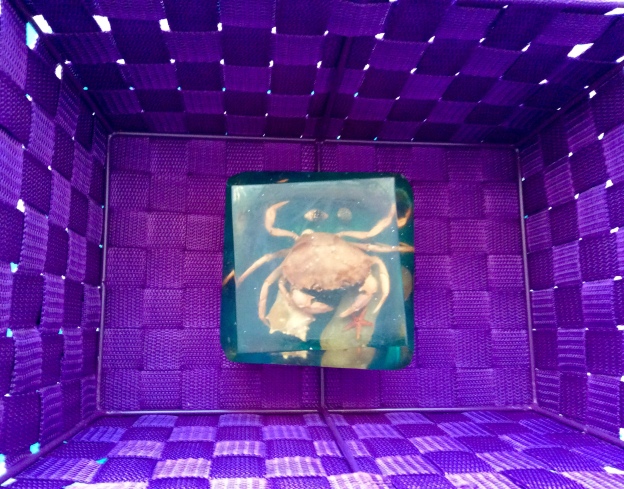
        The purple colour, the crabs, the nightmarish evocations of pig hearts as well as Crabian ones. Embattled by an antagonistic foreign country that is also perhaps the intended reader’s own UNforeign template of a home country, the characters endure stoically an oblique metaphor for something far more frightening than just the normal concerns of abuse, danger or racism as a cancer of crabs. Not knowing, even through the central trope of Dadaistic instinct that this work engenders, how to differentiate what might bring despair and what might bring hope. And who or what is one’s biggest threat? The threat is you, dear reader, whoever you are, however you the reader interprets this never-ending quest for righteous meaning from such a bleakly visionary, sometimes unhealthy, often disarmingly plain-spoken swirl of gratuitous horror for horror’s sake, amid the competing forces working upon young love in an alien universe.
        “Humans are born alone and they die alone. Don’t you think that’s sad?”
      2. This publication also includes a shorter story by the same author that I read and reviewed last June, and this is what I wrote about it then….
        —————————————
        Fountain of Drowned Memories   by Erik Hofstatter
        “That feckin’ material, what yer call it? Why can’t I remember?”
        Insulation cladding?
        A very powerful portrait of a man suffering from dementia in a care home, where he sees his sink as a fountain of drowned memories.
        A fountain, though, usually flowers like attractive features of life, I thought…
        Yet, I see this man suffers from his overgenerous urine outtake as if fed and stemmed upon pure asparagus diet. A throwaway line with a million meanings.IMG_3432
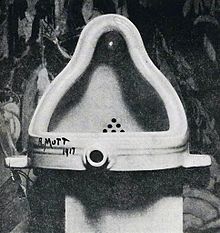
        All close to home for me, with my own prostate, and I expect one day my own son will come to visit me to decry the fountain until we both do sink into it, one by one, over time? And THEN I remembered – Marcel Duchamp’s famous work of art of a pissoir was called FOUNTAIN, wasn’t it? And I smiled.
        Dreadful death will come later following my final Avant Garde smile, after all, I thought.
        A moving work, in more ways than one.
        Dada, my son said.