Thursday, September 13, 2018

Vulgar Things – Lee Rourke

20 thoughts on “Vulgar Things – Lee Rourke

  1. Pages 1 – 14
    “It feels like I belong on some separate level, something higher: a plateau designed only for people like me…”
    Tuning and retuning into caught moments of conversation in this pub talk of a book, captured and captivated by it, a bit like David Mathew stuff, so that’s a good sign. I flow along with this bloke, think I know him, someone who we have just seen being sacked from his editorial job … but he is now asked by his brother Cal to go and sort out his uncle’s death and caravan.
    Some form of rapture, it says somewhere about something else, and check out the strip joint he goes to after a skinful of drink and sees a woman stripping a skinful like someone in my own old story in the 1990s. Queuing behind crazy people.
    So that I do not spoil the plot, but just give you my future ongoing reactions to it, here is the book blurb as if you have picked the book up in Charing Cross Road, in which area we first meet this narrator, called Jon, his name according to my just tuning into his telephone call at the end of this section. Just noticed the blurb below tells you this, too.
    FD38A30D-E6EC-4EF8-864A-FCD4D4B8CBA6
    “Maybe someone is wondering just what I’m doing here”
  2. Pages 15 – 22
    “I like it here, below the sea…”
    I am glad it was suggested I accompany this book to Canvey Island, an island more or less than the name, a strongly summoned genius-loci that ebbs and flows, “time” also ebbing and flowing (today in the book’s real-time being Friday), and I feel at home, although I have never specifically visited this island until now, although much of it here reminds me of the Essex estuary and sea coast that I do know, the creeks and crannies, including my familiarity with Southend, its Kursaal and its long pier. The book, via Jon as narrator, mentions the fatal 1953 floods. That is within my own living memory when I existed as a five year old in Walton-on-the-Naze just along the coast, but with a shorter pier. Is “time” itself a sort of oil that lubricates something that needs lubricating, I gratuitously ask? This book is unputdownable for me, but I am determined to indeed put it down sporadically, eke it out, savour its flavour, and tell you about it without otherwise spoiling it…
    “being here makes perfect sense”
  3. Pages 22 – 33
    “There’s a record already on it, an album by Dr Feelgood. I’ve never heard of them before today.”
    I have hardly heard of them, myself. Though I admire the irony of their name in the context of Jon’s late uncle’s sort of Tardis of a caravan on a gloomy caravan site. His uncle’s backstory and inferred interests in books and stars, his residual detritus, too. I rather relished the overheard ‘pub talk’ of a journey around Southend earlier in this section and relished, too, the Essex lady who wanted her steak well done. I am trapped in recurrence, never to get out of this book until I have recruited my own replacement reader …overcooked, but with the blood still seeping?
    “because there’s nothing else to do”
  4. Pages 35 – 60
    “This book I cannot write, this book I try to finish, to construct each day, this fucking book which is killing me because I cannot reach the truth…”
    That is not the authorial voice, by the way. Meanwhile, I have just read far more than I intended to read just now. I couldn’t put it down, even though I tried to do so, thinking: what on Earth am I going to say about it without spoiling it? Virgil makes me think of parsing and construing for my school days Latin. Then I think the word Virgil is not completely dissimilar from the word Vulgar. Or Vulgate? What I learn about Jon’s Uncle’s aspirations, and the videos, the rewriting of Virgil, and the precarious ability to film himself on videos in the 1980s, and Jon now looking at the videos in our own real-time today, when he could film something and put it on Facebook straightaway. And when I follow Jon from Canvey into Southend, I wonder at the stick he obtains to walk with, then the solitary pier sticking out across the estuary mud, the tiring length of it to walk that I already know well, and the girl on the pier, and the logistics of being left something by his uncle, and I am mesmerised by something I can’t quite explain, changing from an ordinary reader towards becoming a full colluder with Jon, without really understanding everything. But Jon is not understanding the events and ambiances flowing by, either, and the view from the end of the pier is a bit like looking back at those of you left behind on the shore, not privy to the view I see, yet even this is not the whole view…many coordinates yet to triangulate.
    A roof yet to be hawled open upon a pulley.
    “a kind of shuffle”
  5. Pages 60 – 67
    POSSIBLE UNINTENDED SPOILERS FROM THIS POINT ONWARD
    “There are its rings. I’m looking directly at Saturn, by complete chance.”
    I need to claim something here you simply won’t believe, but it’s actually true. It’s so unlikely, I have already defeated my attempts to claim it. Why did I stop last night mid-chapter on page 60? How had I not already glimpsed something significant on the next page? Depending on the answers, this is the strangest and strongest synchronicity yet in my ten years of Gestalt Real-Time Reviewing! ‘Shudder’ is indeed the word. Including similar synchronicities in these few pages today of the Dr Feelgood track and the sight of the same girl stranger swimming in the nearby creek whom he earlier met on the pier.
    Meanwhile, a cliffhanger concerning his uncle… “I want to know why he chose to live here, away from everyone, keeping himself to himself, creating his recordings, writing his unending book, listening to the sea outside his window, gazing at the stars from his shed, lost in time, forgotten.”
    This utterly intriguing and captivating book may answer these questions. This review will hopefully not do so. I will continue tentatively giving my real-time reactions below. But by their very nature, they may let something unintended slip…
    “black screen”
  6. Pingback: Synchronicity rampant… | DES LEWIS GESTALT REAL-TIME REVIEWS Edit
  7. Pages 69 – 90
    Personal “random” observations of mine — alongside these pages themselves that have some strikingly effective observations of human life in Southend, from May Avenue to Queensway and York Road and then the Irish pub and then back to the Lobster Smack pub on Canvey —
    My own road where I have lived for the last 23 years is immediately flanked by another York Road and another Queensway.
    “…but it’s a self-service café so I get up to join the queue.” The 1990s story I mentioned earlier (“Queuing Behind Crazy People”, its text searchable on-line) features a lobster basket as well as a particular mention of a stripper who strips off her clothes, down even below her skin. “Or like I’m watching her through a lens, in real time, a more lucid real time—“ implying comparative grades of real-time? “The fact that all this is happening in real time, right now, is quite hard to believe: the birth of new stars, the death of old, the planets orbiting,…”
    More Virgil, Petrarch, ‘Rerum Vulgarium Fragmenta’, Uncle’s video about someone called Laura, the frustrating strictures and passions of writing a book… “That’s the aim … to be truthful, never to deviate, always to rewrite,…”. Meanwhile, it is also “Sunday” in my own real-time today.
  8. Pages 91 – 114
    “It all seems so fragile, too unstable, as if some fall or crash in the universe is imminent. I’ve had similar thoughts at different times throughout my life, of course. This is nothing new.”
    It is Monday in the book, too. And Jon is confident that his quest, in dour Southend, will find that girl he first met on the pier – just as confident as I am that I will find further personal synchronicities in this book and others. Here, for example, that, from Clacton, I often hear the deep rumbles across the sea of munitions testing (as I understand them to be) from Shoeburyness. And I see the same Thames Barges passing. And I once visited Toledo. But I don’t like cats!
    “She turns around, laughing, and gives him the Vs,…”
  9. “Who shall bring once again an Age of Gold
    To Latium, to the land where Saturn reigned
    In early times.” – from Virgil’s Aeneid
    ========================
    Pages 114 – 140
    “It’s quite mesmerising: a series of arcs and giant ellipses, of widening degrees, sweeping diagonally downward, through the constellations, which I presume to be the path of Saturn in the night sky.”
    Monday, into Tuesday. This work seems to be capturing me as a reader just as much as Jon feels it is capturing him by means of what things it makes happen to him. A sense of kicking against the pricks of the synchronicities, and trying to assuage guilt by helping others, but others who do not want your help, and the sense of being watched through all tranches of time from one’s childhood till now. Revelation and counter-revelation, almost a Toynbeean challenge and response, that I am being forced to parse and construe. Like I once did in my Gestalt Real-Time Review of ‘Finnegans Wake’ and of some other notable books…but this ‘Vulgar Things’ work seems disarmingly simple, compelling, page-tuning as its weapon of first use.
    “Like it’s supposed to be gibberish, like the gibberish is some sort of code, and only readers who go along with it will begin to understand.”
    ========================
    “Books have led some to learning and others to madness.”— Petrarch
  10. My Natal Chart specified above, showing Saturn close to my Ascendant…
    CCB9890E-D756-422E-8FD6-4129684E239A
    ===========================
    Pages 140 – 165
    “: editing this manuscript is pointless now as it can’t ever be read by anyone.”
    The synaesthesia of Jon’s Southend pub and road quest and listening to pub talk between the Southend man and woman, the dealings of drug dealer and dealt, importuner and victim, wondering whether someone is genuine beggar or thief, sex worker or genuine attachment, pub talk with effectively blank three-dot ellipses as well as real speech.
    “I yearn for Saturn, my legs shaking. Just to see it now, hanging peacefully;”
    Synaesthesia, yes, and indeed pareidolia evoked perfectly, in his photographs – and word pictures of Thames Barges and weather storms approaching Southend via rain-streaked bar window vistas. I take photos of this coast but then I often see something in them that I did not know I had taken (many of my photos shown as scrolled here: https://nullimmortalis.wordpress.com) Jon also ponders on the “silent geometry” of buildings as well as of the night sky. And feeling like an actor being filmed…
    “blank spaces between the scenes”
  11. Pages 165 – 190
    “…there’s no one to help you, except the sea, the sea helps us, we live for the sea.”
    We follow Jon spending the night among the homeless of Southend-on-Sea, still intent in his quest, and he returns to the caravan’s Canvey, still sorting his Uncle’s possessions for Jon’s own telling family backstory. His Uncle who has recorded a message also of his “elder season of pain and regret”, the search for this book’s eponymous “common voice”, tempered by another recorded thought: “Strange, marvellous things arise … and our suffering we shall know, was not in vain.” By sonnet of Petrarch or not. By Saturn or not, Jon later “knowing that Saturn is somewhere up there, with me, hanging above me, keeping me rooted.” A dead seagull contrasted with a swarm theory or hive of such birds as rings of Saturn? And the shifting identity of that girl met again on the pier, by the bell…
    “looping at intervals”
    ============
    A quote made a few days ago (in my still ongoing chance concurrent real-time review of it) from Sebald’s “The Rings of Saturn”:
    “I do not believe that these men sit by the sea all day and all night so as not to miss the time when the whiting pass, the flounder rise or the cod come in to the shallower waters, as they claim. They just want to be in place where they have the world behind them, and before them nothing but emptiness.”
    C45D1D3A-2420-42DD-BA7C-37E2951881C5
    DF68D8C4-A6CA-406F-BDE6-D68949F189E2
    A voice from my reading today of VULGAR THINGS:
    “Fishing … Sorts a man’s life right the fuck out … I do all of my best thinking when I’m out on the pier, fishing. Everything goes away. I’m a fucking king out there, geezer, I tell you, a fucking king…” (Ken King?)
  12. Pingback: Vulgar Rings | DES LEWIS GESTALT REAL-TIME REVIEWS Edit
  13. Pages 190 – 212
    “Living things are filthy and it’s only when death confronts us that we finally see ourselves for what we truly are: accumulations of filth.”
    Life, a series of silent alarms. Sounds and sensations as a form of mathematics. Life is, I say, also a series of catharses and sudden realisations and reconciliations of connections, like reading a fiction book about oneself for which you wrote the real-time notes without consciously doing so, till you reach that hindsight gestalt, that Saturn in the sky, made paraeidoliac or synaesthesic as a form of found art by re-recording it. Some beautiful concepts of Saturn, here, including Jon’s black and white photos of it, via his uncle’s telescope, and through his uncle’s hawling-roof. These pages have plot catharses and realisations and rejigged backstories. The arrival of infinite space to house all of us, leaving our filth behind! Soon to be bodiless as a positive form of homeless. A poignant and powerful denouement. Re-recorded here, by my review.
    “it all becomes visible”
  14. Pages 212 – 230
    “Speak quietly, and carry a big stick.”
    These pages represent a telling coda within the book and as a confirmation of what I just said in the last entry. Bearing out what I thought then, but now with a clinching coming together of the palimpsest gestalt, accomplished vividly with better words than mine on page 229. Meantime, the beacons and the food for such beacons at the end seem to echo my emotions when reading ‘The Light of Adria’ in the INNER EUROPE book I mentioned earlier as a chance concurrent real-time review, together with the similarly concurrent Sebald review that is still on-going, in fact hardly started (the Sebald book alongside VULGAR THINGS providing my most significant synchronicity in the ten years of doing such reviews). In itself, as a separate entity, VT (video tape?!) is a great novel I have greatly enjoyed parsing and construing. As you can see I could not put it down today! Virgil and Petrarch will never be the same again, nor my view of my own natal chart that I first erected when I had my own children in the early 1970s…
    “…”


    Wednesday, September 12, 2018

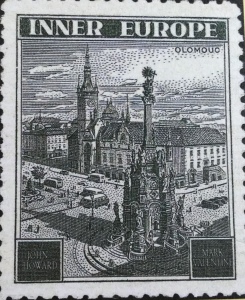
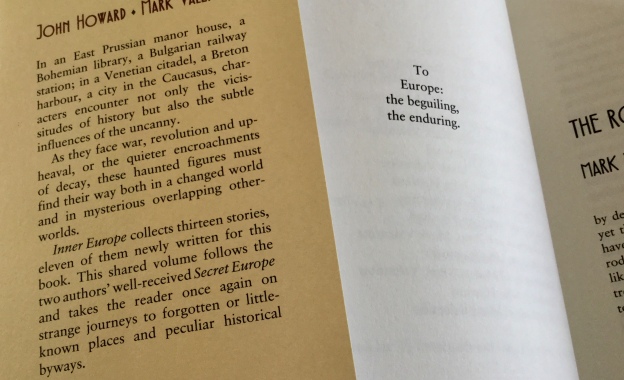
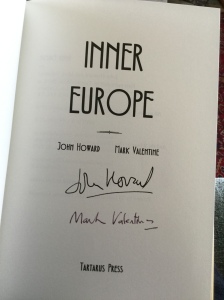
    Inner Europe – John Howard & Mark Valentine

    Inner Europe – John Howard & Mark Valentine


    07F1C1CB-E7BA-49E5-9B7E-91E98333A2A6
    TARTARUS PRESS 2018
    My previous reviews of John Howard & Mark Valentine HERE and of their “Secret Europe’ HERE and of this publisher’s books HERE.
    When I read this book, my thoughts will appear in the comment stream below…
    18 thoughts on “Inner Europe – John Howard & Mark Valentine

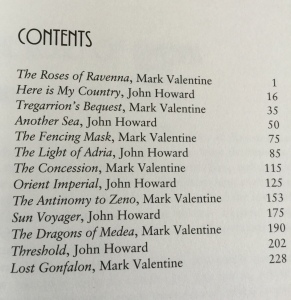
    1. THE ROSES OF RAVENNA by Mark Valentine
      “So I have learned to look at them aslant, to absorb their salient features and character in a few caught moments.”
      These are possibly the richest words with ‘caught moments’ of luxurious terrain and limned character by this author, words perhaps beyond even those of John Gale, depicting both gorgeous rapture and less amenable visions of humanity scarred by history and possible false belief. The rose-cult at the margins of the salt marshes around Ravenna, featuring a good-looking boy-man who is intent upon the riches hidden by the otherwise inimical memory of Nero and his would-be doppelgänger Heliogabalus. To transcend Baal. And the narrator’s view is of this ‘boy’ and also of a man called Lastingham perhaps appropriately named and deemed English for our current times, the last-named taking the ‘boy’ under his tutelary wing in search of Nero’s rose shrine with eventual dire regret following good intentions. (With not so much Death in Ravenna as there was in Venice, but certainly a hair-barber as its latent catalyst.)
      “Nor was Lastingham any use to us. He could not remember much of the route they had taken and was always so tentative that we could hardly place any reliance upon the little he did say.”
    2. HERE IS MY COUNTRY by John Howard
      “The façade was apparently no more than strips of sleek white concrete and lake-clear glass, yet this defined a space within where space itself seemed twisted around, doubling the volume offered by the house it had replaced while conforming to the human scale of the houses still surrounding it.”
      This optically deceptive text is given a clue there, I feel, arising from the history surrounding the place in 1948 that history once knew by several names, and still does, including that of Czechoslovakia, here centred on a specific town, then centred again on its library together with the characters fictional or historical who seem to convey my sense of the Unconsoled, the political machinations leading to these centres of sense and nonsense, the characters who had been Nazi collaborators, the good guys by comparison who hold that tiger by the tail, and today’s lodestar resistance against power during this my own real-time while reading it.
      Intrinsically, the text’s vision of water in the library held at bay by a magic membrane is most memorable. Indeed, another clue is in the other means of looking through glass as well as up at it, i.e. the Defenestration allusion in Czechoslovakian history towards the beginning of this wondrous work. It all comes together, then and now, there and here. “And all in plain sight.”
    3. TREGARRION’S BEQUEST by Mark Valentine
      “The delicate beads of purple and scarlet fuchsias, faded to ghostliness by the dusk, glowed in their window-boxes and urns like the half-asleep eyes of strange creatures.”
      The window-boxes seem obliquely to be part of “Here is my Country”, and here is our country indeed, our inner Europe linked by legends of Cornwall and Brittany, never to break, as our representative or narrator wends that effulgent path, after a bequest from a friend who had also been intent upon such linkage, our narrator exorcising his fingertips’ blue-black ghosts of scrivenly drudging, avoiding Methodist disapproval, meeting a shy handsome lutenist in a Bar Tabac, absorbing vistas with which as readers we are imbued, too, no local nonchalance or brittleness suffered, as that linkage is consummated. Consummated not mundane-carnally, but Cornish-Bretonly as the singular spirituality of a sunset-mask. John Cowper Powys is perhaps reborn.
    4. I read the next story in 2016 and below is what I wrote about it here:
      =================================
      ANOTHER SEA by John Howard
      “…he didn’t realise how mighty, how interconnected everything truly was. He was a child sitting on a petrol pump with his eyes shut, and striking matches.”
      And I feel like that immature child myself, tackling this story. Or I am the old friend brought in at the end with amber lenses… This, for me, is another version of Brexit in a wider sense within Europe, here being its Baltic states transmuted by name and geomantic position, in all its historic-Hanseatic and religious aspects, schisms, heresies and hopes, and despairs. It is a mighty work, one that will take you by the scruffs and sleeves of the land-mass soul.
      Beautifully couched. Substantive with “the mingling of awe, wonder, love, terror and sheer invigorating fright that he wished, somehow, to communicate as a believer in the real religion of our communities.”
    5. THE FENCING MASK by Mark Valentine
      “We followed him around the back wall, with its narrow windows. He peered in the dim light, not at the glass but at the wooden frames. At one he stopped and pushed his thumb into the damp timber,…”
      A traditional ghost story with a twist in its grip. Three men, refugees from war, stumble, amid much previous emptiness and attrition, on a large abandoned house, inside of which, via that rotten fenestration, they find many artefacts of its previous inhabitants, including fencing-masks on the wall. One of which has that grip…
      A sort of obverse mask for this book’s earlier sunset in Brittany?
    6. THE LIGHT OF ADRIA by John Howard
      “No light shone from the windows.”
      Previously water, now fire. This substantive story brought tears to my eyes. The Dalmatian coast, history’s politics of pro-Italian and Serbo-Croat student groups, an overarching professor who invites some of them to his seminar in the disused lighthouse. There is no way I can rehatch here the politics, the considerations involved, whether alternate or real, nor even hint at the goal of the borderless Final Empire, like a giant Vatican City without the religion. These concepts come naturally with the flow of the narrative, imparted subtly by dialogue and events, individual action and reaction, challenge and response. The hawling of a brazier to the top of the lighthouse, the voluntary arranging for the burning by the professor of his own life works as a beacon for the Final Empire, transcending what is happening to us today. A futile catharsis? Well, on a personal note, I have started in the last few weeks a sort of sacrificial, symbolic ‘burning’ by gradually transiting my books and their spirits to others. Including eventually this book itself that I just purchased.
      “A fire, light, can work both ways, and mean more than one thing.”
      “When it comes down to it, we are all so very small.”
    7. THE CONCESSION by Mark Valentine
      “The things glimpsed in the river, not quite floating, not quite sinking. He shook his head, placed his fingers on his eyelids.”
      One must make no concessions to the past. Or to the future, come to that, this being one of those story accounts that works perfectly without the reader knowing quite why or how it does. I call it Proustian, but it spans more than just memory and time. It spans from China to Austria, in the former where our he with the eyelids — originally from Trieste — was Consul for the Austro-Hungarian Concession of visually assonant Tientsin, with its book-pedlars and origami boats. Now the latter as objective-correlatives sink or swim upon the tidal onset of the World War (the First as it happens) and he is praised in bringing back everyone safely to Austria during those upheavals… and asked to write an official account of that and his life. We watch him in real-time trial-and-error with writing the text of this account. As you do with with me writing this review. All ‘minor heroes’ subject to as-above-so-below. Fragile paper lanterns as the new celestial bodies. Or as words describing words.
    8. ORIENT IMPERIAL by John Howard
      “…something more than mere strung-out lines and complex knots of shining steel thread through regions and countries. That boy can see all Europe knitted together in a way that its politicians seem unwilling and unable to.”
      That boy being the younger son of English Mr Soames (the narrator), a son who is obsessed in the 1930s with the trains and railway, Soames’ eldest son being more obsessed with the then new-fangled air travel. Soames meets King Boris of Bulgaria when visiting that country, the King who seemed to know already what Soames’ sons were interested in – so, perhaps the King had already read this story where this information is imparted to its readers, and its machinations already worked out to happen… and when you yourself read it, you will know what I mean and I have no need to forward-adumbrate it here, for fear not only of plot spoilers but also of the reversed happenstance that such spoilers might cause. It is a story with a narrative that is eloquently consuming, compelling, page-turning, and I cannot stress that fact enough. It is about the narrator’s journeys on the Orient Express throughout Europe (immediate history imbued with the tracks he necessarily follows) as a travel writer and journalist who meets kings and queens as well as those who defer to him, at times a flâneur or boulevardier, at other times, a mover or shaker, it seems, as he mixes with his “betters and inferiors” alike. There are chance windows of opportunity by facilitative signature or hypnotic transformation – among literal movers-and-shakers such as traindrivers or kings. Just as one example, the scene where Soames first meets King Boris is a classic in all literature, I suggest. I have such “‘instinct’ for a good story”, just like Soames does as a journalist.
    9. THE ANTINOMY TO ZENO by Mark Valentine
      I. The Master of Zatrikon II. The Song of Miriam III. A Wanderer In The Dark IV. At The Château Noir.
      “I am a writer, a chronicler of the Old Quarter. I walk its ways waiting for encounters with the beautiful and strange.”
      A free flow, as the way I have shown the sub-titles, almost a ritual journey pre or post Damian Murphy, whereby we follow the flow of the writer of the writer, the bet of the bet, a gamble with truth and understanding, never-ending like one of Zeno’s Paradoxes or Antinomies. But more a reverse Toynbeean challenge-and-response from or to Trebizond? Full of wondrous place names and inherent histories of Europe, Ottoman and Habsburg. Eugenics to create the master race versus acceptance of those who live in the city crammed but singing beautiful songs — and arcane objects passed hand to hand in methodical waywardness, for example a chess piece from a game played on a circular not square chess board, plus games of skill OR chance, but this story is, for me, a game of BOTH skill and chance, the forbearance of slums versus striving towards wider boulevards and (necessary or ruinous) clearance…a dilemma for our times. Break or heal, we probably need both. The Statistical Society is meeting in my house tonight. Be there, or be square. No-one knows what crucial action will create the necessary onward concertina or closing checkmate.
      • The Paradox or Antinomy to Zeno that I remember best: “Suppose I wish to cross the room to meet Zeno. First, of course, I must cover half the distance. Then, I must cover half the remaining distance. Then, I must cover half the remaining distance. Then I must cover half the remaining distance…and so on forever. The consequence is that I can never get to Zeno.” The same with my memory that halves each half as I grow older. And I am reminded that the above story is half of another story first published in 2009: one entitled ‘The Seven Treasures of Bucharest’ by Mark Valentine and Geticus Polus that I reviewed here at that time: https://nullimmortalis.wordpress.com/2010/08/18/265/
        The free flow in that earlier version of the story: I. The Master of Zatrikon II. The Song of Miriam III. A Wanderer In The Dark IV. Electricity V. The Heart of the White Ambassador VI. At The Château Noir VII. The Bearer of Peacock Plumes.
        [The 2009 book also published UNDERGROWTH (of books and literature!) that first appeared in NEMONYMOUS (Zencore) in 2007.]
    10. SUN VOYAGER by John Howard
      “But I can grasp the idea behind them more than I can that we first came from somewhere where there’s no sea, rather than Norway and Denmark.”
      …being the Icelandic narrator’s thoughts about the source of who he really is and where he lives. Iceland I had never thought before as part of Europe. But it has certain links of trade and Schengen unity, I see. Somehow I ponder it as an Island Empire, to match an Inland Empire that this book embodies as Inner Europe, expressions that seem to resonate with the title of a David Lynch film. Here, we have mixed for us: Icelandic art as sculpture, the legends, movers and shakers like earthquakes and volcanoes, skylit aurora, and finance as a crypto-currency rather than solid money. All in the ironic form of things like sculpture, and coins, that embody a soul of belief. As it happens, today, before reading this, I watched ‘Fake or Fortune?’ about a Giacometti sculpture while, now, this story’s eponymous sculpture is a mutation of a ship or shipwreck or Giacometti’s typical attenuating figures… just like the Englishman visiting Iceland for its sculptures: Lewis Bell, riven by debt from the world banking crisis, and he sees the Icelandic banks as what helped ignite that debt… a complex story that has its own inner empire of substance as imagination and vice versa, of that substance made real by belief in its intrinsic value or bartering power. Mixed in with a vague sense around him of sexual guilt or jealousy as the wife follows her husband who is the Icelandic narrator semi-obsessively following, in turn, Lewis Bell to the museum with the eponymous sculpture. An English name that rings true. And that Englishman’s need to get his own back, as it were! “Something to get hold of.” A clever story of attenuating graspabilities. Or of imperial weight.
    11. THE DRAGONS OF MEDEA by Mark Valentine
      “We do not need omens to tell us what they mean.”
      A word-rich and luxuriant descrying of Medea and her part in history’s sorcery, with telling shades of history’s more attritional grey. The yellow smoke of cigarettes, too. And books in painted signs and books that seem blank. Boy messengers. And golden filigrees of dragon scales. The Narrator works in a post office and sends off letters with postage stamps worthy of John Howard — letters returning to him with palimpsest carbon imprints whereto they were sent. There are many references, arcane and clear, historical and mythic, in this text, and they still teem within my brain. My particular concern today is that the work preternaturally and tellingly links with the planet Saturn that (differently?) imbues my concurrent review of VULGAR THINGS today here. In that book prevails the Latin of Virgil and Petrarch. Here in the Valentine, the skeins of Ancient Greek. The mutual synergy is striking. Including the ‘silent geometry’ of mundane and celestial architecture…
      “Certainly, yellow Saturn is throwing its vast influence like a sulphurous fog across us all.”
      • I forgot to mention probably the most important thing about the above story for me. The way that books assume the character of where they have been and who has read them, viz. the spirit of this quote with which I have lived for many years –
        “Every book has a soul. The soul of the person who wrote it and of those who read it and lived and dreamed with it. Every time a book changes hands, every time someone runs his eyes down its pages, its spirit grows and strengthens.”
        —from ‘The Shadow Of The Wind’ by Carlos Ruiz Zafon
        And the way I have been recently sending my own books into this perfect circle of soul (described in my review above of Howard’s ‘The Light of Adria’) — and now we find in this Medea one by Valentine: “Perhaps one day these books of mine, these travelled books, will be found and studied, and it will be known that there was one in the city who did what he could.”
    12. THRESHOLD by John Howard
      “He was truly alone — islanded.”
      Another substantive short story that should endure in the realms of great literature. This one tells of Count Philipp von Stern in his large and stately, if not entirely beautiful, house in East Prussia, following the Great War. The house (for him not only built from brick but memories) has now hit harder times and is in unstoppable entropy, poignantly, evocatively and eloquently described, a great director’s cinema masterpiece of an atmospheric film never made, but here made by Howard for our inner Europe of the mind, telling of Stern’s possible dementia in talking to the ghosts of his wife and of an old gardener-mentor, still playing his boyhood conjuring tricks, transposing coins from his hand to other places, a prestidigitation that links with the hyper inflation of the time, and with many of the currency and (non-)substance themes of ‘Sun Voyager’, and the books in the house’s library, one missing, but another there he did not expect to be there. With the themes of the sharing of books by burning beacon or shared passage that I just adumbrated above as a postscript to the previous review. The keeping of the library for others to inherit. And a perfect ending that will resonate, making you wonder what or whom had been conjured back, or conjured away.
    13. THE LOST GONFALON by Mark Valentine
      “The hinterland is no affair of ours.”
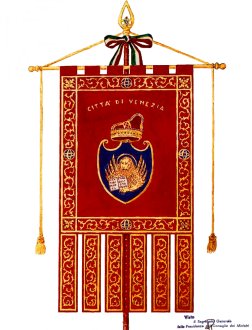
      0DBF36DD-0CDE-4FD7-A7C0-CD2D3079D4A8An intriguing apocryphal coda by flag or emblem to a book of the English narrator’s official travels and descriptions published in 1914, a collusively couched, teasing-out of his visit to the little harbour of Perasto, a distant outpost of the Venetian Republic, at the end of his travels along the Dalmatian coast. A mix of a genius-loci past-its-glory and a visualisable formal dinner where he had booked to stay as a chronicler, but mistaken by his hosts to be a consul. A sense that he had slowly slipped piecemeal into a slice of alternative Napoleonic history or that his hosts (a young woman among them to whom he feels himself attracted) are suffering from pretentious dementia…
      Venice as a psychologically spurned hinterland of a Republic, if such a thing can be imagined, as if it is or was or will be an Inland Empire without borders on the coast. Only my fencing-mask needs taking off for me to tell you with whom you have been sparring story to story inside a book that has no borders or coasts or hinterland. Most of its individual stories, when fenced-off from each other, should never be forgotten as islands of literary craft, nor prevented, for their own discrete sakes, from escaping my attempt at Gestalt. But, then again, maybe they should be brought together again in a book, passed to other reading hands, as a mighty inner strength that they always were. Ever halfway there, ever halfway back.
      end
          
     
    :)