Saturday, December 08, 2018

The Rust Maidens – Gwendolyn Kiste
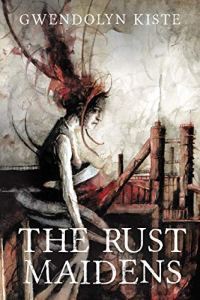
The Rust Maidens – Gwendolyn Kiste


9E625DC3-E890-4171-AEEA-29F7CADA6A83
TREPIDATIO / JOURNALSTONE 2018
My previous reviews of this author: https://dflewisreviews.wordpress.com/tag/gwendolyn-kiste/
And of the publisher: https://dflewisreviews.wordpress.com/tag/journalstone/ and https://dflewisreviews.wordpress.com/tag/trepidatio-publishing/
When I read this book, my thoughts will appear in the comment stream below:

17 thoughts on “The Rust Maidens – Gwendolyn Kiste

  1. ONE
    “Everything I do always feels a moment too late.”
    Like starting to read this. Phoebe, 46, returning to the place she was brought up, after a gap of 28 years earlier, the shops, houses and her mother still there, changed, but not changed. Receded into recession. Father now elsewhere in a tired rest home. Signs of some eponymous legend or fame in the title, a group of girls therefrom, the title she chose to call this book that contains this return towards a future recession in the past. The old bug house, where a much younger eponymous disciple, I guess, (Phoebe unexpectedly finds) is a girl squatting called Quinn. What happened to Phoebe’s ambition with entomology, I wonder? I won’t continue to re-rehearse the plot as I go through, but I think I know that I am already entranced enough thus to continue at all. We shall see.
  2. TWO
    “They never quarreled needlessly, and they never excluded someone just for fun. They were decent and gentle and the closest to kind that anything could be, and they followed comforting patterns—“
    Patterns, yes, but comforting? Phoebe’s treehouse of bugs and insects.
    The Polaroid of 1980, then, as we have expanded for us memories, to live alongside her Graduation Day, the other girls (one, Jacqueline, her inseparable but separated cousin and another, Lisa, you won’t easily forget and another, Dawn, with our given dark vision of what it is to be mis-impregnated at such an age) and the industrial backstory of the deadpan town. Haunting, seeping … emotions with more than just broken waters.
  3. THREE
    “…and tucked myself next to the bookshelf brimming with my mother’s favorites. Madame Bovary and Wuthering Heights and Anna Karenina,…”
    Her 1980 memories, ignited by polarised Polaroid, slightly beyond level graduation, make me think what she and Jacqueiline find within Lisa (and even perhaps within Dawn?) resonates with Phoebe’s Impala…
    “….about how that car couldn’t make it out of the driveway. Then I would say it could reach the stars. Any star in the galaxy.”
    Only rustbucket Tardi are in some late space opera? Each with is impalace or imbalance? Impaled or browned or oil-changed?
    And the mill’s astrike again, her Dad deadpan with industrial acceptance.
    “A dubious queen of the unknown.”
  4. FOUR
    “—invasive as kudzu vines—even chartered a bus. Polaroid cameras tucked in fanny packs, they stalked along the road, those who wanted a glimpse of our neighborhood’s unmentionables,…”
    Unmentionables, the rust mill male strikers, or the eponymous maidens still with their maiden names? Or both? This book has by now become invasive upon my mind, too, like kudzu vines. Strange that the strangeness is emerging piecemeal. Acceptable as truth or normal reality. And girlish bonds broken at a seeming whim… Any dreams of leaving Cleave-Land for a bughouse in Alaska gone? And those coming for Polaroid glimpses, one of them dishy….
    “, learning our mothers’ maiden names…”
  5. FIVE
    “There’s a tiny gash on Quinn’s arm.”
    ‘Cleave’ is one of those few words that can have the opposite meaning to itself. To stick, and to split.
    Back – briefly, I wonder – to today, when Phoebe is 46, and we watch her dismantle things like the tree house and meet up with someone from her Polaroid past, someone who had then been too young for her to know at all…
  6. 359771C9-4743-4E35-B19B-85CE0F9B2225 SIX, SEVEN & EIGHT
    “This whole street was becoming a zoo, a menagerie of girls, and it was all so terribly wrong.”
    The townships voted mostly for Trump in the Rust Belt of America around Cleveland, Ohio…? I have images of fake news spilling out of old 1980s camera like filmic viscera. I think the book says it somewhere, too. As Phoebe debugs her own bugs, tears off the wings to save butterfly angels from their fate, as that fate’s history winds onward from the chain link fences of old Concentration Camps to the chain link fences of working men striking, to the eponymous maidens’ lacerating their new bodies there in face of the fake news tourists…
  7. NINE
    “Hospitals were confusing places that pretended to be orderly, that pretended to make sense. Places that told us to trust them, even though they offered us little reason to do so.”
    The raging polarisation of today is played out back then, in embryo. Even the Polaroids become slick easyspeak. Political and bodily metaphors: home and away. Neighbour against neighbour. Friend against friend. Picket lines and chain link fences. A word came unbidden to my head: ‘pust’. My word not the book’s. Think about it.
  8. TEN
    “We were going to pretend that our lives were normal, even if it killed us, even if it suffocated what little lingering hope we had left.”
    Cocktail-drenching and barbecued-flesh celebrations for July 4th, something that happens across the Atlantic or the Pacific, in USA, or is it something bigger spreading outwards? Like this book’s eponymous rust-cleaving enclave? Amid the tourist fakers and government men…
    “They milled about the neighborhood, their ever-flashing cameras dilating like eyeballs in our faces.”
    The Guffey eyeballs, again, from yesterday’s review here, or Fawver’s orange balls? We need books or just one book gestalt-bound within other novels and stories towards a potential cure or healing – or hawling (“the hot screech of metal and the carriage of heavy earth…”) … and, sometimes, this book seems over-evangelical about its thrusts and turns, in the alliances of the township (insiders and outsiders alike), but only by brainstorming can the remedies of fiction be harnessed… The descriptive scene of a particular Rust Maiden breast-feeding, for example, is a mighty literary scene to remember, but also one that strains the bounds of brainstorming and Kistean fey fantasising…
    “Even if we hadn’t sewn our lips shut years ago, there still might not be words for what we needed to say.”
    My Facebook-programmed ‘memory’ earlier today…
  9. ELEVEN
    “It’s on repeat. This whole city is stuck on repeat. A cycle that, no matter how hard we try, we can never seem to break.”
    Back today, or forward, with Phoebe Shaw, we see through her eyes the area’s wrecking-balls, and two men today, now older, from the earlier Polaroid times, times we have just been re-living in previous chapters… an aura of regret that we all now share. Those two men, then two girls, not born or just born back then, part of the on-going cycle?
    Orange-lined sleeping-bag purchased from Sears 40 years ago, just as important for Phoebe now? A museum archive or monument from just an ordinary thing.
    “Given a long enough trajectory, things have a way of working out. But so rarely is one lifetime long enough.”
    “It’s probably nothing at all, just a haphazard pattern we’re reading like wet tea leaves in the bottom of a cup.”
    “Archives and museums and the collective history of this city can’t help. If everyone else has tried and failed, who are we to fix it?”
    No spoilers here, yet perhaps over-quoting is a sort of misbegotten attempt to grow fiction of past things beyond fiction itself, without wrecking them as part of that process? Like Dawn’s baby back then, still alive today. And the old sleeping-bag.
  10. TWELVE & THIRTEEN
    “They called it the ‘More Trees Down’ derecho.”
    I don’t often learn a new word when reading books these days. Here a historic weather event in early July 1980 around Nebraska and Ohio. As a non-fiction counterpoint to — or countervailing proof source of — Phoebe and others visiting by stealth the mansion: the Rust Maidens’ lair….a fiction of another bughouse?
    “They were sealed, gray decay and rust filling every space, sealing out the sun. Some of the rot was from the stolen items—“
    And the bassinet and blanket. And the darkroom with its developing images. Polaroids didn’t need darkrooms, though?
    Fiction has historically needed paper to develop on, to make real books. But now that it’s often out in the open, it’s sort of truer? Like being told ghost stories around an electronic campfire?
    Phoebe’s earlier liaison or fling — with one of the community’s snooping male visitors of bureaucracy or fake news — had no social media then to bolster it or, for that matter, help destroy it…
    Some moving moments within the mansion, if the reader can believe the rest of it – and can make its fey fantasising have something more restrained or measured within it…
    Phoebe, as narrator, to Jacqueline:
    “‘It doesn’t matter,’ I said, my voice wavering as the pain of her touch seared through me. ‘You’re still my best friend.’”
    I have never had a best friend. Perhaps men never do?
  11. FOURTEEN
    “…and yellowed diaries with their locks and secrets rusted out.”
    “Someone who can help me unravel this.”
    Like ‘cleave’, ‘ravel’ or ‘unravel’ can also mean their opposite, both to tangle and untangle.
    Cloistered by ravelled bones and ruined walls?
    https://www.vocabulary.com/dictionary/ravel
    https://www.vocabulary.com/dictionary/cleave
    “I roll my eyes. How fitting. The church will stand longer than our homes, longer than the people who inhabited this neighborhood. I should keep going. This isn’t where I need to be. This has never been a place I’ve needed to be. But this city is a tricky one. It never misses a chance to confound you.”
    A dead monument to once ancient hope? Now with a new preacher.
    “I’m sure I’m wearing the truth on my skin, a tapestry of the past, etched in wrinkles around my eyes and the hundreds of gray hairs I’ve earned.”
    We’re back to today, Phoebe in her late forties, being the direct fount of Rust knowledge and Rust’s girls of yore. As well as exploring the local church and the derelict steel mill behind the chain link fence, she also encounters two of the men from her past and now the present, too….
  12. FIFTEEN, SIXTEEN & SEVENTEEN
    “At the back of the mansion, Jacqueline untangled her hand from mine and moved toward the door. Her lithe fingers peeled up a splintered board,…”
    Phoebe’s sense of guilt adumbrated.
    But, guilt and unguilt, like cleave, uncleave, ravel, unravel, peel, unpeel – are they really binary choices at all?
    Rust, unrust, one can never truly unrust, except by drastic attenuation of what you really are, I guess.
    “You can’t stop the girls from becoming what they became.”
    “But Cleveland isn’t ready to let me go yet.”
    “Then I peeled the plastic off the windows.”
    Or unpeeled it?
  13. EIGHTEEN & NINETEEN
    “, as though it would be easy, no different than peeling worms off the asphalt.”
    “Some wanted to hurt the girls, some wanted to save the girls,…”
    “, the plaster and wallpaper peeling off like flesh.”
    … “symphony of water”, no wonder the baby’s cradle was once called a bassinet in honour of the basin… A symphony, true, but maybe, for others, an overextended series of climaxes for a Gestalt climax of a Hitchcock film. A pent-up restraint and measured suspense, hopefully implicit in the mayhem.
    “One of the girls’ carapaces. We were tossing the remnants of them out the window.”
    I understood that utter poignancy, without understanding it. No longer a paradox, when in Cleave-land?
    “It was the most beautiful and horrible thing I’d ever seen, watching her become all that she was meant to be.”
    “everything peeling”
    “she untangles her hands from mine and drifts back into the shadow…”
    There are various climaxes …. but do they ever really end?
    A series of binary choices. But each of them has a third option which is doing both. Hence this book’s triple moon.
    A book that has its share of fallibilities but without those fallibilities it would be nothing. The wrecking balls, too. I may be one of them. I hope not.
    end


Saturday, December 01, 2018

Vastarien: Vol. 1, Issue 3

Vastarien: Vol. 1, Issue 3


CE5FBB53-A8A6-413D-B8DB-2AEC61F90446

A Literary Journal, Grimscribe Press, Autumn 2018

My previous reviews of VASTARIEN here.

Jon Padgett, Editor in Chief.

Work by s.j. bagley, Kurt Fawver, F.J. Bergmann, S.T. Joshi, Michael Uhall, Brooke Warra, Rayna Waxhead, S.L. Edwards, Tonya Liburd, Sean M. Thompson, Desiree Zamarano, Michael Cisco, Emmie Bristow, L’Erin Ogle, Sam Schreiber, Dr. Raymond Thoss, John Linwood Grant.

When I read this book, my thoughts will appear in the comment stream below….

20 thoughts on “Vastarien: Vol. 1, Issue 3

  1. five dreams of the red tower by s. j. bagley
    “. i blew out the candles on our table…”
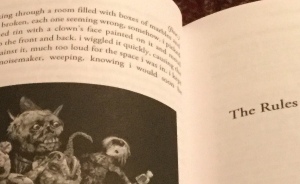
    Just where that sentence is, there follows an empty space, like a blank part of a blank story, below the text of dream (four), crossed, in the edition I received, by the smudged streaks shown below in my photo – unchanged from how I received them, in this book, from Amazon – and on the next page, as shown in the second photo, is the text of dream (five), followed by striking artwork by Aeron Alfrey.
    46F15D9C-D018-4974-BB11-5535123BE449
    F6EE7698-B51C-4005-8511-D298EACF4829
    These five dreams, in wholly lower case, as all dreams are, I guess, is a fine tantalising dark Ligottian finish to this book, at its start.
  2. THE RULES AND REGULATIONS OF WHITE PINES, VERMONT
    by Kurt Fawver
    Another fine future-acclaimable fable for our present times by Fawver, this one as first discovered by Vastarien, by the look of it, now itself looming low or hawling the budding White Pines town perfectionists of wholesome American living into their nearby geographical black hole or pit, one with coordinates and perfect circle qualities that I seem to have somehow predicted in my earlier photo of Vastarien above… Hell and perceived Heaven in contiguity? The former wherein which darkness you need to sign off so as to live in the latter, at least temporarily. The relativities buzz in my head, as this classic emblem from our own particular cut of literary cloth settles in my head. Some of the rules of tradition, history and good living here set out seem hilarious.
    My previous reviews of this author: https://dflewisreviews.wordpress.com/tag/kurt-fawver/
  3. …and that Alfrey artwork seems to be an accompanying illustration of:
    THE MAD GERMAN by Michael Uhall
    1B291516-DE0A-4551-AF33-12B12F841BA0
    …this being a seeming deliberate transplanting of ‘planet’ to ‘plant’, ‘plant’ thereafter holding the Goddess’s dream – as the eponymous gentleman (who told that tale of the dream to a young boy in the cantina) spends his time in (a version of Christ’s?) wilderness towards Ligottian nirvana, after previous debates with a Doctor about the the nature of the soul.
    I then followed it up by reading on-line about the Aztec ‘Mayahuel’ myth.
    Fiction is nothing if not educational? Uhall —> Mayahuel?
    My previous review of this author: https://dflewisreviews.wordpress.com/2018/04/02/vastarien-a-literary-journal/#comment-12096
  4. I FEEL BETTER NOW by Brooke Warra
    “But they did. And no one did.”
    She heard about another girl, one with only thumbs who became the greatest pianist in the world. And her bookish Mum giving birth to her in a pizza delivery van on the way to the hospital and the pizza boy became her Dad after helping deliver her in the van. And her bones out of place in her body. Her deformities echoing those of society’s deprivations and temptations. Powerful stuff culminating in mirror fragments of her face or self out of kilter or Gestalt …depicted by Yves Tourigny illustrating this splintered scene. As I said above for the bagley, a finish as its own start – here Anti-Natalism walking with ballet shoes. (But I still have hope the surgery will work after all.)
    My previous review of this author: https://dflewisreviews.wordpress.com/2017/11/01/looming-low/#comment-10978
  5. Artwork by Toni Tošić (hauntingly soft-muddled faces?) followed by…
    THE GLOW AT HOME by Rayna Waxhead
    “Were they trying to give us their same muddled faces?”
    An interesting contrast, too, with the previous story that deploys another muddled face, but that was sharp-muddled not soft-.
    This Waxhead seems to convey something that I have thought about in a muddled way for most of my life but it has never been crystallised until now. The crudely muddled and bumpy, lumpy nature of the world around me, of the people, of the polarisation of Good and Bad, where Bad is in the Wrong Channel along with blood, full of all the things that bolsters the philosophy of Decadence. This narrator (an interesting comparison with the narrator in the previous story) is snatched from the world of the Right Channel (with cartoonish perfections of margin inside and outside) to the Wrong Channel of losing Big Mother and losing the Glow at Home. But, then, what has been gained by losing what was lost? A thoughtful scenario, haunting me with the dilemma of knowing too little or knowing too much. Best to know oneself at least. Anti-Natalism in ballet shoes again?
  6. CHRONOLOGY OF A BURN by Tonya Liburd
    “, the band-aid strips were peaches-and-cream colored. She’d never realized that band-aids were tailored towards a white person’s skin…”
    Rather than fading into the background, this is the third fiction in a row by the distaff about a distaff loner-through-mind-or-bodily-trauma… except they are loners no longer? But they are the run of the mill in our Trumpish and Brexit era? Fawver’s contiguous Höhle or Hölle? Here, Waxhead’s lumpy and bumpy and muddled become Liburd’s skin itself, the skin of a woman running a Literary Journal, the develop-mental nature of burns on that skin and the need for support of others (on-line or rarely real) when in cognitive crisis, when just getting up to go to the walk-in clinic becomes a major event of will-power, a will often defeated. As I earlier wrote above about surgery, maybe mind-therapy also works in the end. The new faith.
  7. THE BLIND OPERA by Sean M. Thompson
    “…visual art stronger than the sum of its parts.”
    A story about such visual art that thus describes itself. A cult film series akin to ultra-Lynch that evokes someone — trying to watch its fateful emerging episodes, involving another Uhall or Ligottian “Nirvana” in the desert — as fighting an attritional battle against outside inimical influences and guiltily unsettling solipsistic forces from within so as to continue watching them, even through into its second series!
    My previous review of this author: https://dflewisreviews.wordpress.com/2018/01/27/test-patterns/#comment-11628
  8. NIGHTMARES by Désirée Zamorano
    A brief story of a city whose citizens suffer a plague-cycle of nightmares – effectively described for us, should we remember it after we finish real-time reading it….remember it beyond Fawver’s township’s contiguous Hölle or Höhl, that is. Not Anti-Natalism so much as Anti-Mütter?
  9. Then a haunting poem by Emmie Bristow entitled ‘Nightly Senses’, preternaturally, by coincidence, echoing bagley’s candles I quoted above, and an aura of the previous Zamarano Nightmares, my own ticking fridge and Waxhead’s “cartoon smile”….
  10. An appropriate, even more muddled frightening face by Toni Tošić, followed by…
    THE NIGHTMARE MAN by L’Erin Ogle
    “We weren’t big on touching.”
    …the family, that is, parents and two girl sisters. Visited by a recurring Nightmare Man, both the sisters separately visited by something or someone honestly nightmarish, in tune with or now tuning to the full this book’s accretive nightmares, and the girls themselves are well-characterised, their school life, their sparely uncaring parents, and the sister who is the narrator at the inscrutable end is the one we have to believe, otherwise why believe the story at all? A short story disguised as a long one? This book, too? The various fictions feeding into each other, or at least touching, to bolster their stammer of truth?
  11. ENNIGALDI by Sam Schreiber
    “What you do know is that it is your touch that shifts his center of gravity…”
    Just one side of the binary dilemma of Ur or Our in the course of self’s path in life. One binary leading to another binary to another: towards the ultimate “immor-“ that I have long called Null Immortalis. Here the Ur is the eponymous Princess who founded her museum that this story unfolds in a tantalising ticking, not this time of a fridge, but of a clock radio, of Ligotti, Lynch, Borges, Escher, Robbie-Grillet, nemonymous or labelled, no map of itself the museum within but maps of places without. It even has Waxhead’s “cartoon figure”, as representative of, not Ur, but Our, our Our, this book of stories, a curation within a curation, Padgett-wise. History not happening, but written. This major work is one I need to continue working at. So far, just one iteration of You. If not, Me. Rescued from the train track.
  12. A substantive non-fiction article, with much background reading and countless footnotes, Trauma Narrating, by Raymond Thoss, discussing Trauma Therapy and the pros and cons of ‘telling one’s story’ during therapy. In tune with Ligotti, I note that I once told of becoming the Träumtrawler, which is Traum as dream not trauma…
    My previous reference to this author: https://dflewisreviews.wordpress.com/2018/04/02/vastarien-a-literary-journal/#comment-12176
  13. Followed by a meticulous artwork by Michael Hutter, not a stammer but a stutter, in keeping with the previous fiction of the Ur Museum…?
    FOR SHE IS FALLING by John Linwood Grant
    “She does not want to be touched like this and makes it clear with her nails.”
    “, all manner of horrids.”
    “Mutter-time.”
    “Uh, there was an incident by the rail line,…”
    Thrown herself onto that earlier binary line? Jump-Nancy, Jennifer or Huldre or someone else, this is both Trauma and Träum therapy, as we follow such an amazing coda perfect for this book’s symphony of fiction and non-fiction, whether intentional (or not) to be so. Metal boxes as suicide machines (see my other review, of a jump, finished yesterday here).
    Vastarien is whence you jump to not from. For good or ill. Ligotti studies et al.
    Testing patterns, as ever.
    end


Thursday, November 29, 2018

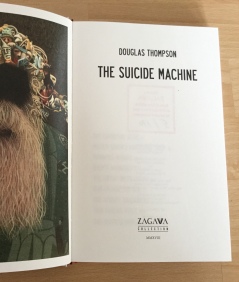
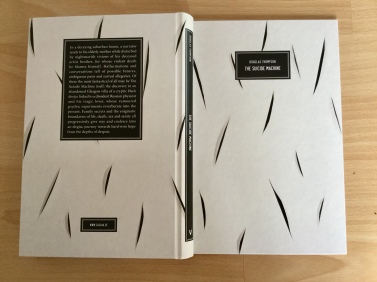
The Suicide Machine – Douglas Thompson


12 thoughts on “The Suicide Machine – Douglas Thompson”


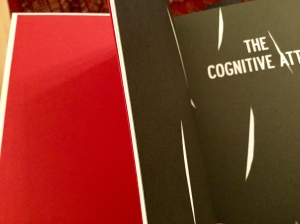
  1. 46ED8881-A7EC-4A48-9A7B-88E3F2BD5D70THE COGNITIVE ATTIC
    “The assassination of Donald Trump.”
    A very moving account of the narrator’s dead brother and painterly words channelled between them, their barely surviving mother of 90 now vicariously channelling for her sons the vistas of the Glasgow flightpaths above their home, and this first piece of prose itself channelling towards the book’s next story that they all will now tell us, via the dead one, I guess. We shall see.

  2. MISTER SINGH’S HARDWARE SHOP
    “In surprising but enlightening connections, forged across your memory and conscience, across time and space.”
    A smoothly stylish and, for me, inspiring portrait of the shop — told by the resurrected dead brother in their mother’s attic to the surviving brother (guilt-ridden by that brother’s death) who in turn re-tells us here as part of this book — the eponymous shop which is a miraculous hardware shop run by a sterling Sikh, magically providing all your needs crucial, trivial and crazy, but only if you are the right sort of customer, a shop as a sort of Tardis with things blooming like books, a wisdom, a sense of battling with and against politics such as good and bad referenda, historic partitions, even the scourge of Nigel Farage, a Far Age of Righteous Dysfunction, I guess, all of these factors often out of keeping with your beloved homes and homelands that are intrinsic to your strength of inner and outer imagination as sown with cosmopolitan riches.

  3. TOWARDS NATURE
    “, a wallflower sapped by congenital anaemia, compared to its swelling trunks and swooping vines, the constant symphonies of birdsong…”
    A heady mix of connections with Escher stairways between them, connections such as a French sentence repeated from the previous story, and the shop’s Tardis like qualities transposed here, and this book’s ‘dead brother’ addressed again, and the earlier attic with its stories passing down to us, is now represented by the sieve-like irrigation from the top of this story’s House’s top storey, a house in France as a Huysmans, an arguably anthropomorphised house man with decadent or pessimistic philosophers as part of its structure. It starts as the narrator unexpectedly inherits this large rambling house in France and, with increasingly manic intent, as supplemented by another inheritance of money, he rebuilds it almost with defiant counterintuitive Green purpose towards a new Hanging Gardens. I found it a breathless journey unexpectedly revealed here. With an idiot dunce called Desmond to aid and abet the narrator.

    • Just re-discovered my original review of TOWARDS NATURE from when it first appeared in TRANSACTIONS OF THE FLESH (Ex Occidente Press / Zagava):
      Towards Nature by Douglas Thompson
      “I was encouraged by the lawyer to maintain the services of my uncle’s erstwhile housekeeper Madame Le Lancourt and her slow-witted son Desmond,”
      At the time I last read and reviewed a story by this author here, I wrote: “Whenever I read a Douglas Thompson story, I feel as if I am looking through a fiction-microscope where physically beautiful words of all lengths and mineral or jellyfish or orchid qualities shimmer or prick one into a special magic reality, then miraculously turning such microscopic visions into a vast macroscopic imaginarium that one can ‘bank’ as if within some accreting noumenon-sump that is somewhere inside yourself even if you do not always consciously remember the process.”
      — and this story does not disappoint in this light, if anything I ever write can be deemed to be ‘light’!
      This story of the first person protagonist’s inheritance of an effectively ‘listed’, ‘preservation-ordered’ Villa Duendelle and his constructive desecration of it by Nature into a wondrous Hanging Garden is a perfect gem of Decadent Literature, rest assured. It does also serve to “cross-pollinate” with Wood’s earlier pollen-in-the-pocket and the London Bridge crossing civil servant or financier (like I was once myself): “He was an odious little jobsworth in a black suit and pince-nez, exactly the kind of world-hating nature-hating petty bureaucrat that we picture the writer JK Huysmans masquerading as for most of his life in the civil service, without, of course, the redeeming imagination.”

  4. BACH’S MARIONETTES
    “…from where the mind of every living soul far above us can be glimpsed like stars in the night sky […] What do I fear most? To meet God. The light of god, falling towards me, probing out the contorted bowels of the earth, […] peering past the ruby red lips and the rotten teeth, of young and old.”
    My previous review of the next story is shown below from when it first appeared in WOUND OF WOUNDS (Ex Occidente Press), an anthology inspired by Emil Cioran and this story features a character called Emil.
    It seems highly significant that I re-encounter this story on the same day as I read and reviewed (about half an hour ago!) this co-resonant, but fundamentally different, work, THE CIRCLES OF GODS by Holly Heisey here: https://dflewisreviews.wordpress.com/2018/11/11/humanagerie/#comment-14236
    ===================================
    In ‘Wound of Wounds’:
    BACH’S MARIONETTES
    “The light of god, falling towards me, probing out the contorted bowels of the earth in search or me, his huge eye burning above me like an accursed sun,…”
    A Parisian genius loci to die for.
    The above quote and a flea market above the bowels of the earth and the beats from under the pavement, a mention of Proust, and this makes me feel at home in some Nemonymous night of my own… but, beyond this, I think I can safely say the Douglas Thompson story is a literary classic that you will remember, where Emil meets God in His deux or deus chevaux car, God who is also Bach, in charge, He claims, of all we marionettes of humanity. It is wondrously acceptable as some intrinsic poetic truth that only inspired works can own. I also happened to be listening, coincidentally, to Bach (Orchestral Suite No. 2, the famous flute solo in which is significant to my earlier life), listening to it from before I picked up this book today and started reading this its next story.
    ====================================
    I shall now read TORLOISK, ISLE OF MULL that seems to represent a new set of passages added to the end of ‘Bach’s Marionettes.’

    • “Pareidolia, closely associated with apophenia; every writer’s illness. We see the connections in things, imagine underlying patterns…”
      Except I don’t imagine them! They emerge autonomously, whether transgressing Wimsatt’s Intentional Fallacy or not! I reveal their emergence.
      “And the dark beast is abroad again. Roaming this endless dark of self-doubt which surrounds me…”
      This TORLOISK section is a moving one about personal relationship matters, beautifully described, also with further references to his dead brother dreaming him, attic dreams, and again the guilt involved with once destroying that brother’s flying saucer. Ending with an intro to the next story that is about Trump…

  5. THE GREAT WHITE TRUMP
    “, his perpetually grimacing face, as if chewing on a wasp, or like a well-skelped erse, as we say in Glasgow, his red baseball hat, his uncannily dainty little hands.”
    This may be the most frightening and poignant few pages you are ever likely to read, involving the eponymous nightmare arrival on the world stage (you will never know Trump to his bottom core till you read this description of him: a necessity to do this for potential catharsis, even if you don’t want to do so) and involving personal Scottish matters, such as the narrator’s mother and the death of his brother. And God’s giant eyeball, to boot, the last ace card as an attempted trumping of Trump himself?

  6. OUR FATHER
    THE SEA
    “What are carpets for if not brushing things under?”
    547F11F2-9121-4352-BC4B-BADF5B287962Not an elephant in the room, but St Elmo’s fire? The narrator’s father’s misstep here extrapolated eloquently and poignantly, his misstep with so-called romance, to the detriment of his wife and sons… This is the depiction by one of these sons of his father’s life, a father as misanthrope, misogynist, would be poet, stickler for standards, inconsistent, demobbed from the Royal Navy following the Second World War. At times an account of the father that is embittered, at others, stoical, rarely understanding. Along with the to and fro objective-correlative of the sea. I sense this whole book is a unique blend of autobiography and of fiction that is also an autobiography of sorts. Here, his mother’s later extended hospital stay leads to meeting, among the old ladies around her, one who tells him what is effectively this book’s title story and looks to be of novella length. I wonder if she lived long enough to tell it all?

  7. THE SUICIDE MACHINE
    “For a Machine it would be no problem. They don’t need the patterns and meanings that we find to delude ourselves, to console and terrify ourselves.”
    But a Machine can live, I guess. Absorbing all these stories, processing them, hawling them by feeding back into them. Despite its deceptive size, this is not a novella; it’s just the next staging post as we read alongside the narrator, about another narrator, the written narration of a woman next to his mother in hospital, a woman, as she tells of her job clearing houses in Glasgow, then living in the house she has almost cleared, except for the eponymous hardcore machine, a thing with vents and apertures, not a storage heater or utility convector, but something that almost acts erotically or uterinely, like those people once trusted around her eventually do so, too, a surrogate father (indirectly echoing her real father’s previous abuse upon her), and a woman friend, auto-erotic or two-way sex, somehow mingled with politics like Brexit and the Scottish Referendum. And Russian spooks. And a Russian backstory of a quantum scientist into the paranormal. Who or what is in that machine, what dire effects it has, it will haunt me with this book’s intermittent Tardis quality and hardcore prehensility. Blending in with dreams that could have come from Twin Peaks, Series Three. A conveyor belt that has linear and non-linear qualities of memories and time travel … towards the next stage in this book’s auto-biography, as I shall call it, now complete with the telling hyphen. A machine that is a trope for a dead brother? This is a work where even info-dumps become part of my reviewing machine’s own feedback… make of that what you will.

  8. THIS FAILING VOICE
    “What is that President Chump up to? And what on earth is Brexit?”
    Very moving and touches me to the core as I read this transcript. As he promised earlier, the narrator interviews his mother, in her ageing version of life’s Tardis, I guess, just as I myself once interviewed on cassette tape my grandmother about her experience of the two World Wars, her difficult marriage, birth of my mother and uncle, and later I interviewed my mother about the Second World War, meeting my Welsh father, then having me…
    Of course, I was and still am only an only child. No Ally for me. No failing stare. No falling stair.

  9. THE RIDDLED MAN
    “Have you ever paused for a second to consider the idea that everything in the universe is about holes and interpenetration? — Not just the human reproductive system.”
    This is the epilogue to the earlier novella-length work and it is also the coda to this whole book’s symphony, its auto-gestalt of fraternal frames in painterly parental palimpsest. As that epilogue, we see things through the pervading mind of this book’s friendly examiner (Voltaire’s best of all worlds dictum), extrapolated as a Russian ‘mad scientist’, who is not mad at all if we can apply our own creative madness to his bodily array of wormhole sores as bouts of time travel making things ‘slightly better’ than worse in any one of our worlds… except we’ve ended up here today with Chump and the fastest ever neologism becoming a real word? As the above mentioned coda, we realise that the Machine Stops with EM Forster or the Hadron Collider and the Internet, and that ‘slightly better’ means a fraternal faint rather than any lethal jump into a Fallen West. A feint or counter-feint. This book is auto-personally monumental and momentous – miraculously meted out, too, for its readers. Somehow a shared journey in more ways than one. The riddle, for me, is in the sands.
    end