Thursday, May 23, 2019

Engelbrecht Again! – Rhys Hughes

25 thoughts on “Engelbrecht Again! – Rhys Hughes

  1. 726A65FC-4FF0-45B4-A2C5-8AAA3224959019B8F782-CE2D-4925-B445-E0282E725940B4EEA7C4-178A-494B-B37D-EF5BDA41F379E18B98F0-CA41-4F6E-8336-39A258037367
    1. GAUNTLET OF GORGONS
    “Now the Id purred like a cat which has been swallowed by a dog, the dog by a horse, the horse by an elephant, the elephant by a whale, the whale by a whirlpool, the whirlpool by a dying star, and the dying star, with difficulty, by a mouse.”
    That’s because a mouse can delete anything with just a single misjudged, misfingered manoeuvre. Or at least when mouses were mouses in 2008 at the time this was published. I wonder who else has read this book other than me and Jeff VanderMeer. Millions, I hear shouted. It is utterly mad, and I studied Louis Aragon at university in the 1960s at a time when I founded the Dadaist ‘Zeroist Group’, and even I STILL think it is mad. Even me. The Surrealist Sporting Club led by the Id, towards London, via Acton, to the Brit Museum where much is already stone without the sly-glanced intervention of Gorgons!
  2. 2. FAR ON BICYCLES
    ‘the thing that was not a thing’
    …as, here, a thing-in-itself, it seems. Not only Far on Bicycles but Fear, too, I guess, if you are persuaded by the Id’s Idea in respect of competing in the Tour de Trance, by a due methodical seeing-to by each of the old pier hypnotists on the South Coast of England. But why not the East Coast, too, I ask, living in Clacton on Sea as I do? Anyway, whether with Chippy or Chirpy on a trice if not a trike, or Engelbrecht himself, or any other number of named riders, this exercise in Deep Absurdism is worth every penny and farthing. Rex Warner, I remember his book The Aerodrome, by the way. And my mum rode a Tandem (not an Ace Double) along with her elder brother in the 1930s. She often took her feet off the pedals, she later confessed.
  3. 3. YOUNG WERTHER CHEERS UP
    As well as the irony connected with what is underlying the title above, there is a section here I cannot resist quoting in full, if I may be so bold:-
    4FE22E63-E4D8-4654-B039-42FFAE9B8B30.jpeg
    And much business about a casino, and, inter alia, gambling chips as minutes in a measure of time, and a reference to dwarf Engelbrecht’s famous wrestling match with a Kraken. So he does wrestling as well as boxing? And oodles of wordplay and referencing, assuming you are ‘in’ enough to get some of the in-jokes, too.
    How can I possibly cover everything that is in these stories! I feel like I am a pioneer reviewer here, scaling the impossible Everest of Absurdist Literature. I intend to read at least one story from this book each month. Base camp towards life’s last ledge, where all chips are down.
  4. 4: SURFING THE SOLAR WIND
    “The whole island of Britain was spread out below us.”
    I don’t know why, but I thought of the BrexId as well as this (2008 published) story’s Id protagonist, when reading it. On this R.A. Lafferty-like Big Wednesday (I know this author had not then read about Lafferty’s Slow Tuesday, nor Lafferty himself vice versa about the other’s Big Wednesday), we ride, along with the growingly familiar characters such as Chippy de Zoete, Dreamy Dan, Charlie Wapentake, Lizard Bayliss, Gamma-Ray Russell, Rex Warner (whose Aerodrome is the launch site for what happens here: Riding the Aurora Borealis), and many more. We also have reference to the Alpine enclave of Chaud-Mellé. This book is almost addictive, so far. Must eke it out more slowly, being Friday tomorrow.
  5. THE NORTH FACE OF THE EGO
    “It was obvious that an organic ego would contribute much more to the science of geography,…”
    My underlinings, if not underlings, above.
    Stemming from the author’s enjoyment of mountain climbing, a convoluted writerly satire, featuring the recurring characters in this book.
    Id versus Ego.
    F08C1C90-C127-419C-B1D0-E50095E68042.jpeg
    .
  6. TUG OF WORLDS
    “And the Id said: ‘Ireland has just collided with Wales.’
    ‘Ireland? I’m afraid I don’t understand.’”
    With that forerunner of the backstop, I have just realised that this whole book (writ in the early naughtiest?) is a zeno’s paradox prophecy of Brexit as a confused tug of wars, with here a veritable cornucopia of paintings within paintings containing the first paintings, worlds within worlds, möbius sections from Escher, and all the characters whose names have taken on rings of familiarity by dint of immersing oneself in this book, a book like not only the impossible Everest of Absurdism, but also like the most ever jaundiced Jarnydyce and Jarndyce. Thomas Love Peacock’s Nightmare Abbey, notwithstanding. And the Night Shade villains.
    Is ours a government of the people, by the people, for the people, or a kakistocracy* rather, for the benefit of knaves at the cost of fools?
    ― Thomas Love Peacock (1785 – 1866)
    *real word, look it up (relating to Trump?)
  7. ENGELBRECHT AT EISTEDDFORD
    This is an astonishing work reaching the actual impossible peak of self-referential wordplay (self as the self of the text itself) and no amount of reportage by me could convey what is ahead of you should you decide to read it. Is there anyone else out there who has read this? Other than perhaps the author and eventual publisher. Is it surprising that Night Shade had cold feet at the last minute? Meanwhile, I was brought up by my Welsh father to know about the poetry and Druidic festival of EISTEDDFORD, but I suspect he had no direct experience of it. Just pride in its concept, the word itself embedding the ID and the ghost of mountainous Ego, but without the G of my father’s initial letter of his own and only forename of Gordon. Lewis as a surname is as Welsh as Hughes.
    Stern measures, perhaps, but my isolated spirit has already been diluted to a shandy…”
    (My erstwhile review of Tristram Shandy as strong beer: https://dflewisreviews.wordpress.com/2014/03/15/tristram-shandy/, another book that was given its chance to show its author’s impossible ego – as potentially diluted by his id?)
  8. A MERMAID SUPPER
    “I used to believe that the history of philosophy was the story of the Search for Truth. Now I think it’s more a case of desperately creating Security.”
    Not sure why I quoted that! Meanwhile, I had not thought much about this book’s narrator till now when he comes into his own, a man I assume. He falls in love with a mermaid, as one does, or as this narrator does. Or the author does vicariously. But there is a rude bit, explicitly pre-warned, about part of the process of sex with a mermaid. And there is something about Ireland fitting into Wales, and things about Mars. And other arcane literary and philosophical references. And badinage and rumpus. And much else.
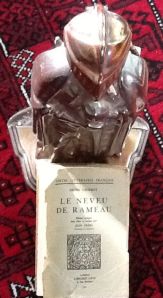
    I once long thought that this author was influenced by Diderot’s Le Neveu de Rameau and, now, having recently encountered R.A. Lafferty myself, I believe this book’s author should be influenced, too by R.A. Lafferty. But neither of these influences are true. But what about literary osmosis. You need that at least to read this book!
  9. LAST TANGO IN ATLANTIS
    “— let’s hope the Inspector of Metaphors doesn’t brew analogy tea!”
    To tango with a book, you tango with the text, its meaning, what it means to you, but some think they are tangoing with the author. Perhaps Rhys Hughes is the only author where the latter applies!
    The title gives away the major conceit of this story, which reaches perhaps new levels of reading power needed to read it. We reach a temple where the Tug of War of Worlds happened, I guess.
    5EFB4330-111F-4946-A530-99CFA2D089D7
    “Vast chins wobbled. ‘You too are just a fictional detail . . .’”
  10. 10. A SANDAL WAITING TO HAPPEN
    058E956B-4BAA-4254-9DCA-3F3AFC3F6114
    Whether the Earth is being disheveled by Climate Change or by Trump or by Engelbrecht’s comet or ‘a quiet game of chess’, this story seems prophetic of many things that have happened since it was written. And not only by dint of that quote above. Read the whole story and gather the prophetic clues! But one thing I wondered about was the Ground Zero of 9/11. Was this story written before that event? We need to know. If it was, that might be very significant. Well, in addition to Black Tuesday in contiguity with this book’s earlier Big Wednesday (the Borges Twins, notwithstanding), it seems to evoke economic Black Wednesday in the UK. Meanwhile, I loved the phrase “an immanentized Eschaton!”, but I did not understand at all the sentence that contained it!
  11. The story that features the destruction of the skyscrapers of New York was indeed written before 9/11. It was written early in the year 2000, probably March or April of that year. I remember that after 9/11 I wondered if I ought to rewrite this chapter (the book wasn’t published until the year 2008, so there would have been plenty of time to make such changes, but in the end — for what reason I can’t remember — I didn’t change anything)
  12. 11. A MONKEY FOR ALL SEASONS
    “Typical of the dwarf to win a sport he wasn’t even aware of playing!”
    Luck being factored into this, I suppose, the nature of luck as covered in this story – all as seen in interface with Brian Zeno’s Paradox, a half of a half onward, like ambient music, I guess. These stories – this one in particular – are huge, with global trips, and multifarious references, characters, and I missed the ILLUMINATUS! reference yesterday, it seems, I think I read it in the seventies, the reference about the Immanentized Eschaton in its first line, I’m told! So huge, it needs many more Gestalt Real-Time Reviewers than just me, grappling with it, doing piece work or shift work, triangulating the myriad of its coordinates. And the birth of Fake News from the viewpoint of our last century’s Fin de Siècle when this book, I think, was written —
    “There would be no oscillation of relevance in the news we encountered, slipping into the past for half a globetrot and then catching up with the present for the remainder, like a cosine wave of incidents.”
    And much talk of the Monkey Trevelyan with a one-branch family tree from slime to him. And other more complex family trees in history. I need to employ a deputy coordinator, here. And JINGJING XU is mentioned here. Sounds like the name of today’s Chinese President currently in trade combat with Trump.
  13. 12. THE DESTRUCTION OF DESTRUCTION
    “, full of the cosmic horror as the spaces between screams, what moves thee, or how couldst thou take such a journey into the fanatic Baghdad?”
    I’ll always remember first reading William Beckford’s VATHEK, and here the Caliph state is renewed well before Daesh, I guess.
    Who knows when this story was first written but it is about considerations regarding truth and fiction as well as alternate realities.
    What is the next lie? Hopeless Hodgson’s swine-things or Engelbrecht’s Googlies on Google?
    There is something remarkable about this story’s title. It seems to encapsulate much.
    “Our club will never retreat.”
    “Revenge, for sure, he would have. He would have revenge…”
    from ILLUMINATUS! by Anton Wilson and Shea.
    Ending with a colon, this story appears to be an intro to the next story…
  14. 13. ENGELBRECHT AND UBU
    “LIZARD. You impetuous semiquaver, if I get bruised badly who’ll promote your career.”
    A play featuring UBU’s Jarry, or is that vice versa, by my green candle! It is enlightening that it takes place in Krakow, with a destructive foot, rather than a conflagration, but especially appropriate if you have already read CONFLAGRATION reviewed here: https://dflewisreviews.wordpress.com/2016/04/29/conflagration/ where Jarry features and Cracow.
    This E(&)U play is followed by prose text headed – FIN –
    Meanwhile, I continue to need fellow triangulators of this book’s coordinates. It is too much to deal with for just one Gestalt book reviewer. I will be conducting auditions for others to review this book alongside me. Please contact me, if you are interested.
    Sorry if this is a plot spoiler…
    “ENGELBRECHT. In a day or two, with your help, I shall be Boss of the Surrealist Sportsman’s Club.
    TOMMY. You will assassinate the Id?”
  15. Just read the final two together in one huge mind-frazzling session.
    14. A SUMWOT LABUD SATTIRE
    “I don’t reckon the Tories won’t get in again for the Labour party hasn’t gripped society by the cuffs.”
    Much more prophetic stuff here, as I am reading this today in 2019 when foul Farage goes hell for leather with the Brexit Party in the EU elections (results not yet in.) Abturdity!
    Meanwhile this continued rolling series of characters and cross-global cartographical anomalies and compromising women, continue here with a pirate queen and galleons and antipopes and antipodes and a quasi-OuLiPo experiment with words and numbers and moves of a knight in chess prefiguring this author’s own HOW MANY TIMES? And thirteen savage jerks.
    “But 1997 was decades ago!”
    *
    15. THE CHRONIC ARGONAUTS GET BETTER
    “I also resign!”
    An HG Wells time-extravaganza. I won’t issue any end-of-book spoilers here, perhaps because there are none to issue! Rex Warner, Thomas Love Peacock, Nightmare Happy, Louis Aragon and the Borges Twins etc all stay in my head, some cross-legumed. But badly needed reviewing help for me (the art of description-interpretation-evaluation in tune with synchronicities) is at hand, though. Several others will now be reading this book, so as to help me out. We’re calling ourselves the Absurdist Reviewing Club. When the final judgement comes in, I will come back here punching above my weight, and tell you what t is. Meanwhile, I will now prepare the well-deserved book of my Rhys Hughes reviews spanning more than a decade. Yesterday, I did one for Gamma-Ray Russell who also appears in this book, at least by that name. Not sure what Maurice Richardson would think about it all. Where Id that name come from all of a sudden?
    “A pure coincidence, I swear.”


Monday, May 20, 2019

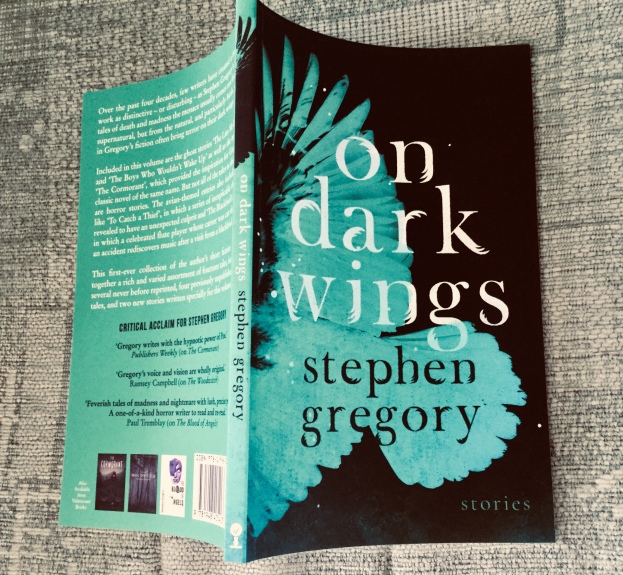
On Dark Wings – Stephen Gregory

14 thoughts on “On Dark Wings – Stephen Gregory

  1. I note the contents list also contains stories called ‘The Late Mr Lewis’ and ‘Dreamcatcher’ as one word. I hope I am not too late to this author! And I must read the stories in order, starting with…
    TO CATCH A THIEF
    “…the wildlife gallery and tea shop owned by my father.”
    A disarmingly eerie, charmingly light-fingered tale of the security problem in this tea shop gallery near Dartmoor. I first suspected something strange when the father cursed or accused a real heron in the garden looking like a finely painted heron in the gallery with making off with a fat goldfish. I knew it was not the waitresses, at least, who done it.
  2. CELANDINE AND PERIWINKLE
    “Her face was mottled and oddly misshapen, on her right cheek there was a wrinkled map of her sleep, the imprinted material of her armchair.”
    A compellingly page-turning, engagingly characterised, movingly poignant, refreshingly innocent, deceptively profound, puckishly humorous, eerily atmospheric, often suspensfully panicky, wholesomely nature-studying story of an informal boarding-school trip organised by an inexperienced young male teacher called Mr Drew, a trip for five boys in the woods at night to collect owl pellets… One boy goes missing. The repercussions for all concerned reminded me, inter alia, of a sort of port in the storm of an erstwhile hanging-rock’s picnic, where time was drawn as a long note by Drew upon a cello’s string. I was imprinted with its tension. The chocolate treats, notwithstanding.
  3. THE CORMORANT
    Of luff and marital yaw, samphire and two damaged thumbs, this is the story of as it were a rogue element – a cormorant – being instilled as a pet into a situation in a pub and its lord and lady of land and sea, to tease out the hidden cracks in a settled cast of characters, as I try hard to get my own nib to its nub of message beneath the plotted plaster.
  4. TWICE BITTEN
    “Worse was to come.”
    This engagingly sad story of a man not dissimilar to the one in the story of a boarding-school teacher’s owl pellets; here it’s the short-eared owls themselves, but the teacher is now much older, having memories of unrequited and discarded loves with the distaff of our kind. Indeed, I get the sense I am granted views of such things in writing by someone who really wants me to see them as some raison d’être of life, but paradoxically they make me wonder about what I have been doing all these years; why have I not been letting such engaging works as these slide over my mind as a forgettable pleasure; why have I forced myself to retell them via my quaint viewpoints on literature; why have I found myself hawling, dreamcatching them, and finding cross-references, synchronicities, preternatural gestalts &c.? But here the owls are not what they seem. I even found myself somehow trying to work out an anagram for Ed Debba! (Bead bed?)
  5. LINGERING
    A vicarious vignette of being tiger-like. A man who merges with one of our woodlands where we live, in his ironic camouflage of orange pullover. Not so ironic, perhaps. He IS the forest, sometimes inadvertently frightening visitors with his abrupt presence. His caravan’s fire was orange, too, I guess. His presence lingering on like a tricksy chameleon. This man still seems a good one. That other orange man whom I infer elsewhere, notwithstanding?
  6. 799F0959-B343-4FCA-A24F-E8D1BF893F63THE BOYS WHO WOULDN’T WAKE UP
    “At the overgrown ha-ha, Mr Hoddesdon told Ian to leap down into the dilapidated bandstand and find owl-pellets…”
    This is an excruciatingly poignant story in the boarding-school cycle, a story, inter alia, of sad cold sunlight on even sadder snow, a buried boy’s head or the headmaster’s own head when he was a boy, I extrapolate, any flames, notwithstanding. A story that is excruciating in an effective way, that is. The odd headmaster, odd by name and manner, old, too, 70, left alone at the small declining school, alone with a boy, 7, Ian, whose parents cannot take him home for Christmas hols. Excruciatingly awkward, I would guess, but the two of them manage together, with stilted conversations, and an outing with a picnic hamper (that hanging rock picnic again?) and Ian sleeps and brushes his teeth in the dormitory with the other empty beds. But the oddness later turns into a sort of madness – with memories about some fire tragedy, the other boys involved, when the headmaster was 7 himself and slept in the same dormitory, even in the same bed as Ian does today. Unforgettable as a story, a putative classic of its kind, I suggest.
  7. THE DREAMING PIG
    “, dreaming and steaming…”
    A ghost story, of a ghost embodied as a deformed, deaf and sightless pig, sleeping and no doubt dreaming under the other pigs as part of a pen’s gestalt-pig, I’d say. Or if not a gestalt ghost, it is a reincarnation of another schoolboy burnt to death or bacon? Soon to become the ghost, ignited by lightning, a ghost that I first assumed it to be. All witnessed by a different boy. We all take our turns upon this Gestalt Wheel? Or become just a final dream? Or buried by where we once lived?
  8. THE THEATRE MOTH
    After the earlier pig, now a moth, one that sometimes sounds like a rodent, is exposed to a potential flame’s engulfment. A Humming Bird Hawk Moth, as Celia at the tender age of 20, having escaped early the silly student behaviour of others at university, writes and directs her own play in the village hall, both helped and hindered, both cowed and inspired by the moth in the Hall, with differing audience reactions to the results of her moth phobia, a phobia she’s had ever since encountering a Death’s Head one as a child… but why on Earth am I trying to retell this story leading to an ending I do not fully (as yet) understand? The story should stand or fall on its own perceived performance, bespoke or otherwise, to each individual reader as part of a gestalt audience of readers, waiting to applaud together… I’ll keep my powder dry, meanwhile.
  9. THE DROWNING OF COLIN HENDERSON
    “There was a cormorant fishing. […] One bird jabbed its beak on into Henderson’s beard and flapped away screaming.”
    A movingly vicarious vignette of a man drowning, then dead, as if you still live through him, amid the elements of Gaia that enfold him and somehow keep him alive by suspended disbelief.
  10. THE LATE MR LEWIS
    “Mr Lewis taught me things.”
    A touching story from the owl pellets cycle of boys’ boarding school stories, where a teacher was never late, till he was! What did it all mean, as the boy, like I was also a boy from the 1950s, wonders? Well, my Gestalt real time reviews will continue after I have gone. Mark my words.
  11. THE DEVIL BIRD
    Swifts and swallows, come one after the other, the latter first, swifts that sleep on the wing, but it is the I of swift not the all of swallow as we imagine the projected I or self of David the boy intent on rescuing a wounded swift, unlike the earlier year when one of his teachers stoned it to a peaceful kind death, so called.
    The boy precariously climbs a tall tree with it between shirt and chest, and then let it go. The ending is iconic and needs to be anthologised regularly in bird story anthologies. But had I read another story where the boy jumped with it? – if so, I must have dreamt it.
  12. THE BLACKBIRD’S SONG
    “…a secret, a secret between herself and the blackbird.”
    There is somehow a musically erotic theme to this story, a secret well kept, perhaps, till now. Or it may be something I imagined. Whatever the case, a touching story of a woman flautist whose car accident, as well as causing a marital bereavement for her, also not allowing her to continue as a world famous concert performer. Until she reaches a synergy of assonance, with the blackbird and its song that had earlier haunted her. An assonance via her lips.
  13. THE PROGRESS OF JOHN ARTHUR CRABBE
    A story of the eponymous boy who is born mentally abnormal, soon after his father had died, his words not words at all, but no doubt full of meaning. A story of healing, but who is healed? Anything more I say about it would spoil a chilling gem of a story. Chilling, but somehow uplifting.
  14. DREAMCATCHER
    “One of the shapes, something dead and broken, stayed where it was. The other lifted off, with a sudden heaving struggle of dark wings.”
    I have long since called my book reviews Dreamcatcher ones as well as Hawler ones. And that quote above seems the perfect description of these two aspects, and indeed an emblem for this whole growingly perfect book, an emblem of fight and flight. This story of a man in the Dreamcatching film industry of California takes time off after a struggle with the aspirational Gestalt of creatives working on a certain film. Towards a hotel they booked for him, but he wilfully wanders off in his car into the desert. Whereby part of this book’s dual collusive, collisional conundrum somehow watermarks itself on the windscreen and another part becomes its own roadkill that had always been roadkill, looking for pellets rather than the bird itself? I hope I have managed to dreamcatch this book as equally well as it has watermarked me. Me and this book in constructive collision and collusion?
    end


    Wednesday, May 15, 2019

    Trying To Be So Quiet – James Everington

    6 thoughts on “Trying To Be So Quiet – James Everington

    1. TRYING TO BE SO QUIET
      I first read and reviewed this work in May 2016, and below is what I wrote about it then…
      ============================
      Trying To Be So Quiet
      image
      This being today’s note, it is addressed to everyone except the book’s author. The Dreamcatcher review below is, as ever, in fusion or symbiosis with a hyper-imaginative fiction. A NO SPOILER POLICY OPERATED THROUGHOUT. But on rare occasions such reviews can accidentally reveal too much…
      Pages 1 – 26
      “They were just building their dreary little spires up into the sky.”
      There is Marie in TS Eliot’s ‘The Waste Land’, but no Lizzie….
      This is the bereaved aftermath of the accountant’s loss of his wife Lizzie, one where the text itself and this aftermath’s environment that it describes are linked, page by page, by an accreting craquelure on the walls of the house where the couple lived, a device like Gahan Wilson’s wall-stain in Again, Dangerous Visions. There, explained, but here, just there. Rotting up. Totting up like a balance sheet, where the numbers always add up to zero.
      I am highly disturbed as well as enchanted by the accretion not only of the design but of the nature of this bereavement, its assumption of pointlessness, the building of spires in a daily office akin to the work on ancient cathedrals, work that often spanned more than the lifetime of those working on them. But Lizzie was always right when she was alive, leaving just a pause to prove that her forthcoming answer was wiser than he could ever be. All this elusiveness blended with an artful construction of the two main characters as backstory, together with his office life that he quickly resumes to help heal the bereavement, yes, all this adds, like a column of effects, to the sheer power of what I feel when reading this. And I thought I would stop here, halfway, briefly, then hurry back to work on it as soon as I post this first of two impressions, just glimpses of what the dead might leave behind, say, in bathroom mirrors, or shadows on the wall, or in remembered discussions they once held on eschatological matters during their backstory.
      *
      Pages 26 – 53
      “He longs to go and hold her, the effect is so lifelike. He wonders which would be worse if he did — touching nothing or touching warm skin.”
      I wondered, too, as I reached into the text, having flipped ahead cursorily, without yet reading the words, seen for whatever reason that the craquelure turned from black to grey towards the end. I wonder, too, how this might work in a vacuum as with digital text, rather than, as here, on paper. The text here holds any ghost true like a memory of the place where you first met the person whose ghost it is, and I reread the backstory’s beginnings in the first half of the text. The text’s backstory complete with craquelure is indeed the ghost, and, in hindsight, I may perhaps have given the wrongly shallow impression when just referring to Lizzie’s widower (the story’s protagonist) as an accountant, especially when we revisit with him where they first met in Oxford as university students. Amid all those dreaming spires that Matthew Arnold first identified.
      There are many other moments you will encounter in this text that I cannot cover here, but one of them strikes me as possibly the most powerful for my own recent circumstances of bereavement (not a wife, but a mother), something I hope is not a spoiler, and that is the concept of the latent Death Scream, one that is owing for release to any dead person who was muted by palliation whilst dying.
      And as I began with ‘The Waste Land’, I now sense, with the universe’s forward rush slowing, near the end of this book, a shade of Byron’s poem, ‘Darkness’.
      This work felt both devastating and uplifting to me. But how can that possibly be?
      And a great ghost story, to boot. Trying to be so quiet.
    2. THE SECOND WISH
      “—he had forgotten how noisy the gulls could sound when they landed on the roof directly above his head.”
      When I judge a story, I should surely not judge it, even partially, by its supposed chance synchronicities with my own life. But I am only human. As is the character here, a middle-aged man trying out his childhood bed for size in the attic bedroom, in a house where his parents had recently died, after he had been abroad on the idyllic Mediterranean coast, somehow with a successful, real or fabricated, life, just as fabricated as these gull sounds on the old roof he remembers from the past, after having met with the Lawyer and the Doctor about the demise of his parents, or was it both the Lawyer and Doctor amorphously, at once, as the same person? I was entranced by this Aickman-like and Tem-Like and Everington-eventing ambiance of shifting doubt in time and shifting place or face. Enhanced PERSONALLY by my knowledge over the last twenty odd years of the sound of sea-birds on an attic-bedroom roof, the death of my own parents over the years, reading this while, by chance, listening to Lee Patterson’s birdsong music with shifting and shimmying gulls, and having read, by equal chance, too, Tem’s Housewarming story with shifting settlement here earlier today.
    3. The woman who doesn’t feel pain https://www.bbc.co.uk/news/uk-scotland-highlands-islands-47719718 (Recent article.)
      DAMAGE
      Pages 83 – 104
      “Her girlfriend had sat and watched the Doctor Who Christmas Special with the same affectionate bafflement Alex had felt when Alyssa had called her to see a bird in the garden.”
      Birds now inside the house, or head? Instead of on the roof. Words and their lines, spread out, relaxed, with white spaces between, some words even gratuitously lengthened by vestigial hyphens. Here a sense of bereavement and pain of the surviving partner after the mindlessness involved in the accidental death of the other one – two women lovers, one into birds and the twelve days of Christmas, like turtle doves, the other into extinction beyond our world’s warming pain, even scalding pain, and a scarf but Who’s? There was no stress, no anxiety, I could allow myself to take time, spoilt for choice between interpretations. So why make any choice at all? Just kill others without culpability for their culpability. Dead sure that whatever will be whatever. The previous story’s Lawyer or Doctor, no one ever knows which you need most or which you are nearest becoming? Killer and healer, both. Christ’s Christmas or the Doctor’s, in her scarf.
      end


      Thursday, May 09, 2019

      The Rhymer: an Heredyssey – Douglas Thompson


      4 thoughts on “The Rhymer: an Heredyssey – Douglas Thompson

      1. PART ONE – SUBURBIA
        Pages 19 – 24
        Just skimmed into the start by only a few pages, but read each page as closely as they deserve, and I’m already on board for the whole ride with the narrator, after his meeting with someone called Weasel. At first this work so far has reminded me of J.W. Böhm’s slow ride (reviewed by me here) around my own Wounded Island during Brexit times, but I note this Thompson work was written well in advance of the dreaded Referendum. But then I noticed a pub that could have come straight from Rhys Hughes’ Deep Absurdism, and I noticed other mythic layers and a turn of mind or tone that could be somehow reviewing the Gestalt Real-Time Reviewer as an entity itself! To show what I mean, I shall make some sizeable quotes from these initial pages, if I may be forgiven. I won’t continue this practice so heavily as I conduct my rhyde proper through this obviously potential seminal book. The dead bleeding deer upon my pilgrim back, notwithstanding.
        “Because this is how it always is at the end, the selfishness made manifest, the isolation devices, the rash of rush and bluster.”
        “…the notion that we are all dead, us humans, and all this that we think life now is but an afterlife. How else to account for the ridiculous preponderance of coincidence, the déjà vu, the way what books we read constantly prefigure our everyday concerns,…”
        “…the lives of the Titans as it were, the huge heroic people we were each before we were woken by death and birth into this becalmed shore of suburban banality, a domain one might say of air-freshener and furniture polish, of broken dreams and haemorrhoid creams,…”
        “So why shouldn’t Buddhist reincarnation and Christian damnation and all the other tosh be rated as equal tosh with all other tosh, fragments of a jigsaw of tosh…”
        Yes, I do have “a blog one can follow…”
      2. —> Page 32
        “I say we are all asleep, and only art can wake us up for a few mad moments each day.”
        I must have been asleep when I read those words yesterday in this book, but now I am awake to the fact that this book should indeed wake me up with its art upon each day that I pick it up to read it in the future. Slow, savoured, textured, eked-out, my reading of this rich prose, with many internal rhymes by the Rhymer and many internal assonances by the Assonancer…
        So that I do not issue any plot spoilers, the only reference to the plot I shall make is this photocopy of these words from the book’s cover:-
        F24A72E2-5A87-4D77-AAC0-B07EAB1A12FF
        Oh, I would add that Nadith in Suburbia seems to have a brother called Zenir currently in Industria, or so I infer. Nadir and Zenith?
      3. I intend to read the rest of this book’s 200 pages outside the scope of my public real-time reviewing. I fully expect them to maintain — and constructively extrapolate upon — the promise of tenor I have already observed above.
        end