Monday, July 01, 2019

Song For The Unraveling Of The World – Brian Evenson


31 thoughts on “Song For The Unraveling Of The World – Brian Evenson”


  1. I reviewed the first work in the context of reading it in July 2017, as follows:
    NO MATTER WHICH WAY WE TURNED
    This haunting abruptness of a faceless girl is Katie’s reflection just now in the Lloyd story and a symbol of this whole book tantalising itself. With a lodge as a blend of a chosen group and an aboded structure and a verb to position something within. Beckett reflecting Lovecraft and vice versa. Just to name two.
    *****
    I have now read its two pages again. And I still do not understand what it is about! Having now read the same half of it as a story twice its size, I will have to keep evening out its odds or circling its potential gestalt till they publish the rest of it or the writer even writes it.
    (I take it that Katie was from the previous context, not from the Evenson work itself. I take Katie.)

    • “…a neat, endless now of monuments and epitaphs,…”
      —- from GRAVES by Quentin S. Crisp
      A dead monument to once ancient hope cloistered by ravelled bones and ruined walls.
      GRAVES arrived in the same postal package as SONG FOR THE UNRAVELING OF THE WORLD by Brian Evenson.

  2. 506E79C5-DB50-4CCC-BB27-2489E532EE33BORN STILLBORN
    “Or even, it occurred to him, as if there were two of him, two different therapists who, for some reason, looked identical.”
    For sum reason? A zero-sum game? This Evenson story seems to fit the previous story perfectly, like the human and the apple being circled within the same Venn diagram? The anti-natalism, too, still unborn, of Ligotti, the fertile banana trapped within the same Venn of Verl Kramm?
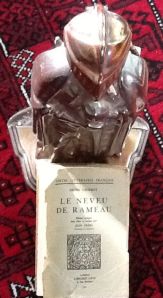
    My photograph herewith from four years ago. The night therapist as the night doctor, equal to the day one? An apple a day keeps the doctor away? An even sum of Evenson stories a day helps the doctor stay? Disturbed and delighted by this work.

  3. My previous review last year of the next story when it was in NEW FEARS 2:-
    “LEAKING OUT
    ‘I already told you this is not that kind of story, the kind that explains things. Be quiet and listen.’
    A story as apotheosis of Evenson. No leaking out from me, either.”
    *
    But I have read it again today, as if I am a different person eking it out. Something the protagonist Lars feels, too, in more ways than one. As if I want to find those dead batteries to see if they are truly dead. A truly great disarmingly dislocated story of zero-sum selfhood. I am the Ake Man, they are the Ake Men. Aking out.

  4. SONG FOR THE UNRAVELING OF THE WORLD
    “He had carefully broken the circle, moving aside his daughter’s coat, her teddy bear, and then stepped inside and closed the circle again.”
    A moving story, of a man who, following marital break up, abducts his own daughter, a daughter who later inexplicably vanishes. Involving this book’s eVENNson diagrams, its VERL ravel. Ravel and unravel mean the same thing, unlike cleave that means two opposite things, cleaver (with ravel embedded), too. Bringing us back full circle to No Matter Which Way We Turned and Born Stillborn. Dead dreamers still do dream.

    • Or perhaps unraveling is removing from the world such ‘songs’ as Le Tombeau de Couperin, Pavane for a Dead Infanta, Miroirs, La Valse, Scheherazade, Bolero…?
      Is not the normal spelling – unravelling?

  5. I reviewed the next story in 2017 in its then context, as follows:
    =====================================
    THE SECOND DOOR
    “I have lived alone now for long enough to no longer have a proper sense of how to convey a story to another being.”
    Except not to know how to convey something is the best way to convey it. I am a great fan of the deadpan tentative self-location literature inspired by Aldiss’s Report on Probability A and Samuel Beckett’s work, and here with two dolls as role-playing props for a brother-sister mėnage to resolve their parental backstory and the nature of two hallway doors and to what sort of outside they lead, with hints of a mechanical being inside trying to get out and a more amorphous carcass of a creature hunted outside trying to get in.
    Cf the Wise hedge short cut (very significant) and the Wehunt morphing with costumes rather than dolls (‘we hunt’, brother and sister as eventually the first person plural??)
    in the Evenson.

  6. SISTERS
    I think I will now call them, not eVennsons, but woVenn, these sisters who are part of a family like the Addams as, discretely, the AI inside A-L-I-E-Ns or within the overlapping circles or skins of all of us – with our traditional holidays, arcane rituals that seem common, here Halloween. I defy anyone to fully get under the skin of this story without reading it in the context of this whole book so far.
    “Remember that I wrote a pavane for a dead princess, and not a dead pavane for a princess!”
    — Maurice Ravel
    For a dead dreamer?

  7. ROOM TONE
    “…the wrong silence.”
    I have not encountered the expression “room tone” before, and it is indeed here quite a revelation. Filip rents temporarily a house for shooting his murder movie but needs to rush the last few shots as the house is sold to a new owner, one who takes great exception to the presence of the film crew in now what is HIS house! The merging of the two scenarios takes on a seemingly inevitable course and makes for a striking reading experience. The story’s own tone, its authorial voice, its register, lasting, at least for me, exactly four minutes thirty-three seconds, quite a bit longer in the scheme of things than the mere twenty seconds given to Filip. And a sense of inevitability as silence overlaps silence.

  8. SHIRTS AND SKINS
    “Didn’t casual prelude heels?”
    “It was as if their relationship, having gotten off on a particular foot, had lopped off the other one —“
    Evenson’s stories themselves are sort of blind dates, this one literally so. Art Installations and real life overlapping, like the two silences in the previous story, and here we have the classic Evenson entrapment in a place unknown, a place that here is a female-upon-male abusive relationship, a flaccid curve asleep to one side upon the thigh. An accreting emptiness over attritional years to come, as equivalently accreted an hour ago when I read a different story here. Another song for an unraveling world. Shirts and then more skins for this book, coming and going…

  9. THE TOWER
    “, the seepage of one skin through another skin, the loss of most of one foot then the loss of most of the other,…”
    To tow is to do horizontally what hawl does vertically, but not always. Here the tower is vertical, and the hawler horizontal. This story – as if, heaven forfend, the whole book was planned! – is the latest exponential extrapolation of the Gestalt, and now we see stragglers struggle with other stragglers in an inferred post-post-apocalyptic city that has holes that in turn have tipping-rocks to guard us against stragglers coming into our holes to get us but those of us who keep being me seem to have a straggler slowly incubating within, to become someone else, up and down, in and out, the tower. Where even heads are cooked and eaten, and skins skinned. Like to cleave something, to skin something has opposite meanings and can mean to give a skin back or peel a skin away. The further this book thus extrapolates itself exponentially the further it skins us, (un)ravels us. I sense we have surely reached the limit of any such process, and now we will ease back. I could be wrong, though.


  10. The next story I reviewed contextually in 2017, as follows:
    =====================================
    THE HOLE
    “The landscape was gray, unvarying,…”
    Washed out, finding or seeking someone or something in the closet, that of Golaski and Bartlett? Here a hole, not a dustbin as in Godot-Golaski. A washed out planet, a vessel, crew looking for the captain. But also an existential search for identity as in Niveau, a spirited if laconic level search, with a sudden hole… one of us breaking their fall on another of us? A gestalt of us. A gestalt of US under Trump? Hole as holism. Whole. Whatever, this is a brilliant Beckettian deployment. Even also with this book’s eponymous forward slash or the hole or the slit in seeking puppet-jawed Slatsky, Slitsky, Slashky… which dream is yours or is it all our own single dream?
    “…and so leaned there as if about to pitch to one side, like an ill-made puppet,…”

  11. A DISAPPEARANCE
    For this book, a relatively straightforward story of a tragic love triangle, but, then again, arguably not straightforward at all. For me, it has a tinge of Christopher Priest in an esoteric way, but mainly it is those erstwhile overlapping Venn diagrams in this book that permeate the triangle and make this a rather special reading experience. Anything else I tell you will spoil it.

  12. THE CARDIACS
    “I have now read its two pages again. And I still do not understand what it is about! Having now read the same half of it as a story twice its size, I will have to keep evening out its odds or circling its potential gestalt till they publish the rest of it or the writer even writes it.”

  13. SMEAR
    “It was a a tremendous effort to move a digit, let alone a limb.”
    …as if this is an oblique way to compare our previous analog living with the modern digital one today (as this Paris story did here just now before reading this one.) A tantalising sense of being part of a machine and a mind, with body parts, by mistaken default, intervening, intervening upon a vessel, with which you are conjoined somehow, a vessel that tours the floaters as smears of someone else’s eyes in the space between bulkhead and face? The space of future time? But there are other bodies with voices watching, with their own floaters between?

  14. 0FC54A42-8C16-467E-91F8-7DC2A35E8176THE GLISTENING WORLD
    “When she was out with Karin, this is what they did: went from bar to bar, drank, waited, watched.”
    Two girls on the town, playing the being-picked-up game, a dangerous game, no doubt, but one where one girl’s man on a particular night might helpfully be the other girl’s evening out of the odds. But it is the first time since I started Gestalt Real-Time Reviewing where I have myself been cancelled out. On the face of it, it just was and then wasn’t. Stuck on you.

  15. WANDERLUST
    “And so it went on, with Rask moving from city to city, either on foot or by way of these bits of overlap,…”
    The eVENNson overlap. A concept I have now grown to treasure. This story, meanwhile, if I tell you too much about the sense office-worker Rask has of being watched, leading to an obsessive panorama of paranoia, it would spoil it. I merely say: Ask yourself, the Reader as wanderer witness. (Cf Melmoth here: https://dflewisreviews.wordpress.com/2018/10/10/melmoth-sarah-perry/)

  16. LORD OF THE VATS
    “—just a vibration, something he was feeling through the soles of his boots.”
    Vats, vessels, and vids; Villads, Vorag, Volke, and that vibration, a craft where interrogation. And investigates a spacecraft. Identity of crew and whats and wherefores. Who is construct, who is nobody and who is somebody? What hit them? Spacecraft and LoVecraft. Rock, paper, scissors, includes a V with the fingers. And salVage. HyperVentilating.

  17. D338280A-728B-4163-881C-2839202979CAGLASSES
    “, turning the pages with apparent synchronicity.”
    Varifocals or Progressives? This is a disarmingly naïve narration of a liberal-placard wielding woman named Geir whose new glasses are biofocals (sic). Just that. The secret of all these stories, disarming naïvety? Towards the vanishing-point amid an increasingly prehensile smear.

  18. MENNO
    “blind spot to blind spot”
    And from apartment to apartment. And judas to judas (I had no idea, till now, that a judas is a sort of peephole.) A man who has paranoia about things going missing in each of his otherwise perfectible apartments where he happens to live; he leaves one apartment for another apartment because of his things mysteriously going missing. He even suspects himself sleep-walking and, while he sleeps, he lets films film his apartment between blind spots. Menno seems to be the name of his neighbour in one apartment block or perhaps in more than one. Is Menno connected to Nemo, I asked myself. Or Omen? Elevator doors opening and shuttling have their own blind spots of filmic purview? Do apartments have apports? I could go on and on about this story. And not get anywhere. The book’s own blind spot.

  19. I reviewed the next story in April 2017 in its then context, as follows:
    ============================================
    LINE OF SIGHT
    “You had to understand, Conrad claimed, that what it looked like was probably not what it was.”
    This starts with some anangst, a sort of non-angst of astonishment that your inborn and endemic angst has not borne self-fulfilling fruit, self-fulfilling truth, a feeling with which I am very familiar, a sort of confirmation denial. Here, it is you having worked on a film that seems perfect, but NOTHING ever goes perfect (does it?) and via a skein of a few characters all of whom may be you, you as director, cameraman and lead actor (who, in one form or another of reality and rôle-playing, had separated his parents from their bodies), and you are trapped within some hiatus warren of feathery glitches that I remember cinema films used to have invading the picture from the margins, when projected.
    An existentialien living ‘In Camera’, in not so much Beckett’s as Danielewski’s house of frames. (Also, any story using the word ‘annealed’ is bound to be a winner.)


  20. KINDRED SPIRIT
    “…that at least one of us—me—was grown in a vat.”
    Or a mirror? Two kindred sisters, if there are two, one of them supposedly looking after the other, under the jurisdiction of their ‘father.’ It is another numinously naïve work that keeps on giving: a work, too, that — although completely different or having the above previous Evenson work’s “same difference, really” — has a synchronous kindred spirit with the different pairs of sisters in the Mauro book that I have been real-time reviewing by chance alongside this one here.

  21. LATHER OF FLIES
    “…as if there were no bones in his neck.”
    There is a fly in the previous story above, one that if you try to squash it you destroy where it is sitting. This, meanwhile, is a unique theme and variations on ‘The Vanishing Life and Films of Emmanuel Escobada’, and here the director’s name is Lahr which, I see, is in Vennish overlap with Lather, and ‘ate’ as a conjoined smear. Acetate, or a cult film that eats you.
    It all figures.
    There is even a character in it called Desmond.
    This tantalising brain-fly of a book cannot be squashed without smashing its reader’s skull. And if that is too glib or clever-clever, so be it. It works for me. Same difference, really.
    end
      

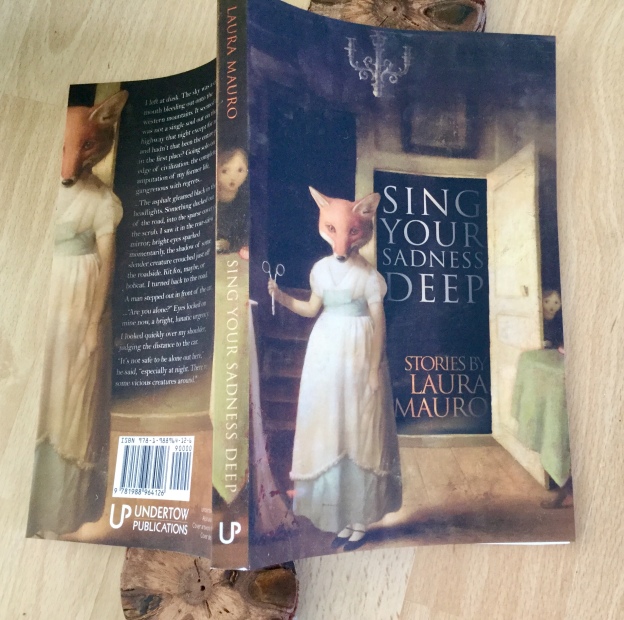
Sing Your Sadness Deep – Laura Mauro

Sing Your Sadness Deep – Laura Mauro


4278F629-F937-4FB6-B215-E6489BDC2620
UNDERTOW PUBLICATIONS 2019
My previous reviews of this author here: https://dflewisreviews.wordpress.com/tag/laura-mauro/ and of this publisher here: https://dflewisreviews.wordpress.com/tag/undertow-publications/
When I read this book, my thoughts will appear in the comment stream below…

18 thoughts on “Sing Your Sadness Deep – Laura Mauro

  1. I reviewed the first story in April 2017, in its then context, as follows…
    ============================
    SUN DOGS
    “; it seemed that the world had stopped without warning and curled in on itself, interminably paused,…”
    …which seems to embrace this whole book so far, ever paused at this moment of Zeno’s Paradox and metamorphosed Tontine. And Alison Moore – Kuder: “They’ve forgotten to be afraid …”
    This is the story of young Sadie, told in her own words, where dryness means rain pent up awaiting almost forever for its sudden convulsion of spilling, beyond any pausing. Thirst and desert and coyotes are cursors, and avoiding men’s advances, who pretend to protect her from roaming critters. A temporary car accident and then a stowaway whom Sadie calls you as ‘you’, and you wonder if you are another foundling child as metamorphosis (rather than the slow-motion pausing of evolution) as depicted in the VHL and the SS stories, and the word ‘cocoon’ is actually used in this text about you, so as to make that link stronger. Until you realise you are perhaps Sadie’s sapphic svelte better half? Or you are that shape-shifter the men wish to protect Sadie from?
    Loneliness is another woman’s living with nothing but a ‘taciturn husband’ and ‘wild beasts’…
    ….’subsumed by your gravity’, ‘a loose-stitched patchwork of intuition, of little stories and guesswork’. A loving svelteness upon svelteness, strange as angels, this is so tantalising, in the end you are indeed left with nothing but that very guesswork, or a “feral Mona Lisa”.
  2. OBSIDIAN
    “Aino believes herself an oracle, a conduit for the magical and the strange, and she believes this not with the lunatic conviction of a man who swears he’s seen aliens…”
    …and that early presumption of ‘man’, one of the story’s participants or its reader, takes on a new meaning by the end of this provocative story of two sisters, Pihla and Aino, 14 and 7 years old, the latter who has epileptic ‘episodes’, plus their dutiful, doleful mother, and the frozen lake nearby and the cosiness inside of snow outside when they are together in the house. The singing from under the ice of the lake. Pihla’s sense of responsibility for Aino is touching when the latter goes missing, presumably magnetised by the lake’s singing. The surrogacy of either sacrifice to man or of rescue by man, man or whatever subsists under the ice as part of someone’s dream or oracle, or both, the quandary still crepitating like crazed ice even after you finish reading about it, any ice-safety cartoon notwithstanding. And the mucoid philtrum, too.
  3. RED RABBIT
    “The sun is setting and the world is cast in the warm pastels of a child’s bedroom.”
    Except a child often likes strident colours, and the the child reader in me has jagged red in the eyesight shaped as saw-rabbits in increasing visual stridency, a sort of paper-cut chase somewhere between Alice in Wonderland and King’s Dark Tower, three Bonny-and-Clydes, one of them Rina, the others two men, already on the road, one of these leading the chase as a raison d’être, despite eyes’ automatic shuttering in and out as a reflex or a quickening strobe with the muscles of some self-destructive cellular life. Till the mass shoot-out in Arizona, part of some Tontine game of hard crucial life, then down the rabbit hole between cellular strobes as an instant instinctive or desperate chance to win that game together, I guess, instead of alone. In Wonderland or Todash.
  4. I reviewed the next story last November in its then context, as follows:
    ===================================
    E0065A28-6E5B-4939-AC6B-0ACCA4827A64LETTERS FROM ELODIE Laura Mauro
    “Sometimes I wonder if she was ever really there. You know? Like she was a dream we all had. She never felt real.”
    An archetypal youthful Brighton aura.
    A seaside pier story with no peer. A sucker for such, am I. And there are the fragments that made the mutual idol, a woman loving a woman, loving each other exclusively as well as mutually, we infer, even if one side of the fragments’ whole is without the physical sexual orientation of the other. Everything is God or Goddess, I guess. A tale of seeming death and love, and letters that are not physical, too, but residing in the eternal ether, as if projected beyond electronica. Beautifully done.
    “With each letter I pieced her together until she was no longer a patchwork of wild stories and daydreams and wispy, far-off ambitions but something else entirely.”
    “That’s all love is, when you strip it down to the bare bones. A loaded gun to the temple with someone else’s finger on the trigger.”
  5. I reviewed the next story in March 2015 in its then context, as follows:
    =========================================
    The Grey Men by Laura Mauro
    “…a strange, abstract skyline emerging from the darkening mist.”
    Fitting my mood at the moment, this is an extremely haunting story, amid the earlier Hargadon-like British workaday commuting pubworld, of encroachment by mist and fog – and the populace suddenly seeing grey men (large as Larson’s whales or here ‘submersibles’ above the basement that is all of us?) hanging amid the fog from the sky; a magician’s trick or viral advertising, and hanging from what hooks upon what wires? Here, another mother’s lost son as in the whale story, another black nostalgia concerning the protagonist’s brother who died from cancer … But is the fog inside his own head as if wired into it, are we seeing it only because he is seeing it? The ending is transcendent, now not fitting my mood but remoulding it?
  6. I reviewed the next story in October 2014 in its then context, as follows:
    =================================.
    Ptichka by Laura Mauro (or Laura Lauro in the contents)
    “‘We get so many Polish girls in here,’ the nurse says. ‘They get themselves knocked up by British men –‘” …as if the uneasy stand-off of unrequited love in the previous Howard story brings such a glibly moral and financial plight of migrant girls in Britain today into stark relief, where love is only in the painful result of the sex not in the sex itself – a love born from pain, borne upon pain, a love of a creature that the sex itself created, albeit nothing more or nothing less than a shut window’s version of roadkill. Joel Lane’s stories often spoke of us as angels with or without wings. This Mauro story speaks of something similar, reminding us strikingly that we are all complicit in whither or whence each of our own eventual migrations do head after the heart’s first or last faint beat. A birdkill that fiction’s now opened window failed to squash. Freed-up frontiers for the rootless, not the ruthless.
  7. I reviewed the next story in January 2014 in its then context, as follows:
    ====================================
    When Charlie Sleeps by Laura Mauro
    “…how can she even try to apply an idea as quaint as ‘coincidence’ to a sexless grey monster living in a bathtub in an abandoned London townhouse?”
    An amazing treatment of urban-torn London and its squats and riots and broken relationships, whereby a creature that is tapped into the actual city drainage systems has some bearing on the nature of the London where the three women (whom we meet in this story) live and look after the creature in their squat’s bathroom. The prose and dialogue evocation of the creature and its ability to turn dreams on and off like electricity is wonderful. And the ending is as sweet as a swollen nut.
    [If I may be self-indulgent for a moment, I have now placed (HERE: password – flickers) a copy of my short short DOGNAHNYI (first published in 1991) as suggested additional reading, not that it is in any way the same as the Mauro story, but it is, I feel, an interesting coincidental adjunct of subject-matter.]
  8. “Most of all the dead, from mortuaries, from under cataracts of rubble, made their anonymous presence – not as today’s dead but as yesterday’s living – felt through London. Uncounted, they continued to move in shoals through the city day, pervading everything to be seen or heard or felt with their torn-off senses, drawing on this tomorrow they had expected – for death cannot be so sudden as that.”
    — Elizabeth Bowen (The Heat of the Day 1949) – post-Blitz
    And the living bones of the dead in a chance concurrent real-time review here of the novel THE SOCIABLE GHOST (1903) by Olive Harper
    Both in wonderful mutual-synergy with Laura Mauro’s hauntingly unique story:
    IN THE CITY OF BONES
    “Don’t they always say that God loves a trinity.”
    Three to two to one, again. Then many? A variably named disfigured girl or as near to a girl as possible who needs to scrub off her scales is left in a house with snow outside as in the frozen lake story – here a taiga that holds memories of some war, like those around Kosovo, Eastern Europe or Cyrillic Russia. And she is receiving shortwave radio transmissions and is meant to collate transcriptions of them on paper similar to the earlier paper chase, here in the style of abstract poems, with numbers as well as words to be translated, if not lost in translation. The one who keeps her there in the house often leaves her alone — a house of once her own choosing, by the snowbound playground, a house arguably like those Houses of Aickman’s Russians — yes, he often leaves her but suddenly does not return, from along roads made from bones or with bones underneath. Another one who visits her also suddenly does not return. This one’s verbs take the singular form but with plural pronouns. Part of the ‘numbers’ conundrum of the transmissions? And so I keep making endless interpretations of this story, one of which means awaiting some outward return diaspora of the dead? It makes me feel I am still there doing that.
  9. Pingback: Synchronicity rampant… | DES LEWIS GESTALT REAL-TIME REVIEWS: I’m gettin great hawlin here. Edit
  10. THE LOOKING GLASS GIRL
    “The city itself is sweating.”
    A strong contrast in Palermo with the lake and snow of two previous sisters in this book. Yet, here we still, in many ways, have the lake under which an older sister is found, a frozen lake now in the form of a mirror, once the older sister’s own mirror, an older sister who once had a secret affair with a man, when Sara, the younger sister, was only seven. The scandalous relationship was of course condemned by their parents, an affair halted by fatal loss at sea of the two sweethearts. If I tell you more, it would spoil this truly iconic story, one that I believe is a classic and missed out on by me till now. Did it win any awards when it was first published? It should have done. Reflect your sadness deep.
  11. I reviewed the next story in November 2017 in its then context, as follows:
    ====================================
    In The Marrow
    “She peeled back a flap of tangerine skin with her thumb.”
    Imagine twin 13 year old girls, one of them 12 minutes older while further ahead in the process of puberty than the other, but both with a shared long-term secret place in the woods… imagine their still individually variable semi-belief in faeries, alongside a past contiguity in body and mind… and then imagine a life-changing event in the younger twin’s mortal prospects, and, then in your own bespoke mind, please imagine the potential outcome from the baselines above that I have barely scratched through toMorrow and toMauro; and finally imagine a growing apotheosis of poignancy in a pitch-perfect style. Those acts of imagining will eventually become this substantive story. And nobody would begrudge it the accolade of calling it a classic of its kind. Life-changing literally in itself.
  12. I reviewed the next story in November 2017 in its then context, as follows….
    =====================================
    LOOKING FOR LAIKA
    “Pete had always thought the end of the world would be a lot louder.”
    A truly limpid tale of a five year old girl, naive with wonder at the bespoke fabrications of fiction concocted by her 13 year old half-brother, while they are on holiday on a caravan site with their shared grandparents. This is potentially a classic SF tale evolving before you, as you tie together your hidden knowledge of the boy’s panic attacks with her constructive gullibility, and how Cyrillic became a way of getting to the very bone of all our fears and hopes, and quaint gullibility beyond the stars and beyond mankind’s misdeeds. If I told you more, it would spoil it.
  13. I reviewed the next story in February 2017 in its then context, as follows:
    =========================================
    STRANGE AS ANGELS
    “She smells resolutely terrestrial, though:”
    It seems not a powerful enough word to call this story powerful. It carries on the meat in the ground (here as a result of a car accident in the Sussex wilds) of the previous story into a world of a young black girl working on the ASDA checkout (you will not believe that I visited this morning an ASDA supermarket midway in the process of reading this work before the reference to ASDA occurred in it, but it is definitely true and added an uncanny feeling to the whole experience for me!) – meat in its most succulently bloody shapes, a girl as self-styled alien herself with self-conscious hang-ups and problems that stem from such dependence on transcending her own felt weaknesses of behaviour, discovering, along with her reluctantly ‘platonic’ boy friend, an angel as alien that grows from nub to almost person-shaped as well as wingèd, by dint of such succulence she feeds it. The interaction of the two humans, alongside the exponential ‘found art’ of the angel, represents a down to earth, but dark visionary, panoply, one that is absolutely perfect within its own terms. As is the ending, so utterly fleshy-devastating, but also hopeful that the now fully constrained and bloodied margins of our green and pleasant land can find new wings…as well as the girl herself.
  14. THE PAIN-EATER’S DAUGHTER
    “Deer and daughter and dad entwined.”
    God’s Trinity or something far more palliative, sin-eating as well as pain-, exorcising, purging, seeping into ranks of collected jars or a suitcase of mochadi — and some filters, I say, can work both ways, and through this svelte novelette the reader can also act palliatively, stoically, in return, hopefully using a review as acknowledgement of – and gratitude for – the triangulated story-coordinates of this book that the reader will have been one of many in helping triangulate. Oldsters as well as striplings. My own daughter was and still is svelte, too, now in her forties. This story in particular is of the 14 year old daughter, Sara, in the title. Her dad, and her grandad before him, and the pain and sorrow they helped syphon, amid a “mountain range of warped and yellowing paperbacks”, “the murderous shriek of foxes” unlike the foxes on the book’s cover, “shrinking down into dense glut,” “the final taboo”, shelves “thick with blood-dark rust,” “this house of wounds”, “piano fingers”, “only bones and empty skin,” numbering the bones, naming them, too, until the iconic “stopping place” created in these last pages.
    end