www.nemonymous.com
Des Lewis - GESTALT REAL-TIME BOOK REVIEWS
A FEARLESS FAITH IN FICTION — THE PASSION OF THE READING MOMENT CRYSTALLISED — Empirical literary critiques from 2008 as based on purchased books.
Tuesday, March 10, 2020

Friday, March 06, 2020
Desmodus – Melanie Tem
Desmodus – Melanie Tem

My previous reviews of this author: https://dflewisreviews.wordpress.com/tag/melanie-tem/
My previous reviews of older or classic books: https://dflewisreviews.wordpress.com/reviews-of-older-books/
When I read this book, my thoughts will appear in the comment stream below…
Man on the Ceiling - Melanie Tem and Steve Rasnic TemIn "Melanie Tem"
In Concert - Melanie Tem & Steve Rasnic TemIn "Melanie Tem"
The Yellow Wood - Melanie TemIn "crossroad press"
24 thoughts on “Desmodus – Melanie Tem”
- Chapter 1
“…for his delinquency had by no means appeared suddenly or out of whole cloth. I did not let myself think about that.”
The whole cloth is also a patchwork quilt, I guess. A mob of “a seething whole.”
This truly is a remarkable and eloquently negotiable tour de force of textured prose style, with so many wild things happening it’s hard to keep one’s breath. A family of these people, mother, sons, aunt (chasing after their uncontrollable nephew), trucking from modem-insular Tallus to the nearby town, their characters and nature evolving for us. The nephew in a scrum with townsfolk and punk kids. Or so. I. Gather. So far. From the. Quilt of chase, events and words. The narrator writing it all out is called Joel. A great writer judging by this chapter. When dial-up modems were all the the rage.
“…it was a given that women had higher-developed echolocation skills than men.”
“The others were particles circling around each other, drawn to and repelled by each other, all these forces combining to create a seething whole.”
“Before I knew it, I had sprung into the mob—which, for all the metaphorical appeal of regarding it as an undifferentiated mass, a single and single-minded creature, was, in fact, comprised of a finite number of separate organisms, each in some or many ways vulnerable.” - Chapter 2
“Obsessively, I made mental lists of the things I was upset about, as though that would anchor them.”
“Poorly socialized though I might be, and chronically dissatisfied with my lot in life, being male had always seemed less trouble than being female.”
But the males, it seem, are the weaker sex and need the females more than they need the males. This, so far, is well and truly a remarkable document of an incredibly redolent society called Tallus, its regimes, its hibernations, its methods of feeding their babies, its smell of communal sleep, its naive sexual togetherness …and much much more. How has this 1995 work crept under my radar? It is the essence of literary style and horror otherness, and it grows on me with utter conviction of what is the nature of these people and their ways, natural and pervasive, and the characters are evolving wonderfully. Including Joel the narrator. I am agog with how this work will surely become something very very special in my reading life … unless it tails off unexpectedly.
“Joel,” my mother exclaimed in some alarm, squinting up at me. “You’re up early. The sun’s not even down.” - Cross-referenced Desmodus with Chronister’s Russala’s Wake here: https://dflewisreviews.wordpress.com/2020/02/09/thin-places-kay-chronister/#comment-18309
- Chapter 3
“…and, indeed, he was stick-thin and ghost-pale. But he survived.”
Today’s funeral in the Desmodus clan reminds me, for the second time, that it is a variant version of unferal. At rest at last, and not amid these wildly instinctive relationships of gender with gender, sibling with sibling, not to mention with the ‘Old Women’. Instinctive, but here Joel reconciles them, describes them beautifully as if he has been gifted some literary leasehold by some freehold author who is not necessarily an ‘Old Woman’, but certainly a woman! And together they create the LEK. A lek perhaps tells you more about this clan than anything else. You will not credit this lek, nothing like it to look at in literature, I suggest. Read it and see. I dare not leak it here. Joel’s ‘luck’, notwithstanding.
And back to Chronister’s ‘Rosemary’ earlier today, we now have, in the Tem, its inverse… “It wasn’t unusual for women to get male names slightly wrong; men were far more likely to pay attention to details like that,…”
- Chapter 4
“Any species, gender, ethnic group, family, hair color, head shape, feeding habit, metabolic cycle, ear size not his own had at one time or another been defined as “other,” with the result that Rory regarded himself—sometimes with pride, sometimes with fury—as a lonely righteous being in a corrupt and alien world.”
There is something remarkable about this book, but I can’t yet put my finger fully on it. Not a glove for my finger, though, but the ear of what turns out to be a dissected rabbit? This now has the commune’s migration towards a southern trip, an explicit Southern Reach, a midsummer-like community in seasonal diaspora (by glider, it seems, if not by walking on air.) Will they reach a lighthouse, later, I even wonder?!
So much inadvertent preternaturalism of commonality with the SynChronister of the Thin Places story that I read only half an hour ago here.
And Rory’s apparent outspoken racism, and Joel’s mother’s attitude to Joel and his sister Alexis. Her belittling of maledom. Yet she criticises her daughter, too. Some of the misandry should bug me. But doesn’t. This book from 1995 was certainly before its time. Now we need to reach back for it, help it give birth to itself. Even an Old Woman can give birth….
“The clouds of insects around the porch lights were noticeably thinner now than even a week ago,…” - Chapter 5
“Only a few tragedies every season. As though only a few, because they were inevitable, were also acceptable.”
… a premonition of how the treatment of Covid-19 today is bound to pan out as it continues to spread? The inverse tontine of pragmatism. At least if only the old among us dwindle, that will solve our Social Care and other population problems…
“So why had we developed a social system, not to mention a physiology, that depended on both female hibernation and male migration?”
That sort of encapsulates the progress of this quite amazing and challenging novel and this Desmodus colony, that I learn more and more about, but not enough. Dealing with the then future gender interactions and changes, the future’s Climate Change, too, the future solipsism of the Internet. And my own later concept of Null Immortalis, here explicitly dealt with. And a woman’s feeding frenzy on stiff-penised bull blood etc. Writer’s block in a dream about flying, too.
I am conscious that there is much here beyond me, (I was once called Desmondo Beyondo in one on-line group) but still I grasp at it. I have long talked about our triangulating the coordinates of a book TOGETHER, each of us using the gestalt real-time reviewing process to help each other and to overlap our emotional, spiritual and intellectual Venn Diagrams. Description to interpretation to evaluation.
Please excuse my heavy quote rate below to assist this process. I am still sure that we shall eventually reach a lighthouse later in this book but if not, we shall reach Ambergen as Ambergris, instead?
Sleeping in transit.
Truck not glider?
“Nobody was ever especially comfortable leaving the infants in the charge of prepubescent child care workers while the adults and teenagers either slept or played. Conventional wisdom had it that this awkward system was an adaptation left over from the days of maternity colonies separate from single-sex migration; if so, I reflected sourly, it was time for the next evolutionary step.”
“…it was probably managerial stupidity to entrust the solution of so major a problem to the very people whose incompetence had caused it in the first place.”
“—I would not have known a dead Old Woman from a live one, or what to do if I knew they were dead.”
“Everyone who wasn’t me wasn’t quite real.”
“—the memories have come to mean more to me than did the incident itself.”
“Although seasonal migration had a vaguely comparable effect for men, because of our differing metabolic patterns between winter in the south and summer up north, migration had turned out to be not nearly so effective an evolutionary adaptation as hibernation.”
“But Ma used to tell me stories about how much Chloe had loved me, how much time she had spent with me, how she had tended me in the nursery long after she’d passed puberty and hadn’t had to anymore.”
“To put an even finer point on it, in this category of mechanical failure alone there were infinite possibilities for disaster: engine breakdown, problems with the elaborate climate control systems, an exhaust or a cold air leak into the trailers. Virtually anything could happen.”
“What, for instance, could possibly be the evolutionary value of our species’ stubborn refusal to accept mortality? Surely we all had always known we would all die. Surely there could be no disputing the even more dreaded corollary: In one way or another, we would all lose everyone we loved. With a few alleged exceptions, the veracity of which enjoyed far from universal acceptance, everyone ever born had died.”
“By the deepest part of the winter, a hibernator’s heartbeat was virtually imperceptible,…’
“And there was also a relentless conviction that the entire social order depended on our successfully bringing the females through the winter.”
“In the creamy autumn dusk, there was hardly a living thing that some female or mass of females did not consider edible—apples, marigolds and asters, gnats, toads, field mice, barn swallows.”
“This hunger and the doomed attempt to take the edge off it could, I reflected sourly, go on forever.” - This is the sort of book that any gestalt real-time reviewing risks SPOILERS, however much care one takes to mitigate them.
Chapter 6
“There were apocryphal stories about clashes between towns people and migrators generations ago, when we were flying, when we were taking so much blood. But we were different now; we had, most of us, evolved.”
This seems to be becoming a very strange, believable and, what must have been in 1995, a ground-breaking pattern (if only the readership at the time could have recognised it), a pattern far more wide-ranging and sophisticated than I first expected. A convoy of male migration ALONG WITH accompanying female hibernations in vehicles that at one moment seem to prophesy those smuggling refugees from Europe to UK today, so rife with incubating dangers to life and, at the next moment, as a complete complex of systems that men like Joel are overseeing from downbeat motel to motel. With designated drivers and reservations, driving between foodlots of sweet permeations of aroma. Playing lethal ‘chicken’, too, amid the boisterous crew of family and others..
“The city was awakening as we staggered back into our motel room, meaning that a hundred thousand potential enemies were regaining consciousness, presumably refreshed and ready for a new day.”
As Joel inspects one hibernation vehicle, he meets the (or an?) Old Woman — the one who has taken over this book, I wonder, in Null Immortalis?
And I think, too, of what in 1995 must have been prophesied mushrooms as gray caps on this route to Ambergen…
“A concentrated presence like an absence. […] …the flesh visible at jawline, pubis, armpit was a mottled, lustrous gray.” - Chapter 7
“Whenever I got out of the truck and made my way into some field or copse or glade, for the purpose of defiling it with my excrement which would shortly be transformed by natural processes and alteration of perspective into fertilizer, I was acutely aware of the presence in the trailer. She shared the expansive night with me, a companionship far more unnerving than loneliness, although I felt loneliness acutely, too.
I could not fathom why she was there; I had never heard of an Old Woman leaving the dens at all, much less traveling all the way to Ambergen in this motley company.”
This book becomes more and more powerful, more and more challenging — challenging with that very power of, say, Joel’s clinical blood-nicking from a drifter and Rory’s full-on blood-rape of a local girl — and challenging with the constructive struggle to unravel its meaning. It was well ahead of its time, I deem.
Also, with thoughts on mother-son relationships, its sense of disorderly yet paradoxically well-ordered diaspora, and dreams of personal gliding, with hyphens as handholds in rock-climbing.
“All men were weak, dependent, impoverished in both physical strength and character.”
“…that I’d just, in fact, dreamed a fragment of The Dream.” - Cross-referenced with Budden’s We Pass Under: https://dflewisreviews.wordpress.com/2020/02/20/uncertainties-iv/#comment-18358
- Chapter 8
“One of the most seductive forms of magical thinking was this: If I could worry in sufficient detail and with sufficient energy about a particular trouble, it would not happen. It never worked, of course; or, more precisely, there was no way to ascertain whether it worked or not.”
Indeed there is a ‘migratory crib death’ of a baby…on this journey as we reach its destination.
And DO PLEASE read the ‘green’ paragraph describing Ambergen. Worth alone the whole entry fee to this book perhaps, with this paragraph’s context. And without the book itself there would be no such context!
“…wet, thick with life just this side of rot.” - Chapter 9
“, and I was both actor and audience.”
You really must experience alongside Joel his visit to the vehicle where the tiers of women are incubating in an apotheosis of the Tem style. His conversation with Rory. (“Why?” I asked warily. “Are you sick?” / He nodded miserably. “I think so. I think I’m really sick.”) And his conversation with David while watching wrestling on TV, and the concept of women’s control over optimum childbirth… - Chapter 10
“…a whole season’s worth of babies, myself among them, a mass of infancy whose individuals were virtually inseparable even to themselves. And every part of my body—which, though tiny and incompletely formed, was all I had—touched by some other body.”


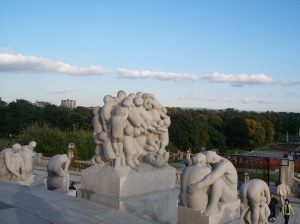
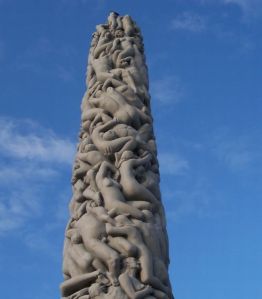


“I couldn’t escape the sensation of being touched everywhere, on every surface, by inchoate, undifferentiated life, and at the far circumference arc…”- Wrestling matches, too, again!
- That COMMARE again too!
https://dflewisreviews.wordpress.com/2020/02/20/uncertainties-iv/
- Chapter 11
“The fine smoke of the burning weed, filtered through water and through the oxygen-rich air that the dense flora exhaled into the room, made my head swim, pleasantly but with an edge of uneasiness. I was not entirely relaxed, but much of my tension was soaking away.”
With increasing elements of my prestigious dysfunction room of literature (a list where I shall now place this book), this sauna scene has itself elements of the earlier LEK….
“…and I moved back and forth between sleep and consciousness as if through a thoroughly permeable boundary. I could taste blood against the roof of my mouth, tiny globules bursting like candy with a liquid center.”
And there are prophetic interfamilial elements, too, reminiscent of the much later film of the commune in Midsommar … Joel’s niece and nephew in a dance of pain with their father. And Joel’s nightly inspection of the hibernaculum trucks. A wound in one of the hibernating ladies….
All of this making this novel seem even more worthy of my dysfunction room. Do please read it and be gobsmacked how you haven’t read this before, you who are already steeped so deeply and widely in the realms of weird literature! - Chapter 12
BECAUSE OF HIS PASSING
And like all phrases that become mind worms they can linger long after their meaning has expired.
“Like the others, I was aware of more dream activity down here than up in Tallus. But they were free-associative, fragmentary, mostly nonsensical dreams that burst like bubbles the moment I awoke and left only the impression of sensory vividness, no messages, no storylines or cryptic clues.”
‘Down here’, being Ambergen. Jokes and dreams, some in competition. Lackadaisical residue hung over from some house party, as if we had got though today’s Coronavirus with resort to sexual or bodily things beyond it, but also as if all our stuffing had been taken out of us. One of Joel’s nephews like a down-sliding sucker on the outside window. Only later for his father to say ‘It sucks.’
This continues to awe me. - Chapter 13
“The farther I went with this examination, the farther I yearned to go, the more urgent became my need to peer and prod and guess.”
… as with my mode of reading/reviewing this book called Desmodus, so does Joel (seeking sanctuary from the storified cut and thrust of other familial matters) searches the tiers of hibernating women in a state of Null Immortalis…
“But no matter what instrumentation or intuition was at my disposal, I could not detect their dreams.”
Recognising, too “…the intimate recognition of mortality that comes and goes, apparently unsustainable through day-to-day life no matter what we know in our hearts and souls.”
Speculating on possible coitus with the Null Immortalis till the shock of recognising the vast difference between Null Immortalis and Death in one woman, while, earlier, touchingly and tellingly, for this prophetic and empathic author, she describes Joel, with a different woman, lingering and saying to himself: “With pleasure I noted how the texture of her graying hair differed from that which still had its melanin.” - Chapter 14
“Maybe the difficulties came from being at Ambergen in the winter instead of at Tallus in the spring.
Or maybe I was wrong. Maybe childbirth was always like this. Maybe that was one hell of an hour.”
I don’t think I have before read such powerful passages describing childbirth and its aftermath. A chapter that should be painted somehow, not into a dark corner, but into the best possible literary frame. Complete with its emotional craquelure. - Chapter 15
“I had never been good with plot twists.”
…nor with books that increasingly surprise me, where all my theories of gestalt falter. Books that, against all the odds, increasingly horrify me, too. I would dub this ‘fontanel fantasy’. With implications I sincerely dare not share here, a sort of brain fluid anti-Natalism, parasitic symbiosis between men and women, but, as I often ask, do filters (or, here, dynastic weirs) work in both directions of flow? We are heading into Transcendia now in 2020, and in 1995 it was just in the germ of an as yet non-sucked brain that once wrote this? We are now as readers the intellectual vampires of this very book? To heal us or hawl us to Hell? As Joel sets off with his surrogate son upon McCarthy’s Road? It’s anyone’s guess, anyone’s gestalt. - Chapter 16
“Above the small plain altar was a stained glass window depicting the crucified Christ, all primary colors and primitive shapes; prismed through it came the unpleasant rays of the sun rising over the high plains.
We had eaten en route. It was not an easy thing for me to feed Eli the way in which he could eat; with my mouth pressed to his, the way I had seen and never really noticed dozens if not hundreds of mothers feed their babies, I tried without complete success to control the muscles and reflexes of regurgitation so that he got the right amount of partly digested food but I was not quite vomiting.”
This book needs reading for yourself, rather than desmodally, for the growing relationship, even synergy between Joel and the baby that he has tantamount to kidnapped so as to rescue it, even to heal it with a better form of emotional acupuncture than those earlier invasive incisions in the soft carapace of the skull? Paternity over maternity? I sense he will fail, but please don’t take my word for it, and I shall just give you some quoted landmarks as we travel through the text that feels to me like a virgin text, between the lines of which or under which the chambers of the Earth’s own skull are to be plumbed, even sucked?
“In some of the stories, our ancestors had evolved in the dark underground chambers, and our emergence into the upper world was regarded as still incomplete, still incipient and even inchoate. Other tales involved mythic heroes, always female, who were our progenitors.” - Chapter 17
“I also couldn’t stop him from sending out the signals that would allow her own maternal echolocation instincts to home right in on him. Every time he clicked and squealed in that particular fashion, I did my best to distract him, and I had to consciously restrain myself from forcibly quieting him.”
“The stone, sheer as taut vertical panels of fine lace, interrupted sound waves and turned them into anagrams.”
This is an inner-world, an ancestral, racist catharsis down here as Joel faces Rory, as if in one of those wrestling matches watched earlier in this book, although I can now no longer remember properly, and I know now why I must have invented gestalt real-time reviewing of such books as this one, those, sometimes inchoate, hyper-imaginaria of literature. Because as I grow older, my mind starts unsticking more easily, losing the plot from the openings that books open up in my own aged version of the fontanel, a crust softening even as it hardens, like the limestone in these caves…
“I despaired, not for the first time, at the myriad of different things we ought to know in order to live in this world and do not.” - Chapter 18
“The ammonia odor of his urine and the rich, acrid smell of his guano made me cough and lightly cover the baby’s face, a gesture I found faintly laughable even as I made it.
“Well,” I said, “why don’t you show me how you really feel?”
He stood back, readjusted his clothes, and surveyed the area he had marked. “Cool,” he said proudly. In fact, he had altered the contours of the rock in ways that, as time passed, would be no more or less interesting than patterns and formations fashioned by dripping water, layered sediment, earthquakes, the burrowing and building of those who lived here. So, was this defacement, to be loathed and avoided, or creation? Was it my responsibility to protect the world from Rory, or to stay out of the way as Rory and the world changed each other?”
Incredibly, Rory’s lullabies for the baby were often far more effective than Joel’s. And we have here an underground attrition, unique in all literature, I suggest, of a wild love-hate relationship, here between two men, an uncle and nephew, around a tiny baby (a mighty Tem adoptive or parental schematic) as the creative burden or stigma of the two men. The challenge and response synergy of Toynbee…? Sun versus its own spat out corona?
“A rather vague but compelling theory took shape that civilization arose out of the tension and then the balance and then the tension again between chaos and order.” - Chapter 19
“There were too many rooms, nestled inside each other like Chinese boxes, strung together like beads irregularly spaced and sized, or not accessible at all one from the other. There were too many forms, made of rock but constantly changing, rock dripping down from ceiling or growing up from floors or shooting out in loops and spirals and angles that moved in place, I swore. Dripping; growing; shooting—action verbs not usually associated with rock. It was too bewildering.”
Earth’s Core, and Azathoth at its centre I propound. Well, perhaps this novel is related to mine in that way, neither having read the other when each wrote itself without human intervention?
“…the machinations of the expedition both mad and methodical, frantic and careful to a fault.”
That is the way I humbly work both as writer and reviewer. I feel they, some Tem of Them, found me in the caves, somehow, too. And placed me in my rightful niche, on their wall.
Wind in tunnels and caves as a prehensile epiphany. Families and relatives, sometimes in erotic union with each other. So deadly erotic even the LEK leaks away into a miasma in favour of utter grinding and ground. A midearthsommar. You will surely not be able to believe this book even exists. It is beyond shock. It is utterly over the top by being found underground. Nobody will give it house room. But perhaps we are now ready…
“I wrestled the baby free.” - Chapters 20 & 21
“Alone somewhere in the caverns, as I had been now for a long, amorphous time, I clung to a wall. The rock was porous and giving; it molded itself around me. I had been practicing, acclimating myself to going incrementally higher and higher. Having started at the bottom, I knew where the edge of the wall was at that point, but otherwise it seemed boundless. There were sensations of curvature, of rotation. It was like climbing the inner surface of an infinite sphere.”
Above is a message to me as I read and reviewed only a few days ago the Aliya Whiteley story here, that I now understand much better; and vice versa with this book itself.
And it is as if it is not only Joel etching his own name and date of birth as modus operandi of legacy into the rockwall of this dream or vision of truths, not only him but ‘me, too’? That me who is nobody, Nemo, Null Immortalis, never passing over beyond death. Of course, none of this was intended, in accordance with the Intentional Fallacy. With the very interesting Ernie character, Rory’s earlier homophobia and racism are now perhaps transcended…beyond the coronal night mask.
Power comes from the inchoate not from the straightforward.
And there are some other haunting scenes, imagined, dreamt or real, with (BEWARE SPOILER) Joel and his dead mother, his mother now as the Commare or Old Woman. I hope my own dead mother shares these visions, visions having now been gifted to us by Melanie for the benefit of all the dead.
This book rocks.
Reflection, Refraction, Dispersion.
Description, interpretation, extrapolation, evaluation. The new path of literary criticism towards gestalt.
end
Subscribe to:
Posts (Atom)
Well, I have done so, now. It seems a real-time review or template of the world as we know it –
“Her monstrous obesity was an offence, but she managed to convey an impression of dignity.”
To the Pacific again, one of the Samoan islands, the above description of the native chiefess is a template for Walker the oppressive colonial administrator of the island, who is ageing and obese like Mr Pickwick and arrogant and often ruthless, but is his heart in the right place? He has instinct, particularly instinct for road-building on the island, and getting things done, a bit like our Boris. He enjoyed girls swimming under him and teasing him in the pool. Should we thus give him some slack? Not if we are like the eyes of this story: the eyes of a regular guy Mackintosh as old Walker’s assistant. A young man with ideals. Against Walker’s means as ends. Ends tragically for whom? Each or both or all? Another template for our once pacific world of nature.
“A ghost of a chuckle came out of his throat. It was astonishingly weird and ghastly.”
Means and ends, again. The Pacific again. The South Seas versus Chicago. Whereby a Fall could be a Rise, and vice versa. Depends what you want from life, not what you THINK you want from life! Just a brief swimming cossie to cover or subtly reveal what is important?
“Desire is sad.”
Volcanic material. Wearing, half-mast, half-cast, the lava-lava, as the makeshift swimming cossie in the previous story, now here like a crude genitals’ covering as a matter of careless course! And you probably know already how this famous ultra-powerful novelette pans out, the merciless, pitiless torrents of relentless rain (“with a fierce malignity that was all too human”) in an enforced Pacific stopover, such rain upon a makeshift hostel with a corrugated roof. Inside, two couples, an overtly and strictly pious Missionary beset by the magnet of sin accompanied by his wife and a relatively common-sensical Doctor also with his wife. Plus a good-time girl whose fat legs puffed out above her boots. And her gramophone. And her visitors. In the previous story, don’t forget the description of someone’s scorn at half-castes mixing with whites. The white standards broken. Now the Biblical commandants are threatened. Here, too, we have temptation as well as merciless madness like the rain the rain the rain, it seems. And what is too obvious remains subtle, and vice versa. We need to wear this story like a hair shirt. Or a hair-cossie, more like! “…one does look at distances differently in the South Seas” — not forgetting the missionary’s memories of the mountains of Nebraska!
Ships leaving Honolulu break coloured streamers between ship and shore…eventually dividing those of us at either end of such streamers.
“…fragments trail down the hull…” and then fly away. Like life’s gestalt or garland?
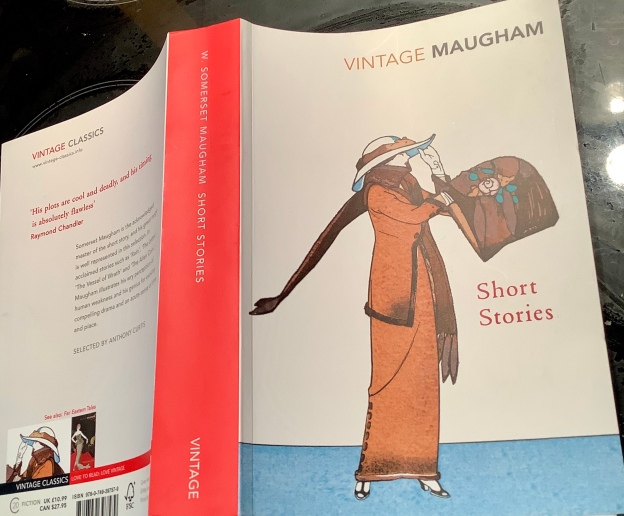
A touching account of how a WSM story collection was thus entitled. Based on myths attaching to the tree and missionaries’ exile in climes now bested by life’s end corona. Though that last bit was my embellishment just as WSM embellished his own casualty of a tree with more of those word streamers…
“Mrs Skinner has an uneasy impression that she looked at them as though they were mannequins at a dressmaker’s. She seemed to live in a different world from theirs and to have no connexion with them.”
Mrs Skinner’s daughter Millicent, that is. This work evolves Millicent’s fraught tale, prior to inevitable revelation at a forthcoming social dinner party, of Millicent’s troubled marriage of convenience or of temperamental mercenariness, to a man who worked in Borneo. Not a childless marriage, though. A man with drink problems leading to tragic results and how all this affects Millicent’s otherwise respectable family, with an added philosophical dilemma of her telling the COMPLETE story at all. The smell of Mrs Skinner’s gloves or the dead man’s ospreys in her toque, notwithstanding.
“And she knew, if anyone did, that the hearts of men, whether their skins are yellow or white or brown, are incalculable.”
From the point of view of a woman whose husband has left her loose….
Purity & Otherness, this is the insular world – harbouring flirtations with love and death – on a ship travelling from Singapore westward, bringing home those who are halfway through their lives at Christmas, a crossover time in more ways than one, with superstition of non-white magic spells to deal with deadly hiccups, a case of a curse as native punishment for the flirt and disingenuousness of the genders, the stereotypes, the interracial prejudices, the first and second class passengers cordoned from each other, too, whatever their colour – and man to man loyalties, where a cockney from 2nd class is represented by elisions in his speech! P & O if said quickly may be the sound of a posh articulate hiccup rather than a guttural one? And a cock that’s de-wattled…
The protagonist woman learns that harbouring grievances is a voyage to nowhere.
A quote from ’Traditions’ a story by William Trevor that I read yesterday here: https://dflewisreviews.wordpress.com/2020/01/13/later-stories-by-william-trevor/#comment-18033
Coincidentally, I happen to be reviewing the complete stories of William Trevor alongside this book of stories by W. Somerset Maugham.
“Singapore is the meeting-place of a hundred peoples; and men of all colours, black Tamils, yellow Chinks, brown Malays, Armenians, Jews and Bengalis, called to one another in raucous tones.”
A truly page-turning story of a crime of self defence, or was it involving duplicity? And the Singaporean ambiance of where we are with it, from ‘more better’ and ‘fliend’ to ‘fiendish passion’. And financial chicanery or Chinkanery? The character of the accused woman called Leslie Crosbie is an unforgettable literary classic character, up for trial, viewed by various men … her husband, her lawyer, and her now murdered or manslaughtered male friend not fliend – and then there is her lawyer’s overtly honest assistant clerk Chink, all of us underestimating a fiendish passion in her or in someone else, for the sake of suspense or mystery? Until we know. The shocking calmness, too.
“…and once more placed the tips of his ten fingers together. The little construction he formed looked like the skeleton of a roof. He was silent for a moment.”
“There is much cry but little wool.”
“He read pencil in hand, underlining passages that attracted his attention, and on the margin making in his neat writing comments on what he read.”
…which has also helped me. I seem to already know this British man Ashenden (a bit of a love rat and intellectual, by the sound of it, vis a vis the ladies and the new craze for Russian literature), know him by dint of a Jungian Collective Consciousness, as we follow him on a long train journey into Russia in the lead-up to a convulsive 1917, with world history milling about us, and the American man he meets called Harrington, Harrington who is a talkative but loveable bore, intent on having a clean change of clothes each day, writing every day to his wife. There are many catalysts for chaos in this story … and turning- and tipping- points, such as the Russian lady whom Ashenden once nearly married after a trial fling in Paris, the utter importance of scrambled eggs, and using her knickers as bandage, and, of course, Harrington’s laundry in war-torn Petrograd, the latter creating a most poignantly tragic scene in the whole of literature, I guess, at the end of this story. Harrington also enjoyed reading aloud. But who is W. D. Howells? And why did Harrington call the Russian lady Delilah and she he Samson? And do you recall that her ex husband had a long head like stretched liquorice?
“I said that was Russia and Mr Harrington said he preferred coloured people.”
(I wonder if he ever forgot not to mix his coloureds in with his whites!)
“‘That’s touch luck, old man,’ said Templeton in his hearty way.”
Templeton, not the sort of chap “to play bumble-puppy bridge with a girl like that…” and Ashenden, the same lively lad as the one in the previous story, now beset with TB. This sanatorium, where various well-characterised characters turn up, makes me think of the one in Mann’s Magic Mountain or Aickman’s Into The Wood, but they all go into some magical alchemy of hope or indeed into a wood of death’s despair, along with a tontine of petty rivalries, and competition over best rooms, and struck up romances, and difficult marriages outside the place, until the marriage of two of them within the place (marriage being deemed by the doctor dangerous for the TB prognosis it seems!) shows genuine love rather than a continuing hope in durability beyond the TB. To Be or not To Be.
“‘It’s not the same thing,’ said the little bird. ‘The rice fields and the lake and the willow-trees look quite different when you see them through the bars of a cage.’”
And, similarly, reading between the lines of print in a story, I wonder?
Why two words? I often wonder whether the second word is misspelt. Currant not current. Still, if you are listening to this, you might wonder what the hell I am talking about. If you listen to everything people say, you might wonder if their intentions are to confuse rather than to clarify.
Even in writing, there is always an undercurrent of being taken for a ride, and you often need to read between the lines to garner the real meaning. Somerset Maugham once wrote about the Princess and the Nightingale, where the nightingale itself spoke to her. To quote Maugham’s story: “‘It’s not the same thing,’ said the little bird. ‘The rice fields and the lake and the willow-trees look quite different when you see them through the bars of a cage.’”
So why two words? I ask this again as I have just thought of something preferable to ‘under current’, a whole, single word with no gap in it, even better than undercurrent itselfwith no gap in it. That is the normal mediocre way. Undercurrent. Nothing to do with raisins or currants. But, then again, as I have already confirmed, I suddenly thought of another word: UNDERTOW. Spelt thus. Nothing to do with feet or their digits!
Then again.
Then again.
The current under our feet is sensed as becoming deeper and deeper, almost like an earth rumour. That was an autocorrect for my clumsy typing of tremor. The throbbing beyond the toes of my feet, a shuddering entrenched within the soul of the support I always try to find in the shaky planet upon which we live. Who knows what waits for us beyond the terror of the terrain?
Take a moment, please, to think, to ponder, yes, to wonder. The earth has its own undercurrent and we should listen to it more than we do.
Towing us through space to our final harbour. Death is above and below everything. A swish and swash of tides nobody can truly ponder – or plunder. The bars of Maugham’s birdcage factored into… into what?
Into ourselves.
Not the digitally manipulative illusion of words and sound, nor any ebb and flow of life as fostered by a nuisance of nuance.
“One November, two or three years after the war, having had a bad attack of influenza, I went down to Elsom to regain my strength.”
And Elsom is of course part of Brighton (well, according to this story), where something slightly worse than flu is centred in the news today. And the narrator here meets someone boring (who had nevertheless met some famous authors of the day like Wilkie Collins and even some of the Pre-Raphaelite painters) and who had also spent his life as a tea merchant trying to persuade people to drink China tea rather than Ceylon. The main thrust of this story, though, is the narrator meeting by chance with a cigarette-cadging man who had been famous for bigamy, a con man marrying women for their money, up to eleven marriages already… regretting he never made it to a round dozen, not that 12 is really round, I’d say! Another chance or coincidence relates to his now fulfilling this ambition by already sniffing around the attractive middle-aged spinster niece of the tea merchant! Sorry about the spoiler, but can an old classic work like this have plot spoilers! You would have thought she was acting quite out of character here, if you did not remember earlier in the story that she had enjoyed reading a racy novel by Ouida! You will not appreciate the coincidences in this work nor its charming descriptions of the social mœurs of seaside life in Brighton, without reading it, though.
“And I give them love. Why, many of them had never known what it was to have a man do them up behind.”
***
My own contribution to this experience –
“Chance is always powerful. Let your hook be always cast; in the pool where you least expect it, there will be a fish.”
– Ovid, Heroides
Covid-19 was Christened today.
And so I’m keeping my own hook clear of the water in more ways than one!
“They saw that Jane was a woman with whom age did not count.”
Amid social manners as an undercurrent of a world we no longer know. Jane is a major figure in literature, it seems, someone I had not met before. An older woman considered by her sister in law as boring and dowdy – and the latter cannot believe when Jane is taken up by a man 27 years her younger. He dresses her artfully in an eyeglass and clothes he designs. They marry. And things pan out perfectly, a divorce where the normal order can continue as an optimum, an optimum that never would have existed without the earlier miraculous transgression of expectations. All through the eyes of another man as independent sounding-board for this story, a story that easily flows with a wonderful rhythm of textured prose and dialogue, and social manners, where disparate age meets disparate age, both beyond and with the grain of a tipping-point.
“Art is is the only thing that matters. In comparison with art, wealth and rank and power are not worth a straw.”
The longest story so far, one that delightfully flows with the usual Maugham narrative synchromesh, with a startling, almost gratuitous, ending to boot. With the Death in Venice sacrifice-everything-for-musical perfection as goal. But something lacking compared to the previous stories, I feel the social mix of Jews and Jewishness hidden amid the Britons, Germans and Gentiles working through the Victorian era into the 1920s. And the fine characterisation of father and the “scapegrace” son, the making of one’s way in life, and the novelist himself as the narrator bringing us towards the ultimate Chopin Test. The crux of art and life. And the wonderful woman who judges this Test..
Today seems to have been Chopin Day. See my review HERE earlier today of this SKLEP story.
“I’ve never seen such a large powder-puff in my life.”
A Marie Laurencin painting, Gauguin also mentioned (that Gauguin Yellow Christ painting comes to my mind, yellow as coward? that King in Yellow?), Debussy, that is played on the piano by someone called Alban. Alban Berg? (that iceberg that is nine tenths hidden?) Alban is the Colonial District Officer in the Far East, married to a monkey-ugly wife Anne, white supremacy both, no, they respect, or at least Anne does, the local white man Prynne who lives with a native girl and had children with her, both Alban and Anne into art and literature, Alban looked at as a snob by the staff and servants, one day he should make Governor, when priggishness is no matter because most of the other white staff already see him as high and mighty, and then THAT will suit the job of Governor! Yet Alban’s Achilles’ heel is as huge as the hidden iceberg, I guess. Seemingly too scared to face the ‘“chinks’” or Chinamen who kill that man who married the native woman. And Alban procrastinates on sorting out the situation, till reinforcements arrive. Atonal notes of equivocation and ambivalence, elements of the dubious double-meaning, a grey area of risk between cowardly caution and bravery. …. what are the eventual repercussions to his job and to his marriage? This story tells you. A story of its time that seems to know more than it should, with undercurrents that only modern people like me can see, while offering up a story to Alban’s contemporary people – who read it THEN – would have expected? Literature holds secrets even from itself! Every sun has a corona, whether invisible or not? The Intentional Fallacy of Colonialism as well as of literary aesthetics.
“…it was a comfort to know that if you fell ill you need not rely only on a Chinese practitioner,… […] On the occasion of an epidemic of influenza the missionary had done the work of ten men…”
This sometimes amusing story of a fat Contrôleur of the Alas Islands, and the pious missionary cum doctor Reverend Owen Jones and his feisty spinsterly seemingly equally pious sister Martha (“She reminded him strangely of wet linen hung on a clothes-line”) and her eventually succumbing to the lslands’ drunken white womaniser called Ginger Ted, her having been marooned with him after a boat’s broken propeller — this otherwise amusing story, yes, takes a backseat today, in our world’s predicament, to other elements of its plot, here metaphorised as an epidemic of ‘cholera’ upon the Alas Islands (in phonetic assonance with ‘corona’?)…
“Hospital sites would have to be erected and quarantine stations. The inhabitants of the various villages on the islands must be forced to take proper precautions…”
“From the standpoint of what eternity is it better to have read a thousand books than to have ploughed a million furrows? Let us admit that reading with us is just a drug that we cannot do without —“
“Once, imprisoned by illness for three weeks in a hill-town in Java, I came to the end of all the books I had brought with me,…”
This is another utterly compelling read in itself, one with a first half containing descriptions of the narrator Mark’s huge book-bag, and how he unloads it by dragging the bag from the books, thus making them a veritable bookriver! He lugs this bag around the world, and one cannot help think his luggage would be less unwieldy if he had a Kindle. But, no, this takes place in the old days of colonies in the East where Englishmen set up their own social communities amid the planters.
The second half of this story is told by one such Englishman to Mark, Mark being a confidence-magnet for personal secrets by, it seems, his role as a writer himself…and this man tells him a story about a brother and sister. The man telling this story to Mark had fallen in love with the sister. And if I tell you more you will know too much. Hope you packed this book at least!
The connection between the story’s thoughts on books and the story of the brother and sister? A connection of pure gratuitousness? Or a connection with a book called ‘The Life of Byron’?
I wonder about books that create stories rather than contain them. Or books that do both of these things at once. Or books with variations of direction inside the relationship with a reader. Synchronicity or cause and effect? A love too close for comfort or a freewheeling emotion of ineluctable truth.
All things are in my book-bag, a bag containing books I often take direct into my veins.
“He was sent here and there, to Spezzia, to Venice, to Bari, and finally to China. Here he fell ill of some mysterious ailment…”
A moving tale of this once thrustingly healthy young man, and an essence of self-goodness that outweighs whatever is brought against him, especially if distilled in ‘story’, as here, forever and ever, even beyond the time when there is anyone left to read it. That balance of a “naked baby” in one hand with empty death in the other, I guess.
Somerset Maugham, do not worry, you managed to do it.
THE KITE
“As we know, there is often a great difference between the man and the writer.”
The man or the writer who the same man also is as kite and kite-flyer? But which is which? (‘Man’ here as generic for man or woman, I suggest.) Freud, incidentally, indeed may be the key to all such kite-flyings of life. Meanwhile, this is a truly blessed page-turning story, each page threatening to become a kite, even eventually the special box-kite featured here that is invented by Herbert from, I guess, the wells of his feet upward. To be flown on the common with his parents, Herbert’s mother (who keeps herself to herself), with his father in meek tow, coming between her son and Betty his wife, a wife whom his mother never wanted Herbert to marry in the first place, a wife who despises kite-flying.
Who flies the kite? Either the man who is seen as flying it or the kite itself autonomously inducing such control of the retrocausal thermals for such a flight to be given it from some lower or upper flight of life’s tier of stories?
The imaginary friend in Solitude or the friend who imagined such a friend?
The sun himself or his corona?
“And you know, when a man once gets bitten with the virus of the ideal not all the King’s doctors and not all the King’s surgeons can rid him of it.”
“; but the philosopher, taking perhaps an unfair advantage of the regrettable happenings just then upon Earth, had asked him how, considering them dispassionately, it was possible to reconcile his All-Power with his All-Goodness.”
God in reply uses the example of three people come to the Judgement Seat, John, Mary and Ruth, a love triangle whereby the standard interpretation of this famous fable is that God punishes them for their lack of sincerity and honesty to themselves and for their perseverance of selfish do-gooding that they hoped would get them into Heaven.
Yet, God does not seem to send them to Hell, but expunges all three AB INITIO? As if they are airbrushed from having ever existed. As if, too, God is now finally convinced by the philosopher’s impossible conundrum of His contradictory Nature as God.
God becomes a Ligottian Anti-Natalist with that one fell stroke, and the consequent virus of a happy non-existence spreads therefrom — up and down in space, back and forth in time.
Until eventually its annihilating reach of contagion reaches towards even the author who wrote this fable containing God.
GIGOLO AND GIGOLETTE
“It was certainly an odd pair. They were sitting by themselves
at a small table. They were very old. The man was big and stout
with a mass of white hair, great bushy white eyebrows and an
enormous white mustache. He looked like the late King Humbert
of Italy, but much more like a king. He sat bolt upright. He wore
full evening dress, with a white tie and a collar that has been out
of fashion for hard on thirty years. His companion was a little old
lady in a black satin ball dress, cut very low and tight at the waist.
Round her neck were several chains of colored beads. She wore
what was obviously a wig, and a very ill-fitting one at that; it was
very elaborate, all curls and sausages, and raven black. She was
outrageously made up, bright blue under the eyes and on the eye-
lids, the eyebrows heavily black, a great patch of very pink rouge
on each cheek and the lips a livid scarlet. The skin hung loosely on
her face in deep wrinkles. She had large bold eyes, and they darted
eagerly from table to table. She was taking everything in, and
every other minute called the old man’s attention to someone or
other. The appearance of the couple was so fantastic in that fash-
ionable crowd, the men in dinner jackets, the women in thin, pale-
colored frocks, that many eyes were turned on them. The staring
did not seem to incommode the old lady. When she felt certain
persons were looking at her she raised her eyebrows archly, smiled
and rolled her eyes. She seemed on the point of acknowledging
applause.”
That is the core of this story, but a story that is otherwise not about them; the story itself is actually about a different couple, the eponymous couple, in a Casino on the French Riviera, many many years before Coronavirus hit the planet, she, to attract diners and gamblers, by diving from a great height into a shallow petrol-lit tank. Twice a night. Daredevil stunt. Tempting at least a broken back by this personal closing of the distance between her and death, in each of her sudden spurts downward. Yes, twice a night. She suddenly loses her nerve between the two dives. Threatening a return to the more lowly paid job, for the couple, of physically attritional marathon-dancing…
And that’s where we must leave this story, before it ends. Between one dive and the next.
***
Artwork above by Camille Gabrielle for the chapbook ‘The Weirdmonger’s Tales’ (Wyrd Press 1994
“It was as inconceivable that Evie should have had a love affair, and a wildly passionate one at that, as that the trout in a glass case over the chimney piece in his study, the finest he had ever caught, should suddenly wag its tail.”
Or was it a tench, not a trout? There is an undercurrent here, one I am unsure was intended. The shallow-minded colonel probably thought of his barren wife Evie as a bit of a dried fish. He had a fancy piece in London, after all, called Daphne. But when Evie publishes a book (‘When Pyramids Decay’) of modern ground-breaking poetry that takes off as a book telling of what appears to be the poet’s passionate, eventually tragic love affair, his pride is hurt and is embarrassed socially. He cannot actually comprehend all the implications of there being any young man who could possibly have seen anything in her!
I think the story’s tail actually does wag — in this short section where a critic says to him of Evie’s poetry… “You know, now and then, as I read and re-read those heart-rending pages I thought of Sappho.”
“The Griffith family were sitting in their pew well in view of the congregation; and, losing even the shadow of decency, the people turned round and stared at them, ghoul-like . . .”
For me, a rather lightweight story aping Austen, with a girl (Daisy) eloping scandalously, here with shame brought on the family. A melodramatic satire on social mœurs and a family’s, a township’s and a religious community’s hypocritical stances upon such a situation. Culminating in a Dick Whittington pantomime where the cat’s jokes compensated Daisy’s brother for much else. For me, such compensation was provided by the thoughtfully described genius loci of the seaside resort where it happens and Daisy’s own subtle mixed feelings about her lost roots and social status at the end.
end