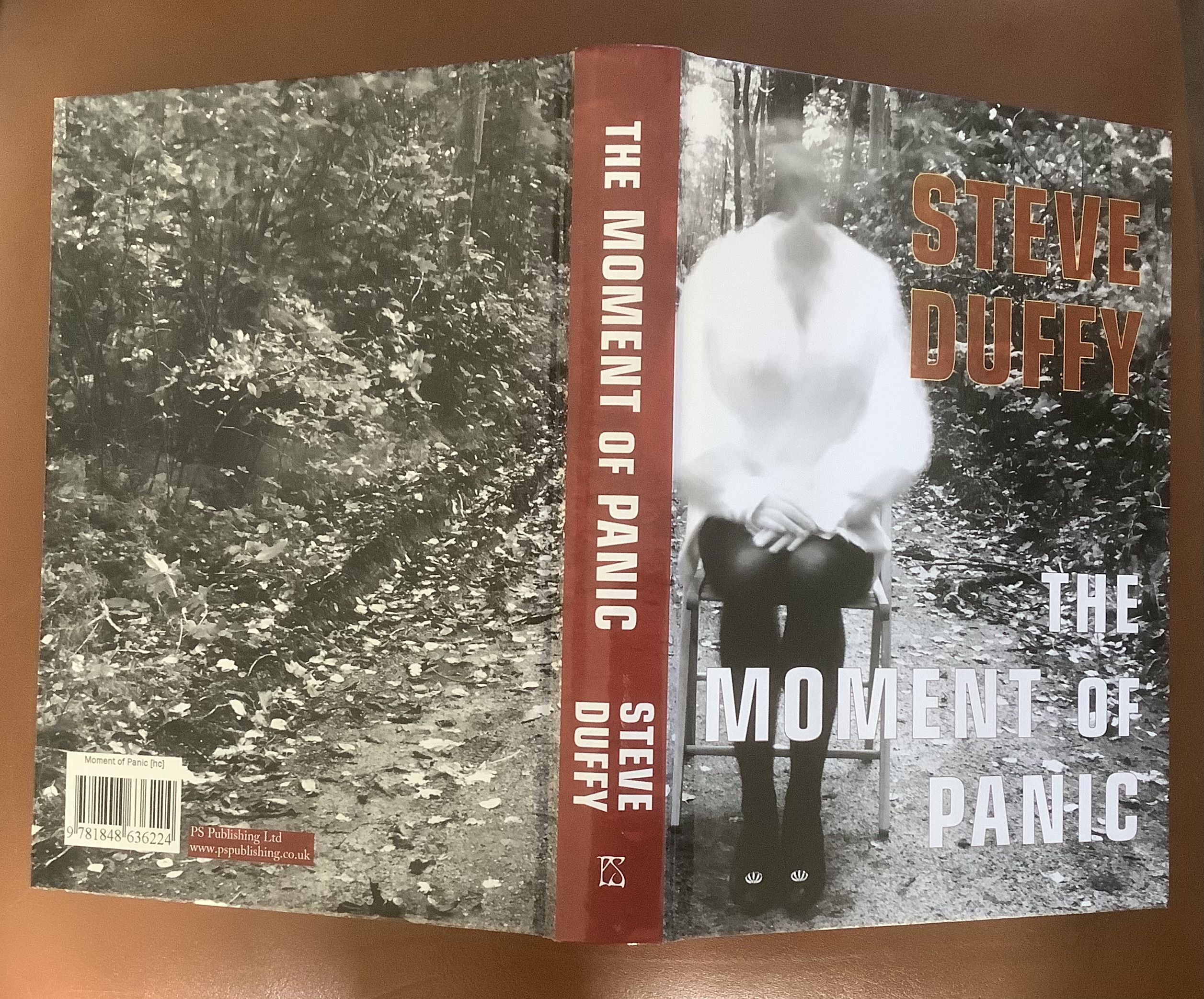
Des Lewis - GESTALT REAL-TIME BOOK REVIEWS A FEARLESS FAITH IN FICTION — THE PASSION OF THE READING MOMENT CRYSTALLISED — Empirical literary critiques from 2008 as based on purchased books.
16 thoughts on “The Moment of Panic — Steve Duffy”
THE MARGINALS
This is utterly the greatest bespoke opening to a story collection I have ever read. I sense I belong, have ALWAYS belonged, to this story, and employed by it, now one of its eponymous delegates at the margin, taken to a certain place, here in my own world as a beachcomber by the sea, but there, in the story, beside a motorway, taken to work in a caravan, with a trailer nearby, and men who come and go, seeming to know why they are there, with a poster on the trailer seen from this no man’s land where I am and another on it now unseeable, only seeable from the motorway itself, and I am soon to replace this story’s Howard, to become a new delegate for seeking out the ring-binder with headed pages that he looks at before darkness comes, a chance to read about inscrutable duties, duties without duties. ‘Ring-binder’, as an expression, sounds about right to me. Can’t think why, though. After all, it’s not the M25 motorway that is so precarious to grid-locking, but another motorway near where “the business parks and industrial estates gave way to the wide flat fields of the Cheshire plain.” Like Barry, what else can I say about what this story is about? A trailer for the whole book yet to be read?
BEWARE SPOILERS below.
THE A TO Z
A man generated by this book so far with its own progression of letters into words, a man called Hugo, in the well-portrayed era of the 1980s, who “made a virtue of his own marginalisation.” Aickman might easily have named a protagonist Hugo, and at first I thought this story was a particularly effective, even playful, theme-and-variations upon Aickman’s ‘Your Tiny Hand Is Frozen’ (note, inter alia, the use of telephones etc. and, later, the use of a woman’s ‘mincing fingertips’ in this Duffy), but I soon realised it goes even beyond Aickman in its deceptively playful power. Believe me! It has the naively sexual and lifely failed young man from Aickman’s ‘Letters to the Postman’ (reviewed by me only yesterday!) and similar obsessions …here with Hugo seeking out that ‘hidden clue’ scrawled into his London A to Z to renew contact with a past fling. Well, as this work compellingly progresses, I immediately airbrushed the mention of my old university up north, and I thought where has this terrifying story been all my life? I can only imagine I had airbrushed it if I had indeed read it before, i.e. blocked it into a form of denial. As I hope I will airbrush it again! As Hugo had himself airbrushed from his memory the previous experience of that past fling called Caroline and her ‘flatmate’ called Lucy. Anything else I tell you will be a spoiler. And indeed if I go into too much detail in public, I will not be able to airbrush it very easily for myself. Suffice to say, I loved its initial development of Hugo’s life up north and now in London, and its era-painting, and the plot mechanics regarding the A to Z, and the taxi man that finally took Hugo home. But some of the implications of its explicitly mentioned ‘muscle memory’ as to the nastinesses within it, ‘the something that becomes something else’, the reference to ‘camps of last resort’… well enough is enough! (Its ‘musky base note’, notwithstanding.) Seriously, a classic.
“; all the rest was a vast murky undulation, slop and ebb, slop and ebb, featureless, unknowable.”
This is, on the face of it, a rather straightforward zombie horror story for its own sake, one that takes place at sea, involving three men and a woman attached to the narrator and joining for the first time their customary night cruise in a ship with a beeping ‘fish-finder’ radar, all of them well-characterised and developed, and there is the materialisation of a legend where a stretch of sea off the North Wales coast spits out its drowned ones, with poetic potential. But Duffy certainly takes it to a new level of cold tactility on a hot night and the consequent terrors not unlike some of Hodgson’s, extending them into realms of rot with flesh-colours and more. The fact this crew of men always played backgammon on these night trips seemed strangely relevant to the qualitative nature of the humanity exhumed from down there. And the fact that the word ‘poky’ can seem to mean constriction as well as having sudden strengths.
VULNAVIA, OR, THE MECHANICAL PRINCESS
I can’t quite believe that this story as a masterpiece of Dr Phibes’ “filthy creation” rested perhaps unconsidered as long as it has and I have not sufficient skills to summon it to readerly life, other than to literally beg you to read it, too, and you, and you, and you… exponentially, as we all try to triangulate its cornucopia of coordinates into full life from the bones of its utterly utterly exquisite prose style and scintillating words as the literary landmark it is and really always has been. No exaggeration. Unfilthy, though, in the crudest sense of ‘filthy’. Ranging through the history of post revolution Russia, taking place there as well as in Switzerland and London, comprising the counterpoint of Bach music and famous real roles from history preserved here as not automata, although they are automata, but on the cusp of living creatures, and what Phibes did to preserve himself and his wife from gory accident, and what he did to succour his feral female helpmate with the title’s name, and how she survived what I infer today to be even this story’s own death within the book where it was published. If it’s unfilthy, it is certainly erotic, though, to play with automata as the solicitor at the end discovers. So, if filthiness can bring you to help create this story again from its unheard rumours by dint of the heroine’s name, then I am willing to pretend that it is whatever you want it to be, just to entice your readerly eyes to the communal task, along with me, as its Dr Fictionstein. And what you want this story to be is genuinely what it is.
LIVES OF THE SAINTS
“Fat lot of good that’ll do me here.”
I usually can’t get on with dialect stories. But this one works perfectly with a brand of seemingly naive adolescentese with sexual overcurrents written believably as a real-time review by a 14 or 15 year old Irish girl as she stays with her religious mad aunt in Wales, as if rescued from her environment of people (particularly Uncle Declan) in Ireland to save her soul and to take her demons out. I was expecting to be lukewarm about this arguably reprehensible screed, but I must again risk allegations of serial overpraise of this book so far by saying here that it is unbelievably powerful. A brave work of abuse and religious mania, where there is an interpolation by a seeming freehold omniscient narrator at which point the voice of Uncle Declan becomes that of Jesus Christ. But whose omniscience is it? Another genuine masterpiece that should not be sent away into a readerless darkness to lick its wounds of shame. It poses eternal questions that only literature can pose. That’s my answer to its challenge. What is yours? Fat chance of you getting to read it, though. Mention of “workers’ playtime” gave me the period. A story worthy of William Trevor, and that is a huge compliment. I have reviewed on this site every single story in his enormous canon.
“How strange it is, to walk where people walk when there is only stillness and dark. Before, it used not to bother me.”
This surely dangerously unrivalled book now deepens further into a left past from page to page, its depiction of rightness ever to become empty as a simple truth? Like history. A powerful vision of England twenty years after the Holocaust, where this our land’s Mysterious Kôr has already, even back then, summoned a spurning of those foreigners — gypsies, totters, this story’s eponymous ones as if from Belsen, bleedin’ come over here, as the barman in this story’s strongly evoked pub might have said! — the same English ironically having at that time recently fought for these people in the war! Yet, one of these foreigners, a Lithuanian, has been utilised bleedin’ over here as a school caretaker, and as in Anna Seghers stories, he was one of those who had turned his coat on behalf of Hitler, and sent his fellows to Padernice, that place which never existed except as a salving fiction for those sent there but now salvaged here as a depiction byfiction! This work has an irony of power that truly works. It skirts dangers so as to transcend them and makes us think more than we can ever think, moving our eyes from left to right across its pages, ever moving our eyes.
OLD AS THE HILLS
“‘Mint-sauce,’ he shouted, and raised a single finger to the baaing from behind the hedge.”
Every story Duffy does is most beautifully written, and his stories themselves are versatile. This is comic horror story excursion to Snowdonia from Rhyll in 1981 during a snowy whiteout, an excursion in a Scimitar car on business by a sexual Machiavelli and wood restorer called Ravi, and it is Ravi who tells this story of his adventure as rewritten here by a narrator acting on behalf of Duffy or actually as Duffy himself, the homely soul behind this whole book, just as a different narrator rewrote a story on behalf of Aickman or as Aickman, a less homely soul, I guess, a story originally told by an old man who was gang-raped, when he was 17, by a small girl and a huge woman in the outrageous ‘Mark Ingestre’ story that I reviewed HERE today just before reading this Duffy! And I reckon the hairy trolls in this Duffy escaped through one of the portals that are by chance opened up between two stories if these stories are somehow chosen by me to be consecutively ‘gestalted’ — i.e. the hairy barber, his assistant covered in waste hair and the huge hairy woman passed, by the means of such a portal, from the Aickman to the Duffy. Meantime, the Duffy is about a snowbound chapel vigil overnight around a dead person in a coffin, to protect the corpse from the legendary trolls that are not only hairy but also often baa like sheep before they are made into meals with mint sauce (or the meat pies in the Aickman?), while Ravi has his salacious way with the dead man’s daughter in a box pew, a woman whom he had not met till now! You can’t make it up. (Another highlight is the description of a road accident involving a skid in snow.)
To honour the previous story above, we now have the next one’s “counting all the baa-baa black sheep in the world”… and even oblique references to Aickman’s Strangers, reviewed an hour or so ago.
If I am right about this story, my review below contains a final sentence in italics that contains an enormous Spoiler!
TODHUNTER’S ROCK
“Sometimes it seems that way, for we know there are no strangers in dreams….”
I have a problem; most times I read a new Duffy, or at least new to me, I wonder not only if this is simply my favourite Duffy, but also whether it might be a long-term favourite of mine among a few others by different authors — or even my favourite ever story! This time it reaches that upper limit of consideration, but surely this is due to the passion of the reading moment, a moment not of panic, but a panic of embarrassment or self-doubt? More a moment of finalising something too early. Like life itself. Overlapping this moment of passion with a moment that divulges too much. About myself as well as about this story.
“…and it would be enough for the moment, just enough.”
A stylised murder whodunnit with self-organic references to that tradition of writing — and it’s as if the various character sections here partitioned represent a film projected in random reels or on a faulty projector, just to tantalise us even more. The sections give a portrait of each suspect amidst a island scenario hinted at by the overall title, amidst words some banned by political correctness and other words, in their syntax of semantics, literally to die for. This text goes beyond the final tipping-point of prose-style power? Involving motives that reach into human behaviours that will make you gasp within the context of old wars and races that participated in them, sexual and financial desires beyond any pale or imitation. I cannot do justice to each character nor how they fit together despite any mis-projection. So I will end by asking: who did do it? The now less than homely omniscient soul working the projector!
“…again and again and again, so good that it hurt.”
A SERIOUS PIECE OF METAL
There is no way I can directly review the plot without spoiling it. Suffice to say, I kept my beady eye looking through a seedy seeping Glory Hole at its own observationals upon Kenneth a socially inept who is still a mother’s boy of a dead mother, a simple man beset by an imperious uncle and aunt, as well as stalked by a man in in his seventies with an axe. And believable details of a housing estate and a self-help group with people who easily fly off handles. They say that a reader feels they actually can become the main protagonist, step into their shoes, as it were, in well written fiction like this.
“Home again, home again, jiggety-jig.”
SECRETS OF THE BEEHIVE
“Through it all, the little subsets continued to intersect and the larger, protean group remained.”
In this sometimes contrived romance story with rivalry in love and recrimination and witchy revenge involved, we are subsumed by the nature of a bee swarm’s gestalt, and the evocative descriptions of their darkly beautiful tidal flow (and bees in general, healing unguent from honey or skin blight), swarms both as love or, when, misdirected from other climes, unnatural hate…and a Halloween death. However contrived this work is, it is an engaging portrait of the woman narrator arrived in the community on the Suffolk-Norfolk border, content to take lower pay for a more contented life. Meanwhile, her love life remains the complicating factor…. but any contrivance of such relationships and their ‘firebreaks’ is compensated by the utterly wonderful style in which everything is couched. And by what inspiration it gave me with the secrets of these bee-tender touches upon my philosophy of literature as what I shall now call ‘distributed sentience’, however much, occasionally, it can feel like wading through estuary mud amidst the bathing in the joy of such touches over the years. “…the bees shared a consciousness, that the hive was the real sentient being, the apiary as a whole, and its individual members were to some extent distributed portions of a larger entity.” — “…to follow through the litany of seeming coincidences down to where their instincts led.”
THE SUICIDE WOOD
“…This rush to live./ This rush to die. Could it be a coincidence? Could it really be . . .? No, of course not. None of it could be. Everything was meant.”
Like wrapping oneself in the previous potentially dangerous bees, this unmissable story builds on that instinct irresistibly and dangerously, by entering the trees of this story’s wood as Lucas Maybury sat close to the wood of the coffin in the hearse at the end of another story — with the perfect impulse, here, a Japanese man or youth (mourning his idolised music star he later listens to on his iPod during this story’s journey), a man or youth called Harumi, an impulse of self-destruction along with his media-met, yet until now unmet, Yuki girl, soon to be harnessed to the same music iPod, as the train travels towards the place where hangers regularly hang each day from trees whatever the noticeboards say to make them change their minds, whatever old ladies with big faces intervene innocently and unconsciously to stop them. You feel pulled along as the missing ‘I’ – Harum-Scarum — by his very slowly onward impulse and the words describing the events, words that are somehow miraculously couched by whatever soul took over the omniscience of this remarkable experience of a story that seriously must be read before you die. Whatever the collusive inimical forces (you now recognise) of the ghostly hangers-on upon your feet (your Yuki with whom you have fallen in love included among them?) as you suffer your noose’s final endless jerk of pain, this story ineluctably takes you to its end with no discernible retrocausal possibility of altering it. Only Zeno’s paradox arguably to save you from the I pod hearse?
This is a story’s story, a storyteller’s story, an author’s author’s story, combining (seriously!) all the classic, slickly told, but densely textured, with witty offshoot thoughts, stories of all those great American authors who once told of township life in the earlier 20th century, I could name them all for you but I won’t, all merged into a version of James Stewart’s ‘It’s A Wonderful Life’ with twists and turns, and sexual flings of an otherwise meek and upstanding man, George, and a wife and children and subjected himself to higher older forces of business in the town, yes, George with a silly uncle thinking of Poe’s Raven, a man whom George keeps employed in the bank and loan company — but who, I ask, is the Angel at the end that makes it the perfect ending when, as George threatens to become another tragic life, among many such tragic lives, finding himself in the dark as his fateful night duly comes, towards his ultimate moment of panic, when he threatens to do what just happened in the Suicide Wood, just now, but instead, no longer downtrodden but beautifully devilishly devious, he holds the girl’s ankles like a ghastly ghost instead of the other way around (what an irony)! But perhaps the real moment of panic is still to come in a Saigon hotel beyond when our official Angel’s ending finishes. That Angel-Demon, as I call this so-called oddbody omniscience who calls himself, I infer, an Angel proper; it’s that homely soul again who first brought our deliciously darksome night to come upon us…
A remarkable book with some genuine dangerous classics that deserve being kept under wraps, so I can gloat. Sorry for any inadvertent spoilers, but it won’t matter, if you never get to read it.
end
Seriously, this extraordinarily powerful collection needs reprinting — and damn quick!
“All the larks were holed that day. […] The larks were chiming to the pulses in his body; the waves whispering. […] The larks flew higher than ever. The waves lapped erotically.”
“They were in a region of unadopted roads, underdefined boundaries, random structures at uncoordinated angles.”
It is is usually down to any Aickman readers to help triangulate such regions of his work into a gestalt, I guess. Not least with this particular story, where genders feint and prestidigitate across such underdefined boundaries — feints and prestidigitations between sister and brother, mother and son, man and woman, more specifically, here, a young postman and the peat-burning woman to whom he delivers letters and from whom he receives personal letters when they spring out of her literal letter “box”, a box where her letters are placed at the front toor, these being missives about the husband who once turned up without her knowing who he was, just his name. There are mysterious protocols of ‘Your’ without an s and an x as a kiss, whether it be an initial as a name or the full name itself, at the end of the letters to each other. The woman seems to want to be rescued from this mysterious (uncouth?) husband and later to find a handsome Prince perhaps currently disguised as a dog. Equally, our callow GPO postman (who happens to be the son of a GP) wants to find a woman to fulfil his even more mysterious protocols of relationship and/or his physical expectations of romance. You see, he plants his face into his own mother’s bosom one day in the family kitchen and later allows his own sister to pull down her skirt in the expensive digs he hires to house the woman to whom he delivers letters and from whom he receives letters. Except pulling down her skirt really means that his sister is pulling it down straight in a prudent spinsterish way while keeping it tightly belted at the waist! Ironically, when he later tells the woman whom he has rescued to take of her dress when alone with her in the digs, it is discovered that she is wearing more than one dress underneath. Every young man should take note, I guess. All of this taking place in an Aickman-like Holihaven seaside resort where the sea is so flat the tide never comes in, and the larks are now inaudible, I infer. All of it being an absurdist way to make some sense, some rhyme and reason, of the interaction between different genders in the days of yore when there was always a second delivery. A second meaning that creeps up on you like a letter dropping on the mat late in the afternoon, that you discover later and decide to leave ever unopened and unrequited. Meanwhile, in order to rescue you ‘little people’ from future temptation of coming in closer union with this story’s own delivery, below there is a harmless clue as another quotation that I have endangered myself by digging it out from the rest of it… The further need for any of you little people to triangulate coordinates from “deep beneath the praties” is thus obviated….
“Problems, if meant to be solved, solve themselves more effectively than we can solve them.”
“How agreeable to watch, from the other side of the high stile, this mighty creature, this fat bull of Bashan, snorting, champing, pawing the earth, lashing the tail, breathing defiance at heaven and at me … his heart hot with hate, unable to climb a stile.” – Rose Macaulay
Robert Aickman considered Elizabeth Bowen to be “the most distinguished living practitioner” of ghost stories. And she happened to be a close friend of Rose Macaulay. Bowen has long been my favourite writer!
“Elk and yak, the bulls of Bashan and of Babylon, mammoth and mastodon, they come trooping to the sunken sea, Lacus Mortis. Ominous revengeful zodiacal host! They moan, passing upon the clouds, horned and capricorned, the trumpeted with the tusked, the lionmaned, the giantantlered, snouter and crawler, rodent, ruminant and pachyderm, all their moving moaning multitude, murderers of the sun.” — ULYSSES by James Joyce (a book also with a section headed ‘Raising the Wind.’)
And Thomas Mann had a favourite dog called Bashan about which he wrote one of his works.
My photo of a Thames Barge also on route for Southend Pier.
RAISING THE WIND by Robert Aickman
“The din was like six mad bulls charging about and bellowing like Bashan. You will remember Bashan.”
No, but I do remember the bulls disguised as cows, or vice versa, in Aickman’s other Essex story HAND IN GLOVE, and the implications involved there, making it a strongly kindred work (my review of it HERE). Now, after some research, I can see the connections with the Bible. And the wind that God makes in the same context of the Book of Amos. And this story is a brief gust of a story compared to his usual seeming attritional story lengths elsewhere! And, indeed, I see this story as an ironic nod by an author at his own now perceived obsession in fiction with literary slowth, Zenoism aka nullimmortalis….
“; and I could imagine that speed could well be of the essence.” — here in RAISING THE WIND
compared with
“‘I’m not sure that time is the essence, Slow,’….” — THE BREAKTHROUGH
A story of an insurance man as narrator raised from rest by a friend to accompany him in a commission to sail, two-handed, a Thames Barge along the estuary coast in the area where I happen to live — from a stinky downtrodden port to another no doubt more salubrious one, with a time deadline involved and if they didn’t get there duly on time there would be a financial forfeit!
While they did succeed, they also somehow didn’t succeed! See what I mean by raising this story to read. It won’t take much of your time, I promise.
The wind raised through the keyhole of a church door between the narrator and an old stinky woman blowing into each other’s mouth raises whatever power is then somehow bottled in a Chianti flask provided by the narrator, later to help the sails of the barge fill with wind…. And the voyage then became indeed ‘sweetly swift’, but leaving behind the church in a near ruinous mess. But their craft perhaps fares no better, by some act of ‘pandemonium’, I infer. A craft called Dorothea.
“I mean, marriage drinks up all of our power of giving or getting any blessedness in that sort of love. I know it may be very dear—but it murders our marriage—and then the marriage stays with us like a murder—and everything else is gone.” — said by Dorothea Brooke in MIDDLEMARCH, probably the most famous Dorothea of all.
I simply know in my heart, from research, that Aickman was an enthusiast for Thomas Mann, but now I wonder what MIDDLEMARCH meant to him. It seems, in hindsight, now, and from what I have grown to know about his fiction and its themes, that it surely must have been an enormous influence on him!
“When I was a boy, confetti was at least confetti. Now it is great lumps of stuff, which lie about far longer than the tiny things ever did.”
I’d better now try halt this review before it grows longer than the story itself!
Here it is the buzzing Moth aeroplane that the book creates, not to take you away, but to stalk you as close to the loose slates of your roof as possible. And it sure did this to me many years ago I now recall, but I must have blocked it out or — perhaps more meaningfully in the context — airbrushed it till I foolhardily read it again just now, and without warning, it’s back there but this time under the roof of my head, seeking to airbrush equivalently its version of my own “implicit ghost”, I feel.
The satisfyingly complex story of the Trenwiths, Colin and Grace, husband and wife, living near Cromwell Rd and their endurance of the ‘boring’ Eileen McGrath, a widow and top civil servant with her own ‘lodestar’, the one who lives in oblique neighbourly contiguity with them, along with her invisible tenants — a story of aloneness and social differences and false fronts, and richly if darkly tantalising interactions between them. About the English and their use of laughter. Then there is Eileen’s one attempt to co-opt Colin when Grace is abroad in India to visit a dying mother. But when Grace returns it is her instead who is co-opted by Eileen into an aviation project, resulting in the hunting of Colin by both or one of them — or by neither of them, as the small aeroplane is often seen flying without a pilot. It even hugs Colin’s trail on holiday by train to visit a country house, one whose “ornamental waters were full of sewage.” (My italics.)
Reading this story one tempts such airbrushing or subsuming upon oneself in a similar way, and so I am trying to get it off my chest again, and leaving it for you to deal with by means of this review. Not a game, I assure you, but something definitely compulsory! Not sure whether it is a gender thing, whether any reader is more or less susceptible to reading it? But I sense it is a masochistic man who wrote it for married men to read. Unless you know different?
Probably the most important passage that Aickman ever wrote:
“A year ago, all the words that matter had suddenly changed their meanings and changed them for ever. Nor was this process of change going to cease. Colin felt that he would never even die. Rather was he to be endlessly dragged out of himself; moulded, melted, and miniaturized: while all the time, his real self remained entirely conscious but entirely powerless, like a discarded chrysalis still with feeling. A manikin was materializing while the man watched, having first been paralysed.”
The heads above the country house wall watching him at the end are probably all you readers. Me included, if I could but know. Or have all the words changed meaning yet again?




THE MARGINALS
This is utterly the greatest bespoke opening to a story collection I have ever read. I sense I belong, have ALWAYS belonged, to this story, and employed by it, now one of its eponymous delegates at the margin, taken to a certain place, here in my own world as a beachcomber by the sea, but there, in the story, beside a motorway, taken to work in a caravan, with a trailer nearby, and men who come and go, seeming to know why they are there, with a poster on the trailer seen from this no man’s land where I am and another on it now unseeable, only seeable from the motorway itself, and I am soon to replace this story’s Howard, to become a new delegate for seeking out the ring-binder with headed pages that he looks at before darkness comes, a chance to read about inscrutable duties, duties without duties. ‘Ring-binder’, as an expression, sounds about right to me. Can’t think why, though. After all, it’s not the M25 motorway that is so precarious to grid-locking, but another motorway near where “the business parks and industrial estates gave way to the wide flat fields of the Cheshire plain.” Like Barry, what else can I say about what this story is about? A trailer for the whole book yet to be read?
BEWARE SPOILERS below.
THE A TO Z
A man generated by this book so far with its own progression of letters into words, a man called Hugo, in the well-portrayed era of the 1980s, who “made a virtue of his own marginalisation.” Aickman might easily have named a protagonist Hugo, and at first I thought this story was a particularly effective, even playful, theme-and-variations upon Aickman’s ‘Your Tiny Hand Is Frozen’ (note, inter alia, the use of telephones etc. and, later, the use of a woman’s ‘mincing fingertips’ in this Duffy), but I soon realised it goes even beyond Aickman in its deceptively playful power. Believe me!
It has the naively sexual and lifely failed young man from Aickman’s ‘Letters to the Postman’ (reviewed by me only yesterday!) and similar obsessions …here with Hugo seeking out that ‘hidden clue’ scrawled into his London A to Z to renew contact with a past fling. Well, as this work compellingly progresses, I immediately airbrushed the mention of my old university up north, and I thought where has this terrifying story been all my life? I can only imagine I had airbrushed it if I had indeed read it before, i.e. blocked it into a form of denial. As I hope I will airbrush it again! As Hugo had himself airbrushed from his memory the previous experience of that past fling called Caroline and her ‘flatmate’ called Lucy. Anything else I tell you will be a spoiler. And indeed if I go into too much detail in public, I will not be able to airbrush it very easily for myself. Suffice to say, I loved its initial development of Hugo’s life up north and now in London, and its era-painting, and the plot mechanics regarding the A to Z, and the taxi man that finally took Hugo home. But some of the implications of its explicitly mentioned ‘muscle memory’ as to the nastinesses within it, ‘the something that becomes something else’, the reference to ‘camps of last resort’… well enough is enough! (Its ‘musky base note’, notwithstanding.)
Seriously, a classic.
Pingback: The A to Z by Steve Duffy | The Des Lewis Gestalt Real-Time Reviews Edit
LIE STILL, SLEEP BECALMED
“; all the rest was a vast murky undulation, slop and ebb, slop and ebb, featureless, unknowable.”
This is, on the face of it, a rather straightforward zombie horror story for its own sake, one that takes place at sea, involving three men and a woman attached to the narrator and joining for the first time their customary night cruise in a ship with a beeping ‘fish-finder’ radar, all of them well-characterised and developed, and there is the materialisation of a legend where a stretch of sea off the North Wales coast spits out its drowned ones, with poetic potential. But Duffy certainly takes it to a new level of cold tactility on a hot night and the consequent terrors not unlike some of Hodgson’s, extending them into realms of rot with flesh-colours and more. The fact this crew of men always played backgammon on these night trips seemed strangely relevant to the qualitative nature of the humanity exhumed from down there. And the fact that the word ‘poky’ can seem to mean constriction as well as having sudden strengths.
VULNAVIA, OR, THE MECHANICAL PRINCESS
I can’t quite believe that this story as a masterpiece of Dr Phibes’ “filthy creation” rested perhaps unconsidered as long as it has and I have not sufficient skills to summon it to readerly life, other than to literally beg you to read it, too, and you, and you, and you… exponentially, as we all try to triangulate its cornucopia of coordinates into full life from the bones of its utterly utterly exquisite prose style and scintillating words as the literary landmark it is and really always has been. No exaggeration.
Unfilthy, though, in the crudest sense of ‘filthy’. Ranging through the history of post revolution Russia, taking place there as well as in Switzerland and London, comprising the counterpoint of Bach music and famous real roles from history preserved here as not automata, although they are automata, but on the cusp of living creatures, and what Phibes did to preserve himself and his wife from gory accident, and what he did to succour his feral female helpmate with the title’s name, and how she survived what I infer today to be even this story’s own death within the book where it was published. If it’s unfilthy, it is certainly erotic, though, to play with automata as the solicitor at the end discovers. So, if filthiness can bring you to help create this story again from its unheard rumours by dint of the heroine’s name, then I am willing to pretend that it is whatever you want it to be, just to entice your readerly eyes to the communal task, along with me, as its Dr Fictionstein.
And what you want this story to be is genuinely what it is.
LIVES OF THE SAINTS
“Fat lot of good that’ll do me here.”
I usually can’t get on with dialect stories. But this one works perfectly with a brand of seemingly naive adolescentese with sexual overcurrents written believably as a real-time review by a 14 or 15 year old Irish girl as she stays with her religious mad aunt in Wales, as if rescued from her environment of people (particularly Uncle Declan) in Ireland to save her soul and to take her demons out. I was expecting to be lukewarm about this arguably reprehensible screed, but I must again risk allegations of serial overpraise of this book so far by saying here that it is unbelievably powerful. A brave work of abuse and religious mania, where there is an interpolation by a seeming freehold omniscient narrator at which point the voice of Uncle Declan becomes that of Jesus Christ. But whose omniscience is it? Another genuine masterpiece that should not be sent away into a readerless darkness to lick its wounds of shame. It poses eternal questions that only literature can pose. That’s my answer to its challenge. What is yours? Fat chance of you getting to read it, though.
Mention of “workers’ playtime” gave me the period. A story worthy of William Trevor, and that is a huge compliment. I have reviewed on this site every single story in his enormous canon.
Pingback: Lives of the Saints by Steve Duffy | The Des Lewis Gestalt Real-Time ReviewsEdit
THE RAG-AND-BONE MEN
“How strange it is, to walk where people walk when there is only stillness and dark. Before, it used not to bother me.”
This surely dangerously unrivalled book now deepens further into a left past from page to page, its depiction of rightness ever to become empty as a simple truth? Like history. A powerful vision of England twenty years after the Holocaust, where this our land’s Mysterious Kôr has already, even back then, summoned a spurning of those foreigners — gypsies, totters, this story’s eponymous ones as if from Belsen, bleedin’ come over here, as the barman in this story’s strongly evoked pub might have said! — the same English ironically having at that time recently fought for these people in the war! Yet, one of these foreigners, a Lithuanian, has been utilised bleedin’ over here as a school caretaker, and as in Anna Seghers stories, he was one of those who had turned his coat on behalf of Hitler, and sent his fellows to Padernice, that place which never existed except as a salving fiction for those sent there but now salvaged here as a depiction byfiction! This work has an irony of power that truly works. It skirts dangers so as to transcend them and makes us think more than we can ever think, moving our eyes from left to right across its pages, ever moving our eyes.
OLD AS THE HILLS
“‘Mint-sauce,’ he shouted, and raised a single finger to the baaing from behind the hedge.”
Every story Duffy does is most beautifully written, and his stories themselves are versatile. This is comic horror story excursion to Snowdonia from Rhyll in 1981 during a snowy whiteout, an excursion in a Scimitar car on business by a sexual Machiavelli and wood restorer called Ravi, and it is Ravi who tells this story of his adventure as rewritten here by a narrator acting on behalf of Duffy or actually as Duffy himself, the homely soul behind this whole book, just as a different narrator rewrote a story on behalf of Aickman or as Aickman, a less homely soul, I guess, a story originally told by an old man who was gang-raped, when he was 17, by a small girl and a huge woman in the outrageous ‘Mark Ingestre’ story that I reviewed HERE today just before reading this Duffy! And I reckon the hairy trolls in this Duffy escaped through one of the portals that are by chance opened up between two stories if these stories are somehow chosen by me to be consecutively ‘gestalted’ — i.e. the hairy barber, his assistant covered in waste hair and the huge hairy woman passed, by the means of such a portal, from the Aickman to the Duffy. Meantime, the Duffy is about a snowbound chapel vigil overnight around a dead person in a coffin, to protect the corpse from the legendary trolls that are not only hairy but also often baa like sheep before they are made into meals with mint sauce (or the meat pies in the Aickman?), while Ravi has his salacious way with the dead man’s daughter in a box pew, a woman whom he had not met till now! You can’t make it up. (Another highlight is the description of a road accident involving a skid in snow.)
Pingback: The Portals of Gestalt | The Des Lewis Gestalt Real-Time Reviews Edit
To honour the previous story above, we now have the next one’s “counting all the baa-baa black sheep in the world”… and even oblique references to Aickman’s Strangers, reviewed an hour or so ago.
If I am right about this story, my review below contains a final sentence in italics that contains an enormous Spoiler!
TODHUNTER’S ROCK
“Sometimes it seems that way, for we know there are no strangers in dreams….”
I have a problem; most times I read a new Duffy, or at least new to me, I wonder not only if this is simply my favourite Duffy, but also whether it might be a long-term favourite of mine among a few others by different authors — or even my favourite ever story! This time it reaches that upper limit of consideration, but surely this is due to the passion of the reading moment, a moment not of panic, but a panic of embarrassment or self-doubt? More a moment of finalising something too early. Like life itself. Overlapping this moment of passion with a moment that divulges too much. About myself as well as about this story.
“…and it would be enough for the moment, just enough.”
A stylised murder whodunnit with self-organic references to that tradition of writing — and it’s as if the various character sections here partitioned represent a film projected in random reels or on a faulty projector, just to tantalise us even more. The sections give a portrait of each suspect amidst a island scenario hinted at by the overall title, amidst words some banned by political correctness and other words, in their syntax of semantics, literally to die for. This text goes beyond the final tipping-point of prose-style power? Involving motives that reach into human behaviours that will make you gasp within the context of old wars and races that participated in them, sexual and financial desires beyond any pale or imitation. I cannot do justice to each character nor how they fit together despite any mis-projection. So I will end by asking: who did do it? The now less than homely omniscient soul working the projector!
“…again and again and again, so good that it hurt.”
A SERIOUS PIECE OF METAL
There is no way I can directly review the plot without spoiling it. Suffice to say, I kept my beady eye looking through a seedy seeping Glory Hole at its own observationals upon Kenneth a socially inept who is still a mother’s boy of a dead mother, a simple man beset by an imperious uncle and aunt, as well as stalked by a man in in his seventies with an axe. And believable details of a housing estate and a self-help group with people who easily fly off handles. They say that a reader feels they actually can become the main protagonist, step into their shoes, as it were, in well written fiction like this.
“Home again, home again, jiggety-jig.”
SECRETS OF THE BEEHIVE
“Through it all, the little subsets continued to intersect and the larger, protean group remained.”
In this sometimes contrived romance story with rivalry in love and recrimination and witchy revenge involved, we are subsumed by the nature of a bee swarm’s gestalt, and the evocative descriptions of their darkly beautiful tidal flow (and bees in general, healing unguent from honey or skin blight), swarms both as love or, when, misdirected from other climes, unnatural hate…and a Halloween death. However contrived this work is, it is an engaging portrait of the woman narrator arrived in the community on the Suffolk-Norfolk border, content to take lower pay for a more contented life. Meanwhile, her love life remains the complicating factor…. but any contrivance of such relationships and their ‘firebreaks’ is compensated by the utterly wonderful style in which everything is couched. And by what inspiration it gave me with the secrets of these bee-tender touches upon my philosophy of literature as what I shall now call ‘distributed sentience’, however much, occasionally, it can feel like wading through estuary mud amidst the bathing in the joy of such touches over the years.
“…the bees shared a consciousness, that the hive was the real sentient being, the apiary as a whole, and its individual members were to some extent distributed portions of a larger entity.” — “…to follow through the litany of seeming coincidences down to where their instincts led.”
THE SUICIDE WOOD
“…This rush to live./ This rush to die. Could it be a coincidence? Could it really be . . .? No, of course not. None of it could be. Everything was meant.”
Like wrapping oneself in the previous potentially dangerous bees, this unmissable story builds on that instinct irresistibly and dangerously, by entering the trees of this story’s wood as Lucas Maybury sat close to the wood of the coffin in the hearse at the end of another story — with the perfect impulse, here, a Japanese man or youth (mourning his idolised music star he later listens to on his iPod during this story’s journey), a man or youth called Harumi, an impulse of self-destruction along with his media-met, yet until now unmet, Yuki girl, soon to be harnessed to the same music iPod, as the train travels towards the place where hangers regularly hang each day from trees whatever the noticeboards say to make them change their minds, whatever old ladies with big faces intervene innocently and unconsciously to stop them. You feel pulled along as the missing ‘I’ – Harum-Scarum — by his very slowly onward impulse and the words describing the events, words that are somehow miraculously couched by whatever soul took over the omniscience of this remarkable experience of a story that seriously must be read before you die. Whatever the collusive inimical forces (you now recognise) of the ghostly hangers-on upon your feet (your Yuki with whom you have fallen in love included among them?) as you suffer your noose’s final endless jerk of pain, this story ineluctably takes you to its end with no discernible retrocausal possibility of altering it. Only Zeno’s paradox arguably to save you from the I pod hearse?
BEWARE INEVITABLY DEVILISH SPOILERS below! (Seriously)
***
YOU ARE NOW IN BEDFORD FALLS
“…but again. I’m getting ahead of myself.”
This is a story’s story, a storyteller’s story, an author’s author’s story, combining (seriously!) all the classic, slickly told, but densely textured, with witty offshoot thoughts, stories of all those great American authors who once told of township life in the earlier 20th century, I could name them all for you but I won’t, all merged into a version of James Stewart’s ‘It’s A Wonderful Life’ with twists and turns, and sexual flings of an otherwise meek and upstanding man, George, and a wife and children and subjected himself to higher older forces of business in the town, yes, George with a silly uncle thinking of Poe’s Raven, a man whom George keeps employed in the bank and loan company — but who, I ask, is the Angel at the end that makes it the perfect ending when, as George threatens to become another tragic life, among many such tragic lives, finding himself in the dark as his fateful night duly comes, towards his ultimate moment of panic, when he threatens to do what just happened in the Suicide Wood, just now, but instead, no longer downtrodden but beautifully devilishly devious, he holds the girl’s ankles like a ghastly ghost instead of the other way around (what an irony)! But perhaps the real moment of panic is still to come in a Saigon hotel beyond when our official Angel’s ending finishes. That Angel-Demon, as I call this so-called oddbody omniscience who calls himself, I infer, an Angel proper; it’s that homely soul again who first brought our deliciously darksome night to come upon us…
A remarkable book with some genuine dangerous classics that deserve being kept under wraps, so I can gloat. Sorry for any inadvertent spoilers, but it won’t matter, if you never get to read it.
end
Seriously, this extraordinarily powerful collection needs reprinting — and damn quick!