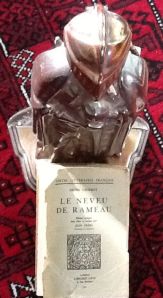
Daniel Mills

UNDERTOW PUBLICATIONS 2021
PART THREE of this review, as continued from here: https://classicalhorror.wordpress.com/daniel-mills/
My previous reviews of Daniel Mills: https://dflewisreviews.wordpress.com/tag/daniel-mills/and this publisher: https://dflewisreviews.wordpress.com/tag/undertow-publications/
This author had a story in my edited Classical Music Horror Anthology in 2012.
I HOPE TO CONTINUE REAL-TIMING THIS BOOK IN THE COMMENT STREAM BELOW…


The Account of David Stonehouse, Exile
Continued…
“I lie upon the floor with the journal resting open on my breast and the pencil moving over the page, keeping pace with my mind, as the past weeks return in fragments. The memories twist in my hands, bending to one side and another in the manner of a blacksmith’s puzzle.”
That metal puzzle I used to have to fathom every Christmas when a boy, to separate the pieces. I now seem to be working towards opposite goals, a new revelation of putting the bits together again as gestalt. David recounts here the dreams of Jerusha as once told to him by her (or as he felt them as or through her, I wonder?) and a younger more innocent girl with a Bowen apple amid broad Biblical cycles, but since when, I ask, was any creature’s self-cannibalism Biblical? Even Aickmanesque? I fear I am being led astray again. Meanings escape me as do the pieces of the puzzle, the puzzle of my life?
Read up to: “That sensation.”
“I dropped from the broken window and scuttled away on all fours to the shelter of the apple-trees.”
This work is so maddening it fills the reading veins with the spirit and need to master it. As David, too, is now determined to reconcile its loose ends, the identity of August Fitch whose journal’s residual blank pages David is using, AF’s similarly initialled boots and those of the to be exhumed man to whose body David takes me (on all fours?) so as to dig it up using this book’s textured goriness of tactile text…no longer ‘to be exhumed’ but laid out. Stench and all.
Read up to: “striking my elbow”
Cf my review of Bowen’s I DIED OF LOVE that I completed before reading that Mills section above: https://nullimmortalis2010.wordpress.com/elizabeth-bowen-stories-12/#comment-754
“…the severed roots belching warm fluid in rhythmic spurts, as with the beating of a great god’s heart.”
As words root each other, so do skulls, one man or many, Fitch as stalker, a ghost of a girl whose footprints vanish, this is intrinsically a ravening wolf pack of words the power of which you have surely never experienced before, a pack of dreaming words, too. It’s like separating word from word as if they are heady sinews. Surely this exhumation of meaning has never left human senses such as sight, touch, smell intact but also tactless. Each reader bereft of their own meaning. And no hope that such meaning will be found even by the end of this work. Unless that ‘great god’s heart’ beats again? (That ‘persistent ghost’ in Bowen earlier today?)
Read up to end of ‘Part Three’.
PART FOUR
Judah’s illness segued with listening to Jerusha’s belly after the Gift transfigured into sex amid the cornfields at the stone house, but Elder Job despaired the Gift was squandered…
All couched in words to which I cannot do justice… and this makes me despair, too, that my reviews are just a measuring out of time as a record of words, as a ritualised record of my own false achievement, words without exterior elucidation. And, here, words without interior elucidation, too.
Judah’s plight and the gathering wolves… and time measured not in words but in marked crosses.
“….moonlight on the apple-blossoms as they fall.”
“More disturbingly, however, one can be unknowingly inhabited by the crypt or crypt-effect of someone else — […] …the logic of cause and effect is placed in abeyance and becomes a function of reading itself. […] …a kind of wound, or, more accurately, a cicatrice …“
From The Dissolution of the Novel here: https://dflewisreviews.wordpress.com/2021/11/12/the-trance-of-reading/
“We entered the orchard, where I laid him down amidst the crush of fallen blossoms.”
The apple blossoms coming down upon the most poignant scenes of exposed brain and tactile dying that you will probably read in any literature. A wrenchingly tactful putting to sleep that overlaps with David’s memories of being found out when a new life promised from within such exposed brain that any author needs. Elbow become bowel, in my own terms. Angels below…
Amid songs of angels, one of ‘whom’ once came down upon while the Eldress Rose. While I still add words to my review of Daniel’s work without yet fully understanding why.
“…til the Gift of Interpretation was granted me that I might understand the Gifts…”
“In our exile we were even then in Eden,…”
Enlightenment for me as this plot at last coheres excoriatingly or umbilically for me here in our own co-vivid co-here. Those co-memories I can now share with David about the circumstances of his exile along with Jerusha. I Have A Dream?
Read up to: ”Abba abba lema sabachthani?”
I believe in angels.
“We haunt ourselves. We are dead but unburied and with nothing left to us save the haunting.”
And now I face the haunting enlightenment with a larger saudade of text till its very end. It is not enlightenment at all, but creative God-given confusion. And I consider this some of the strongest writing I have ever read, where fiction has at last become the fearless faith I always believed it was. Through into PART FIVE where the handwriting changes again. A woman’s hand. The Child is Mother of the Woman, in contrast to being the Father of the Man as Wordsworth once said in his intimations of Null Immortalis. The Eden created. A birth in death resurrected as life. Out of such awesome tactility of gory living expression couched within words. The word as flesh.
“I have told you that faith is a gift of God.”
A passion of the reading moment, and I may think differently of the the Bible in the dying days that will never die.
“…to rain down earth and apples til the grave’s walls collapsed and he vanished into the ground. Only the white hands visible. They sat upon his chest, folded together, as though he were praying.
An apple tree grows there now,…”
“He was known for it when he was young, but it suffered, I think, for the cold of this place and there are passages inside which I cannot make out.”
Marked to die. As we all are. But what is dying?
***
I shall complete this review below by re-reading and reviewing this author’s DE PROFUNDIS as a coda to this book, but one that is not printed within it…
“Do you remember the sower, how some seeds fall on good ground? Others fall among the weeds and are choked by them.“
[In Isaiah, ‘Fitch’ are aromatic seeds (seeds that happen to be native to southwest Asia).]
Some of this possibly needs cross-referencing here as a mutual synergy, whether preternatural or not — https://etepsed.wordpress.com/mark-samuels/
DE PROFUNDIS as Apocrypha
“It is January 18th.”
It always used to snow in whiteouts upon my birthday, which that date happens to be! This rare story, compared to the story of David, is of a character called Damien but the style is often more staccato, representing “jagged static”, an element of the ‘atonal’ as this reliving of a father-son relationship with cruel spatula and Catholic upbringing, talking in tongues, belief in angels, he has a dream, too, and his religious theology studies clashes with his musicianship in discovering my favourite composer Scriabin and the hidden melodies or mystic chords that slowly develop like photographs or as slowly as I read David’s story until its sudden clinching enlightenment manqué, God not Azathoth from boiling chaos? DE profundiS. All centred upon on David’s ‘pine grove’. And much more. Beyond #abba or other key registers such as C. F# E. et al. The chord of the Pleroma…
***
As a whole, this is a most inspiring book, now finished reading, even with that ghostly participant of a story that appears like a forgotten mystic chord that I now understand more than I did when I first read it. This book is important and holistic enough not to need this unseen extra at all; it is in fact even more holistic for its absence, its absence as a Holy Ghost or inferred Shadowy Fraction.
This mighty spiritual Undertow of a book is not simply (simply?!) weird fiction; it is a religion by fiction. It talks in tongues and things are still developing even as I write this.
End Immortalis