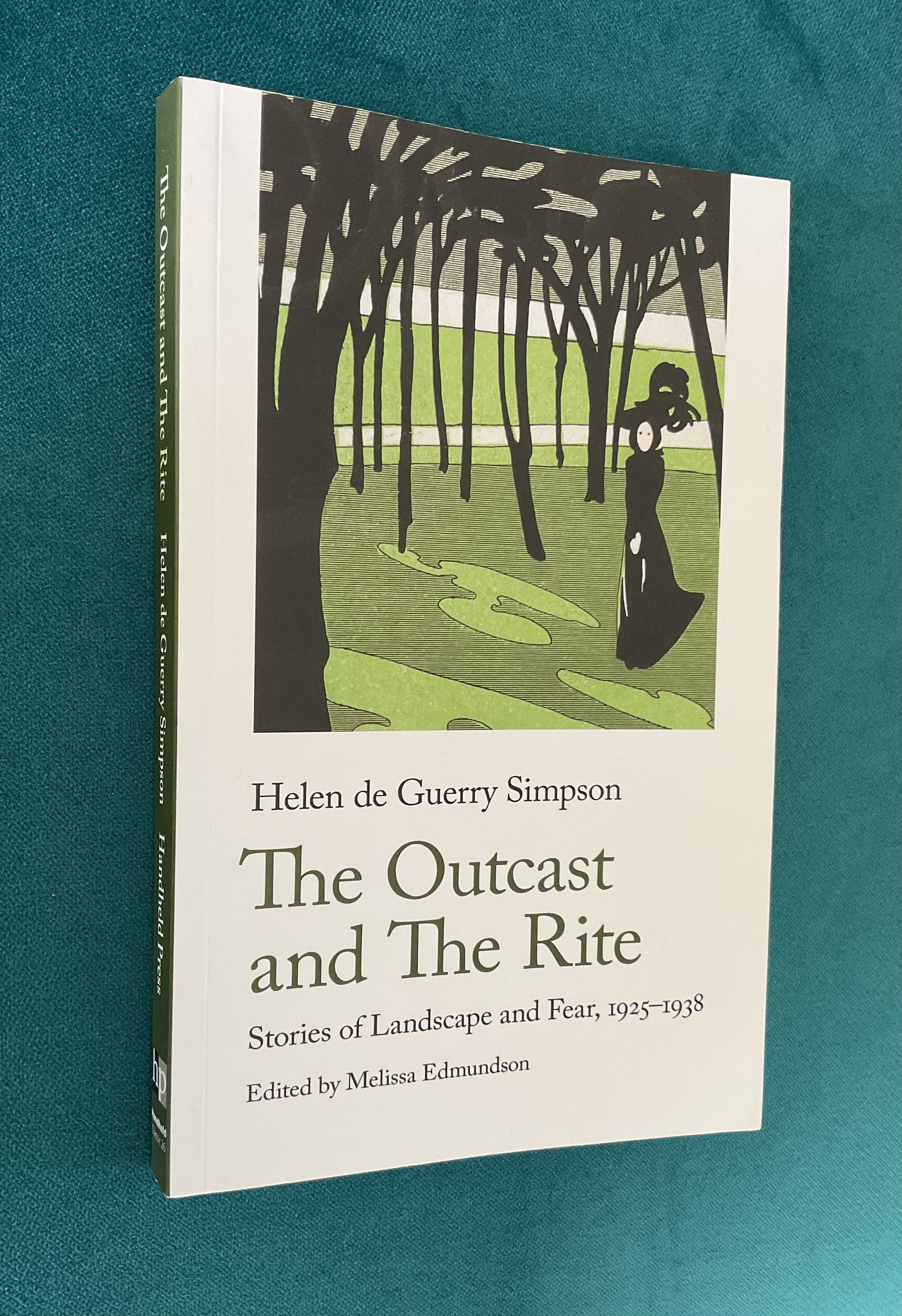
STORIES OF LANDSCAPE AND FEAR, 1925-1938, by Helen de Guerry Simpson
Edited by Melissa Edmundson
My previous reviews of classic or older works: https://dflewisreviews.wordpress.com/reviews-of-older-books/
When I read this book, my thoughts will appear in the comment stream below…

GREY SAND AND WHITE SAND
“Her absence brought things nearer, halved the weight of time.”
This is quite a stunning and worrying revelation, a painstakingly detailed story of a male painter called Hilary Monk, alongside merging, almost anthropomorphic seasons and sands and sea and skies that remind me of where I live and where I wander, too. With tricksy winds. And psychologically shifting sands, as he finds a secret in a marsh, and uses his painting and his own seemingly autonomous and rebellious thoughts to battle against such a secret in order somehow to discover it. His wife in their lonely cottage is almost nastily perceived, a woman who, he finds, knows the secret, too, or so I infer. Till such nastiness reaches a disarmingly non-didactic apotheosis. As if one of his battles, the one with his own thoughts, results in what was merely seen — a reached pointlessness of ‘disdain’ in his marriage as well as in his own painting — as becoming something far more brutal than just the black cockerel he captures for some unknown ritual of legacy or posterity. The neuro-diverse weather and the painter now as one? The secret of this story about a secret as well as a would-be miracle will no doubt continue to bug me and also make me “vaguely connected in some way with the secret”— as once happened with the sandman?
PS: This story seems perfectly to fit the overall title of this collection.
I shall be reviewing this book in due course…
THE RITE
“The sun was malignant.”
A textured work of high heat and dilemma. And the flowers in the relative cool shade of this vignette’s Parvus wood were fleshy. Len goes there to shake off grievances with her mother. And to resolve whether to marry an indifferent man for his money or another man because she needed such a man… and when she finally leaves the wood, the omniscience or narrative point of view switches to the wood itself…
Perhaps this was the secret of the previous story’s marsh. Gaia readying to do battle against those who made the sun seem malignant?
THE OUTCAST
The narrator is a woman arriving at an inn on her own, out of the cold, given the parlour as she checked in, after being checked over. Overheard a conversation in the bar about 17 yew trees as memorials, in the local churchyard, for men lost in some wars, but one yew that did not grow right as the man was a foreigner or ‘gypsy’. She returns to her parlour bed and meal. This story did not grow right, either, for me if not a yew for you. But it hangs in the memory.
AS MUCH MORE LAND
“Half an hour gone, anyhow. I haven’t been frightened yet. Not properly. I’ve been making my own terrors.”
This should be a classic ghost story for all ghost story lovers. Perhaps it’s the young priggish, self-entitled, self-styled Patrician of a male protagonist that has prevented it being so, with his thoughts about ‘pose’ and ‘poise’, and the colour white, and Elizabethan poets, and his patronising of the woman who owns the house where he is staying, and where the servants are consigned to the upper floors. And women, in general, to be consigned to the will of God, and yearly confined to the bed with green curtains! Having said that, the story is genuinely spooky, through those very thoughts of the young man, and his daring himself to visit the rumoured haunted room, his precarious means of getting to it on the outside of the building, the nature of induced fear by hearsay versus actual fear, as a haunting tied up with a burning candle where they could not have been such a candle in a room said to be cursed by a now hanged man who had once occupied it, and this priggish young man’s own thoughts seemingly transforming into autonomous thoughts, thoughts with their own volition in dealing with the horrifically prehensile room itself…
The room was a cube, and white….but the rest is yours to read from white blank pages with such a story rumoured to be on them?
YOUNG MAGIC
(Possible spoiler.)
Now something even more special, if that were possible! An ‘imaginary friend’ story perhaps even outdoing the more boy-like Slopbasin Soilipsism stories of Walter de la Mare!
Viola starts, of course, here, as a child with her ‘imaginary friend’ she calls Binns, in all the magic of those times and of large houses and sewing rooms, and pareidoliac cosy fires, flames as flowers, and much else like that, and her sense of her head as a bare attic to fill, and getting her own back on her frustrating nurse by spitefully setting Binns to make the scissors start walking on their round-headed handles towards the nurse! A magical kinetic power? Or something even more rarefied? The passages describing these scissors are second to none.
Or is Binns real in some peculiar sense? As she grows older we feel her associative emotions when in France with its strange songs — and even when aged 17 and a man only she seems to know as James woos her, or does she woo him? And she has these daydreams or real sightings by magic of what he is doing when he is not with her. She somehow resents his absences and she calls him back and perhaps it is only myself who thinks his full name may be James Binns even though he is unaware of his own magical existence. I somehow doubt it, but a part of me does wonder…
Her laughter at the end — does she now relate his presence in her room to the shadow that she herself casts of Binns upon its wall? Whatever the case, I cannot do justice to this substantive work, and I am spoilt for choice in quoting from it, so I shall quote nothing.
Pingback: YOUNG MAGIC by Helen de Guerry Simpson | The Gestalt Real-Time Reviews of Books Edit
DISTURBING EXPERIENCE OF AN ELDERLY LADY
Wondrously prose-styled, this story made me note that the “unostentatious holding of elbows” by the participants of a coach party at glimpse of the roofs of a grandiose English historical house of Kings once staying in it as it first appeared to ‘common’ Mrs Jones. And she took a grievance or jealousy or envy against it, to the extent that, when her husband’s death equally triggered sufficient legacy, she bought it! To get her own back. To halt, as her potential pet builder put it, its hanging together as time’s mighty gestalt. She went through wallpaper patterns you won’t easily forget to alter it beyond recognition, but upon epiphany in the woods nearby after her first night sleeping there, as part of some ‘disorderly folly’ in the grounds that she had seen, you wonder who or what said the perfect ending’s clinching ‘Mine; mine now.’
GOOD COMPANY
A story told by a good friend of Elizabeth. A leasehold Canidia as “half-self”? A saint who shared the soul of Elizabeth (“a wealthy and eccentric foreigner. She was nobility obliged…”) touring Italy, after a most lingering scene Elizabeth witnessed of a religious procession and a holy statue meeting a holy statue, a sort of priestly hide and seek of saints. Elizabeth later arrives penniless, her pack stolen, in a a town and allowed to stay in a room over a wine-shop, upon the promise of a letter with money in it. The wife threatens to evict them both, Elizabeth and the saint within her. But the husband of the place ‘sex-consciously’ importunes Elizabeth as part of her missing rent! This is very complex spiritual material even though I think we know she resists the man but I wonder how the story is told to us at all. By the ‘good company’ of another saint in the shape of a freehold Helen de? — herself with the same bleeding knuckles? A story as some Purgatory of truth as fiction?
“…a number written in metal, the same number but differently wrought, two X’s together;”
A CURIOUS STORY
“‘And it was there you noticed about the shadow?’
‘It noticed itself.’”
A story that needs the poet’s imagination to review it, a reviewer who needs, too, the skill to act out the parts that are in it. Although there seems to be some confusion between ‘the author’ and ‘the poet’ and the latter’s interaction with ‘the actor’, this is a tantalising theatrical ghost story where make-up is applied by a hare’s foot upon the actor by a man who suddenly appears without introduction but is called Gibbons. The actor, or the author describing him, seems to think he is ‘clay’ acting to an audience of ‘lumps of dough’, and there is a ghostly actress as a shadow of pain evolving in this work, making it a ghost story that might appeal to Reggie Oliver and his readers, should they be given the poet’s imagination that the actor gives him. Meantime, the author, if he is indeed another character in it rather than its typo, threatens to turn this brief curious story into a novel, I guess. Thus giving them all substance more than mere clay or dough?
THE MAN WHO HAD GREAT POSSESSIONS
“He was no longer gracefully strong as the room was accustomed to see him, for he had forgotten to adjust that other appearance which here was his, and the clumsy and angular figure with which his mirror in the real world was familiar had leave to show itself.”
This a writerly tour de force that no review could possibly do justice to. A story about writer’s block? Paradoxically gauche, too, but inspiring what I dream to be a Big Book of Gauche Stories, Ghost characters that grow and flourish — and fight back at the author, or ironically with whom the author or his protagonist is in unrequited love, and this one is about a man with only one friend called Philip but a whole imaginative life whereby he created a real terrain with a woman who lives by having this written fiction about her, whence she then becomes autonomous. He seeks to retrieve the manuscript from the friend to whom he had sent the sole manuscript for comment, to reclaim the woman he had created… unless I have clumsily, if creatively, misinterpreted it all!
There is so much more in this work, and I guess its male author as fiction character has been effectively created by a female author, and here we experience a description of her being the one he truly seeks so as to reclaim her or to melt back into her or somehow to punish or even to love her without unrequitedness, the Guerry de Guerre and its rapprochements between fiction and reality?
TEIGNE
A strange strangeness of a story, a story without structure, about the Teigne structure of a folly as house-within-castle, that, over the generations, involves you in the adumbrated lives of of those who built it and who lived in it and who eventually demolished it to escape its curse. But the latter tenant — tellingly named Mr La Vie who is a collector — was pursued by some of its contents….
THE PLEDGE
The beautiful thing about this book is how different each story is from the others. This one of a well-conjured street, now a distance from the sea but near enough to see it, a street of ship-like buildings with portholes and it tells of a woman called Miss Alquist, as a lodger in one house, whose ‘acquisitions’ accrete gradually and thus the space she takes up threatens the family living there as she yearns for her lover once lost at sea. And one night she has a vision of the sea getting closer… The exquisite prose style is as textured as some of the objects in it, including a brooch with blue feathers, a prose to die for. Can a sea leave its mark upon where its hasn’t been, I ask?
THE PYTHONESS
“I could hardly leave her boo-hooing after me like a punished dog and so took action at once; gripped her by the elbow,…”
As described earlier in this review, there is possibly the classic ‘imaginary friend’ story, and this the similar candidacy as the classic ‘séance’ story, full of suspense with ungainly love and secrets revealed. The medium is a gauche lady called Mrs Bain who performs her skills ‘stark’ and with a coil of heavy black hair, one of the party being called Pybus, but those are perhaps asides. The man somehow attracted to this ‘ugly’ widow Mrs Bain is the widower Mortimer whose late wife Aileen is now a catalyst from the realms of death….
But what, I ask, is the pythoness? The meaning of THONESS by numerology is said to be ‘Leader, Visionary, Powerful’. And I shudder at the thought of Mrs Bain’s involuntary trance and the beguiling humour in the last words of this story, a story about a few baneful HYPNOSES et al. And what part did Tarrant and the possibly unreliable narrator called Findlay play in this fateful ‘circle’?
AN EXPERIMENT OF THE DEAD
“Time will show.”
A solicitor who loves Jarndyce & Jarndyce, evidently!
But ironically he seems facilitator of an explicitly thaumaturgical pact that speeds up a proof of life after death, as a woman to be hanged for murder returns straight after it happens. A fitting coda to this book, with another lethally humorous ending similar to the one above, the whole book itself being a gestalt better than any of its parts, even though at least two of its parts, as adumbrated above, are potential separate classics of the supernatural. “We may safely leave the whole matter to Time.”
end