Sunday, September 03, 2023

Lost Endings (2) stories by D.F. Lewis

 CONTINUED FROM: http://weirdmonger.blogspot.com/2023/09/lost-endings-1-stories-by-df-lewis.html


THE WAVES 

He enjoyed having a bath more than anything else he did. He lived in a large Victorian mansion, where the plumbing wasn’t up to very much, full of draughts this time of the year coming through the sash windows and creaking floorboards, and the bath itself was a huge one on rusted claw feet of a larger-than-life mutancy of appearance, and he found it difficult to climb into and even more difficult to climb out of that bath. He often cringed at the brown running lines of yellow or brown that made its once white innards more like the skin of a diseased zebra than anything else. It showed the potential of the real mucky having once been in it.

The hot tap croaked upon turning but did allow in a good flow of scaldingly hot water at a generous, if stuttering, pace. Naturally, he had to ensure that his later turning on of the cold tap worked equally well as the hot one — otherwise he would become nothing better than a boiled lobster, if that’s not too hackneyed a phrase to use. The trouble was that the cold tap was not very dependable and often gave up the ghost even before it had croaked. Then, he would be left with a good hour or so sitting on the edge of the bath in his stringy dressing-gown to allow the water to cool to a level hot enough but not too hot. But once in, he was in. Croaking ghost or not.

He loved his ducks, he loved the soap he collected in all manner of carved shapes, that would now be blurred by the lathering he loved smarming himself all over with. He loved his scrubbing brush, too, now a bit worse for wear, its bristles having become more like the bottom of a newly dredged quarry. But it did set his skin tingling and his teeth on edge simply to look at it and anticipate its first contact with his skin.

The water swished and swilled around him as he luxuriously allowed its warmth to take away any memory of the chill in the air. There was one mystery however that he had never solved. However much he loved creating waves with the gentle pumping up and down of his knees, the waves were never satisfying enough. But he knew a wave would not be a wave at all if it was strong enough to spill water over the edge of the bath. That would be a self-defeating wave. A wave to be a satisfying wave needed to be strong enough to lift up the loose bits of his body but not too strong so as to drain the bath of water. Tonight it was cooling anyway, and he would soon be forced to struggle out, torso turned and knees down to assist a handle upon such leverage.

No, the actual mystery was of a wave that occurred in his bathwater without him causing it. Often he would relax, sprawled out as far as he could, only the barest amount of face left above the water like a nosy island, resisting the onset of the bathroom’s chill that the water was now absorbing, and he remained still for at least five minutes, stock still, until he felt the mysterious wave swirl gently over and above him till it splashed across the face with a cheeky mucky slap. He never knew how that wave had generated itself. He often joked that the bath itself on its outlandish claw feet was a living creature. But that didn’t hold water.

***

THINK OF THE FUTURE

Edna knew she had three dolls that she called Dandy, Mandy and Andy – because, well, she liked names like that, rhyming, flowing like a river. If she had more dolls she would have called them Handy, Shandy and Pandy – but then she remembered that Pandy was Andy’s surname in the old kids’ programme from Fifties TV called ‘Watch With Mother’, something Edna was old enough to have experienced in real-time.

She was old enough, too, to have dolls to play with again, though she refused to acknowledge she was now entering her own second childhood. Picture Book on Mondays. Andy Pandy, Teddy and Looby Loo on Tuesdays. Bill and Ben and Little Weed and the House That Did or Didn’t Know All about It on Wednesdays. Rag, Tag and Bobtail on Thursdays. The Woodentops on Fridays. Nothing on Saturdays or Sundays. The rest of daytime hours had the Test Card or Welsh speaking programmes – but Edna lived in England!

Dandy suddenly sat up and said: “Stop daydreaming about the past, Edna. Think of your future, instead.”

Edna was startled. None of the dolls had spoken before. Perhaps she was a doll herself, one that didn’t rhyme or flow like a river. Dandy, Mandy, Andy and Edna. Didn’t really go, did it? Perhaps she was Hannah, instead? But that didn’t work, either, whichever way you looked at it.

She felt tears pricking at the corners of her eyes. Mandy was now stirring. These were things that were happening that shouldn’t happen — a human being such as Edna being watched by dolls to see if she still moved.

“Are you OK, Edna?” asked Mandy.

Andy had begun to crawl on all fours towards Elenor.

“Can I do anything for you, Edna?” he asked. “You look as if you need a hand.”

Edna strained her eyes to look down at herself. She couldn’t have seen her hands because they were hidden under a cushion as if they were ashamed of being hers. Her dress was down to her ankles and, of course, she couldn’t have seen her face, being behind the face itself – and the angle of the mirror over the fireplace couldn’t reflect her at all, it seemed. 

Then Looby Loo suddenly came into the room. And all the dolls froze. They couldn’t be seen to be alive. Maybe the house knew something about it. Its mirror, too. But that was that. 

Looby Loo dragged Teddy across the carpet by his ear. And placed him next to Edna. Except Looby Loo never called her Edna, not even Hannah. She called her Handy. And when Handy was tilted in a certain direction, her eyes opened wider to cry tears but they spilled a mucky river instead.

***

IT JUST IS

I do not know why they called it an Edwardian Pram; it seemed quite timeless to me, more 1950s than anything. But then someone suggested to me that it might have belonged to someone called Edward, with that being the era of the so-called Teddy Boys in Britain — guys in lounge suits, winklepickers and quiffs named after a King Edward who gave the word Edwardian its derivation…or have I got my history completely wrong? Not that Edward owned the pram as such, if that was the name of the baby who was originally pushed around in the pram. That particular jurisdiction of ownership was down to Edward’s parents who hopefully bought the pram from a posh shop pre-dating Mothercare… 

If I could travel back in time to the 1950s, you’d probably call me the Doctor. Well, I am a doctor, but not that time-travelling sort. A Doctor of Philosophy. Not philosophical philosophy as such, because, frankly, I don’t know my Kant from my Descartes. No, my degree was in the philosophy of ghost hunting. And that Edwardian Pram seemed a fine case study. And, yes, you’ve guessed it. It was the pram itself that was the time-traveller. Or is. 

Time travel, you see, is intrinsic to ghosts being able to exist at all. Not that I ever really found a ghost proper, even by finding it first, then hunting for it later!

The clever question to then ask, I suggest, a question worthy of a Doctor of Philosophy like me, is that, if the Edwardian Pram can travel through time, does that necessarily mean that any occupant of that Edwardian Pram will go with it to wherever or whenever it is going? We do take certain ideas for granted, but my research meanwhile is intended to question them. When we see those Edwardian gents board an HG Wells type contraption like the one he called a Time Machine, we always assume that it will take those gents with it and one day they may become Teddy Boys in the 1950s or modern people with nothing but computers and iPhones today. But my strong factual belief is that only inanimate things like a pram or other contraptions can travel through time — but the human passengers of those contraptions will simply be left behind. That is why all those stories about the Tardis carrying passengers through time is so far-fetched. But again that takes no account of ghosts, was my thesis.

You may feel that I am exceeding the brief of my doctorate in studying matters like who or what can time travel. But why I am here today, in front of you all on the stage in this lecture hall, is to demonstrate that such things are vitally entwined with the very fibre of our social interaction from the Twentieth Century onward, a period of our history when most of us here were born. You see, you were hand-picked to be invited to this lecture. This is really an experiment, rather than a lecture, but it’s probably both. Ah, I see you are shuffling awkwardly in your seats. You obviously think I am mad, or at least eccentric. But be patient. All shall become clear …eventually. But do feel free to leave if you wish. Good. I see that only one person has left. More or less as I expected. 

Well, before I reveal the Edwardian Pram itself — indeed it has not yet arrived — let me tell you one further thing about yourselves, assuming that all the small talk among you before I arrived on the stage has not already revealed a certain specific common factor true to everyone here, even to that person who has just left the hall. 

You may think some of you look slightly older than others, and therefore some look slightly younger than others, too. But you must have at least realised that you are all likely to be from the same generation. But let me tell you that there is one particular year in your era of birth, a year that all statistics and subsequent research has shown, with the give and take of some good fortune and some bad fortune in what has been made available by successive British governments since that year, yes, that year, when all of you, yes each and every one of you, was born, yes, that year, your year, was the luckiest of all years to have been born, when taking everything into account. Yes, I now see you all looking at each other and smiling as realisation dawns. Each of you already knows in which year you yourself was born, and now you know in which year everyone else around you here now looking at you with a knowingness in that look was born. Yes, that year can no longer be a secret, that year was 1948. 

But I know it wasn’t all good to have been born in that year. Some of you have had hard lives, harder than some others here. I think you can tell which of you have had the hardest lives simply by looking at each other, searching the eyes of your near neighbour in the audience. That’s the way of life. But generally speaking, when taking the rough with the smooth, by the law of averages which is more than an average law, it is definitely true that 1948 was the best year to have been born in the Britain of recent generations. So congratulations to you all. 

I just heard someone call out that some people born in 1948 are already dead. Yes, you will all die in all probability relatively soon, especially as you are today older than you once were. How lucky is that, I hear you ask with some degree of irony.

But that takes no account of the Edwardian Pram. 

Don’t look mystified. There is no mystery about the Edwardian Pram. It just is. It just was. And it always will be. Moving from generation to generation, or even leapfrogging generations. Itself created in a lucky or unlucky year of manufacture like your good selves. 

I’ll let you meditate for a few moments… 

Don’t look round: it is trundling down the central aisle from the back where the entrance to the hall is. Some of you at the back have already seen it pass by your row of chairs, and those of you at the front will see it soon. Don’t look round, I said! It is unlucky to look round and see it before you were intended to see it. Its wheels are squeaking, groaning even. Well, after all, it’s older than you are. What do you expect? 

But now it’s gone. It has moved to another year, another generation, perhaps even to the end of time itself. It can’t collect passengers as passengers cannot travel in time; only things can do that. That’s my genuine factual belief. Even if it could take passengers, it would have to be a baby, because only a baby would fit. Or two babies at a push. Or a million ghosts.

But did you see someone pushing it just now? I see some of you at the back nodding. Forgive me, but you at the back look happier now than those in the front. It’s as if you at the back have realised what life is all about, what my experiment here today for my doctorate is all about, too. Proving something against the grain of one’s original factual belief. You at the front should feel happy too. So long as you didn’t look back. 

Ah, I see what has now happened. But I didn’t see it when it happened. It just is. Perhaps it always has been. Emptiness often creeps up. 

You were the luckiest, after all. Not just some of you, but all of you. Gone to wherever forever. 

Anyway, just think about it. If a large hall of empty chairs can think about anything at all. You were definitely the luckiest year’s generation. Still are. Always will be. I envy you. But at least I have the satisfaction of a successful counter-factual experiment and my doctorate assured. Sometimes you have to make the best of a bad job. The best of a bad year to be born in. 

By the way, I know I am now lecturing to nobody at all, only to those rows of empty chairs, as psychotherapy props, but I can at least tell you, O chairs, that the pram you saw or at least heard was the pram my dear late lamented Mother pushed me around in, a pram that was then secondhand and still in use from the Edwardian times of HG Wells. And she was still pushing it today, from what I could see of her from up here on the stage. A pram with slowly turning vanes on its hood.

Anyone got a tissue for my tears, or a vessel for my own emptiness? Perhaps the audience member who left early would be so kind. The one who looked a bit dressed up like a Teddy Boy of yore. A bit undignified at our age, though, I thought.

***

THE SHADOWY THIRD PROGRAMME

There was a definite atmosphere in the old-fashioned parlour – except there was nobody there to feel it. The ancient TV seemed dead and gone in one corner, perhaps never to have been invented at all, but the huge wireless set in another corner, lit up like a cruise ship, was playing very quietly a programme of late string quartets, but even later it seemed autonomously to tune itself to a gap between stations, a gap that added a hiss to the atmosphere instead of the barely audible music.

A ghost was sitting in a third corner like someone’s grandmother used to sit there, and indeed the hiss had clacking knitting-needles added to it.

On the floor was a glint – and the ghost bent to pick it up, intending to add it to the woollen waistcoat she was knitting, to see if the silver button suited it, and to judge its position for sewing it on, given the materials.

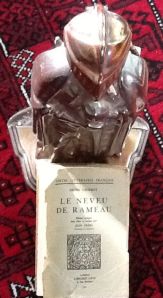
There were many shadows in the parlour, although the light-bulb hanging from the ceiling rose was not switched on. There was, you see, sufficient glow from the hissing wireless to set shadows free. But one dark shape in the fourth corner was not a shadow at all; it was a coal bucket beside the companion set that looked like a man in armour with the shovel, brush and tongs hanging behind it, glinting, too, from the wireless glow. This bucket’s hills of nuggets were of a blacker black than itself, those hills themselves setting free their own shadows against the chintzy wallpaper.

A pity there was still nobody there to soak in the atmosphere, not even one ghost hunter, and now even the ghost itself had been subsumed by the gloom, absorbing, indeed, its own human shadow like dark blood. The ghost was now so impersonal, it could no longer be called ‘she’, no longer someone’s grandmother. And without her, there could be no hope of anybody to remember what or who had been there at all. Casting on, casting off, casting on, casting off, to the sound of silent needles. 

But if no ghost hunter had been present, who wrote this? 

***

AIAIGASA: LEAVING A GHOST IN HER PLACE

I was one of the very few people who took time out to stop when passing the pavement bench on which Trampy Pammy was sitting with her collection of shapeless bags and parcels. She was a fair weather tramp; she was never around when it was too cold or raining and I often wondered whither she went on those days, or was it simply back to whatever (god)forsaken place she spent each night. She would never tell anyone where her lair happened to be, unless it was to tell her fellow baggies. 

I was nothing but a passing stranger, a seeming office worker who once worked with giant desk calculators near St Paul’s but now in Surrey with smaller ones, a younger man, as I was then, in a sharp suit and carrying a neatly rolled and colourful Legal & General umbrella. A fair weather implement, that umbrella, she would think, as it seemed to her irretrievably rolled, a pretentious over-the-top ornament rather than a practical article. The description of her as tramp was also a misnomer, she thought. It was as if she had read my mind when I earlier referred to her with that word. 

I often wondered what Pammy must have been like as a girl or fledgling woman. I tried to picture her all those years in the past, as I visualised her face slowly transforming as we trod back in time together. She, I knew, also tried to imagine my thus visualising her, as I stood for a short while making small talk. She sought in my face any giveaway signs of my turning her into a beautiful young woman. Not undressing her with my eyes, as the rather crude saying goes, but peeling back the years, dislodging the encroached grime upon the outer casing of the bag lady, to reveal the slender figure of someone quite different underneath, if ultimately this was the same person made out of two people that only time divided.

Once she had promised to show me a photo of when she was younger. And eventually she did so. I suppose that was the day when we both proceeded well beyond mere small talk. I had a longer lunch break than normal, or was that my way of saying that I had been made redundant and escorted off the office premises that very morning? A golden handshake, mixed unnoticeably with the same colour as gold but softer, smellier…

She would have felt sorry for me, if I had told her. Yet, I sensed that she knew exactly what had happened to me. She had a kindness beneath the hard-bitten look of age and experience, and as she fished into one of her bags, she said something I couldn’t quite catch, something about a farm where she spent summers as a girl, and there in the old black and white photo, I could make out a slightly podgy creature perched on a stook. I don’t know why — because black and white photos are harder to identify as place and time than colour ones — but the scene looked more like autumn than summer. Or on the cusp of both, like today.

As I more closely examined the image, I wondered who could have wanted so much to take a photo of Trampy Pammy. Photographs were taken very sparingly in those black and white days, you see. They also needed delayed development in chemists. And I now discerned she had a crumpled bag which she had put in front of her face. Or she might have done that precisely at the moment when the camera clicked.

I shivered, as the rain started and I unrolled my previously unrolled umbrella to shelter us both. But she had slipped away, leaving me with the photo.

***

A RIGMAROLE FOR NO PURPOSE

The shop was a relatively ordinary one, with cracked paint on its frames revealing it was not a terribly successful business but with wide and healthy glass in its show-window, an old-fashioned bell to indicate its door opening or shutting, with all manner of bric-a-brac being sold, some items useful, but most of them useless while still quite desirable dependent on your taste in collecting things. Yes, relatively ordinary if slightly unworldly, this shop did equally have an extraordinary position in the city, beyond a side-alley that most prospective customers hardly noticed, if at all. The actual alley wherein it could be found was in an alley off such a side-alley, this second alley also having an entrance hardly noticeable, if at all. Effectively a double chance of nobody ever noticing it, if at all. And such a double chance was tantamount to never being noticed. Your guess is as good as mine.

Still, you found it one day, didn’t you? Against all the odds, you discovered its whereabouts by almost blindly following your nose. The wide and healthy window, seemingly newly cleaned, with not a smear in the sparkling sunlight, a condition of weather that hardly visited the city these days, if at all. A sign in the window caught your attention, one with these words neatly written upon it: “Boy Balloons, newly in stock.” This, of course, mystified you, as it would have mystified me, no doubt, or anyone else. The items you could see on display were nothing that looked like balloons. There were a few dinky toys in their original boxes, a large Victorian doll in a condition that looked like new, and a few pot plants, some flowering. And, oh yes, thanks for reminding me, there was a faded painting in a gilded frame that looked as if had just been put around it, dressed to dazzle, with its own glass. The image was of a woman, you noticed, a woman who looked a bit like you. You put this down to coincidence. A lot of people looked like you, judging by the amount of friends and relations who often told you that they saw someone they thought was you in a place and at a time it was impossible for you to have been there.

It is no secret that you are bit devilish, or should I say mischievous, because the word ‘devilish’ is a bit strong, I suppose. You see, I now know that you had determined, after a while, to stride into the shop and ask the shopkeeper if he had any GIRL balloons! You loved nonsense like that.

The bell tinkled as you opened the door but there was nobody behind the counter. Meanwhile, you looked at some of the small things on the shelves and the larger things that stood around on the floorboards. A whole treasure trove of a boot sale from heaven. Every one an old world bargain that would send the eyelashes aflutter on FLOG IT, the TV auction show. But still no sign of any balloons or even a shopkeeper whom to ask about them. You wondered if the balloons would be already blown up, which begged a question about durability. An antique that started to sink into itself soon after you bought it did not sound like a bargain to you. Maybe you should simply buy that painting from the window as a keepsake, a souvenir of this occasion when you had found, against the odds, such a charming old world shop in itself. Richer people than yourself may even have thought about buying the whole shop itself as an antique in itself… And you thought to place such a shop on your mantlepiece at home, with someone staring at you from its window. You cleaned the glass every day, inside and out. You took out the neatly written sign, though, with its job now done. A sign used as a double belt-and-braces chance to reach a meaning. But that was a crazy thought or simple day dreaming on your part, yet you had no time to accuse yourself of being crazy or even to decide otherwise, as the shopkeeper at that moment entered from a door you had not previously spotted behind the counter, although it was almost certain that that there must have been a door of some sort there all the time. You expected a wizened old man, one who enjoyed writing invoices and accounts with several purple carbon paper copies…

But this was a woman as young and as beautiful as yourself.

“Can I help you?” Her voice was plummy like that of Sylvia Peters from early 1950s television.

“Yes…” You hesitated before deciding to continue with your planned devilish mischief. “Yes, I see from the notice in the window that you have some boy balloons fresh in. But really I am more interested in girl balloons. Have you got some in stock?” You found it hard keeping a straight face.

You then noticed that the door behind the counter was covered in a bead curtain that you hadn’t heard rattling when Sylvia Peters had come in from the back of the shop. Yet, they were not beads at all, you soon noticed, but tiny blue balloons, each individually inflated, and running in their hundreds, shaped like cocktail sausages, down the many curtain-cords from ceiling to floor. One or two sagged as if leaking air. They must have taken a lot of time and patience to inflate and fix.

“Yes, we have one left.” And Sylvia Peters proceeded to shout these words: “Pammy, the lady wants a girl balloon, not a boy one. Can you bring the last one in.”

And what seemed to be a huge mauve ballon, nipped together at the middle, proceeded to nudge through the now squeaking curtain-cords.

You managed to escape before whatever it was could emerge completely into the shop. The bell above the exit door, exactly as when it was an entrance rather than an exit, tinkled busily upon opening and shutting. But you felt ashamed at such a flight, and you re-entered the shop, igniting another double-tinkle.

The woman called Pammy flicked a sudden swarm of buzzing bluebottles away from her face. She seemed to have an increasingly small choice of things to sell. Only some old-fashioned stationery, such as sheets of purple carbon-paper doubling as sticky dreamcatchers. And thousands of extremely tiny foot-pumps.

You suddenly remembered that your late uncle had been big on the variety shows in the Square Mile of London at the turn of the century. How could you have forgotten? A magician, in the main, but his act also featured bendy balloons that he made into what he called sculptures. Squeaking raspberries upon one another’s skin as he manipulated such inflated balloons into conjoined and intertwisted shapes that could be recognised as objects, animals, even human limbs. The children in the audience loved him and often cheered their encouragement as the balloons were torqued and tortured into a single outlandish shape of shapes under his nimble hands. A gestalt of shapes. A huge dome with a cupola? Or the effigy of some ancient god in need of violins, flutes and drums to supplement the balloons’ squawking surfaces? But who were you? 

Pammy hadn’t even heard one doorbell tinkle.


CONTINUED HERE: https://weirdmonger.blogspot.com/2023/09/lost-endings-3-stories-by-df-lewis.html

Saturday, September 02, 2023

Lost Endings (1) stories by D.F. Lewis

 Continued from here: http://weirdmonger.blogspot.com/2023/09/torque-tales-3-by-df-lewis.html

AN END

When the sands started shifting I knew it was the end of some mansion within the sea.  But to know an end one needs to exist beyond that end to be able to see it for what it is – or was.  That day I met Edna was one such end – as well as beginning. Beginnings and ends can be very close indeed and still keep their identities either as a beginning or an end. Beginning: the sight of a vehicle looming in the sky from the corner of your eye – middle: collision – end: death.  Torque, then a tightening tourniquet of descent. All in a few seconds. Except, from what I said earlier, death as an end is not an end in itself unless you view it from afterwards as an end.  Therefore, death is not an end.  It’s something else altogether. An end’s end, perhaps. But not the end.  Not an end in itself.  Not an end you saw as a whole process of a verifiable end after it has ended. And only you can verify it. Anyone else verifying it is merely hearsay. For ‘end’ please read ‘ghost’, enlightening earlier miniatures as giants.

Before I get you too confused, I’d better tell you more about Edna.   She was sitting on one of those many back-support bench-type seating-arrangements of ribbed solid plank-wood that are plentiful along the promenade looking out to sea. Not that the bench itself looks out to sea, but the people sitting on them.  The protruding pier just off to the right. 

A middle-aged woman (with no name at that stage as in the early days names were forbidden). Too young for me, and I didn’t really think it appropriate for me to engage her in talking so I prepared to walk on. But then I heard a helicopter off to the left – outlandish clattering growing louder and louder – presumably the air ambulance or a coastguard patrol. It was so low I feared it was going to ditch, but it eventually clattered with twisting vanes off towards Jaywick, with no obvious reason for its manoeuvres in hindsight. So, yes, I had thought it had crashed into the sea’s roof, but it hadn’t, or it was now it own whickering ghost completing the journey, and I looked back to the bench and Edna had vanished, presumably lost forever in the ocean of strangers with which the world is mainly populated. Some of that ocean is close by in your own neighbourhood, the rest in far reaches of the world you will never … reach.  A literally man-made ocean with its own inexplicable, often dangerous, tides across cockle-beds or shingle or ribbed beach or sieved granulations or rocky coral.  

But in addition to that ocean of strangers there are usually local inlets or lakes or rivers of non-strangers. Friends or lovers. Colleagues or drinking pals. People you know or have met however briefly  – even just seen in the distance.  Like Edna.  

Thinking about her, Edna probably doesn’t count as a real meeting or encounter, because she would have had to look at me, too. Just an exchange of passing glances would have sufficed for it to have been qualified as a proper encounter. But, as far as I was aware, I had looked at Edna, but she had not turned to look at me. 

As I continued my walk along the promenade towards the pier, I started musing again about Edna. Suppose she had looked at me while I was preoccupied by the noisy manoeuvres of the helicopter? I can’t imagine that would have been the case as I guess everyone was looking at the helicopter at that stage rather than at each other. But that is only a guess. Edna may have scrutinised me closely, even at some length. The incident with the helicopter, I now recalled, lasted at least a few minutes.  Time enough for Edna to get as close as a couple of dancers about to embark on a waltz at the local palais. Skin-pore close. 

I shook my head and shrugged.  I was getting carried away.  The relationship with Edna had begun and ended with my pointless glance of appraisal at a nameless middle-aged woman sitting alone on a bench looking out at sea.  There I go again. A bench doesn’t look out at sea. It’s the people sitting on it that look out at sea. Watching the tide come in and out across the rattly shingle. Wondering which tide would be the last one. Which cloud in the sky the last one that you would ever see skimming above? Feeling eyes boring into your back, and not daring to look round. 

Shingle isn’t like shifting sands. But my lap rucks oh too easily without even daring to move the bent knees within it.  Not daring to move is equivalent to being on the brink of it being impossible to move.  To move or turn. Ever upon the quicksand of hesitation. Ever on the benchmark of differentiating trial and error. Ever upon each edge of the end.   A ghost’s end, as a new beginning,

The tide faintly sweeps in like some soft machine.

***

MANSION MANQUÉ

The stiff key like a tiny intricately static machine became sticky in the lock and bent out of true as I tried to turn it.  The place I was trying to unlock seemed more like a barn than a cottage but I had already convinced myself – based on earlier-read literature – that it was comfortable inside as a would-be mansion would have been, even if made mainly from wood. Well, as a cheap place for a weekend break, pretty basic, but still acceptable with a real bed.  No need for heating at this sticky time of the year, I thought, as, despite having bent out of true, the key released the tumblers one by one in slow motion sound.

Inside was dark. No lights.  I cursed as the switch by the door made no difference at all – not even a short-circuit flash. Despite the lateness of the hour, there was still enough natural vision to read the notice just inside the door: “The pilot is under the sink in the kitchen”. This was the shorter of two notices. The other one was full of small print relating to the temporary tenancy.

I presumed it meant the pilot light. Not someone, say, who flew a helicopter.

I lingered for a while looking back through the open door at the wonderful view of rolling hills. I found the key still in my hand – strangely in two bits, as if I had just carried out, absent-mindedly, my own version of a Uri Geller trick of softening metal with the will-power of my tender fingertips. A sort of soft machine.  I’d better find the pilot light under the kitchen sink before it was too dark even to find the kitchen.

The rolling hills had merged with the twilit sky even as I gazed at them back through the open door. The moon had carved its horn-shape into Heaven’s masonic under-roof. Words that had taken over my mind, as if I were a poet, not someone who had very little vocabulary before entering this edifice, let alone the holiday cottage or pitch-black barn or even mansion manqué…

I felt my way along the wall, meeting protuberances that I would not care to describe or guess their nature despite my increased word-power to do so.  I desperately tried to stop my new gift of imagination running away with itself.  Normally, I could not even imagine anything beyond my immediate selfish needs.

Eventually, I found what I guessed to be the kitchen – judging by the smell of rank food. But then I stumbled into what could only be described as a bed. Soft covers – too soft – my fingers going through the material and its under-stuffing with uncomfortable ease.  But then I found the sink – drip, drip, drip, said the tap – so loudly I wondered how I hadn’t heard it before now. Gurgle, gurgle, gurgle, said the drain beneath the open plug. I bent down to open the cupboard where I imagined the u-bend to be.  Even if I found the pilot-light, how would I ignite it? With a hiss of flame or the mere click of a switch – as the whole place would hopefully, at best or at worst, spring into flumes of gaseous gloom, a gloom capable of outshining the darkness that had by now set in with an impenetrable shroud, thick enough to touch.

I saw the back of someone’s head under the sink, strangely luminous with smooth brylcreemed hair glistening off the reflection from my eyes, eyes still storing depletions of hillside sun that I had kept inside the hump of my own head.  Slowly, that head, with nostrils large enough to swallow me, looked round – as if upon a revolving plinth reminiscent of one of a seaside array of novelty clowns’ heads.

I struck a sudden match, somehow snapping it in two, but not before allowing the flame to ignite one of the nostrils – and bright red eyes broke open not only from the head in question but from scores of other heads around the walls like Hallowe’en pumpkins. Some with vertical eyes, not horizontal, as if in a state of dizzy descent.

This was not going to be a holiday easy to forget, I thought, my absent mind now returned to simple words and simple thoughts. I was ever a simple sleepy soul… 

In the glowing blood-light, he staggered back to the disintegrating plumpness of the bed-covers – tired of the waking dreams. He twisted the stiff key in some soft lock’s ignition and let sleep do the rest.

***

BIRD FLEW

It came as a shock that Avian Influenza was back in the breaking news.  It was the day I made a visit to the National Gallery not far from where I lived in London.  I wasn’t entirely sure whether it housed ‘The Laughing Cavalier’ and, if I had a computer, a computer that actually worked, I could have looked it up I suppose before I went.  One fact of which I was sure, however, was that ‘The Laughing Cavalier’ was not the painting’s correct title; it had been christened that by some future Victorian lady.  Its eyes (or, rather, his eyes) not only follow you around the room, they also follow you, perhaps, through time itself. Slowly turning from upright slits to full openings and back again. A series of knowing, smirking glances that told each one of us something about glimpsing. Something like: trust in me and I’ll save you. Or: I am nothing but chemical pigments, so despair!

Dawn was breaking, like a Turner, before I reached Trafalgar Square. The taxis looked as if yellow yolk had spilled all over them. It made me think this wasn’t London at all, but a  different city that did not otherwise exist. I was driven by some unknown purpose. Taken a sickie from work. It was almost as if I then thought that ‘The Laughing Cavalier’ was a form of lucky charm, a talisman in tangible form, to ward off the onset of doom.  Whatever else it might have said with its eyes. 

I imagined a chicken soul. A tiny spirit of existence that was obsessed with eggs.  The dawn by now had become slugs of orange marmalade crawling along the roof-ridges and draping the top of Nelson’s Column (i.e. Nelson himself) with pithy residue from God’s lemon-squeezer.

I cursed. I could see the Gallery was not yet open. Foolishly, I imagined everyone else had, like me, been up for hours.  It felt like lunchtime to me.  I asked a passer-by whether the Gallery contained ‘The Laughing Cavalier’ because, if not, I would be able to kill time with a task satisfyingly useful: like tracking it down elsewhere. I was ignored as if I were considered ‘persona non grata’.  With some dismay, I suddenly realised the painting might not be in London at all. But in some upstart city like Amsterdam or Madrid. Upstart. The word had ‘art’ in it! I laughed with self-mockery as I opened my earlier packed lunchbox while sitting near the stone lions and the fountains.

Swarms of pigeon-life swooped around in synchronised patterns because some tourists illegally scattered breadcrumbs for them in the square. That reminded me that the news had only broken late yesterday, the news about the re-awakening of Avian Influenza or H5N1 as some called it. Many of these torurists may not even have heard about it. I liked the expression Bird Flew. I laughed again. This was no laughing matter. When you eventually read this and see how I spelt ‘Flew’, you won’t laugh, either. Unless you never  get to read this…

Eventually, I saw the doors of the National Gallery being opened like a countrified stately mansion. Dawn, had, by now, finally broken.  And the oranges and yellows were slowly fading to grey.  Like a painting that had sat too long in the sun. Hung in a window that got too much exposure to the prevailing heat of a long hot summer. I replaced the uneaten Marmite sandwich in my box and I called across to one of the Gallery wardens standing on the outside with a cigarette in his mouth.

“The Laughing Cavalier?”

“In the Wallace Collection,” he shouted back.

I waved a sign of gratitude, as I heard the spinning tourniquet of many clattering wings above me. With now no glancing sun to make their eye domes flash.

***

DEADLY WORDS

It wasn’t always dark, it wasn’t always damp.  Or should I have said that the corner was never only dark, it was never only damp.  It seemed to go in cycles. It was the top corner of one of the top floor mansion bedrooms; near a chimney flue and where the severely sloping ceiling met the outside wall.  The cycles comprised periods of not being damp or dark at all. For months on end, and going back in history, for years on end, I suspect.  Neither damp nor dark. Then cycles comprising periods of being both damp and dark at once.  Never one condition without the other. Darkness and dampness as a tug of war: a host in creative or destructive battle with its parasite, but I was never sure which was which. Darkness or dampness as the cause or effect? How could I tell? I am not a surveyor or professional builder. I was simply sure that you always needed both dampness and darkness for each to exist.

Meanwhile, it was a mystery in other ways, too.  There seemed no obvious reason for it. The roof in the corner’s vicinity had been repaired (and eventually the whole roof was replaced as just one repercussion), various other pointing or structural jobs done, chemical treatments given to the wall, even prayers given up to whatever gods controlled dry rot or whatever the condition was called.  When in a whimsical mood, I often compared the phenomenon of that corner’s characteristics to those of a real person, someone with moods.  Body as well as outer personality and inner mentality. Someone like me. Or someone like my wife. Or someone or something else completely.

We had lived together in the mansion for many years. A shadowy third lived there, too, but we never saw it, being usually where we were not.  Except on the rare occasion when the three of us attended the same room; it would hide behind something in the room, made itself as small as possible, climbing in, for example, behind a book on the bookshelf. Just like a shadowy third would. 

 “What’s that noise?” I asked. We were sitting together in one of the centrally-heated drawing-rooms that stretched from back garden to frontward drive. This drawing-room, being downstairs, was naturally longer than the combined width and length of the many bedrooms, even though one of them was above the stairs-area and the kitchen. All bedrooms, though, were kept centrally heated, too, in this modern age. I think I was the only one who had got to grips with the logistics of this place where we lived. Its spaces and margins, and its accoutrements or aids of comforting existence that swelled and unswelled with the seasons. Neither my wife or I gave the impression of ever even thinking about such matters.  Mysteries for us were never mysteries. Unless you consider something to be mysterious, it never becomes a mystery. 

“It’s the wind,” she replied. But, upon thinking about it, the shadowy third was possibly just as unthinking as we were. It never questioned our existence, never thought about how old we must be now, never wondered what it was doing there and why there was a purpose in it being there. Doing and being, different words meaning the same thing perhaps. What and why. What doing? Why being?  It knew it was not the wind making a noise. It knew it was itself we had heard.  That was the ‘what’ at least?  The ‘why’ remained beyond its reach to know.  Beyond, indeed, its reach to be.

It scuttled from the drawing-room as soundlessly as possible and then up the stairs on all fours, on all its tip-toes.  Its favourite lurking-hole was in one of the bedrooms beneath the roof. Yes, you guessed it. That corner. That dark damp corner. That damp dark corner.  Each room normally has eight corners, half of them ceiling level, the other half floor level.  It kept repeating “dark damp corner, damp dark corner” in some form of incantation. Not with words aloud, but from thoughts inside. Thoughts are always silent. Even when you come to speak thoughts, they turn out to be quite different thoughts from the thoughts you thought you were thinking before you spoke them or they are not your thoughts at all! Or someone or something else thought your thoughts on your behalf? Like the shadowy third, for example.

Perhaps its presence explained everything about that corner and about my trying to explain it here at all. Eventually, it hears the whispering of myself  coming upstairs with my wife, and carrying our bedtime reading.  The days are closing in, growing shorter.  Autumn: the only season that is known for certain to exist.  For all of us, mysteriously never-ending.  While the shadowy third remained silent, perhaps forever.

.

“Don’t say anything,” was the last thing she said.

There was a hush that lengthened into a silence, a long silence, as we stared at each other.

When someone says “Don’t say anything” to you with a certain emphasis on the words, the meaning is often clear. Do not dare to say anything as anything you are likely to say in the present circumstances is bound to incriminate you even further or make that someone who said “Don’t say anything” even angrier with you. And that was how she said it. And that was how I took it.

But who was to break the silence that was still lengthening even as I dwelt upon these thoughts? By saying “Don’t say anything” to me, she sort of imposed the same constraints upon herself, I felt — as if anything she decided to say at this precise juncture would also incriminate her or make me angry. 

This is what I call a pivot moment, as if we sat at each end of childhood’s see-saw balanced upon the fulcrum of our relationship. A relationship that had lasted many years — and now it seemed, as if by some retrospective objectivity, that we had always been at this pivot moment, with silence stretching back and back and back and back till we couldn’t remember ever speaking to each other.

But, as I say, who was to break the silence? Who would dare to utter the very words neither of us wanted to hear?

Death is a shadowy third, a sort of pivot moment, too, when Autumn finally ends, along with your whole life being balanced out by an enormous weight of silence that is about to fill the future.

I felt myself hovering in silence. Years had passed since we first noticed the incurable dampness of the dark corner. The seat opposite was now empty, but the pivot moment continued, as I did not dare to break the silence by saying anything I had been forbidden to say, even though there was nobody in the room now, nobody other than myself, nobody there to hear the deadly words I wanted to speak.

I sobbed as I realised that I had not noticed the seat opposite emptying of its occupant, emptying gradually — with her body starting at first to grow slightly ghostly, then more ghostly, until she was so ghostly I could see through to the back of the seat, and then I saw nothing but the back of the seat.

I had been gradually sinking lower and lower on my end of the see-saw as my trusted counterweight at the other end had grown lighter and lighter … higher and higher —

But which way Heaven? Which way Hell?

The shadowy third still embedded in the mansion’s damp, dark corner finally broke the silence with the answers. But I did not hear them.

***

KISSING AS THE ART OF MARKING VICTIMS

Some god looked down at us — or looked up at us? — with a beady or vertical eye, and this god’s so-called helper angels wore opaque clattering vanes instead of soft translucent wings. And we felt watched as if by Greek gods made by more modern myths. The wave and the kiss. But who was it who wrote the ‘story’ below  and called whoever it turned out to be as me? Never the ghost I really sought.

***

The wave was huge, a tsunami of humani, each with its hand raised and wavering in unison. They told me to watch out for any of the many wavering out of tune, so that each could then be picked out, taken out and dealt with. Kissing as the art of marking victims. That was my job. 

One of them, I saw, a young woman about my own age, was seen to be deliberately wavering out of synchronicity. You could not tell this clearly, but I was practised in recognising such rebels, and I went up to her and, before she could respond, I kissed her gently on the mouth, and then the invisible officials soon came out of hiding and roughly took her away.

In many ways, a kiss is a sign of love, making any exit from the wave easier, insulating the pain with a temporary connection between two humani and then it is almost as if the other one takes on the responsibility of your self, and you of theirs. Just a split second while the enormity of behaviour is realised and then quickly forgotten. And later you get back or someone like you gets back simply to keeping watch on others in the wave.

In many periods, of peace and war, the kiss has been disguised as a moment of mental or physical passion about to happen between willing or unwilling partners in synchronicity, or just one more politeness that makes we humani tick. Deep or shallow, a kiss is the friendly poison transferred.

A tidal rhythm that remains uniquely conscious only through its unbroken unison. And its keepers of the kiss who sacrifice themselves with each kiss simply to keep that rhythm going.

The one I had picked out created her own story of being hidden away in a dead body. Then that dead body hidden away itself as a matter of diluting decomposition — wavering imperceptibly between saliva and tears. Lips puckering too late. Humani, humanus, humus.

***

THE WAVE AND THE KISS

I wasn’t clear what the young woman was doing in the window opposite, sitting there as she did all the hours of the day that I was sitting in the window opposite hers. But I guessed that she was working at her desk, just as I was working at my own desk while writing about hunting ghosts such as her.

The street below was always busy but it wasn’t always busy with the same people being busy all the time. I couldn’t see the people inside the cars driving them, so there being different drivers was a safe assumption to make, unless the same cars and the same drivers were going round in circles all day, following the city’s inner ring road of which the street below was part. However, I often did study the pedestrians walking along the pavements below and I could safely say that they were not the same people all the time, but I did often recognise some who had already walked past hours before and were walking past again. Some even returned within minutes, but that wasn’t often.

I often became bored with my work on the desk at which I sat and I would daydream, sometimes idly staring at the young woman opposite who could obviously concentrate more easily on the work at which she was staring downward. She never seemed to look back at me. Which was a shame as I could plainly see, just from her profile, that she was attractive. I even uncharacteristically gave her a name: Edna it was. Old-fashioned, though such a name was. Even literally demeaning.

My daydreams, meantime, might turn my gaze to the passing pedestrians on the pavements, some of whom would often suddenly dash across the street, dodging the vehicles that had invisible drivers, or at least invisible to me from up above. I wondered, with quite outlandish bouts of wild imagination, whether some of these passing people spent more time scaling the sides of the buildings, including the building wherein I sat on the seventh floor, than they did actually walking along the street. A bit like spidermen or spiderwomen. In this city that combined both St Paul’s dome and the giant shards I called sharks, with helicopters precariously buzzing between them,

I looked back at the young woman in the window opposite and she was still sitting at her desk, of course. She had been sitting there for two years to my certain knowledge. I had only missed keeping watch during my toilet breaks but I ate my sandwiches sitting at my desk and I was never sick and I couldn’t remember the last holiday I had had – but, of course, I couldn’t keep watch when out of office hours. And down in the street, if I happened to walk along it during the evening or the small hours of the morning, I couldn’t see anyone at all sitting in her window because that would be impossible to discern from where I stood down below staring up. At these times, the city was relatively deserted. Indeed, I didn’t often have cause to pass along this street out of office hours, as I commuted daily from my home in Coulsdon an hour’s train journey away and I would have had to stay up in the empty city deliberately – and my wife would have wondered.

I continued daydreaming and wildly imagined human fingers curling over the edge of the ledge in front of my gaze a few inches beyond the glass of my window. Not that it was my window. It belonged to the building.

But having glanced up to carry out this act of wild imagining, I abruptly spotted that the young woman opposite was staring back at me staring back at her, not that I had been staring at her until now, this precise moment of staring back at her following my act of wildly imagining human fingers curling over the edge of my window ledge.

This was an apocalyptic instant of life, it struck me, after such an extremely long period of time without any response from the attractive young woman to my own staring. And her face now in full frontage turned out to be not only attractive but stunningly beautiful, even without a smile to enhance it. And indeed it continued not to smile. A newly inscrutable Mona Lisa bobbing on waves about which I told you before. Ready for a kiss but tantalisingly floating past.

What should I do? Smile back? But would that be impertinent without her smiling first? With some connected impulse, I decided to wave, but before I had started waving, she was waving. Not a gently regal wafting back and forth of her hand but something far more frantic just before I heard the sudden noise of my window cracking: the last thing I ever heard before watching the crack widen around the fingers that had first created it: the last thing I ever saw. The sight of Edna waving across the way: the last thing I ever thought. Except I somehow saw the crack grow ever wider and taller, so I knew a soupçon of me remained to see it.


CONTINUED HERE: 

http://weirdmonger.blogspot.com/2023/09/lost-endings-2-stories-by-df-lewis.html


Friday, September 01, 2023

Torque Tales (3) by D.F. Lewis

CONTINUED FROM: http://weirdmonger.blogspot.com/2023/08/torque-tales-2-by-df-lewis.html

***

MYSTERIOUS MANSION

 It was intended to be a holiday home. Yet, as the years went by, it became, by default, my main abode, while my flat in the city grew its own ghosts without me.

It seems laughable now, but, when I bought ‘Mysterious Mansion’ from a distant Aunt who was emigrating further away in the world than I could imagine any mysterious place being situated from England, I did not question that name she had given the house. ‘Mysterious Mansion’ was indeed a mysterious place, in hindsight, and probably seemed appropriate, situated as it was in the corner of some common ground that was in itself quite a few miles from the nearest village, with woodland and hedges between it and the shops. Having said that, there was another abode situated within that common ground, on the other side of it, in fact, next to the access gate and just perceptible from my window. Common ground may be a misnomer – I call it common ground because there were disputes regarding ownership of it outside of the land occupied by the two houses themselves, or so I heard.

Whether such an interface of disputed freeholds could subsist legally, I was determined one day to ask my solicitor friend when I saw him next. But when I did see him, the whole matter had gone out of my mind, because life is often like that, especially when in your sixties as I was then.

There was a single woman living in the house opposite, I soon gathered, when taking my first holiday break under the roof of this mysterious place. We waved to each other but it did not seem right not to have a few words face to face. She was quite attractive, dressed to kill, in fact, and she advised me about various delivery and shopping logistics for our two abodes. I offered her help when I was staying in my abode as any man worth his salt would.

Looking back on it, she must have been off duty on that first occasion because, next time I occupied ‘Mysterious Mansion’, I saw her in a police uniform, being collected by a colleague in a police car. Over the next few years, I saw her both in her off-duty ‘dressed to kill’ mode and in her day-job mode as a very smart policewoman, with all the paraphernalia that police personnel seem to carry with them these days. I was indeed astonished by the contrast between the two modes. As a policewoman, official walky-talky phone jabbering in her ear, truncheon in its neat belt-pack. And as a woman-about-town with a posh handbag and high-heeled shoes. In the latter mode, she was often collected, by someone I guessed to be her boy friend in a small white van, but in this day and age one wonders about the true relationship and why they didn’t live together … or whatever.

I did not pry … except recently when, after a long period of staying in ‘Mysterious Mansion’, during which time I had even forgotten that I should be returning to my city flat to cope with my normal life, we had a rare conversation. She was picking some sort of wayside fruit from the bushes near my house as I happened to be inspecting a fence after the previous night’s storm.

She seemed neither the woman picked up in the boy friend’s van or the police constable collected by the smarter official vehicle with the blue light on top. She now looked more matronly, with an apron and hair untidily loose. More kindly, in fact. With a wicker basket instead of her posh handbag. Maybe there had been more years than I realised since I first saw her. And we all change gradually.

“Not at work?” I asked.

“No, it’s a long story – but I’ve left the police force.”

“Oh dear… Or should I be congratulating you?” I laughed nervously.

She spoke about a situation which I couldn’t really follow. Something about losing her handbag – or about losing something she had lost from her handbag – and then, strangely enough, something she had somehow lost in her handbag – I’m still not sure which of these or if any of these.

“Well, it’ll be good to have a break from work. Have you any plans?”

She nodded – presumably acknowledging the first part of what I had said but ignoring the question.

She delved, plucking, into a deeper part of the hedgerow.

Had I told you that the common ground between our two abodes was mainly grass? It was the sort of scrubby grass that never seemed to need mowing. I often wondered if it was done when I was back in the city at my flat.

Had I told you, too, that I fancied the young lady? Not so young now, though. But it seemed off-putting, knowing about her being a policewoman. I’m sure you will know what I mean by that. Also knowing about the man in the van. I had never asked her about him. Until now…

“Has your friend been able to help?” I asked towards the back of the woman as she leaned into the hedge.

It was then I saw she was swishing a police truncheon at the undergrowth, beating a path further into mysterious places. She must have had it in her basket.

She called back to me without turning: “I’m looking for what I lost.”

“Can I help?” I asked. “What is it exactly?”

I admired her round fulsome behind, with the tied bow of the apron strings tagging down cutely in a countrywoman or housewife sort of fashion.

But then that caused me to recall the type of handbag she used when in her glamorous evening wear. In fact, over the years, she had used several different handbags, all in high top fashion. Like many women, she seemed to collect them and often replaced them before they were worn out. Each a handle-bag to fit a pretty hand.

Manufactured with different materials, some animal and some synthetic, bearing delicate chains and baubles of stylish quality on the outside, often jingling as I heard her walk from her house towards the white van when it came to collect her.

As she eventually became immersed in the hedge to the very point of vanishment, I saw at the corner of my eye the pulsing blue light so common in our English cities. And heard the same single siren from two different directions at once.

Unaccountably, I shed a tear. A mysterious place is ever inside a woman’s handbag. With many back-storeys to dig through. Except if things were chopped and changed too often to count as evidence. Like tantalisingly hunting for ghosts that weren’t there. Or fathoming the changing of gender stereo-types in the context of social history. Each a too easily triggered jingle as a signal of virtue or vice.

***

A PRONOUN’S SHAME

Hannah became irritated when she was told one day – in relative middle age – that her name spelt the same backward as well as forward and she realised that she hadn’t realised this before. For ‘irritated’ please read ‘inexplicably distraught’, but that only became evident in hindsight.

Then – in some bizarre method of transcending the eventual despair – she found herself frantically examining words to see how they looked backward and it soon extended towards an obsession about anagrams. She couldn’t even read words without trying to shuffle their letters in as many permutations as possible and, before long, she couldn’t read anything properly even if she skimmed the text in an attempt to override her lexicographical tics while absorbing its meaning – a sort of enforced dyslexia where no dyslexia had existed before.

Writing words was OK but as soon as Hannah had typed them she then found the letters dodging about like flying insects – even words she had handwritten in joined-up letters designed to anchor each to each. She literally witnessed each letter uncurl, uncoil, dislodge, dehook, defuse – even to the extent she could watch the arms and legs of her attempts at linguistic glue unstick themselves with increasingly audible clicks, rips and hisses. To the atonal backdrop of sharpened flutes.

Hannah, of course, blamed whoever had called her Hannah – and then blamed the person who had first drawn attention to the palindromic potential of words, leading to a glut of tugging anagrams at every corner whether meaningful or not.

Her ‘disability’ meant she couldn’t hold down a job. Office work was obviously out. Even manual jobs were difficult as, without prior warning, here or elsewhere, she had begun to see objects as the words that described them, each business end, lever, handle, aperture or torque of the thing leaning or twining or twitching as if the thing itself thought she were dreaming about it rather than seeing it for real. Things now twisted into the increasingly fluid words that were used to label them, all of them made for Hannah’s world alone, thank goodness. Or is it your world, too?

One day, her body itself came apart as each of its sections pulled into swarms of competing fixed and unfixed motives and whims. Her arm became an a and r and m, like a fleshy tattoo. The tattoo was her arm. Then, as we all watched, she visibly became an anagram of her body, a palindrome and rejigged jigsaw at several levels of a twisted language that ran amok like earworms. Each anagram, though, cancelling each other out into a presumably welcome nothingness.

She screams as I try to join up the letters of her soul – and in the right order of words and meaning.

“Nah, Nah,” were the only sounds we all eventually heard. “Nah Nah,” again and again — like a police siren with the ear-drumming pain of a relentless refrain. Several competing versions of Hannah now yearning never to have been born … yet, while still bearing her refrain’s name, she sadly couldn’t die without becoming a pronoun first. Shame.

***

THE SILENT ONE


“It was very much like being mad, only it was worse because one was aware of it.”


– from ‘The Secret Sharer’ by Joseph Conrad.

It was 2010. I was on a coach, surrounded by several other people, one who apparently was my wife of 40 years’ standing. I was in the window-seat – silent.

I wasn’t always silent, but usually silent. I called myself ‘a silent one’ because I was generally silent except when stirred into conversation for the sake of social ease or the obtaining of life’s necessaries or pleasures. 

The coach was travelling to Russia via various countries and I should now get to the nub of the situation by saying it was a holiday trip. That much I gathered. The coach group stayed in pre-booked hotels in various cities. However, I sensed that everyone else was there for my benefit, creating this situation just for me, while pretending that they were independent of me, in fact strangers to me – all on their own holiday trip rather than acting as a backdrop for the only real holiday trip: mine.

The only ‘non-stranger’ (in inverted commas) was my supposed wife of 40 years’ standing. The other people – as the days went by – became less and less as strangers as we mingled at mealtimes and at communal tours of various sites of interest. The two drivers of the coach (who took it in turns to drive or to do paperwork to cross various borders or to serve drinks as the coach travelled along through much tedious scenery as well as interesting cityscapes) became very ‘familiar’, in all senses of that word.

How I had gathered that this was all a set-up – just for me – remained a mystery for the early part of the journey but like the co-passengers and the drivers becoming gradually ‘familiar’, the mystery clarified itself – equally gradually – into a distinct mystery, then a known quantity, finally something that I could consider to be a certainty of fact.

I noticed surreptitious glances between the eyes of various passengers as if sizing me up, laughing behind their faces, keeping up the pretence with obvious pleasure. My so-called wife kept a very steady role and I must say she was the best actress of them all.

I often wondered if the whole world outside the coach was in on the act. Many of the roads in Poland had coloured panels to protect houses from sight of the traffic or from its noise. But as I sat in the coach I wondered if it were the houses we needed protection from – or at least me needing protection from the knowledge that all outside the coach was one-dimensional, even the tiny orange bus balanced on the horizon. But that was too fanciful even for me. So I began wondering how long I had been ‘a silent one’ – so-called – this centre of attention who everyone tiptoed around in apparent ignorance of my specialness while all the time scrutinising my every move, even my slightest tic.

I seemed to remember – deep somewhere in my mind – that once upon a time I was full of chatter, completely at my social ease with everyone while serious facts as well as ‘small talk’ tripped over my tongue. I even remembered my name in those times – Tinup. 

I remembered little else since I had become ‘a silent one’. My so-called wife was the only person I recognised from those early misty times – presumably Mrs Tinup. Perhaps I shall never know, never remember, never become ‘me’. Never again.

At that point in my thoughts, the coach reached the border with the Russian Federation at Belarus. According to the coach’s Sat Nav display there was nothing beyond the border – either the Sat Nav system didn’t work beyond the border or there was some other significance. Time would tell. Although I didn’t say much, there was a lot of excitement within me about the trip and what would befall us beyond the ex-Iron Curtain.

Often I felt I needed to assert my character. I did say things from time to time just to be polite – but I tried to plough my own furrow of silent motivation. Despite this and the other passengers’ studied nonchalance about me, I did feel them nudging me in certain directions when they saw me moving in a direction that they did not want me to take. These nudges were not at all apparent but I was certain they were there. My so-called wife’s nudges were more direct, more obvious, and I swam with their tide. We should have stayed in England, a trip to London perhaps, not been there for years since the war. But which war?

II

As we left the Russian Federation, I suddenly looked at the passenger who was more silent than the rest. Quite anti-social I thought. I am, of course, what people call an alpha male, and I was the undisputed alpha male on this coach trip and he was, by contrast, the omega male. 

The rest of the passengers called me the Daddy of the group. They didn’t really call him anything at all, although his wife told me he was Tinup and she was Mrs Tinup. And, as his own wife did, the coach’s drivers also called him Tinup, not Mr Tinup, not whatever his first name was. The Russian guide – called Violetta – who told jokes on the coach’s tannoy during boring parts of the journey had often referred to a stock character in her stories, one called Tinup – and we all wondered if she was ridiculing him on purpose. 

Now that we had left Russia, Tinup was even more silent, as if we had all sucked in the residual parts of his personality. We noticed that his wife talked to him less and less which probably pleased him – because much of what she addressed to him were complaints or nags. Or so we noticed.

By the way, as alpha male, I was spokesman for the group, hence the ‘we’ that I have adopted in these notes. However, I decided one day, at one of the coach’s comfort-stops, to secretly share a few words with Tinup when I saw him alone near the foreign toilets waiting for Mrs Tinup. He stood looking absentmindedly into a shop window containing Russian Doll souvenirs.

This all happened before the coach left Russia, but I’m only remembering it now for the first time. I must say it felt like talking to another version of myself, someone I might have become given other circumstances of life. He must have been unutterably shy. I am quite the opposite, as proved by me being the Daddy of the passenger group. The two drivers, of course, were in ultimate control, but they were only alpha males by virtue of their job. They probably only acted bossy, because they were paid to do so. 

“Enjoying the holiday?” I asked Tinup.

He nodded and, breaking his silence, said: “Yes, but it’s a bit like hard work having to leave each hotel with the suitcases packed each morning so very early.”

That was an enormous speech for Tinup, needless to say. Surprised, I merely nudged him on the arm and passed on, leaving him to wait for his wife.

Being an alpha male, I don’t normally see the subtle expressions of other people. I cannot empathise. All I can think of are my own needs and how to satisfy my longing to control other people not only for my own benefit but also, it has to be said, for their benefit. So, I surprised myself when I began to notice gradual changes in Tinup – a self-confessed ‘silent one’ – as the coach trip progressed. Every time he said something, his head grew slightly larger. You might laugh but I became convinced of this. In hindsight, I probably had an obsession with Tinup – and with his slowly expanding head. Not only that, but the skin on his face gradually became pastier, until one day I imagined it would be white and pulpy. My theory was wrong, however. Alpha males are not always right and I have since ceased to be an alpha male as a result of this realisation. Tinup taught me a lot even if he didn’t do this on purpose. Even when he was silent for days on end, his head still grew slightly larger, his skin slightly pastier. The speed of this process was therefore nothing to do with his relative silence. Silence did not seem able to control it either way. I determined to have a quiet word with Mrs Tinup, in case she hadn’t noticed this process, fearful as I was that Tinup was suffering an illness. An illness abroad is an illness doubled.

She did not seem to understand, however.

III

By the time we reached Helsinki, I had gradually become so worried about Tinup that it was affecting me unduly – causing me to be silent, too, for long periods of anxiety. And as you will not be surprised to learn, there is no such thing as a silent one who is also an alpha male.

I cannot remember the exact circumstances of the coach trip’s ending. It sort of tailed off in Calais before we crossed the Channel. I said goodbye to Tinup and Mrs Tinup after tipping the two drivers. We exchanged details as many coach holiday friendships do in the normally unfulfilled future promises about keeping in contact, unfulfilled even with the relative ease of emailing.

Tinup did not have an email but he gave me his real address, and I gave him mine. Mrs Tinup and I looked at each other, knowing that this would be the last time we would see each other. Thus is life.

But time has bends and corners that life itself doesn’t. That’s the only way I can explain it, much like a coach trip of the mind. So, a number of years later, I visited – on impulse – the Tinup address while being in the area, I forget why. Imagine my surprise that Mrs Tinup had married one of those coach drivers from the Russian trip, one who had by now retired from conducting such trips. He was still full of himself, all mouth and trousers. If I had once been an alpha male, he was – and still is, I guess – a being I could never hope to become. A man with no chink in his armour at all. All smiles and confidence. I didn’t stay long. I don’t think either of them remembered me from the trip – but they were polite enough when I showed them photos of the coach group on holiday all those expanding years before. I noticed my own face was half-concealed by other faces.

Before leaving, I pointed to Tinup’s face in one of the photos – a silent one, a rare breed with whom I now empathised rather than sneered at. Mrs Tinup nonchalantly pointed to an armchair in the corner which was in half-darkness and as if looking upon it stirred whatever it contained into non-silence, I heard a slight pulping noise and saw the very wide shape of whiteness: a face without features. Sometimes more a real mucky orange than white. Soft and puffy enough to be a secret sharer. It was as large as the slow-punctured dome of St Paul’s would have been after landing in the Kremlin grounds with a single columnar arm silently moving up and down as if to salute the alpha male who worked there in 2010 and still worked there now in 2023.

I left silently, my mind tongue-tied by unpronounceable Russian letters.


***

HAUNTED MANSION

They lived here for real, many centuries ago. Today, they are ghosts. Right now, under my nose. Or, rather, if the truth be known, they live for real today — and many centuries ago their ghosts lived here first. Real people as the eventual fulfilment-in-flesh of their earlier ghosts. In many ways, that seems to be the most logical order of things. For centuries, people have believed we precede our ghosts, while all along ghosts preceded us.  

But that begs a question – where is here? It is Haunted Mansion on the road between Colchester and Chelmsford – once well known for receiving visitors on day trips, but, today, a near-forgotten hulk where the old family – now on hard times – manages to cling on. I am their only member of staff: a man-with-many-tricks-of-the-trade, they call me. A do-it-all who haunts the Mansion in a real body, mending broken things and, if the truth be known, breaking things so that I can mend them again. Indeed, I do jobs not only for the old family but also for the even older family – trying to match up the old with the less old when and where they happen to coincide in the same part of the Mansion. That’s what I call make-do and mend. Helping people meet their own ghosts – across time.

You may wonder whether I have managed to coincide with myself across the centuries in the Mansion that haunts the older version of itself and me. Except when it was older, it was, of course, newer. Which goes for us all, I guess. And tonight is the night when I shall mend myself and my guilt. I shall discover the broken body with the knife I placed into its chest so very long ago. The knife still sticking out of it like a handle. And then I shall slowly, ever so slowly try not to hurt him, while watching the smile return to his mouth before I can even realise he is trying to smile – trying to smile at me. And as he does so, I feel tears arrive in my eyes. Noise of the traffic outside on the A12 highway hiding the sound of what I did next. Just a careful twist and turn like a surgeon, then nothing.

The way at last to begin hunting for the ghost is by actually finding it first?


THE END OF THE ‘TORQUES’ SERIES

A third series of fiction miniatures has commenced here: 

https://weirdmonger.blogspot.com/2023/09/lost-endings-1-stories-by-df-lewis.html