Clive was alone in a waiting-room, as part of a mansion now, in its dotage, as a makeshift stack of such waiting-rooms. He conducted a surveying sweep, checking off each item. The china dog on the mantelpiece. The clockcase standing within the curve of a bay window, its pendulum stock still. The tiled coffee table with a full set of crockery ready positioned and a teapot that steamed slightly as it brewed, showing that someone must have placed it there before Clive arrived. The two easy chairs matching the upholstered couch upon which he sat, all with silky antimacassars prudently laid out for the elbows and the heel of the skull. The oil painting glistening in the late afternoon light, as it hung above the fireplace with a visage which was so nondescriptly portrayed it should have been nobody at all. The old-fashioned radiogram manufactured from heavy-duty bakelite which must have been moulded in the earliest days prior to the eventual mass-marketing of plastic. Each no doubt had its story.
A middle-aged woman entered the waiting-room. She pondered over a magazine rack, the only item which Clive had left unnoticed. She raised her eyebrows to see him but, without saying a word, buried herself in what must have been an enthralling article or piece of fiction. Not that she was unattractive, he mused, but she had a cold look about her. He did not notice the serviceable frock: it was so much part and parcel of her persona, it could not be differentiated from the whole. The next to breach the room’s doorway was a boy in short trousers, dragging a kite that was larger than himself. He sat on the couch, leaving a space in the middle between him and Clive. The kite leaned against the radiogram. The tableau was completed by the grand entrance of an old lady with a coarse-grained net, veiling her face as it hung from the hat-pinned fascinator upon the head. Her frock was noticeable, since it revealed rather more of her wrinkled bosom than was seemly.
Clive now knew instinctively that the world was as it should be. The gathering had been pre-ordained; the coming of Netface, as he called the old lady, was the positioning of the last piece of the jigsaw. He did not want to pre-empt fate, so he began to fulfil the role that had been settled for him since time immemorial. He would be mother, he vowed, as he set out the cups upon the bone china saucers, poured the milk in dashes from the jug that had been concealed from view by the teapot, placed the strainer upon the nearest open-mouthed cup and proceeded to pour the golden liquid. The sparkling gurgle, as he filled each cup, delighted the senses: an art form in every respect. Each innuendo of the process was accounted for.
But, of course, nobody had pre-ordained the wasp.
As Clive parted his lips to sample a sip from the fine edge of the smoothly burnished surface of sweetest liquid infusion which he failed to remember sugaring, the wasp flew straight into his mouth … and down. He could sense it darting about his insides like a dollop of fizzing acid. He kept pointing to his mouth in dumbfounded sudden horror — whilst memories half-skirted his mind … until, with a flourish, they were flung off as if he were a stripper. Except real strippers didn’t usually get as far as the bones…
But he wanted the biggest audience. More than himself, at any rate. So he rose with splayed legs, wandered over to the tallboy and pulled out suitable apparel for his grand divestment. He poised a needle upon the inlet groove of an operatic disc, one he’d liked since childhood. Its heroic tale would weave the waiting-room into something akin to wonder and myth. Instead it became his own bed-sit in the mansion, with all the others gone.
Tugging long striped socks until they reached above his grubby knees, he abruptly realised that it would be the devil’s own job to accomplish his life’s ambition, which was death. He feared he’d be inside his head for ever more. Audience or not. And now he somehow preferred not.
The morning air given off by the frozen butter sun brought him to premature, if bleary-eyed, wakefulness. An early wasp irritated itself, without noticing what effect it had on Clive. The human early-goers elsewhere were evidently firing on all drives from some internal white heat engendered by the promise of the day. He did not know exactly what he wanted to do and why he wanted to do it. Life was one long launching of a makeshift kite. But whatever he did, there would be no going back, he was sure. And then he went out.
To the girl looking at Clive, he did not act confused. He did not see her lurking behind the unemptied dustbins outside the mansion flats. God forbid that she would ever need to use that as her reconnaissance spot again because, even in dreams, the smells returned. She surely lost track of him down by the Fast Canal, where the Bell-House must have given her the impression that some architect must once have played a real blinder, since it made the surrounding urban sprawl seem even sprawlier.
He first followed his nose by the Fast Canal’s stagnant waters — which at that time in the morning still bore a veneer of scummy ice — and simply gave his amnesia full rein losing himself in the no man’s land of the outer inner city. As he would have been the first to admit, he was indeed a no man in no man’s land and thus felt at home there, amid the wasps, nettle and coke. The girl? Well, she returned to the bed-sit where ghosts of Clive’s aches and agues still lingered. She decided to dedicate the rest of her life to his memory. She followed the aches around hoping that they would attach themselves to her bones. Even in here you could smell the dustbins outside.
The black disc was still revolving with the needle unable to spool off the wide-placed grooves towards its centre. It had been scratching a living all day — whilst Clive’s own bitter-sweet memories of the girl were always woven into his dreams — when she played hopscotch and tugged kites into the orange-rind twilights of that now untenable countryside called the past. Sometimes, during those long far-off days when they would rather kiss than talk, he could well imagine that they were one person. He can barely recall what she looked like. “Looking like” implies that she could be compared with something, but that was arrant nonsense, of course. She was a paragon and Clive her paramour. At least for a time. Too young to have been older than him, he wondered how she had ever been given charge of him.
The girly games she played as a child had left sparkles in her older eyes. Clive often sat into the early mornings, listening to her tell of the various playground activities: skipping under quick loops in tune to rhymes and unreason; playing mothers and fathers, doctors and nurses, masters and servants; that wondrous hopscotch game again with their frocks tucked into navy-blue knickers for optimum white-thighed freedom; heaving down kites that didn’t want to stop flying through the luminously wasp-lit sky; and watching the boys through the railings that divided the two playgrounds. The games the boys played were even stranger than those of the girls, more arcane, involving glinting marbles, shiny conkers, out-staring each other’s eyes, flicking ciggie cards and “guess-the-strangest-item-in-my-trouser-pocket”. Those boys, well, they did not dare watch the girls through the same railings, except perhaps surreptitiously after their own games had grown sour with the interminable chant of “fight, fight, fight, fight” ending in bloody noses, scraped shins and spider-webbed specs.
But her telling of such matters was so much more vivid than Clive’s. He wishes he could recall the actual words she used. There is one occasion he is trying to tease back into existence, the implications of which are still lost on him. This occasion was nearly Christmas Day at his parents’ house and they had on a Nat King Cole LP. Probably, “These Foolish Things Remind Me Of You” or “Smoke Gets In Your Eyes”, but no matter. They sat, gently resting against each other, on the settee. His parents had gone to bed a trifle early, diplomatically leaving them alone. He supposes the Nat King Cole was merely a needle’s run-off following their departure up the wooden hills, neither of the youngsters caring to get up and turn it off.
Although most of their peers had TV sets in the family parlours, his parents did not care to own one. Father said it squared the eyes and pulped the brain. Mother agreed with him, not knowing too well what one was in any event. Clive knows now that his mum must have seen everything through the blur of senility, but she did recall somehow those grey screens flickering the Coronation in Evans’ TV shop window. The reception had been so bad in the area, it was no good trying to discern even the rudiments of a logical image. Father had indeed bought a TV aerial — he said it set off the chimneystack a real treat. (Clive suspects Father did not want others to know he did not own a TV set). The aerial lead dangled into the parlour, unattached.
Suddenly, thoughts of his absent parents were disrupted. The girl was unrolling her stockings from the legs one by one, a process which had started with high heels being kicked off and a fumbling up her own skirt, followed by the mysterious sound of what Clive later gathered to be the unpopping of suspenders. The seams scribbled the top of each stocking pile as it was carelessly strewn upon the carpet at her feet. He peered quizzically at these hastily thrown together artefacts, as if they were precursors of dog-muck puddles on the floor of the Tate Gallery. And, indeed, a drowsy winter wasp was landing upon one of them…
It is difficult to detach his present self from those events, overlaying them as he does with the false perspective of experience and maturity. It was obviously a mating-dance of some kind, but one that he failed to understand as much as it excited him.
She kissed him lightly on the cheek. Then he kissed her lightly back. This was something he did understand. He had often seen older boys and girls than themselves kissing in the dark cinema. It was the kissing that counted. The harder the better. Only the kissing. What else could there have been?
He was eager to ask more about her childhood, for he had not been one of those boys in the divided playground. Was the hopscotch game one that merely ended with the number ten, or was it one of those rarer versions that snakes around the whole chalk-marked schoolyard, an endless hokey-cokey of occult memories? She shrugged. Took off her blouse, quickly. Not lovingly, nor teasingly. As if she were getting ready for netball. Only enough time to gasp at the sight of her lacy bra.
Abruptly, she burst into tears and disappeared up the stairs in a trice, where Clive’s parents had allotted her his single room for the duration of the Christmas period she was to spend with them. That room had been the scene of his boyhood, reaching back forever into the beginnings of time itself. As well as resenting her, he wondered how she could cope with the dreams that inhabited it.
He was to sleep on the softee settee in the parlour … where he was now feeling so utterly lonely. The muffled movements of her clambering into his bed made it seem even lonelier. He stared at the crumpled stockings she had left on the floor. They were his companions of the night. He held them to himself as he settled into the prodding springs of the settee, under the makeshift covers. Desperately trying to reach into those dreams of hers with which he hoped to share, he felt his own soft flesh shapefully ballooning those gossamer vessels of medium denier sheen.
He has not seen her now for twenty odd years. That particular Christmas was effectively their last allegiance. Hastily snatched pecks on the cheek were not Clive’s idea of sex acts. And he did not know how heavy the petting was meant to be before it became full penetration. His parents said it was a shame — she was such a nice girl. However, they did not know half of it. Nor will anyone else for that matter.
His mother died when he was still no more than a pucker-arsed, bristly-chinned kid. His father dawdled after. These days, Clive plays Nat King Cole on his audio stack, watching the numbers click by on the counter — after 999 they start again at nought. His TV is switched on without the sound. He owns no aerial, so it is all snowstorm. He can hear kids outside playing amid the chalk marks he has left for them on the pavements. He is as old now as his parents were that Christmas. But the girl ached to wear the vestments of different memories. For her, the trip to the south coast with Clive had all the promise of a honeymoon, with none of the bother of going through a wedding. Equally, the expression “dirty weekend” was only meant for other people. The memories she would lay down in the cellar of her mind to mature like bottles of dark red wine were hopefully to last for the rest of her life. Such words she used spoke volumes for her own maturity at such a tender age.
She knew, soon after meeting Clive, that he was not so much in love with her as a person, but with the idea of the love he thought he experienced. Not that it seemed to matter, for she considered it important to be escorted by a man who was sufficiently self-respecting as to be worthy of her reciprocation. They loved each other for their own selves.
She had always felt at a loose end without a male arm to put her own arm through. So, the idea of a better half being an ill-kempt churl was not even to be contemplated. She wanted no half measures, and Clive seemed squarely to fit the the bill.
She saw straightaway that he was not without his quirks. She had always prided herself on understanding people — this, despite one or two bad experiences with boy friends. However, none of his idiosyncracies (during that now legendary party at Ilona’s flat) were significant enough to allow her to indulge cold-shouldering his advances. If she made a mistake at all, it was condoning, by her silence, the single-mindedness of one particular facet of his make-up. And that was the apparent need to wear outlandish clothes, such as highly coloured silk scarves, decorative nugget rings, over polished patent leather shoes with high heels, shoulder pads, dress shirts and, on one especially memorable occasion, a wide bright red cummerbund around his waist not much smaller than her own mini skirt. These were affectations, she soon realised, with which she could live, since they seemed to be the bolster of his personality, his raison d’etre almost. In fact, some of his items of jewellery suited her fingers, toes and ear-lobes better than his.
She needed a man with pride and there was no harm (was there?) in Clive deriving his from what he chose to wear. All that she really needed was the end result, and she did indeed feel good in his company; basking in reflected glory, as it were; both of them mutually refined; each for the other a shoulder to cry on and a body to hide behind.
The seaside resort was in two main parts. The old town was full of quaint antique shops and narrow winding streets. And then there was the new town, rather over-stocked with department stores. Between the two, a hill-cliff reared with pleasant views of both towns and the sea, where kids regularly heaved on massive kites. One could reach the top either by climbing the steep, seemingly endless steps or by a “Train” lift pulled on a chain by a stationary steam engine.
Having arrived late on a Saturday afternoon, they decided to take the trip to the top. It seemed the natural thing to do: to take in the whole place in one fresh gulp, as it were, before getting down to the nitty gritty of exploring each nook and cranny of the place. They looked out to sea, as darkness settled upon them from the sky. The lights of the old town were sparkling between the cliff and the empty horizon like the jewels of which they were both so fond. As she put her arm around his shoulder, he said something that she later found very difficult to put out of her mind, although she could not recall his precise words.
“Each one of those lights hides a thousand mysteries, don’t you think? Whenever I see windows lit up, I suppose there must be a reason for the curtains to be closed? Why else close them?”
“Everybody likes their privacy, Clive. Most people can’t bear being watched. After all, we’re always needing to wear our public faces, aren’t we? Curtains provide some relief, a chance to recuperate, to reconstitute.” She surprised herself at her own wordiness, but Clive made this come out in her. In hindsight, she realised her own makeshift maturity at that time completely concealed an even deeper immaturity.
They sat down, legs hanging over the cliff-edge, like puppets. She brushed away a peculiarly insistent night-wasp and a light sea-breeze riffled her hair. He looked straight at her. She did not question how they could see each other in the darkness but, trying to look back at it all through the random effectiveness of human memory, she supposed the glow from the street-lighting far below was rising like heat … perhaps leaving the roads darker than ever.
“Clothes are curtains, in a way…”
“Don’t be damned silly, Clive, how many people have you seen wearing masks outside of a pandemic? And, in this country, you’ve got to wear clothes because it’s so bloody cold half the time…”
Another thing he brought out in her was swearing. She supposed it was herself trying to match his egoism, like a reflection in a funfair hall of mirrors.
“So, if all their purpose is utility, as you say, why aren’t all clothes just plain sacking and such-like. I think they have to be symbols of the wearer…”
“You’re arguing against yourself, Clive. One moment you say clothes are the same as curtains, the next that people reveal their own inner selves through the clothes they wear.”
It was no victory to defeat him with words. Words are blunt instruments – so what use subtlety? Before he could reply, she smothered his mouth with a girlish kiss. She had always seemed to take the initiative in their relationship, and it was only at this point that she questioned the whole affair. The air off the sea had cleared her head.
“Your own clothes are not exactly demure.” She spoke to fill the awkward silence, seeing the outline of his face, but not the eyes which had sunk back into the darkness. She took his hand. It felt cold. Or the relative warmth of hers made his appear cold. She knew she had broached a subject that had previously been out of bounds, ever since first meeting him at Ilona’s party.
The moon fleetingly made an appearance, like a stage star taking a curtain call between the shifting clouds. Its light, reflected off the sea, glowed softly upon him, and she saw that he was the most beautiful woman she had ever seen. And she realised that she could only ever truly love such a creature.
She burst into tears of anger. “Damn you!” she screeched, her voice seeming to echo across the distant rooftops of the old town like a witch on a broomstick…
They spent the rest of what the clouds turned into a wet weekend at arm’s length. Polite, yes. Even partners in bed, but never unnecessarily intimate. There was still a residue of yearning inside her, but nothing she could rationalise. She suspected the pall of full-blooded maturity had already settled upon her. She now has a proper boy friend who takes her places, treats her like a real lady. She basks in his handsome sparkling smiles. His sharp-creased suits.
Notwithstanding this, she thinks she will always have a soft spot for that Clive who disappeared for good behind the selective curtains of memory. She heard a vague rumour that he was living with Ilona … and his name wasn’t Clive. Thus, she left him in the waiting-room of memories. His screeches echoed on and on. The little boy hesitated at the door for a last glance but, seeing his own older face for perhaps the first time, forgot to take his kite… And woke up.
His wife snored beside him, probably embroiled in a dream of her own. Knowing her, she was already decked with the pretty frock she wanted for next Christmas. His little son stirred in the next bedroom, impatient for ambitions to form. No more room for awaiting life to begin.
But what son? There was no son of course. Just himself still waiting. The silently shuttling kite-winged stork had indeed failed to bless them with the child for whom he and his wife had always yearned. But, indeed, what wife? The snores had, of course, been his.
The shimmering gold of dawn seeped into the carefully pulled-together curtains like oriental tea, as he rose to look at himself in the dressing-table mirror. His features were crow-footed over with the netface of residue night. He opened the toothless mouth — and used it to scream with. Out flew the wasp, into the sky, via the mansion’s missing roof. No more room for waiting.


WINN’S CLOCK
“If someone did do things by halves, it stood to (my) reason that nothing would get done. We’d live in a world of things only half done.”
A folk story from the PENInSula with a woman’s black triangle, a story that mixes ‘wealths’ from, say, boxing prizes to, ironically, a woman ‘pissing wealthily’, and an alder tree that goes bodily mad from a grandfather’s ungrandfather clock stuck in it, amidst a life journey by a boy till he becomes well beyond centenarian age, even at some stage working in car insurance on said peninsula, and with two elbows and a shoulder affected by a cruel flensing. I find this story tuck like a Zeno’s Paradox cLock stuck within me and it has sent me quite mad. Even madder than I was once was. Beautifully written and it is crammed by inimical figures couched as Aickmanisms, which is honestly not a bad thing.
Moving The Yew
ARRIVAL
“‘No you get to live in a tent.’
De Frees was a member of the Yew Society…”
I was wondering whether the italics were misplaced there? Otherwise, this is immaculately stylish prose, if mis-accented with folk horror innuendo in places. An atmospheric arrival amidst a mixed-gender group of believable characters who, while billeted at a purpose-built encampment, need to move a giant yew tree via a vast created trench in the ground for reasons of irrigable redirection and a housing project on the Peninsula, also involving, in this chapter, a conflict of methods, modern and traditional, and a ghost story told before they go to bed upon the male narrator’s first night there.
THE FIRST DAY
“…began to enclose the rootball…[…] On being called from the trench, I lay on the grass…”
Some fascinating and tactile knowledge given us – through the believable interaction of characters – of the preparation of the Yew for moving, remarkably bolstered by my reviewing, this very morning, a story called ‘The Fifth Horizon’ here. Followed by another potentially memorable inner ghost story told in the evening by one of the sort of commune’s characters, a story about a mother’s son, a giant fish and a coffin…
“…the small green fuss created by their gowns on grass.”
THE SECOND DAY
I can’t tell you what is found in this story let alone — by ‘staring the Yew in the eye’ — to divulge, for fear of spoilers, what was discovered within the Yew’s rootball itself, yet I should try to convey to you the suspense of logistics in a giant ancient Yew’s removal and transit — and of implications of each separate inner story told so far within each chapter… Here, also, today, this Yew as a ‘rocket to its launch pad’ to match the explicit rocket science in the story reviewed in Interzone concurrently today and “As Above, So Below’, said Murray” to match the previous story linked as above, so below in the same Interzone yesterday! Or, more arguably, this chapter’s “Isle of Lewis” snatching a peninsula from its body with irrigable isthmus attenuated to nothing between?
THE THIRD DAY
“It seemed a pitifully small distance for a day.”
Yew progression as a Zeno’s Paradox? And a mysterious shape at night that makes loo visits more of a regression!
THE FOURTH DAY
It is as if I, too, am rolling the Yew forward a little each day, and learning more and more about it, and about yews in general, each us named after a yew as ‘you’, I wonder? Learning more of the satisfyingly complex characters and their place in the myths of their own ‘me’. Thinking of wooden loos, of dark presences, and of a tiny, literally toy-like chess set when compared to the quietus of quoits and their codes as found within you.
THE FIFTH DAY
“I’ve been noticing coincidences that I don’t think are coincidences.”
As well as the flow of plot, with talk of ominous presences and departures that will lead to absences, I am fascinated by the aspect of the time lapse camera showing a moving Yew with ‘fizzing’ people around it, and also the image of miniature people in another photo.
THE SIXTH DAY (part one)
“I kept quiet. I was alive to narrative and concerned the group was slowly working its unconscious way toward the neat story.”
A shock turning-point in the plot, with human cutting down and food smell and fear. Yet, I am suffering greater shock at the cutting down, in the incredibly simultaneous news today, of the Sycamore Gap Tree at Hadrian’s Wall, and whether I am to blame by stirring up colluding presences and by inadvertently reading this story out of order today, and moving it closer to YOU. I need at least a curative placebo, I think. Back to the fifth day tomorrow?
It has made me fearful for my own Yieldingtree. Here, some of the many photos of it I have taken since discovering it over ten years ago: https://dflewisreviews.wordpress.com/2022/09/15/todays-visit-to-the-yieldingtrees-2/
The fifth day now done, see above, correctly timed on the same day.
THE SIXTH DAY (part two)
“I felt an obligation to the yew.”
I feel an obligation to this work, as we suffer along with their self-guilt, recriminations, and the subsuming by presences beyond our capacity to see, as the group depletes and the Yew gap tree reaches the end of the trench, the psychotherapeutic theories of the narrator alongside, peninsularities if not aislewise ones.
As a cohort within this story, as well as one of its reviewers, I have triggered today new visions of my own Yieldingtree: https://etepsed.wordpress.com/2023/09/30/yieldingtree-aislewise/
THE NIGHT OF THE YEW
“| Silence |”
A vision or masochistic dream or ritual or simply a poetic enjambment mended?
Both pretentious and heartfelt, I become you. And, cruelly, more.
THE SEVENTH DAY
“Are we going to let this happen?”
The narrator’s self-debrief from the previous night, the Yew now rolled so far along the trench as to be beyond certain eye-lines – or I-lines?
THE EIGHTH DAY
“I could see no apparent pattern, yet still the feeling remained that there was an order hidden to me.”
…as if the felling of the Sycamore Gap Tree in the real-time while reading and reviewing ‘Moving The Yew’ has been part of that very pattern. I almost feel guilty I chose to read it when I did, because literature and life are inextricably entwined. I hope what happens, by magic or dream or a character’s bodily shriving, in this penultimate chapter, is a healing process or, at worst, a placebo for its nocebo, that retrospectively justifies the pattern I feel I must have triggered.
“If this tree is gone, then we will no longer exist.”
THREE MEETINGS
“….and Inappropriate words.”
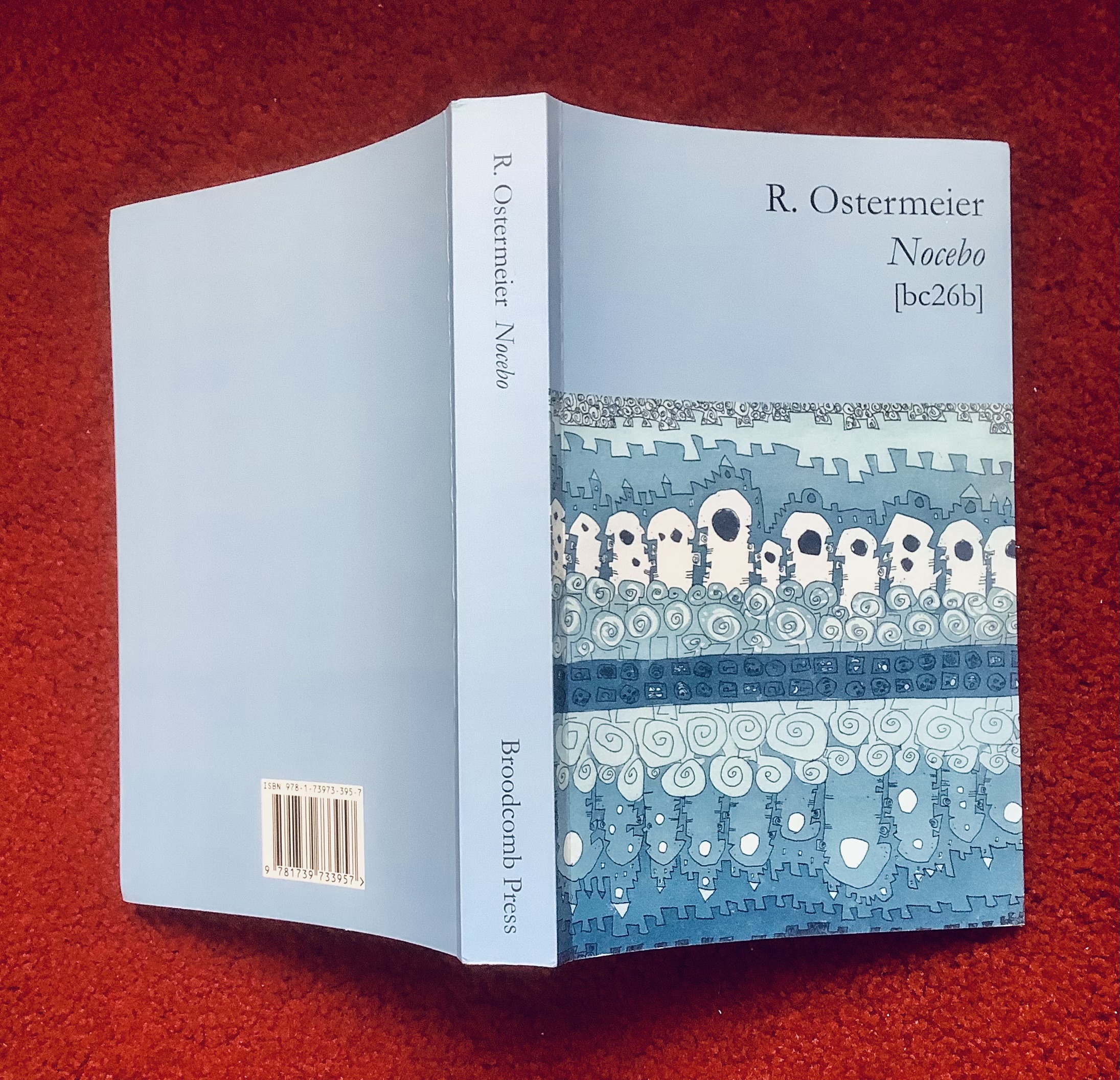
A debriefing and possible healing after intensity, with described photographs, connections, and a trepanning, names, a pattern of quoits, and a resolution of sorts, and possible spoilers galore that I shall leave well alone, leaving only me bemused but hopeful, and also noting the fact that the narrator as psychotherapist is explicitly shown here as bearing the author’s surname, the letters of the full by-line containing ‘terrorism’ as well as ‘roisterer’. Indeed, not everything means something.
Mommick
I
“Footnote fame, however, can lead to fervid support; the idea an artist might be considered overlooked is catnip to some.”
If this work continues in the same vein as its first chapter, then we have a dark masterpiece on our hands. Broadly about a Hungarian family of artist, such as parents as sculptor and life drawer respectively and grandfather as photographer, seen through the eyes of the more digital son \ grandson, particularly the grandfather’s photos, and also the differing nature of nudity in men and women, and a most haunting vision of a certain missing book listed in the grandfather’s bibliography of photo collections. The bits hanging out of the words of this chapter are challenging to tackle but immensely fruitful. Not smooth or comprehensibly triangulate. And that takes no account of the bits in it I haven’t told you about!
II
I am awed, while impelled onward by this work, at the certainty that we do indeed have a dark fiction masterpiece on our hands here. I can’t help empathising my own current body as self with the grandfather in the photos of the book entitled 6.20, and my earlier younger self with the grandson, and especially with the ‘airbag’ metaphor. And the nature of the photographs, too. And much else with my own hanging peninsula, pulled pillar to post in the name of art or healing in a miniaturised mansion amidst woods where scarecrows would not be expected to crowd round. And I could not help further investigating into the word ‘mommick’: http://www.word-detective.com/2011/12/mommick-mammock/
And I feel, in hindsight, that it has always been inevitable that I would read this work before I died, and has such certainty thus kept me alive? So, do I dare finish it? Do I dare not? Am I pretentious enough to even ask such questions?
III
“…the elbow-joints made of gnarled wood.”
It’ll be hard to forget the visit to the scene of 6.20 and the almost conjoined scarecrows there. Anything else I say here will spoil it even more.
…
Meanwhile I am wondering about…
GENESIS 6.20: “Of the birds according to their kinds, and of the animals according to their kinds, of every creeping thing of the ground, according to its kind, two of every sort shall come in to you to keep them alive.”
IV, V & VI
“Maybe none of this means anything.”
And from that Black Maybe, the Noah’s ark of scarecrows, as unpaired by a later bloody pig-sticking, I can’t help thinking that Ostermeier’s Bartoš is Attila Veres’ version of Bartók HERE (and a timely Bartók concert attended live in last few days HERE), as earlier preparations for Mommick as Boy born from the ultimate parthenogenetic pairing within a giant scarecrow. And an old soldier’s testicles that hung lower than a towel’s privacy. The narrator’s guilt, shame and paranoia accompanying a suspicion of human body-parts having been smuggled into the scarecrows as catalyst of each pairing in the ‘6.20’ photos, factors hung out to dry, too?
“It’s the opposite of the placebo effect.”
Upmorchard
I & II
“The train did not stop at any of the coastal stations. They passed Careton, Fines, Shuck, Padgett-on-Sea.”
From Bartók to an at least slightly academic man called Barlick, and I follow him on a somewhat random tour of the Peninsula by train and on foot and I realise that I am in my own world as mutated by another’s greater skills, or vice versa, with big-headed people between various strange trains some being ‘dig trains’, pubs with odd locals, stones and bones and a b & b; I just re-read my own old miniature ‘Skinning the Yolks’ recently rewritten HERE, by chance, re-read it before starting this work, a work that has already, after just two chapters, has swept me off my feet with its prose charms and its sinister doppelgänger stalking. I did not know of this whole world’s existence, or vice versa. Not implying anything but utter admiration, as this work feels as if it’s much more previous than I am, and far better written, to boot.
III & IV
“The stairs were bare wood, and exposing the fact of their structure bled backwards in time to taint his every memory of stairs.”
Exposing other facts in this fiction, I feel I would be breaking some rule of this work’s “writy hiding” to take you beyond its own yellow light to reveal more of the characters he meets in the hangar environs of an abandoned fishing village, their stones and statues, and the fact that my own novella The Apocryphan ends with a foot with four toes. Needless to say, I am utterly beguiled. And the lesson taught me by this book ….
“Not. Everything. Has. Meaning.”
Not even the prime number: 90,127.
V & VI
“Maybe later, he said. / The truth. After clean up. A fragment. The meaning.”
Whatever the “vertical permutations” and some empty white spaces in this text, reading it is like his scrying the told-of text here associated with the stones, even inserting oneself into an eyehole, giving a sense of the scale of things here. Some music is tried by one of the characters as backdrop and I screamed out ‘Bartók!’— who gave such major influence upon contemporary jazz! But nobody listened. (I studied ‘The History of Language’ with Anne Cluysenaar in 1967, by the way.)
VII – XI
“…toe found a hole in the stone.”
Whether genuine vision, dream or madness, the “one block of text” taken as a body of Gloy stones for translation into such numinous realms will be something you will never forget, including its poignant and bloody, flower-tagged finale, and the subsequent musical ‘dying fall’ of a coda. I could not help myself finishing it today. Today somehow seems significant.
Taken to “the Padgett-on-Sea lighthouse then in wide circle”, I, its ‘Great Stranger’, or not. Well, I saw meaning in the stones, even if there were none! And in this book, too, deservedly chosen as one of my rare reviews in the twilight of my reviewing career. Sorry to make it about me, but isn’t that what reading good books is all about? Hope you also find a satisfying ‘me’ in it, should you read it.
END