
www.nemonymous.com
Des Lewis - GESTALT REAL-TIME BOOK REVIEWS
A FEARLESS FAITH IN FICTION — THE PASSION OF THE READING MOMENT CRYSTALLISED — Empirical literary critiques from 2008 as based on purchased books.
Sunday, February 19, 2012
Basket of Coinages (updated)
‘zeroism, egnisomicon, egnisism’ in conjunction with PF Jeffery (1967), ‘whofage’ in conjunction with PF Jeffery (1973), ‘agra aska’ (1983), ‘weirdmonger’ (1988), use of ‘brainwright’ in modern times (1990), Salustrade (1992) use of ‘yesterfang’ in modern times (1997), ‘wordhunger’ (1999), ‘nemonymous, ‘nemonymity’, late-labelling, veils-&-piques’ (2001), ‘denemonise’ (2002), ‘megazanthus’, ‘weirdonymous’, ‘chasing the noumenon’ (2003), ‘wordonymous’, ‘wordominous’, ‘the-ominous-imagination’, revelling in vulnerability (2004), ‘a woven fire-wall of words’, ‘the synchronised shards of random truth and fiction’, ‘nemoguity’, ‘vexed texture of text’, ‘fictipathy’, ‘nemotion’, ‘the hawler’, ‘the angel megazanthus’, ‘klaxon city’, ‘horrorism’ when used as a word for the philosophy of horror fiction (2005), ‘publication-on-reading’, ‘antipodal angst’, ‘the tenacity of feathers’, ‘a writer’s mandala’, ‘wordy weird’, ‘nemophilia / nemophobia’, ‘magic fiction’ as the obverse of the more common expression ‘magic realism’, ‘weirdtongue’ as the ‘name’ of a language, ‘Glistenberry’ as an alternative name for ‘Glastonbury’, ‘tonguage’ as a ‘conscious’ language, ‘yester-eggs’ as a term for Proustian ‘selves’, ‘the parthenogenesis of reality from artifice’, ‘all is for the pest in the pest of all worlds’, ‘Baffles’ as fables with muffled morals (2006), ‘fanblade fable’, ‘abutting the if’, ‘word clones / word clowns’, ‘bumps for books’, ‘rite of review’, ‘cone zero’, ‘a basket of coinages’ (2007), ‘small press cover ark(ive), the baser pulps’ ‘orrorfaces’, ‘the wheel culture’, ‘netogenic’, the first fiction about a ‘drogulus’, ‘Innerskull’, ‘meganthus‘ (2008), ‘CERN Zoo’ in literature, ‘Real-Time Reviewing‘, ‘ligottum‘, ‘the pit and the pessimum‘, ‘ligottus‘, ‘fubbcuckle’, ‘extraneity creep’, ‘pillowghost’, ‘intowards’, ‘powderghost’, ‘nightmare’s moat’ (2009), ‘THE TENSES’, ‘scream munch’ as another word for ‘captcha’, ‘skight’ – threepenny bit, ‘invitations from within’, ‘novellatory’, ’Ress’, ‘Venn Dreams’, ‘Tearsheet Doll’, scanbuncle, A Götterdämmerung of Guts , Holistic Horror (2010), SFtopia, Salustraders / Overspacers, Novellarette, Inquel, Gaddafery, Jungian autonymity, sudracide, an impesto novel, trendbaffler, our planet as reliquary, fictionatronics, Lovecraftianisation, “To know the worst is also to know the best“, vignellarette, “Nothing is controlled by logic other than logic itself.”, nightgators, Horror Genreators, dicksplay, roman littoral, ghostalt, poltergeistalt, horrasy, Horrasy: The Horrastic and the Heuristic, srednibution, srednidipity, Lovecraftian indescriptivities, bememorise, alephantiasis, reva-menders, metapomorphic, rarifiction, neoloquism, Was the God Particle born instable? (2011), angelivalent, literal-meaning dreaming, the ‘Higgs boson’ of Horror, The Weirdonomicon, Aickmania, shortcomings harnessed are stronger than strengths unused, privacy-trawler. (2012).

Wednesday, February 15, 2012
The Far Side of the Lake – Steve Rasnic Tem
Real-Time Review continued from HERE
————————————
The Snow People
"Charlie Goode was a great believer in synchronicity."
The next Ghost-Hunter story seems to me to be the natural, yet unpredictable, progression of this book's inter-generationality theme towards an absurdist but - due to this book's 'magic fiction' as opposed to mere 'magic realism' alone - highly believable culmination. Via the imputed cryologies of 'gradual' bereavement and by means of 'passing on' rather than being 'lost' or vanishing altogether during the death process, here the powers let loose by the 'Ice House Pond' give their answer to all Ligottian nihilism by embracing that nihilism: by stitching music from snowflakes: allowing fiction to be our religion, tantamount. Seems to be synchronous with my 'relaxed snowman' photo above that was placed on this site around 5 Feb before I started reading this book. Do work through the logic of this story together with the foregoing backstories, and you will see, I hope, what I see in this story. There are some incredible descriptions of those hanging on to death and thus to life - 'playing' in the snow. It is simply a gem of a piece that needs to be read before you are lost or pass on yourself. Or possibly keep it unread, and you will never die? Meanwhile: "Inside, Charlie found Bobby helping Jimmy dump several boxes of old books and knick-knacks into a large crate labelled TRASH." (15 Feb 11 - two hours later)
THIS REAL-TIME REVIEW IS NOW CONTINUED HERE.
--------------------------
————————————
The Snow People
"Charlie Goode was a great believer in synchronicity."
The next Ghost-Hunter story seems to me to be the natural, yet unpredictable, progression of this book's inter-generationality theme towards an absurdist but - due to this book's 'magic fiction' as opposed to mere 'magic realism' alone - highly believable culmination. Via the imputed cryologies of 'gradual' bereavement and by means of 'passing on' rather than being 'lost' or vanishing altogether during the death process, here the powers let loose by the 'Ice House Pond' give their answer to all Ligottian nihilism by embracing that nihilism: by stitching music from snowflakes: allowing fiction to be our religion, tantamount. Seems to be synchronous with my 'relaxed snowman' photo above that was placed on this site around 5 Feb before I started reading this book. Do work through the logic of this story together with the foregoing backstories, and you will see, I hope, what I see in this story. There are some incredible descriptions of those hanging on to death and thus to life - 'playing' in the snow. It is simply a gem of a piece that needs to be read before you are lost or pass on yourself. Or possibly keep it unread, and you will never die? Meanwhile: "Inside, Charlie found Bobby helping Jimmy dump several boxes of old books and knick-knacks into a large crate labelled TRASH." (15 Feb 11 - two hours later)
THIS REAL-TIME REVIEW IS NOW CONTINUED HERE.
--------------------------
Tuesday, February 14, 2012
Ice House Pond
From my real-time review HERE
Ice House Pond - by Steve Rasnic Tem
“More life meant more death.”
A novella-sized tour de force. The male protagonist says the pond is much bigger than it is. A strange statement. [But this ebook is much bigger than it is, too. I had no idea how big when I started it - unlike with a real thick book in your hand as you riffle through its pages assessing its scope. Certainly got my money's worth.] Thus, by means of that ostensibly strange statement, sharing the previous story’s boy’s larger-than-life or imagino-kinetic abilities and whose ‘fog’ trope is now here to be frozen. The male protagonist (who suffers his own past of inter-generational tragedies of wife and daughter in a car accident and more) takes over a desolate ice-property (you have to read this novella to appreciate the enormous stunning scope of that expression, that ’ice-property’ concept in real cold-numbing, cold-abrading, shard-tall grandeur as well as this book’s erstwhile seedy ‘Leaks‘ potential infecting that grandeur, the erstwhile ‘Underground‘ and its ‘hawling’ images, its death-sacrifices to prevent suffering, the purging of past sorrows by creating today greater sorrows or diseases that are paradoxically easier to bear, the Concentration Camp gas ovens [that map-maze with yellowish haze the "mad scientist's" inner earth of my aforementioned 'Nemonymous Night' by dint of its sister novella 'Weirdtongue']; the Ice House’s inner scrying cryological crystal-ball shapes both sickishly mutant and ripe with potential stunning palaces of magic realism (not unlike that sometimes evoked by ’Oscar and Lucinda’ in retrospect) – “…the cold had the presence and intensity of stone” – the ‘genius loci’ of the house, ice pond, ice house that he’s bought, complete with nursery, is via cumulatively powerful prose, or rather an ice-genie-loci? The sun like a huge white eye in the sky reminding me that it is my eye scrying the white screen of this novella (it’s white on my screen). ”Magic ice“. “Ice palaces“. This is Greystone Bay again, now complete with a hinterland of the missing people that the ice has taken and turned into self-redemptive ghosts (your self, not necessarily their selves). An ice house with the scope of a literally global shock, too. Ice block, “love breath” (sharing a bed is important on Valentine’s Day of all days, and I agree with what this novella says so touchingly on this score!). “The oldest cold”. The madness-veined ice-walls. Can memories be frozen like food? (My question, not the novella’s). Fishermen fishing for painted fish (still waiting for something to happen?). Can you tell I’m impressed? Yes, I particularly resonate with the cruel kindness of such fiction. It is replete with traditional stylisms of the Horror fiction genre; it’s as if the artificial world built up cumulatively like an ice sculpture, striking image piled upon striking image with feverous authorial gluttony; it never actually goes over the top because of those genre tropes employed so skilfully, even though it may go over the top for some not accustomed to such literature; and it will melt like all great ice sculptures will inevitably melt as my memory fades with the onset of old age and even my sadnesses will be numbed by the coming ice beyond any melting. Accepting that is like appreciating what makes you accept that. Like this novella. There’s even a bookshop in it with real redolent books waiting to be riffled through. Only global catastrophe will destroy them, I guess. (14 Feb 12 – another 4 hours later)
Ice House Pond - by Steve Rasnic Tem
“More life meant more death.”
A novella-sized tour de force. The male protagonist says the pond is much bigger than it is. A strange statement. [But this ebook is much bigger than it is, too. I had no idea how big when I started it - unlike with a real thick book in your hand as you riffle through its pages assessing its scope. Certainly got my money's worth.] Thus, by means of that ostensibly strange statement, sharing the previous story’s boy’s larger-than-life or imagino-kinetic abilities and whose ‘fog’ trope is now here to be frozen. The male protagonist (who suffers his own past of inter-generational tragedies of wife and daughter in a car accident and more) takes over a desolate ice-property (you have to read this novella to appreciate the enormous stunning scope of that expression, that ’ice-property’ concept in real cold-numbing, cold-abrading, shard-tall grandeur as well as this book’s erstwhile seedy ‘Leaks‘ potential infecting that grandeur, the erstwhile ‘Underground‘ and its ‘hawling’ images, its death-sacrifices to prevent suffering, the purging of past sorrows by creating today greater sorrows or diseases that are paradoxically easier to bear, the Concentration Camp gas ovens [that map-maze with yellowish haze the "mad scientist's" inner earth of my aforementioned 'Nemonymous Night' by dint of its sister novella 'Weirdtongue']; the Ice House’s inner scrying cryological crystal-ball shapes both sickishly mutant and ripe with potential stunning palaces of magic realism (not unlike that sometimes evoked by ’Oscar and Lucinda’ in retrospect) – “…the cold had the presence and intensity of stone” – the ‘genius loci’ of the house, ice pond, ice house that he’s bought, complete with nursery, is via cumulatively powerful prose, or rather an ice-genie-loci? The sun like a huge white eye in the sky reminding me that it is my eye scrying the white screen of this novella (it’s white on my screen). ”Magic ice“. “Ice palaces“. This is Greystone Bay again, now complete with a hinterland of the missing people that the ice has taken and turned into self-redemptive ghosts (your self, not necessarily their selves). An ice house with the scope of a literally global shock, too. Ice block, “love breath” (sharing a bed is important on Valentine’s Day of all days, and I agree with what this novella says so touchingly on this score!). “The oldest cold”. The madness-veined ice-walls. Can memories be frozen like food? (My question, not the novella’s). Fishermen fishing for painted fish (still waiting for something to happen?). Can you tell I’m impressed? Yes, I particularly resonate with the cruel kindness of such fiction. It is replete with traditional stylisms of the Horror fiction genre; it’s as if the artificial world built up cumulatively like an ice sculpture, striking image piled upon striking image with feverous authorial gluttony; it never actually goes over the top because of those genre tropes employed so skilfully, even though it may go over the top for some not accustomed to such literature; and it will melt like all great ice sculptures will inevitably melt as my memory fades with the onset of old age and even my sadnesses will be numbed by the coming ice beyond any melting. Accepting that is like appreciating what makes you accept that. Like this novella. There’s even a bookshop in it with real redolent books waiting to be riffled through. Only global catastrophe will destroy them, I guess. (14 Feb 12 – another 4 hours later)
Monday, February 13, 2012
UNDERGROUND - the story
Excerpt from Real-Time Review
Underground - by Steve Rasnic Tem
A substantial Tem story, without a doubt, and, for me, a personally important one that (like all the stories in this book so far) I’ve just read for the first time. It carries this book’s own internally connected themes plus a pre 9/11 ground zero (or cone zero – see another Nemonymous volume that preceded cern zoo), here a seemingly deliberate building construction hole, with encroaching themes of that hole ineluctably being out of control, and themes concerning explicitly stated statues, ‘tree-men’, travel to ‘earth’s core’, the swimmability within ground or earth [and in my novel 'Nemonymous Night' it is flyability in the earth as well as swimmability! - a novel, for me, felicitously and coincidentally and differently resonating with Tem's 'Underground' as perhaps encapsulated by the concept of what I call 'hawling'] – and the poignancy of ‘difference’, sexual prejudice and many other factors I could enumerate. Here quite brilliantly connected within Poe’s premature burial fear – and a bereft sense or fear of leaving no descendants (note that word!), even too fearful to leave one’s dead body so as to mulch the future? Hence, that bereftness, too, perhaps, when there is no inter-generationality by enforced personal proclivity, i.e. no potential posterity. It’s as if we’ve been led artfully to this point by the previous stories, whereby the meticulously caring among us can now be shown how to care horizontally as well as vertically. You will know what I mean. An intensely caring literature. And so much more, too, like messages not getting through. This one, for me, did. But one needs to read literature with all these moments of meticulous care in their cumulation so as to reach such a point. A ‘hawling’ of emotions to the surface so as to optimise their message, empowering it even further by making readers work hard to ‘hawl’ the meanings free from their clinging roots. But God knows, even optimisation is often not enough. We can only do our best. A story for our times. And for the moving ’dead’ in the Guest House of our soul. (13 Feb 12 – another 90 minutes later)
Underground - by Steve Rasnic Tem
A substantial Tem story, without a doubt, and, for me, a personally important one that (like all the stories in this book so far) I’ve just read for the first time. It carries this book’s own internally connected themes plus a pre 9/11 ground zero (or cone zero – see another Nemonymous volume that preceded cern zoo), here a seemingly deliberate building construction hole, with encroaching themes of that hole ineluctably being out of control, and themes concerning explicitly stated statues, ‘tree-men’, travel to ‘earth’s core’, the swimmability within ground or earth [and in my novel 'Nemonymous Night' it is flyability in the earth as well as swimmability! - a novel, for me, felicitously and coincidentally and differently resonating with Tem's 'Underground' as perhaps encapsulated by the concept of what I call 'hawling'] – and the poignancy of ‘difference’, sexual prejudice and many other factors I could enumerate. Here quite brilliantly connected within Poe’s premature burial fear – and a bereft sense or fear of leaving no descendants (note that word!), even too fearful to leave one’s dead body so as to mulch the future? Hence, that bereftness, too, perhaps, when there is no inter-generationality by enforced personal proclivity, i.e. no potential posterity. It’s as if we’ve been led artfully to this point by the previous stories, whereby the meticulously caring among us can now be shown how to care horizontally as well as vertically. You will know what I mean. An intensely caring literature. And so much more, too, like messages not getting through. This one, for me, did. But one needs to read literature with all these moments of meticulous care in their cumulation so as to reach such a point. A ‘hawling’ of emotions to the surface so as to optimise their message, empowering it even further by making readers work hard to ‘hawl’ the meanings free from their clinging roots. But God knows, even optimisation is often not enough. We can only do our best. A story for our times. And for the moving ’dead’ in the Guest House of our soul. (13 Feb 12 – another 90 minutes later)
Wednesday, February 08, 2012
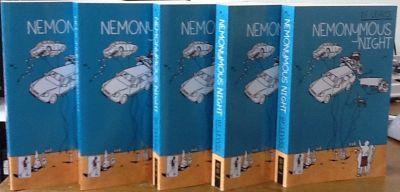
I have now finished Nemonymous Night. And, on another level, have come to terms with the fact that I have scarcely read it at all.
That is a quote from the book's excellent first review.
One can't dare hope for this book to be read at all, then?

One can't dare hope for this book to be read at all, then?
Monday, February 06, 2012
The HA of HA - stock-taking so far

Enthusiastic response since this HORROR ANTHOLOGY OF HORROR ANTHOLOGIES was first published in June 2011.
All reviews linked here: http://horroranthology.wordpress.com/ha-of-ha-reviews/
I have a few copies of the above book – and the one here - available for anyone who is willing to review either or both. Please contact me at dflewis48@hotmail.com
Sunday, February 05, 2012
Aickmania
I've just completed a review of SHRIKE by Quentin S. Crisp started here http://nullimmortalis.wordpress.com/2012/02/03/shrike-quentin-s-crisp/ and finished here http://zencore2007.wordpress.com/111-2/
Contains the first recorded use of the word 'Aickmania' in the comment today on the second link above.
EDIT: Maybe not the first recorded use as someone may have used it before on Googlegroups.
Contains the first recorded use of the word 'Aickmania' in the comment today on the second link above.
EDIT: Maybe not the first recorded use as someone may have used it before on Googlegroups.
Saturday, January 28, 2012
Twelve collaborations with Tim Lebbon
Twelve collaborations with Tim Lebbon linked from here:
DIRTY PIPES (Peeping Tom 1999)
SQUALID FINGERS (Strix 1998)
DIRTY PIPES (Peeping Tom 1999)
SQUALID FINGERS (Strix 1998)
=============================================
All my collaborations linked here: http://dflcollaborations.wordpress.com/
Saturday, January 21, 2012
A Dream of Real Air
published 'Peripheral Visions' 1992
There was no use denying him access to the parlour.
He was my son after all, and I couldn't see him curled up like a whelk in the cold scullery all night.
But when, on that retrospectively fateful weekend, he brought a young lady to visit, one with a dagger-fish brooch on the left lapel of her cavalry-twill costume top - well, I would have needed to resort to the direst vocabulary to warn them both off.
I was indeed sure there would be no safety in numbers. I wanted to continue my life in the magic realism of solitude--and, so, it would be necessary for me to get in my tantrum of making the pair of them unwelcome before they had the chance to sneer at the shortcomings of my abilities as a host.
It is difficult to disentangle my reasoning on such an occasion, as the words slide too easily from my memory, staining the screen of my mind's eye with a pattern of meaning comprehensible only to Hottentots; I even wonder whether I’m actually capable of perpetrating the Queen's English, let alone that alien dialect which the Old Spaceships once crated to Earth in the beaks of insane, if articulate, chickens.
Back to fundamentals.
I opened the front door upon hearing the knock, thus allowing dustmotes and sunlit air to swirl past me. He had warned that he might be coming for a long weekend, if time permitted. There, though, with him, was this female with goggle eyes, both feet planted on the balding doormat. She peered over my shoulder into the well of the hall.
''Yes?'' I scowled. Well, I think that I scowled, since only in stories can a narrator really see through the eyes of others. I had already decided to treat them both as strangers--that was at least what my son deserved by bringing someone I couldn't trust at first sight.
"Hello, Dad ... can I introduce Felicia Kelp?" He did not spell out the name so, even now, I’m unsure as to whether even the Hottentots would be able to get their tongues round what I visualised as the correct words.
I glanced into the sky blue yonder and caught the fleeting sparkle of a star-hopper slowing down for Heathrow . . . or, at that hour, it may even have been Gatwick. Light travel (or travelling light as the popular song of the time put it was so inconsistent. Tachyons had not really bottomed out until AJ Sylvester later dissected one under a microscopic microscope, using a near endless array of diminishing pulleys to guide a scalpel manufactured from one highly sharpened molecule.
Just as I was about to answer as unwelcomingly as possible, I heard a furor from the chicken run in the back garden. The squawking and screeching was fit to raise the Devil on his hindmost. Something had disturbed the creatures' equilibrium. Either too much grit in the meal or the barely perceptible shift of the Earth off its axial cord, which tended to happen nowadays, had gone to their coxcombed heads. Luckily, the moon no longer toppled into the sea, as it did back in the more poetic days of pre-reality--only to be put back in the sky by everybody's image of a God with flowing white beard, trident and sharkbone corsets.
Without a further word (saying nothing was indeed more unwelcoming than pointedly expressing my grievance in stronger language), I showed them into the parlour. There was a put-you-up in there, just big enough for two thin ones, I indicated. I saw Felicity Kell (or whatever her Christforsaken name was) studying the framed photographs on the mantelpiece. One was of me and my late wife.
"Mr. Lewis, you sure looked young in the past." That was no way to inveigle me into accepting her as a complete stranger no longer (or even an incomplete one). I could imagine, indeed, nobody stranger. Before I could protest, my so-called son intervened.
"What's wrong with my own bedroom, Dad? Hasn't it still got hot and cold running water?" He motioned as if to take their suitcases to that very room.
Whether it was the deep rumbling of the starhopper landing across the other side of London, he did not seem to hear my reply:
''You're not taking any see-through floosies up there, Johnny me lad. Your dead mother would turn over in her bed."
He shrugged. He knew I had spoken something, since I had watched his eyes trying to follow my lips. For a man, his eyes were very widely set apart. In his heart, he must have been aware of my misgivings.
"We'll go and feed the poultry for you, Dad." He took his lady friend by the arm (both of which were extremely short for her body, I noticed) and directed her towards the front door, via the parlour door .
"Done it already," I said, pointing to the carriage clock which was between the photographs like a sentry of old. The imperceptible swing of its pendulum proved that the ancient maxim of time never standing still was worthy, at least, of scrutiny by that breed of scientists even now living in the think-tanks of old Ministry of Defence establishments dotted along the eroding coasts of downtown Great Britain.
The lady, who had evidently stolen my son's heart, made herself at home. She spread her legs in an ungainly fashion as she settled down in what used to be my wife's wicker basket, allowing me to see as much as the stocking-tops, but no further. My son smiled at my blushes, if blush I did.
In an attempt to bring matters to an even keel, he started on one of his long boring conversation-pieces about the ancient research into how fish think, make music. Highfaluting college talk, I called it. He needed his brain flushed out. The lady said nothing, while tugging at the harness of her bodice and wriggling to remove her most sensitive areas from the basket's various discomfort points. Then, without prior warning, the shrill alarm in the carriage clock blurted out.
"Time to fill the house!" I shouted, scorching for the tap by the open radiator.
I was just in time. The lighter-than-air water gradually filled the parlour, before our lungs could burst from our mouths like punctured balloons. The water was lukewarm in view of the season. It was strange what routines post-reality brought along in its wake.
That's the way the world is, these days. At least, the three of us stopped the inane chatter. Creatures under water can only open and shut their mouths in the arcane rhythm of misspent speech. When words are empty, lip-reading is worth no more than braille to those now limbless coffins of flesh which were once called human beings kept locked up in disused nuclear shelters, as they are--for their own good, let me add.
My eyes slid round to my temples, slugs that merely looked like the marbles children used to play with. Despite this, I could still discern my son's grinning from side to side, as I think he knew I knew he probably hated the lady (whatever her name) and it was only a matter of time before he unscrewed the stopcock of the sewage outlet under the television set. But would it be wide enough?
The sun shafted through the parlour window and milled with the multi-coloured plankton that swirled from the secret coral seas beyond the stocking-tops.
I would have told my son not to darken my door again, if I hadn't first fallen asleep and dreamed of drowning.
Friday, January 20, 2012
You Walk The Pages - Mark Valentine.
One of horror's favourite archetypes is the highly intelligent, articulate and cultured homicidal psychopath, yet most real acts of evil are committed for petty reasons, by people who are a little insecure and not very bright. Real characters with these properties are not popular because they are less engaging and more annoying, yet Mr. Valentine has created one we can absolutely enjoy spending time with. It's a first person narration from someone with little literary skill, but the character voice is consistent and engaging, and the slow drip feed of growing terrors is nastily effective.
-------------------------
It's called "You Walk the Pages", and was written by Mark Valentine, a writer I only know by name. Also quite short, this story is narrated by a clearly insane man who wishes to relate how he used the services of a gift website called youwalkthepages.com to get back at his enemies. The site -- which, if some version doesn't actually exist now, certainly will soon -- takes classic literature and replaces the names of the heroes with the names of whoever you want to give the gift to. So if someone wanted to get me a copy of Ulysses wherein I can read things like "Mr. Bill R. ate with relish the inner organs of beasts and fowls", that's how you'd go about it. But our narrator has the idea to place his enemies in the position of victims in horror stories. The resulting private volume is Valentine's horror anthology. And I know what you're probably thinking about where this one's heading, but I'll go ahead and spoil it, sort of, by pointing out that no, these enemies do not suddenly drop dead. This is because our narrator is insane. He's delusional. He's never not those things, and the story doesn't try to fool us into thinking that what he believes might be true but might not be true -- it pretty obviously isn't, and the horror of "You Walk the Pages" is the horror of the narrator's madness. On this level, it is entirely successful. When describing one of his "enemies", an old man who takes up too much space at the library table, our narrator says: "I want to sit there and make notes, I only have a standard size notebook, I do not need much space, but it is all I can do to get a little patch of the desk because of all the space he has got with his papers. He does not even look up, he does not give any sign that he sees you, or that you might want some space as well, you might as well not be there. If he saw what books I was looking at and what i was writing in my book he might take a different attitude I believe." I also like the approach to the anthology idea here. While O'Driscoll's approach is as delightfull literal as you might expect when hearing the idea for The Horror Anthology of Horror Anthologies, and Hughes's approach is to sort of not approach it at all, Valentine imagines something entirely new and unique and on point. Well done.
-------------------------------
The title of this excellent story refers to an internet service which allows you to replace the name of a principal character from a famous book with your own, or that of a friend or family member- or perhaps, of someone you might consider to be your enemy. This captures the imagination of Mark Valentine’s colorful, obsessive and fastidious writer-narrator. ‘One day I sat in my room wondering what to think about, what should engage a man who is a thinker and a dreamer, who is able to have visions like I am.’ I won’t say more but that the narrator incorporates ideas concerning the magical properties of the Seven Wonders of the World into his narrative to great and chilling effect.
---------------------------
“You Walk the Pages” by Mark Valentine deals with a similarly autistic-seeming individual who uses horror stories as a way of getting back at people who offend him, like the lady in the chip shop, by substituting their names for the characters in the stories and making them suffer the same fate, or worse. It is the hilariously deadpan first person narrator that made the story work so well.
---------------------------
Any further reviews after 20 Jan 12 will appear in the comments below.
My own views: http://horroranthology.wordpress.com/editors-story-by-story-commentary/
-------------------------
It's called "You Walk the Pages", and was written by Mark Valentine, a writer I only know by name. Also quite short, this story is narrated by a clearly insane man who wishes to relate how he used the services of a gift website called youwalkthepages.com to get back at his enemies. The site -- which, if some version doesn't actually exist now, certainly will soon -- takes classic literature and replaces the names of the heroes with the names of whoever you want to give the gift to. So if someone wanted to get me a copy of Ulysses wherein I can read things like "Mr. Bill R. ate with relish the inner organs of beasts and fowls", that's how you'd go about it. But our narrator has the idea to place his enemies in the position of victims in horror stories. The resulting private volume is Valentine's horror anthology. And I know what you're probably thinking about where this one's heading, but I'll go ahead and spoil it, sort of, by pointing out that no, these enemies do not suddenly drop dead. This is because our narrator is insane. He's delusional. He's never not those things, and the story doesn't try to fool us into thinking that what he believes might be true but might not be true -- it pretty obviously isn't, and the horror of "You Walk the Pages" is the horror of the narrator's madness. On this level, it is entirely successful. When describing one of his "enemies", an old man who takes up too much space at the library table, our narrator says: "I want to sit there and make notes, I only have a standard size notebook, I do not need much space, but it is all I can do to get a little patch of the desk because of all the space he has got with his papers. He does not even look up, he does not give any sign that he sees you, or that you might want some space as well, you might as well not be there. If he saw what books I was looking at and what i was writing in my book he might take a different attitude I believe." I also like the approach to the anthology idea here. While O'Driscoll's approach is as delightfull literal as you might expect when hearing the idea for The Horror Anthology of Horror Anthologies, and Hughes's approach is to sort of not approach it at all, Valentine imagines something entirely new and unique and on point. Well done.
-------------------------------
The title of this excellent story refers to an internet service which allows you to replace the name of a principal character from a famous book with your own, or that of a friend or family member- or perhaps, of someone you might consider to be your enemy. This captures the imagination of Mark Valentine’s colorful, obsessive and fastidious writer-narrator. ‘One day I sat in my room wondering what to think about, what should engage a man who is a thinker and a dreamer, who is able to have visions like I am.’ I won’t say more but that the narrator incorporates ideas concerning the magical properties of the Seven Wonders of the World into his narrative to great and chilling effect.
---------------------------
“You Walk the Pages” by Mark Valentine deals with a similarly autistic-seeming individual who uses horror stories as a way of getting back at people who offend him, like the lady in the chip shop, by substituting their names for the characters in the stories and making them suffer the same fate, or worse. It is the hilariously deadpan first person narrator that made the story work so well.
---------------------------
Any further reviews after 20 Jan 12 will appear in the comments below.
My own views: http://horroranthology.wordpress.com/editors-story-by-story-commentary/
Horror Planet - S. D. Tullis
It is almost impossible to pick and choose what should be lifted from the text and quoted as I would have to retype the entire story here. I suggest you pick up a copy of this anthology and read everything in it including this story and then you will see what I mean. But I will quote one observation here: ‘But he knew, or at least guessed- which for him was as good as knowing- that it was how the mechanics of dream operated: constructing through an unfathomable process a piecemeal assemblage of dream-motifs, a willy-nilly patchwork culled from first- and second hand experience, overactive imagination, and even smuggling them in from already dreamed landscapes of the unreal.’ This is a guy meets girl story. Robert falls in love with Charlotte. I am still not giving too much away to say that we end up in space, hurtling towards the sun. There is a role to play for a horror anthology. I’m just going to quote one more paragraph here. No I’d better not. I want to though. I must resist. Read the story.
-------------------------
"...its acid trip condensed narrative bringing to mind similar voyages by J.G. Ballard and Malzberg." (Black Static #25 - TTA Press)
-------------------------
S.D. Tullis’s “Horror Planet” consists of a deconstructed narrative that flits between scraps of seemingly random thought, depicting, in a few short pages, a kind of planetary collapse. I loved the frantic pace of this story.
---------------------
Any further reviews after 20 Jan 12 will appear in the comments below.
My own views: http://horroranthology.wordpress.com/editors-story-by-story-commentary/
-------------------------
"...its acid trip condensed narrative bringing to mind similar voyages by J.G. Ballard and Malzberg." (Black Static #25 - TTA Press)
-------------------------
S.D. Tullis’s “Horror Planet” consists of a deconstructed narrative that flits between scraps of seemingly random thought, depicting, in a few short pages, a kind of planetary collapse. I loved the frantic pace of this story.
---------------------
Any further reviews after 20 Jan 12 will appear in the comments below.
My own views: http://horroranthology.wordpress.com/editors-story-by-story-commentary/
The Writer - Clayton Stealback
Some beautifully written passages and nice touches of domestic detail make this a convincing little tale. It's a study of obsession, sliding into psychosis, all undermined by a magnificently unreliable narrator.
----------------------
"It is a cracker though. Really, it is."
----------------------
"...with the suggestion of somnething more sinister and conceptually daring in the background." (Black Static #25 - TTA Press)
-----------------------
For several weeks Steven has been wrestling with a short story he wants to submit to a horror anthology called Dark Heights. He just can’t seem to finish his story, he constantly redrafts, reedits, rewrites, changing paragraphs around, polishing sentences- the story is going nowhere and it is driving him crazy. His wife Alice is getting fed up with the routine. Every night when Steven crawls up into his attic to hack away at his story, she sits alone on the sofa downstairs, nodding off to the news of financial collapse on TV. Strange things begin to happen. They must not be revealed here, though they involve elements of Steven’s narrative bleeding into the reality of the story. There are some great one liners of internal rationalizing here, and I was smiling to myself all the way through this story. It was genuinely scary as well. I was reminded somehow of Ash from the Evil Dead films, suddenly confronting surreal and horrific forces. But is it real? Are the manifestations a result of Steven’s imagination? You have to read the story to find out.
--------------------------
This is one of those stories that keeps you guessing right up to the end. The worlds of fiction and reality start to meld into each other as author Steve struggles to finish writing a short story. This is a very good story. That manages to be a fresh take on this sort of tale.
-----------------------
In several of the stories, the process of writing itself is evoked in all its arduousness – the anxiety, the growing sense of purposelessness and the sheer bloody-minded determination to define the indefinable, half aware that, in the very act of creating, the author destroys the very thing he is trying to perfect, the beauty of the idea submitted to the harsh and sometimes ugly reality of ink and paper. Oh the horror! “The Writer” by Clayton Steelback draws on this creative struggle. The story gradually assumes an uncomfortable presence in the writer’s life, becoming ever more concrete until an evil character breaks through into real life. The horror of nightmares becoming flesh crops up in several of the stories. As authors perhaps we are more than usually susceptible to this illusion or delusion, perhaps because we are always striving to model characters from real life. I’m surely not the only author to feel confused as to whether a memory of an incident is from real-life or one I imagined for some self-created literary world. Perhaps it’s the first sign of madness. [...] In other stories plants poison or become symbols of annihilation as in “Flowers of the Sea”. In “The Writer”, a vase is transformed into a multi-stemmed plant that scatters its spores and invokes a state of madness.
--------------------
Any further reviews after 20 Jan 12 will appear in the comments below.
My own views: http://horroranthology.wordpress.com/editors-story-by-story-commentary/
----------------------
"It is a cracker though. Really, it is."
----------------------
"...with the suggestion of somnething more sinister and conceptually daring in the background." (Black Static #25 - TTA Press)
-----------------------
For several weeks Steven has been wrestling with a short story he wants to submit to a horror anthology called Dark Heights. He just can’t seem to finish his story, he constantly redrafts, reedits, rewrites, changing paragraphs around, polishing sentences- the story is going nowhere and it is driving him crazy. His wife Alice is getting fed up with the routine. Every night when Steven crawls up into his attic to hack away at his story, she sits alone on the sofa downstairs, nodding off to the news of financial collapse on TV. Strange things begin to happen. They must not be revealed here, though they involve elements of Steven’s narrative bleeding into the reality of the story. There are some great one liners of internal rationalizing here, and I was smiling to myself all the way through this story. It was genuinely scary as well. I was reminded somehow of Ash from the Evil Dead films, suddenly confronting surreal and horrific forces. But is it real? Are the manifestations a result of Steven’s imagination? You have to read the story to find out.
--------------------------
This is one of those stories that keeps you guessing right up to the end. The worlds of fiction and reality start to meld into each other as author Steve struggles to finish writing a short story. This is a very good story. That manages to be a fresh take on this sort of tale.
-----------------------
In several of the stories, the process of writing itself is evoked in all its arduousness – the anxiety, the growing sense of purposelessness and the sheer bloody-minded determination to define the indefinable, half aware that, in the very act of creating, the author destroys the very thing he is trying to perfect, the beauty of the idea submitted to the harsh and sometimes ugly reality of ink and paper. Oh the horror! “The Writer” by Clayton Steelback draws on this creative struggle. The story gradually assumes an uncomfortable presence in the writer’s life, becoming ever more concrete until an evil character breaks through into real life. The horror of nightmares becoming flesh crops up in several of the stories. As authors perhaps we are more than usually susceptible to this illusion or delusion, perhaps because we are always striving to model characters from real life. I’m surely not the only author to feel confused as to whether a memory of an incident is from real-life or one I imagined for some self-created literary world. Perhaps it’s the first sign of madness. [...] In other stories plants poison or become symbols of annihilation as in “Flowers of the Sea”. In “The Writer”, a vase is transformed into a multi-stemmed plant that scatters its spores and invokes a state of madness.
--------------------
Any further reviews after 20 Jan 12 will appear in the comments below.
My own views: http://horroranthology.wordpress.com/editors-story-by-story-commentary/
The Pearl and the Boil - Rosanne Rabinowitz
In adolescence, we form very strong attachments to music, films or books that seem to speak to us. Such things can stick with us for life, and a rediscovery in middle age can be as evocative of youth as photographs or diaries. This story is about that rediscovery, about regret and missed opportunities. Ms. Rabinowitz writes in a subtle impressionistic style that perfectly complements the subject matter.
--------------------------
Flying back from Oxford to New Jersey, Cora joins her sister Julie in helping their parents relocate to a new home. When Cora stumbles upon an undiscovered, unopened letter addressed to her childhood self, she is flooded with memories and sensations concerning a collection of stories called The Scarlet Thread and the Amber Road. The letter it turns out, is a response to a note which Cora has left in the very book and returned to the library – almost like a message in a bottle. The message could be understood as Cora’s childhood self longing to share her experience of the stories with a kindred spirit. The story shifts from the first to the third person, scenes from her adult self are juxtaposed with moments from her childhood, the scenes overlapping with fragments vividly described from the collection of stories: A girl enters a house that is filled with sky, another girl is trapped in a bottle, a flower mysteriously starts to play music only to devour the little girl who has nurtured it to bloom, statues come to life during a moment of passion, cities exist where colors are banned, a train is filled with distorted bodies. There is a rich pattern of images and colors and sensations in this story.
------------------------
Rosanne Rabinowitz’s finely detailed study of a woman’s search for a book she once picked up in the school library acknowledges the power of books as totems, somehow focusing a person’s entire worldview. The story within this story develops the idea of feelings or ideas transforming people’s lives –either for the better – a pearl, or for the worse – a boil. The story’s psychological depth allows the reader to appreciate the symbolic power of the book. A girl and boy encountered in a field of flowers, provides a sort of Arcadian vision for the story’s protagonist, towards which she strives. Flowers and plants are symbols of love but, later, in a different story within the story, another plant engulfs and digests the girl who tends it.
---------------------
"There's an element of something almost fable like about this story, with the events described entirely empirical on the surface, but beneath that the hint of fact and fiction entangling in the manner of sympathetic magic." (Black Static #25 - TTA Press)
-------------------------
"And the warmth and final joy of "The Pearl and the Boil"?"
---------------------
Any further reviews after 20 Jan 12 will appear in the comments below.
My own views: http://horroranthology.wordpress.com/editors-story-by-story-commentary/
--------------------------
Flying back from Oxford to New Jersey, Cora joins her sister Julie in helping their parents relocate to a new home. When Cora stumbles upon an undiscovered, unopened letter addressed to her childhood self, she is flooded with memories and sensations concerning a collection of stories called The Scarlet Thread and the Amber Road. The letter it turns out, is a response to a note which Cora has left in the very book and returned to the library – almost like a message in a bottle. The message could be understood as Cora’s childhood self longing to share her experience of the stories with a kindred spirit. The story shifts from the first to the third person, scenes from her adult self are juxtaposed with moments from her childhood, the scenes overlapping with fragments vividly described from the collection of stories: A girl enters a house that is filled with sky, another girl is trapped in a bottle, a flower mysteriously starts to play music only to devour the little girl who has nurtured it to bloom, statues come to life during a moment of passion, cities exist where colors are banned, a train is filled with distorted bodies. There is a rich pattern of images and colors and sensations in this story.
------------------------
Rosanne Rabinowitz’s finely detailed study of a woman’s search for a book she once picked up in the school library acknowledges the power of books as totems, somehow focusing a person’s entire worldview. The story within this story develops the idea of feelings or ideas transforming people’s lives –either for the better – a pearl, or for the worse – a boil. The story’s psychological depth allows the reader to appreciate the symbolic power of the book. A girl and boy encountered in a field of flowers, provides a sort of Arcadian vision for the story’s protagonist, towards which she strives. Flowers and plants are symbols of love but, later, in a different story within the story, another plant engulfs and digests the girl who tends it.
---------------------
"There's an element of something almost fable like about this story, with the events described entirely empirical on the surface, but beneath that the hint of fact and fiction entangling in the manner of sympathetic magic." (Black Static #25 - TTA Press)
-------------------------
"And the warmth and final joy of "The Pearl and the Boil"?"
---------------------
Any further reviews after 20 Jan 12 will appear in the comments below.
My own views: http://horroranthology.wordpress.com/editors-story-by-story-commentary/
The American Club, - Christopher Morris
A story with layers of meaning, it leaves the reader with many questions unanswered, but that's fine by me. Elements of Jeckyll and Hyde, and The Spiderwick Chronicles
-----------------------------
When Daniel Polzer receives a phone call informing him that his father is dying in a hospital in Ockham, Wisconsin, he is forced to abandon his school work during finals week and rush to his bedside. His father Edgar Polzer is the victim of an anonymous hit and run accident. As Daniel sits vigil at his bedside with his sister Sarah who has also returned home, we discover that Edgar has been displaying increasingly strange and paranoid behavior, particularly just prior to his accident. He fears the family home is haunted, he believes that he is being watched and followed. Without giving any more away, the story centers around a Faustian collection of tales, one of which has been penned by Daniel’s father. You have to read this gripping tale to find out the significance of the title. The setting in Wisconsin, and certain elements of the story reminded me at times of something we might encounter in a tale penned by Peter Straub, but Christopher Morris’s voice is his own, and the title and its significance is incorporated into the tale in an interesting way. The story made me want to turn the pages to discover what was going to happen next.
-----------------------------
“The American Club” by Christopher Morris follows a young man named Daniel who discovers that his eccentric writer of a father is in a coma following a car accident. Daniel finds a letter from his dad instructing him that in the event of his death, he should to burn all his fiction, the majority of which is unpublished. This is a top class mystery that unravels with perfect pace and likeable voice, and has a tense finale that leaves an unsettling aftertaste.
-------------------------
The American Club by Christopher Morris is a griping dark story which sees a son dicover his father’s hidden talent for writing and the dark secret behind that talent.
---------------------
The American Club by Christopher Morris is a brilliant tale, Daniel Polzer is a student sitting his final exams, but when he hears that his father has been put in hospital after a hit and run accident, he has to rush home. When he gets there he discovers that his father has been acting odd, and it all seems to centre around a collection of tales. A highly enjoyable read.
--------------------
“The American Club” also features a doppelganger, of sorts. The narrator delves into the enigma of his dying father’s writing but uncovers an unpalatable explanation for his father’s refusal to publish his work. This is an intense study of the subconscious. A ruined building with its decaying staircases and abandoned cellars acts as a metaphor for the writer’s twisted imagination and reflects an over-arching theme of this collection – the horror of the literary imagination. As writers in search of horror we become subjects of our own literary endeavours. What could be worse? The author, Christopher Morris, is astute enough to leave the ending insubstantial, to give the reader the merest hint of the dark truth.
-----------------------
Any further reviews after 20 Jan 12 will appear in the comments below.
My own views: http://horroranthology.wordpress.com/editors-story-by-story-commentary/
-----------------------------
When Daniel Polzer receives a phone call informing him that his father is dying in a hospital in Ockham, Wisconsin, he is forced to abandon his school work during finals week and rush to his bedside. His father Edgar Polzer is the victim of an anonymous hit and run accident. As Daniel sits vigil at his bedside with his sister Sarah who has also returned home, we discover that Edgar has been displaying increasingly strange and paranoid behavior, particularly just prior to his accident. He fears the family home is haunted, he believes that he is being watched and followed. Without giving any more away, the story centers around a Faustian collection of tales, one of which has been penned by Daniel’s father. You have to read this gripping tale to find out the significance of the title. The setting in Wisconsin, and certain elements of the story reminded me at times of something we might encounter in a tale penned by Peter Straub, but Christopher Morris’s voice is his own, and the title and its significance is incorporated into the tale in an interesting way. The story made me want to turn the pages to discover what was going to happen next.
-----------------------------
“The American Club” by Christopher Morris follows a young man named Daniel who discovers that his eccentric writer of a father is in a coma following a car accident. Daniel finds a letter from his dad instructing him that in the event of his death, he should to burn all his fiction, the majority of which is unpublished. This is a top class mystery that unravels with perfect pace and likeable voice, and has a tense finale that leaves an unsettling aftertaste.
-------------------------
The American Club by Christopher Morris is a griping dark story which sees a son dicover his father’s hidden talent for writing and the dark secret behind that talent.
---------------------
The American Club by Christopher Morris is a brilliant tale, Daniel Polzer is a student sitting his final exams, but when he hears that his father has been put in hospital after a hit and run accident, he has to rush home. When he gets there he discovers that his father has been acting odd, and it all seems to centre around a collection of tales. A highly enjoyable read.
--------------------
“The American Club” also features a doppelganger, of sorts. The narrator delves into the enigma of his dying father’s writing but uncovers an unpalatable explanation for his father’s refusal to publish his work. This is an intense study of the subconscious. A ruined building with its decaying staircases and abandoned cellars acts as a metaphor for the writer’s twisted imagination and reflects an over-arching theme of this collection – the horror of the literary imagination. As writers in search of horror we become subjects of our own literary endeavours. What could be worse? The author, Christopher Morris, is astute enough to leave the ending insubstantial, to give the reader the merest hint of the dark truth.
-----------------------
Any further reviews after 20 Jan 12 will appear in the comments below.
My own views: http://horroranthology.wordpress.com/editors-story-by-story-commentary/
Residua - David Mathew
A lovely and gradual unfolding of the psychological complexity of an apparently simple, if unpleasant scenario. Mr. Mathew takes a not entirely original concept and moulds it into something new and unique.
-----------------------
Steve Bilty is in prison, sentenced to 18 years of hard time for a crime he may or may not have committed. A prison guard, Orwenson, seems to know something about it. When Bilty comes across an Alfred Hitchcock presented anthology called Ghostly Gallery in the prison library, strange things begin to happen behind the prison walls. The enjoyment in this involving story revolves around the scenes between Bilty and the prison guard Orwenson. The dialogue between these two characters just jumps off the page. Slowly we come to realize what is haunting Bilty, and you have to read this entertaining story to find out what his crime may or may not have been, and if he is guilty or innocent. (And those Hitch anthos surely have seeped into the impressionable minds of many a young reader.)
----------------------------
One of the longer tales, “Residua” by David Mathew is the intriguing story of a possibly-innocent con who becomes attached to a book called Ghostly Gallery in the prison library. He starts to encounter characters from it in real life, also baffled by the intentions of an oddly benevolent guard who seems able to read his mind. It notches up the tension and curiosity well with strong, fleshed-out characters and snappy dialogue. There’s a lot of subtle fear in this story, and when some horrible truths come to light, it pans out into an absorbing journey of damage with a cheeky punch-line.
-----------------------
-----------------------
Steve Bilty is in prison, sentenced to 18 years of hard time for a crime he may or may not have committed. A prison guard, Orwenson, seems to know something about it. When Bilty comes across an Alfred Hitchcock presented anthology called Ghostly Gallery in the prison library, strange things begin to happen behind the prison walls. The enjoyment in this involving story revolves around the scenes between Bilty and the prison guard Orwenson. The dialogue between these two characters just jumps off the page. Slowly we come to realize what is haunting Bilty, and you have to read this entertaining story to find out what his crime may or may not have been, and if he is guilty or innocent. (And those Hitch anthos surely have seeped into the impressionable minds of many a young reader.)
----------------------------
One of the longer tales, “Residua” by David Mathew is the intriguing story of a possibly-innocent con who becomes attached to a book called Ghostly Gallery in the prison library. He starts to encounter characters from it in real life, also baffled by the intentions of an oddly benevolent guard who seems able to read his mind. It notches up the tension and curiosity well with strong, fleshed-out characters and snappy dialogue. There’s a lot of subtle fear in this story, and when some horrible truths come to light, it pans out into an absorbing journey of damage with a cheeky punch-line.
-----------------------
-------------------------
---------------------
"...cleverly blurs the lines between reality and fiction,..." (Black Static #25 - TTA Press)
--------------------
Any further reviews after 20 Jan 12 will appear in the comments below.
My own views: http://horroranthology.wordpress.com/editors-story-by-story-commentary/
My own views: http://horroranthology.wordpress.com/editors-story-by-story-commentary/
The Fifth Corner - E. Michael Lewis
A great little supernatural tale, somewhat in the style of Ramsay Campbell with a little nod to Lovecraft. Short and pacy, with a good sense of growing menace.
-----------------------
Vered Kyle, an associate professor of literature, is assembling an anthology of ghost stories for his debuting university press imprint, and he wants Roman Maddox Booth, an university alumnus and author of golden age pulpy ghost stories and revenge plots to include an unpublished tale in his anthology. This he hopes will draw some notoriety and attention to his book. Private and ascetic in life style, old and wheelchair bound, Booth now lives in an old manor house, Heatherby Estate, outside a town called Blackchurch. The ‘Fifth Corner’ it turns out, is a tale which Booth had penned upon hearing of H.P. Lovecraft’s death, a tale so terrifying that it has been sealed in an envelope and sown into the seat of one of booth’s limousines, a 1933 Rolls Royce Phantom II, in nearby Marymont: ‘a three story pseudo-gothic brick and marble edifice’ filled with other notorious cars. The only copy of the tale in existence it turns out, is to be found inside the car. Drawing on occult Lovecraftian themes, infamous and legendary Necronomicon texts, and images which reminds me of King’s Christine, and more perhaps, From A Buick 8, E. Michael Lewis has penned a straight to the gut horror story, which is very welcomed in the collection here. Scenes are genuinely well handled and gripping. Sometimes the straight, no nonsense horror story delivers what it promises, it does what it says on the box, or in this case, in the car, and this story does it well.
--------------------------
The Fifth Corner by E. Michael Lewis is another dark tale which has some powerfully scary scenes as an old vehicle refuses to give up it’s secrets.
-------------------------
The Fifth Corner by E. Michael Lewis, is so far the most horror story, horror story here. Looking to assemble a great anthology of horror stories, Vared Kyle wants an unpublished tale by Roman Maddox Booth. However, Booth after writing this story thought it too terrible see the light of day. It has been sealed in an envelope and stitched in to the lining of one of his limousines. This is an out and out horror story that tips its hat to both H P Lovecraft and Stephen King's Christine. A nice change of pace in he collection
----------------------
In the creepy, superbly crafted “The Fifth Corner” by E Michael Lewis, the manuscript of a terrifying ghost story ( and much more than that) lies hidden within a very sinister car.
----------------------------
“The Fifth Corner” by E. Michael Lewis is a well-written story that might have made its way into any collection of horror fiction. It’s the story which stands out for me as being less concerned with the world of literature and ideas and more with the standard tropes of the horror genre: a struggle against a manifestation of evil. It kept me on the edge of my seat and turning the pages but I was aware, even as I admired its technical skill, of the extent to which its central “horror image” was familiar to me from films and stories within the genre. The protagonist, unlike many of the other characters in this collection, seems to emerge unchanged by his experience. It serves as a reminder of what it is about “horror” that the small press and particularly the slipstream is so good at subverting.
Any further reviews after 20 Jan 12 will appear in the comments below.
My own views: http://horroranthology.wordpress.com/editors-story-by-story-commentary/
-----------------------
Vered Kyle, an associate professor of literature, is assembling an anthology of ghost stories for his debuting university press imprint, and he wants Roman Maddox Booth, an university alumnus and author of golden age pulpy ghost stories and revenge plots to include an unpublished tale in his anthology. This he hopes will draw some notoriety and attention to his book. Private and ascetic in life style, old and wheelchair bound, Booth now lives in an old manor house, Heatherby Estate, outside a town called Blackchurch. The ‘Fifth Corner’ it turns out, is a tale which Booth had penned upon hearing of H.P. Lovecraft’s death, a tale so terrifying that it has been sealed in an envelope and sown into the seat of one of booth’s limousines, a 1933 Rolls Royce Phantom II, in nearby Marymont: ‘a three story pseudo-gothic brick and marble edifice’ filled with other notorious cars. The only copy of the tale in existence it turns out, is to be found inside the car. Drawing on occult Lovecraftian themes, infamous and legendary Necronomicon texts, and images which reminds me of King’s Christine, and more perhaps, From A Buick 8, E. Michael Lewis has penned a straight to the gut horror story, which is very welcomed in the collection here. Scenes are genuinely well handled and gripping. Sometimes the straight, no nonsense horror story delivers what it promises, it does what it says on the box, or in this case, in the car, and this story does it well.
--------------------------
The Fifth Corner by E. Michael Lewis is another dark tale which has some powerfully scary scenes as an old vehicle refuses to give up it’s secrets.
-------------------------
The Fifth Corner by E. Michael Lewis, is so far the most horror story, horror story here. Looking to assemble a great anthology of horror stories, Vared Kyle wants an unpublished tale by Roman Maddox Booth. However, Booth after writing this story thought it too terrible see the light of day. It has been sealed in an envelope and stitched in to the lining of one of his limousines. This is an out and out horror story that tips its hat to both H P Lovecraft and Stephen King's Christine. A nice change of pace in he collection
----------------------
In the creepy, superbly crafted “The Fifth Corner” by E Michael Lewis, the manuscript of a terrifying ghost story ( and much more than that) lies hidden within a very sinister car.
----------------------------
“The Fifth Corner” by E. Michael Lewis is a well-written story that might have made its way into any collection of horror fiction. It’s the story which stands out for me as being less concerned with the world of literature and ideas and more with the standard tropes of the horror genre: a struggle against a manifestation of evil. It kept me on the edge of my seat and turning the pages but I was aware, even as I admired its technical skill, of the extent to which its central “horror image” was familiar to me from films and stories within the genre. The protagonist, unlike many of the other characters in this collection, seems to emerge unchanged by his experience. It serves as a reminder of what it is about “horror” that the small press and particularly the slipstream is so good at subverting.
Any further reviews after 20 Jan 12 will appear in the comments below.
My own views: http://horroranthology.wordpress.com/editors-story-by-story-commentary/
The Rediscovery of Death - Mike O'Driscoll
The two best stories of the collection for me are The Rediscovery of Death by Mike O'Driscoll which uses the classic trope of a haunted/cursed book but does so in a stylish way in a beautifully paced story that leads to a climax that - if not entirely unexpected - is extremely satisfying....
-----------------------
Nicholas Cleaver, the owner of an ailing independent publishing business in Roath, Cardiff, has enjoyed some critical and financial success in the past. Anxious to repeat some of his early successes, he agrees to meet up with a sickly looking man called Simon Strickle who claims ‘to have the rights to over thirty unpublished tales of supernatural fiction by some of the field’s most acclaimed writers’. The manuscript which shares the story’s title, contains a true treasure trove of hitherto undiscovered works by Aickman, Leiber, Bloch, Clark Ashton Smith, Shirley Jackson, Lovecraft, Angela Carter- the list is extensive, and Cleaver is understandably more than a little skeptical about its authenticity- until he sees the manuscript with his own eyes. There is a catch of course, and you have to read the tale to find out how this anthologist’s dream turns into nightmare. Authors and editors presently in the field (and in this anthology) may find themselves interwoven into the fabric of this chilling story.
-----------------------
And although I very much enjoyed “The Rediscovery of Death” by Michael O’Driscoll – a slick piece of paranoia and obsession concerning a small press stalwart who discovers the publishing opportunity of a lifetime – I predicted the pay-off well before it arrived.
-------------------------
In "The Rediscovery of Death," Mike O'Driscoll adapts the responsibilities and uncertainties of a small press editor and the seductive quality of great fiction to comment on gradual psychological collapse
------------------------
The Rediscovery Of Death by Mike O’Driscoll finds a small press publisher given the opportunity of a lifetime, the use of real people and facts help give this story weight.
---------------------
The Rediscovery of Death by Mike O’Driscoll. This is another one of those tales that reminds me of The Tales of The Unexpected, and that is a good thing. They were a staple of my childhood andI still remember them fondly. Nicholas Cleaver is given the chance to save hissmall publishing company, when he meets Simon, who claims to have the rights to unpublished stories from masters of the genre. Of course there is a catch, you get nothing for nothing, but you need to read this tsale to find out what that catch is.
-------------------
In the enticing “The Rediscovery of Death” O’Driscoll describes how the owner of a small imprint happens to assemble a collection of unpublished stories by famous writers ( but things are not quite what they seem…).
--------------------
It's a common conceit among writers that words have power, that books are magical, that something can be written strongly enough to exist independently after it's sent out into the world. The idea of a book that feeds and grows fat on its readers is not completely new, but Mr. O'Driscoll delas with it confidently here, juggling abstract concepts with an exciting, pacy story. A great read.
------------------------
“The Rediscovery of Death” by Mike O’Driscoll, features a struggling small press publisher in search of a winning title to keep the publishing wheels turning and a shadowy character offering some kind of Faustian bargain. A down-to-earth girlfriend provides the rational viewpoint. The horror anthology becomes, for the publisher, a horrific anthology. This is a story about literary obsession and also, crucially, about the disintegration of meaning.
-------------------------
"Such is O'Driscoll's skill that, like Nicholas Cleaver, we lust after the proposed anthology,..." (Black Static #25 - TTA Press).
-----------------------
Which mainly worked out, since the first story I chose, Mike O'Driscoll's "The Rediscovery of Death", is sort of a hoot, and catnip for a guy like me. The main character is Nick Cleaver, and Cleaver is the owner of the small horror publisher Thingumbob Press. He specializes in publishing the first story collections by promising young horror writers. His business life has been a bit of a see-saw, and Nick is nervous about the future when he's contacted by a man named Simon Strickle who claims to have in his possession a large number of excellent, never-before published stories by the genre's leading writers. Intrigued, Cleaver agrees to meet with Strickle and have a look. However, he'd assumed that by "leading writers" Strickle had meant contemporary names, like King, Campbell, Barker, and so on. But no. The first name Strickle mentions is Robert Aickman, dead for thirty years. And Shirley Jackson, dead for almost fifty. Fritz Leiber, August Derleth, Angela Carter, all dead. H.P. Lovecraft... How, Cleaver wants to know, did nobody know about these stories? How could the estates, the various biographers and anthologists, not know? And right around here is where "The Rediscovery of Death" gets amusing, because O'Driscoll starts name-dropping like crazy. Not name-dropping in the "I know this person!" sense, but in the "I'm going to pack my story as full of real names as is physically possible." So, when Cleaver is researching Strickle on the internet, we get: "By the late eighties Strickle was editing a series of little known but highly influential anthologies, all now out of print. Among those who commented on Strickle's work was Jonathan Carroll, who called him one of the most astute editors in the field, while Peter Crowther said he owed him a huge debt of gratitude... There were people [Cleaver] could speak to about Strickle -- Peter Crowther for one. And surely Ellen Datlow and Stephen Jones could confirm his reputation?" And elsewhere he wonders aloud to Strickle how editors like David G. Hartwell and S. T. Joshi could have missed these stories, so thorough are they. Outside of the double up on Peter Crowther, no horror editor or anthologist is mentioned twice -- every time, it's someone knew, which gets a little ridiculous (although, on the other hand, where the hell was Kim Newman in all this?). But fun. I found it to be sort of like watching a film and suddenly a major scene is taking place on a streetcorner you know very well, maybe near where you grew up. It's uselessly exciting. Useless or not, though, I enjoyed how fully within the world of contemporary horror publishing O'Driscoll wanted to submerge his story, and this method ended up achieving the verisimilitude he was no doubt going for. He does the same thing with the writers whose stories Strickle gives to Cleaver, and that was neat, too, although I did blanch when suddenly Richard Laymon's name was dropped in there with Aickman and Lovecraft and Jackson and Leiber and so on. I mean, please. As for the story itself, it's a good one. It's not entirely not what you might expect from a story with that premise -- Strickle is clearly a sinister figure, and Cleaver has no clue what he's getting into, even as the stories themselves, each one a fresh masterpiece, begin to obsess him. I won't ruin it, though. One odd thing is that among the writers being celebrated/used to crush Nick Cleaver's soul is one named Willard Grant. He appears to be fictional, but my assumption that Grant would come to function in a way similar to Lilith Blake from Mark Samuels' fiction turned out to be off. There's something going on there -- O'Driscoll's "The Rediscovery of Death" takes it's title from Grant's "The Rediscovery of Death", which in turn will become the title anthology, The Rediscovery of Death, being put together by Cleaver. But O'Driscoll doesn't go much further with that. Maybe for the best. Anyway, I'm in favor of this sort of post-modern horror fiction, of which there is very little -- you're far more likely to find this kind of thing on film, and there it's generally being produced by a pack of gibbering idiots. So this is better!
----------------------
Any further reviews after 20 Jan 12 will appear in the comments below.
My own views: http://horroranthology.wordpress.com/editors-story-by-story-commentary/
-----------------------
Nicholas Cleaver, the owner of an ailing independent publishing business in Roath, Cardiff, has enjoyed some critical and financial success in the past. Anxious to repeat some of his early successes, he agrees to meet up with a sickly looking man called Simon Strickle who claims ‘to have the rights to over thirty unpublished tales of supernatural fiction by some of the field’s most acclaimed writers’. The manuscript which shares the story’s title, contains a true treasure trove of hitherto undiscovered works by Aickman, Leiber, Bloch, Clark Ashton Smith, Shirley Jackson, Lovecraft, Angela Carter- the list is extensive, and Cleaver is understandably more than a little skeptical about its authenticity- until he sees the manuscript with his own eyes. There is a catch of course, and you have to read the tale to find out how this anthologist’s dream turns into nightmare. Authors and editors presently in the field (and in this anthology) may find themselves interwoven into the fabric of this chilling story.
-----------------------
And although I very much enjoyed “The Rediscovery of Death” by Michael O’Driscoll – a slick piece of paranoia and obsession concerning a small press stalwart who discovers the publishing opportunity of a lifetime – I predicted the pay-off well before it arrived.
-------------------------
In "The Rediscovery of Death," Mike O'Driscoll adapts the responsibilities and uncertainties of a small press editor and the seductive quality of great fiction to comment on gradual psychological collapse
------------------------
The Rediscovery Of Death by Mike O’Driscoll finds a small press publisher given the opportunity of a lifetime, the use of real people and facts help give this story weight.
---------------------
The Rediscovery of Death by Mike O’Driscoll. This is another one of those tales that reminds me of The Tales of The Unexpected, and that is a good thing. They were a staple of my childhood andI still remember them fondly. Nicholas Cleaver is given the chance to save hissmall publishing company, when he meets Simon, who claims to have the rights to unpublished stories from masters of the genre. Of course there is a catch, you get nothing for nothing, but you need to read this tsale to find out what that catch is.
-------------------
In the enticing “The Rediscovery of Death” O’Driscoll describes how the owner of a small imprint happens to assemble a collection of unpublished stories by famous writers ( but things are not quite what they seem…).
--------------------
It's a common conceit among writers that words have power, that books are magical, that something can be written strongly enough to exist independently after it's sent out into the world. The idea of a book that feeds and grows fat on its readers is not completely new, but Mr. O'Driscoll delas with it confidently here, juggling abstract concepts with an exciting, pacy story. A great read.
------------------------
“The Rediscovery of Death” by Mike O’Driscoll, features a struggling small press publisher in search of a winning title to keep the publishing wheels turning and a shadowy character offering some kind of Faustian bargain. A down-to-earth girlfriend provides the rational viewpoint. The horror anthology becomes, for the publisher, a horrific anthology. This is a story about literary obsession and also, crucially, about the disintegration of meaning.
-------------------------
"Such is O'Driscoll's skill that, like Nicholas Cleaver, we lust after the proposed anthology,..." (Black Static #25 - TTA Press).
-----------------------
Which mainly worked out, since the first story I chose, Mike O'Driscoll's "The Rediscovery of Death", is sort of a hoot, and catnip for a guy like me. The main character is Nick Cleaver, and Cleaver is the owner of the small horror publisher Thingumbob Press. He specializes in publishing the first story collections by promising young horror writers. His business life has been a bit of a see-saw, and Nick is nervous about the future when he's contacted by a man named Simon Strickle who claims to have in his possession a large number of excellent, never-before published stories by the genre's leading writers. Intrigued, Cleaver agrees to meet with Strickle and have a look. However, he'd assumed that by "leading writers" Strickle had meant contemporary names, like King, Campbell, Barker, and so on. But no. The first name Strickle mentions is Robert Aickman, dead for thirty years. And Shirley Jackson, dead for almost fifty. Fritz Leiber, August Derleth, Angela Carter, all dead. H.P. Lovecraft... How, Cleaver wants to know, did nobody know about these stories? How could the estates, the various biographers and anthologists, not know? And right around here is where "The Rediscovery of Death" gets amusing, because O'Driscoll starts name-dropping like crazy. Not name-dropping in the "I know this person!" sense, but in the "I'm going to pack my story as full of real names as is physically possible." So, when Cleaver is researching Strickle on the internet, we get: "By the late eighties Strickle was editing a series of little known but highly influential anthologies, all now out of print. Among those who commented on Strickle's work was Jonathan Carroll, who called him one of the most astute editors in the field, while Peter Crowther said he owed him a huge debt of gratitude... There were people [Cleaver] could speak to about Strickle -- Peter Crowther for one. And surely Ellen Datlow and Stephen Jones could confirm his reputation?" And elsewhere he wonders aloud to Strickle how editors like David G. Hartwell and S. T. Joshi could have missed these stories, so thorough are they. Outside of the double up on Peter Crowther, no horror editor or anthologist is mentioned twice -- every time, it's someone knew, which gets a little ridiculous (although, on the other hand, where the hell was Kim Newman in all this?). But fun. I found it to be sort of like watching a film and suddenly a major scene is taking place on a streetcorner you know very well, maybe near where you grew up. It's uselessly exciting. Useless or not, though, I enjoyed how fully within the world of contemporary horror publishing O'Driscoll wanted to submerge his story, and this method ended up achieving the verisimilitude he was no doubt going for. He does the same thing with the writers whose stories Strickle gives to Cleaver, and that was neat, too, although I did blanch when suddenly Richard Laymon's name was dropped in there with Aickman and Lovecraft and Jackson and Leiber and so on. I mean, please. As for the story itself, it's a good one. It's not entirely not what you might expect from a story with that premise -- Strickle is clearly a sinister figure, and Cleaver has no clue what he's getting into, even as the stories themselves, each one a fresh masterpiece, begin to obsess him. I won't ruin it, though. One odd thing is that among the writers being celebrated/used to crush Nick Cleaver's soul is one named Willard Grant. He appears to be fictional, but my assumption that Grant would come to function in a way similar to Lilith Blake from Mark Samuels' fiction turned out to be off. There's something going on there -- O'Driscoll's "The Rediscovery of Death" takes it's title from Grant's "The Rediscovery of Death", which in turn will become the title anthology, The Rediscovery of Death, being put together by Cleaver. But O'Driscoll doesn't go much further with that. Maybe for the best. Anyway, I'm in favor of this sort of post-modern horror fiction, of which there is very little -- you're far more likely to find this kind of thing on film, and there it's generally being produced by a pack of gibbering idiots. So this is better!
----------------------
Any further reviews after 20 Jan 12 will appear in the comments below.
My own views: http://horroranthology.wordpress.com/editors-story-by-story-commentary/
Common Myths and Misconceptions Regarding Rita Kendall - AJ Kirby
Rita Kendall, scream queen of schlock horror films of times past, is perhaps past her prime herself, and she now spends her halcyon days languishing in front of a swimming pool with strong drink at her side. Expecting to recount juicy details of her days in the film business, and eager for an extended modicum of fame, she accepts an offer to have an in-depth piece written about her by a visiting writer in residence. Martin Smart (Smartin), the ‘writer in residence’, has been commissioned to write an in-depth piece on her by a mysterious patron, a horror aficionado, who wishes to remain anonymous and assemble a collection to be titled: The Horror of Horrors Anthology- the HOHA. In the space of the story AJ Kirby draws what feels like an effective in-depth portrait of his heroine, using flashbacks, psychological fugues, fragmentary well chosen observations- all infused with rich film imagery that increasingly draws into question Rita Kendall’s fragile mental condition.
------------------------
Common Myths and Misconceptions Regarding Rita Kendall by AJ Kirby. Is an account of past her prime horror actress Rita Kendall, who is recounting her life for a reporter commissioned to write an article for The Horror of Horrors anthology. This is a well written, story, that draws you in with some excellent use of flashback story telling.
-----------------------
This is an ingenious exploration of identity, with a protagonist we empathise with from the start, even as we gradually realise how little she is in touch with reality. There is a tragic past, some things we are all actually afraid of, and a proper horror story moment.
-------------------------
Werner Herzog said that the thing to be avoided at all costs, in cinematic terms, is the clichéd image, as presented through the lens of any Hollywood movie. The stories in this anthology avoid the clichés of horror, either by creating fresh sources of disturbance or by getting inside the horror image to dissect its psychological power. In “Common Myths and Misconceptions Regarding Rita Kendall”, A.J. Kirby exposes the world of an aging horror starlet whose famous scream is subjected to analysis by a bored magazine writer who thereby uncovers the star’s secret source of guilt. As Rita Kendall’s shadowy doppelganger is slowly and clumsily sleuthed out by the hack we slowly witness the pain behind the melodrama and the emptiness of the celebrity life that conceals it.
Any further reviews after 20 Jan 12 will appear in the comments below.
My own views: http://horroranthology.wordpress.com/editors-story-by-story-commentary/
------------------------
Common Myths and Misconceptions Regarding Rita Kendall by AJ Kirby. Is an account of past her prime horror actress Rita Kendall, who is recounting her life for a reporter commissioned to write an article for The Horror of Horrors anthology. This is a well written, story, that draws you in with some excellent use of flashback story telling.
-----------------------
This is an ingenious exploration of identity, with a protagonist we empathise with from the start, even as we gradually realise how little she is in touch with reality. There is a tragic past, some things we are all actually afraid of, and a proper horror story moment.
-------------------------
Werner Herzog said that the thing to be avoided at all costs, in cinematic terms, is the clichéd image, as presented through the lens of any Hollywood movie. The stories in this anthology avoid the clichés of horror, either by creating fresh sources of disturbance or by getting inside the horror image to dissect its psychological power. In “Common Myths and Misconceptions Regarding Rita Kendall”, A.J. Kirby exposes the world of an aging horror starlet whose famous scream is subjected to analysis by a bored magazine writer who thereby uncovers the star’s secret source of guilt. As Rita Kendall’s shadowy doppelganger is slowly and clumsily sleuthed out by the hack we slowly witness the pain behind the melodrama and the emptiness of the celebrity life that conceals it.
Any further reviews after 20 Jan 12 will appear in the comments below.
My own views: http://horroranthology.wordpress.com/editors-story-by-story-commentary/
Horror Stories FOR Boys - Rachel Kendall
Despite a series of powerful and caustic flashbacks spurred by the discovery of an anthology in his childhood home, Gary, the story’s anguished, melancholic protagonist, reluctantly decides to make the two hundred mile drive to visit his dying father in hospital. Perhaps due to the main character’s first name, I was reminded in moments of the writing of Gary McMahon, particularly in its unflinching honest portrayals of often grim existences. Rachel Kendall’s writing voice is her own however, and the power in the story lies in the hard and bitter decisions that Gary has to make, but you have to read the tale to find out exactly what those choices are.
--------------------
In “Horror Stories for Boys” Rachel Kendall presents a powerful story of a man suffering from migraines who must visit his dying father and face an abusive past. The author managed to make me feel that bitter-sweetness of nostalgia – even though the past evoked isn’t mine – and although light on plot, this is mature and emotional writing. Of a similar calibre is “Midnight Flight” by Joel Lane about an old man losing his memory, searching for a book he recalls from childhood. Both these tales satisfy with very brittle emotions and atmopshere.
--------------------
...an excellent examination of the consequences of childhood trauma.
----------------------
Horror Stories For Boys by Rachel Kendall revisits an abusive childhood and the escape offered by a much loved book, it’s a rich and emotionally powerful story.
--------------------
Horror Stories For Boys, by Rachel Kendall, has Gary a migraine sufferer having to make a journey to visit his dying dad, a journey that throws up old memories, and decisions that Gary must make. This is a grim and melancholic story that works very well.
-----------------------
“Horror Stories for Boys” by Rachel Kendall is a gloomy tale of hate and pain, featuring a man visiting his dying father and bringing back grim childhood memories.
--------------------
"The emotions are keenly felt,..." (Black Static #25 - TTA Press)
---------------------
At the heart of this story is a rather implausible incident, but Ms Kendall writes so nicely we have to forgive her. A story firmly rooted in reality, and the banal everyday horrors of troubled families everywhere. She just pushes it a little further and skews the point of view enough to make this a compelling read.
-------------
Rachel Kendall’s “Horror Stories For Boys” shows no restraint in revealing the brutality of an abusive father and the traumatic effects of his up-bringing on the son who returns to his childhood home to remember, with the aid of a book of horror stories, and rekindle his hatred of his father. But it’s the final scene, as he visits his dying father in hospital which carries the full sting of this powerful narrative. This is a story full of light and darkness and a terrifying realism.
Any further reviews after 20 Jan 12 will appear in the comments below.
My own views: http://horroranthology.wordpress.com/editors-story-by-story-commentary/
--------------------
In “Horror Stories for Boys” Rachel Kendall presents a powerful story of a man suffering from migraines who must visit his dying father and face an abusive past. The author managed to make me feel that bitter-sweetness of nostalgia – even though the past evoked isn’t mine – and although light on plot, this is mature and emotional writing. Of a similar calibre is “Midnight Flight” by Joel Lane about an old man losing his memory, searching for a book he recalls from childhood. Both these tales satisfy with very brittle emotions and atmopshere.
--------------------
...an excellent examination of the consequences of childhood trauma.
----------------------
Horror Stories For Boys by Rachel Kendall revisits an abusive childhood and the escape offered by a much loved book, it’s a rich and emotionally powerful story.
--------------------
Horror Stories For Boys, by Rachel Kendall, has Gary a migraine sufferer having to make a journey to visit his dying dad, a journey that throws up old memories, and decisions that Gary must make. This is a grim and melancholic story that works very well.
-----------------------
“Horror Stories for Boys” by Rachel Kendall is a gloomy tale of hate and pain, featuring a man visiting his dying father and bringing back grim childhood memories.
--------------------
"The emotions are keenly felt,..." (Black Static #25 - TTA Press)
---------------------
At the heart of this story is a rather implausible incident, but Ms Kendall writes so nicely we have to forgive her. A story firmly rooted in reality, and the banal everyday horrors of troubled families everywhere. She just pushes it a little further and skews the point of view enough to make this a compelling read.
-------------
Rachel Kendall’s “Horror Stories For Boys” shows no restraint in revealing the brutality of an abusive father and the traumatic effects of his up-bringing on the son who returns to his childhood home to remember, with the aid of a book of horror stories, and rekindle his hatred of his father. But it’s the final scene, as he visits his dying father in hospital which carries the full sting of this powerful narrative. This is a story full of light and darkness and a terrifying realism.
Any further reviews after 20 Jan 12 will appear in the comments below.
My own views: http://horroranthology.wordpress.com/editors-story-by-story-commentary/
Paper Cuts - Nick Jackson
Mr. Volpius, a writer of horror stories, is bitten one morning by a serpent coiled around the thorny stem of a rose bush in his front garden. Panicked, he quickly instructs his wife Eva to call upon a doctor, who soon turns out to be of dubious intent. The story takes off from here and revealing more would spoil this entertaining tale. As in Rhys Hughes’s previous story, some absurdist and comic elements are incorporated into the narrative to great effect. The story explores ideas concerning poetic inspiration, the solitary nature perhaps of the writer’s life and his imagination- and particularly, the role of his muse (and her infidelities, also to great and grotesque effect.) The tale moves beyond its boundaries in its final act, contrasting nicely with the well handled claustrophobic parameters in the first half of the story.
----------------
Paper Cuts, by Nick Jackson, one morning horror writer Mr Volpis is bitten by a serpent hiding in his rose bushes. Is a fine story that mix the comedic elements of the story well with the more tenser moments.
-----------------
In this collection, the theme of circularity crops up several times. Here, a writer writes about a writer, and the words bite back. Every writer will recognise the feeling of digging as deep as you can inside yourself, laying your soul on the page and still only seeing a poor shadow of better writers' work. Sometimes your own words come back and mock you - here they do worse than that. Ironically, this is a highly original piece, and often quite beautiful, in a red, squishy and dripping sort of way.
Any further reviews after 20 Jan 12 will appear in the comments below.
My own views: http://horroranthology.wordpress.com/editors-story-by-story-commentary/
----------------
Paper Cuts, by Nick Jackson, one morning horror writer Mr Volpis is bitten by a serpent hiding in his rose bushes. Is a fine story that mix the comedic elements of the story well with the more tenser moments.
-----------------
In this collection, the theme of circularity crops up several times. Here, a writer writes about a writer, and the words bite back. Every writer will recognise the feeling of digging as deep as you can inside yourself, laying your soul on the page and still only seeing a poor shadow of better writers' work. Sometimes your own words come back and mock you - here they do worse than that. Ironically, this is a highly original piece, and often quite beautiful, in a red, squishy and dripping sort of way.
Any further reviews after 20 Jan 12 will appear in the comments below.
My own views: http://horroranthology.wordpress.com/editors-story-by-story-commentary/
Subscribe to:
Comments (Atom)