Saturday, November 21, 2015

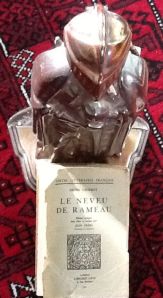
My Work Is Not Yet Done - Thomas Ligotti

My Work Is Not Yet Done – Thomas Ligotti

Three Tales of Corporate Horror

image

image

image

image

 MYTHOS BOOKS 2002

My previous reviews of Thomas Ligotti works are linked from HERE.

When I re-read this book of mine, I shall conduct a real-time review of it, to be found as comments in the thought stream below of by clicking on this post’s title above.

12 thoughts on “My Work Is Not Yet Done – Thomas Ligotti

  1. MY WORK IS NOT YET DONE
    Pages 13 – 22
    “I enjoy brainstorming new ideas as much as the next guy.”
    Like Frank Dominio (note two i’s), I recall a time when I myself worked exactly in this corporate meeting of business colleagues amid a sort of ancient modernity of an urban building, with their slick business phrases, dog eat dog but feel able to trust me attitudes, and project reports, my own “special plan”, and so forth. I did not then think in these knotty ligotti terms of swine and seven dwarves…and “anxiety provoked by other people.” – but I now see what he means.
    My own special plan is not to be downtrodden or cowed or pigged out by such forces today when in the business of brainstorming or dreamcatching fiction books with real undercurrents, be those forces representative of each book’s authorial corporateness of control (here Ligotti himself) or the forces of the genre and literary establishments. Where the Can can he should. Leverage reversed. Urinals drained.
    “And I was grateful for the aging monuments of the city for providing me, by no means for the first time, with a calming perspective that only a vision of degeneration and decline can bestow.”
  2. Pages 22 – 31
    “…a dissonant cluster of notes made by a smash of his left hand on the lowest register of the keyboard. The cacophonous growl of these notes followed me…”
    We have lost some of the textured Gothic-Baroque style of Ligotti’s earlier works but gained a more accessible irony about corporate business life and the paranoia of having broken the mould of one’s habit of acting out an acceptable tediousness but now coming up with a ‘special plan’, one that potentially picks Frank from the crowd, as he begins to itemise for us the subtle aberrations of inferentially scornful insinuations from his various colleagues who are more in cahoots with management than Frank seems to be about his ‘special plan’.
    Management and its intention here, at another level, is the author himself, with his management of this fiction’s irony, an irony that the work is not fiction at all but based on truth. And I am the reviewer with a ‘special plan’ to apply the literary theory of Intentional Fallacy to this book’s purpose, a plan that lies outside the book instead of within it. It’s me now with a cacophonous growl to match that of Ligotti? All implanted “secondary selves” notwithstanding.
  3. Pages 31 – 46
    “But the moment she spoke or the moment her thing-like eyes came into view, she became a Gorgon (no mythic significance intended or necessary.)”
    But we only have Frank Dominio the narrator’s word for that or the author’s word who put Frank’s word into his mouth!
    You know, I miss Ligotti’s textured landmark style of his stories that were published before this book. But there are here, nevertheless, some pungent pen-pictures of Frank’s colleagues who faze Frank out, and they remind me of some of my own work colleagues of yore and Frank reminds me of me. I hope none of my erstwhile colleagues in real life read this and compare themselves to Frank’s pen-pictures…
    I now wonder if the two i’s in Frank’s surname are not after all his own I and my I, but the I’s of Frank and Frank, the latter being a colleague with whom the first Frank somewhat sympathises, a man who coincidentally has the same name as him. By the way, my middle name is Frank as a shortening of Francis (seriously).
    I like, too, the ambiance of this office building but dislike the concept of soon relocating from its situation as the ‘luxuriant rot’ of the city “to some nice new high-rise in the suburbs”. That happened to me, too. My era of such work was the whole of the 70’s and 80’s, just for the record.
    And why is Frank’s boss Richard known as The Doctor (cf Doc in the Seven Dwarves)? Well, the reason is very Ligottian, but no spoilers in this review.
  4. Pages 46 – 60
    “Because nothing in dreams is original; it’s all plagiarized from waking life.”
    We now enter a hypnotically obsessive theme-and-variations — in mock-Ligottian accessibility (or Ligottian mock-accessibility) of a simpler prose style when compared to this book’s previous hinterland of Songs of a Dead Dreamer, Grimscribe and Noctuary — of dreams / reality, workplace machinations, points of triangulation, photographing deeply or distantly one’s environment (as I have been doing for the last few years on behalf of Facebook or my blog, both wabi and sabi).
    On the subject of Facebook et al there is, arguably, a striking image of a mad internet as a monumental, if not momentous, ‘windowless and entranceless building’ amid the differentiable factories and warehouses in dereliction. The sites of the photos as well as the sites of our nightmares: sites and sights that made tiny boxes to fit your daylight-saving captcha-codes….
    Notwithstanding Richard’s mannikin gloves grasping us inside, “fixing and fixing, fixing until — in one way or another — ”
    we broke.
    Frank’s special plan included.
  5. Pages 60 – 72
    “‘Your credit card is really taking a pounding today,’ said the bearded little man, who had returned to his previous height.”
    As Frank the itemised OCD Work-Not-Done narrator tries to gunquip himself from gun shops, there is the above ‘spectral link’ quote to Olan-Loan, as well as to a disarming disgust with his own bank…and the following premonitory glance to our present day…
    “‘Better to be the one who is executed than the one who performs the execution.’ I knew that I would have to come up with some fancy reasoning to maneuver myself from that position of armchair rectitude to a pile of bullet-shredded bodies, even if the last one on the heap was my own.”
    …till the inevitable sudden shock we all shall meet on our streets one day. Or so I infer. No spoilers here as I haven’t yet turned the corner myself.
    Corner of the page.
  6. Pages 75 – 89
    “There was only darkness flowing in darkness.”
    An existential epiphany for whomsoever is meant by ‘I’, Frank Dominio or the other Frank or me or the author (“that my competence had been questioned by buffoons, my messages ignored by morons”) or some unknown gazer at black stars: all of this slowly evolving into a crime story or murder whodunnit or the very ignition of the anti-natalist tontine to reap today’s latest news of anti-antibiotic cataclysm as if the world itself seems to be committing suicide in more ways than one, a very un-‘black-and-white’ scenario investigated by Black and White detectives, concerning the apparent murder of one of Frank’s crass work colleagues. Stokowski who was also a conductor.
    And the rest room’s wash sink plumbing tapped into the sewage system.
    WND, not WMD?
    “Red goes into red.”
    “blackness behind the blackness”
  7. Pages 89 – 102
    “–tying the transistors into the tiniest knots with only a twitch of my mind, melting wiring boards and decimating the soul of that thing–”
    The Des Lewis Dreamcatcher Real-Time Reviews site is sticking by its Schengen Zone for literature, a part of the New Jungianism…
    I wrote that earlier today on my site and, aptly, now, MWINYD at last reaches its own MIND-Hive in this section of pages, as first Frank or second Frank or myself or MWINYD’s author or this author’s fallible view of himself (“an instinct for devious caution, for hyper-vigilance in the cause of self-interested wile.”) jointly or severally have internet surveillance by old-fashioned ‘modem’ upon the archetypal business conference of Frank’s swinish colleagues who seem to hatch plots conscious and unconscious, all connecting Jungianly with each other – and the solution of the murder whodunnit is not only impossible but unnecessary, notwithstanding the then as yet unconsummated massacre ‘bullet-fest’ upon the radicalised Day of Domino (note only one ‘i’).
    “…that we, ‘I’ for the sake of convenience…”
  8. Page 102 – 118
    “Everything that exists is subject to limitations imposed upon it by forces within and forces without. There are no exceptions or exemptions, although there may be some striking transformations.”
    I am now confirmed in my various Schengen theories about this book, the fluid ease of possession as an element of shape shifting – and of pareidolia. Indeed, now with the sudden appearance of a door whence faces can be imagined in the texture of its wood, I sense a pareidolia that I had not previously considered part and parcel of dreamcatching real-time reviews with free passage between (and within) otherwise separate books, their real covers as necessarily resistant but compliant frontiers, accepting and fulfilling the need for such covers, so that the sense of free passage, between the books, works properly by means of a hard-achieved creativity of interpenetration. [Ebooks, since MWINYD was first published, simply present amorphously non-tactile nothingnesses as the divisions between each other, a phenomenon that will eventually corrupt their own encryptions with random and muddled nonsense.]
    Whilst reading this section, as Frank ‘possessed’ Lilian, I suddenly felt a frisson that I was being possessed, too, by the author – or something worse? The pareidolia of horror’s empathy. The cloying doors that suck me in one by one with work not done, work perhaps never done, as Sherry was sucked in.
    And indeed what was the chain of command in “my overwhelming urge to purchase a selection of handguns”? The “friendly twitter” notwithstanding.
  9. Pages 121 – 155
    “–the damage that was given to me to do was compounded at a fixed rate. And there remained enough principal in my account of worldly existence for me to complete the task I had started–”
    There is something disturbingly subsuming about this literary work not yet done till it is done. The subsuming by death’s loan compounded by daylight saving hours (a sort of sleep-nothingness)…
    A subsuming, also, by incubating – as an incubus would – a cockroach by dying with and within it. Abandoning others to dolls and mannequins in a Mechanic Museum, and to a man called Can who is a cross between a garbage can and a cannibal, and to one’s still to be articulated special plan in writing rather than preserved electronically and, finally, abandoning oneself to a struggle for death – a death from under a bus – ‘falling under a bus’ being a stock traditional phrase, at least where I live, for dying unexpectedly before making implied provision (with interest) for those left behind you as if in a race towards “the knotted events of the past and the unraveling of these knots in the future” that make up the recurrently opening and closing noose of The Great Black Swine.
    A story that becomes an unforgettable slow motion Tontine of Eschatology.
    The Corporate and Corporeal in symbiosis. Cathr-in-utero.
    “manipulated and conspired against…”
    THE END OF THIS COLLECTION’S EPONYMOUS MWINYD.
  10. I HAVE A SPECIAL PLAN FOR THIS WORLD
    “Early the next morning, the street lights still shining through the yellowish haze, brutally mauled bodies were discovered lying in every street if the city…”
    I was wondering whether various future inimical world events after this story was first published could have been obviated by a careful reading of it at that time, one such event being the 2008/9 credit crunch, where documents were manipulated and leveraged for their own sake, just like in the business of the Blaine corporation…
    The relocation of the Blaine business to a city that is variously known as Murder City or Golden City, one where a prevailing yellowish haze seeps, and murder and plague suspected or truly enacted. How relevant is that? How relevant, too, that Blaine is the name of the Mono train in The Dark Tower series?
    MWINYD spoke of Machiavellianism, while IHASPFTW is not only ABOUT Machiavellianism but also IS Machiavellian, manipulating the readers as well as the characters.
    Ligotti may be the most Machiavellian writer of fiction who ever lived – or at least his first person narrator is.
    This whole story as a text is, for me, a personified and embodied form of Mr Can from MWINYD, including the bullet-shaped wastepaper container to smash the window of the Lavatory where the narrator is due to have a business meeting with UG Blaine himself, thus letting in more of the seasoning of yellowish haze. And why else is there a ready supply of mauled (and tenderised?) bodies in the streets?
    The whole Tontine structure of manipulating documents – as well as manipulating Blaine’s staff and supervisors – is believably frightening, only one step away from the reality of many companies in my experience. I once personally knew the Bow Tie Man himself. And the often inexplicable hothouse conspiracies of firing and hiring certain sorts. No longer Kafkaesque, because it can now be seen, in hindsight, to be generically Ligottian.
    I feel both dirtied and inspired by this text. Relieved at reliving it, and then escaping again. No mean feat on behalf of its author.
  11. THE NIGHTMARE NETWORK
    “And if I were determined to live solely on the flesh of my own staff, with no access to the staffs of other surviving supervisors or any other personnel, the greatest challenge to present itself would be maintaining each of them in an edible state,…”
    After my above re-readings of MWINYD (The Wages of Life) and IHASPFTW (The Second Coming of the Dead), I now reach their coda entitled TNN (Going Out of Business), where it is as if a makeshift home-video version of CNN is making a patchwork film of a future’s symbiosis of two giant corporations, plus an extrapolation of the film 2001: A Space Odyssey, the Space being that within each of us.
    The waste container and the cannibalism now becoming the ironic vision of our once CAN-DO society soon to be that symbiosis of ONEIRICON : ONE WORLD, ONE DREAM (cf above my earlier Schengen Zone of books as the New Jungianism) and THE NIGHTMARE NETWORK today explicitly represented by TLO, the retrocausal CEO of which Is DR LOCRIAN fresh from managing his ASYLUM… We are all now Masters and Slaves of such electronica; we are all now soon to exist (or not) by dint of that fragile single power source, while making us create our own ‘puppet entities’ as interacting selves within the One Self. Hostile Mergers and Double Agents galore. Showmen and Prophets.
    “All we desire (in all our bitterness) is to go to our ruin in our own way — with a little style and a lot of noise.”
    END


    Tuesday, November 17, 2015

    The Early Stories of Truman Capote

    The Early Stories of Truman Capote

    image
    Random House 2015
    Foreword by Hilton Als
    Received the above book, as delivered hotfoot by Amazon this Saturday afternoon. These stories by Truman Capote have just been discovered.
    My previous reviews of Truman Capote works are linked from HERE.
    When I real-time review this book, my comments will be found in the thought stream below or by clicking on this post’s title above…

    14 thoughts on “The Early Stories of Truman Capote

    1. PARTING OF THE WAY
      …as this writer begins, ironically?
      A touching story of a man and a naive youth, Capote then and later, as boy and country slicker, a retrocausal relationship, one with fried bacon — travelling together, the youth carefully preserving his money so as to not let his Ma down. Touching, because a true man is a true man through and through, then and now, man and boy, I guess.
    2. MILL STORE
      “That was the only trouble with this damn smoking; it hurt the ulcers in her mouth.”
      If I am not mistaken, this is a budding classic story, fully deserving to be in the Capote canon. It is an anguished story of snake poison, mouth ulcers, and a touch of instinctive love amid a moment of buying something in the store near the lake where weekenders gather to sun-bathe and fish, a moment between the woman who’s trying to survive by recently getting this store job (who, in hindsight, we know, knows about the snakes having fished them herself accidentally from the lake), and a little girl who thinks the woman stares too much at her. A moment of guilt and sacrifice, and unrecognised, but instinctive, hard-faced love between two human beings, extended beyond its own moment as one is forced to continue thinking about what happened in such striking language.
      (Interesting to compare the man and youth in the previous story who follow a different but co-resonant audit trail of relationship.)
    3. HILDA
      “Well I don’t know, Sir. I thought I would like to be an actress.”
      She is asked to see the school head at the end of the day – and this is an effectively scary portrait of being accused of something as well as being in inexplicable denial as a child. A trauma of a soon-to-be-fulfilled paranoia that has lain unconscious or dormant beneath an inscrutable surface of self.
      The unexpected motivations of the man in the first story, as if he, too, was still such a naive child? Like being gratuitously stared-at as felt by the girl in the second story?
      I am wondering if Hilda is a premonition of Holly?
      And why the edges of the pages in this stylish hardback are rawly cut, with a delicious frisson of tactility?
    4. MISS BELLE RANKIN
      “She seemed too old to be alive – it must be terrible to be that old.”
      Almost artless with its sudden change of point of view, but eventually perfect in its knowhow to break rules and express callow emotions, like all these stories so far. Belle unselfconsciously broke rules, too, like Hilda, scaring ‘negroes’ but essentially, I infer, being their friend, and also counterintuitively refusing large amounts of money for her Japonica trees. No consistency, except age, and then beauty in death. A lesson for us all.
    5. IF I FORGET YOU
      As if prefiguring the boy who left home in ‘Other Voices, Other Rooms’, Capote started here that scenario from the viewpoint of one he left behind, a sixteen year old girl in denial about future memory loss by their Proustian selves detached from their colonised or impassioned past. It is highly poignant puppy love, though, today, as she waits for his visit to say goodbye and, eventually, impatient and set against her parents’ command not to do so, she leaves the porch swing so as to go meet him, not halfway between their houses, but set on going all the way to his house…
    6. THE MOTH IN THE FLAME
      “…yet she felt that there was someone staring at her, following her every move.”
      …like the MILL STORE stare story? A continual sense of wanting to to do the best in the worst of all circumstances, as one woman betrays another, for her own good or in a sense of justice – or both? It’s as if God is staring at us ever waiting for us to do the right thing,
    7. SWAMP TERROR
      “All right. O.K. But tell me — what part of the woods have they already covered?”
      …asks the hunted convict, echoing a similar question in similar circumstances in the previous story. This suspenseful page-turning story about two boys together and then separate, as they play at hunting the convict in the woods, but meet more of this book’s bites from swamp snakes called moccasins and worse… And the most shocking and surprising ending that you will go far to meet.
      The unexpectedness of mind and its traumas and a yearning for self-honesty, like Hilda et al?
    8. THE FAMILIAR STRANGER
      “She was proud that she was still alive while they lay cold and still in their graves.”
      The ‘they’ that the old lady reads about regularly in the local paper’s obituary columns, people she once knew during an as yet endless life living in the same house and remembering building up the fire in its fireplace every morning. Flames that dance “mincingly” at the tantalisingly open end of this story.
      An effective and chilling ghost story of a visitation, a story that deserves to be anthologised as such, I feel – while still lingeringly summoning up some new ‘fireplace’?
    9. LOUISE
      A striking story that deals with a girl’s school, the jealousy of one girl Elthel for the popularity and beauty of another Louise, and the ways and means of the former in ‘outing’ the latter…
      Just as omniscience is withdrawn suddenly in this story, when Ethel imparts the incriminating information about Louise to a teacher, I shall withdraw my own omniscience about reading this story. No plot spoilers In my reviews. Except I do wonder if it is significant that miscegenation is associated with a character whose surname is Semon.
      Meanwhile, the story’s ending is another open-ended one that resonates on and on in the head.
    10. THIS IS FOR JAMIE
      “…his mother and father came to say good night. His mother was dressed in a long flowery evening gown and she had flowers and perfume in her hair. He loved the smell of gardenias, so pungently sweet.”
      There is something Proustian about Capote, as we read about this boy who visits the park with his Nanny and meets the mother of another boy called Jamie with Jamie’s dog Frisky. Jamie is sick so can’t come to the park himself. A tale of boyish counterintuitive naivety (cf this whole book’s counterintuition), of kindness and poignant loss. Charmingly, sadly memorable.
    11. LUCY
      “…there was just the trace of a tear gleaming in the exquisite blackness of those negro eyes.”
      A touching and sometime sublimely felt slice of life as Lucy, a ‘colored’ woman from the South, comes awestruck to New York to work as housekeeper in the boy narrator’s home, at first fast buddies, then she has a beau, then gets homesick…
      Has the poignancy of losing Jamie earlier, whose existence was never proved. It was almost as if Lucy had never been, either. Except for the film stars left behind and whose existence the boy imagines Lucy boasting to her Mama about meeting, boasting when she gets back to Alabama.
    12. TRAFFIC WEST
      At first I thought this was a legal tontine, but one going backwards in line with the chapter numbers going backwards. But in fact it’s patterned upon a Beethoven String Quartet. One of the Opus 18 set, I guess, not a late one!
      This is young Truman extending his experimental range.
    13. KINDRED SPIRITS
      A lethally, hilariously sharply, strikingly pointed conversation between two high-class women about their respective husbands – reminiscent of Elizabeth Bowen as blended with Ivy Compton-Burnett. Would-be tontine widows, I say!
    14. WHERE THE WORLD BEGINS
      “I’m gonna stay right here until I get the whole story.”
      An apt title and an apt quote from the story with that title, by ending the book. A story of Sally Lamb who sits in an Algebra lesson imagining her future as a starlet like Marilyn Monroe or as a top-flight journalist on her own Titanic mission, such a mission which ends all our lives eventually or one we never reach by being eternally youthful in timeless literature like Truman’s.
      The ultimate tontine story both in substance and by use of Algebraic methods?
      A tontine for the whole gamut of words that was, then, still left for you to reap. Reap and read. Other voices, other rooms, old days, new days, whatever our failings.
      end


      Friday, November 13, 2015

      The Night Clock by Paul Meloy

      13 thoughts on “The Night Clock by Paul Meloy

      1. Pages 7 – 21
        “The girls had great bodies but faces like a witness description.”
        Two pubs opposite each other, one with this book’s title as its name and the other with THE DOG WITH ITS EYES SHUT as its name, based on another Meloy book title. There is a knowingness here that none of this is real, well, of course it isn’t, but having accepted that, shaken hands again with its author, even if metaphorically, so that I can now sit back and allow it to be really REAL, as things happen to people, brutal, just a few synchronised or nightclock-timed moves along the LUDO board from sanity into nightmare — and a jobsworth special constable picks up my tiny incontinent turd and bins it for me. He wants a good review as a backhander in return. No, none of that is real, as I sit above the text that crackles with potato crisp images, things that are knowingly, word-acrobatically cast around to astonish the reader that this is the BUSINESS, better than Amis or Rushdie. But I know this author from old. I sense he can even outdo himself. We shall see.
        A play area with a kids’ slide. A third pub now, the Snowcat. And the special constable Gollick cock investigating a Joel Lane like urban area and its general store where the owner seems to be nailing up its front entrance. Perhaps he doesn’t want me to come in?
      2. Pages 21 – 32
        “Once certain paths had been trodden, certain choices made, then it seemed only a matter of time before the mind turned in on itself and began to cascade despair along its pathways.”
        …which is a succinct view of life itself when stupidity is often mistaken for life-enhancing freedom, I guess — and this book resumes its own wittily hilarious and impressively modern-literary pathway, but too early to say whether this tone is typical of it, but signs are already promising, as Gollick the jobsworth policeman on his straitened path and his newly met, scatter-pathed pal from school days together clumsily face out one of those potential gunman massacre situations that beset society these days, already prefigured as well as foreshadowing my own pathway through the book.
      3. Pages 33 – 50
        “Hit delete.”
        This novel now seems to have become genuinely enthralling as a best-selling popular book might, a page-turning experience about a well-characterised Phil Trevena (even art, ever ant, rave ten?) who is a believable Mental Health worker in a Crisis Team, dealing with the repercussions about the earlier near-massacre incident, details tying together previous characters and their place in this scenario.
        Genuinely chilling moments as some of the crisis clients with known hallucinations spread effects that now seem to be growing real to Trevena…?
        Some crisp images also continue (“The room smelt of biscuits…” and “a foamy sorbet of excreta unflushed in the toilet”) plus some striking effects like square shadows…
        I do not intend to continue itemising the plot of this book, but hope to adumbrate my own broad reactions to it as I happen to read it in real-time. So far, my knack of choosing to buy books to review them continues to pay off, judging by this one. “Here, in this grotty, flyblown hovel.”
      4. Pages 50 – 67
        “An opening paragraph so clever it was impenetrable, you just had to accept it meant something and move on. Like life.”
        Meanwhile, “meaning implied destination.” Those pathways again, and here, at first, I am impressed by Trevena’s subtle, if panicky, handling of his boss Stibbs, despite the inexplicable cluster of topping themselves by Trevena’s ‘clients’. And impressed, too, by the ‘yellow’ of Dog and C**t, and Gollick’s cowardice, a cartoon squirted into the eyes, and no doubt Ethel’s uniform if not her lollipop, and Rob’s “lethal force” as another Yellow Sign? This stuff is making stuff, too much stuff to itemise here, each paragraph making tough love with meaning and shape-shifting. Old Moley, Cheshire Cat, Norfolk Pike, men giving concrete ball clumps in pubs. It all somehow makes sense and some of this sense is very very worrying. Romany ghettos, notwithstanding
      5. Pages 67 – 82
        “Dog eat dog. Or at least dog takes a little nibble when the other dog’s not looking.”
        …especially if it’s a dog, that other one, with its eyes shut?
        The previous section of this book that I read finished with yellow and lumpy milk, and I can imagine that sort of fluid coming out of things that fight in Robot Wars or Extreme Machines on TV, especially if such machines are almost like cyborgs? Here, the stakes are heightened, the shards more scattercast, as some of our human characters reach a pecking order of being decimated or bone-riven — or promoted to Hypnopomp, depending whether they control a large domineering bunch of keys or, at the other end of the scale, have thoughts less meagre than a child’s cheap damp fireworks…
        A Ligottian like Doctor named Doctor Mocking here, too, and the Night Clock’s “ten past three” as reference, I guess, to the first line of a Larkin poem: http://allpoetry.com/poem/8495749-Love-Again-by-Philip-Larkin
        This whole prose syntax and its semantic fields present a rigorously emotionless portrayal of such bone and brain tectonics as well as leaving us with such synchronised and random shards of truth and fiction embedded in our own contrastively emotional brainpan … thus demonstrating, by the nature of the text’s own style, the same text’s own stated “taxonomy of distress.” REEEEEEEEEEEEEEEEEE.
        Ending towards the end of this section with another (yellow?) ‘reflective jacket.’ One we need to wear when reading this book.
      6. Pages 83 – 95
        “Was death a fuel for other universes?”
        A highly moving shift into new characters, now seen from the first person singular of Daniel, his childhood, his meeting with a girl called Elizabeth and her grandparents on holiday, all these characters (including his own parents) you can truly believe in as accompanied by sharply etched, equally believable personal eccentricities that you will probably never forget. It is, fundamentally, a skilfully literary and page-turningly accessible portrait, leading to Daniel’s more tragic later life, with a slotting in of elements that share kinship with Ligotti’s philosophical ‘Conspiracy Against The Human Race’ together with a provocative view of the treatment of so-called mental illness and its transfer to the community, something else you will probably never forget.
        Elizabeth’s postcard, by the way, brings clocktime from 3.10 to 3.20.
        And Dr Widge, Dr Sat, Dr Kun, to be added to Mocking.
        • Pages 97 – 103
          There are certain things I can’t tell you about this book. Call them spoilers, if you like. But there is one possible divulgence I forgot earlier – Elizabeth’s missing eye (she has a glass eye where it used to be). And Bert the tiny conch shell hermit crab. Not sure whether they are just connected by my connecting them, as is my usual wont when dreamcatching books, or actually they are the same thing. (The dead crab has its own eyes).
      7. Pages 105 – 125
        “If there was life inside it moved with the slow dreamlike glide of fish dying in dense, polluted water.”
        I feel Dr Natus may be central, combining the Ligottian Doctor with Nativity (birth) (anti-Natalism its opposite), and Natation (swimming) as I feel I am swimming in this book, often out of my depth. The slots now take on a Kingian Dark Tower aspect, ‘Dark Time’ measured by the Night Clock, as ECT treatment and/or community care seem to be ciphers in opening the gates back and forth to the world of Quays, Paladins, AutoScopes of this author’s previous fiction works. This book itself seems to be just one of the slots of access. The words flow over your swimming mind as well as digging points in either to wake you up or inject you further within dreams. I cannot judge how a new Meloy reader will be affected…
        Even a Whovian payphone in that other world.
        “…an equation mocking good order and progression.”
      8. Pages 127 – 156
        “– oxidizing plates and wine-glass thin shells, of liquid meat and powdering bone — they were terrible. They were a nightmare installation set up in a deserted town by a troupe of artists obeying the compulsive, baying creativity of their disrupted and railing minds.”
        Remarkably I read this section as its own tour de force of dream or alternate world machinations but also in fascinating kinship with a story called ‘Mrs Rinaldi’s Angel’ by Ligotti that I coincidentally happened to review HERE this very morning.
        Meanwhile, from Dr Natus as a sort of dead birth or a communicable aborted foetus or homunculus in a jar, we now aptly meet another birth, this time of a fully formed woman named Chloe in her own Quay world, at first in a cave, as if a sort of womb, and we are artfully led to grow up alongside her, as she finds, say, bookshops and DiY books, grappling with her own as yet unknown identity in the same way that some fiction authors need to help mere names of characters become the fully grown characters that they had to find for themselves FIRST. Never seen the creation of a character by her own creation of herself done so well as here, except possibly in Nemonymous Night! All of this wrapped round with the reader’s accreting view of the world wherein she is becoming a self, with, say, words or spiders invading a comfort zone, and more. And the people she meets.
        And when I learnt that Chloe is an intrinsic part (Escape Wheel) of the Night Clock to allow it to work I was immediately reminded of my all time favourite Elizabeth Bowen story (in my top ten of any story by anyone), from which I show an extract below. Not in any way the same as Meloy’s Night Clock, but a passage that I think lovers of Meloy fiction will enjoy and find fascinating in the light of this novel.
        ————————
        The skeleton clock, in daylight, was threatening to a degree its oddness could not explain. Looking through the glass at its wheels, cogs, springs and tensions, and at its upraised striker, awaiting with a sensible quiver the finish of the hour that was in force, Clara tried to tell herself that it was, only, shocking to see the anatomy of time. The clock was without a face, its twelve numerals being welded on to a just visible wire ring. As she watched, the minute hand against its background of nothing made one, then another, spectral advance. […]
        ‘I’ll tell you something, Clara. Have you ever SEEN a minute? Have you actually had one wriggling inside your hand? Did you know if you keep your finger inside a clock for a minute, you can pick out that very minute and take it home for your own?’ So it is Paul who stealthily lifts the dome off. It is Paul who selects the finger of Clara’s that is to be guided, shrinking, then forced wincing into the works, to be wedged in them, bruised in them, bitten into and eaten up by the cogs. ‘No you have got to keep it there, or you will lose the minute. I am doing the counting – the counting up to sixty.’ . . . But there is to be no sixty. The ticking stops.
        From ‘The Inherited Clock’ by Elizabeth Bowen (1944)
      9. Pages 157 – 186
        jumbo“It’s the devil-in-dreams…”
        An archetypal tiger akin to Blake or, more importantly, Henri Rousseau’s painterly naivety (even a talking dog here from a previous Meloy work), plus a blend of the DOGAN from Stephen King with this book’s own ENDWORLD or ENDULA, with splattering, cranking, industrial, sometimes Heath Robinson-like monsters, natural life like a scorpodile, a book (about a boy besieged by these bristling creations that lethally compete with each other to scare him) within a novel recited to us (and to Chloe) by that Bix Beiderbecke of a dog amid Dream Sickness and monsters like urban features or rough-nosed architecture, such as water towers etc.
        I grew up with a significant, but relatively unknown, water-tower, one nicknamed locally as Jumbo (shown alongside) and this can be found in Colchester, a strange town at the upper urban end of marshy Flatland or Fennish Essex, akin to Meloy’s added-on world, Jumbo being an ancient folly that engenders madness or a landmark upon which to hook one’s madness for a healing while? I was never sure exactly which of those two possibilities that Jumbo was (and still is). A time for the mind to fish for healing amid the dark tower’s precincts…?.
        Some stunning passages in these latest pages from this off-the-wall, off-the-world book.
      10. Pages 186 – 221
        “No child should have such existential insight. Life stretches too far ahead to sustain it, an impossible slog towards nothingness.”
        This author is already in my Dysfunction Room HERE with his ‘Islington Crocodiles’, but this book emphasises that the Meloy Mythos should be in there TWICE.
        There’s nothing funny or fantastical about mental illness, but both the grotesque humour here and its dream archipelago pier like the long pier of Essex’s Walton on Naze that happens to be near where I was born in 1948 and the shoddy beach huts and the splendid vision of Quay-Endula make this a seminal work for such illness to be at least bearable or poeticised — even, one day, to be actually healed by such a Dream Sickness catharsis.
        There are dreams here for boys to become the train driver they always wanted to be, travelling on the Railgrinder, fighting all manner of monsters of mine, hawling the mine-pits of their minds.
        This section of pages is the backstory to the whole Meloy Mythos.
        And we haven’t finished yet.
        An old petrol advert from my youth – a Tiger in the Tank.
      11. Page 221 – 256
        “The Night Clock is calling its numbers to its face and a man and his son stand together on the stony earth in the middle of a disused and abandoned reclamation yard.”
        Why abandoned as well as disused – belt-and-braces?
        This book is itself a reclamation yard , an art installation of machines and monsters or a scrapheap of Meloy’s previous published works, Islington Crocodiles, Dogs With their Eyes Shut, Reclamation Yard, including the two collaborations: Loose and Compartments of Hell. This book itself is also perhaps a collaboration, one with the devil-in-dreams, a Toyceiver that is pitchforked to death, or one with the prophet-showman himself? Or with the child murderer from ‘The Frolic’ or with some Autoscope who a year or so ago preached a rabid anti-natalism on TLO having once worked for Toys R Us?
        This is no easy read with its eventually dysfunctional plot worthy of my aforementioned ‘dysfunction room’ of honourable literary traumas. One that started with an engagingly modernistic and stylish scenario that might easily have won a prize literary accolade (seriously) if it had carried on in that way.
        As I said before, I can have no idea how this novel will affect someone completely new to Meloy fiction. All I know is that you can’t unstick yourself from the goo of its parts, from the bristling word-family of characters that started off real but tragically flawed.
        The catharsis of madness BY a madness that remains.
        “Make it personal.”
        Father and son, empty self and created self, mother and child, doctor and patient, head and hermit eye, community carer and client, dreamer and dream, seaside and pier and more – let it fit where it may.
        “‘It’s inside there,’ Colin said, and tapped a bony finger on the centre of Barry’s forehead. ‘Trapped in a dead dream.'”
        end
        ———————————-
        “In the Bible there is a beast,” he said. “You know this, Andrew. But did you know that the beast is also within you? It lives in a place that can never see light. Yes, it is housed here, inside the skull, the habitation of the Great Beast. It is a thing so wonderful in form that its existence might be attributed to the fantastic conjuring of a sorcerer or to a visitation from a far, dark place which no one has ever seen. It is a nightmare that would stop our hearts should we ever behold it gleaming in some shadowy corner of our home, or should we ever — by terrible mischance — place our hands upon the slime of its flesh. This must never happen. The beast must be kept within its lair and not reach out into the world. By now you must know that the beast is a great power that may work changes on the world. Darkness and light, shape and color, the heavens and the earth — all may be transformed by the beast, the great molder of things seen and unseen, known and unknown. For all that we see and know are but empty vessels in which the beast shall pour a new essence, therewith changing the aspect of the land, altering the shadows themselves, giving a strange color to our days and our nights, making the day into night, so that we dream while awake and can never sleep again. There is nothing more awful and nothing more sinful than such changes in things. Nothing is more grotesque than these changes. All changes in things are grotesque. The very possibility of changes in things is grotesque. And the beast is the author of all changes.
        — from ‘The Tsalal’ in NOCTUARY by Thomas Ligotti