Monday, December 26, 2016

Deadfall Hotel – Steve Rasnic Tem


22 thoughts on “Deadfall Hotel – Steve Rasnic Tem

  1. Chapter One THE FUNHOUSE
    Up to “I can help you, Richard.”
    ————————–
    “Richard could imagine the dead looking down from their private apartments in Heaven, gazing with a surfeit of arrogant pity at the poor, uncomprehending families they’d abandoned. Easier to imagine that, than to imagine nothing.”
    Llafdaed sounds like a Welsh placename. But that is nothing to do with this book, I guess.
    An engaging start, a poignant start, a slightly absurdist start, Richard and his daughter Serena, he still having visions of his now dead wife, Serena’s mother, killed by a house fire – his deadpan sense of guilt – as he takes Serena to a funhouse maze with distorting mirrors (just like my real-time review labyrinth) whence he thinks he has to rescue her. Then an interview for a job at the eponymous hotel. But why was the interview at Richard’s home, not at the hotel itself?
    Intrigued.
    No more plot give-aways from me. Just my reactions.
  2. From “He had never really enjoyed driving” to end of chapter
    ———————
    “I have, perhaps, revealed too much already, I’m afraid.”
    As RIchard arrives at the hotel with Serena, I am struck by this being a tantalising gestalt of a type of Aickman novel you have always wished Aickman might have written before he died – with a soupçon of Alice in Wonderland. And other intangible aspects so far original to our own wishfulness for Tem’s own pre-posthumous legacy.
    Rituals, privacies, strange perspectives of journey, side-mirrors, haunted marital mourning, these and more all factored in…
  3. Chapter Two: BLOODWOLF
    Up to “No, Richard, learn to treasure it.”
    ————————————-
    “It was a time of grass that grew too quickly to mow, and in nooks and crannies too out of the way to trim. And it was a time of blood. Richard’s daughter was becoming a woman.”
    We grow darkly captivated by Richard’s overseer, Jacob Ascher, as from excerpts in Jacob’s own diary and by Richard’s own account of Jacob, say, manfully grappling with the hotel’s deadfall incursions and other infestations that need capturing, if not captivating like us.
    And a new guest… Read on, dear reader, to find more about this guest, as I will do so also, soon.
    A sense of complementarity, too, with Stephen Poliakoff’s latest drama serial on British TV (Close to the Enemy.) Apt that I should have picked up this book while in-media-res with that serial. Another young girl in a large hotel, inter alios.
    Meanwhile, I also sense things about Serena’s precocious development and Richard’s recent loss of his wife. Highly poignant and meaningful, especially, also, as I happen to be simultaneously real-timing THE CEREMONIES (1985) by TED Klein, particularly today’s reviewing episode with that book (here) as regard sexual epochs…
  4. From “Richard and Serena sat out in the front lobby” to “Soft sighs under the dry whisper of sheets.”
    ————————————
    “The first time I stayed here, it was a Mr. Grant who was the manager. William. A quiet, dark man, that one, said almost nothing. As ‘other’ as his guests. That one didn’t die, I believe. He was simply lost on a midnight’s journey to the lavatory. Perhaps he booked himself into a room.”
    This book and the history of the hotel, so far richly seeps such a hinterland as that. There is also an insidious feel, a strange-Aickman-absurdist one, a Tem one, and I fear for Serena’s safety – but the danger to her from whom? The old lady guests who regularly play ritual badminton with a flighty shuttlecock? Probably not.
  5. From “The Deadfall was periodically infested” up to end of chapter.
    ——————————
    “Walls suddenly became new passages. Passages suddenly became solid walls.”
    Don’t mention the war. Though Jacob mentions Hitler in one of the lessons as Serena’s in-house tutor. And Richard’s late wife increasingly seems to present an uxorial tutelage over him from death’s approaching distance …. like Sybil once did over Basil in real life…
    And Deadfall increasingly becomes for me a nightmarish Expressionist painting with Jekyll-Hyde and Red Riding Hood-the wolf becoming a shapeshifting theme, worm sticks and birthday parties, notwithstanding.
    The inscrutable other guests, too
  6. Chapter Three: THE KING OF THE CATS
    Up to “Then so be it. Go spend some time with your daughter.”
    ———————————–
    “She was no longer part of his life, really. He might wave to her in the hall; she might smile his way. But she was no longer part of his life. She had moved on. He needed to move on as well.”
    ….his dead wife, still that tutelary force. Seen ever with love but also with attempted candid clarity regarding her habits and ways during life. But ever impenetrable like the habits and ways of the hotel itself. The bodily intricacies of a human female’s trajectory of corridors, too? The tragedies of her life, and how one particular foetus is part of some obsessive panoply of foetuses that Serena knows instinctively about but can hardly grasp, foetuses that for me grow into the naked hidden guests we can hardly expect to meet in the unmapped and unmappable corridors, There is some kind of emotion intensely powerful underlying the tropes of this book, I feel. And, indeed, its text reaches conceptual overdrive in this section, but I already thought it had reached overdrive before, and if this is overdrive NOW, what can we expect of its future overdrive? The mind stretching in readiness. Stretching towards the eschatology surrounding a quote from Dylan Thomas in Jacob’s diary. A philosophy, firstly impenetrable like the hotel, but one that slowly, as a result of that provocative impenetrability, creates an oblique meaningfulness about the human lot, and the existential angst that I find grows easier with age.
    The hotel seems to be a mutated structure a bit like a Whovian Tardis? And, indeed, there is overdrive about the hotel itself, too, some of it oblique like the visits from bus drivers. And then we have the annual cleaning of the hotel with an army of cleaners when most guests make themselves scarce. Richard has his work cut out organising it. He is a trainee version of Jacob, subject to the latter’s mentoring. Serena subject to Jacob’s tutoring.
    (After all, Existentialism is all about the Absurd.)
  7. From “One of the cleaning crew found the thing” to “but he would make sure this cat was not found again.”
    ——————————-
    “He discovered that besides reading everything she could find concerning babies and small animals, her personal studies had recently turned to volumes of folklore concerning dragons.”
    Serena is at that “temperamental” age that we fathers of daughters know very well!
    There continues to be some very strong writing – each an overdrive of an overdrive in continued accretion that we readers are tutored or mentored by the sense-flows to accept without blinking. No point in diving straight into purple prose without putting one’s toe in the grey first. Here the exponentialities of a creature’s birth from a paint tin to the exploration of the hotel’s outside Deadfall (I nearly wrote Dadfall!)
  8. From “The chaos of the cleaning” to “pushing it up against her doors.”
    —————————-
    “But he’d been the same way at her age. No one really liked growing up, the way the body, the mind, changed. He remembered feeling like some sort of animal. In fact, he remembered smelling like some sort of animal. Cornered and in a constant state of confusion. Transformed. As if you didn’t know what kind of animal you were going to turn out to be.”
    More of the Alice-like? Animal Farm, too. HItchcock’s cinematic birds, in the shape of cats. Even taking Serena in the overdrive car, to slip away from the mass feline attackers…
    This is becoming the most (provide your own adjective) novel I’ve ever read, I guess. But does it work? I can’t actually imagine or empathise with Tem sitting down actually WANTING to write these scenes into the book, much less Cleese sitting down to write Fawlty Towers, with any hope of its eventual legacy of iconicity. But Tem does and Bravo! I say. There are more ways than one to skin a squirrel. Time will tell.
    As to the mass cleaning of the hotel, meanwhile, why did they leave out cleaning the windows?
    “Besides, most of the guests would not help in any case. Remember that they are of a different world – it simply rubs up against ours now and again. Most of them would be quite unable to parse what the fuss was all about.”
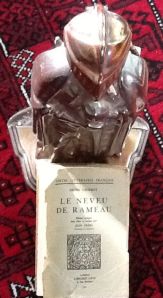
  9. “Some of those things you really didn’t want to see, but you’d paid your fifty cents so you just had to look.”img_2626
    From “Sometime in the middle of the night,” up to end of chapter.
    —————————
    Ah, those who post loving pictures of their cats on social media should steer clear of this chapter’s end scenes. Bur I have no sympathy with THEM, of course. And I sense the attitude of Richard and his authorial doll-master stems from the uxorial residue still present and the ‘candid clarity’ I mentioned above. (“The cat needed to be let out, the cat needed to be fed. His turn. He never took responsibility. He never did what he was supposed to.”) The ‘candid clarity’ of cats, too.
    Peepholes and Escher, and I hope the author and his publisher will forgive me for making more quotes than usual from this section. They grow on you.
    “No more than you, my friend. I simply have a dark turn of mind. It is one of the qualifications for working here. When I’m with other people with similar dark turns of mind, and when we’re looking at the same scenes, it’s not too difficult to guess what you’re thinking.”
    “None of us is entirely safe in this world. It’s understandable when a father cannot accept that. We do what we can.”
    “The Deadfall makes you live up to your potential. Good or bad – it’s all the same to the Hotel.”
    “On Christmas Eve, the cats get on their knees to pray.”
    “Now we’re both in the dollhouse, he thought, and it did not reassure him. We’ll never get back out.”
    We learn much… And even MY Dreamcatcher net couldn’t catch it all. And talking about cats and peepholes, above is my own wife’s latest quilt…
  10. Chapter Four: THE CRAVING (up to “Sleeping, or dead?”)
    ————————-
    “These pipes are old.
    Not cold.
    After the low-grade ‘fun’ of battling with horrible cats, we are now back into the wondrous realms of this book’s Rasnic Temmery. Back to the intricacies of the Hotel itself, its pipes of plumbing and sew-age, also relating to age itself and to bodily passages, the repulsion-and-attraction byways of marital sex. Also winter, the nature of snow and unenthusiasm for Christmas (topical for me in real-time) held by the Hotel denizens – and Serena outside in the cold with a new woman tenant, a woman-to-woman liaison in the bud, perhaps, despite the new one, Mary Rosenow (Rosie?), looking a bit like Serena’s late mother – and there is a general tenant diaspora because of the cold, although I think the mysterious central heating embedded in those pipes keeps it warm by some sort of inexplicable synergy with the Deadfall tree outside, a tree that now gives out pareidoliac shapes for at least one tenant. But why tenants; I thought they were residents.
    I enjoyed the concept of the Checklist, a sort of tenant stocktaking.
    The tomahawk syndrome, too!
    “Of course, death changes most things, but not everything.”
    “The deadness of the winter here,” he continued, “it makes everyone nervous at first, even our long-term residents. The sudden… nakedness, I suppose.”
    “If you do not face the wolf sometime, it’s likely to circle around behind you.”
    • I am autonomously conscious that I may have inadvertently allowed an odd plot spoiler or two above, by nature of real-time reviewing. For this, I apologise, but as this book was published four years ago or so, many will be re-living this great work alongside me rather than for the first time.
  11. From “Alone in his bed” up to end of chapter.
    ———————————-
    “….if you are denied a better love, you will settle for any love.”
    There is something effulgent, ephemeral, going on here, uncertain, too, but rhapsodic and rapturous, with a brief wind past a headstone called Renfield. A craving indeed. The moving feast of women’s rôles around Richard, as daughter, late wife, a late mother, lover, assailant, stalker, bloodsucker, and a mix of those women interacting between themselves and late-labelled, to an extent that one of them needs urgently shipping out from the hotel to protect her, and there is also the one I called Rosie now called Marie, earlier Mary, overshadowed by the clever-by-half tutelage of Jacob, and the perhaps living hotel itself. You need to summon up the sinews of power-reading to tap such stuff from the bereaved heart, stuff that even perhaps the heart-owner itself fails to encompass. You simply know there IS something reciprocal to encompass, if you are able to do so. Differentiating dead from dead. And concupiscence from cremation.
  12. Chapter Five: IN MEMORY OF HEAVEN, up to “we will both be tested.”
    —————————–
    “In other words, it’s best to rein in the imagination when looking at this, umm, compost?”
    Serena back, Mary gone, now you read on to see the sweep of imagination needed to disrupt past blots and future Rorschach pareidolia in plant layers of death and life, this the seemingly endless spring disposal of nature’s growth and decay, each pile with its images from scribbled mulch or things within. Things within like your past secrets, secrets even from the close uxorial mate of your life, sometimes a retrocausal thing from her real death later, a bird returned into your past?
    The darkness fairy, a memory of heaven itself retrocausal? The managers of 1930s yore in the past of the name Hotel Deadfall marked on the incinerators, Hitler and Stalin…?
    The pulse of life, the non-pulse of future death.
    RIchard is told that a religious group convention is about to arrive at the hotel.
    There continues to be miraculous writing in this book, whence and whereto is met a couple’s synchronous creation.
    “…we will both be tested” indeed.
  13. From “The next day the Reverend Johnson et al. arrived” to “Annabelle out of there.”
    ——————————–
    “…many of them appeared obviously saddened to be so left out, faces yearning like children with no presents at Christmastime.”
    “Annabelle leading Serena through this group, no doubt reciprocating Serena’s tour through the hotel, holding hands the way little girls will, with that talent for making ‘best friends forever’ at a moment’s notice.”
    A seminal, sermonal section, I feel, when darkness (lights flickering with tinned fruit junction boxes) becomes — today in my real-time of all days, out of kilter as well as in tune with THEN — “of an ancient variety”, a Vessel like John Cowper Powys’ Holy Grail, in a novel Aickman should have written given a longer life. Like that Pageant by the Lake.
    Exorcising, cleaning the hotel of other ownership, the Devil’s?
    Cocktail groups of religious discussion – and there is so much wisdom and truth from all quarters in this book, amidst the effective backdrop of absurdism and dark Weird Fiction, the only backdrop optimal for such godly or ungodly work.
    I also love Annabelle’s mother, Rev Johnson’s wife. A character to die for.
    “I’m not sure we can have any salvation, in fact, without imagining.”
  14. From “Richard found Jacob” to end of chapter
    ———————————————
    “People are always wanting to get through things, to get over things.”
    Cute and Cure are only one letter different. They say children grow up even before you’ve noticed they’ve even begun.
    Aspirational Horror Without Victims, a Cure or Kill, Healing, Religion, childish attitude towards death, a grown-up being similarly child-like, but being grown-up retrocausated us to become constrained and uncute, a wrong-headed attitude towards bereavement and the potential resurrection of the body without such a healing process, say, hinging limbs the wrong way.
    Attenuation and relative height.
    Gravestones and relics.
    (Born to be resurrected. Like a born-again Christian. thinking of Easter on Christmas Day?)
    Brainstorming the human condition.
    Dark connections of unnatural magicking of resurrection or healing that do the mutating of the loving arms of the couple tangled within each other….
    But –
    “Jacob claimed there was a wealth of useful information here if you knew how to weed out the ridiculous.”
    A real-time poem as a book review. At least for a while. ‘The Hotel’ with hole not heal or health embedded?
  15. Chapter Six: PHANTASMAGORIA up to “when house and sister work as one.”
    ——————————-
    “Hanging from much of the ceiling was a huge, continuous fishnet. Jittering shadows danced on the other side of its thick strands.”
    My dreamcatcher net, my hawling device, and I shall perhaps always know this Christmas (alongside its family importance to me) as my Deadfall Hotel Christmas, hopefully not my ‘Last Christmas’. For unaccountable reasons, I have never read this seminal Weird Fiction work till now, which is surprising, I suppose, in view of my previous deep interest in Tem’s work (my previous reviews here.)
    Perhaps it was simply meant to be read now, at the clinched hindsight Gestalt of an optimal moment. There is nothing so great as pretence that becomes constructive pretentiousness. There are many more ways to skin a squirrel, as I said before somewhere above … leading to this chapter’s “The Crooked House, A Story for Children, by M.M. Malachiuk.” A book written by a previous hotel manager, with Richard now its new full-fledged manager, I guess.
    Some brilliant descriptions of the hotel library and its books. This book itself is like an overcrowded museum of weird oddities, curiosities, freakish specimens but also teeming with truths and dark wisdoms, and aids to death and bereavement. And outlandish absurdities. Crowding in with increasing believability that any book can thus be crammed and still survive.
    “Books are safer than dreams.” Irony or truth? You will need to read this book yourself to find out. But you probably have read it already.
    The hauntingly immanent, sometimes raging, uxoriality and Lewis’s Bleeding Nun.
    RIchard’s growing realisation of the nature of the Hotel and what is happening accretively to it now.
    The painting with fat grazing sheep and purple mountains retrieved from the cellar at Serena’s request.
    The Fantascope.
    The millipedal cleaners.
    And much more. Crammed to the rafters.
    Still a bit yet to read, though, to empty my head or fill it even fuller…its bereavements radiated backwards from the future, when a death can come at any time for anyone in these discrete years of ever more crammed potential deaths. Wake me up before you go-go.
  16. From “Richard read to the end of the book” to the end of the book.
    ———————————–
    “Most ordinary people, certainly, were monsters. Their skin was scarred, their recesses stank, they hid their motivations behind tired, pain-stained eyes. When they looked at themselves in mirrors what they saw was strange and unpredictable, and yet nothing unfamiliar at all.”
    But we live together, rub along, tantamount to childhood sweethearts till now & forever. Wiring up the tinned peaches junction box in the wall? Et al.
    These closing sections are probably the most humanly powerful in the whole book, and that’s saying something! A power fed by cramming, unlike most other books that are more diluted or more easily paced in the misguided belief we can’t cope with being crammed.
    Brainstorming the human condition, I said earlier above. But this book has a new process that is different to brainstorming, more radical, more deep-seated with a sense of responsibility for our family or children. Those we usually spend Christmases with.
    TV has awful things to show and it is not a funhouse anymore. The Pool room cometh. To drown your cats in.
    “– but we don’t live in Usual, USA, now do we?”
    —————————————–
        

Saturday, December 24, 2016

They Don’t Come Home Anymore – T.E. Grau


10 thoughts on “They Don’t Come Home Anymore – T.E. Grau”


  1. I – V
    “Not death itself, but what waits for the body afterward.”
    First five bite-size chapters forming mid-teen girl Hettie’s story seen through a prose-sophisticated lens darkly. Threading, at least in mind if not body, passages like sewer outlets, the equally mid-teen but fey girl called Avery gifts Hettie with best-friendship from her toilet throne in a derelict toilet where Hettie finds her. This I sense is their first real engagement together as human beings in their school career so far, and I sense more than I can tell you without spoiling something not yet told to me.
    If you know what ‘fey’ really means without googling it, a word not yet used by this book (if at all), then please proceed. (Even if you google it, some of the definitions the search engine finds are wrong. Be careful.)

  2. VI – IX
    “They passed through the rooms, on their way to somewhere else. But no living took place here. No memories were created, no shared moments.”
    They say grotesque humour and horror in fiction often go together well. And they do. But here we have cerebral wittiness and horror, and they, judging by this book so far, go together even better.
    Hettie’s crush on Avery (not a Sapphic one so much as a self-conscious girly one) stretches between social classes, Hettie’s family being on a lower rung than Avery’s. And it is also a crush between death and life, as well as between social rungs? Avery is suddenly suffering from leukaemia, but that is the last time in this review I will give out a potential plot spoiler.
    The immaculate prose style about the circumstances of the two girls evokes a mind-stretching quality, but the font size it’s printed in has a less expansive effect. Another tension of opposites?

  3. X – XII
    “Supernatural creatures must set the humor bar lower than those burdened with mortality.”
    …indeed, as Hettie treats us to glimpses of her parents’ Bad Movie Night, and of the suburbs in America when compared to its midtown!
    Some brilliant character studies here on her “journey to the hinterlands” – and descriptions of types, too, like underage Goth girls. I think i know the nature of the by-product of Hettie’s quest for vampires, REAL vampires… But do you?
    I feel my brain is sharpened every time I pick up this chapbook. Into a spike?
    Don’t forget: vampires are forever, not just for Christmas.
    “ODDVCK.”

  4. XIII
    “Critics who dared give less than glowing reviews were savaged online by dedicated internet honor warriors…”
    A whole commercial world of twilight vampires of which this book is an obliquely constituent part and about which it is a satirically witty whole. And Hettie’s thinking outside of her box takes on new dimensions, but whether she sucks inspiration from her own author who is named on the tiny spine or that author sucks it from her, I keep my powder dry.
    This book flows sweetly and sophisticatedly along a line of trip-switches and hilarious booby-traps it has set for itself. I, for one, will not now attend any signing, even if (or especially if!) it is one for this book’s author. We understand the ends of Hettie’s mission but the means remain mean with their meaning. After all, any general brainstorming process keeps its likely eventual results secret in real-time – until the orgasmically revelatory moment of pay-off.
    Part of the tegumented deal, I guess. Fannish flashmobs, notwithstanding,

  5. XIV – XVI
    “The tag was labeled with an ‘L’…”
    Burroughs-type “cut up lines”; a falsehood, a temptation to follow, but whereto and whence? Hettie (Henrietta Wexler or Wexy or Waxy) shrugs like one of the dark’s born-again shruggers she is with, shrugs on a costume in a fitting-room and taken through the destined by-ways of this text, like upon a tiny insect path, towards another stage in her quest, a preachy gathering in Mall-land, a gathering that she skips. I am beginning to believe in this character, her new-found curves and her ability to face off others she needs to face off.
    A “wax seal” on Waxy’s wrist.
    Love the style, the panache, of this book, so far.

  6. XVII – XXI
    image
    “Just mute trees that had seen too much over too much time and an empty city that didn’t care enough to watch.”
    … bracketed by air quotes.
    Hettie meets someone, a sort of saviour with a collapsible cattle prod ostensibly defending her from abuse or bullying, one who promises to further her quest, a figure in nondescript Corporatese, but with a factory without minimum wages, making distressed denim so that people can be seen, I guess, to wear down faster into life than life does itself, let down by parents and peers alike. Avery notwithstanding, remaining Hettie’s fey raison d’être.
    There is so much in these passages that spikes with fresh bright witty expressions deliberately made somehow to seem worn, seasoned or distressed ones. Even rotting ones.
    “…the legs of the M bending in on itself in exhausted surrender.”

  7. XXII – XXVII
    “Age and retelling does not a fact make.”
    I am the first – and doing the second.
    But neither will conjure for you the fact of this novella. In any event, the whole work takes time to filter through the reading artery, still filtering through mine even now, as I stir in my seat after staring lifelessly at the pages passing before my dead eyes, allowing the keyboard to delay the flashing retrocausality of fast typing dulled by “internal antennae that coated every nerve ending”, and external ones like mobile prods, I guess. With bling or not.
    The end of Hettie’s quest is, inter alios, hyper-Ligottian to match that distressed factory, and now a slow hindsight revelation about the fey Avery, not an anti-natalism so much but more a pro-eschatological process of dulled rejuvenation. Striking visions of vampires not as twilight heroines, but as…. but if I retell those visions here, that would be far inferior to you truly having this text directly enter your artery.
    And there is also an inscrutable seemingly discrete chapter that I am still filtering, one that you will need to help me with, help me as Hettie wishfully tried to help preserve her fey soulmate … but any soulmate needs the other one to be a reciprocal soulmate? There are so many questions as to intentions and results still ringing in the antennae of my cerebrum. There is no pretence as adorable as pretentiousness. Meanwhile, the tegument prevails, its promise fulfilled – and promising, I sense, even more in the literary future (if there is a future), sensed with my personal faith in the relative directions of up and down via, at the end of this remarkable book, a “button labeled M.” CoMe hoMe anyMore.
    Strong dark rapture this text, one you will experience fathoming during the process of connection with the dark-Platonic aspirations of an empathic creation like Hettie, whatever your age or gender or height or other healthy size or sickly gauntness, or whatever other epithets you decide to use about yourself.
    end

Thursday, December 22, 2016

Central Station – Lavie Tidhar


18 thoughts on “Central Station – Lavie Tidhar

  1. img_2705
    PROLOGUE
    ONE: THE INDIGNITY OF RAIN
    TWO: UNDER THE EAVES
    “I missed the sort of rain that falls from clouds.”
    The setting and plot-compass seems, so far, to be summrised above on the back cover of this book and no doubt in any digital adverts for this book, so all I’ll say is that the book is a sort of central station itself for a connection between a late dawn of past history/geographical politics and an early dusk, I infer, of a far future like a sort of digital/ moving metal/ flesh-mind (a future now the book’s present), plus a central station’s connections between religion and mind, robot and human, insulation as a once Earth on its own and now of a civilisation into the solar planetary systems, private mind and digital conversation (a Conversation like a ‘cloud’ in that quote above?), textual reality and virtual reality, love and metal, inside Station and outside (cf Reed’s Remoras?)
    A fiction world of nemonymity and self, where fiction is stronger than reality? And another connection…”No one had produced robots for a very long time. They were a missing link, an awkward evolutionary step between human and Other.”
    I am positively entrammelled, and will take this book slowly.
    Texture and feel, so far, a bit like one of my favourite writers, Salman Rushdie. Don’t rush to die…
  2. I intend there to be no plot spoilers in this long-term review.
    THREE: THE SMELL OF ORANGE GROVES
    Pages 34 – 38
    “And they needed their buffer, that in-between-zone that was Central Station, old South Tel Aviv, a poor place, a vibrant place — most of all, a liminal place.”
    A buffer, and an “art installation”? I wonder as I travel back with Boris Chong’s ‘memory-scent’, gaining the genius loci of this place, and (like Johnson, a Russian spy today whose ‘Conversation’ enabled Brexit?) why he is called Boris…
    The politics and today’s history seep for me into this wondrous text of the future, as we explore, through Boris, the Jaffa part of the installation…
    [I read a lot of SF in 70s and 80s, but not a lot more till in the last few years I started reviewing the fiction in every issue of INTERZONE and latterly a whole real time review (!) of VanderMeers’ THE BIG BOOK OF SCIENCE FICTION (at those links) plus some other SF publications. These are my shaky SF credentials.]
  3. Pages 39 – 52
    “Humans lived longer now, but the mind grew old just the same,…”
    …this being a resonance with our lot today, while empathising with something stronger than mere empathy itself, the sense of the Conversation and the I-loop, the aug on the neck or a golden thumb as hyper-‘on-line’ Others, feeding into us a sort of immortality (like these my looped labyrinths of connected gestalt real-time reviews of hyper-literature?) or a reincarnation-by-genealogical-memory? I am now reminded of Lawrence Durrell and his ancient Alexandrian Quartet by style and early premonition of rarefied multi-Othered substance in this Tidhar. And its cosmopolitan, non-alien, future inter-religious genius loci with political and religious tentacles back to our own troublous times, and perhaps not so far forward as my earlier expression of ‘far’ future portended. A literary time-compact Oracle.
    I do not think it’s accidental that the text here embeds the words: “…like an explorer in an unknown land, feeling his way by touch and instinct.”
    It is a strange fascinating world we are visiting, paradoxically accessible and inaccessible at the same time. A sort of intertextual, interpersonal, multi-nemonymous ablution by Lavie?
  4. FOUR: THE LORD OF DISCARDED THINGS
    “Adaptoplant neighbourhoods, seasonal, unstable, sprouting walls and doors and windows, half-open sewers hanging in the air, exposed bamboo plants, apartments growing over and into each other, growing without order or sense,…”
    In many ways this text is not so much such an Adaptoplant neighbourhood in itself, but sometimes it feels that way in spite – or because? – of the Durrell and Rushdie comparisons I made earlier, but it’s more something that makes you into an Adaptoplant Neighbourhood as part of the the reading brain inside the skull.
    Here new characters, Ibrahim as this chapter’s eponymous character, finding a baby boy amongst the discarded things, that boy’s later connection and meeting with the boy from earlier in the book, some sort of collaborative messiah (?) with the oblique hinterland of Jaffa oranges, the Holocaust as we knew it as a keynote word now as a denial with six million ghosts, and other tentacles of past religious history of messiah &c. &c. – each with its own Other and the ‘crazy angles’ of Conversation – and “consensus illusion.”
    This real-time review has already become this book’s own Other, a Chiang-like retrocausality as consensus clinching gestalt? Or vice versa? I have no presumption as to which has more effect on the other, this review or the book it’s reviewing. More of a belated Adaptoplant synergy, I guess?
  5. FIVE: STRIGOI
    “In space, cargo was a religion all by itself.”
    I feel I am a sort of cargo cult myself, awash in this staggering imaginarium that my Adaptobrain makes real, now ubicking in all directions, clouded and mist-mashed, but I am following it, as well as being followed – learning more about Boris and the more I learn the more I think he is Boris Chongson – and his past relationship with a Strigoi – now meeting up again at Central Station via their backstory – this long enthralling chapter not so much a data dump but a crystallisation and a bringing back together characters in tune with the brief summary of the plot I found on the back cover of this old-fashioned paperback with rough-to-the-touch pages in contradistinction to the onoff lines of these data vampires but more in keeping with the hanging sewers when we once read realbooks in base terraced houses, as some of us still do now, being taken out of ourselves by reading SF, particularly this hyper-hyper-hyper SF, where I sense the only pure alien is a human being.
    “data moving at the speed of light, so slowly . . .”
  6. SIX: FILAMENTS
    “Blong stap o no blong stap
    Hemi wan gudfala kwesjen ia”
    A short burst of Pidgin reminds me that this novel – in a good way – is exponentially reminding me of my real-time review of ‘Finnegans Wake’….and it is another truly staggering chapter, this one exploring the connection between religion and the book’s concept of digital Otherness – and between that and metal as a sort of spiritual cyborging …….”Crucifixation” and Circumcision, the latter making me wonder what the procedure would entail if the member is metal, or what that concept might lead to with abuse if the bit of the body being abused is metal. That connection and the amalgamation of all faiths as we understand them today, that amalgamation now being the essence of Central Station itself, both the book with that eponymity as its title and the Station itself near Tel Aviv and Jaffa, a genius loci that the book has created within it.
    The characters and plot continue to develop, too, as they do in Joyce.
    “A group of disgruntled house appliances watched the sermon…” cf Lock’s ‘The Cone Zero Ultimatum’ in CONE ZERO (Nemonymous ∞)
    “But it was not easy becoming a Jew. It was a faith that discouraged strangers.”
    “Love made humans shine, as though they were metal filaments heated by electrical current.”
    “Our maker who art in the zero point field, hallowed be thy nine billion names…”
  7. Yes, I read Lavie’s Central Station recently too and thoroughly enjoyed it. And yes again, the networking of sentient beings and especially of the AIs struck a chord in me and brought back memories of Arnold Washinator, the self-aware washing machine🙂
    The Cone Zero Ultimatum still remains one of the most favourite things I’ve ever written.
    Read ‘Central Station’ it’s certainly worth it.
  8. SEVEN: ROBOTNIK
    EIGHT: THE BOOKSELLER (up to page 143)
    “Backwash, hitting him: memories that shouldn’t be, of times that never were.”
    …and a similar ungraspable feeling of backwash that I might have read some of this book’s text already, as the characters and their characteristics of place and self gradually form a gestalt in my real-time ageing mind – a similar experience, it seems, is that of together ageing and gestalting / gestating books like this one!
    I am like the collector of books (paperbacks like this Central Station one that I described earlier above) – ancient books (supplied by the earlier Discard man) that are now valuable as rare antiques, smelling of my piss and other bodily wafture ( Craphound et al). His meeting with the Strigoi, seems obliquely apt the day that Rabbi Lionel Blue dies in real-time today. RIP. I listened to him often. Discarded bust of Albert Einstein, notwithstanding.
    “… the works of poet and science fiction writer Lior Tirosh.”
    The bookseller and the Strigoi. Motl the robotnik and his love for a real girl. The accoutrements of my thoughts earlier as to the sexuality of cyborgs…
    “Life was half-completed plots abandoned, heroes dying halfway along their quests, loves requited and un-,”
  9. Pages 143 – 163
    “It is, perhaps, the prerogative of every man and woman to imagine, and thus force a shape, a meaning, onto that wild and meandering narrative of their lives, by choosing genre.”
    And this book has already but here, with great acceleration, taken off with that prerogative of hyper-Imagination or High Weird, bordering upon some essential truth closer than any other version of articulate ratiocination. I also know what it means to be “drunk on data”, as this book puts it. To have its “secret purpose.”
    To have books that fill the “holes” of the Conversation. To fear but love the “empty labels” (this author’s interview with me in 2003 about Nemonymous etc here.)
    We are now gaining more knowledge, too, of the interaction between this book’s characters, for example the nature of the two boys I called a ‘dual messiah’ at the beginning of this review. The nature of the Strigoi (or Nosferatu from the books) and possibly about what reason and how she had been let into this world of Central Station, her romantic force as a lover? Her “I am not a weapon” on this very moment of real-time (yesterday) someone used a lorry as one in Berlin.
    “But we do turn off. Shut-eye.”
  10. Pingback: The Central Station of the Cross-Genre | The Des Lewis Gestalt Real-Time Reviews Edit
  11. NINE: THE GOD ARTIST
    “running in real-time”
    I feel I am the god of this book, at least for the extent of this chapter’s quilt. But then like the old artist who created the god, as Boris arguably created children without being a parent? In many ways there is a growing Gestalt here of the nature of some of these characters and their interactions, unclear again with drugs and a new area called ‘gamesworld’, the text fitting well with different types of electronic music, as I have tried this morning. I feel I am on a roll as a Dreamcatcher, been given this chance to be a book’s god for real.
    So many quotes I pencilled to quote as remarkably expressed or enlightening passages that I have decided not to quote any of them except the one above. Gods are like that. Oh, but there is this one quoted from the rough paper page:
    “‘Gods are born, and die,’ the old artist said;”
    My wife’s latest quilt (mind-spatial created from crude material):
    img_2626
  12. TEN: THE ORACLE
    “New faiths rose and fell like breath.”
    Whether Conch or Cohen, I seriously think the only way to understand this book is not to understand it. I extrapolate, in its own terrms, that it has been written by a committee of writers stretching through future and past, using the composite name on the spine, the ultimate nemonymous parthenogenesis of late labelling. If any reviewer of this book tries to explain the plot to you or seems to confidently describe, interpret and evaluate it, then you must smell a rat, sense an Other in this chapter which makes a fist of explaining the differences between Others and what we think we know today as Artificial Intelligence. But such a fist needs to contain a golden thumb!
    This book is the future of SF, not the other way round.
    Not a committee of writers, then, but an eventual Gestalt of all its readers? Only ‘A Third Alive’ as a Zeno’s Paradox so far. Till full, then understanding is not possible.
    I note the author was talking to me about Gestalts in 2003: http://web.archive.org/web/20050221035642/http:/www.dusksite.ukgo.com/print.php?content.49
  13. ELEVEN: THE CORE
    “…a paperback much worn and stained with age.”
    But, meanwhile, this chapter is the book’s wonderful and never-to-be-forgotten epiphany, I guess (the remaining two chapters being its combined coda remain to be seen and read.)
    This epiphany is experienced by Achimwene (the erstwhile discard man), one without a node, stalking the Strigoi as a lover, out of the loop of this book’s version of something we saw in the early real-time days today as our involvemeant with social media (in the BBC news today about lurking on FB as a source of unhappiness)? Out of this book’s Conversation. Now within Central Station, its elevators and itself accretive beings of Conversation? And the halfway children tapped into significantly more than just the Conversation….
    “He was the hero of his own story.”
  14. TWELVE: VLADIMIR CHONG CHOOSES TO DIE
    “Boris when he was five and his node infected by a hostile malware virus with rudimentary intelligence.”
    Meanwhile, this is another moving chapter, indeed another pre-coda, to be clinched by the final Chiang-like hindsight Gestalt of the presumed coda proper (still to follow and be read.)
    This chapter deals with an eschatology that exists in this world despite that nodal world’s consciousnesses beyond the consciousness. A potential blend of Cyborging and Cryology? Even euthanasia at euthanasia park leads to an embrace by gravity, I assume, that continues some form of consciousness? A sort of real-time Alzheimer’s as I even feel it encroaching today: a wistful carelessness and acceptance of real-times-a-changing – for the worse or better? This chapter is miraculously part and parcel of my own consciousness of death and laid-backness at dodgier health at the age of 69: not old, I know, but old enough.
    “– how quickly and startlingly the landscape changed in so small a place. It was no wonder the Jews and the Arabs had fought over it for so long.”
  15. THIRTEEN: BIRTHS
    “‘I left before he was born.’
    ‘I know that, Boris!'”
    A telling coda in the light of the vision of tapping children and the concepts of death in the two pre-codas. Also an I-Loop of this paper book itself from beginning to end and back to beginning again.
    And in view of something I said about Boris earlier in this review, his workaday occupation is not surprising, but in fact inevitable, judging by even today’s variegating real-time methods of human birth. In a nodal world of robotic machines, virtual reality, Gestalt Jungian codes and data, space travel, Otherness, what could we otherwise have envisaged beyond that?
    I shall just grab on one element – virtual reality – in the above list. This book, despite its paper and its non-visual, non-illuminated real-time words of today, somehow becomes a miracle of tomorrow’s nodal virtual-reality in itself.
    “The traditional words.”
    end