The Drowning Girl – Caitlín R. Kiernan
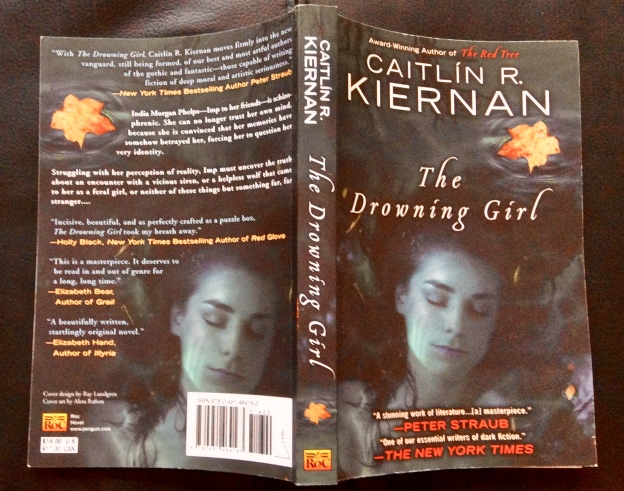
A ROC BOOK 2012
When I review this novel, my thoughts will appear in the comment stream below…
www.nemonymous.com
Des Lewis - GESTALT REAL-TIME BOOK REVIEWS
A FEARLESS FAITH IN FICTION — THE PASSION OF THE READING MOMENT CRYSTALLISED — Empirical literary critiques from 2008 as based on purchased books.

 ANIMALS


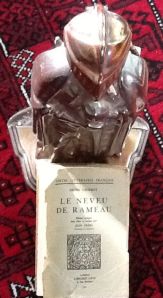
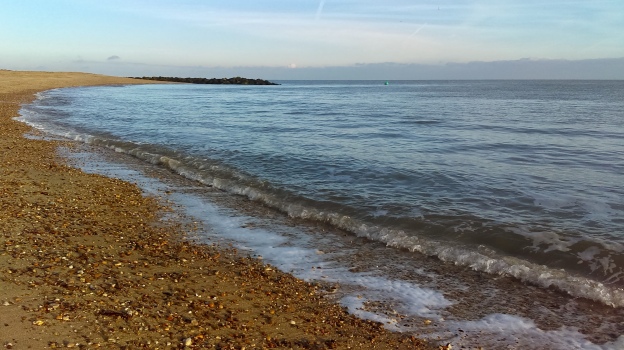
 Braving this book in the warm of my chalet bungalow (the Soft Tread of my wife upstairs) on a cold frosty seaside morning outside (photograph taken about an hour ago.) In the second, I see a man with a tarpaulin bag with his items for self-storage or for the tarpaulin loft in Cicisbeo. The third is substantive, and with clues such as a funicular railway up to West Hill I knew it was some consuming version of Hastings (a very important place in my youth.) This work is the whole book’s eponymous apotheosis as well as its haunting themes, I guess, but who is following whom, who is being enticed to come NOW? Also, a possible woman’s drowning at the end significantly links with my already ever-concurrent review or co-voyeuring of THE DROWNING GIRL here, together with a vision of the spate of paintings on show, “They were all called ‘Woman from the Sea’, with a hashmark and a number.” Focus as a would-be religion, at an age when focus tends to fade? “…a midnight passeo“ also a midnight Pessoa?
I hope to start realtiming The Drowned Girl below shortly.
Bus Fare: https://dflewisreviews.wordpress.com/2015/10/17/years-best-weird-fiction-volume-two/#comment-5648
Ballad of an Echo Whisperer: https://dflewisreviews.wordpress.com/2014/06/24/fearful-symmetries/#comment-3185
A Redress for Andromeda: https://nullimmortalis2010.wordpress.com/58-2/
Pages 1 – 14
“It’s a myth that crazy people don’t know they are crazy.”
Already entranced into this limpidly cloying text (if that is not a contradiction in adjectives). Eyes close to the paper without my spectacles, as with my reading of The Red Tree.
The speaker to us is India Morgan Phelps (Imp) and we learn about her view of her own ‘craziness’, her psychiatric treatment by others, the women in her bloodline also ‘crazy’ including a portrait of her mother Rosemary, and the eponymous painting she sees by chance at the age of 11 in a gallery. False and real memories. I won’t give you details here of the painting in case you google its image. At least, I am not crazy enough to tempt Imp’s wrath.
“But the worst is, you accidentally or on purpose start seeing them [ghosts], you make the gestalt shift that permits you to recognize them for what they are, and they start to see you, too.”
“Of course, I’ve never actually met an innocent person. Everyone hurts someone eventually, no matter how hard they try not to be hurtful.”
Easily remembered scene of thinking someone had left junk outside for others to scavenge, but the situation ends up – via the nature of the woman’s hair and eyes together – feistily meeting her future girl friend in this woman called Abalyn, and Imp, our heroine, has also much to say of fairy stories and artwork containing mermaids and wolves … and a strobe between two Perraults, a shimmer of artist and writer that was passed along to this book from the Red Tree book, I guess. “Contagious hauntings and memes.” Craziness is not even a consideration, when grappling with life and love, nor any distaff heritage of audited insanity.
Pages 28 – 44
“Why does anyone bother with chapters?”
…To help a real-time reviewer like me? A pity, though, that Imp’s chapter numbers are not more frequent. Otherwise I could avoid using page number divisions (I need to eke out my short doses in view of its layered texture.) Page numbers that might not be consistent between the different editions of this book. And I am someone who has no real preconception about this novel other than what the Red Tree told me about the authorial voice there, if not here. But perhaps not enough help is coming my way; I feel I am not able to master this work with a real-time review, at least not this early in the process. I must talk to that authorial voice as I type, as also Imp (painter) talks by typing to transgender Abalyn (video reviewer). And as she talks or types to herself about what she calls this ghost story, of Eva, of this book’s eponymous painting. My trans-review (?) as a sort of echo, too, of Imp’s own admission of her mental heritage … her multiphrenia? But, again, have I the ability to capture this book, oh, yes, doing that without spoiling it, too? The first book, old or new, literary or genre, that has so far made me ask that ‘ability’ question out loud. It feels as if I am about to be made part of something real. Something that transcends the words simple or complex, fiction or truth.
“Duality. […] Transition. […] Masks. Secrecy. Mermaids, werewolves, gender. […] Confessions. Metaphors. Transformation.”
3
Pages 56 – 68
“My ghost story is filled with significant moments that I would only become aware were significant moments in hindsight.”
…as with any real-time review like this aiming towards a final gestalt. Apt that we work together, Imp, as it were. I note later in these pages that the actual writing of a review within the narration is significant in what happens in preventing Abalyn to accompany you somewhere. I wouldn’t want to second-guess your relationship with her other than what you tell me about your initial naturally mutual sexual accommodation, but so much depends on the butterfly effect of the moment, which, even if a minor event, could be so major in hindsight. And I note your childhood OCD superstition with numbers, and I thought it appropriate to bridge chapters 2 and 3 above in the above numbered way, particularly as you yourself explicitly mention this arbitrary bridge between the two chapters. Needless to say (but I will say it because I am a real-time reviewer not a finish-reading-it-before-reviewing-it reviewer) I am now fully entranced by the narration. The narration about your past CPR dummy, the legend behind this book’s eponymous painting and your prospective first meeting with Eva, a meeting not yet happened within these particular pages even if it already has happened within your life proper. Nabokov, Supervielle and Man Ray as proof sources impress me, too. Spirals within spirals trapped within words. Nuns and ravens. Apple pie and other words, old-fashioned ones, to fill out your character for me. The nature of perception different between that of the sane and insane. Different perceptions, indeed, but the same truth that is being perceived. And much more in these pages that I chew over in some hope of retrocausal hindsight to make the you that is you, Imp. And I promise there will be no plot spoilers, subject to the nature of real-time reviewing, hopefully rarely, but inadvertently doing so. (Sorry, this entry of mine is longer than intended!)
“But I also need to write, so I’ll write this, instead.”
I did not think I would have time to read this book today. But I am glad I did, as in this relatively short tranche of text is –
“Caroline was sewing, and I was watching her sew. She had an antique Singer sewing machine, the sort you work with a foot pedal.”
My own grandmother Alice – so important in my life – regularly worked such a Singer within my childhood hearing, although in those ancient days it was not really ‘antique’. This book’s grandmother’s references to the Crow at the window – and crows and other black birds in general – are now so utterly significant bearing in mind the Crow called Dar Oakley in KA by John Crowley concurrently being real-time reviewed here (wherein there is also a character called Singer) and my previous reading of the typescript by Sarah Crowley!
“And so this is the night I meet Eva Canning. The first night I meet her for the first time, I mean.”
That is Imp’s inscrutable ‘I mean’, because the word “unearthly” in these pages reminds me that I might have met Eva naked near the benighted river by means of reading this book before today. The word ‘feral’, too, rings a bell, although I personally think ‘fey’ is a good suggestion on my part, better perhaps than ‘pale’? I dare not divulge everything here, not knowing where upon the two narrations the readers of this review have reached. Whether they know a certain quote derives from Coleridge or Melville. All I can say, is that I now have a different slant on Imp’s relationship with Abalyn, and its relative significance, or what is about to happen to it, what has indeed already happened to it. I know at least where I myself am in the book. If I smoked, I would now go outside for a smoke and dwell on this fascinating and believable ‘ghost story’, unsure whether just one is a ghost or all of them are ghosts. The ghosts of fiction? Or are they the embodied truths of projected self, neither ghosts or non-ghosts? Perhaps next time I will start talking to Imp again.
Pages 87 – 101
“A book. A pernicious meme that created a haunting, a sort of focal point for people who don’t want to live anymore.”
…a book that is compared to the eponymous painting, whose artist I have not named in this review. I wrote recently on Facebook that all memes are mean. I do not really need to type talk to Imp, because she types talk to herself. I shall merely type talk to myself and perhaps to my imagined or hallucinated readers of this real-time book review, susceptible, as I am, like Imp or Sarah Crowley, to digressions and non-linearity. Imp, here, gives a Japanese example of that pernicious meme, but here her own crafted meme is to make a haunting believable (and if such a haunting scares you, then this one will scare you) and ironically a well-crafted meme as artfully mis-crafted narration is ostensibly more able to convey that haunting in the most believable way. Including the glimpse of Eva following that first meeting and the possibly parallel importance of the fading relationship with Abalyn even before that fading happens, if indeed it does happen? A mis-crafted review, too, on my part? In any event, as an aside, Imp was once Rosemary’s baby… but evil and madness do not necessarily go together, do they?
“I prefer to have a room filled with music, instead of silence all around me and only music in my ears.”
Reading fiction is like that for me, all around me with no eyephones. We have Imp’s digressions around us, too, on sirens, ‘intrusive thoughts’, Elizabeth Bowen’s ‘Shadowy Thirds’ here exemplified by Eliot and Shackleton, and telling us, like the scrying of bowel movements. her dreams she had written out in Mansfield Park end-papers. Imp thinks that “No one’s reading these pages over my shoulder.” Imp is sure in denial, I guess. Now I’ve got hold of this book, there is no going back.
“Dead people and dead thoughts and supposedly dead moments are never ever truly dead, and they shape every moment of or lives.”
I had cause to append these quotes here yesterday in a concurrent review of fading ghosts –
“And death shall be no more; Death, thou shalt die.” John Donne
“And death shall have no dominion.” Dylan Thomas
“And with strange aeons even death may die.” HP Lovecraft
”No one reads by accident.”
.“My sweat, mixing with my paint, which struck me as something wicked” this way comes, and “I watched as the wrong yellow became an entirely wrong orange.” Singing in my sleep, answering the phone when it hasn’t rung. I am now well into this woman’s mind. But which woman? And which of her minds? Especially when I see she apologises to Abalyn merely by typing to herself that she did! And now she’s paper-clipped a short story, or at least it must have been paper-clipped before it was trans-scribed for this book? I shall read that next.
Leonora Carrington, Sueño de Sirenas (Dream of Sirens), 1963
Last night, serendipitously, I saw the new BBC televised documentary upon the life of Leonora Carrington, that I have already today mentioned on Facebook and Twitter.
THE MERMAID OF THE CONCRETE OCEAN
By India Morgan Phelps
A compelling, not factual, but true, story within a story, a story by Imp from the POV of a magazine interviewer interviewing an aged woman in a wheelchair who had once modelled for a famous male painter, an interview conducted in front of one of that painter’s paintings. Not transgender so much as trans something else? Trans-surreal? A central objective-correlative for this book?
My grandmother always had perilously long cigarette ash intact upon the cigarette in her mouth as she treadled her Singer…
Pages 142 – 159
“If I could write that well, Imp, I would.”
“You write. You write your reviews.”
“You don’t seriously think that’s the same thing?”
And you can only watch cartoons when sitting on the floor. I sat on the floor the whole time I read these pages. But that might be lie. Even though it felt like a cartoon half of the time, an adult one regarding trans-things and sexual politics predicting a time when today we are more easily who we are. Trans-things like changelings in fairy stories. Not that Imp’s Red Riding Hood (“…to keep my wolves at bay”) was a changeling, although maybe her grandmother was. It now seems from these pages that Imp has a great-aunt as well as a grandmother called Caroline… And Imp’s story of the Mermaid now counterpoints the Abalyn life story of someone born into the wrong body, told while she is holding an unlit cigarette. Then the astrological changelings of the Mars and Venus symbols. (Astrology once an obsession of mine.) And, of course, there are the mutual changelings “of what had happened and what would happen”, in that we do not know whether we are ever likely to hear what question Abalyn asked Imp about the Mermaid story or how Imp answered it, other than that there was definitely a question and definitely an answer. Is this due to lack of trust In the future reader or real-time reviewer? One of us perhaps was born into the wrong mind.
“I spent a day and a half composing that sentence. I must have written twenty-five or thirty versions of it on various scraps of paper before letting myself type it here.”
And about thirty seconds to write those two sentences about it? This book itself is a ‘thing’, with a cover like the one on my edition of The Red Tree, that might have attracted someone wanting a light, if deliciously spooky, holiday read. I might imagine though its author suddenly appearing in my reading-room and telling me otherwise, and, despite its odd references to the film JAWS, it is certainly more than just a light holiday read. It cloys and takes me by the non-linear implicatory scruff of the neck. It does indeed imply ‘things’ beyond itself. But I keep my powder dry, as I approach a section of the book (inadvertently glimpsed ahead) headed A PLAY IN FIVE ACTS. Meanwhile, the verb I use above about ‘things’ is actually used again on page 168 within the currently reviewed section: “The woman in the painting is glancing back over her shoulder towards the shore and a shadowy forest that imply threat.” (It is my implication regarding that verb, not necessarily the book’s.)
……The modulations of time in real-time reviewing this book, being like Lewis Carroll’s snail above or are they more like racing on ahead to the end to write a one-take review which is later disguised – in the way that most so-called reviews are – as a PREview, to make you want to experience (or not) the book or film being previewed.
6 (whole chapter)
Here, such modulations described above are ironically geared to the ‘dictates of Aristotle’ considerations in the previous chapter (i.e. the whole of the second paragraph on page 171.) Riven tellingly with Imp’s Carrollian earworm (unusually called an ‘earwig’ in this chapter). Within that gearing, again ironically, we can now feel the timing of the end of the relationship with Abalyn in some sort of retrospective context but without experiencing, alongside Imp, that intervening context. Perhaps we will be allowed to do this eventually? Whatever the case, these various modulations reveal to us something intangible about what Imp is experiencing – or is about to experience despite our ignorance so far about such experiences – in this ‘ghost story’, thus helping make that ghost story somehow a sort of mindworm.
Slouches towards Bethlehem to be born?” — WB Yeats
“Here is a sad, sad tale, woebegone story of the girl who stopped for the two strangers who would not could not could not would not stop for me.”
So, at last, do I reach the now famous chapter 7 seven VII of ‘The Drowning Girl’? Indeed, I do, a riff on the lobster quadrille? Not exactly, but, yes, that, too. More a breathtakingly Joycean First Mover’s Coming through the power of literary tricks, far more powerful, for me, than Biblical ones, and a slant on what was met by Imp in the guise of Eva Canning upon that variously named road in the light of centuries’ legends….
And that crow, too. Or crows.
Trans-changelings. They were wolves, too.
This book’s brilliant ‘the Wolf who cried Girl’!
Years as 18th century digits and sevens as part of Imp’s phrenic Numberism, too.
This is major major stuff, in my book. Truly glad that STJ got me to read this author by dint of his blogs I read.
“‘God,’ she said, ‘if He exists, has an inordinate fondness for beetles.’”
It seems significant about an ‘if’ if that ‘if’ creates more certainty about something than it otherwise possessed before the use of that ‘if’. And in synergy with that thought, Imp’s attempts at triangulating the coordinates of her so-called insanity and potential mis-memories or deliberate lying take on a new perspective, particularly in voluntary or involuntary collusion with Abalyn (yes, Abalyn, who also has a name that, to me, sounds a little ‘Gone With The Wind’, returned again to this book without really having left it) and with Imp’s psychiatrist who said that about God above….
You know, I have spent so far nine years ‘gestalt real-time reviewing’ hyper-imaginative fiction and I have often publicly explained — on-line in various blogs and published within my review site — my view of the communal importance of ‘triangulating fiction’s coordinates’, to reach some truth or meaning about that fiction. That if we all triangulated a book together with our various slants, we would eventually reach the gestalt of its convictions or aberrations or unreliabilities, its truth of imagination and creative expression.
“‘If the fiction has been contained,’ she replied, ‘then you’ve gained control of it.’”
by India Morgan Phelps
“Almost like Edvard Munch trying to forge a Van Gogh, almost.”
A substantive story factored skilfully if overt-unintentionally into the phrenic mix in my mind about this mighty book, a Werewolf story with satisfyingly Proust-long paragraphs. The message is in the story’s title and its happening or installation of word and literally fabricated art, although I did manage to find an on-line image of the main referred painting linking Eva and the narrator who are lovers as well as co-nightmare sharers, and there is arguably a crow just discernible in that image’s shadows, incredibly further linking, for me, the painting’s explicitly identified ‘Red Cap’ (as a variation on Red Riding Hood) with John Crowley’s ‘Fox Cap’ girl in KA, a novel that also has wolves. Red Fox or Maned Wolf? And Aleister Crowley is also mentioned in Imp’s one-off werewolf story. But not Sarah Crowley.
A story of body casting and of perceived slow suicide. I cannot do it justice here nor explain the fears the links I found caused in me.
“But I didn’t think kill. I thought murder,…”
“But what I don’t know is worse than what I do.”
Imp promises to be more linear even while feeding us fragmented items of information for our own continued pattern-making, items such as real quotes from her favourite poem that takes on a new significance, an informal research visit to a Library with Abalyn, the word ‘unsettling’, a reference to “the underground zine culture of the late eighties and early nineties” of which, as DF Lewis, I was myself part, a spate of Imp’s paintings revealed, and, for me, a startling reference to a crow or crows that makes me wonder if my earlier pursuit of one in this book is a blessing or curse, that this is not just a ghost story but something far more frightening of which I have so far managed to catch semi-prophetic glimpses. Including a possible ‘Freudian slip’ on page 271 when referring to “Abalyn Canning’s marker.”
“The room was filled with the darting, sinuous shadows of fish.”
‘Is it a tench?’ I ask myself. Well, there was much varying sealife listed in this most erotic of panoplies, that they must include a tench. (“There were no crows, or ravens, or black birds of any sort.” Ironic, that!)
Imp is, for me, hawled in these final pages, as well as bewitched, almost flensed, filleted and flayed for or by sex, almost. I am staggered, genuinely staggered, by the serendipities that have enraptured me, including one you will NOT believe. Yesterday, here, I wrote a short short for this month’s Clacton writer’s group pre-set ‘Ripple Across The Pond’ writing homework, and it turns out that, today, I read about the climax of this book that takes place at somewhere called Card Pond!!!!! I do not believe it myself, but it is sincerely true. Also, the link I made earlier today above about the MJH book is now even more borne out: “, and she walked into the sea.”
And much more has taken me about this book in its final pages, the Eva-induced-discarded-meds catharsis of Winter India Imp, not her India Ink, that she might have used in a different age instead of a keyboard. “One is never unhaunted.” Except when one types to oneself as if you are talking to a Proustian self which is also YOU but discrete. “The voyeur of utter destruction.”
“facts are patient things.” Natalie Wood, Man Ray, another carp. I could draw this review out. But all I will say is that it is a classic. And, oh yes, I wondered whether perhaps this author’s books are designed externally to appeal to the ‘summer people’ not the winter ones … as some of Imp’s paintings are?
And I must not forget the Back Pages that give even more traction to belief.
“Lost paintings, daughters of mystery, mysteries and the pieces aren’t ever going to stop falling into place. Or falling, anyway.”
end