Friday, May 24, 2019

Blood Moon – Melanie Tem

Blood Moon – Melanie Tem

 
DE92E0EB-D41A-40E7-918D-E6180CD3F21E
.
CROSSROAD PRESS 2011 (originally 1992)
My previous reviews of Melanie Tem: https://dflewisreviews.wordpress.com/tag/melanie-tem/
My other reviews of older or classic books: https://dflewisreviews.wordpress.com/reviews-of-older-books/
When I read this book, my thoughts will appear in the comment stream below…

17 thoughts on “Blood Moon – Melanie Tem

  1. 1
    “None of that mattered. The little face in the photograph was demanding her attention.”
    Extraordinarily, I start this initially engaging novel after reading earlier today Steve Rasnic Tem’s ‘Photograph’ (here) and after my also wild extrapolating the staking of claims with photographs with another SRT work (here). Literally both stories read and reviews written just before starting to read this novel for the first time! The photographs in Blood Moon concern a woman’s adoption of Greg when inspecting a photo of him, and he having earlier seen a photo of her as a potential mother. And, then, there is his backstory…
    And when I said ‘extraordinarily’ above, I meant it! Scry the synchronicity.
    “He waited a boy’s eternity—fifteen, twenty minutes, half an hour.”
  2. 2 & 3
    “The older he got the worse it was, the more he saw that the world at large was in a mess from which it would never recover,…”
    About my age, Andy, with a lifetime of headaches pent up as in unopenable cupboards. Thinks of his daughter Breanne adopting Greg… his new ‘grandson’. Then we are placed in Greg’s head as a smaller child in painfully retrieved backstory. Some of the strongest stuff I have ever read about child abuse from the point of view of the child.
  3. 4 & 5
    “She listened, smiling, to her father’s terse, impatient explanations of economic theory to Greg, whose questions were almost total non sequiturs.”
    There’s a definite power here I sense, one that is so powerful it ever escapes my grasp – so far. The emotions of Breanne, of her father Andy, of Greg her adopted son and his memory of his own father and the latent presence of his mother. Andy worries, amid his headaches, worries, like me, about the world and its troubles. A world about to explode. There is so much going on here, outside and inside of various heads, much of it inchoate, perhaps inchoate forever, with no hope of resolution, so much so that my own head feels fit to burst.
    “The room was filled with strange, thick shadows cast by the red blanket over the lamp, and when he put his hand on it the flesh was red, too, the bones black.”
  4. 6
    “…and unlocked his bike from the porch railing with such force that the wrought iron sang.”
    And the sky sang, too, with a more frightful song of yellow tornado or atom bomb. The latter alternative reminds me of my own fears as a child in the fifties onward, embracing nuclear storms as the coming sleepover with our old friend Death. Not that anyone had heard of sleepovers then, and Greg — amid such contemporaneous angst as we learn of his school life then, ever on some brink of his past-induced anger — has mixed feelings about his school friends, but he tries hard, amid his crush for a woman teacher… and his image of security, beyond anger’s danger, in the concepts of home and mother, when dangers ensue. But which home, which mother?
  5. 7
    “There will be an eclipse,” Andy corrected him. “We just may not be able to see it.”
    Greg is 12. Squints through gaps in bathroom handle as Breanne baths, later gaps in clouds, to squint for moon’s (de)tumescence…
    The accretion in boy’s emotions of jealousy and lust, and later naive or clumsy thoughts of old man Andy ‘babysitting’ the boy, with equal ironic tuning or untuning of thoughts, individual complexities amid a universe’s expanding or shrinking gestalt…
    “It takes seven minutes for the light of the sun to get here. How long does it take for anger to get where it’s going, old man?”
    How long does it take a boy’s blood to reach his moon, I ask? Blood moon.
  6. 8
    “There were too many of them; they were crowded and crooked, and the plastic sheet over them had fat rows of air bubbles.”
    Seems appropriate that my initial image in this review of photographs is now the trigger for a dreadful éclat between mother and adopted son, the boy who can make eclipses himself, more cosmic than mere camera flashes or other sudden exposures, I guess. Not self-pleasuring so much as self-rage?
  7. 9
    “She herself found C. S. Lewis a little precious and pompous and more than a little sexist, but she was willing to read for the sheer pleasure of the language, for the beauty of the children’s adventures…”
    I have always found it strange that the name C.S. Lewis coincidentally rhymes perfectly with that of D.F. Lewis. Though, I draw the line at sexism! Breanne reads Narnia books to Greg, and by default to her father Andy, too. There is something very Christmassy, very family-like. Yet we are also drawn effectively into the two males’ heads as points of view, in addition to Breanne’s. The power to visualise faces in the fire. The pareidolia of cause and effect? This work causes an effect in me as it ineluctably unfolds.
    “…and Greg found himself thinking a grownup word: Coincidence.”
  8. 10 & 11
    “He pushed at her face in his mind. It fell to pieces and then put itself together again.”
    There is something that somehow makes you telekinetic when reading this book. As if you can control what happens…and perhaps you do. Looking ahead in it may spoil your chances of doing so, though.
    “Greg stopped to watch a crane lift something to the top of a building. He stared so long at the bright-orange crane and the black building ribs and the blue sky…”
  9. 12 & 13
    “Coincidence.”
    A single word followed by a full stop, not a hard return nor a stroke. Not a pregnant pause, but a prägnant sentence. As Breanne is told this curtly, and she tells Greg and Andy equally curtly. ‘We are going to have a baby’, a later afterthought. This continues to be strong stuff, and I imagine – as with much of the Tems’ work I have been recently discovering – worthy of far wider attention than perhaps it has received in the past. Meanwhile, with me chiming along with old Andy —
    “The world was in a mess. Not that it affected him personally, but he liked to keep informed.”
  10. 14
    “It’s hard to stay oriented when the words you hear yourself speaking aren’t the words you had in your head.”
    I know the verbal aphasia affects of Stroke, hearing it in my mother in law for several years. Andy’s name phasia, Breanne’s ‘starfish’ exudation or not, Greg’s going missing or not, “The situation bears watching,…”
  11. Possible spoilers
    15 & 16
    “Breanne wondered whether doctors, like everyone else, could have perfectly coherent middle-of-the-night conversations of which they didn’t remember a word.”
    ‘Red pain.’
    Many other women will know it, too. Sadly, cathartically. Knocks the stuffing out of them,
    One ‘child’ 9 months stayed with her, another inchoate ‘child’ 4 months, but both now gone?
    ‘Childs’ in cahoots with each other by telekinesis?
    Her father’s words, too. Flowed out wrong? Or not. Inchoate, too.
    Meanwhile, we’re now inside Greg’s head, watching the black dude in the orange stocking cap on the public transport, and then the Social Service office with orange chairs, transporting a catharsis with cushions via the social care worker woman we met before. An exorcism like a real, if miscarried, miscarriage? Strong dark-literary stuff, with strong stuffing, too. What comes out, comes out, what doesn’t, doesn’t.
  12. 17 & 18
    “Maybe he would be a doctor when he grew up. Maybe he would be a writer, naming things, breaking them apart into words.”
    Alien corn in poems, tulip head of a baby, we reach some sort of understanding with this book’s understanding, if in different words. Some of of us will use the wrong words to understand it. But the creation of a baby and its eventual exit is a bit like the grappling with anger in a padded room, and the baby comes out often screaming. Not that it has necessarily come out yet. Greg with mixed feelings, mixed powers, will he create or destroy? Andy with his naive dependency on classic poetry and his own memories, the love he remembers that destroys as well as creates, himself also grappling with something. There is much truth in not understanding, juggling the words into different words, although I think I did understand it, unlike a different story I read earlier today elsewhere that went over my head. This didn’t do so. Today, at least.
  13. 19
    “Instead, he was writing. The words came out sometimes in streams, sometimes one by one like hard, brown stools.”
    That was Andy, is Andy. A writer, whose words have skewed. Writers who can empathise with this can also write better books than those who can’t? Andy is a natural writer, without realising it. But far more skewed than we can realise? (“I am farmer,” he had insisted, and, again “I am fantasy”). Famous, too. I can imagine him writing this in his cramped writing, often cramped when printed, too, like babies are cramped inside the womb. I can also imagine him writing about the alien corn at the beginning of this chapter, this fructifying nature, and Breanne soon coming to full term, coming to terms, too, as well as coming to fruition with Greg’s adoption in a court. And Greg’s sense of surrogate tumescent adoption projected preternaturally within Breanne’s womb, his empathy with the baby and its attachments. Birth certificate changed, indeed. Big and small things within such powers as he owns?
  14. 20 – 22
    “If there is a noodle window, all hungrys will die.”
    An inevitability pervades what happens. A fated catalytic ricochet of tongue-twisted oldster and miscontrolled youth. That blood moon seeping back through the clouds. And, as perhaps instinctualised predictively by me above, Greg now looking back at himself in his own mother’s womb. The house of the soul’s as well as the flesh’s beginning: now in metaphorical flames to match real flames elsewhere.
    “The old man was his mortal enemy and his only true friend.”
  15. 23 – 26
    “She’d seen him everywhere, heard his voice and his silences, but when she approached he was never there.”
    Breanne and her children, one being born and the other, literary and literal adoption having now made him hers for real, almost in erotic communion, I guess, with the act of birthing. Can that be right? Surely we are not reading this right. A synergy and symbiosis, a destructive-creative force where the breaking of waters become the breaking of the blood from the monthly moon. There are surely many different interpretations, so many of them that only the phenomenon of potentially great literature like this can cope with them, or cope with the many different readers thus interpreting it differently — meanings strobing here, in tune with the bodily cylinders as well as vibrating with earlier sculptural ones. We surely can empathise with the forces at work here, some good, some bad, but it’s the mixture of the two that makes each what it is by contrast with the other. The stoical pangs and passions now in stasis, a star above, now a moving aeroplane, now a star again with its own as yet unseen moon…and the photos of lost children now outgrown.
    “A dozen thin stainless steel cylinders, from waist-height to well over ten feet tall, constructed and arranged to vibrate at the slightest breeze.”
    end


    Thursday, May 23, 2019

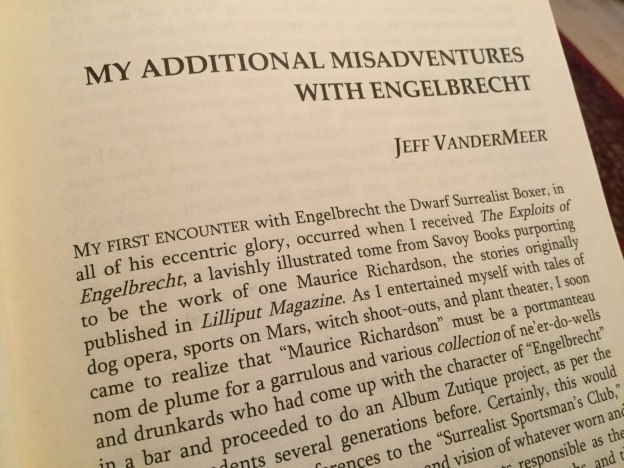
    Engelbrecht Again! – Rhys Hughes

    25 thoughts on “Engelbrecht Again! – Rhys Hughes

    1. 726A65FC-4FF0-45B4-A2C5-8AAA3224959019B8F782-CE2D-4925-B445-E0282E725940B4EEA7C4-178A-494B-B37D-EF5BDA41F379E18B98F0-CA41-4F6E-8336-39A258037367
      1. GAUNTLET OF GORGONS
      “Now the Id purred like a cat which has been swallowed by a dog, the dog by a horse, the horse by an elephant, the elephant by a whale, the whale by a whirlpool, the whirlpool by a dying star, and the dying star, with difficulty, by a mouse.”
      That’s because a mouse can delete anything with just a single misjudged, misfingered manoeuvre. Or at least when mouses were mouses in 2008 at the time this was published. I wonder who else has read this book other than me and Jeff VanderMeer. Millions, I hear shouted. It is utterly mad, and I studied Louis Aragon at university in the 1960s at a time when I founded the Dadaist ‘Zeroist Group’, and even I STILL think it is mad. Even me. The Surrealist Sporting Club led by the Id, towards London, via Acton, to the Brit Museum where much is already stone without the sly-glanced intervention of Gorgons!
    2. 2. FAR ON BICYCLES
      ‘the thing that was not a thing’
      …as, here, a thing-in-itself, it seems. Not only Far on Bicycles but Fear, too, I guess, if you are persuaded by the Id’s Idea in respect of competing in the Tour de Trance, by a due methodical seeing-to by each of the old pier hypnotists on the South Coast of England. But why not the East Coast, too, I ask, living in Clacton on Sea as I do? Anyway, whether with Chippy or Chirpy on a trice if not a trike, or Engelbrecht himself, or any other number of named riders, this exercise in Deep Absurdism is worth every penny and farthing. Rex Warner, I remember his book The Aerodrome, by the way. And my mum rode a Tandem (not an Ace Double) along with her elder brother in the 1930s. She often took her feet off the pedals, she later confessed.
    3. 3. YOUNG WERTHER CHEERS UP
      As well as the irony connected with what is underlying the title above, there is a section here I cannot resist quoting in full, if I may be so bold:-
      4FE22E63-E4D8-4654-B039-42FFAE9B8B30.jpeg
      And much business about a casino, and, inter alia, gambling chips as minutes in a measure of time, and a reference to dwarf Engelbrecht’s famous wrestling match with a Kraken. So he does wrestling as well as boxing? And oodles of wordplay and referencing, assuming you are ‘in’ enough to get some of the in-jokes, too.
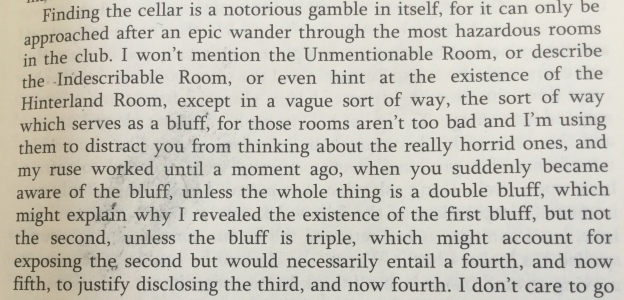
      How can I possibly cover everything that is in these stories! I feel like I am a pioneer reviewer here, scaling the impossible Everest of Absurdist Literature. I intend to read at least one story from this book each month. Base camp towards life’s last ledge, where all chips are down.
    4. 4: SURFING THE SOLAR WIND
      “The whole island of Britain was spread out below us.”
      I don’t know why, but I thought of the BrexId as well as this (2008 published) story’s Id protagonist, when reading it. On this R.A. Lafferty-like Big Wednesday (I know this author had not then read about Lafferty’s Slow Tuesday, nor Lafferty himself vice versa about the other’s Big Wednesday), we ride, along with the growingly familiar characters such as Chippy de Zoete, Dreamy Dan, Charlie Wapentake, Lizard Bayliss, Gamma-Ray Russell, Rex Warner (whose Aerodrome is the launch site for what happens here: Riding the Aurora Borealis), and many more. We also have reference to the Alpine enclave of Chaud-Mellé. This book is almost addictive, so far. Must eke it out more slowly, being Friday tomorrow.
    5. THE NORTH FACE OF THE EGO
      “It was obvious that an organic ego would contribute much more to the science of geography,…”
      My underlinings, if not underlings, above.
      Stemming from the author’s enjoyment of mountain climbing, a convoluted writerly satire, featuring the recurring characters in this book.
      Id versus Ego.
      F08C1C90-C127-419C-B1D0-E50095E68042.jpeg
      .
    6. TUG OF WORLDS
      “And the Id said: ‘Ireland has just collided with Wales.’
      ‘Ireland? I’m afraid I don’t understand.’”
      With that forerunner of the backstop, I have just realised that this whole book (writ in the early naughtiest?) is a zeno’s paradox prophecy of Brexit as a confused tug of wars, with here a veritable cornucopia of paintings within paintings containing the first paintings, worlds within worlds, möbius sections from Escher, and all the characters whose names have taken on rings of familiarity by dint of immersing oneself in this book, a book like not only the impossible Everest of Absurdism, but also like the most ever jaundiced Jarnydyce and Jarndyce. Thomas Love Peacock’s Nightmare Abbey, notwithstanding. And the Night Shade villains.
      Is ours a government of the people, by the people, for the people, or a kakistocracy* rather, for the benefit of knaves at the cost of fools?
      ― Thomas Love Peacock (1785 – 1866)
      *real word, look it up (relating to Trump?)
    7. ENGELBRECHT AT EISTEDDFORD
      This is an astonishing work reaching the actual impossible peak of self-referential wordplay (self as the self of the text itself) and no amount of reportage by me could convey what is ahead of you should you decide to read it. Is there anyone else out there who has read this? Other than perhaps the author and eventual publisher. Is it surprising that Night Shade had cold feet at the last minute? Meanwhile, I was brought up by my Welsh father to know about the poetry and Druidic festival of EISTEDDFORD, but I suspect he had no direct experience of it. Just pride in its concept, the word itself embedding the ID and the ghost of mountainous Ego, but without the G of my father’s initial letter of his own and only forename of Gordon. Lewis as a surname is as Welsh as Hughes.
      Stern measures, perhaps, but my isolated spirit has already been diluted to a shandy…”
      (My erstwhile review of Tristram Shandy as strong beer: https://dflewisreviews.wordpress.com/2014/03/15/tristram-shandy/, another book that was given its chance to show its author’s impossible ego – as potentially diluted by his id?)
    8. A MERMAID SUPPER
      “I used to believe that the history of philosophy was the story of the Search for Truth. Now I think it’s more a case of desperately creating Security.”
      Not sure why I quoted that! Meanwhile, I had not thought much about this book’s narrator till now when he comes into his own, a man I assume. He falls in love with a mermaid, as one does, or as this narrator does. Or the author does vicariously. But there is a rude bit, explicitly pre-warned, about part of the process of sex with a mermaid. And there is something about Ireland fitting into Wales, and things about Mars. And other arcane literary and philosophical references. And badinage and rumpus. And much else.
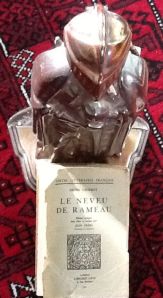
      I once long thought that this author was influenced by Diderot’s Le Neveu de Rameau and, now, having recently encountered R.A. Lafferty myself, I believe this book’s author should be influenced, too by R.A. Lafferty. But neither of these influences are true. But what about literary osmosis. You need that at least to read this book!
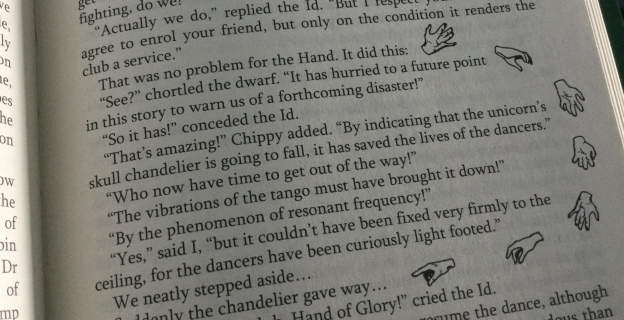
    9. LAST TANGO IN ATLANTIS
      “— let’s hope the Inspector of Metaphors doesn’t brew analogy tea!”
      To tango with a book, you tango with the text, its meaning, what it means to you, but some think they are tangoing with the author. Perhaps Rhys Hughes is the only author where the latter applies!
      The title gives away the major conceit of this story, which reaches perhaps new levels of reading power needed to read it. We reach a temple where the Tug of War of Worlds happened, I guess.
      5EFB4330-111F-4946-A530-99CFA2D089D7
      “Vast chins wobbled. ‘You too are just a fictional detail . . .’”
    10. 10. A SANDAL WAITING TO HAPPEN
      058E956B-4BAA-4254-9DCA-3F3AFC3F6114
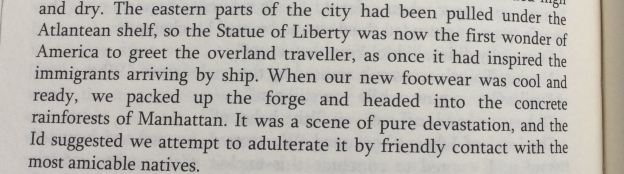
      Whether the Earth is being disheveled by Climate Change or by Trump or by Engelbrecht’s comet or ‘a quiet game of chess’, this story seems prophetic of many things that have happened since it was written. And not only by dint of that quote above. Read the whole story and gather the prophetic clues! But one thing I wondered about was the Ground Zero of 9/11. Was this story written before that event? We need to know. If it was, that might be very significant. Well, in addition to Black Tuesday in contiguity with this book’s earlier Big Wednesday (the Borges Twins, notwithstanding), it seems to evoke economic Black Wednesday in the UK. Meanwhile, I loved the phrase “an immanentized Eschaton!”, but I did not understand at all the sentence that contained it!
    11. The story that features the destruction of the skyscrapers of New York was indeed written before 9/11. It was written early in the year 2000, probably March or April of that year. I remember that after 9/11 I wondered if I ought to rewrite this chapter (the book wasn’t published until the year 2008, so there would have been plenty of time to make such changes, but in the end — for what reason I can’t remember — I didn’t change anything)
    12. 11. A MONKEY FOR ALL SEASONS
      “Typical of the dwarf to win a sport he wasn’t even aware of playing!”
      Luck being factored into this, I suppose, the nature of luck as covered in this story – all as seen in interface with Brian Zeno’s Paradox, a half of a half onward, like ambient music, I guess. These stories – this one in particular – are huge, with global trips, and multifarious references, characters, and I missed the ILLUMINATUS! reference yesterday, it seems, I think I read it in the seventies, the reference about the Immanentized Eschaton in its first line, I’m told! So huge, it needs many more Gestalt Real-Time Reviewers than just me, grappling with it, doing piece work or shift work, triangulating the myriad of its coordinates. And the birth of Fake News from the viewpoint of our last century’s Fin de Siècle when this book, I think, was written —
      “There would be no oscillation of relevance in the news we encountered, slipping into the past for half a globetrot and then catching up with the present for the remainder, like a cosine wave of incidents.”
      And much talk of the Monkey Trevelyan with a one-branch family tree from slime to him. And other more complex family trees in history. I need to employ a deputy coordinator, here. And JINGJING XU is mentioned here. Sounds like the name of today’s Chinese President currently in trade combat with Trump.
    13. 12. THE DESTRUCTION OF DESTRUCTION
      “, full of the cosmic horror as the spaces between screams, what moves thee, or how couldst thou take such a journey into the fanatic Baghdad?”
      I’ll always remember first reading William Beckford’s VATHEK, and here the Caliph state is renewed well before Daesh, I guess.
      Who knows when this story was first written but it is about considerations regarding truth and fiction as well as alternate realities.
      What is the next lie? Hopeless Hodgson’s swine-things or Engelbrecht’s Googlies on Google?
      There is something remarkable about this story’s title. It seems to encapsulate much.
      “Our club will never retreat.”
      “Revenge, for sure, he would have. He would have revenge…”
      from ILLUMINATUS! by Anton Wilson and Shea.
      Ending with a colon, this story appears to be an intro to the next story…
    14. 13. ENGELBRECHT AND UBU
      “LIZARD. You impetuous semiquaver, if I get bruised badly who’ll promote your career.”
      A play featuring UBU’s Jarry, or is that vice versa, by my green candle! It is enlightening that it takes place in Krakow, with a destructive foot, rather than a conflagration, but especially appropriate if you have already read CONFLAGRATION reviewed here: https://dflewisreviews.wordpress.com/2016/04/29/conflagration/ where Jarry features and Cracow.
      This E(&)U play is followed by prose text headed – FIN –
      Meanwhile, I continue to need fellow triangulators of this book’s coordinates. It is too much to deal with for just one Gestalt book reviewer. I will be conducting auditions for others to review this book alongside me. Please contact me, if you are interested.
      Sorry if this is a plot spoiler…
      “ENGELBRECHT. In a day or two, with your help, I shall be Boss of the Surrealist Sportsman’s Club.
      TOMMY. You will assassinate the Id?”
    15. Just read the final two together in one huge mind-frazzling session.
      14. A SUMWOT LABUD SATTIRE
      “I don’t reckon the Tories won’t get in again for the Labour party hasn’t gripped society by the cuffs.”
      Much more prophetic stuff here, as I am reading this today in 2019 when foul Farage goes hell for leather with the Brexit Party in the EU elections (results not yet in.) Abturdity!
      Meanwhile this continued rolling series of characters and cross-global cartographical anomalies and compromising women, continue here with a pirate queen and galleons and antipopes and antipodes and a quasi-OuLiPo experiment with words and numbers and moves of a knight in chess prefiguring this author’s own HOW MANY TIMES? And thirteen savage jerks.
      “But 1997 was decades ago!”
      *
      15. THE CHRONIC ARGONAUTS GET BETTER
      “I also resign!”
      An HG Wells time-extravaganza. I won’t issue any end-of-book spoilers here, perhaps because there are none to issue! Rex Warner, Thomas Love Peacock, Nightmare Happy, Louis Aragon and the Borges Twins etc all stay in my head, some cross-legumed. But badly needed reviewing help for me (the art of description-interpretation-evaluation in tune with synchronicities) is at hand, though. Several others will now be reading this book, so as to help me out. We’re calling ourselves the Absurdist Reviewing Club. When the final judgement comes in, I will come back here punching above my weight, and tell you what t is. Meanwhile, I will now prepare the well-deserved book of my Rhys Hughes reviews spanning more than a decade. Yesterday, I did one for Gamma-Ray Russell who also appears in this book, at least by that name. Not sure what Maurice Richardson would think about it all. Where Id that name come from all of a sudden?
      “A pure coincidence, I swear.”