Friday, June 21, 2019

Murmured In Dreams - Stephen Bacon


21 thoughts on “Murmured In Dreams – Stephen Bacon”


  1. I reviewed the first story in 2012, as follows in the original context
    ===================================
    Cuckoo Spit
    “Sunlight was crowding the edges of the curtain. The clock ticked a comforting heartbeat. Timber was stretching within the structure of the building. The fridge began humming to itself, distracting her.”
    [Stephen Bacon is a rising star of the Horror genre whose work appeared on three separate occasions within ‘Nemonymous’ from 2008. So very pleased to see his work synchromeshing with ‘Black Static’]. An atmospheric, well-stylised, often effectively poetic Cumbrian tale of feral concupiscence — conveying a similar (but equally different) relationship between a daughter (Megan) and her mother to Cassie’s relationship with her own mother in the previous story, both relationships containing parallel senses of detachment by creatures or outgrowths or ‘were’-nesses acting as vehicles for humanity, and vice versa. The relationships here are also well-drawn and any metamorphoses are sufficiently subtle-haunting without allaying their head-on power as horror images. No mean feat. And the cuckoo spit’s conceit as salaciousness is another subtle but striking momentariness of realisation. And, arguably, the metaphor of the cuckoo as occupier is present here. Who is the occupier? The animal-human parasite/host symbiosis? Or simply Megan subconsciously assuming control of the house just before her mother’s ‘departure’? Not even the characters always know their own motives because, in my experience, any author is often powerless to help such characters’ eventual puzzlings-out of self (thankfully). And that lack of ultimate control works for me here, even if Bacon may not have consciously intended to relinquish any authorial control for creative purposes. [Me brainstorming:- In tune with the chain of cause and effect: the empty page from the first story above: awaiting some unknown force to start writing upon it — so as to help alleviate those challenging tentative tusslings that most writers (old and new) have when beginning a story from scratch or claw. That unknown force is ‘occupying’, in micro, this portrait of Cumbria or, in macro, the fluid-glistening White Noise of ‘Black Static’ itself?] (20 Feb 12 – three hours later)

  2. NONE SO BLIND
    “The server asked Novak if he’d like anything else. He declined, and the server left them.”
    There seems a rarefied reason in a café for a server. As if murmured in dreams, a more subtle vehicle for communication than what I’m writing on to write about it to you. I follow Novak (Alexander) and the woman in a mask in that café, amid implications of their past, as unacknowledged by omniscience. And urban deprivation and its ghosts, its memories.
    This is a genuine weird classic. Pleased to say this. Surprised I have not read it before.

  3. I reviewed the next story within its context in September 2013, as follows:
    ===============================
    Apports
    “Ahead, his destination loomed like a beacon for the destitute.”
    I have long had a rapport with the fiction of Stephen Bacon – and here, I simply knew I would come away from this story tantalised – even while being creeped out by the stock urban seediness and then the suspenseful imminence of something, all of which was narratively workmanlike and enjoyable enough, but as (similar to Boyd’s story’s ‘feel’ for the gun) I begun to feel as if I could handle the gun here, too, regarding a boy’s story that I hear about. Later, I imagine the retribution about to be wrought following the boy’s story told through the potential gunman’s mind and the resulting dilemma or weakness does not end up just simply tantalising me but literally radiating out in untold directions of further tantalisation.
    And the story itself seemed to become, for me, a set of bound apports paging me…

  4. LORD OF THE SAND
    “Without Facebook, it never would have happened.”
    A ribbon of detritus, I think it said in this workmanlike story. A reunion in a pub of soldiers from Fallujah. And retribution upon an erstwhile bully via the beard-cutters et al, one of which gives this story its title. Bare facebook under the mask; social mania reaching out its iraqnid legs of unfriending…

  5. SOMEWHERE ON SEBASTIAN STREET
    “But houses dream, too,…”
    Dereliction of the street revisited, in older age, with walkie-talkie, and still high-pitched voice of youth transmitted, but into which Elysian Fields or nightmares are held here for his revisit? A tantalising story that is not so much workmanlike as untoward creative. Sometimes this author hits on things that hit the nerve almost accidentally, or by some preternatural force that uses him as a conduit? Naivety with complexity hid within it.
    “As he drives, I can hear his toolboxes rattling in the back.”

  6. I reviewed the next story in its context, as follows in September 2015:
    =========================
    BANDERSNATCH
    “That’s the word I use – ‘nauseous’, not sick,…”
    Although I thought I understood this story, it has been nagging at me ever since. Which is a good thing.
    It is what I would call a simple-tantalising tale, of a brother ‘exiled’ from his sister for ten years, with our never knowing fully why they have not been able to have a reunion (although it becomes easier to guess why) – till their mother died. The sister has changed, he notes, with her now liking dogs when she didn’t before, has a boy friend who accentuates his biceps, needs to be whittled down to size, I guess, like the boys at the end of the Jeffrey Thomas story did with their long sticks, making the human bandersnatch frumious….
    There is a sense of wrongness with the Bacon story, so utterly wrong, so aversionary, I was left with undercurrents of bad taste but mixed artfully with the Carrollian.
    Practice makes perfect. Dogleg and wrist.

  7. I reviewed the next story in its context, as follows in September 2016:
    ========================================
    FEAR OF THE MUSIC by Stephen Bacon
    “‘You can’t half bust some moves on the dance floor yourself.’
    He glanced at the quotation and smiled. ‘Nietzsche.’”
    Somewhere in this otherwise workmanlike text, it is claimed that there is no longer any middle ground. This story is an ironic emblem of a middle ground itself, I guess, as if trying to prove that the passion of a new relationship — the fire perceived and envied in the belly of your lover’s life, the art of dancing as proof of that fire — comes to one of two extremes: a point of ennui or a desperate self-dosing. Ecstasy as a two-way filter. Meanwhile, the spontaneous fire eventually burns itself out. Within and without. Metaphorically and literally. Strictly, too.

  8. THE SUMMER OF BRADBURY
    “Another piece of my heart crumbled.”
    A moving account of childhood on the cusp of puberty during the hot summer of 1976. With a sense of mortality and bodily changes tinging the wonder and dread of new discoveries, real and fictional. Close to the reservoir and the old colliery. The secluded den. The eventually tragic tunnel. Making me wonder if life’s rite of passage is a dead-end tunnel or an open-ended gambol in childhood’s endless summers? Never to become an old man? Questions ever murmured in dreams.
    “I had begun to see the world through the eyes of a man who told life’s truths through the art of fiction.”


  9. I reviewed the next story in its context, as follows in October 2014:
    =======================================
    The Devil’s Only Friend by Stephen Bacon
    “He smelt vaguely of stale, enclosed rooms, like the interior of caravans or a musty attic; nothing too unpleasant, but, somehow infinitely sad.”
    A perfect portrait of a seedy and rundown seaside resort seen as a palimpsest of six years ago and today – dislocated with new street line shop patterns, added Aldi supermarket et al. A well-characterised arsonist who has done his due time returns to his haunts and loves here – and to face his demons and to make meagre amends. That palimpsest seemed to me to indent further the story’s ‘widening gulf’ metaphor: an apotheosis of Exodus. And this seems to sit tellingly with this book’s earlier ‘stone and hammer’ syndrome, those chunked out gaps to escape from as unwelcome gaps in themselves and, paradoxically, to use as welcome gaps that become the very means of escape–
    “There was just a rocky slope leading away, tongues of black seaweed carpeting the ground.”

  10. PENNYROYAL
    “Nature’s way of sorting things out.”
    Not so much the title’s herbal flavour as an old wives’ method of controlling the cross-grains of life, but more a strong dose of story as a parallel sorting of things out, as if fiction is a purging enema for life’s natural woes — here an old widowed man today leaving the house where he spent his married years, and the strong dose of story he has to tell his adult grandson becomes an extrapolation of what used to be crude measures as a way of humanity’s coping with birth and death, here both birth and death as a simultaneous curse upon a woman’s body even after it has been purged. An extrapolation taken to extremes, as only fiction can do, by making even the worst imaginable of things believable, with believability itself being essential to off-loading the unwanted at its most demonic. Dig it up and see.

  11. I reviewed the next story when reading it over a year ago in the mighty MURMURATIONS, now murmured in today’s dreams, as follows:
    ==================================
    Husks
    “A click of the switch revealed magnolia walls, faded watercolours, yellowed skirting.”
    A heart-rending story you will never forget, about previous happiness of a family, the story’s male protagonist, his wife and daughter, but, as prefigured and later nightmarishly agented by the kookaburra they saw at the zoo, their subsequent dealings with cancer, suicide and eventual spiritual reunion in a new happiness…….. or pie in the sky? That now peeled sky…
    “The sky was losing its final vestiges of light. The birds had fallen silent.”
    *
    An image during my review of MURMURATIONS:
    https://dflewisreviews.wordpress.com/2018/04/26/beyond-murmurations-end/

  12. THE CHILDREN OF MEDEA
    “Maybe the meaning was lost in translation.”
    The meaning of the milk moustaches, that is. At heart, a workmanlike story of an Englishman called Saxton on a strange Greek Island, trying to unlive his tragic backstory as a temporary teacher with passive deadpan primary school children who seem already to know about this backstory. The island itself has a genius loci — relating his backstory to its own. Yet there is more. A thing that Bacon is good at, making me relish his stories without always knowing exactly why. As if his writing is as instinctive as the paintings that Saxton finds in the strange church nearby. Like ideas in a head that the head didn’t put there. Young and old heads alike. Mine is older than many. Crept out.

  13. I reviewed the next story in January 2014, in its context then, as follows:
    ==================================
    What Grief Can Do
    “She clenched her teeth in an effort to prevent the rawness from spilling out.”
    A powerful short short that deals with bereavement, misbegotten love and whatever else spills out, bursting through the dam of denial. A “funeral” that eventually becomes “feral” with animalistic sobs of shame as well as of grief, this way or that to exorcise life’s vile baggage. With the sky’s first light spilling out of this New Year’s Day, it makes me wonder if the world itself has a giant skeleton in its giant cupboard, a whole world’s reality with its own version of Nick’s tank under its floor?

  14. THE IVORY TEAT
    “It smells of tears in here.”
    Hey, this is even better than I remember it. I haven’t read it since I was responsible for publishing it in a 2013 classical-music horror-story anthology. I may be biased, but it is utterly musical, non-workmanlike, with visual word assonances like ‘teat’ and ‘tenant’ and creepy ideas that will haunt you, a real dream if there can be such a thing, two flats opposite each other where the tenants watch each other at night, the sound of Chopin’s Nocturnes coming from elusive room 313, in 2013, in a book published at a no. 113 where I live. Murmured in dreams, for sure. And a mug with lipstick on it. Languid connections, even an unspoken, barely felt sexual attraction, with a throwaway mention of female genitalia almost unnoticed. And the rat poison from the Medea piece. A classic story, this, playing the ivories, dare I say. Why is it not more well known? Probably because I was crap at distributing books in 2013!

  15. DOUBLE HELIX
    “This time she managed to haul it against the side of the hole.”
    A woman with cancer has a reunion with her ex from university, having since lived the rich ‘dream’ as it were with a more societally acceptable man. The ex takes her to Scotland to meet an older magus who heals her through this hauling of a rough hessian sack of herself in a crudely dug hole. I sense I was by-passed as an unwanted influencing witness and it went somewhere I could not, should not follow.

  16. THE CAMBION
    This story of a female UN official in North Africa, her encounter with the locals’ religious beliefs and the eponymous hybrid boy as produce of a demon and human woman, and her nightmares, is unquestionably very well written, hellish and at times erotic, but it does not have what I infer as the Stephen Bacon extra indefinable ingredient, an ingredient needed to evolve it into one of his classics. Those who read all these stories and those in his previous collection will sense what I mean. But I suspect, perhaps, that even Stephen Bacon himself does not know what that extra ingredient entails!

  17. Well now I’m no hero
    That’s understood
    All the redemption I can offer girl
    Is beneath this dirty hood
    – from THUNDER ROAD (the late Bruce Springsteen)
    HAPPY SANDS
    I knew Morecambe, having lived there for two years in the late sixties, and now in the future’s future, when most of our heroes are gone, we are allowed a haunting glimpse there of a dead holiday camp and its dubious denizens, and of the way our sadnesses and sins can be assuaged by surrogacy. Who knows how death can be replaced, or forbidden lusts catered for, or even whether artificial intelligence is artificial at all? Even fantasies are culpable if you can’t prove they’re not. Yet more came.

  18. RAPID-EYE MOVEMENT
    “He mentally counts her breaths, losing himself in the numbers.”
    A most moving, frightening, embracingly human, end-of-the-world story.
    If the basic concept is original, it should be honoured and also made into a cinema film. This should happen, even if the basic concept has been used before. The story itself as a story feels intrinsically original. All I know is that it worked strongly for me.

  19. IT CAME FROM THE GROUND
    “Were these things simply pieces of art?”
    Like ‘The Cambion’, this novelette is very well written, a narrative that is a real story, a workmanlike adventure with perhaps deeper meanings, involving believable characters and their reactions, an insectoid monster and an orphan boy with a machete, and sculptures or statues, about a photographer in Rwanda in the 1990s, and its aftermath’s effect on his life and loves. A sometimes tragic adventure where his quest — for a crystallised photo to earn, perhaps as a crazy ambition, the Pulitzer prize — is set against those frozen works of art of humans as crystallised in our mad world, a world that started going mad even before we realised it. The Gestalt reached, pieces of art as one. Art as craziness incarnate?
    This whole book gives further evidence that Stephen Bacon’s canon of work often needs crystallising, and real-time assessed at each stage it reaches. Whether this on-going canon is underrated or not, it is time that we make sure that we start rating it properly as it already deserves, and as what it may become beyond as well as within genre. It came from the ground.


    Monday, June 03, 2019

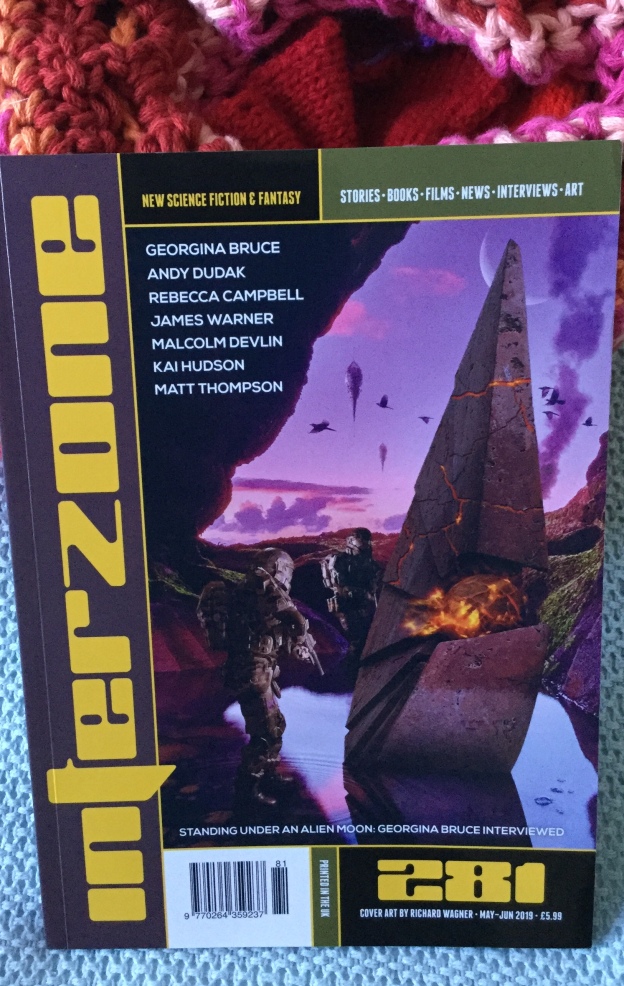
    Interzone #281

    Interzone #281


    7715B073-A7B1-4666-8BD4-62B306794D8B
    TTA PRESS May – Jun 2019
    My previous reviews of this publisher: https://dflewisreviews.wordpress.com/tta-press-interzone-black-static/
    Stories by James Warner, Kai Hudson, Andy Dudak, Malcolm Devlin, Matt Thompson, Georgina Bruce, Rebecca Campbell.
    When I read the fiction in this magazine, my thoughts will appear in the comment stream below…
    9 thoughts on “Interzone #281

    1. THE REALITARIANS by James Warner
      “His favourite book was Bulgakov’s ‘The Master and Margharita’…”
      Also ‘The Master in Café Morphine’, no doubt, a café where Gertrude Stein often sat mumbling ‘Rhombus is a rhombus is a rhombus is a rhombus’ to herself, in tune with a man in Bogotá who had invented some physics that would tear the world apart…. perhaps strange that, by chance, I am simultaneously reviewing a huge fiction book here about Paris, where Paris resists your presence by dint of its title, and in the story that I have already reviewed today by Gerke, someone also buys new shoes and I have cause to mention a passport. Jacinta here buys new shoes and has had a false passport given to her with a strange name, and she meets talking cats, and cuts herself to ease stress, and moves suitcases of drugs for people, and ends up, like Alice, in the Paris catacombs with the cats talking about unicorns. And Brexit is mentioned, too, and the Deep State. All configured by someone called Nestor with the tattoo of a heart above his heart. A liar and a cad. The master of cafe morphine? Not for long I hope, and I enjoyed this story because I am myself a realitarian as defined in it. You will, too, if you’re into Interzone as much as I am.
      My previous review of James Warner: https://dflewisreviews.wordpress.com/2018/07/19/interzone-276/#comment-13277
    2. FLOAT by Kai Hudson
      845D5DA1-4BE4-4084-B45C-1A46DFC9750F
      Only this morning I learnt of the blue gravity demon significantly described earlier this morning here and quoted in a chance concurrent review. And another review finished by chance yesterday here with words printed on blue paper as it is here. And I wallowed in the blue sky here, the ocean, the gravity. More a poem than a story? Yet it has story, too. An experience of a space colony worth having. Worth thinking back on.
    3. HARMONY by Andy Dudak
      “The only true sanctuary is within yourself.”
      An imbuing song that hooks you with its harmony into behavioural modes beyond anhedonia, in a society in conflict and endemic brexiting. It seems that the ‘you’ narrator fits in with a quote I happened to requote only half an hour before reading this story ‘There’s a call to reclassify schizophrenia as a spectrum instead of a disease.’ In connection with the review of ‘Speaking Still’ here. Combining the hypnotising self-imbual represented by the blue gravity etc. in the previous story above and exploring the catacombs, here a labyrinth, in the Realitarians. Dudak ending arguably satisfying that divisive spectrum, if that is not a contradiction in terms? Doodack as the hook in the tune?
      My previous review of the Dudak: https://dflewisreviews.wordpress.com/2017/07/25/interzone-271/#comment-10294
    4. A DREAMER ARRIVES IN THE OCCUPIED CITY by Malcolm Devlin
      “Depending on the context, dreams were described as prophecies, memories or strange, illogical narrative defined by the subconscious of the dreamer.”
      I am a Hawler, not a Loper, yet I recognised the Gestalt real-time going on here, an inturning of the patronage, conspiracy and aberrance, the art and the treason of this magazine of fiction so far, as we enter one of those bars in a genius loci of a place you soon establish, in your mind if not your own dreams, if you are allowed dreams at all, an ambiance akin to the dream singing in Twin Peaks clubs or bars, and we hear a new Dudak song, a place where dreaming is banned, and citadels hold those who, during curfews, spread their own gestalt of dreams to feed our art. Who is dreaming whom here? Tantalising. Performance art via words that dreamcatch themselves.
      My previous reviews of Malcolm Devlin: https://dflewisreviews.wordpress.com/tag/malcolm-devlin/
    5. SCOLEX by Matt Thompson
      “From somewhere two chaabi songs overlay on top of each other. The resultant polyrhythm matches the beat of his heart.”
      The beating tattoo of the heart above the heart erstwhile in this review? Or a Dudak song that takes you over just as this drug mule is taken over not by drugs he transports in his luggage — in this far future orientation of the Orient — but in his veins themselves, tantamount perhaps to the drug overload or drug overlord himself actually being in the mule’s veins, thus almost BEING him? Or not? There is so much going on here, that it seemed to enter my own veins with a dizzy feeling of plot. And in tune with the blue sky thinking of Kai. “The light bird song rises in pitch, disintegrating into an electronic howl as the scene shivers in and out of focus.”
      My previous reviews of Matt Thompson: https://dflewisreviews.wordpress.com/tag/matt-thompson/
      And amazingly, as an added bonus of gestalt, I explicitly mentioned the levelling of Ash or by Ash TWICE for separate stories in this review of a different book in the last day or so! And here in the Matt Thompson, today: “A wildfire burned in Ash’s eyes. ‘Levellers of the playing field, you know?’”
    6. 922786D9-248E-4F10-A515-182645CB2A3A
      August Macke, 1912
      CAFÉ CORONA by Georgina Bruce
      “You’ve given up on the sky, on the colour blue.”
      Almost literally as well as by accepted terminology, a flash fiction. A rhomboid aperture opening and then shutting to a theme-and-variations upon scalded milk coffee, and ink-stained newspapers, all with an orange corona. As we all are experiencing today in real life, experiencing something orange, visited as we are by its ammoniac stench or tench, and a negative’s vista of world domination, as a dreadful flash snapped and shot of Mr Mommy — him to be snapshot, dare I say, hopefully. Renoir umbrellas, too. A painting as a photograph, constructively blurred by Brucean vision.
    7. From Bruce’s snapchat of Mr Mommy to the mummies in…
      “Circles and right lines limit and close all bodies, and the mortal right lined circle must conclude and shut up all. There is no antidote against the opium of time, which temporally considereth all things: our fathers find their graves in our short memories, and sadly tell us how we may be buried in our survivors. Grave-stones tell truth scarce forty years. Generations pass while some trees stand, and old families last not three oaks. To be read by bare inscriptions like many in Gruter, to hope for eternity by enigmatical epithets or first letters of our names, to be studied by antiquaries, who we were, and have new names given us like many of the mummies are cold consolations unto the students of perpetuity, even by everlasting languages.”
      — Sir Thomas Browne, URN BURIAL

    8. My bold. (I studied Sir Thomas Browne at university in the late 1960s. It says so in whatever Gestalt is finally collected of me, beyond the blank otherwise.)

    9. My previous review of Rebecca Campbell: https://dflewisreviews.wordpress.com/2014/01/25/interzone-250/#comment-1702 (also the same issue wherein I first read Georgina Bruce.)
      “…and bought an Instagram-friendly Vermillion Dragon latte, made of iridescent gold and copper syrup,…”
      And the flash instagrams et al collected here in this unforgettable global-percolation vision as the new Google, the new Ossuary of us all, our memories, our selves, even “that corner coffee shop”, today, on Covfefe Day in UK, in outer orbits, some orbits or obits decaying , even as I speak… the only review that precedes what it reviews…”precious lost ephemera the screen flashes.”

    10. OUR FATHERS FIND THEIR GRAVES IN OUR SHORT MEMORIES by Rebecca Campbell
      end


    Sunday, June 02, 2019

    Best New Horror #29

    Best New Horror #29

     
    A5F87919-199D-4D5A-9354-25D07C2D2A3F

    PS PUBLISHING 2019
    Edited by Stephen Jones

    My previous reviews of PS Publishing: https://dflewisreviews.wordpress.com/tag/ps-publishing/

    Stories by Helen Marshall, Conrad Williams, Gemma Files, Alison Littlewood, John Linwood Grant, Richard Gavin, Simon Strantzas, Alison Moore, William F. Nolan, Angela Slatter, Danny Rhodes, Tim Lebbon, Ramsey Campbell, Michael Bailey, Mark Samuels, Felice Picano, Nicholas Royle, Reggie Oliver, Steve Rasnic Tem, Garth Nix, Thana Niveau.
    Having had stories in three of the earlier issues in this series, I seem to have recently resisted purchasing Best New Horror books because the cover styles do not suit my tastes. And when there is a natural maximum capacity for my reading and reviewing, this has weighed in the balance, I guess. But I have now decided to take the plunge again…
    When I read this book, my thoughts will appear in the comment stream below…

    27 thoughts on “Best New Horror #29

    1. Nearly 600 pages, and from page 3 – 103 there is INTRODUCTION: HORROR IN 2017 by Stephen Jones that I intend to read and enjoy in due course. I only consider myself to be a reviewer, if that, of fiction itself, as to be shown gradually below…
    2. The first story I reviewed in May 2017, as follows….
      =====================================
      SURVIVAL STRATEGIES by Helen Marshall
      “And that underneath every story is a pivotal moment when things changed. I wanted to know what that looked like.”
      …and in our own world, too, even the gestalt I had been building with these stories so far, now side-stepped as a new body-swerve around the caltrop of death or a new pivot of literary history? This work stands slightly aside of our own reality while being part of it, with, explicitly, telling references to Trump and Brexit by name, and, less explicitly, Barron St. John as, arguably, Stephen King in the world of Horror publishing (or some other horror writer closer to that name in an even more distant alternate world than the one in this story?), all seen from the female narrator’s viewpoint, embedded in that publishing world as she is, and amid her associates over the years, her relationships, the ‘story’ she seeks about what really went on, who wrote what, including some scoop of writerly history, but dare she write that story (she just has!) and how the world has gone on, is actually going on as we speak, our world just one slight triangulation adrift from its own pivot, whereby we read horror stories but dare not look at the news. For Paddington here, read Manchester. The ultimate Overlook, making my previous attempts at gestalt making seem puny by comparison.
      My other reviews of Helen Marshall: https://dflewisreviews.wordpress.com/tag/helen-marshall/
    3. The next story I reviewed in November 2017, as follows…
      ==========================================
      CWTCH by Conrad Williams
      “It was as if the wood had lungs and he had detected the rhythm of its breathing.”
      …in telling contrast to this book’s erstwhile kipper lungs of some old people who chain-smoked when it was fashionable to do so.
      This work is a classic camping story, one that ‘The Fox’ would have been if it had not been so neatly parcelled between past and present. Here, we need to consider all variations of what happened then and now as well as the choice of words as synonyms used to unparcel it. Bridging the devil’s interval of future with past. [Together with the concept of ‘rust ghosts’, one for any writer to die for.]
      A Grandpa-type goes camping on his own to a silence-friendly site without children. But the disturbances in the night about which he plans to complain represent only one variation of an expressed nostalgia for his childhood camping holidays to Wales when his parents told him to share sweets with his twin sister Mo. An essentially disturbing connection to and fro across that interval of time. A remarkable work caught between words and worlds.
      My previous reviews of Conrad Williams: https://dflewisreviews.wordpress.com/tag/conrad-williams/
    4. LAGAN by Gemma Files
      “The ocean adapts to our corrupting influences, shaping itself to what it assumes is a new system of prey-or-be-preyed-upon.”
      To pray or be prayed to. Very impressed by this fractured staccato yet miraculously free-flowing style of story-telling, as if we readers ourselves get accreted into the hawling and trawling gestalt of goo that is its flotsam, jetsam and lagan — amid a “million hauls” and a Knot of sargasso seas, whereby a bad luck boat is combing such seas for trash or treasure to sell on eBay or wherever, a boat with a motley crew, including two men Ric and Sean in hard love with each other, as part of such a kelp parcel and the other humans or creatures accreted therein, its found-object sculptures, be this goo their own nightmares or their own love of nemo or each other. Absolutely remarkably, in this my trawl for a gestalt of lagan in literature, only yesterday I reviewed a Kemper story here that is in mutual synergy by chance with this Files one! Love mulched by two stories. A “salvage-hauler” experience and an “immense all-over kiss.”
      My previous reviews of Gemma Files: https://dflewisreviews.wordpress.com/tag/gemma-files/
    5. I reviewed the next story in November 2018 as follows…
      ====================================
      THE ENTERTAINMENT ARRIVES by Alison Littlewood
      “I need a volunteer!”
      Potentially, THE classic Punch and Judy horror story. The arrival of the man doing it in the booth, the dowdy seaside hotel genius-loci, the show itself, the audience, all seem spot on and frightening. Especially for me as a child brought up by my two parents as an only child in a dowdy seaside resort in the 1950s. When I often saw such a show. I feel the three of us were already subsumed then! An inverse Kayembe syndrome, with our skin loosened from within? And this story gives me the realisation of having done something wrong, by proceeding, as, until now, I thought I did, with our ‘that’s the way to do it’ culture.
      My other reviews of this author: https://dflewisreviews.wordpress.com/tag/alison-littlewood/
    6. HIS HEART SHALL SPEAK NO MORE by John Linwood Grant
      Beachcombing for flotsam and jetsam returns to us here, and, incredibly, a girl with long wet hair in mutual synergy with a Parypinski story I reviewed yesterday, again here! This, meanwhile, is an engaging Oh Whistle type story with a wooden scrimshaw heart, after an aunt takes her young lovelorn nephew to stay with her lady friend and that friend’s husband on the Suffolk coast near Dunwich with its haunted waves of a lost city. (I am myself an old Dunwich beachcomber of yore: https://expenscusil.wordpress.com/735-2/)
      My previous reviews of John Linwood Grant: https://dflewisreviews.wordpress.com/tag/john-linwood-grant/
    7. The next story I reviewed in November 2017, as follows…
      ============================================
      BANISHMENTS by Richard Gavin
      “It grew entangled in the low-looming branches and thickets that bearded the mud.”
      For me this promises to become a generally considered Weird Fiction Classic. Perfectly expressed, perfectly weighted and disturbing, bringing to us along a storm-swollen river the story of the two brothers’ reunion, only linked for years by one of them lurking on the other’s social media. The backstory, for fear of spoilers, I dare not tell you nor what flotsam they discovered floating past in that river, what the utter nightmarish implications of one brother’s failed marriage are. It also deploys the feeling in the previous two stories by Thomas and Slatsky of interpreting nonsense while suffering from dementia. Which links in turn to various other syndromes for our times in this book so far. “The newspaper was a jumble of meaningless words.”
      This story is unmissable. In a style to die for.
      “Like a cryptographer, he was compiling lists that twisted the Dear John note into anagrams, into weird insect-looking hybrids of letters, not unlike the iron basket’s engravings.”
      My previous reviews of Richard Gavin: https://dflewisreviews.wordpress.com/john-travis-richard-gavin/
    8. I reviewed the next story in October 2017, as follows:
      ====================================
      THE FLOWER UNFOLDS by Simon Strantzas
      A5EEF849-5E87-4BCB-B9A7-5E119CBEAEDA
      “Sweat was cold at the base of her spine, and a hinted dizziness unmoored her—both multiplied by the mixture of floral scents.”
      The telling tale of dowdy, almost invisible, office worker Candice Lourdes, Ms Flask her boss, a tall man called Ben Stanley, and an off-kilter Corporate Horror scenario with uncaring colleagues, officious duties with files between the many floors, an elevator, a roof garden, and an awakening….
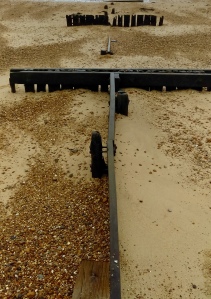
      I took this photo while on holiday last week in a place where I had never been before – a photo taken before I read this story today, one that seemed perfect to illustrate it. This story was meant to be. It sort of seems right. Without losing its disarming offness.
      My other reviews of Simon Strantzas: https://dflewisreviews.wordpress.com/simon-strantzas/
    9. I reviewed the next story in May 2017, as follows:
      =======================================
      THE VOICE OF THE PEOPLE by Alison Moore
      “…slowly, as if she were stepping through the mud…”
      A relatively short work that obliquely and satisfyingly blends today’s Brexit politics in the U.K….. and un-green industrial aberrations dulling health and the mind ……. and a theme and variations upon my own felt approaching onset of senility whereby everything seems to be too much trouble, a porridgy stigmatisation now affecting everyone, (not only those who are already old like me), an onset via the Zeno’s Paradox of clawing one’s way through mud and confusion, towards what? Tall trees in the shadows?
      This work is a neat, probably inadvertent, contribution to the book’s gestalt, as well as standing on its own as a telling fable.
      Not the voice, but the will of the people?
      My previous reviews of Alison Moore:
      https://dflewisreviews.wordpress.com/tag/alison-moore/ and https://nullimmortalis.wordpress.com/2012/10/23/the-lighthouse-alison-moore/
    10. CARNIVOROUS by William F. Nolan
      A nifty yarn of a couple leaving Chicago’s cold for California’s warmth and duly faced with monstrous plants creating more than just what the flower unfolds. Or what the world’s climate heats.
    11. I reviewed the next story A SONG OF DUST in October 2017 when it was first published with a different title, as follows…
      =================================
      640AD4CC-669E-4315-B3A8-A1C53E38A6E1NO GOOD DEED by Angela Slatter
      “Oh, you think yourself ridden by the mare of night?”
      “….where all things might end or begin again depending on the whims of her womb.”
      There are no NEW fears, only endemic ones in changed settings ever to be relived or interpreted anew. And this text turns in its own grave at this my attempt to hawl it… but turns towards me or away?
      As a darkly rich apotheosis of Tanith Lee, Mary Shelley, Charlotte Perkins Gilman and ‘Monk’ Lewis, this Slatter is a woman tagged and wired not only for her ends and means but also eventually for what niches lie beneath her puppy fat. Niches and riches. Longer dead self helping her newly dead self, she rises from some pent prison she deems to be a body spent, to take vengeance upon a tangle of female cousinage to find wherein it her Trajan husband still nests… with more weapons of womanhood than a simple secret hairpin. A fortune, if hoarded can only at the end be wasted, transient money and flesh alike…. But such concerns are as nothing when compared to things eventually to be learned beyond life?
      “As for madness, sometimes taking refuge in it is the only way to maintain a modicum of sanity.”
      My previous reviews of Angela Slatter: https://dflewisreviews.wordpress.com/tag/angela-slatter/
    12. I reviewed the next story in January 2017, as follows…
      =================================
      BORDER COUNTRY by Danny Rhodes
      A deceptively plain narrative, as deceptive as its moving wood. It packs a punch when the various simple emotions mix Into a complex gestalt of real or self-manufactured hauntings and subtle threats leading to an eventual growing dread of a father for the safety of his small son, a dread to echo that in the previous story between a father and small daughter.
      All of this is skilfully accentuated by the atmosphere of the downtrodden camping-site together with our sense of the guilt and despair attaching to the father’s thoughts about his broken marriage to his son’s now remarried mother.
      “What’s done cannot be undone.”
      ― from ‘Macbeth’ that also has witchery and a moving wood – and the Border Country?
      My previous reviews of Danny Rhodes: https://dflewisreviews.wordpress.com/tag/danny-rhodes/
    13. IN STONE by Tim Lebbon
      A story of mates, man and woman, man and man, not sexual, but mates, in the city. And the city takes them one by one, like brutalist architecture embracing them. Rites of passage, or, rather, rites of dark alley, with slugs and football pubs. Missing those we need when they’ve gone or about to go. From the point of view of one man, a man who has lost his best mate, and now who tries to avoid the city’s glance of attention. Ash the one leveller.
      My previous Tim Lebbons: https://dflewisreviews.wordpress.com/tag/tim-lebbon/
    14. I reviewed the next story in October 2017, as follows –
      =======================================
      SPEAKING STILL by Ramsey Campbell
      “There’s a call to reclassify schizophrenia as a spectrum instead of a disease.”
      That being a call on your mobile.
      The internet as a speaking sort of smart still or beer vat or psycho sump for spite from the dead to the living? Real ale as a doctor’s medicine like Mohammad’s Prohibition or Hound’s Howl …. accountancy of message texts or voicemail to contact the loved one, an ingenious method to take calls from the wormy grave? Whereby second childhood lasts for ever, with marital or parental love having a price in the profit and loss balance sheet. Ingenious chilling concept, indeed.
      My previous reviews of Ramsey Campbell: https://dflewisreviews.wordpress.com/tag/ramsey-campbell/: including The Searching Dead
      https://nullimmortalis.wordpress.com/2010/08/17/ghosts-and-grisly-things-by-ramsey-campbell/
      https://nullimmortalis.wordpress.com/2011/11/20/the-weird-8/
      https://nullimmortalis.wordpress.com/2010/08/10/beneath-the-ground-edited-by-joel-lane/
    15. UNDERWATER FERRIS WHEEL by Michael Bailey
      “In back, a man wearing a hairnet spins pink silk onto a conical cone of white paper.”
      68813F06-5E29-4E4C-A5FD-4F6A9D2F94B8
      Later, for boy-Ian’s Mom to use this pink candy floss as a beacon to look for her son in this tremendous fairground or carnival story, and I am taken by — and constructively lost in — the act of his, this boy’s, getting lost himself: is he with his Mom or someone called Cate or with a clown with big feet or even with his Dad? The eponymous ride somehow tells me. As I become my own reflection. Or vice versa. A story gem.
      “Maybe means no most times.”
    16. I reviewed the next story in January 2018, as follows…
      ==========================================
      IN THE COMPLEX by Mark Samuels
      “When the noise of laughter returned it seemed to emanate from all directions at once, as if mocking my attempts to isolate the source.”
      The source of this book’s Prozess?
      The last work is a truly terrifying coda to this book’s symphony — but also a stand-alone worthy of isolating as a great horror story — and it takes the ground from under my feet, the ground I had heretofore built for myself to stand this physically stylish book upon. Not a book to be thrust at me on my death bed, saying I told you so, not for you to read now! It starts as an Evenson or Beckett type incarceration-fiction, here subject to the perceived whims of that erstwhile Doctor who is responsible for keeping you – as a disease of ‘you’ – in strict quarantine. 67460333-594C-4029-805B-E82362478853A Quarantine Tontine that now extends to the discrete parts of one’s own body. And as you listen to the projected passing of trains, you keep, with a Zeno-angst, a slavishly religious tally of those trains like earlier keeping that Atlantic ship moving forward through the sea, even to the extent of concocting such a future tally for when you are absent and can’t hear them pass. A concertina of quarantined ‘YOUs’ with a reverse cri de cœur ostensibly in the shape of a Lovecraftian Mythos neologism now made Ligottian. Yes, a mighty coda, still giving off new meanings, even as I finish writing this gestalt real- time review while still in its immediate aftermath.
      My previous reviews of Mark Francis Samuels: https://dflewisreviews.wordpress.com/mark-samuels/
    17. AFTER SUNSET IN THE SECOND DRAWING ROOM by Felice Picano
      I am afraid I could not get my head round this plotter, concerning those in charge of Oratorio in Black, a Tv series, I guess, and all the conspiracies and patronage and partying shenanigans of the Entertainment world, and the large house that a couple, involved here, take on. A house the au pair says has voices and haints or duppies in some of the rooms… I was just left wondering if this is the second story in the book where Ash is a great leveller?
    18. I reviewed the next story in April 2017, as follows…
      =====================================
      DISPOSSESSION by Nicholas Royle
      “I lower the binoculars…”
      But what binoculars?
      It as if this matter-of-fact exercise in a coda-making for any book it happens to end is also a worm ouroboros of spying not only on others but also on oneself, surveillance by sound and sight, amid the humdrum dysfunctional nature of city rental properties as well as the personal relationships that share those spaces. The yearning for one’s own children even before they have become the foundlings of books no longer read, like this one, that isn’t be put on the shelf, or left behind like forgotten hangers.
      An insidious anti-story with echoes of deadpan existential authors you also once read. Robbe-Grillet or Beckett or Aldiss’ Report on Probability A?
      Or a different Nicholas Royle?
      My previous reviews of the said Nicholas Royle: https://dflewisreviews.wordpress.com/14748-2/
      And the other Nicholas Royle: https://dflewisreviews.wordpress.com/2017/05/24/an-english-guide-to-birdwatching-a-novel-by-nicholas-royle/
    19. I reviewed the next story in January 2019, as follows…
      =====================================
      THE ENDLESS CORRIDOR by Reggie Oliver
      “…a succession of horrific and bizarre escapades involving flying skeletons, giant toads dressed as monks, strange shifts in perspective, and, worse still . . . No! You’ll just have to read it for yourself!”
      For me, a rather silly, satirical Reggification of a distaff academic – this time with a distaff ‘partner’ and with a career thrust towards ‘impact’ – built upon MR Jamesian type research and arcane textual info-dumps of information about an obscure poet from the past and something called ‘The Castle of Oblivion’. Otranto, eat your heart out. Fracking, too. (See also this author’s distaff satire ‘Coruvorn’.)
      My many other reviews of the Reggie: https://dflewisreviews.wordpress.com/reggie-oliver/
    20. WHATEVER YOU WANT by Steve Rasnic Tem
      “, gobbling up more of the calendar with each trip of the world around the sun.”
      I want a Tem classic about Christmas FOR Christmas, one about a harassed single mother and her small daughter, her last-minute Christmas shopping in a near-derelict store, leaving her daughter with an elf woman and an amorphous Santa. This is good enough a story that I enjoyed, but it is, I am afraid, not a Tem classic by my own standards of expectation to which I have learnt to become accustomed.
      My previous reviews of Tem: https://dflewisreviews.wordpress.com/steve-rasnic-tem/
    21. THE SEVENTEEN-YEAR ITCH by Garth Nix
      “Old Scratch.”
      A laughable hokum of a nonagenarian inmate patient, a man who suffers accretive and diminuendo cycles of itching – desperately trying to assuage the itch in his chest to excoriate whatever lies within it in the guise of an itch and who is kept in a sphere as restraint every Halloween when the high points of each cycle occur. Evocative enough that I felt the itch myself. I mean that as a compliment to the text’s chutzpah.You see, also, that I am myself a septuagenarian like the doctor in the story, one who is wiser than you young coves, with an itch that gets worse the nearer death I get. And I have my eye on the lengthy necrology at the end of this book. Humanity ever has the endemic bad luck to always end up by leaving you the same way, I guess.
      My previous review of a Garth Nix work: https://dflewisreviews.wordpress.com/2014/06/24/fearful-symmetries/#comment-3219
    22. My previous reviews of Thana Niveau: https://dflewisreviews.wordpress.com/tag/thana-niveau/
      TO DROWN THE WORLD by Thana Niveau
      “I gave myself to the water. I’ve been drinking it. And they’ve been drinking me.”
      I don’t think this story was written for the likes of me. Yet, I can see others that it was written for, the story soaking them in, then them soaking it in, inveigling symbiotically with each other, amid global warming, stirring things in otherwise empty water; the symbiosis between twins, now a woman and a man, and earlier when they were small, about what she as a child pulled from the well-evoked causeway with its landmark sunken boat, and the symbiosis between it and her, and now her twin brother comes to the rescue, a rescue eventually diverted by a tornado. With possible alien implications. It’s almost as if the evocations came from some water and went back in, again and again, emptiness manifolded. Well it’s set me thinking, stirred the bugs where my brain swims.

    23. Till my brain is ready for steeping in the brine of a future Necrology. The one here for 2017 compiled by Stephen Jones and Kim Newman spreads over 100 pages. And, as with the 100 page introduction, I will read it later. I have finished reviewing the fiction, forming a strange, often star-pointed gestalt, a Gaia of stories that starts to settle towards its own level or niveau of fulminating water…shuttling at the edge of — even beyond — the complex itself. And I hereby make a formal request that, if I am ever considered for listing in a future Necrology, a blank should be left in it instead.
      end