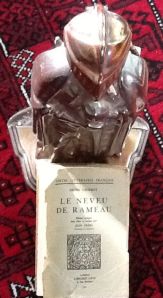
The Jungle by Elizabeth Bowen
“‘Anywhere special? I know of a tree with three apples they’ve forgotten to pick. We might go round that way and just see —’ […] Elise’s apple tree was half way down the kitchen-garden. They looked up: one of the apples was missing. Either it had fallen or some interfering idiot had succeeded in getting it down with a stone. The two others, beautifully bronze, nestled snugly into a clump of leaves about eight feet up. The girls looked round; the kitchen-garden was empty.”
…and this is quoted at length not only because of its meaningful vibes with ‘The Apple Tree’ (thud, thud, thud) but also because of the snug lap sleeping by Elise on Rachel’s KNEE at the end, without the oreaence of any Shadowy Third such as Joyce – or Charity of the ‘two tennis balls’ chest!
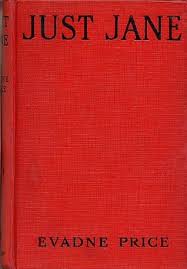
Fifteen years old on the brink of big sister Adela’s ‘boy and girl parties’, but not quite ready, with Elise, boyish and wielding a significant under-lip, and Rachel who discovered the secret Jungle land near the school, signs of tramps and even a vision of a dead girl’s bent arm, with its ‘elbow’ unspoken. They end up there, innocent sexually awakening versions that have been unblended from the contemporary Evadne Price’s Just Jane character as versions of Crompton’s Just William. With bloomers tucked into their skirts. ‘Wading’ to the autumn Jungle with late childhood’s cloying progress of Zeno’s Paradox? And the apples may Fall. or be offered?
“Elise was not listening. ‘I ought to have been a boy,’ she said in a matter-of-fact, convinced voice. She rolled a sleeve back. ‘Feel my muscle! Watch it – look!’”
…again, with any elbow unspoken. Although both Elise and Rachel have EL in their names.
Rooks circling above, so was this an October dream version of a happy autumn field? …
“Here was the place where the dead girl’s arm, blue-white, had come out from under the bushes. Here was the place where Elise, in the later dream, had come up and touched her so queerly.”
We all wake up in the slow no man’s land between wars? When we think that sleeping forever, on someone’s knee version of an elbow, is just biding our time? Re- or Un-Wilding?
***
All my reviews of Bowen stories: https://dflewisreviews.wordpress.com/31260-2/

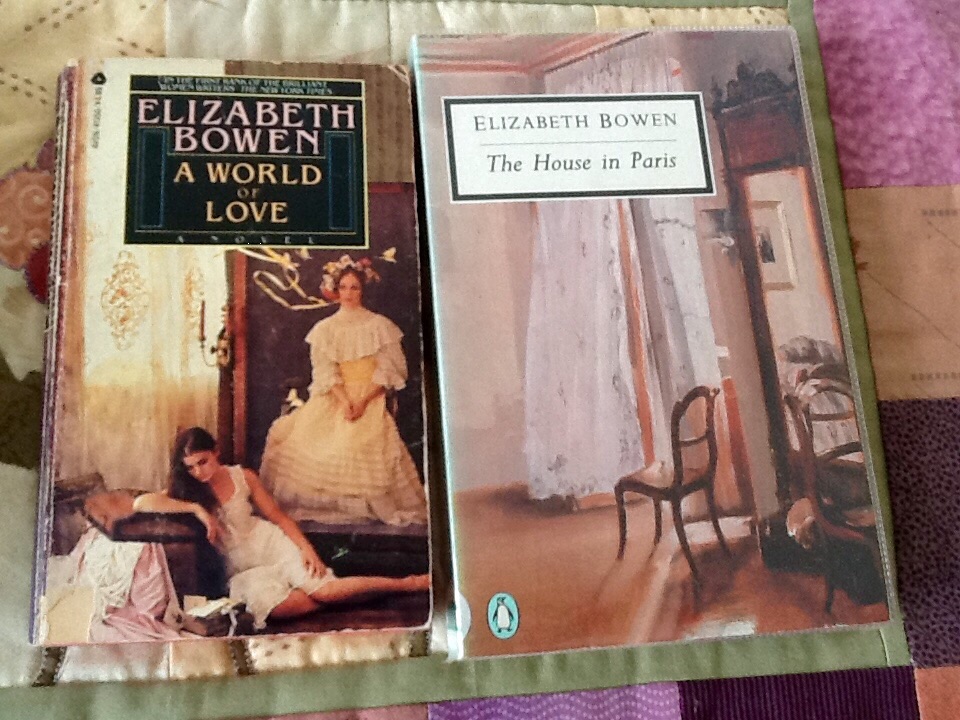

 Or did these so-called “supernatural” Easter Eggs appear as if from a strange Fate we cannot fathom? These Eggs found under the equally so-called “original” Apple Tree (cf Bowen’s own thuds of falling sounds of death in her ‘The Apple Tree’). Just remember this fact: “In her [Hermione’s] eyes existed a world of alien experience.” The white Panama Hat is merely an ironic decoy for what we can scry from such an obliquely amoral fable as this is. And the fact Hermione did not eat them nor even turn them to pulp — the latter transubstantiation perpetrated by God or the Devil? In a large village called West Wallows, one with a “nursery-rhyme hill.” And other nonsenses of truth that fictions often disguise.
UNWELCOME IDEA
“– its rival, the quicker bus, lurches ahead of it down the same road.”
It seems ironic that this story read today happens to come after yesterday’s ‘The Last Bus’ in my series of random (but eventually all) Bowen stories. This is a tram journey in variable clock time and variable general times of war or rumours and complaints, fears, blames (Hitler or not) in the Howth area, with all its evocative scenes, peoples, lighting and heat, forgotten Protestant ladies marshalled, as two women talk as they no doubt did everywhere like this, say, keep off the roads, the need to live anywhere except where you live now , each and every time of confusion, too, that there are such uncertain threats as there were recently in our own wars with an invisible enemy. A metaphor of inhumanly unwelcome elbow in our ribs of time, I guess. There are many human elbows, too, in Bowen, as, here, the one on a tram. Bracketing unwelcome ideas as well as lives.
“‘Are you on the tram?’ She settled round in her seat with her elbow hooked over the back – it is bare and sharp, with a rubbed joint:”
“Out from the tops of the shops on brackets stand a number of clocks. As though wrought up by the clocks the tram-driver smites his bell again and again, till the checked tram noses its way through.”
“But with parallel indignation Mrs Kearney has just noticed a clock. ‘Will you look at the time!’ she says, plaintively.”
There are indeed many elBOWs in Bowen stories! Check them out.
Not so many brackets, though?
THE HAPPY AUTUMN FIELDS
“They walked inside a continuous stuffy sound, but left silence behind them.”
“There was no end to the afternoon,…”
This is apotheosised Bowen, for me. How could I have forgotten it till now? As if I have been living a parallel life in a different time zone, till woken back to where I once was or will be. Sarah’s co-vivid dream (“The unreality of this room and of Travis’s presence preyed on her as figments of dreams that one knows to be dreams can do”) and now such a dream of our own times makes sense for the first time, as she returns from some other distant time, time, time, when Sarah fell in love with Eugene on a horse following the rest of the family under skies and rooks, the brothers about to leave home, all walking with their Father who had ordered the walkers alongside him and behind him, and Sarah’s twin sister Henrietta falling behind the group, a sister with whom she lives as literally bosom friends, never out of each other’s sight (“Rather than they should cease to lie in the same bed she prayed they might lie in the same grave”), never till now, that is, and now waving, I infer, a handkerchief as a “scientific ray” of time itself (making this rigorous SF not whimsical fantasy) a wave farewell, as if whatever made Eugene’s horse shy with a start is implied here, that hour within Henrietta like the Inherited Clock’s agonising minute (“But now Henrietta had locked the hour inside her breast”) an hour now caught into the future of the ‘No. 16’ terrace in another Bowen story of the London blitz…
“‘Do you realize you’re the last soul left in the terrace?’ — ‘Then who is that playing the piano?’”
Somehow also fitting with…
“‘Charles the First walked and talked half an hour after his head was cut off,’ said Henrietta.”
How ironic, and, now, after today’s earlier Unwelcome Idea, how ironic is handsome Eugene’s elbow…
“Eugene matched his naturally long free step to hers. His elbow was through the reins; with his fingers he brushed back the lock that his bending to her had sent falling over his forehead.”
That lock of hair in Travis’s box at No. 16! And later, or earlier, “the shells and figurines on the flights of brackets,” brackets now broken by a twentieth century war, but with classical music present, if tantalisingly unheard… “…the music on the piano-forte bore tender titles, and the harp though unplayed gleamed in a corner,…”
“Henrietta singing…” then…
Sarah, “saddled with Mary’s body and lover.” Travis, her dream-real lover in a ruined terrace.
“…she tried to attach her being to each second, not because each was singular in itself, each a drop condensed from the mist of love in the room, but because she apprehended that the seconds were numbered?”
“Through the torn window appeared the timelessness of an impermeably clouded late summer afternoon.”
“What has happened is cruel: I am left with a fragment torn out of a day, a day I don’t even know where or when; and now how am I to help laying that like a pattern against the poor stuff of everything else? – Alternatively, I am a person drained by a dream. I cannot forget the climate of those hours. Or life at that pitch, eventful – not happy, no, but strung like a harp. I have had a sister called Henrietta.”
But what of her little brother Arthur, who had also been in that fateful walk in that rooky wood of past time! Those happy autumn fields become…
“…fuming cataracts and null eternal snows as poor Arthur kept turning over the pages, which had tissue paper between.”
Great literature can never end. Reviews of it can only hope to reach conclusion
‘Forever Autumn’, see my https://nullimmortalis.wordpress.com/2012/09/20/forever-autumn/ in 2012…
“eternity seemed to have set in at late autumn.” The Disinherited (Elizabeth Bowen)
“At the other side of the horse, Henrietta began to sing. At once her pain, like a scientific ray, passed through the horse and Eugene to penetrate Sarah’s heart.”
My next review is of THE JUNGLE here: https://elizabethbowensite.wordpress.com/2021/10/30/the-jungle-by-elizabeth-bowen/
BRIGANDS
The story of ten year old Oliver who has a “darker side of his character” that “is only mentioned because of its exciting results.” Well, he was mischievous and inquisitive, like William Brown, and with his ten year old companion Jane Turpin by the name of Maria, follows ‘brigands’ (who were really the head gardener with some footmen and other gardeners) down a secret trap door and into a cave — and thus they prevent a huge robbery of the castellated house and the kidnapping of the obnoxious fat Priscilla, the daughter of his Uncle Arthur and Aunt Alice with whom Oliver is staying. Outlandish events with peashooters and waterpistols but has a good prophetic grasp of today’s Co-vivid dreaming when, after going down the secret trapdoor,
“Maria and Oliver were quite staggered. For a moment, they accused each other of having gone to sleep.”
Much come-uppance duly ensues. Well done, Maria and Oliver.
“After this, Aunt Alice would have nothing but lady gardeners; she also gave up the footmen and had nice parlour-maids.”
This review now continues here: https://nemonymous123456.wordpress.com/elizabeth-bowen-stories-8/