Sunday, April 28, 2013

NO DREAMS


There was no way it could  happen without involving dreams, but I've been banned dreams by my friends and family, banned them categorically, because, I'm told, they're bad for me, bad not only for my mental health, but also for my creativity, like when I obsessively put dreams or tedious concepts about dreams in my stories or crazy dream visions in my paintings or gradually falling asleep with non-programmatic music, such as symphonies and sonatas, sounding through my ear-plugs, feeding, no doubt, the onset of more dreams for me to re-cook....

So how could I make it happen without the help of dreams or what I imagined dreams to be? The task itself that I had been set you already know because I just told you. The task was to be starved of dreams or of thinking about dreams -- for there to be NO DREAMS. But how could this happen without me thinking about dreams first, without me having dreams, and so forth, so that I could later ensure that I had made it all happen, made the NO DREAMS life not only possible to happen but actually happening, observably happening in the shape of an absence of something rather than the more provable presence  of something ... An absence not only achievable but incontrovertibly achieved.

To have something in your life obliterated you first needed to know everything there was to know about that something so that you could ensure that not only the something itself but also every disguised trace of it, every encoded  innuendo of it, every secret lurking power of it, every clandestine clue of it, were all obliterated, too.

And I was not yet ready to KNOW.

Not ready to know when there were no more dreams possible in my life. I had to continue dreaming about dreaming -- even about not-dreaming -- as a sort of belt-and-braces method to allow something like a dream to know more about itself in comparison with a not-dream, in order for a dream to rid itself *of* itself.

In other words, if you can forgive me, this was no overnight process!

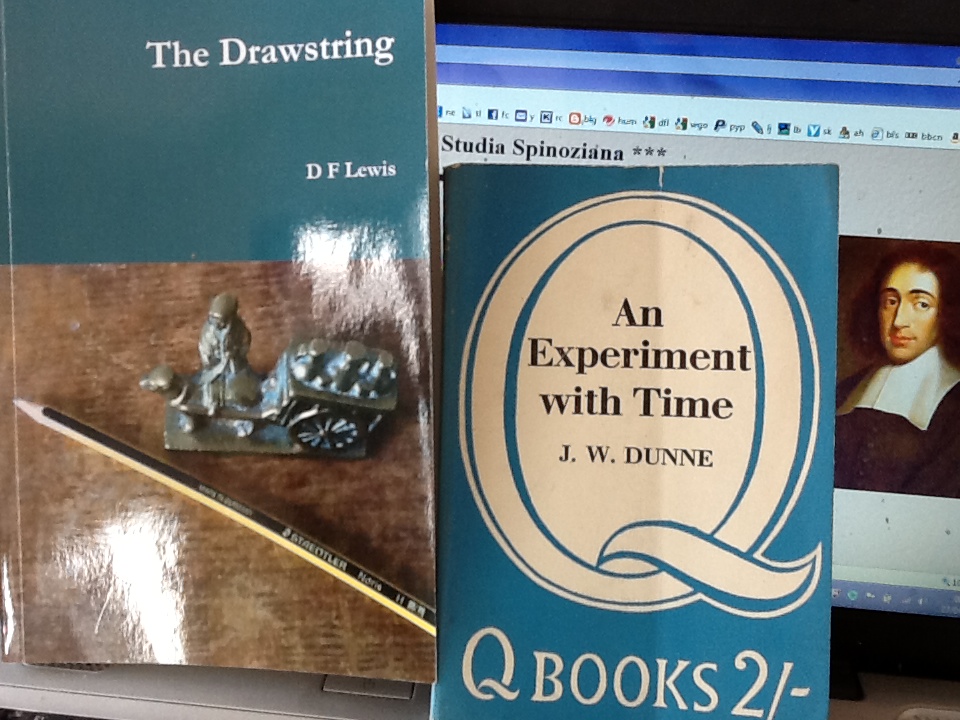
TIME, then, was the essence. An Experiment with Time. The linear absorption of further dreams and not-dreams would be insufficient.


Using more of an instinct than a knowable fact, I felt I needed, somehow, to scatter any new test-dreams throughout my past and my future as well as my present, seeking an absence of a dream  for each presence of a dream and systematically replacing the latter with the former. This would be the only way to clear my complete system from dreams, so that a whole lifetime of such dreams could be flensed.  Scraping at the sides of the mind till every corner of it had been given the all clear from dreams. And I was sure that this was the only way to do that -- by using dream to destroy dream.

But then it dawned on me that this 'scattering' process would need to be conducted through all time not only my own time. Those dreams that existed before I was born and those dreams that may exist beyond my own finite future would otherwise likely impinge toward the middle that was me.

In other words, I needed to be concerned with other people's dreams, people dead, people still living and even people not living now but people who were due to live.  NO DREAMS must mean NO DREAMS.  Otherwise,  I could never be sure. And, so, the task took on mammoth proportions in my mind and, if you will forgive me,  I must tell you that I began to suffer nightmares about it!

How dare I be set such an inhuman task,  I asked myself. If my friends and family loved me they would never have asked me, would they? The reasons they had given  for setting the task  I had now forgotten, and even if I could remember the reasons, they would probably now seem so trivial when compared with the enormity of the task itself.

Time, as I say, is of the essence. It may be easier than I thought. The quickest way would be probably be the *only* way.


I live now in the past and in the future, but never in the present. The strength of dreams prevailed, after all, to make such an existence possible.

This is the moment in time that is me,
a moment never quite crystallising but always there,
merely a thought away.
Not a not-dream, as such,
but a memory of somebody that nobody can ever quite place.

Saturday, April 27, 2013

RTRcausal

I arguably coined these words and expressions: ‘zeroism, egnisomicon, egnisism’ in conjunction with PF Jeffery (1967), ‘whofage’ in conjunction with PF Jeffery (1973), ‘agra aska’ (1983), ‘weirdmonger’ (1988), use of ‘brainwright’ in modern times (1990), Salustrade (1992) use of ‘yesterfang’ in modern times (1997), ‘wordhunger’ (1999), ‘nemonymous, ‘nemonymity’, late-labelling, veils-&-piques’ (2001), ‘denemonise’ (2002), ‘megazanthus’, ‘weirdonymous’, ‘chasing the noumenon’ (2003), ‘wordonymous’, ‘wordominous’, ‘the-ominous-imagination’, revelling in vulnerability (2004), ‘a woven fire-wall of words’, ‘the synchronised shards of random truth and fiction’, ‘nemoguity’, ‘vexed texture of text’, ‘fictipathy’, ‘nemotion’, ‘the hawler’, ‘the angel megazanthus’, ‘klaxon city’, ‘horrorism’ when used as a word for the philosophy of horror fiction (2005), ‘publication-on-reading’, ‘antipodal angst’, ‘the tenacity of feathers’, ‘a writer’s mandala’, ‘wordy weird’, ‘nemophilia / nemophobia’, ‘magic fiction’ as the obverse of the more common expression ‘magic realism’, ‘weirdtongue’ as the ‘name’ of a language, ‘Glistenberry’ as an alternative name for ‘Glastonbury’, ‘tonguage’ as a ‘conscious’ language, ‘yester-eggs’ as a term for Proustian ‘selves’, ‘the parthenogenesis of reality from artifice’, ‘all is for the pest in the pest of all worlds’, ‘Baffles’ as fables with muffled morals (2006), ‘fanblade fable’, ‘abutting the if’, ‘word clones / word clowns’, ‘bumps for books’, ‘rite of review’, ‘cone zero’, ‘a basket of coinages’ (2007), ‘small press cover ark(ive), the baser pulps’ ‘orrorfaces’, ‘the wheel culture’, ‘netogenic’, the first fiction about a ‘drogulus’, ‘Innerskull’, ‘meganthus‘ (2008), ‘CERN Zoo’ in literature, ‘Real-Time Reviewing‘, ‘ligottum‘, ‘the pit and the pessimum‘, ‘ligottus‘, ‘fubbcuckle’, ‘extraneity creep’, ‘pillowghost’, ‘intowards’, ‘powderghost’, ‘nightmare’s moat’ (2009), ‘THE TENSES’, ‘scream munch’ as another word for ‘captcha’, ‘skight’ – threepenny bit, ‘invitations from within’, ‘novellatory’, ’Ress’, ‘Venn Dreams’, ‘Tearsheet Doll’, scanbuncle, A Götterdämmerung of Guts , Holistic Horror (2010), SFtopia, Salustraders / Overspacers, Novellarette, Inquel, Gaddafery, Jungian autonymity, sudracide, an impesto novel, trendbaffler, our planet as reliquary, fictionatronics, Lovecraftianisation, “To know the worst is also to know the best“, vignellarette, “Nothing is controlled by logic other than logic itself.”, nightgators, Horror Genreators, dicksplay, roman littoral, ghostalt, poltergeistalt, horrasy, Horrasy: The Horrastic and the Heuristic, srednibution, srednidipity, Lovecraftian indescriptivities, bememorise, alephantiasis, reva-menders, metapomorphic, rarifiction, neoloquism, Was the God Particle born instable? (2011), angelivalent, literal-meaning dreaming, the ‘Higgs boson’ of Horror, The Weirdonomicon, Aickmania, shortcomings harnessed are stronger than strengths unused, privacy-trawler, disarming strangeness in connection with Robert Aickman, Fiction is like currency: belief is everything, oblique concomitant / oblique contaminant, age at the edge, A writer should make clouds shine even if the world’s sun has gone, The Call of the Silly, pastilential, eschairtology, e-born, read-tangler, ghorror, the authorial cloud, grosmance, quixotiose, most placating is playacting, ‘friendly fire’ fiction, dilemmachination, absurface, aeontonomous, HobbYiSt / Hobbit, aeontonomy, Horror Without Victims, fuckerlode, Earkth, Pronoun Horror, The Ives of November, PreMonday-ition, NoV – No Victims, an amid-life crisis, God created Ground in His own image by adding ‘run’ to His name, Old boots are always better than no boots, truth is never brash, End tring, Tendring is Trending, HorNET Nest, The empty future expects our arrival soon, if you fit, wear yourself, The Worldwide Cliff (2012), quantitative kamikaze, The Ohm Resistor of Literature, Only real books can be left anonymously on chairs, The Sibling Thing (as monster), lachrymonics, Cold Sororist, Gangster Gongsters, Cathrian, Cathrianity, Cathrechism, the optimum delusion, dogstone as a form of ‘found sculpture’, iDEATH as a form of internet implosion of self, Judge me on my works, not on my request thus to judge me, dyschronous recurrence, Belarhombus, the Palimp’s Zest, abseil-surdity, paradoxilogically, Devolved Fiction, fratrinity, bock-hide, the Ligottian lurch, denouement or deligottiment, Does a Seraph suffer from Harpes?, AickMANN, RTRcausal (2013).

Elogious


jacques2

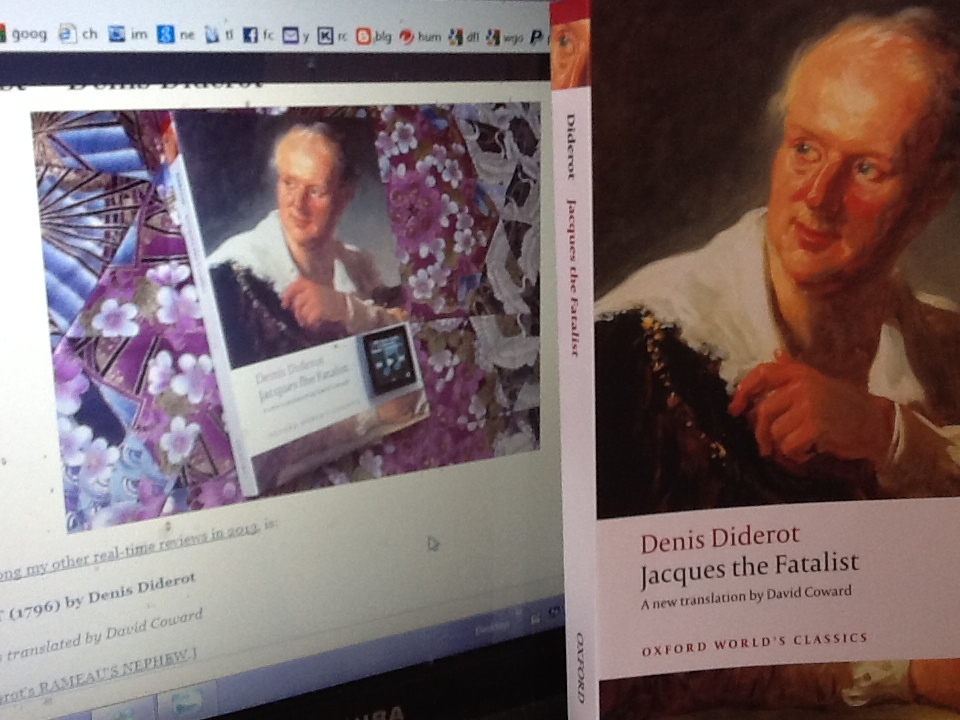
AN EXCERPT BELOW FROM MY REAL-TIME REVIEW HERE OF JACQUES THE FATALIST (1796) by Denis Diderot

jacques4

Pages 147 – 163
Dogs as underlings in some universal pecking order and public executions provide some disconnected topics here. And pictures for the Master being “word pictures” with a pen or pencil rather than a paintbrush, I guess. The latter seems later to elicit the word “elogious” and this book’s use of this word is the first I have ever encountered, I’m sure. This seems to radiate back somewhat to my above reference to the physical translation, through time, of language or text (skipping or adding, Whovian or not)… There is also a turn of phrase in this section that sticks out like a sore thumb involving being called an “old shit”.

Meanwhile, as a result of this section in this book, I have started to brush up on Spinoza and I wonder if Diderot (or his narrator) may not be a Plura-Monist rather than simply a Monist (the concept first raised by me in connection with my recent real-time review of ‘The Magic Mountain’ by Thomas Mann here). Meanwhile again, there is yet another interruption of Jacques’ tale about his love-life with a co-traveller’s tale of some saucy pranks regarding some monks, whose Abbot is into austerity and was pre-Thatcher, the latter seeming, since her very recent death, to raise her post-retrocausal head quite often in my reviews.
 

“It was his view that if we had a clear sight of the chain of causes and effects which shape a man’s life from the moment he is born until his dying day, we would be convinced that everything he had done was what he had no choice but to do. [...] His Captain had stuffed Jacques’s head with his opinions which he had got from Spinoza,…[...] …he [Jacques] was a good man , candid, honest, brave, loyal, faithful, very obstinate, even more loquacious, and no less vexed than you and I to discover that he had embarked upon the story of his loves with almost no hope of ever finishing it. [...] In any case, I can see poor Jacques now, with a large scarf would round his neck…”

Saturday, April 20, 2013

Horizontals and Uprights


  1. Having completed my month-long real-time review of THE MAGIC MOUNTAIN by Thomas Mann, I am convinced that it must have been an enormous influence, outweighing any other influence, on the fiction of Robert Aickman. This is not only because of the similarity I seem to be the first to observe between The Hospice and The House Berghof, and their residents, and their meals, but also because of many other factors, including tone and beguiling disarming undercurrents and tropes, an absurd-weirdness that borders on nightmare as well as rationality.
  2. I am now revising my thoughts on the AickMANN story ‘Into The Wood’......
  3.  
  4. Into The Wood by Robert Aickman
  5. This novella seems to house a balustraded Sanatorium equivalent to that in ‘The Magic Mountain’ (except it is for the Half-Sleep not the Half-Lung Club!) where Mann’s ‘horizontals’ have become Aickman’s ‘uprights’, ritually walking off into the benighted wood, much like Hans Castorp once tried walking off into the white-out of snow. Mann’s sanatorium conveys tropes for the First World War, and Aickman’s for the Second World War. Both ‘rest cures’ of encroaching death-luxury… Both sleep and hunger unpredictable quantities.
    Lord Rosebery we’re told in this novella never got any sleep, and our female protagonist here, Margaret (another politician like Thatcher?) gradually loses the need for sleep as she approaches her own ritual withdrawal from life or her own Strindbergian Dance of Death… Within Mrs Slater’s ‘didactic stare’.

  6. “…a faint mistiness, a clammy softness; [...] When the sun did strike, the vague mist seemed to make it still hotter.”

  7. “She had noticed before that a person’s troubles, the pity the person has for those troubles, and the pity a second person feels for the first person, are all independent from one another.”
    “Losing one’s way was largely an act of intention.”

  8. “So eat up your mört, Margaret, and take no notice of all these gloomy thoughts.”

  9. A reference in the Aickman to Casanova who is another Italian Freemason like Mann’s Settembrini.

  10. “It is a little like the Italian parable of the onion: skin after skin comes away, until in the end there is nothing — nothing but a perfume that lingers a little, as the dead linger here a little after death, perfuming the air, and then are gone.”

  11. ————————————-

  12. And my final word on ‘The Magic Mountain’ – I have just read Mann’s own afterword to the novel for the first time and its following passage seems very relevant to this having been my SECOND reading of the novel (having first read it in 1970) and ALSO relevant to my real-time reviewing for the last five years being described as garnering a gestalt from leitmotifs!

  13. “But if you have read The Magic Mountain once, I recommend that you read it twice. The way in which the book is composed results in the reader’s getting a deeper enjoyment from the second reading. Just as in music one needs to know a piece to enjoy it properly, I intentionally used the word “composed” in referring to the writing of a book. I mean it in the sense we more commonly apply to the writing of music. For music has always had a strong formative influence upon the style of my writing. Writers are very often “really” something else; they are transplanted painters or sculptors or architects or what not. To me the novel was always like a symphony, a work in counterpoint, a thematic fabric; the idea of the musical motif plays a great role in it.
    People have pointed out the influence of Wagner’s music on my work. Certainly I do not disclaim this influence. In particular, I followed Wagner in the use of the leitmotiv, which I carried over into the work of language. Not as Tolstoy and Zola use it, or as I used it myself in ‘Buddenbrooks’, naturalistically and as a means of characterization—so to speak, mechanically. I sought to employ it in its musical sense. My first attempts were in ‘Tonio Kröger’. But the technique I there employed is in ‘The Magic Mountain’ greatly expanded; it is used in a very much more complicated and all-pervasive way. That is why I make my presumptuous plea to my readers to read the book twice.”

Friday, April 19, 2013

The Thunderbolt

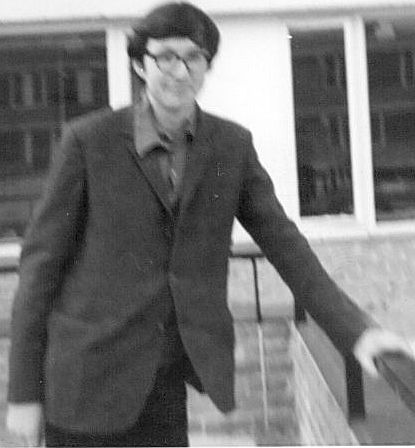
magicm20 Me as Hans Castorp in 1967:
The 'slanting' on the balcony outside Room 34.

The Thunderbolt
"They let him be. He was like the scholar in the peculiarly happy state of never being “asked” any more; of never having a task, of being left to sit, since the fact of his being left behind is established, and no one troubles about him further—"

Like Peeperkorn, he is "settled". With his 'brand' of 'Maria' (or memory of Clavdia, rather than Ellen's 'child'?). But...
.
"His watch had fallen from his night-table; it did not go, and he had neglected to have it regulated, perhaps on the same grounds as had made him long since give up using a calendar, whether to keep track of the day, or to look out an approaching feast: the grounds, namely, of his “freedom.” Thus he did honour to his abiding-everlasting, his walk by the ocean of time, the hermetic enchantment to which he had proved so extraordinarily susceptible that it had become the fundamental adventure of his life, in which all the alchemistical processes of his simple substance had found full play."

The cruise-ship Berghof becomes indeed the Titanic, as flat-land becomes War, and we lose our hero amid its congestivities of human infamy.
.
"...their wild, chaotic contents pressed up out of the depths to his very balcony,"

"...laden with death, slopes earthward thirty paces in front of him...[...] Your tale is told. We have told it to the end, and it was neither short nor long, but hermetic. We have told it for its own sake,"

And thus my real-time reviewing reaches Hiraeth.

ABOVE IS AN EXCERPT FROM REAL-TIME REVIEW OF 'THE MAGIC MOUNTAIN' BY THOMAS MANN HERE.

Sunday, April 14, 2013

Libanomantic Dreams

skites15 .
The Incense: a free version of 'The Incense' by Zabel Khanjian Assatour, 'Mother Sibyl'.

"A white shadow burns"

A libanomantic exercise, perhaps, in showing that old witches once were (in this poem's last stanza) charming, innocent children, now wafted into the air for reading their souls' runes. Incense smoke as the veil from or against burning passions.

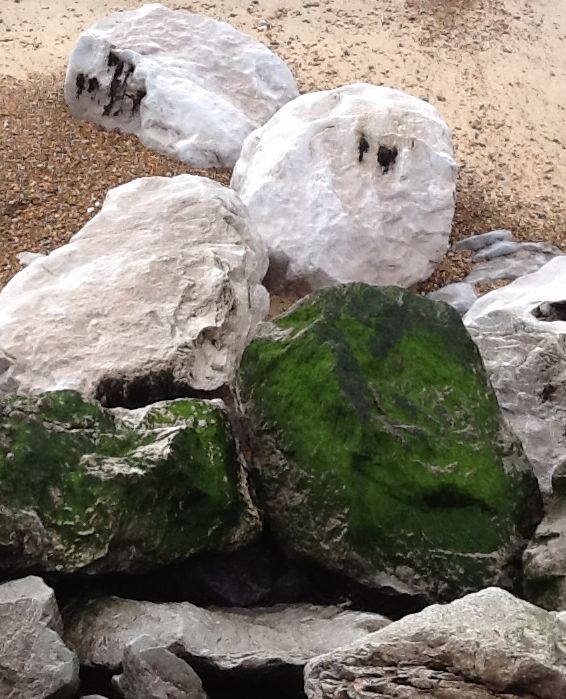
Even old men like me, who sometimes enter churches of the wrong religion only to find that incense can also summon their own souls' runes -- and in this photo of me (a year ago), there can be just seen an incense burner beside me on the ground, gushing its fumes upward, but this is nothing when compared to the sun's strong beam. Yet, one day, no doubt, that beam will grow paler than its own projected kite's future light.

Libanomancy, or smouldering stars as distant anvils' sparks, not the anvils themselves.


ABOVE IS AN EXCERPT FROM MY REVIEW OF 'STAR KITES' by MARK VALENTINE HERE.

Wednesday, April 10, 2013

Knurl Immortalis

'The British Museum' (2006) - Celia Paul 'The British Museum' (2006) - Celia Paul

On Celia Paul's 'The British Museum' (1996)
"where mauve shadows move;,"
Whether images or words can ever match each other, this poem is a truly fine conjurement of a painterly dream and, again in this book, of 'the plasticity of time'.
And if it can rain in a museum, one wonders if the past scries us as much as we scry it? [Cf "I am always reading the rain" from 'Psammomancy'.] 'Shades', too, each a word's reflection.


EXCERPT from my review OF 'STAR KITES' by Mark Valentine (TARTARUS BOOKS)

Monday, April 08, 2013

From Zeroism to Deligottiment

I arguably coined these words and expressions: ‘zeroism, egnisomicon, egnisism’ in conjunction with PF Jeffery (1967), ‘whofage’ in conjunction with PF Jeffery (1973), ‘agra aska’ (1983), ‘weirdmonger’ (1988), use of ‘brainwright’ in modern times (1990), Salustrade (1992) use of ‘yesterfang’ in modern times (1997), ‘wordhunger’ (1999), ‘nemonymous, ‘nemonymity’, late-labelling, veils-&-piques’ (2001), ‘denemonise’ (2002), ‘megazanthus’, ‘weirdonymous’, ‘chasing the noumenon’ (2003), ‘wordonymous’, ‘wordominous’, ‘the-ominous-imagination’, revelling in vulnerability (2004), ‘a woven fire-wall of words’, ‘the synchronised shards of random truth and fiction’, ‘nemoguity’, ‘vexed texture of text’, ‘fictipathy’, ‘nemotion’, ‘the hawler’, ‘the angel megazanthus’, ‘klaxon city’, ‘horrorism’ when used as a word for the philosophy of horror fiction (2005), ‘publication-on-reading’, ‘antipodal angst’, ‘the tenacity of feathers’, ‘a writer’s mandala’, ‘wordy weird’, ‘nemophilia / nemophobia’, ‘magic fiction’ as the obverse of the more common expression ‘magic realism’, ‘weirdtongue’ as the ‘name’ of a language, ‘Glistenberry’ as an alternative name for ‘Glastonbury’, ‘tonguage’ as a ‘conscious’ language, ‘yester-eggs’ as a term for Proustian ‘selves’, ‘the parthenogenesis of reality from artifice’, ‘all is for the pest in the pest of all worlds’, ‘Baffles’ as fables with muffled morals (2006), ‘fanblade fable’, ‘abutting the if’, ‘word clones / word clowns’, ‘bumps for books’, ‘rite of review’, ‘cone zero’, ‘a basket of coinages’ (2007), ‘small press cover ark(ive), the baser pulps’ ‘orrorfaces’, ‘the wheel culture’, ‘netogenic’, the first fiction about a ‘drogulus’, ‘Innerskull’, ‘meganthus‘ (2008), ‘CERN Zoo’ in literature, ‘Real-Time Reviewing‘, ‘ligottum‘, ‘the pit and the pessimum‘, ‘ligottus‘, ‘fubbcuckle’, ‘extraneity creep’, ‘pillowghost’, ‘intowards’, ‘powderghost’, ‘nightmare’s moat’ (2009), ‘THE TENSES’, ‘scream munch’ as another word for ‘captcha’, ‘skight’ – threepenny bit, ‘invitations from within’, ‘novellatory’, ’Ress’, ‘Venn Dreams’, ‘Tearsheet Doll’, scanbuncle, A Götterdämmerung of Guts , Holistic Horror (2010), SFtopia, Salustraders / Overspacers, Novellarette, Inquel, Gaddafery, Jungian autonymity, sudracide, an impesto novel, trendbaffler, our planet as reliquary, fictionatronics, Lovecraftianisation, “To know the worst is also to know the best“, vignellarette, “Nothing is controlled by logic other than logic itself.”, nightgators, Horror Genreators, dicksplay, roman littoral, ghostalt, poltergeistalt, horrasy, Horrasy: The Horrastic and the Heuristic, srednibution, srednidipity, Lovecraftian indescriptivities, bememorise, alephantiasis, reva-menders, metapomorphic, rarifiction, neoloquism, Was the God Particle born instable? (2011), angelivalent, literal-meaning dreaming, the ‘Higgs boson’ of Horror, The Weirdonomicon, Aickmania, shortcomings harnessed are stronger than strengths unused, privacy-trawler, disarming strangeness in connection with Robert Aickman, Fiction is like currency: belief is everything, oblique concomitant / oblique contaminant, age at the edge, A writer should make clouds shine even if the world’s sun has gone, The Call of the Silly, pastilential, eschairtology, e-born, read-tangler, ghorror, the authorial cloud, grosmance, quixotiose, most placating is playacting, ‘friendly fire’ fiction, dilemmachination, absurface, aeontonomous, HobbYiSt / Hobbit, aeontonomy, Horror Without Victims, fuckerlode, Earkth, Pronoun Horror, The Ives of November, PreMonday-ition, NoV – No Victims, an amid-life crisis, God created Ground in His own image by adding ‘run’ to His name, Old boots are always better than no boots, truth is never brash, End tring, Tendring is Trending, HorNET Nest, The empty future expects our arrival soon, if you fit, wear yourself, The Worldwide Cliff (2012), quantitative kamikaze, The Ohm Resistor of Literature, Only real books can be left anonymously on chairs, The Sibling Thing (as monster), lachrymonics, Cold Sororist, Gangster Gongsters, Cathrian, Cathrianity, Cathrechism, the optimum delusion, dogstone as a form of ‘found sculpture’, iDEATH as a form of internet implosion of self, Judge me on my works, not on my request thus to judge me, dyschronous recurrence, Belarhombus, the Palimp’s Zest, abseil-surdity, paradoxilogically, Devolved Fiction, fratrinity, bock-hide, the Ligottian lurch, denouement or deligottiment (2013).

Friday, April 05, 2013

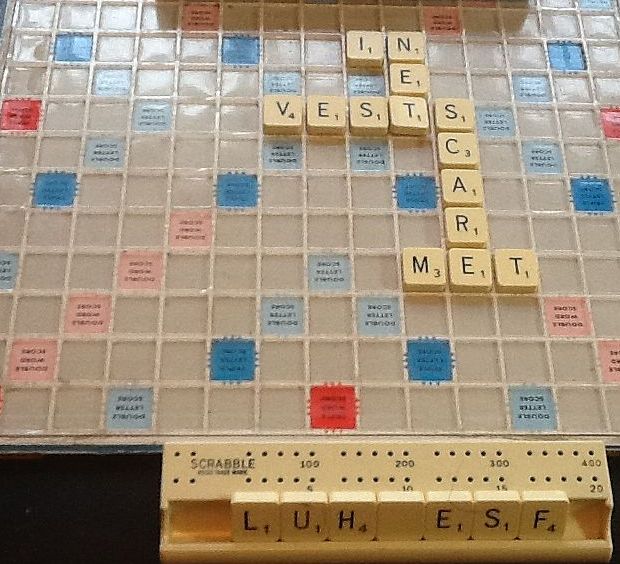
Scare

skites4ScareThe rules of ‘scare’…”
Still unrhyming enjambement, yet simpler words than in ‘Marbles’, again powerfully conveying the nostalgic days of my youth, with one of those benighted children’s games that, I now feel, grew up almost autonomously like skipping rhymes and onion songs that kids knew not whence they came but they knew them anyway.
[Yesterday, fortuitously, in my review of 'Onion Songs' I did 'shuffle' the letters in "Rasnic Tem" into 'Met in Scare'.]
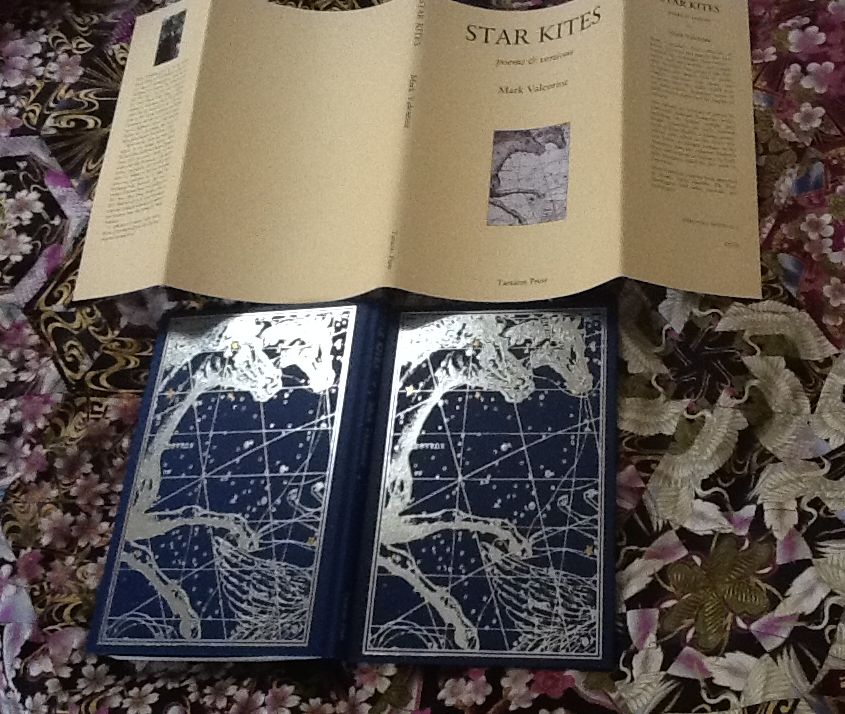
EXCERPT FROM BELOW:


skites1
Tartarus Press (2013)

My previous reviews of Mark Valentine’s work: The Nightfarers – Cinnabar’s Gnosis – The Mascarons of the Late Empire & Other Studies – Null Immortalis – The Peacock Escritoire – The Master in Café Morphine – THE HA OF HA – Secret EuropeAt Dusk

STAR KITES – poems & versions by Mark Valentine

His own poems and his ‘versions’ of poems by Zabel Khanjian Assatour, George Bacovia, Sergio Corazzini, Charles Cros, Florbela Espanca, Gustav Falke, Georg Heym, Hugo von Hofmannsthal, Ludmila Jevsejeva, Hedwig Lachmann, Charles Leconte de Lisle, Antonio Machado, Émile Malespine, Georgo E. Maura, O.V. de L. Milosz, Jean Moréas, Fernando Pessoa, Edith Södergran, Ernst Stadler, Paul Valéry, Maria Luise Weissmann.

MY REAL TIME REVIEW OF THIS BOOK COMMENCES HERE.

Tuesday, April 02, 2013

THE GREEN DOG

os16The Green Dog
"He loved making the effort. He loved trying."
I know I first published this story (in Null Immortalis: Nemonymous Ten, with my original review of it here), but, having just re-read it, in the context of this book, I genuinely believe it is (so far) the most poignant and the most central to the 'old man process', as I have begun to call it in this review. Also relevant to another theme of this book: 'identity'. There is nothing sexist intended by me about the 'old man process' (semi-colon) it's just a frame of mind that only 'old men' of any age can have (but, of course, not all old men). A combination of anal-retentive, curmudgeonliness, a paradoxical spirituality and creativity deriving from that otherwise negativity-strewn oldmanness, often with a Ligottian cathricity, sporadically peppered with good intentions and, dare I say, love (often unrecognised). Well, who knows, that may just be me trying to make me into a class of many mes, to make me feel better! This story has the 'miscegenation of souls' I mentioned about 'The Multiples of Sorrow' and seen, too, in 'Merry-Go-Round' via, here, a symbiosis between an old man and a green dog, the refraction and incidence of the lights in 'The Glare and the Glow', the state of human 'existence' represented by Charles in 'Charles', the 'inventing of holidays' from that earlier holiday in foreign UK, an aspirational love of one's family as well as the isolation beyond family and the irritation of the negative channels between family members, and much more, both negative and arguably positive. 'The Green Dog' has to be read at least once in your life.

An Excerpt from my real-time review of ONION SONGS by Steve Rasnic Tem (Chomu Press): HERE

Thursday, March 28, 2013

'Jungle J.D.' by Steve Rasnic Tem


os5Jungle J.D.
“It was like living with dead people.”
When I finished reading this story, I uttered aloud: “Wow!”
What a story, I thought, how can I possibly categorise this, ‘gestaltise’ this, chase the noumenon of this, because, simply, it’s its protagonist Tony’s “it”! The “hypo” of the “hippo”.
Any story that features the 1960 record ‘Runaway’ by Del Shannon — that was so significant in my life at that time, playing it almost incessantly, as I did, on my Dansette auto-change — cannot possibly fail, even if it’s completely above my head. This is a significant gem of literature for me, with its rocking and rolling cruising of boy and his gal in his kooky car, the sudden crash and the wild alternate post-war Nazi-Tarzan future that we all missed because we weren’t killed. Well that’s one interpretation. A seriously politically-incorrect gig that makes me think I am in a dream – or nightmare? Or literary Heaven? Ungawa!
[His gal's name is Joy. Well, here's a story I had published in 1998 that also features Del Shannon, called 'Joy Rider'!!!]
 
An excerpt from my real-time review of ONION SONGS (Chomu Press) here.

Friday, March 22, 2013

Desperate Measures

DESPERATE MEASURES

As I leant on my walking-stick, I watched him as he inched nearer to the goods behind the glass. It was as if he were slowly measuring the pavement rather than preparing to window-shop.

His steps were so methodical he sometimes back-tracked them and then started new steps from a precise point marked by a crack in a paving-slab or a hardened smear of a substance that once must have been chewing-gum - or that was the least unsavoury assumption to make about such a smear.

Eventually, after much toing and froing, he reached the pane's closed threshold, so near to it that his nose was almost pressed up against it.

 I could see he had been counting silently to himself - much like small children do when mouthing the words they read, head lowered close to the page to prevent anyone spotting them thus mimic the shapes that were configured against a sea of white.

"How far was it then?" I dared ask, while leaning the time of day against the support of my stick.

He pretended not to know me. In fact, pretence wasn't hard, I guess, as I was a complete stranger poking my own nose closer and closer with each jab of my words.

I assumed he was a local council official, despite what I estimated to be the late Autumn of his years. Why else was he pacing the pavement so painstakingly if not to divine some need to narrow or widen it? Surely, he would be using a graduated yardstick purposely marked out with strict stages of significant scope. That would have looked far more professional.

"Are they going to move the road nearer the pavement?" I asked, while waving my stick officiously. I was ever alert for local council shenanigans in our town. I didn't approve of ANYTHING they ever did, WHATEVER they did.  My letters were often in capitals when written down. Widening or narrowing, just as despicable as each other.

He turned round to face me, forcing me to realise that my stick-waving had been wasted ... Until now.

But perhaps he had been window-shopping after all. Or, as it turned out, being window-shopped himself, the meted-out steps having been just a means to delay the inevitable. 

Before I could even blink, two men in shop-soiled white coats emerged from inside and dragged him to the business-end depths of the establishment.

"Cheap at half the price!" I shouted out, victory in my voice. I now saw it was a butcher's shop, where bones often cracked audibly at night, if there was anyone about to hear them.

 Supplements for the food chain. Off-street curmudgeons were second-best to horse meat, but hardly anyone ever noticed.

I suddenly felt the urge to touch heel to toe, the business-end of my notched stick ready in hand.


Thursday, March 21, 2013

Heart Palpitations

“…Hans Castorp went on, and laid his hands like a lover on his heart, ‘if I only knew why I have palpitations the whole time – it is very disquieting; I keep thinking about it. For, you see, a person ordinarily has palpitations of the heart when he is frightened, or when he is looking forward to some great joy. But when the heart palpitates all by itself, without any reason, senselessly, of its ow...n accord, so to speak, I feel that’s uncanny, you understand, as if the body was going its own gait without any reference to the soul, like a dead body, only it is not really dead — there isn’t any such thing, of course — but leading a very active existence all on its own account, growing hair and nails and doing a lively business…’”
--from THE MAGIC MOUNTAIN by Thoma Mann.

 Quoted in my real-time review of this book here: http://dflewisreviews.wordpress.com/2013/03/18/the-magic-mountain-thomas-mann/

Wednesday, March 20, 2013

Close Intrusions of the Third Kind

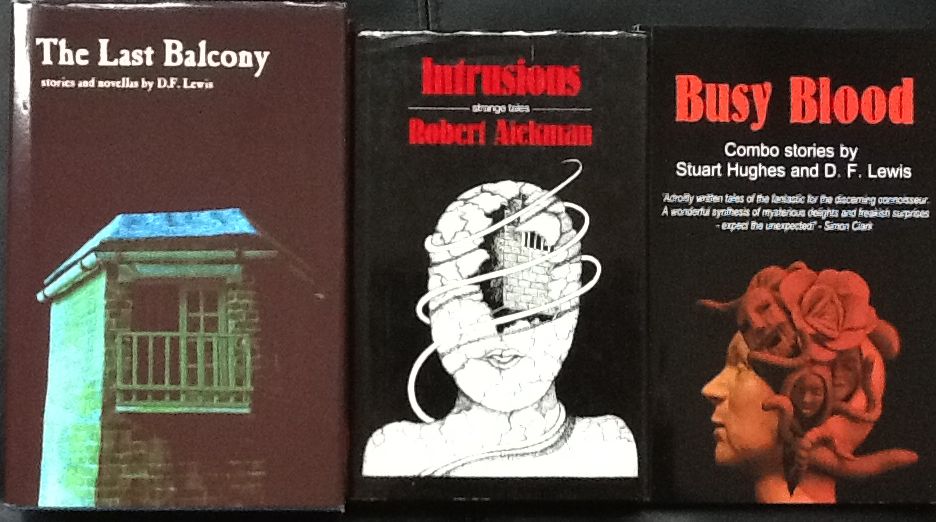
Read it between jumping and hitting the ground. The last balcony, you see, is at the top of a building with many stories…


“I already know that I’ll be recommending it most highly to any and all readers who love original weird fiction…”
RHYS HUGHES, from his review of ‘The Last Balcony’ HERE

I’ve owned the rare book INTRUSIONS by Robert Aickman since the 1980s but I can’t remember having taken it off the shelf since first reading it (all its stories are contained elsewhere). I had occasion to look at it recently and was amazed at the wondrous synchronicity between its front cover and that of ‘The Last Balcony’ (2012). On consulting Tony Lovell (the artist who shaped the real object photographed for the ‘Last Balcony’ artwork) he also drew comparison with the shape he created and photographed for the cover artwork of ‘Busy Blood’ (2012). We’re both pleasantly surprised at this inspiring correlation. Perhaps we should call this the ‘Close Intrusions of a Third Kind’ syndrome?

magicm7
The ‘Intrusions’ cover in 1980 is by Andrzej Krause (Andrzej Krauze?)

Saturday, March 16, 2013

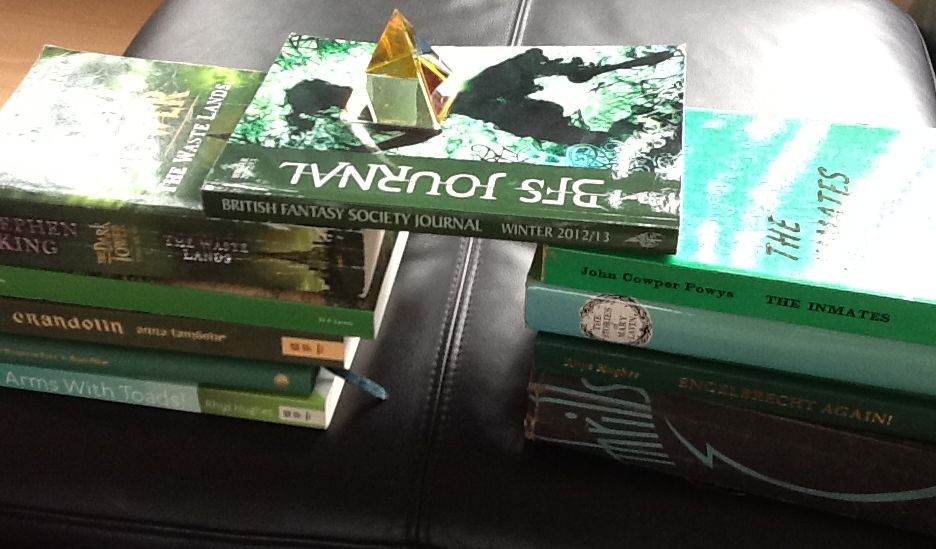
A Bridge of Green Books

bfsjournal8

Hal decided to build on one side of the river first, stacking each book on another; he was surprised how many books he had with green covers, paperbacks and hardbacks, the latter with green dust jackets even if their inner board covers were anything but green.

To be any shade or all shades of green on the outside was his only prescription for the books he used.

But once he had deemed the tower of books to be tall enough, he suddenly knew he wouldn't be able to complete the bridge without first crossing the river's wild currents by means of the completed bridge.

Hal picked up the randomly unused book that he had left out on a whim as he thought somehow that it would have been the last straw, as it were, to topple the tower. He opened it at any page.

He read it with interest. Words were a sort of bridge towards meaning. Or towards each other.

'Why build a bridge with books?' Hal thought, as he eventually looked up. 'There must be a better way.'

He saw a figure on the opposite bank who was building a tower of his or her own as if to prove the point. And those books didn't look to be green at all.

Hal almost cried.

Wednesday, March 13, 2013

A Name in a Story's Title from 'Nemonymous Two' 2002


...and the title of a 1910 novel:


Also, the name of a famous opera by Handel,

an equally famous play by Jean Racine,

an iconic story by Edgar Allan Poe,

the Empress and University in 'The Warriors of Love' novels,

the daughter of King Herod Agrippa,

an Ancient Egyptian Queen,

an increasingly famous actress surnamed Bejo,

another actress who once played a Bond girl,

a famous photographer who died in 1991,

a novel by Emily Pierpont De Lesdernier,

a novel by Johannes Themelis,

a character in a Jilly Cooper novel,

and, with her hair, a constellation of stars - a name as a pattern of infinity.


A name literally meaning THE BRINGER OF VICTORY.

.................

Monday, March 11, 2013

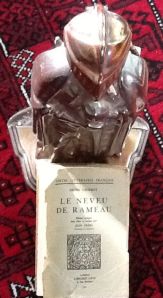
Rameau's Nephew

LE NEVEU DE RAMEAU
Please see my comments on this work by Denis Diderot: HERE


“…like a motionless Chinese idol from beneath whose chin a string hangs, leading down under his chair. One waits for the string to be pulled, but it is not pulled; or, if the jaw happens to open slightly, it’s to utter some disheartening words, words which tell you that you have not been noticed, and that all your antics are wasted; the words answer a question you asked several days ago; once they are uttered, the mastoid spring relaxes and the jaws snap shut…”
“He wept, he laughed, he sighed; he gazed tenderly, or placidly, or furiously; he was a woman swooning with grief; a wretch overcome with despair; a temple rising up from the ground; birds falling silent at sunset; rivers murmuring their way through cool solitudes or cascading down from high mountains; a storm; a tempest, the moans of the dying mingling with the whistling of the wind and the crashing of the thunder; night, with its darkness; shadows and silence — for sound can portray silence itself.”
“If I’m alone, I take up my pen, I try to write. I gnaw my nails, I rub at my forehead. Nothing doing. Good-night. The god’s not at home. I’d convinced myself that I had genius; at the end of the first line I read that I’m a fool, a fool, a fool.”

Tuesday, March 05, 2013

Le Neveu de Rameau

"Le Neveu de Rameau" by Denis Diderot, that I read many years ago, is a rambling philosophical dialogue that, I suddenly realise, seems to show the value of what I have long called the synchronised shards of random truth and fiction. Did this book invent brainstorming?

Saturday, March 02, 2013

Nathair Dhubh

Friday, February 22, 2013

Once upon a time I realise that it is happening now.


Not then.

Then, I am someone else. Today, I am myself. Tomorrow, I am someone else again. And so on, all happening now: yesterday, today, tomorrow. The same thing happens to other people. Anne is painting a cornfield using my palette of paints. George is running on the spot for exercise, while pretending he is me. Lesley is outside looking in through the window, amazed that the room is empty. The yellow paint runs out - cornfields are heavy on yellow paint. George sprains his ankle. His ankle is paining him. Painting his ankle. I convey the pain with false blood red paint. He cuts his ankle with my palette knife to make it real. Lesley's face is no longer in the window looking in. She is in the room massaging her ankle surprised it is covered in red paint, not blood. I am outside walking towards the cornfield. The cornfield is beautiful despite some of it being blue like the sky. I suddenly slip on an untidy plot or spot and break my ankle. But there is no pain. The pain's still inside the house. Three separate times of yesterday, today and tomorrow grow to a single focus, a single spot - and the focused time paints the pain with a colour not yet invented.

A pain colour.

Once upon a time I am George and Anne's baby, not now, not then, but forever. Painted for pain, covered in a colourless bodily substance running on the spot like a funnel of nothingness seeping into the once yellow ground, the cross-section of then, now and never.

-------------------------
written yesterday in the random speed-writing exercise at the Third Thursday Writer's Group in Clacton.