Sunday, December 04, 2016

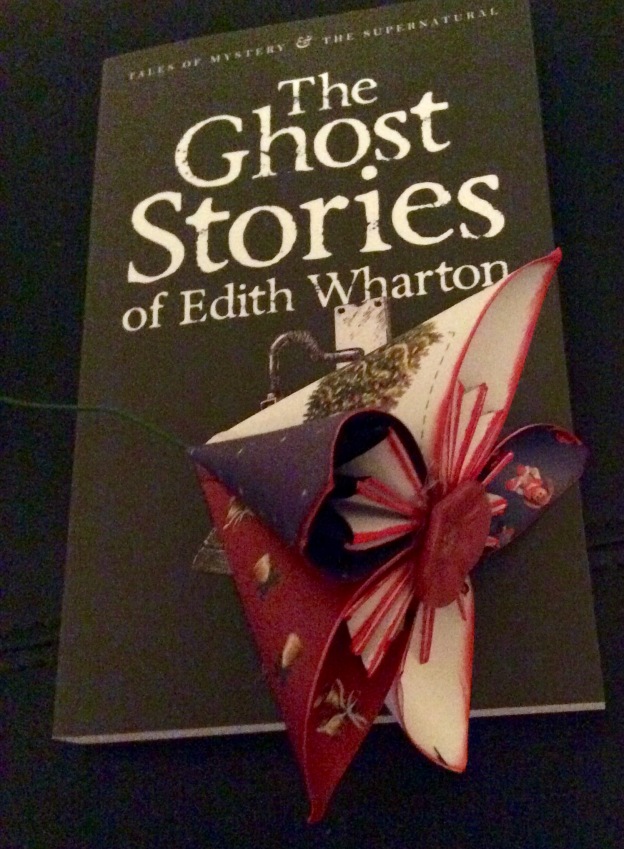
The Ghost Stories of Edith Wharton

15 thoughts on “The Ghost Stories of Edith Wharton

  1. THE LADY’S MAID’S BELL
    “It was not a gloomy house, exactly, yet I never entered it but a feeling of gloom came over me.”
    Hartley never questions the ghost nor do we know exactly the circumstances behind the haunting. Despite being a first person narrator, I don’t think we ever reach her inner thoughts. There is a sense of unreliability about the place, including the inner thoughts of the other servants. Inferences. No footprints in the snow. Why is Agnes nearer Mrs Brymptom than Hartley and needs to fetch Hartley? The uneasy relationship between Messrs Brympton and Raford? Why does the latter later lean on a stick? Many other questions. It will stick with me now I’ve thought about matters beyond the text’s ability to help me with. The text itself is the ghost! Never trouble to dread to read it again.
    “…and Mr Wace said the bears would eat us.”
  2. THE EYES
    “There were moments of our pilgrimage when beauty born of murmuring sound seemed actually to pass into his face — but only to issue forth in a shallow flood of the palest ink.”
    This really must be the most oblique but equally most frightening ghost story told by a gentleman to other gentlemen in front of a log fire and through their own self-made, self-maddened smoke-rings.
    “…and his study of the human race seemed to have resulted in the conclusion that all men were superfluous, and women necessary only because someone had to do the cooking.”
    The story of two ghosts: a pair of eyes recurrently turning up in the dark, eyes that grow more and more disturbing to him as well as to us through him, as it were – eyes that seem linked to the narrator’s love-life, perhaps platonic, perhaps not. First with a young lady, whom he feels (as excuse?) he cannot do right by. Then a young man – a would-be novelist, like today, most young men write bad novels — a young man with beautiful eye-lashes and ‘blissful eyes’ and ‘gay’. The venue of the story and the implications of the story grow into the lugubriousness or “Rembrandtish blur” – and those eyes “which had built up their baseness coral-wise” become a life’s eventual dreariness of that previously ‘gay’ young man. Cruel to be kind, “about as pleasant as slitting the throat of some artless animal.”
    Also some very evocative touches regarding the era and its social mores.
    Now in a gentleman’s club of exchanged ghost stories with a new young male disciple … but… “For my part, I haven’t found the link.”
    Meanwhile, the eyes will now ever haunt me.
  3. AFTERWARD
    “: that so few miles made a distance, and so short a distance a difference.”
    England for visiting Americans as a geographical Zeno’s Paradox?
    This story is so famous, possibly the greatest ever ghost story, that it would be pointless for me to re-rehearse the plot of Ned and Mary Boyne, on the suggestion of Alida Stair, staying, with their new obtained business-wrought fortune, at this remote Dorsetshire house with few “vulgar necessities.” And Alida’s answer to their question about whether there it has a ghost…
    But it seems apt that — for hindsight’s obvious reasons of the future crystallisation of something as embedded in the past via the anxiety of Zeno’s Paradox — I reread this Wharton tale about the “afterward” ghost after having just read Ted Chiang’s novelette ‘Story of Your Life’ for the first time and reviewed it here (a work I subsequently discovered has recently been filmed under the title ARRIVAL.) “– as if this dim questioning of the future, and startled return upon the past — had between them liquidated the arrears…”
    “there were infinite gradations of pleasure in the fixed recurrence of habit.”
    “and a beautiful legend grew up about this imaginary state of waiting.”
    “It leaped out at her suddenly, like a grin out of the dark, that they had often called England so little — ‘such a confoundedly hard place to get lost in.'”
    (Apt, too, perhaps, that I am also currently reviewing here ‘The Searching Dead’ by Ramsey Campbell?)
  4. KERFOL
    “I had an idea that their distance from me was as nothing to my remoteness from them.”
    A lonely house in Brittany, and a visit to see whether he wants to buy it cut price; the protagonist is creepily out-stared by a group of dogs, and no sign of human habitation. Worth reading for this scene alone.
    His reportage of the reportage that he subsequently reads about — involving a court case concerning the house’s history, a happy marriage gradually turned a broken one, plus a gruesome death, with dogs involved — is for me a bit of a kerfuffle, melodramatic with non-human ghosts….
    The last word of this story is “Pascal”, but is that Pascal’s Wager – or Pascal’s Wagger?
  5. THE TRIUMPH OF NIGHT
    “…unutterably sick of all strange houses, and of the prospect of perpetually treading other people’s stairs.”
    A chance forgetting by someone in his being collected from the station amid the dark snow, Faxon is caught up in an AFTERWARD-like failed-business or other business treachery, met by chance by the attractive young man called Rainer, but a young man with old hands and TB to boot, Faxon invited to stay with Rainer’s well-reputed uncle and other strangers in a nearby house, Faxon later seeing a figure with “unsatisfied hates”, and “thwarted hopes”, a figure nobody else can see, at a ‘will’ gathering and then a dinner party, a house full of flowers, and a room with modern paintings like Monet, Faxon’s sudden bolting into the snow, snow that you breathe like blades, Faxon singled out, Rainer snowed on, but whose hands turn red?
    This is a disciplined prose that flows beautifully, but telling of mad corners of fate that stutter wildly. And a very haunting ghost.
    “: his pinched smile was screwed to his blank face like a gas-light to a white-washed wall.”
    And that’s not the ghost but Rainer’s famous business uncle, a madness-inducing ingredient of an act of gas-lighting itself?
  6. THE DUCHESS AT PRAYER
    .”He was the oldest man I had ever seen; so sucked back into the past that he seemed more like a memory than a living being.”
    This story is like interactions between old Italian paintings and statues come to life, then ceasing to be alive, with their facial expressions changed and frozen again. Crypts and relics, and adultery, and a Duke not only jealous about his wife the Duchess canoodling with a young man but also for her being ever prone praying before a saint’s relics (a female saint!), as well as other machinations and characters that are richly presented and then teasingly withheld from the reader to accentuate the bizarre eeriness and the obsessive piety.
    All this told by the grandmother of that ‘oldest man’, a woman (as a young servant) who knew the Duchess in those relatively olden times now gone like all of them, as told to the narrator by that ‘oldest man’ who had once heard her tell it to him.
  7. MISS MARY PASK
    “You couldn’t be lonelier if you were dead.”
    If I told you how this narrator’s visit to a lonely house in Brittany is one of the most creepy ghost stories you are ever likely to read without arguably being a ghost story at all, you would look at me askance, and indeed I wonder if someone forgot to tell the narrator something or was mistaken in telling him something that he had now forgotten or another of various different permutations. After all, this story (reputed not to be a ghost story) contains the most ghostly poignant moment in all literature I suggest – a moment of a real person leaving the presence of a ghost or of a ghost’s own leaving the presence of that person .
    “Something white and wraith-like seemed to…” yes, the whole of that sentence, please read it, do.
    DIsbelief is only half of belief, I always say.
    But above all, this ghost story is in an explicit ghost story book.
  8. BEWITCHED
    “‘I never knew a place,’ Deacon Hibben said, ‘as seemed as far away from humanity. And yet it ain’t so in miles.”
    That earlier AFTERWARD ‘distance’ here betokens some interesting eccentric characterisations (including the “monumental structure” of a funeral hat) of three men arrived in the snow with their cutters and horses at the out of the way Rutledge place, summoned by Mrs R, summoned to give advice about her husband who is recurrently ‘seeing’ (in more sense than one?) the dead daughter of one of the men, meeting at an icy pond…
    The main point of view is not the father of the ‘ghost’ but a man named Orrin (“born under the icy shadow of Lonetop”), the dead daughter’s name being Ora. But I make no significance from that.
    Ora’s sister is still alive.
    If I tell you more, I will spoil something, but unsure what that something is. The canary and the cage, notwithstanding.
    “The snow had ceased, and a green sunset was spreadIng upward into the crystal sky.”
    This story, like many here, will haunt me. The story as a text. “I see ’em.” “She just draws you.”
  9. THE FULNESS OF LIFE
    “At last even these dim sensations spent themselves in the thickening obscurity which enveloped her; a dusk now filled with pale geometric roses,…”
    (A geometric rose in my earlier photo above?)
    This story is fulsomely worded as a rhapsodic rapture, but only felt to be overdone, if you never each the end of it and learn about the imperfection she decides to await so as to complete eternity. This is a story of the ghost of a woman after her death, speaking about her previous existence to the Spirit of Life (a welcoming angel of some sort) and about her imperfect husband who read railway books, had creaking boots that annoyed her and never was able to reach her inner sanctum. The Spirit awards her with the perfect soulmate as compensation, a man seems in complete tune with her. About to spend eternity with him together. But she feel something is missing…the creaking of boots?
    I have now decided this is the perfect story to read aloud to my wife. Better make sure I do it soon.
    [Cf my synchronous serendipitous comment about ‘Down to the Boots’ here today in connection with EYES LOOKING (see review of ‘The Eyes’ above, too!)
    Regarding regrets as well as eyes and boots!]
  10. MR JONES
    “While Lady Jane was dressing she heard a knock, and saw Mrs Clemm’s round face just inside the door, like a red apple on a garden wall.”
    Mrs Clemm often spoke of the dead with apparent relish, a bit like this whole,book of stories about those who “must hardly have known when they passed from their beds to their graves.” A bit like those bed-blocking hospitals today? I sense Wharton turning in her own grave at my loose talk concerning her story, but there is, in any event, an element of humour in this one, as well as dread, and Lady Jane issues an expletive at one point in it: “Fudge!” Yes, really.
    Meanwhile, this is a tale of a house that was inherited and in those olden days you could hardly reckon all the rooms of such houses and who already lived in them as servants or whatever, even if it was a relatively small house like this one. Here, Lady Jane is prevented by Mrs Clemm and her niece from seeing Mr Jones who seems to have lived there beyond a normal single life span but seems to hold sway over it. But Lady Jane is never inquisitive enough to bother to find his (sick?) room and face him out. This is an incredible story of a presence ruling the roost, glimpsed now and again. And death turns someone into someone else, the text hints at one point. Inscrutable and haunting.
  11. POMEGRANATE SEED
    “; the address was always written as though there were not enough ink in the pen, or the writer’s wrist were too weak to bear upon it.”
    I am finding it hard to restrain my enthusiasm for this story. It even beats anything by my favourite ever writer, Elizabeth Bowen. There, I’ve said it. But I feel I have betrayed something…
    This is a long story slowly built up, relentlessly meticulous, intensely suspenseful without anything much happening, even while all manner of things are happening in it. A perfect story, that all the while I was reading it I forgot I was reading a story. Where has it been all my life? Even the footnote to the title turns out to wield the most significant obliquities of incisive meaning.
    Basically, it tells of a woman whose husband had been a widower, and she is mystified by the letter he receives intermittently since the return from their honeymoon. Presumably something to do with his legal work. The tension this causes, the anxiety, the residual love between them, their two children, his mother, reaches a convergence of something more rarefied than anything in or out of literature. (No wonder I gaze at the last few pages of this work in awe, as I also sometimes shamelessly stare lengthily at the spaces between its words or even, once upon a time, at the pages of what I deem to be citable as darkly tantalising nemonymousness.)
  12. THE LOOKING GLASS
    “Like many humble persons of her kind and creed, she had a vague idea that a sin unrevealed was, as far as the consequences went, a sin uncommitted;”
    But today Cora un-unreveals it to her granddaughter, a story of means against ends, as a masseuse she often tricked her patients into believing she was a medium to their dear dead departed ones. But one patient in particular, a rich lady, desperate about losing her beauty, pays in kind for messages from a young man who she feels loved her before he drowned on the Titanic. Cora uses another young man to help with the messages from the dead young man to make them feel genuine.
    The outcome has probably been mis-interpreted by all readers till today when I read this work. A symbiosis between the dead and the living, like that of a mating (whatever its orientation) where that very act kills one of them. Thinking about the potential permutations makes this a classic ghost story instead of a mediocre one, a story that lost the beauty of its message across the years till I brought it back here.
    Cora, rest easy, I say.
    “‘It’s damn difficult, making love for a dead man to a woman you’ve never seen,’ says, he…”
    Another pomegranate seed syndrome?
    ————————
    A quote from another work that I happened to read and review earlier today here:
    “He noticed that the two mirrors were improper reflections of one another. The upper mirror faced left, while its lower twin, inverted, faced right. Were one a mirror image of the other, they would face the same direction.”
  13. THE JOURNEY
    “When they married, she had such arrears of living to make up: her days had been as bare as the whitewashed schoolroom where she forced innutritious facts upon reluctant children. His coming had broken in on the slumber of circumstance, widening the present till it became the encloser of remotest chances. But imperceptibly the horizon narrowed. Life had a grudge against her: she was never to be allowed to spread her wings.”
    A touching and haunting ten-pager as a companion to similarly sized ‘The Fulness of Life’ (and I indeed read aloud the latter to my wife, as it happens, yesterday evening.)
    This tale of the wife travelling on a night sleeper train with her sick husband (having fallen sick soon after they got married) as they returned home after unsuccessful convalescence. He is now lying asleep behind the sleeping-booth’s curtains, amid the well-characterised co-passengers, described in the beautiful Whartonian density of prose, and obliquity of outcome. The end echoing the wife’s earlier dream, and what she fears and dreads to be revealed, come to a culmination that makes this another priceless masterpiece. This book continues to be a revelation.
  14. ALL SOULS’
    “– I’ll efface myself, and tell the tale, not in my cousin’s words, for they were too confused and fragmentary, but as I built it up gradually out of her half-avowals and nervous reticences.”
    I don’t really believe this narrator who calls him- or herself ‘me’ and his or her appraisal of his or her oldening female cousin’s words about this intensely haunting tale of herself abandoned with a near-broken ankle in her snow-induced accretiveness of a house, where she sees or imagines furniture moving and hears silence greater beyond any silence subsuming everything, subsuming even the servants who had thus inexplicably been seen to have vanished. Was it the narrator’s ridiculous explanation of All Souls’ Night (but, significantly, according to the title, All Souls’ nothing) and the servants or one in particular servant wanting to be fetched to a coven on that so called All Souls’ Night each year? The onerous struggle through her own house looking for them with her painful ankle is a literary tour de force but also pain for pain’s sake, a sort of ritual about who was that preliminary woman she met outside? That fetcher. But was that herself? Or, more likely, ‘me’?
    Please read the last paragraph.
  15. A BOTTLE OF PERRIER
    “A white-skirted boy with watchful eyes was watering the plants; but at Medford’s approach he vanished like a wisp of vapour.”
    A classic, of which you must already know the plot. A desert domain, a servant with a palimpsest of cockney and something else, interface of Muslim and Christian, Arabic and Non-Arabic, a smelly noxious water-well, and a post-malarial Westen guest who wants water not wine, but they have run out of Perrier, and a host who’s neither here nor there. An Aickman angst. A nagging hauntedness.
    A proto-Pinteresque masterpiece of dialogue as well as scintillating prose, this book’s best story in many ways, left to last, not experimental so much as a looking-glass reflection of the previous story, with the lame horse (cf the woman’s ankle) that prevents the guest’s departure, but a place that can’t wait for him to leave.
    The style is richer than Graham Greene with a paradoxical panoply of smoothly jagged interactions of meaning.

  16. This book is its own revelation. It stirs in the hand as if hiding a hidden ghost.
    end
        

Saturday, December 03, 2016

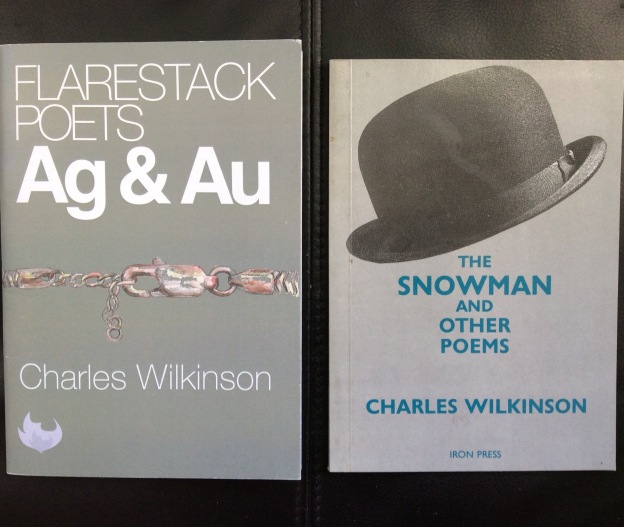
AG & AU; SNOWMAN - Charles Wilkinson


2 thoughts on “Poems by Charles Wilkinson

  1. SNOWMAN And OTHER POEMS
    Turmans and Turnips.
    “All words are stripped of meaning;
    Bodies are less than clay,
    Pale and pointless as ghosts
    An exorcist forgot to lay.”
    Just read this whole book and I am sure that those who enjoy the writer’s fiction will cherish them (see my reviews of his fiction linked above).
  2. IMG_2659.JPGAg & Au
    “re-shape and pull away with
    the slow tide, down to the deep-
    er book below,…”
    This is an amazing chapbook, full of wonderful artwork by different artists for each poem. A publication to cherish.
    While there were at least a few references to ironing or iron in the Iron Press booklet, this one has rarefied gems of poetry with, inter alios, silver references in the first half of the book and gold in the second half. I shall now read the poet’s explanatory notes at the end for the first time to see what I have missed.
    end
        

Thursday, December 01, 2016

Out There - Quentin S. Crisp


10 thoughts on “Out There – Quentin S. Crisp

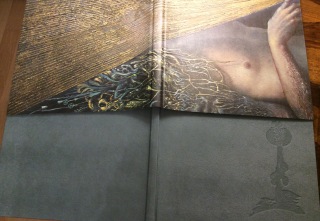
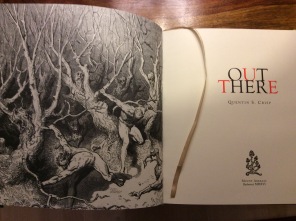
  1. Copy numbered 25/107. Luxuriously upholstered book with quality materials, about 10 inches square, 72 pages, marker ribbon, pull-out glossary, all beautifully designed with dust jacket, and embossed hardback cover.
  2. :I:
    “Strange how something green and fresh can give a sense of the archaic, as if the scenery were in the handwriting of a former age.”
    As if this text is an older person’s text than the one who wrote it.
    About Jake travelling by aeroplane strung between the moon and the clouds like the circumflex on an o in Tôkyô. To stay with his friend Sean, well-suffered as a friend, a friend with a future’s uncaring, a friend who is planning an expedition for them both up a Japanese mountain to visit a temple, a temple mid-changing from famous to obscure. (Sean’s current job is a mock Christian priest blessing Japanese weddings.)
    An engaging start strung between slightly mystic self-wrangling and story-telling for others like me.
  3. :II:
    “His tiny life held the universe on top of it, and yet it was not crushed.”
    The two friends depart on their expedition, now around a campfire, sparking off each other, philosophically, aspirationally – and pragmatically, e.g. regarding maps or GPS – with a sense of proto-immaculation, something more or less precise than their thoughts and statements, something preying on them, exacting them, from the genius loci of this Japanese ‘territory’, in spite (or because?) of the strange half-manmade artefacts, half-creature half statue, lining their route, entities that Jake compares to the earlier clouds when he was on the plane travelling to Japan.
    You know, when I read text that has ended up as carried by such richly produced pages within highly stylised artwork, thick board covers, fly-leaves etc., I often imagine the writer once having scribbled out his text in his garret, little knowing one day where it might end up. If the author is out there, reading this, he can rest assured that my feeling is that his words and this physical book work in an aesthetic synergy that was pre-destined, also positively sparking off each other.
  4. :III:
    “As old as nowhere, eh?”
    I am not often at a loss for words when real-time reviewing. But I feel I have reached the literary equivalent of that ‘nowhere’; I think that what Mars is to Jake, this book is to me. Being out there is more useful than nowhere, I guess. The territory, though, I pluck from nowhere, while accompanying this pair of friends on their expedition, their passing another half-living, half-manmade entity, then a stone drum, and a shop (!) that seems part of the wild terrain with a shopkeeper as bridge-ticket issuer, with the feeling that there is some other story parallel being used as a template but off-kilter to their real story, (friends with a spur of antipathy as well as friendship between them), yes, this territory feels synaesthetic about itself rather than Jake about it, and Jake’s questionable sense of sound and other instincts about the territory seems like a literary ritual when compared to his wish to strip it down to a tabula rasa for an even more difficult adventure he has set himself and wants to prove he can accomplish. For one at a loss for words, I still managed to fill in the gaps, as my own reading is yet another story altogether, a third one, not off kilter so much as completely out of step, the extravagant baroqueness of the territory and the ‘tangledrown’ being part and parcel of the book’s own physical extravagance, with the path upon it tenuously reaching from a scribbled attempt to defeat blankness with words from scratch, words-without-loss, a proto-immaculation. A bridge across a gorge.
  5. POSSIBLE UNINTENDED SPOILERS HEREAFTER

    .
    :IV:
    Pages 33 – 37
    “Clouds formed, hanging — as it seemed — near overhead, as if parts of the mountain had detached and were drifting off to some other, higher mountain range, way up in the stratosphere.”
    I don’t think any reader will easily forget the two friends approaching, via an inscrutably signed fingerpost, this “quicksand of lostness”, then reaching through further territory their destination the Temple, and its Jake-described nature , and its “Buddha of some kind”…
    “…but there was obviously some fine, deep order to the time-stained clutter, speaking of a labyrinth of unfathomable habits.”
  6. img_2645
    Pages 37 – 47
    img_2646I feel that handling this book is like a child with a book bigger than itself, turning the large heavy pages with small arms and fingers on a tiny lap and that gives a strange sense to this precise but also widely and paradoxically imprecise journey as the two friends are offered quiet hospitality by a monk in perhaps the wrong temple, or a different story’s temple. Had they taken a wrong turning or turned a wrong page? The books they riffle through in this temple summon ideas amid the tea-drinking….
    There is something entrancing about all this and the scene of the noodle-seller in the dark. And “How do you decide what is real?” Compare it to the unreal, the text suggests. “What is learning for?” To fill the emptiness of nothing or nowhere, I suggest, as an alternative answer to the text’s.
    Meanwhile, Jake and Sean “gripped each other’s hands. Whatever their current bewilderment, their companionship as travellers, isolated, was also highlighted and affirmed, becoming a mutually known mutuality, almost as certain as ‘I am’.”
  7. Pages 48 – 59
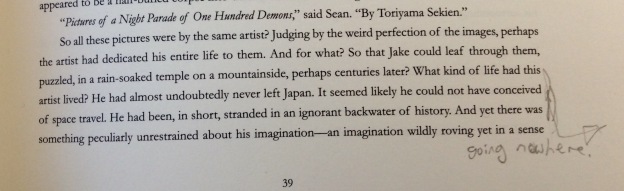
    And indeed all my Ex Occidente Press books bear my pencil marks – and anyone out there who puts in a bid for my entire such collection after my death must bear this in mind. These latest ten pages bear more pencilled marginalia, I think, than any other ten pages in any of my books. So you know these pages must be rather special and indeed I cannot cover all the aspects here, and do please rest assured what I do choose to mention (in a puckish manner) may not do justice to the seriously great hyper-imaginative literature contained in them.
    Jake has indeed separated from Sean for an intended short while alone as he walks away from the light, but there is a “resurgence of dusk”, “a continuing corridor of twilight green”; dusk rarely resurges, I suggest, but, together with the “face-tree” among these ten pages, I sense a Face of eternal Twilight. Then he is beset by rain. The meeting with the blue umbrella, and what or who stands beneath it, enticing him along the path he intended to take (or not), and then through a door not so much into Narnia but something far more effulgent, rapturous, rhapsodic, genuinely inspirational. I could give you far too many representative quotes, so I shall give you hardly any at all. Perhaps a mention of a ‘dream-eater’ to match my dreamcatcher.
    And the fact that what he experienced “resisted analysis”, as does my own experience of his experience. Often child-like with “sheer stupendousness.” Byzantine and sublime. I now leave Jake for another interlude in my reading as he follows the monk “from the jetty up a footpath…”
  8. img_2655Pages 59 – 70
    “Jake had never known a place so much like a kaleidoscope — internally shifting, colourful, so that to turn a corner or pass beneath a lintel was to enter upon another pattern, born from those previous and yielding, at the next turn or chamber, to yet another, in endless series.”
    “Think of names, and words with double meanings, everything you can that combines things together.”
    Immodestly, I sense all this with my own labyrinths of gestalts.
    I repeat what I said above. And this continues in the same vein. It is miraculous stuff and surely this is QSC’s greatest work to date. Surely as the words ‘surely’ and ‘no doubt’ express a certain amount of doubt, too? Passions of the moment are no doubt deceptive ones.
    I’ll pick out a few points from this inspirational rite of passage, not the least of which is the sumptuous order and nature of the words. And there is the church of laughter – a church whose creed is momentously uncertain. I have been concurrently reviewing here ‘The Searching Dead’ by Ramsey Campbell where there is another uncertainly deconsecrated church, a chapter called LAUGHTER NEEDS A MOUTH and it also invokes the word DAOLOTH (cf “If men do not laugh, it is not the Dao,” in OUT THERE) – image
    “There is… nowhere… to go…”
    Except to the strangest thing of all? Or back to whence you came? Or Mars?
    This journey is something else. The “paranoid nausea”, notwithstanding.
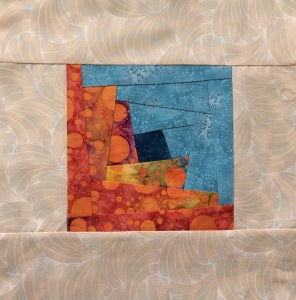
    (The image above is my wife’s latest quilt (a small one this time) that she happened to show me just as she finished it and I finished reading this book that she did not know I was reading, as I hadn’t told her yet.)
    :V:
    “Do you remember them, these twenty-seven different ways?”
    There happens to be 27 chapters in total in ‘The SeArChInG DEAD.’
    The Seer Ching Deed.
    end
        

The Searching Dead - Ramsey Campbell


17 thoughts on “The SeArChInG DEAD – Ramsey Campbell

  1. My previous reviews of Ramsey Campbell –
    https://dflewisreviews.wordpress.com/2016/11/24/the-madness-of-dr-caligari/#comment-8578
    https://nullimmortalis.wordpress.com/2010/08/17/ghosts-and-grisly-things-by-ramsey-campbell/
    https://dflewisreviews.wordpress.com/2016/09/27/years-best-weird-fiction-vol-3/#comment-8337
    https://nullimmortalis.wordpress.com/2011/11/20/the-weird-8/
    https://nullimmortalis.wordpress.com/2010/08/10/beneath-the-ground-edited-by-joel-lane/
    ——————-
    ONE, TWO, THREE
    “The dead outnumber us by many billions, Mr Joyce. I can see no point in adding to them without a pressing reason.”
    I would have thought it was only millions, then? But I fully recognise the era of the 1950s from my own childhood experience, and relish the text’s touches of recall. But ‘text’ is too formal a word for my accompanying Dominic Sheldrake on his first day at secondary school after passing his eleven plus. The eccentric teachers in gowns, or seemingly eccentric in hindsight. But here Dominic recalls with deadpan assurance one teacher in an earlier chapter pushing something lowdown in a graveyard and now talking to something lowdown near the school.
    This reads like a library book from those wonderful days, especially with its mention of Enid Blyton, but it has the prose traction of Richmal Crompton. It feels like an old-fashioned library book in the hand. The skull on its cover is a bit off-putting, though. Decided to hide it below the desklid.
    Beyond my 1950s experience however are the references to the Roman Catholic Church in those days versus Spiritualism. But it all rings true, too.
    A good start. A great sense of the period just after the War. And the talk of its sadly dead.
  2. FOUR
    “It made me feel events had converged on me, as if I’d been singled out somehow.”
    Dominic is still naive or youthfully creative enough to feel he also needs to spell out the word ‘walk’ so as not to get Mrs Norris’ dog too excited about going for one. But the convergence of Catholicism versus Spiritualism accretes, converging possibly around that teacher mentioned above called Mr Noble, as well as many more evocative touches about the 1950s, now in the approach to Christmas. I am really being captivated by this book and I shall pleasurably eke it out – and hopefully continue to be abstemious with releasing too many details of its plot in my real-time review.
    With Mr Noble’s vision of Hell described to his class, it seems appropriate to me that the boy who provoked it had the surname Joyce.
  3. FIVE
    “Now I feel almost nostalgic for them — for rites that don’t alter the world.”
    I, too, contemporaneously ridiculed set behaviours of the 1950s, but now they seem so much more preferable than what new foul political rites are being stirred today. The book’s sense of time and place, 1950s England, is, I feel, beginning to absorb a magnified ominous effect upon itself, through the filter of what happens afterwards as a trend, if not exactly yet knowing what precise events are about to happen to Dominic in 1950s Liverpool. And I see this is the Christmas where the new Queen anticipates her Coronation in the following year during her first Christmas address on the tiny snowy black and white TV screens. Nostalgia needs to be earnt.
    Pidgin or pigeon, notwithstanding. Whether or not English words need to be spelt out for dogs and infants in prams. A dog called Winston, of course.
  4. SIX
    “…the hundreds of people drowned in the North Sea flood, a disaster apparently designed to remind us that God’s plan was too large for us to grasp.”
    Although I was only 5 in 1953, I can remember that event well, living in Walton on Naze as I did, and I can also relate to these 10 and 11 year old characters in that year, and the SF-type story Dominic wrote, and some boy hiding a horror comic under a desklid.. In fact the latter phenomenon seems to litter my memory right up to the Sixth form!
    This book continues to be a real treat for me.
  5. SEVEN
    “Some things can reach back.”
    A searing dead-hungry chapter, if you dig into it. Striking talk in front of Dominic and the other school kids by Mr Noble’s father who was in the First World War trenches where the school is about to visit. Striking implications, too, of Easter in a Catholic school, and the old man’s ‘lecture’ about lice, rats, missing toes,,,
    And this chapter also deals with the generality of possible retrocausality (not a specific word used in the text so far but one that has haunted me for the last few decades), retrocausality not only in the faith of religion taught at Dominic’s school – but also ‘afterward’ in real life? In Chiang’s ‘Story of Your Life’? And in gestalt real-time reviewing?
    I wonder if it is significant that ‘searching’ is a word we use a lot these days, aka ‘googling’ (googol: – a real word previously for those dead millions or billions?)
  6. EIGHT, NINE
    “We were impressed most by a field where unmarked crosses stretched to the horizon as if the throng of unidentified dead were erasing the landscape.”
    A characterful school trip to France, one so typical of the 1950s, with teachers often prying if not preying on the kids as well as other apparent eccentric behaviour, here with Dominic and his pal in turn spying on Mr Noble visiting a French battlefield after dark where its trees seem to be averse to where they have grown for centuries. The adventurous innocence of Richmal Crompton or Enid Blyton but as if infected from where we sit today.
    On the Channel 4 news today, we’re told that the 1950s were the last time wages truly grew and where that growth is now in 2016 collapsing faster than ever, not so much in hindsight as in backtowards motion, I sense. Thinking aloud. Brainstorming. Me, not the book. But the book has ominously stirred these thoughts in me. While Dominic dreams in tune with what he thinks he saw….
    “The dream might have been lying in wait for me, ….”
    • While Dominic’s gang with Jim and Bobby has elements of both Just William and the Famous Five, Bobby (a girl) has shades of Evadne Price’s Jane Turpin (arguably the era’s female William).
      But now we reach a wonderful evocation of watching the 1953 coronation on TV….
  7. TEN, ELEVEN, TWELVE
    “Ambulances rarely used their sirens in those days. You might think they were showing respect for the sick.”
    And indeed, the experience of re-experiencing the 1953 Coronation live TV broadcast via this book has been spot on…
    as have, in the terms of this book’s plot, its aftermath amid one of the street parties. The political incorrectness of that age, the mindsets on politics itself, religion as superstition or faith or a means to spirit away fear of death by replacing it with fear of the dead, social class, economics. One wonders if all this were Brexit in utero….
    and then we have the school open day for parents to see teachers, accompanied by their kids, and the aftermath of the French trip and the dreams it spawned, the commoners’ biteback against authority in (prospective if not retrospective) utero…
    the need for Latin and the oddly accentuated fingerprints, notwithstanding.
  8. THIRTEEN, FOURTEEN
    “They felt as if they were enticing me to read more — as if the book was hungry to be read.”
    …as if, too, the words – as the book itself states here at its midpoint – are reaching inside my skull. Hard for me to thus eke it out suitably. I sense something important, something darkly transcendent beyond the book’s wilily evocative, sometimes workmanlike, prose and its sporadic mockery of neatly configured, almost child-like, handwriting – literally!
    I thought it highly significant today that it was the fourth anniversary of my salvaging a quote about the Malebolge from John Cowper Powys (Facebook alerted me to this), a quote which I had subsequently been reminded was a reference to Dante’s levels of the Dead… and for those interested, here is proof of that: http://www.ligotti.net/showthread.php?p=131178#post131178
    Meanwhile, Dominic’s experience at school and his own clear sight as to the hypocrisy of his Catholic teachers and of others are well portrayed, a hypocrisy and naivety so typical of (what Mr Noble also refers to as) the ‘masses’, not only in the 1950s but also, in different competing politically correct and incorrect forms, today.
    “…how difficult it is to maintain that sense of self in the great dark.”
    “I wouldn’t learn until much later that many writers don’t speak the way they write – that writing lets their true selves speak.”
  9. FIFTEEN, SIXTEEN
    “Laughter needs a mouth.”
    This book seems expert – unique? – in summoning uncertain, but frighteningly provocative, visions through the special power (perceptively harnessed) from the growing minds of pre-teenage children in synergy with an experiential sense of living through the special power of the 1950s. I can vouch for much of this from my own experience, in the hindsight of now having read this book so far, something heretofore I have failed to harness.
    For example, these children adventuring into 1950s cinemas (evocatively conveyed) showing films just beyond your reach or your age to be admitted to it, blended with your naive childishness bordering on your future older ages radiating back at you, with shapes formed from amassed amorphous cigarette smoke and angled light, and in the Gents, the mirrors, and the images and sound of the film being watched.
    This parallels the hidden book (both hidden physically as part of the plot and hidden as a hidden text within the overt text), hidden that is within THIS book, written by the narrator/author or retold by him or simply transcribed without understanding.
    I would suggest all this IS unique, and would have been worth experimenting the marketing of it as a mainstream novel (hidden within or outside the one with a skull on the front?), at least partly tapping the many readers these days interested in reading literary not genre fiction about growing up in certain eras… also as a new form of nostalgia that goes forward instead of back …or rediscovering now hidden memories of events infected by the future…a darkness that is preferable to the inferior darkness of the future as we have seen it in the last few months?
    “….there was something it wouldn’t be wise to remember. How should I evade it if I didn’t know what it was?”
    “My dad says if you don’t try what you think you can’t do you won’t try what you can.”
  10. POSSIBLE UNINTENDED SPOILERS HEREAFTER

    .
    SEVENTEEN, EIGHTEEN
    “If my fears were responsible, could they bring it again?”
    Fears dissipate, at least, during a family holiday in Scarborough, a hotel where people still gather even today. Books developing as powers-in-themselves at this stage in Dominic’s life, while things and people from THIS book seem on hold, pent up, an aftermath perhaps as significant as what it is after? And the precociousness of Tina, to whom the hidden book is addressed, TINA an as yet obscure but synchronous acronym? Reaching into a sky where angels reach back? My thoughts, not necessarily the book’s, whether hidden or not.
    I wonder, too, meanwhile, if “the Christians are given feeble hints of the ancient rite of the three,” words in the ‘hidden book’, are intended to resonate with the Tremendous Three, this being their own group name equivalent to the Outlaws or Famous Five or Secret Seven for Dominic, Jim and Bobby? Bobby says something that I also imagine Jane Turpin echoing when she eventually reaches beyond agelessness in her own fiction book (as William surely reached beyond agelessness, too). Beyond the malebolge?
    “‘Maybe she’s how girls need to be,’ Bobby said.”
    [From the Wikipedia on Jane Turpin: “One significant difference in the two series is the absence of an analogue (in the Jane stories) to “The Outlaws” (in the William stories). While Jane has two close friends in Pug Washington and Chaw Smith, she does not command the kind of fidelity that William Brown commanded over the members of his gang.”]
  11. NINETEEN, TWENTY
    “TIna was leading the procession. I could easily have fancied she was directing it from her pushchair.”
    In spite (or because?) of the adept straightforward workmanlike prose and dialogue, with richer wordshots of horror image (like the poignantly desperate circumstances of the tram crash) which are very effective as a sort of punctuated colour, this book is very painterly. The scene of the pushed toddler actually leading as a motley group (not effectively being pushed at all?) clasping a grocery bag like a tribute, early Picasso? Also the punctuation of words bifurcated or unhealthily joined, like “Assertive” and “He was sort of”… Dom’s readerly interest in Robotics leading to thoughts of the Holy Trinity, semi-childish Secret Seven-like surveillance of adults, early sexual awakenings, a punctuated but obsessive pushing forward of fiction-like adventure and investigation into nefarious matters such as churchly mutation…the children themselves questioning whether they are in a story, one of Dom’s? Yes, painterly, but more real than if it had been left unpainted as frameless reality.
    Then Dom’s signal dream that seems more real after he wakes up from it. And I wonder what is pursuing them from the smug and often two-faced future wherein we live today, a demented but well-intentioned social justice or something more evil…?
    “There are too many people wanting to tell us what to think.”
  12. TWENTY-ONE, TWENTY-TWO
    “It felt as though too much in my life was eager to converge, though I could never have foreseen how it would.”
    You know, my memory of the 1950s entailed no street lighting at all in suburban side-streets (at least where I lived in Colchester, Essex) and, at the age of around 8 or 9, I often used a torch on dark evenings to reach, on my own, the Church Hall where Wolf Cub meetings were held… Foggy nights were particularly difficult, and scary! (Who could imagine a child today being allowed to experience such a journey?) A fogginess as scary as the night in this book, if with street lighting, with an era-transcendent imaginarium of dark painterly shapes beyond the methodical prose and ponderously extended nonchalance craftily textualised as the text masking another inferred text written by Dominic (or someone pretending to be Dominic, or vice versa?) so as to carry so evocatively such an imaginarium within us.
    Meanwhile, Dom reaches severe doubts about his own inculcated Catholic religion together with mixed feelings, fears if not doubts, about a different belief summoned by the ‘religion’ of the dark side of this book.
    Lighter touches of omelette whipping to convey another habit growing on Dom, and a teacher’s advice on which books to read if Dom is serious about his aspirational fiction writing.
    “…to conceal a meaning, however unintentional.”
  13. TWENTY-THREE
    The proof of the 1950s school dinner pudding is in the eating, and this book gave me a very fitful sleep last night – including dreams now hardly grasped – but also more conscious thoughts about the future infecting the past like a blight, until I thought of this book as having been effectively created in its own future.
    I shall try to finish this remarkable book today…
    “…or how threatened by the future…”
    “…as if it were holding back the future.”
    Some compelling passages about Dom’s reading of BRIGHTON ROCK by Graham Greene and repercussions about it at school. And the Tremendous Three in Mr Noble’s ‘church’, a disused Catholic one with confessionals….whence the three adventurers conduct a surveillance of a conversation…
    “The past and the present and the future.”
    “They’re the three which are one,…”
    And names like “Sir Pent” and “Daoloth.”
    As well as seeing the weeds that cringe like those earlier French trees….
    (One memory of the Brighton Rock film is a cracked record repeating itself – relevant to the children’s sporadic broken words (cf “Sir Pent”) … and that a bit of something sometimes is more important than the whole – a blasphemy for those of us who seek gestalts?)
  14. TWENTY-FOUR, TWENTY-FIVE
    (Wharton’s Way – is it significant I’m currently real-time reviewing Edith Wharton’ s book of ghost stories?)
    Provocative thoughts here on the difference between telling lies and telling white lies or fibs and just being economical with the twisted truth…
    And a characterful bus conductor spooling out his tickets from his portable machine on the top deck of a bus ride through Liverpool’s blitz-damaged streets…
    And Dom stepping out on his own ‘crusade’ without Jim or Bobby…
    “We should always be on the alert for an invasion of our shores, but we should never let that make us overlook corruption that is growing from our own soil.”
    — Dennis Wheatley (on a retrocausal Brexit?)
  15. TWENTY-SIX, TWENTY-SEVEN
    img_2654
    Dom’s Dad is called Desmond, by the way.
    A cinematic finale, now just experienced by me, with a spectacular suspenseful Hitchcockian feel, perhaps echoing retrocausally some of my thoughts and dreams about this book last night. Meanwhile, Dom’s chase on a bus to the church, and to the cinematic cinema itself where, in my own childhood, I often recall myriads of snogging or necking young humans in the darksome smoky back rows of 1950s and 60s Britain, who seemed to intertwine and snuffle like some of this effectively writhing cornucopia of the Pulp Horror and ‘Seed in the Sepulchre’ visions with which a Threesome-betrayed Dominic Sheldrake has to grapple on his own…after a backward conversation that never happened and a sorely personal emotional sight that did.
    This is amazing stuff and I will no longer feel the same when placing flowers on a loved one’s grave.
    Somehow, I do feel purged. But Dominic, I sense, has yet many more nightmares to transcend in the future of this remarkable book. Googols of the Sear Ching Dead.
    “My doubts hadn’t finished with me, however. Not many nights later I was wakened by a dream that felt composed of thoughts.”
    end