Tuesday, December 13, 2016

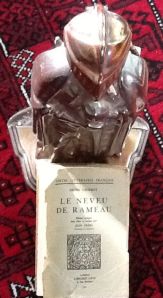
The Complete Samuel Beckett Short Prose


44 thoughts on “The Complete Samuel Beckett Short Prose

  1. FIRST LOVE
    “Personally I have no bone to pick with graveyards,”
    It seems appropriate that I read this encounter with a prostitute on the same day as I read and reviewed this extrapolation by Adam Golaski upon a painting of prostitutes on medical parade by Toulouse-Lautrec.
  2. THE EXPELLED
    “He was wearing a little harness, I remember, with little bells, he must have taken himself for a pony, or a Clydesdale, why not. I would have crushed him gladly, I loathe children, and it would have been doing him a service, but I was afraid of reprisals. Everyone is a parent, that is what keeps you from hoping. One should reserve, on busy streets, special tracks for these nasty little creatures,…”
    After that harness, the narrative protagonist later meets a horse, almost sleeps with it, having been friended by a cabman. This protagonist with a pustule on the head, we gradually learn has health issues, difficult walking procedure, a bit of a loner? Counts the feet’s steps as a sort of convoluted game and has had incontinence issues, too. Through a clever stream of consciousness relating to the protagonistic nature, we enter the head, BECOME that mind or self, as if riding a crippled, beshitted horse where you and the horse are harnessed as one creature, a bell-wether for misery.
  3. THE CALMATIVE
    “Into what nightmare thingness am I fallen?”
    An astonishing word-maniacal, satisfyingly textured self-portrait of a ninety year old protagonist from within the dead self, echoing or becoming the protagonist in the previous story, having been expelled, into death, now seeing death from the other side while still conscious of that self you had once been and whom you meet and what you did, still meet and do — circling a cathedral tower stairway, meeting different folk, then a man with a penis he erects, the old Joe Breen or Breem character your father once read aloud, and horses hung as carcasses and much more. Time as the eventual CALMATIVE of death, not yet reached? I base that on this…
    “He said a time, I don’t remember which, a time that explained nothing, that’s all I remember, and did not calm me.”
      • FIRST LOVE (second reading)
        “What mattered to me in my dispeopled kingdom, that in regard to which the disposition of my carcass was the merest and most futile of accidents, was supineness in the mind, the dulling of the self and of that residue of execrable frippery known as the non-self and even the world.”
        That sort of summarises Beckett so far in this book, in this exponential streaming — by father’s death, bench, parsnips, violets, diarrhoea confused with constipation and stewpan as pisspot — of the protagonist’s first love who turns out to be a prostitute he seeds with a child, song and doubt.
        This is text that grows on you, al dente, textured and mind-elasticising. This is now my first love with Beckett. Sent out to sleep in humus and straw by his posthumous Dad.
  4. THE END
    “There was even a hole for my cyst.”
    “I lay inert on the bed and it took three women to put on my trousers. They didn’t seem to take much interest in my private parts […] I didn’t take much interest in them myself.”
    “Come come, he said, and anyway no one understands a tenth of what you say. I’m so old, I said. You are not so old as all that, he said.”
    “I didn’t know our cows too could be so inhuman.”
    Hand to mouth, with pissing and farting matters described, begging and making do, in basement, sea cave and then self-made boat, this is a stream of consciousness which rings more than just true. A text to die for. Ending with the “calmative” that he swallows with the sea visions around him, utterly poignant…
    “The sea, the sky, the mountains and the island’s closed in and crushed me in a mighty systole, then scattered to the uttermost confines of space.”
    systole – a cross between my own cyst and a pisshole?
  5. TEXTS FOR NOTHING
    I
    “Yes, I was my father and I was my son,”
    A textured stream of consciousness of self, not self-consciousness, which compares well with another work I read today and reviewed here of a man who sees a boy on Mars, his son or himself when younger?
    Also a reprise here from earlier in this book for the story of Joe Breen, or Breem.
    • 2
      “, watch out for the genuine death-pangs, some are deceptive, you think you’re home, start howling and revive,…”
      The best advice I can give about these wonderful texts is to read them out loud to an imaginary or real audience. It all comes home.
      • 3
        “…I’ll say I’m a body, stirring back and forth, up and down, as required. With a cluther of limbs and organs,…”
        A revelation.
        For many years now I have been going on about “the synchronised shards of random truth and fiction” (now a googleable expression), and these texts for nothing seem to be the prime evidence of what I meant!
              • 7
                “…I’d like to be sure I left no stone unturned before reporting me missing…”
                8
                “Me, here, if they could open, those little words, open and swallow me up, perhaps that is what has happened. If so let them open again and let me out, in the tumult of light that sealed my eyes, and of men, to try and be one again.”
                  • 11, 12 & 13
                    “But peekaboo here I come again, just when most needed, like the square root of minus one, having terminated my humanities, this should be worth seeing, the livid face stained with ink and jam, caput mortuum…”
                    An existential labyrinth. I could sit reading it forever. Like the square root of minus one.
                    -1 being death itself..
  6. FROM AN ABANDONED WORK
    “But let me get on now from where I left off, the white horse and then the rage, no connexion I suppose. But why go on with all this, I don’t know, some day I must end, why not now. But these are thoughts, not mine, no matter, shame upon me.”
    The above title would be a good title for many works in this whole book, if not the whole book itself. Going from where to where? And in whose body? Read by the person who has become the person who wrote it.
  7. THE IMAGE
    ‘Image’ is an ‘I’m however old I am when I am’ and that is me talking not Beckett as it’s impossible to break down this complex entanglement of self, even to make discrete sense from quotable chunks, so nothing quoted.
  8. IMAGINATION DEAD IMAGINE
    Two white bodies in geometrical designs conveyed by words.
    “Sweat and mirror notwithstanding they might well pass for inanimate but for the left eyes which at incalculable intervals suddenly open wide…”
  9. ENOUGH
    “I don’t know what the weather is now. But in my life it was eternally mild. As if the earth had come to rest in spring. I am thinking of our hemisphere. Sudden pelting downpours overtook us. Without noticeable darkening of the sky.”
    Two old men wreaking sex from each other? Amid a prophecy of climate change.
    “What do I know of man’s destiny? I could tell you more about radishes.”
  10. FIZZLES
    FIzzle 1
    “Murphy had first-rate legs. The head is still a little weak, it needs time to get going again, that part does.”
    – struggling in or out of oblivion, this sometime Beckett-precursor-referential slice of prose has the feel of retrocausal Evenson again – and my trial gestalt of the “that part does” that doesn’t yet?
  11. Fizzle 8: For to end yet again
    “Sepulchral skull is this then its last state all set for always litter and dwarfs ruins and little body grey cloudless sky glutted dust verge upon verge hell air not a breath?”
    ‘Fizzles’, by the way, seems a very apt name for the year of Trump and Brexit.
  12. HEARD IN THE DARK 2
    This and the other short prose in this book seem as if to struggle to exist out of and probably back into darkness, here as fragments of visitation and sex, with a struggle to be Elizabeth Bowen and others, perhaps, towards a literary gestalt that would transcend the struggle that the texts have with life as well as with their own language?
  13. AS THE STORY WAS TOLD
    “It reminded me strongly of a summer-house in which as a child I used to sit quite still for hours on end, on the window-seat, all the year round.”
    More Bowenesque yearnings, Proustian, too, yet with the undercurrents of the rest of this book, fanning back in my own time it has taken me to read it. I look forward to reading all the extraneity creep in the rest of this book once I have finished reviewing all the fiction.
  14. STIRRINGS STILL
    “Head on hands half hoping when he disappeared again that he would not reappear again and half fearing that he would not. Or merely wondering. Or merely waiting.”
    The evensong.
    As it happens, the three sections of this masterpiece are the best work left to the end. And that means something, Just read it aloud to yourself, and see. A summation, too, of the whole book, as if this book was meant to be – its own gestalt now dreamcaught. Not my doing, as I have the same struggle for meaning.
    “Oh all to end.”
    But stirrings still.
    end of this but not of all.
    ——————–
        

Sunday, December 11, 2016

The Academy Outside of Ingolstadt – Damian Murphy


14 thoughts on “The Academy Outside of Ingolstadt – Damian Murphy”


  1. img_2656
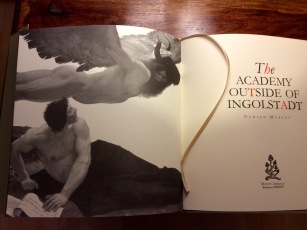
    Copy numbered 25/240. Luxuriously upholstered book with quality materials, about 10 inches square, 100 pages, marker ribbon, all beautifully designed and illustrated with dust jacket, and embossed hardback cover.

  2. A Vessel OF IMPENETRABLE DIAMOND
    “He had long been familiar with the particular vibration that distinguished dream from prophecy.”
    “A host of bestial angels, having fled the remains of the ivory city, had descended upon the institutions of an unsuspecting Europe.”
    We first meet Franz in the German city eating mussels, effectively under the “effusive chandelier” of this breathlessly resplendent text, changing between visions of flaming stags setting the ornate city alight like some Internal European Brexit, I guess, and the sight of pouring rain and a uniformed mob arriving in the same restaurant….
    He seeks sanctuary in his old Academy, and, intriguingly, we learn of his past studentship there involving ritual decisions with cards and rules about rules that may involve the breaking of such rules: Offerings, Requests, Relics, Perils and the single Threat. He wonders if the Fräulein who first mentored him is still there?
    If I sometimes misunderstand in real-time the tenor of this work (as I may have done already), I shall strive to rectify myself as we together proceed through its intricacies, but with the avoidance of spoilers my priority.
    Using Franz’s own Art of Intuition as my own?

  3. Exemplars OF A DOCTRINE ETERNAL
    Pages 21 – 27
    “He selected the second of three volumes of ‘The Stones of Venice’ by John Ruskin.”
    I very recently finished reviewing here ‘The Stones Are Singing’, a wonderful novel by R.B. Russell, that takes place in Venice, but when I first saw its title, I thought of the song “NIneteenth Nervous Breakdown”, as I mentioned in my review. But, incredibly, that novel has a significant scene where something is deemed to have fallen from a balcony to the balcony immediately below it, as is also the case in this section of the Murphy work!
    Meanwhile, we follow the two parallel paths of Franz at the Academy outside of Ingolstadt within sight of the Danube, one path when he was student there, and the other, years later, as an employee, now given a room “three stories beneath the surface of the earth”, and beneath the dormitories of the current students. The narrations and thoughts are extremely engaging and this work promises, for me, to be a great one, where Murphy is fully stretching his literary wings. There is too much to mention here, details that resonate and are placed in the sump of the reader’s building a picture with the high sense of genius loci. I will mention, however, his remeeting of his erstwhile teacher, the Fräulein, and also his discovery of the word ‘Incendiary’ to add to ‘Implicit’ in the first chapter. And, a loose typewriter key for the letter J.
    “…muttering to himself and smoking hand-rolled cigarettes.”


      • Pages 27 – 31
        “‘We are exemplars of a doctrine eternal, nothing less,’ he’d said, in one such moment. ‘That this doctrine remains unwritten is a testament to its inviolability.'”
        This is wonderful stuff evolving, as Franz meets his line manager Kraus at the Academy, in Franz’s role as employee, their discussion being inconclusive as to his duties, but deploying the contradictions of this doctrine’s amorphous non-archive, as well as Kraus’ claim as to a millennium of real archives, too, which we can visualise alongside the panoply of the academy’s inconclusive geography of rooms, and Kraus’ own calligraphy… All this will stay with you, staying with me as I write this or because I write this about it, as will the parallel era when Franz was once a student, and his knowing a fellow student in those days called Elise and, in this regard, I hope the author or publisher will forgive me quoting this irresistible short passage:
        “She tossed the stolen cigarettes over the lip of the balcony, one after another, where they sailed swiftly down like suicidal sailors abandoning their bodies to the open sea.”
        I do not intend to continue over-quoting or itemising this book’s plot as I continue reading it, but hopefully I will be able to convey some of its anticipated treasures.

  4. Heil DIR IM SIEGERKRANZ
    Pages 33 – 38
    “Transgression loses its potency if it’s divested of the risk of being caught.”
    Felicitously, this book is still exceeding even my own very high anticipations for it. Here, Franz reads the notebook he found, a ‘florid’ narration by a past female student and her meeting another in some strange corridor and their plan and machinations and semi-encouraged breaking of rules seem perfect accompaniment for a FB post I made earlier today, where I can now compare Eton to this Academy, if only insofar (so far) as what is embodied in the above quote from the notebook and my understanding of the two female students’ agreement together.
    We now return to Franz as Academy employee in this book’s ‘present’ where Kraus presents him with his first ‘relic’. Aptly what he needs to determine or alter about this intriguing object is what I have already been considering about this Murphy book itself!

    • Pages 39 – 45
      “It was made clear to the student body that the main object of study at the Academy was the Academy itself.”
      Having now returned to Franz’s student days and his (and, thus, my) continual entrancement by events (such as his sifting and potentially experiencing Relics, Perils and the Threat), I wonder if I am being similarly tested by the book itself, one of “mystery and deceit”, “not the slightest clue what was expected of him”, “being subtly teased”…
      One experience for me in this section was like awakening into an Evensonic or Beckettian situation…except I think this is the first time listening to Schubert as part of that experience, Evenson, not Evensong.
      And just as I read about the paper swan, The Swan of Tuonela came on the radio. Sibelius, not Schubert, Sibelius who had 32 years of silence…

  5. That ALL THEIR SHORES MAY WITHER AND CRUMBLE
    Pages 47 – 53
    “Our bodies are contorted into impossible positions. We face inward in a circle as Herr Schwarz paces around us, occasionally checking and correcting our postures.”
    There are more inspiringly rhapsodic descriptions as we continue reading (as Franz also presumably does) the red notebook he found: Una’s description of Faustine and some other girls together at the Academy under Herr Schwarz, the third path, as I might call it, of this book, perhaps, or as it says itself, ‘third state’… scrubbing the ‘perplexing geometry’ of the floor…….the power of the one in authority over the girls and the power the girls have in turn over such power with (permitted?) transgressions. HS reminds me of the power that football coaches have over budding professional young footballers in our news at the moment? But the two girls’ already planned secret concert of transgression together reaches even into HS’s own inner sanctum where they find a dubious(?) book he is writing, one about, inter alios, “a catalog of knots and a lengthy comment on the art of tying them;”

    • Pages 53 – 59
      “…the open lid entirely obscured its contents.”
      Franz, on the present path as adult ’employee’ of the Academy, visits the Headmaster for him to help supply a paintbrush for the Fräulein’s ‘Threat’ task…or so I sense sort of. This book, meanwhile, is exponentially becoming a true classic of this publisher’s trove of books, perhaps its eventual zenith? Only universal hindsight will later prove or not this my humble premonition, my being a mere reader of these books.
      This book has its own plot as its cursor, a “care and reverence” in its execution as well as in the reader’s need to have these qualities, too. As in its music within this text, in its own text as literature, we can also find “the hidden order of all things”, “A lifetime’s worth of mystery…”
      With my real-time reviewing of this book, I seem to be slowing it with my finger as upon a spinning shellac disc and what do I hear instead? And I steal things from this book, as I feel it has given me implicit permission to do so. An allowed ‘deviance’. And I note the Headmaster himself uses the word ‘implicit’ in this section of text…
      But what about the rat?
      And how (dare I ask?) is the world faring outside?

  6. “Pleased to meet you
    Hope you guess my name
    But what’s puzzling you
    Is the nature of my game…”
    — from the Stones’ “Sympathy with the Devil.”
    My quote, not the book’s.
    —————-
    ‘InsiDIOUS’
    “As with the vast majority of the students at the Academy, in the absence of coherence, consistency, or certainty, they’d managed to find meaning in a series of arbitrary rites and transactions of their own invention.”
    Invention – insidious, implicit, inane, incarnation, incantation, iridescence, icon etc …I keep seeing ‘i’ words, or imagine I do in the text, as I speculate who is exactly the ‘I’ in the red notebook, the text of which is again being shown to us here, and perhaps I was wrong about the notebook’s narrator and whose name confuses me (as in the Stones’ song), as the girls (their bodily posture still being ‘tested’ by Herr S) rôle-play immersively with marionettes, including a marionette representing the ‘sympathetic’ Devil. So many “I”s, so many eyes decorating this book. I am more than entranced now, not simply blown away, but constructively magicked adrift. They even start to call the Academy “Institute”…
    These scenes follow some scenes with Franz and Elise in his own past as a student, given a new task by Fräulein, one that is sedately and holily imparted and I was struck by this item of description (among many others): “Franz understood, given his experience with this type of assignment, that the object searched for was secondary to the exercise itself,…” and in this sense you need to read this book for yourself. You cannot simply depend on me…If only for the reference, inter alia, to the ‘pungi’…

  7. The BELL TOWER
    Pages 73 – 83
    “a gentle pocket of illumination” “uncertain the intention” “the English word ‘Incestuous'” “‘The Book of Indulgences'” “we seek for nothing less than to perceive the underlying principle that lies implicit within each of us.”
    This is Franz on both paths at once, searching, as a real-time employee, the labyrinth of this book – during my gestalt real-time’s own labyrinth – for the Academy’s library amid the Academy’s own mazes and what happened to him in his redawning memory as a student in the Bell Tower. Surely these scenes are the innermost crux of this yet unfinished book, unfinished by me, if not unfinished by its pecking-order of leasehold or possibly unreliable narrative point-of-view and of the freehold author who I assume has finished it at a point beyond where I have so far read it alongside my accompaniment of Franz on his paths present and past.
    In that past, we see Franz led by the Headmaster towards an act that I dare not read about as if I have been led to the point of the book that is forbidden.
    But if I have not read the whole of the text that I say I have read, by dint of the page numbers above, that would be one duplicity too far. One mirror two many.
    If I have dared read it – as you probably infer I have done so – I certainly dare not impart it to you, in case you have not read this far yourself, “at once exhilarated and aghast.” Whether or not you are a Kabbalist or “one of the followers of Mohammed.”
    Remarkable writing, in any eventuality.
    ——————–
    “When the whip comes down
    When the whip comes down
    When the whip comes down
    When the whip comes down, yeah”
    — from the Stones’ song of the same title.
    My quote, not the book’s.

    • Pages 83 – 91
      “It was the very soul of the implicit, he concluded; at once perfectly individual, and common to everything.”
      The literally bedevilled aftermath of Franz’s epiphany of ‘Threat’ (Portrait of the Artist as a Young Man by Joyce or The Magic Mountain by Mann?) evolves into a gropenghast climb from the tower to the roof, a mountaineering of architecture, beneath the stars, from stone to stone, ledge to ledge, balcony to balcony, not towards the Last Balcony or The Last Time? This reaches a pivotal decision. Shall I go or shall I stay?
      The answer is In the text which is one of nightmarish proportions, of guilt at what he has just been put to, of shame and of eventual acceptance by an expected onward routine of relics, requests etc, then what else following this smoothly styled cornucopia of jack flash images and thoughts?
      A literary work that deserves equal footing with those I mentioned above. I really believe so. The inspirationally constructive irrationale and conflation, et al.

  8. The LIGHT ABOMINABLE
    “The world which he had left behind, and to which he must eventually return, stood perched, for the second time in his short life, upon the perilous shores of a vast and all-devouring sea,…”
    This the book’s (Chiang-like Arrival-retrocausal?) coda is like a Holy Relic or a Sacrament, as if we as readers are involved in the passing on of its torch, and I hope I have fulfilled that mission-in-hindsight-of-gestalt.
    I just wonder, as Franz does, whether the rats were laid deliberately.
    end

Saturday, December 10, 2016

Brexintendum

The result of the EU Referendum was mutated by previous wild statements of disinformation on both sides.
In the enormity of gestalt hindsight, a new dual BREXintendum should be issued along these lines on one sheet of paper -
------------
(A) There should be a repeat yes-no referendum on EU Membership.
Yes or No.
(B) Britain should leave the EU
Yes or No
......
(A) will be counted first.
(B) will only be counted if the result of (A) in total is YES