A Work Of Art
posted Saturday, 10 February 2007
A WORK OF ART
When I first met Wrzesmian I took him to be an eccentric asylum seeker. Accustomed to finding him in the library's reading room stooped over a book, I assumed that he was quickly learning the English language so as better to fulfil the requirements of a Curriculum Vitae. Jobs were scarce unless the job you wanted was one nobody else wanted to do.
Wrzesmian’s ambitions were evidently grappling with the task of being a middle-aged man finding that the next necessary step in his destiny was to make a living for himself in a place where even his much younger fellow asylum seekers found it difficult to cut swathes beyond the path that led between their digs and the Job Centre.
His coat was buttoned to the neck whatever the temperature inside or outside. Its lapels were extra-wide in a fashion that was perhaps more appropriate to his own country. His long nose was ever in that book I found him poring over. But when I eventually spotted his eyes, I knew he harboured a spirit that just needed persuading out into the open so that it could unfurl its wings and fly. Or flick its svelte tail and swim.
“Good book?”
I’m sure I could have thought of a better opener. It being an English language textbook, as I already assumed, the thought of its status as a ‘good book’ seemed somewhat trite or unnecessarily patronising. So worried was I, I failed to accompany my enquiry with a smile, even a nervous one.
I didn’t, therefore, blame him for the steely stare he returned.
The next time I saw Wrzesmian in his place at the reading room table, I forgot the constraints of such a place regarding the ease with which one could hold a conversation. I still do not understand how we were allowed to prattle on at such a length, although perhaps we were indulged because others were genuinely interested in listening to what we had to say.
This time I opened up both with a smile and a passably efficient item of conversational bait. Looking back on it, however, it was a natural continuation of my opening gambit of the previous occasion I had seen him. Meanwhile, memory plays tricks and it may have been the third or fourth such occasion. It doesn’t matter because what I did say upon the day in question opened the floodgates at last.
“Sorry, I assumed it was a book on learning English," I said, "but I see there are full colour plates of art in it. Are you an artist?”
He then spoke perfect English, if with a tinge of an Eastern European accent. His nose was now raised and I could see his full face as he spoke: a living portrait by a modern artist, giving many angles of his personality in one treatment as it were. I would never have painted it thus. But one could not escape from the reality of the treatment: this was truly him. Truly Wrzesmian.
“No, I am not an artist. But I do seek the definition of a work of art.”
I nodded, speechless. This would not add to his Curriculum Vitae. I itched to advise him to a better course if he should still need a job. I thought about questioning why he was an asylum seeker, failing to pay much attention to his showing me various items of art that his book depicted. I was worried. Never speak to strangers, my parents had always warned, and this was good advice throughout life, I guess. But withdrawing from contact at this point might have been more dangerous than the initial making of contact itself.
“What is the purpose of defining a work of art?” I eventually decided to ask, having chosen this question from a thousand others I had toyed with.
He seemed to weigh this question heavily upon his heart. He sighed thickly. “I need to establish what is a work of art and what is a ready-made?”
“A ready-made?” I knew nothing about art so was unable to help the conversation along other than by enquiring echoes.
“Well, Duchamp’s pissoir is art – people view it in a gallery – and how does that differ from, say, a Picasso or a Van Gogh?”
Ours was a seaside town and I made what I now consider to be quite a clever remark:
“Is the sea a work of art?”
“Yes, yes, yes!” he almost shouted. I looked around ruefully hoping we were not disturbing anyone. But the lines of students were still bent over their books and no doubt a few others still crouched within their carrels.
I was amazed at the sudden rush of enthusiasm to Wrzesmian’s face. My ambitious leap beyond a mere enquiring echo such as ‘pissoir?’ or ‘Picasso?’ or ‘gallery?’ or ‘ceramics?’ had evidently woken him to the possibilities of further conversation. Perhaps he wanted to run a gallery as a career and such studies would after all look quite good on his Curriculum Vitae.
“The sea,” he continued, “is a very good example. It is a living being that moves, changes mood, with a colour of a silky sheen one day, a blue canopy the next or a grey morose gruel the next. It takes light or colour or mood from the sky above and the often unseen weather that embraces it. Much art could never be contained in a gallery…”
He hesitated as if he was wandering beyond his brief, given the assumption that he actually wanted to work in a gallery. A painting of the sea would be relevant, but the sea itself?
We soon returned to our own quiet affairs, as a certain few of the other readers shuffled impatiently giving the impression that they were at the end of their various tethers. I left the library soon afterwards. It was a late winter afternoon where the sea was of that ‘grey morose gruel’, I noticed. I later gazed quizzically at the urinal as I hissed steamily upon it.
The next time I encountered Wrzesmian in the reading room there were luckily only a few, if any, other readers, unless the carrels hid more lowered temples.
He took up the thread at the point we had left it:
“I have managed to add to my CV with the help of your mention of the sea.”
I nodded. This was the first real confirmation that Wrzesmian was actually preparing a Curriculum Vitae. I felt proud that I was helping an asylum seeker with worthy credentials for mixing well with the community in which he now found himself. One who demonstrated kinship with a native like me by extending such polite gratitude implied by his statement.
“Good luck with it. Do you paint things yourself? It’s not the weather for painting the sea, I fear.”
I was now a top class athlete in the gymnastics of conversation. This also involved the ability to stay silent so as to give my co-conversationalist his own head of steam.
“I watched the sea all day yesterday,” he said. “That’s why I wasn’t here.”
I nodded, without even a single enquiring echo. I had noticed he wasn’t here yesterday. It had quite perturbed me to see his empty place.
“There was a lot of what I first thought to be driftwood,” he continued, “flotsam and jetsam, I know not which … framed paintings … and ceramics that should never have been able to float, and things which came out of their frames, split from corner to corner. Antiques … and long-lost masterpieces, I’m sure. I managed to struggle down to the shoreline but they floated in and out just beyond my reach. I got wet but I still couldn’t wade far enough to the nearest things many of which I happened to recognise from this book…”
He held up a photographic image of the book: ART AS WORK. A very rare book, as nearly everyone who needed to read it could not afford to buy it. And it was always out when you tried to borrow it from a lending library, unreservable, thus intrinsically unreadable. It was a legendary book, spoken about in hushed whispers in many reading-rooms worldwide, even, no doubt, in the library of the Eastern European town where Wrzesmian was born and brought up.
I cried (later, secretly, at home, not in front of the other readers) following my next visit to the reading room. Wrzesmian was not there and I knew, by instinct, that this was the first of many occasions when he wouldn’t be there. I hoped he would rediscover his book. If memory serves me right, he did hold that book once and even showed me pictures from it. But that was so long ago, now, I can never be sure.
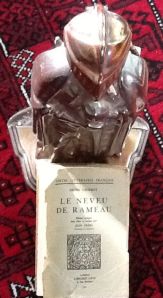
The photo he had held up that day was a photo of a framed painting of a book, a painting covered in what appeared to be seaweed.
“Ceramics?” I often mumble to myself, as I leave the reading-room.
He never realised, I guess, that I was a retired local fisherman, as I had never given anything of myself away to him. I was Wrzesmian’s stranger.
(above written today)
www.nemonymous.com
Des Lewis - GESTALT REAL-TIME BOOK REVIEWS
A FEARLESS FAITH IN FICTION — THE PASSION OF THE READING MOMENT CRYSTALLISED — Empirical literary critiques from 2008 as based on purchased books.

No comments:
Post a Comment