Tuesday, June 23, 2009

Nemonymous Two


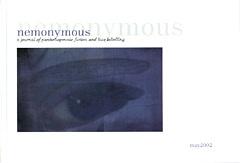
Nemonymous Two came out in May 2002 and is the first to disclose the names of those published in the previous issue. It features a a story of roughly four and a half blank pages titled "Four Minutes Thirty-Three Seconds", arguably the first formal blank story ever published. There is also the now legendary 'Emmanuel Escobada' story that still remains anonymous at the request of its author.


Contents
"Climbing the Tallest Tree in the World", Rhys Hughes
"Mighty Fine Days", Antony Mann
"The Assistant to Dr Jacob", Eric Schaller
"Buffet Freud", Dawn Andrews
"Ice Age", Iain Rowan
"The Vanishing Life and Films of Emmanuel Escobada", Anonymous
"Berenice's Journal", Richard Gavin
"Showcase", Sarah Singleton
"Eyes Like Water, Like Ice", Jai Clare
"Earthworks", Simon Kewin
"Striped Pajamas", Margaret B. Simon
"The Drowned", Joel Lane
"Adult Books", Robert Morrish
"Nothing", John Travis
"The Secret", G. W. Thomas
"A Spot of Tea", Janet L. Hetherington
"White Dream", Neil Bristow
"Four Minutes Thirty-Three Seconds"

Nemonymous One


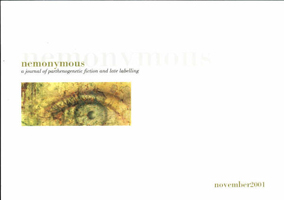
The first issue of Nemonymous appeared in November 2001. The missing bylines below were announced six months later, in Nemonymous Two. This anthology was arguably the world's very first self-contained anonymous collection of multi-authored stories.

Contents
"A Smile in the Sky", Gary Couzens
"The Friends of Mike Santini", Terry Gates-Grimwood
"The Quiet House", Allen Ashley
"With Arms Outstretched", Daniel Pearlman
"Breaking Rules", Avital Gad-Cykman
"The Gravedigger", Lawrence Dyer
"Alone", Shawn James
"The Idiot Whistled Dead", Simon Clark
"The Unmiraculous Life of Jackie Mendoza", Tamar Yellin
"Across the Hills", Tony Mileman
"All for Nothing", Rhys Hughes
"Double Zero for Emptiness", Mike O'Driscoll
"Strobe", Paul Kane
"Balafer de Vie", Lida Broadhurst
"Mansions of the Moon", Jeff VanderMeer
"Gamlingay Churchyard", A. D. Harvey

Sunday, June 21, 2009

Taught by Masters

Written today (21 June 2009) and first published here.


They ended up not wanting to have names. A group of people who ripped off their unseen labels one by one. There needed to be an example set, however. Nobody would unname themselves without a lead to follow. A First Mover. The pre-emptive Clockmaker. If this were a story, the author would start with the example-setting character’s name – followed by a narrative of his rite-of-passage from name to namelessness. A tale of bravery and hardship, of a dimmer-switch controlling the light of identity, of those who failed to follow and remained named, of those who did follow and became unnamed. Yet to name the leading character as he was once named would be to jam the dimmer-switch by wedging in what it was trying to dim. The others who remained named would gain prominence by having real characters’ names in the story while the rest floundered about unidentified – not only confusing the pecking-orders within the plot but the plot itself. To call them by false names or even by letters like A, B, C would, no doubt, cloud the issue even further. Meanwhile, it’s good for any story’s author to relax and concentrate on the plot’s landscape, its spirit of place, before worrying about the entrance of characters,

The public park in Colchester, with Norman Castle, flower-neatened gardens, an empty bandstand, all eventually leading down grassy slopes towards a small boating-lake. Nobody has hired a boat today. It must be one of those times when everyone is asleep at home. The Longest Day of the year. Light at Night like the Land of the Midnight Sun. Even here in England’s Essex. The dimmer-switch of the Sun turned right up.

Without people, there can be no story to tell. But now, at first dimly seen, are tall dark shadows wandering around the Castle. They are the nameless Masters of Existence trying to form gradually into real people. They have been given no belief in the story-premise that all the real people are at home sleeping. Yet the Masters, so-called, remain only partly formed into what they had hoped to become since the story had given them no names other than as fictionalised Masters of Existence, no names on which to hang their identities. The story refused them any such luxury. So mere shadows (if slightly flesh-corrupted) they remained, ever-circling the Castle like forgotten druids. Masters of Existence who could not even master existence for themselves!

Suddenly, there appeared, on the margins of the boating-lake, the legendary Clockmaker whose clocks had hands but no numbers but, more often, numbers but no hands, because, with the former, one could at least guess the time they told. A real flesh-and-blood person. Taught by Masters, but lacking their ambition of existence, the Clockmaker actually succeeded in becoming what they had desired but failed to be. The Clockmaker knew that any ambition destroys the goal of that same ambition.

And now is time for waking. We are here, stretching, fully-formed, truly nameless, stirred by pre-alarmed timepieces within our minds but pure of heart and unconstrained by the deadlines of finding identities to wrap ourselves in. Owning identities simply because we didn’t want identities, the only pre-condition for identity being not to have one.

And the story can at last begin.

Thursday, June 18, 2009

Big Brother - Summer 2009

CONTINUED FROM: http://weirdmonger.blog-city.com/celebrity_big_brother_2009.htm

These are DFL's comments taken from a conversation here: http://www.ttapress.com/forum/viewtopic.php?t=182

------------------

Siavash and Angel - truly weird. Rodrigo. Yes, I did think. That's the winner. I don't know whether it will matter that he usually goes to Church every day. But what about the scandal of Noiron's Eyebrows? And why did Davina keep calling Marcus a 'Wolverine'?

Halfwit seems (inadvisedly!) to be taking a leaf out of that lady's book who used to croon jazz songs on a previous BB. What was her name? I sense the three who passed the SAS tests simply knew they would not be subjected to something dangerous (however dangerous it looked). I simply admire their opportunism, not their bravery.

But there is much open-ended meaning in incomprehensibility.
Quote:
she was less than happy to have it pointed out that her elevated Double FFs had a plastic seam.

Oh, wll, you can't have everything.This phenomenon is probably the most telling of our bizarre (often cyborgnine) society. BB is SF in action. 'Dhalgren' theatricalised and extemporised.

Quote:
What a pitch Sree made in the Diary Room - that tremulous break in the voice, that tearless crying,that passionate declaration of love for EVERYONE

Sree was Soreeee! But now he is SO REEELIEVED!

Quote:
And there were echoes of last year - Siavash is having trouble with his identity since he does not have his own clothes. He knows not who he is
.

Again and again BB fits into the Nemonymous template. Cf: Halfwit and Dog face. And that entity called Nothingness who sits at the bus stop when the camera is not on it. A ghost? If so, of a past BB HM?

Quote:
I had one wish come true - Angel stays. I had one wish not come true - Siavash stays. Such is life.

Me. too, Marion. Benazir was not abe to come out from under her name. She was brave: a Shakesperean tragedy. A soliloquy on an otherwise empty London bus that nobody heard. Not even our old friend Nothingness.

I think Halfwit has an interesting view of his new BB existence, whereby real life is now fading as if controlled by a dimmer-switch and the HMs are puppets.

Quote:
The chemistry between Sophia and Saffia is fizzy and with more than a whiff of sulphur on Sophia's part.

This chemisty is more like mutually induced alchemy to create gold from the dross, i.e. feisty personalities for themselves. An unspoken pact through a mock antipathy.

Quote:
WEEEE-EEED! But you were right about open ended convos, Des - no matter that what they say is incomprehensible , there is no doubt of the chemistry between them
.

Yes, another form of symbiosis (this time Cairon and Siavash). But often with such things (as in insects) one often dies as a result of the symbiosis. And sooner or later, a husk will topple down the eviction steps towards a new Zombification of Davina.

Quote:
Angel is having a problem with Siavash's language ( I was RIGHT to like her!)

Angel, right on! Serendipitously, I'm reading a wonderful novel called 'The Angel's Game' at the moment by Carlos Ruiz Zafon.

Quote:
Siavash's wardrobe is every bit as colourful as his mouth. It is a Frankenstein chemistry experiment gone wrong, what with feathers and beaks and bandsman uniforms
,...

Sergeant Pepper in a mutant dream of Venice. He is all contraptions, tags, pieces, masks - a Caliban (not Tallyban) at the Masque of the Red Death. I like Noiron and the lightly-stylised moustache and glasses suit her.

Vignette upon vignette tonight:

And the vinaigrette on Halfwit's salad. Plus Noiron's lorgnettes.

Quote:
Siavash in the bath attended by handmaiden Cairon - what was all that about?

Yes, Vereeee strange. In fact I'm finding this BB experience stranger than most. Reality skewed a notch or two. Full of mignonettes and obliquities and Marion's observations shimmering in some hothouse of odalisques & lizards.

Quote:
...the evolution of language tonight:sentence order got all mixed up ... singing opera, and murdering 'Summertime'...

Who was that lady who broke into songs in a previous BB?

Quote:
Lisa is turning into House Mother

Lisa is an archetype HM. She is the Platonic Form of an interchangeable modern creature who just is, so simply confident and brash.

Quote:
Kris says he's an annoying little bugger. Marcus thinks he;s immature. Cairon thinks he;s a pimple.

Sree is a self-incubated plant of delicate immaturity but one that will grow into a triffid from the seedbed mulch stirred by BB's searing searchlight beams

I find myself more in tune with the Russian Soul but alerted now, by Marion, to Rodrigo's proximity to a shop window mannequin, I find this an even more interesting contrast. Mannequins and Marionettes, Lizards and Odalisques, Egyptian tomb-effigy or walking Tea-Cosy, I am glad I'm watching BB, simply to enjoy Marion's observations to the full! Dogface is a charm-catalyst that is like an open flower that only can respond passively to Nature's stimuli - and here in 2009, Nature is made of many teasing tentacles of modern instincts quite alien to life as I remember it, say, in the Fifties. I don't know why Charlie seems to be the current favourite to win. I think Noiron is a dark horse. A doodled-upon icon. And sensible and nice, too. I, too, hope Sophia goes on Friday.

I love the twirling moustache motif, which also fits in with Noiron's real mock-up (if that's not a contradiction in terms) of a moustachio. Two memorable phrases were said yesterday: 'Zero tolerance' by Sree. And 'Lost in Translation' by Noiron. In an oblique way, each is very telling, and potentially devastating to the way we think BB works as both a Reality TV show and a cultural breakthrough in Art and Aesthetics. If others reading this thread enjoy Marion's wonderful BB reports, you should read her fiction works, and I'd suggest her book 'Sleepwalkers' (a collection of stories), which I reviewed here: http://ttapress.com/forum/viewtopic.php?t=875

Huzzah! Sophia is first Housemate to be evicted, but really second evictee and third preson to leave the house, after Benazir and Saffia (who left to see her children after getting in a Benny with Sophia) and Sree had a Benny with Cairon while trying to exercise zero tolerance (on the face of it the first BB HM to try to maintain a zero tolerance regime on swearing etc) but perhaps all this is lost in translation while Cairon gets on a course for anger management and Lisa tries to make up for not intervening in the first Benny...while Charlie acts as a counsellor and ... more later

Sophia's interview went well. I like the three interviewer approach and i even began to like Sophia. This shows you that people are not really people unless seen in the round of the many habitats that they pass through (including the BB House and any web presence).

Some more bite on the screw of one-on-one relationships, following Cairon and Sree, now Dogaface and Kris, Halfwit and Lisa, Siavash and a giant pierrot hat.

Good on BB calling the fake romance of Kris and Dogface. Marcus and Lisa - what's the betting on them having a romance before BB s finished? I'd have a menage-a-trois any time with those two. Sree and Noiron - another romance? Some of the others seem like an audience - wide-eyed - as if they can't believe what is going on. Angel is quite mad no doubt, but she seems sane in there. Karly the hard cynic. Not sure about her. She must wonder what she's got herself into! You can see the hate she looks at Marcus with. That slithy tove of a wolverine. Rodrigo seems to have gone low-key. Halfwit is someone I'd dread meeting on a BTCV holiday. Cairon and Skiavash - another fake romance? Charlie is just plain street-ready. An ordinary lad.

Lisa is perhaps Sycorax, Angel Ariel and most of the rest are a single gestalt of Caliban and/or Trinculo & Stefano. Big Brother is Prospero. Noirin is Miranda. Sree /Noirin - I thought this was beautifully enacted by both parties, and whether they each have the emotions attributed to them by Marion, we perhaps shall never know when they become the next celebrity couple. I think Noirin's doodled face is fast becoming an icon, after all. She should be thankful for it. She should also be thankful for her own sweet nature. The flower dance was another pure BB 'Happening' that becomes an Art installation of the mind.

There are some genuinely interesting characters this year, some blossoming before our eyes. And difficult to tell posing from positioning from positivity of personality. After all, these 'cats' have walked the decade-old BB earth - having learnt for most of their 'sensible' lives how to play the game.

Very strange goings on indeed. It's as if the world has entered a new phase, Angel's phase, Angel's dream, sometimes Angel's nightmare. Cleansed only to dirty herself time and time again with other people. Absorb them, let them be your parasite. The Foggy Day in London Town is just anothe Bleak House. And there was Skiavash picking nits from Cairon's hair. Or was it more sexual than nursing care? Parts of Angel made manifest by incarnation? If so, how can Ariel's soul bear any body weight whatsoever? How can Rasputin reach Heaven - by telling Sree that Noirin was wanting him in the bedroom? No, by transmuting a-trinketed Trinculo to Tallyban via Kaliban out of Sycorax. It's strange that someone's Heaven is someone else's Hell. Marcus is cool. He is so cool, he can even shit cool. Apparently. A speech in the Diary Room that was seriously cool. Sleek wolverine within a body's weight.

CONTINUED HERE: http://weirdmonger.livejournal.com/111444.html
Wednesday, June 03, 2009

Saturday, May 30, 2009

'Weirdmonger' Review - Part 8

CONTINUED FROM HERE


The Spigot and the Speechmark (1996)
We return to the world of an old couple as in ‘Season of Lost Will’ and the use of speechmarks as in ‘Rosewolf’. This story has a ‘snorting monster’ – if sat on a motorbike or on a lavatory.
I remember it getting good reviews when it first appeared in ‘Deathrealm’. But it gains even more power here in the context of this book, I find. Yet some have told me that many of my stories lose power by being in this book's sheer textual overpowering. Who is right?
Meanwhile, I find myself wishing to go back and edit all these stories. Even destroy them. Can’t do that with a book as easily as I can with all my other stories that I've spent some years posting on the Internet. Who knows what I may do when ‘I’ become like this story's two characters in real life. Not long to go, I guess. (30 May 09 - 7 hours later)

Sponge and China Tea (1989)
This was one of the eight stories by DFL that ended up either in ‘Best New Horror’ or ‘Year’s Best Horror Stories’ in the Nineties. DFL was, however, never really a Horror Story writer as such, but, as someone once said, he is a writer who writes in a genre of one. The big question is – does his work have an audience of one, too?
This story was first published in 1989 in the ‘Dagon’ DFL Special. It is about a daughter and mother, as the latter dies. A horrific, yes horrific, account of this relationship – and the arrival of an old school friend as a travelling salesman whose products bring ... hmmm, what shall we call it? ... scar tissue (cf. that in ‘The Scar Museum’). He also brings a variety of ‘small talk’ that borders on ‘pub talk’...!
A borderline Ghost Story, too. With marked DFLisms of style.
“The body wherein she lived toward the end had been little better than a wrinkled sack of rattling bones, which sometimes spoke up for itself with a voice I no longer recognised.” (31 May 09)

The Stories of Murkales: Twelve Zodiacal Tales (1987, 1988 – in separate issues of ‘Dagon’)
Re-reading this substantial mini-collection-within-a-collection reminds me that ‘Egnis’ was not the only story in ‘Weirdmonger’ representative of my much earlier writing times when I did not expect ever to be published.
These tales stem, I guess, from the late seventies or early eighties. The twelve tales – highly wrought, containing many astrological references, conveying a Biblical feel of (to coin a phrase) Baffles and Fables – are each representative of a Sign of the Zodiac. There is a strangely Arabic air, inter alia. And a scatological / eschatological feel that is emblematic of later work represented in this book. There seem to be astrological harmonics to which any chance reader of these tales should – the then ‘author-self’ surely hoped – slowly grow attuned. My present-self has severe doubts.
“Each. Sentence. Is. A. Word. In. Itself.” (31 May 09 - 4 hours later)

Stricken With Glee (1992)
A companion story to ‘The Christmas Angel’, with pathos and absurdity in symbiosis. There are back-stokers who live behind all the roaring fires in the large many-chimneyed house – living in tunnels and intermittently opening the backs of fires to throw on more coal. One of the protagonists (protagonists who sit desultorily in front of these many roaring fires to dissipate the aching cold) will need to dress up as Santa Claus on Christmas Eve and climb up on the roof to choose which chimney he will use...
Pity he has upset the back-stokers throughout the year!
That’s a story spoiler, by the way. But I love spoiling things –
These stories often work better if the readers fear the author they imagine behind them.
One consolation: the back-stokers are here brilliantly described and I will not quote anything for fear of spoiling your enjoyment even further.... (31 May 09 - another 3 hours later)

The Swing (1997)
This is, I’ve now decided, the perfect DFLism! It works on many levels – the ambition of a swing’s upswing – young love that matures (symbolically and sexually) into a ghostly future – the religionisation of life’s characters such as parents – the full blooming of the story’s swing-emblem into something or someone other...
This whole book is now firmly back on the upswing – having been on the downswing for a while...
There is also a subtly implied re-visit from ‘The Christmas Angel’.
“As they say, whilst human beings reach out for Heaven, angels die the other way". (1 June 09)

The Tallest King (1988)
This, I’m now reminded, is another pre-DFL DFL-story like ‘Egnis’ and ‘The Stories of Murkales’ written a number of years before the late eighties. This is in a simple style -- a fable or fantasy story of islanded communities that reach beyond themselves by the power of individuality.
It stirred the then much younger Mark Samuels to write in the next issue of the magazine where it was first published as follows: “The highlight of the issue was undeniably Des Lewis' beautiful little story, 'The Tallest King'. A wonderful faerie-tale told in perfectly child-like manner, and singing with the glory of descriptive prose. Really delightful. What a talent this fellow is.” :)
“There came a time when the tallest king in the city was a man of strong mind. When he first went up the stairs to the tallest room in the tallest palace in the whole city, he stood with amazement on his tallest chair, peering through the tallest window near the tallest roof, and gazed for the first time on...”
(1 June 09 - 2 hours later)

Tentacles Across The Atlantic (The Story) (1996)
"GIMME GIMME GIMME!"

Presumably labelled ‘the story’ to differentiate it from the regular non-fiction column of the same name that DFL wrote in ‘Deathrealm’ during the Nineties.
This is another very long monologue like ‘Shades of Emptiness’ – with some amazing separate images but, ultimately, non-synchromeshing. Or at least my present self so judges. The opening seaside scenario is, however, worth reading the whole book for alone ... perhaps.
This is one of the half-a-dozen similar unreviewable stories in this book under ‘S’ and ‘T’ in the alphabetical contents that make the whole book ultimately flawed, and predominantly why I have assumed it to have foundered since it was first published – despite the excellent production qualities of Prime Books and the stunning cover and internal design by Garry Nurrish. Or it is simply wishful thinking to believe that, given a different contents list, it wouldn’t have foundered in any event. A tentacle-tangled wreck on the ocean-bed of misbegotten literature.
“I will have shown Max my old marbles – the ones I played with at his age. I will have taught him their names: Big Red, Split Dark Blue, Blur Green, Spot Yellow, Thin Red, Big Green, Large Light Blue, Thick Red, Bubble Red...”
(1 June 09 - another 3 hours later)


'WEIRDMONGER' REAL-TIME REVIEW CONTINUED HERE

.

Tuesday, May 26, 2009

'Weirdmonger' review - part 5

CONTINUED FROM HERE.


The Merest Tilt (1994)
Well, a real gem of showgirls and froths and frills and creamy realities that the narrator fashions from a selective use of his own diary written during the events of the story. This pencilled diary needed a merest tilt sometimes for him to be able to read parts he had earlier rubbed out. This seems to fit in with the way I’ve been looking at this whole review! Truths and fictions?
A story with its darker moments, too.
“My companions were surly souls with curt courtesies in the taxi. Humourless asides intended to be funny made me cringe. One was my uncle I think (the diary is unclear). Someone else was there whom I’d once loved but did no longer, somehow. Yet another was silent and shadowy who made me afraid to talk out loud in case I revealed something of myself he wanted to catch. There was also a dwarfish creature, pressed up close to me on the back seat, who kept broaching unwanted topics and expecting us to comment.” (26 May 09 - another 2 hours later)

Migrations of the Heart (1993)
Coincidentally, following alphabetically straight on from the previous story, this one says: “I can only convey things by things I leave out.”
A very brief piece of poignancy about a childless couple haunted by the ghost of childlessness and of their own encroaching old age when decisions (like where to sleep) become arbitrary. Alphabetical by way of its own plot, too, incredibly, in the above light! (26 May 09 - another hour later)

A Mind’s Kidney (1993)
Another quick-change act by what turns out to be (from the point of view of the author) a fast-and-loose I-Narrator as in ‘Angel of the Agony’. Also ‘bed-switch’ repercussions almost in tune with those in the immediately previous alphabetical story! All taking place mid bladder-change during a night in strange lodgings, the room having oversized door-hooks and old-fashioned chintzy decoration. A real ghost that is generated by confused thought. The story of my life!
“Filters can work both ways, I thought, in the tired way my thoughts sometimes made me think.” (26 May 09 - another 2 hours later)

Padgett Weggs (1986)
Archetypal early DFL tale of pub talk, St Paul’s Cathedral, Great Old Ones roosting on London’s roofs, walking heads, brain surgery conducted in a pub lavatory, smuggling ambergris...
Also a clumsy wooden arch constructed over the bed as a second ‘roof’ to keep God out ... or in! [The latter bit was inspired by the novella ‘Agra Aska’ written in 1983.]
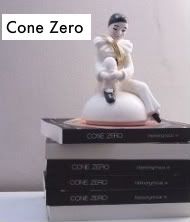
This is one helluva crazy author's first published story. It cannot be reviewed. It just is. It needed to exist. Ironically iconic. Cone Zero. A zoo of words that escaped their cages.
Ever since coming to this strange city, he felt that his mind was channelled between two blind alleys – so, although he could indeed think straight, the thoughts themselves were in the dark and ambivalently cobbled together.” (26 May 09 - another 3 hours later)


Queuing Behind Crazy People (1997)
A tale of a film that becomes a tale of its queue outside the cinema, with Ligottian buskers entertaining its length. Some queue-members even have to leave the queue because they spend their entrance money on the buskers. Conversations and friendships underpin the queue. A story of craziness even crazier than the story that tells about such craziness. (This book is a meta-book only crazy because it was ever published in the first place.) Coincidentally, following on alphabetically – in a presumably neat queue of stories – from ‘Padgett Weggs’ which tells of a living human head in separate existence, here a queue-member tells of a head being found in a lobster-pot when fished from the sea by the fishermen. A character called Ken King tries to befriend the we-Narrator after the film simply because he recognised ‘us’ from having sat in the same row in the auditorium. The film itself (which fails to feature in the story because too much time was spent describing its audience’s preliminary queue) was, apparently, banned after its first showing – because of one fleetingly brief scene which most of the audience missed as they were snogging. I won’t mention the toy gun. This story is not iconic like ‘Padgett Weggs’, but it is certainly a memorable busker for you queue of readers who want to read the book as long as you can manage to get into it. Some memorable images, but fundamentally firing blanks.
“That night, we believed Ken King would have an itch in his brain. / A terrible itch. / Such an itch, if it were at a point on one's back which could not be reached without a degree of bodily contortion, was bad enough. But an itch in the brain--well, Ken King pawed at his ear, trying to dig in as far as he could go. The itch became so unbearable, he prodded his eye, until it wept blood. Then thrust fingers up his nostrils. If he had been able to do so, he would have peeled back his face with a rip-roaring wrench, simply to uncover a route to the bone basin of the lobster brain. And scratch it to his own delight. His last resort, of course, was to detach the head in its entirety, with the neck-flashings removed. / Thoughts themselves were itches he could not remove, whatever method adopted.” (26 May 09 - another 3 hours later)

Rosewolf (1992)
“You obviously know I have been keeping these pages for, it seems, centuries now, and I do have the misfortune (sometimes) of dipping into purple prose and, at another point of the literary compass, near-illiteracy.”
I think this is the one story in ‘Weirdmonger’ that more people have told me is their favourite story in it. A ghost story that Elizabeth Bowen might have written – and situated in Innsmouth! A family of oblique children and retainers and many aunts and uncles – excitedly taking a cliff walk (in queue form!) to Innsmouth at which destination one of the Uncles has a miscegenate relationship (with a Deep One?). There is also a renowned description of a specialist fork collection in the family house. Here, in this story, resides the hub of a wheel that is ‘Weirdmonger’ - of dimmer-switch controlled character identities and a Narrator that needs tuning in like an ancient wireless, with the signal coming and going. Sometimes static. DFL was probably the first horror writer to use ‘static’ as a pervading symbol or signal.
“‘Ghosts never use speech marks,’ said Aunt Guide, thus proving she wasn’t one.”
(27 May 09)


'WEIRDMONGER' REAL-TIME REVIEW CONTINUED HERE


Wednesday, May 20, 2009

'The Weirdmonger' Real-Time Review


CONTINUED FROM HERE.

A Brief Visit To Bonnyville (1995)
“‘Which way in?’ asked the guide.”
You can ask that again! This is an ostensibly substantial story about a visit to the seaside, written, I recall, immediately after my move in 1994 to the seaside of North East Essex (where I was originally brought up in the Nineteen Fifties) - after living in a South London / Croydon no man’s land for 22 years as a Company Pensions expert. It turned out to be longer than a brief visit to the seaside, as I am still here!
The story is now too salacious for my taste and imponderable. But I am now just another reader. Not a very sympathetic one. It does have its enticing moments of conundrum and inscrutable vision, however. ‘Claura and the Gulls’ would have been a better title. In a strange way, it now strikes me as very Restoration Comedy with disguises and inferred asides and set-piece tableaux.
“At a point where two prayers cross.” (20 May 09)


Caretaker (1993)
Upon re-reading this recently (for reading aloud purposes on-line), I decided this was my favourite prose poem of all time and of all writers. But I have a very narrow definition of prose poem.
It tells of a communal gas oven where its caretaker operates inside it arranging for wool to be pulled over our eyes that it is a beauty parlour. And then wheeling my readers in. Haw Haw.
Treat both triumph and disaster as impostors – Kipling (20 May 09 - 2 hours later)

The Chaise Longue (1998)
I suddenly thought - I’ve been second-guessing an earlier self of mine above – and I should be reviewing each story in the cold light of today... as it appears on the page uncluttered by any memory of creating it.
This story then has a strange mixture of Pinteresque / Ivy Compton-Burnettesque dialogue as a misguided sticking-plaster for a relationship under ancient duress. Fustian to the nth degree. An experiment in re-coupling the de-coupled. With a sting in its tail. It does strike me as being a powerful scenario, splatting the fiction-reading-head with a de-boxed but still fully ripe wine-bag.
“...decked out in a floral print frock that hugged her bosom tightly enough for the nipples to show through even a heavy-duty brassiere.” (21 May 09)

The Christmas Angel (1995)
This, for me, is a DF Lewis classic. Quite perfect within his own then perceived terms. With the most pathos in any story’s ending that can be squeezed into Christmas Day’s start. Didactic about a then future credit crunch as well as free-wheelingly ‘l’art pour l’art’.
“Unfurling its sugar-glass wings, like silver spider-webs, it peered down with pearl-bead eyes at the piles of presents at the foot of the Tree.” (21 May 09 - 3 hours later)

Dark They Were And Empty-Eyed (1995)
An incantatory monologue of dungeon-dark buffet and pain, whereby the I plops from its socket, just as, indeed, many of this book’s story narrators nil out (pre-figuring the concept of Nemonymity in 2001?)
“... my own mind’s bony meat haven...” (22 May 09)

The Dead (1995)
A Joycean (I guess) dinner party, where items of furniture have finger-holes like ten-pin bowls – and prandial conversation has bizarre innuendo. There are skeleton girls and/or servants haunting the backdrop. It means far more than one would ever expect from that summary! Now after 14 years can I scratch more than just its surface. Also, this story’s Ligotti-like ending is the loosest ending, I feel, that has appeared at the end of any story – ever.
“There was silence, save for the wireless’s residual fidgets of warming down.” (22 May 09 - after 4 hours)

Dear Mum (1990)
A SF story in the form of a letter from a man on an exploratory spaceship to his Mum back on Earth. In hindsight, a sort of email. A bit like Dr Wormius opening the sash-window with his back?
It is potentially very good with a highly poignant ending but it’s not quite carried off, I feel.
Apparently, immortality’s only half of it.” (23 May 09)

Digory Smalls (1989)
If it is possible at all for there to be an externally favourite or most well-known story by DFL, this possibly one of them. A master and his ‘disabled’ servant explore the interlocking attic-systems of a large house, with horrific and absurdic results. A family’s generations ooze back and forth over time...? An amorality tale. Fiction for fiction’s sake. It certainly remains startling, even to me!
“‘Come, Mister Smalls, no time for larks. We only have a few more attics to negotiate.’ He looked askance at me.” (23 May 09 - 2 hours later)


I am trying to summarise the stories real-time-reviewed so far ... in an ambition to match my own apparent success at identifying leit-motifs and gestalts when conducting such reviews on other writers’ books. So far I seem to have drawn a blank with ‘Weirdmonger’. Possibly, then, as an interim measure, we all have attic-systems to traverse towards our eventual heaven – heaven being, for me, an optimum thought that is one’s last thought before expiring. One needs to face the genuine monsters as well as the absurdities of existence: facing them out by absorbing them (but are you the parasite or them?), eventually becoming ‘the old man of the sea’ who perhaps takes on board one’s own internals like the experiences, illnesses, sadnesses, joys etc. of your previous selves (as well as taking on board, altruistically, externals like loved ones and you readers and, by so doing, their internals) along with oneself in the journey or quest for that optimum thought. (23 May 09 - another hour later)


'WEIRDMONGER' REAL-TIME REVIEW CONTINUED HERE (24 May 09)

===========================

Friday, May 15, 2009

A Handbag

I often wonder what is in various handbags as they pass by on ladies’ arms. It’s not that I’m a potential thief sizing up the opportunities of seizing them and legging it off down the road. No, I assure you it is a genuine curiosity about their contents.

You can see straight through men’s pockets quite easily – a piece of string, a penknife and a shilling. Never anything else. But ladies’ handbags are often full of the unlikeliest things. So unlikely, I do not even dare to guess.

One day, I spotted a particular handbag floating down the road. I turned a blind eye to the lady who must have carried it, because the handbag looked far more interesting than any lady, an object that was really expensive and at the height of fashion. Large, without being unwieldy. Chunky, yet strangely delicate. With fastenings and straps ... and clips glinting like gold in the sunlight. A multitude of tassels, too, and obtrusive stitching following scar-like tracks along the seams of the various fabrics and cured leathers that constituted the bulk of the handbag. Indeed, its exterior even made me forget my curiosity as to its contents, as if its contents were on the outside and the handbag itself on the inside.

I was startled from my revery when, suddenly, I focussed on the lady herself – or what I had supposed would be a lady, given the femininity of the handbag she carried. But she had slipped by me so quickly I could only see her diminishing backward view as she headed towards turning beyond the corner shop within the blind spot of my following gaze. I started to follow. There was no sight of her. Just a few kids traipsing home from school.

The girls had tiny make-shift handbags with string handles to make them look older than they were. Little bigger than dolls’ handbags. There was one boy among them and he took a rather large penknife from his pocket. And I took a shilling from mine. A fair exchange.
We both smiled and continued on our opposite ways. The girls just giggled.

(written today and first published here)

Friday, April 17, 2009

Who Is Robert Elesco?

by Anonymous (i.e. not by DF Lewis)


“Don’t argue with me, that’s a Titian.” The rampant child carer sent her rays of wisdom over the child, hoping that they would warm its heart enough to make a sensible comment about the golden section or the mathematics surrounding the masterpieces on view.

Nothing but silence greeted the girl who was too engrossed in the painting to notice that her little chum was flicking his space ship up into the air, only allowed along to keep him company, not to participate in lessons. He made it fly across the room in the general direction of the alcoves full of baroque amusements, seething with day trippers intent on enlightenment, except that they had no intention to go everywhere they wished. They were too lazy for that effort. Instead they took solace with the Titians and left the other wandering much to their mind’s eye.

She had washed up looking after this child for a friend and relied wholly on her patience to see her through rooms and rooms containing treasures that would encompass the great reference points heralding artistic development.

“Come here,” she shouted, beginning to get a little tipsy with exasperation.

“Come over here now!” The child didn’t acknowledge her but everyone else did as they were told, turning round on their haunches to view this new exhibit, this time a living installation.

The space captain bombed down the corridor out of sight, leaving his poor caretaker friend to get on with her bewildering act which ended up unapplauded and most of all unappreciated.

“You’ll be amazed with what he can come up with,” the boy’s mother told her expecting a favourable impression, “he tells me things that go way above my head.”

“Not anymore,” she thought.

He was determined to be as obstructive as possible when she told him that the gallery was today’s treat. The brat was entrusted with a determination to play her up right from morn until this moment in late afternoon, which meant an unsatisfactory arrangement tearing around the place without any debate over the slew of golden oldies from the baroque school.

There was nothing wrong with the painting she was looking at, just the fact that the man’s elbow was half way out of the picture. She was almost sure, that the man wanted to nudge her for a prank, a wilful episode in a very serious situation. She also noticed seemingly little room for mirth in this man’s life, but yet the outward bound elbow would suggest otherwise – like a bit of a wisecrack left in when applying the last brush strokes.

On the way up to this portrait she heard scholarly conversations summoned up by the art apprentices, arch students, some still hazy from excessive drinking away the night before; sprinkling curators leaving words like “painterly” singing in the ears, even after such a long while eyeing up the more classical daubs.

Hurrying down the corridors, the errant boy carried his rocket nestled under his cardigan, stalking his own imagination derived from far off space wars, while displaying how flight could be achieved under the thumb and forefinger clasped tightly around a spindly plastic tube.

“Hey, there young man, who might you be?” It was a Brummie accent, probably a tourist. The boy noticed that his beard was thickly set on a middle aged profile which seemed quite penetrating when one focused on it completely.

“The man tried to grab me,” the youngster yelled.

“Which man?” the adult requested.

“The painting man,”, began the infant. “His arms got stuck and he wants to get out; he told me.”

“Not on my watch”, laughed the old man, “but I know who you are talking about –'The Man with a Blue Sleeve'. "

“Yes. That’s him.”

It was clear that the child hadn’t noticed beforehand that this particular person had a red nose on display which was perched right inside his leather carry bag. As the child went to grab it, the man’s hand intercepted its carriage.

“You know that’s my nose.” The man was becoming plaintive. “Keep those little mittens away from my stuff will you? That’s my box of tricks.”

The boy began his inevitable enquiry, “When do you use that thing?”

“I plonk it on and then march up and down in a silly fashion, just like this.”

He demonstrated with determined gusto shoving his snout up so that it seemed he was balancing a bauble on his nose bridge. Whatever one believed about this man, he seemed quite distinct from the surrounding emporium he’d created – not a realistic probability. He never smiled once during the whole charade. The child watched his feet sweeping along the floor and imagined as if they were detached from his body, a bit like the elbow from the picture.

“I’m a professional clown and that’s all you need to know about me sonny.” He guffawed twice just to make it clear who he was.

“You’re a wicked man, that’s what you are,” the boy retorted. “You’re not good enough to be a clown. Don’t they have make-up or something like that?”

The Brummie carried on his speech regardless with raised eyebrows: “No make-up for me when I’m not on the job - why you must have heard of me? I’m known as the great Robert Elesco, clown extraordinaire. I can whistle as well as sing for my supper.” Oh dear, and he even bowed just to deepen the authenticity, twisting his jowls in an effort to prove he could pull a funny face. “I’ve also seen proper fairies and can talk in fairy language; I’ll teach you if you wish.” He whispered this particular secret as an aside just in case his audience should doubt him even at this point.

But his eyes did not match the description. It was as if these were lines he had learned in a play or he was reeling off catch phrases that had reached past their peak time.

“Well, I’ve never heard or seen of you. My Nan doesn’t like clowns neither!” The child was now becoming visibly angry and its cheeks puffed out from the harassment this silly man was causing, almost making him cry.

“Make sure you tell your mother about me young man and I will give her a free ticket to my show!” he shouted.

But the child had already sped off, gone as fast as his shoes would carry him, trembling lips, quite frightened and greatly flustered: there was not the remotest chance this man had been a clown or would ever wear the blue smock espied in the carry bag under the joke nose. The boy wondered what happened to the real deal – a preoccupation which would take him from now until he reached his awaiting guardian. He definitely knew this man was not who he said he was.

“I’ve seen the man in the painting!” he gasped while grabbing at her hand's iron-clasped grip.

“So what do you think?” she asked with renewed enthusiasm. She had obviously got over her initial shock and embarrassment, remembering that she was supposed to be looking after the boy as requested by her friend.

Sunday, April 05, 2009

The Art Gallery

(written today and first published here)


Robert Elesco had been stationed in the Gallery – just around the corner from the city’s White Chapel – and, as if he were one of the wardens who usually sit in the corner of each room to guard the paintings, he now watched the desultory groups of art-goers as they came and went. It was a Show loosely depicting clowns and circuses through the ages. Robert had been hired for the day complete with his clown outfit to wander from room to room – thus to grant some Big Top atmosphere to proceedings. However, he was tired and had filched a warden’s chair so as to give his legs a rest. Toulouse-Lautrec faced him and he studied the original painting as if it were the painter himself. He held imaginary conversations with him – only rarely interrupted by a new supply of art-goers in ones and twos who wandered through having wondered why Robert was tucked away in this room instead of greeting people at the main door. His baggy white tunic’s black rosettes and even his red nose sunk back into the shadows.

But then came three visitors who stayed longer than welcome – at least from Robert’s point of view. These visitors evidently didn’t know each other, having arrived in this part of the Gallery by chance. They stared singly at each painting, returning time and time again to one particular painting which Robert couldn’t see from where he was sitting in the gloom. He hadn’t bothered to inspect each painting in the room before deciding to plump down in the fortuitously vacant chair. He had not even wondered to where the room’s warden had vanished. They were supposed to relieve each other. He didn’t get on with the wardens. They probably thought that Robert’s role was a waste of time. A mere gimmick, bringing the show into tacky disgrace.

He turned his attention to the three art-sticklers in the room. He took unconscious pride in fathoming people by just looking at them. Indeed, unknown to himself, he had a tiny creature inside - separate from his brain but seeing through his eyes. This creature could dig deeper and more seriously into reality than the outward slapstick of Robert’s job as a clown could ever otherwise promise to deliver.

One was Julius Barton (Digger) aged 41, Civil Servant, lover of Oscar Wilde’s wit, obsessed with tidiness, lover of Amateur Dramatics – who said “Mmm, Nice” as he approached each painting. The second was Ella Solomon, age 46, unemployed, with a West Country accent even before she spoke aloud ... but she did say something eventually with a “I’m sooooo tired!” to herself. The third was Daisy Winters, age 27, Administrator at a 6th Form College, someone who complained a lot, cynical about love or romance, and said, for no apparent reason, into the empty air : “I have never been drunk.” She had, by saying this, merely spoken aloud the title on one of the labels next to a painting depicting a clown who was apparently the only sober person centrally among many ordinarily dressed people who were riotously drunk. The clown, acting clownishly, also appeared drunk, but was acting the part of being drunk. One would need a lot of empathy to gather exactly the moral of the painting or its wider interpretation. For example, was the clown drunk, and were the others acting drunk?

Taken up by these hidden considerations, Robert and even his inner creature had forgotten to continue fathoming the characters of the three visitors to the room, visitors who now seemed to have pitched their metaphorical tents for the duration, not one of them yet, however, communicating with the others, let alone with Robert himself. They did gradually and more consistently gravitate towards one particular painting that Robert could now see in his mind’s eye even if he could not see it for real from where he sat. He pictured a portrait of himself sitting in the corner of the room. A poignant image of a sad clown or jester. But why did the three visitors not therefore visibly compare the painting to his presence in the corner. Surely they had spotted the resemblance and marvelled at the coincidence. He felt their gaze penetrate his baggy costume even as far as the distinguishing marks of his sunken chest and strawberry birthmark on his back. It was as if the painting was him and he was otherwise nowhere to be seen. He was urged to get up and start clowning about. Unlike most clowns, Robert could perform alone, so it would not be difficult to ad lib within the rarefied space he inhabited. After all, that was what he was being paid for – to give an atmosphere of the circus and its clowns.

But why should he? These were chance, unconnected visitors, each with their own agenda, each with their separate paths to the Gallery and, later, away from it. He could tell at least that from their very chance names, their chance jobs, and their chance ill-chosen words. Let them make what they could of the unmakeable. Of the unremarkable.

He’d give them no pleasure of synchronicity or serendipity. That wasn’t his job. He was there merely as a clown in a vacuum jar. Or just another frozen exhibit on the wall. But it was wishful thinking to imagine that he had no role to play other than simply to be there.

He saw sinewy tendrils winding slowly in the air between the three visitors, a communication system of which they were evidently unaware. But which of them would break the silence first and to whom and why? The question remained in the air as they finally struck camp and left the Gallery almost together for the outside world.

The chair’s warden now returned to the room and gave Robert a piece of his mind - to get going, circulate, make a brouhaha of welcome, get out on the street, rustle up a few more paying customers for the Gallery... A clown among disguised clowns.

Not to be rushed, Robert sluggishly left the chair to its rightful owner and, before finally leaving the room, he walked over (his eyes custard-pying the inward tears of curdled sleep) to discover half-heartedly what painting the three visitors had earlier gravitated towards. It was a meticulously detailed painting of a tiny prematurely dead foetal creature of inner as well as outer ugliness that the vague background shape of a huge circus beast had painfully jettisoned rather than deliver it alive to the captivity of the outside world.


===========
The character of Robert Elesco was first 'built' here: http://www.ligotti.net/showthread.php?t=2615

Sunday, February 08, 2009

Derivatives

After some heavy drinking, I fall easily into a sleep so deep that I remain unconscious of my dreams. To know you are dreaming when (on the face of it) you are not dreaming is inextricable from knowing that any period of sleep is a Variant Senility Disease (VSD) affecting us all, even when we are new-born babies or 'foetuses and beyond'.

A single period of otherwise broken sleep – broken, for example, by prior over-indulgence – often allows you to glimpse the true nature of your condition from the vantage point of an observer who is independent of you, but an observer suffering from your VSD. So, after a day obsessively reading about the global banking crisis, I spend hours drowning my sorrows followed by an imperceptible slippage into further hours (in hindsight) watching abstractions that focus in and out of existence like the sporadically poor reception of a digital TV signal. The monstrous margins between each abstraction appear to be constructed from complex financial instruments of leverage and derivative in the form of spiky vegetation disguised as a hybrid of man-made barbed-wire and natural undergrowth.

My memory of all this – a memory equally as complex in nature as the derivatives themselves – also contains dream images that keep joining and unjoining as they continue even into the very ‘forgetting processes’ that often follow full waking ... beyond the reach of any further breaking and mending that can be mistaken as waking ... accompanied not by the normal thumping headache eating you from within but by the prickly crown-of-thorns eating you from without.

Written today and first published here.

CONNECTED:

The Fubbcuckle: http://weirdmonger.blog-city.com/name_for_the_credit_crunch.htm
Yesterday Was A Funny Day: http://weirdmonger.blog-city.com/yesterday_was_a_funny_day.htm


Monday, January 26, 2009

Man-Oba

Entry Two: http://weirdmonger.blog-city.com/entry_two.htm
-------------------------------------------------------------------------------

Entry Three

I've been accused - off piste - with playing with words. But when you've got a new world leader whose name resonates with other names-in-frames in more than one perceptibly sinister way, I feel entitled to do so.

And when an important oath is repeated in private to replace a public one, you are also entitled, I'd say, to speculate weirdly on an increasingly weird world.

But the world and those in it have always been weird. Yes, but in the days of my Nineteen Fifties childhood, via a hindsight from an even weirder world (i.e. now), those cloystered animals we once were are animals no longer but multi-connected 'gods' in our own right and, by such connections, can monger weirds as well as words.... and everyone's word is everyone else's weird.

This mongered 'diary' has been so far described in words of 'mongered connection' here and elsewhere, viz:
"Reading this was like listening to William Blake comment on a typical 15 minutes of CNN and YouTube"
and
"meh"
and
"I love this Des. Especially this line "I am a drunk, though. But drunk on words, not drink. Drunk on death. Drunk on dream. Drunk on despair. Drunk on description of all of these things." Hopefully you continue this. Possibly a future novella or in progress?"
and others...

But is this a diary or a fiction? I say it is neither. It is certainly not a mixture of both! But what do I know? Meanwhile, Only Connect...

-----------------

Entry Four HERE.


.

Saturday, January 10, 2009

GLIMPSE


TO BE PUBLISHED IN 2012 - 'THE LAST BALCONY' COLLECTION (The InkerMen Press)

Thursday, January 01, 2009

Padgett Weggs XIV

“All heads below the knees!”

The City streets, to Padgett Weggs, were paved with golden scales… making it slippery underfoot. It was tantamount to walking upon a Great Old One’s hide which had just been shed as soon as its owner had been born, still fresh with Mother. Since the invasion of these immeasurable creatures (that had somehow found the key to the landlocked space-time-mind monopoly and arrived within the sanctuary of Earth, eager for equalising Good and Evil), those in the City (of every livery and trade, such as barber-surgeons, costermongers, ex-Lord mayors, etc.) had craned their necks to peer into the turbulence of the roiling skies, to ensure they dodged the inevitable random off-loading of such a vasty fleet of Aliens...

“All heads below the knees? NOW LET ‘EM Go!”

Padgett Weggs was rudely disturbed from his reverie. He knew what he had been doing: dreaming again, slightly heady as he was with draining straight glasses in the Jackass Penguin hostelry. He’d staggered into the street, cursing the day his mother gave him birth. The talk he’d undergone with Diamante Fillul, elderly prostitute of this parish, had been full of ambiguities. Was she propositioning him? Or vice versa? To avoid further misunderstanding, he quaffed a tall pint (that had been left standing by another customer who’d momentarily turned his back whilst begging for a penny from the charity jar on the bar)… and left the pub. Leaving untold gossip in his wake.

“LET EM GO! Attack! Attack! Attack! Tear ‘em limb from limb!”

He could not judge the direction wherefrom the raised voice was coming. He shrugged: probably another dosser trying to fit his (or her) own brain back into its rightful skull. The fact that he could not tell the sex of the voice told him something.

The sky had cleared since the night had first fallen. However, a fitful mist was rising from the cold pavement, as if the sewer-workers below the business City had lit bonfires. He could just make out the perfect shape of St Paul’s great Dome, politely lifting above a nearby office block. That building should not be there, he mused; but, when all the counterfeit money was reckoned at the end of the game, he himself did not appreciate which building he meant. All he knew was the voice could not possibly be a coster’s street call, for they had long ceased business (except, perhaps, those selling plague pills on prescription).

If his dreams were true, it would soon be the opportune moment for a Great Old One to be settling upon the Dome for the night. Apparently, there was much rivalry (friendly or otherwise) for this prime roost. The small hours dragged for such creatures, so the rounded shoulder of a religious building would be warmth and comfort indeed. The creature’s skeletal limb-joints that seemed to splay in all directions, with very little flesh to speak of clinging, once the birth-hide had been jettisoned, were literally made for such geometry of architecture. Furthermore, its skullhead (so much like a human’s but equally so different) actually slotted neatly, via the complexes of the labyrinthine ear, upon the Dome’s crowning tower... thus to prevent the toppling down, the toppling down when its brain had wriggled off for more suitable lodgings within the Cathedral itself.

“Command the beast as if you mean it!”

The same voice was louder. Padgett Weggs resented the way it kept interfering with his own private thoughts. Who the Hell was it, anyway?

A schoolboy was heading towards him.

“What’s yer name, mistah?”

“Why do you need to know, young lad?”

“Cos I do. Cos I don’t.”

“Why should I give you my name? It’s mine, isn’t it?”

“Cos Teacher says we’re to do a bit of writing about down-and-outs like you. It’d read bettah wi’ yer name innit.”

The boy was scruffy, a dangly striped tail of inch-wide cloth ill-tied at his neck with a cub’s woggle. His short trousers were long enough to hide the scabs on his knees. The wrinkly socks no doubt stank to high heaven. The greasy mop that had once been hair was now more like a cap.

“What’s your name? Fair exchange, eh?”

“Idle White.”

“Mine’s Padgett Weggs. Or so my mother told me... when I had a mother.”

Tears filled the dosser’s eyes. They came more often these days. Even the urchin looked sad.
Suddenly perking up, Padgett asked, “Have you any Special Brew about your person, Idle White? Us down-and-outs live off the stuff.”

The other quickly scribbled in his notebook.

“Do you know how to spell ‘Special’?” queried Padgett. “It’s got more letters than you’d credit.”

“Course I know how to spell, mistah. It aint an orphans’ school, you know, that I go to.”

“You don’t say!”

“I do say! My teacher’s a right swankpot about the best pupil in his form. He say it be me. Though, other teachers are bad hats, and do say that he talk from the back of his head. Though it looks OK to me, his head...”

“Idle White? Can I now ask you something more? Fair exchange?”

“I s’pose.”

“Well, do you hear that loud voice that keeps a-calling out? What the Hell is it?”

“It be a dog-handler trainer.”

“How do you know?”

“Back there in Patter-Noster, there be a whole load of people with brutes on leads. They’re being learned to make ‘em do things they don’ wanna do - like jump over fings and attack critters they don’ like or who don’ like ‘em or just ornery people...”

Padgett Weggs ruminated. “You’ve got a good eye on you, Mister Idle White. You sure see things well. My own eyes are growing greyer by the day. Will you be my eyes for me? Lead me around, so I can find the door of the Jackass Penguin. I’ll pay you in tales...”

“No fear, mistah, I’ve got me own life to lead. I’ll be no bleeding guide dog for the likes of you, tales or no tales.”

And, with that, Idle White skidaddled, with not even a backward glance.

Padgett Weggs looked back towards the mighty Dome of the Cathedral but it was quickly being hidden by the further encroachments of the unseasonable fog. For the second time that eventful night, tears filled his eyes. Nothing special about tonight, though...

“Now they’re done, tickle their necks, give ‘em big hugs!”

The voice grew fainter as Padgett Weggs made his way towards the Underground... taking care all the time to keep his feet...

“All heads below the knees!”

But now he could not hear it, mercifully, let alone understand it, as the cycle began again. He did not even need to question whether it were the owners or their pets that had to make such contortions.

Published 'Panurge' 1989

Tuesday, December 16, 2008

Onion Soup

Dark brown, piping hot, laced with configurations of its main ingredient, floated upon by bites of toasted French bread and with a soupçon of secrecy as to its other ingredients, Amy’s deep platefuls of onion soup (so-called) were dished out noisily to those beaming faces around the trestle-table in Amy’s old-fashioned kitchen. Onion soup, in the particular guise of Amy’s homely and indelicate delicacy, was renowned from county to county. The accoutrements of lunchtime – involving a social affair in most rural communities – were copied between households and, then, between townships themselves, as the less-than-secret fame of Amy’s secret recipe took hold on the culinary imagination. But nobody knew for absolute whether their own versions of the onion soup were anything like the version that was Amy’s. One drawback of secrecy was that misunderstandings and confusions followed in the wake of concealment, as night followed day.

Baron Charles was a case in point. He was – on the face of it – a common township owner with no axe to grind other than to collect his due tithes from those who spent all day over lunch. He felt obliged to attend social functions (to keep his face known) and when Amy’s onion soup was on the menu, he wished that two of him could go, even more of him like four or five versions of himself, as there was always too much to eat of the scrumptious fare.

When he heard that Amy had travelled from her old-fashioned kitchen towards his township to supply catering for such an all-day lunch, he shrugged off the common sense of his own position in life and found himself involved in all manner of crossed intention as to why he wanted to meet this lady. He guessed she was after onion soup rights in his township, to the point of tinning and labelling for barter. So with quite a complicated sense of himself, he lurched towards the makeshift misroofed barn dedicated to lunchers, his stern purpose ready both to gulp as well as savour the hot dark brown portions that Amy’s men hefted in wagons as not only culinary belly-fillings but also as toning and lubrication for the skin or unguent for the soul in the form of spas or jacuzzis or christening-fonts, some scouring, some scalding, some vichyssoise.

He unhasped the plank-door, expecting to see several pleasant peasant faces turned towards him in glee at the arrival of the township’s Baron, all craning to show him their brimming spoons or ladles as they fished the dark brown wells sunk into the very wood of the long and deep trestle diner: with Amy in the shadows, a figure of secrecy as well as of mother nature.

“Welcome dear Baron Charles, thanks for coming,” said the lady in a dark brown apron to conceal stains, staring straight past his face through the shadows from which she eventually emerged, casting into the background any mindless gabble of the diners.

Had he come, indeed? He turned round and found himself followed by another. He was a ghost and so he stepped aside to allow the real Baron Charles to stride past him into the barn to shake the lady’s ladle.

He was not yet convinced this was Amy herself. Secrecy meant that identities remained uncertain, but he was damn sure that the likely looking country characters stuck into the table were the larger-than-life tenant farmers who owed him tithes-in-arrears galore. He’d soon complete the full social circle and make them feel guilty rather than accuse them of guilt itself: always the best way in the mechanics of debt recovery. Side-on, not head-on… Glancing blows rather than fists-in-the-face…

His ruminations were diverted by a sudden rage at realisation that the lady (Amy?) had seen fit to welcome him to his own barn and, even if it were an unwelcoming barn-in-disrepair, she had no right to welcome him to it.

He eyed a huge steaming cauldron of what he assumed to be Amy’s onion soup in the corner with a large corn-dolly sitting beside it looking quizzically, if inanimatedly, at him. A clownish face. A face with no life, yet acting the goat by the merest permanent glance from its tantalising features. He shuddered at the thought of the secrets involved: more secrecy than salt or seasoning.

Floating, as on any worthy onion soup, clear or clouded, were barques of toasted crouton, a whole fleet of them upon its hot inland tides.

“Do help yourself, Baron,” said the lady. She held out her ladle, this time not for shaking but for dipping. “Or would you prefer to use your own hand cupped…?”

Remembering the rather strange idea that had earlier crossed his mind of spa or jacuzzi or christening-font, he wondered whether the Earth’s springs took the same colour from the earth they travelled through or were encased by. A dirty onion plucked from good old mother nature was a wholesome bulb from which to cultivate taste-buds as well as a steady growth towards death. The mixed metaphors were simply an unwelcome spin-off. He just wanted his lunch and good company. Tithes or not.

“I’ll use myself,” he replied at last. “At least I know I’m clean.”

He reached out his hand towards the bubbling soup, fingertips-first. Slanting hesitation rather than a premature plumping.

Meanwhile, the other diners guffawed over their repast. They watched the two figures in the shadow enfolding gradually within each other in a moment of love so rare these days between man and woman, that they all felt good inside. Amy’s onion soup had reached parts other soups could never have reached.

They always liked to see the Baron diverted from pursuance of tithes. But they were pleased for him, too, as they heard the gentle bubbling noise and the scrape of crouton on crouton. They were all heart. Lunch was not just for lunch, but for life. A free lunch. They clattered their spoons and kneed the undersides of the trestle, as they wantonly basked in a memory of death that they had forgotten forever.

Till they heard the hasp of the plank-door opened yet again. No secret who that might be.


Another newly written piece: http://cwgpress.com/joomla080806/index.php?option=com_content&task=view&id=70
====================

Wednesday, December 10, 2008

The Hoop (4)

-------------------------
The toys settled in for the night. The playroom’s girl-child had been taken to bed in the nursery by Nanny without time to tidy behind her properly. The Jack-in-Box was not pressed back beneath the lid, now hanging over the edge in a mess of head-springs. The Dolls House was left lit, its front-hinged ‘lid’ swinging imperceptibly to and fro in the moving air. Air moving because the Radiators were yet to be turned off. The window locked ajar.
No, not Radiators! It was a coal fire behind its metal-mesh guard still smouldering quite warmly in the playroom’s dimming light. Radiators were for the future. Not now. As was the screen flickering in the corner where the Rocking-Horse, when untended, used to rock as imperceptibly as the Dolls House’s ‘lid’ did. Time seemed to strobe between then and now. Screen, horse, screen, horse...
There was, if one squinted hard enough through duration’s migraine, a large wooden Hoop to be seen leaning against the now re-established Rocking-Horse. This ‘installation’ was not far from another which was, if every irrelevant detail is required, formed by a Whip and Spinning-Top within the Hoop’s circle of sight.
A cuddly Winnie-the-Pooh Bear lolled against the Jack-in-the-Box’s box, its ears tangled with the extraneous loose springs that had previously required such little description before the radiators intervened with their own attention-grabbing modernity. In the end, neither Jack-in-the-Box or Radiators deserved description, as it was the Winnie-the-Pooh who had actually now had the gumption to move for real, it seemed, of its own volition. This was the stuff of fairy-tales of which any description here aspires to be part.
No mistaking the Bear’s tentative paw moving to comfort the dead Toy Soldiers strewn across the floor in a path of radiant moonlight at its feet. One wondered if the Bear wondered how the playroom’s usual occupant was ungirly enough for such mind-activities as soldiering in wars or watching sparks moving up the back of the sooty chimney as imagined armies heading for battles in the sky above the house.
But wait! The slowly gaping door (in magnified mirror-image of the dolls house ‘lid’) is casting a wedge of marmaladed light from the landing. Nanny returning to tidy up? Or the child herself, escaped from sleep’s enticing arms? Or indeed, on the contrary, quite fast asleep enough to dream of this return to the playroom?
Winnie-the-Pooh turned with a sudden snarl and, for whatever mysterious inverted purpose, psychokinetically called the wooden Hoop across the room. This was managed by employing a magic of some scientific force: perhaps hyperlinking it invisibly under the more realistic subterfuge that it had been bowled across the playroom floor (in the direction of the Bear) with an ability to thread between the Toy Soldiers’ bodies – bowled indeed by the Rocking-Horse’s final nod of grudging acceptance towards the realms of death it clearly saw for itself within a screen.
Only time now to warn that the hoped-for fairy-story was left undescribed and replaced with the above spiteful symbolism, and that this very coda or caveat (or apology?) may spring off the bottom edge of the page before it’s read.

Monday, November 24, 2008

'Odalisque' by PF Jeffery (DFL's Comments)

EPILOGUE

The Epilogue gives no authorship of itself and mentions PF Jeffery, ie: the person I know in real life who supposedly wrote ‘Odalisque’ as a whole, ie: the person who wrote about Tuerqui as a simple story or plot for our entertainment - or empathised with (became?) Tuerqui for the purpose of this novel - or always was Tuerqui until the Fiction (Magic Fiction?) revealed this co-identity. [Perhaps I created PF Jeffery! He appeared as a commentator in my 1974 novel ‘The Visitor’. In all seriousness, we are brushing against various truths here with each alternative of the Narrative's pecking-order (and more we have not yet thought about) and each is true, none are true, all are true.]

This Epilogue was in fact written by Jennifer Petrie (I recall) and she, in Odalisque’s future, gives an interesting (albeit possibly dry) bibliographical / historical view of the text we have just been reading. This sets up many tantalising thoughts in the reader and seems neatly to encapsulate and rationalise and make believable the text and its intrinsic as well as potentially apocryphal credo as fiction-reality.

To give a flavour here are some exemplary passages:

Almost a tenth of Tuerqui’s manuscript seems to be missing, and we have relied entirely on the P F Jeffery notebooks to supply the lost portions.

What is more, the manuscripts are not preserved in the correct sequence of pages, and are mixed with several other texts. Without the transcripts, placing the text in the right order would have been an enormously difficult task.

The papers believed to be in Tuerqui’s hand were amongst the manuscripts to be bound in royal blue leather about two hundred and fifty years after they were written. There are 127 such volumes, with Tuerqui’s handwriting scattered almost throughout. The neat exterior of the books belies the chaos inside. The confusion is compounded by the fact that each volume is made up of sheets of the same size paper. Tuerqui wrote on sheets of several different sizes, possibly with an eye to economy – this leads to adjacent pages being widely scattered. At one point, four consecutive pages are in volumes 114, 23, 119 and 6.

Also my responsibility are the idiosyncrasies of the notes. The empire has changed a great deal since Tuerqui’s time, and some points do need clarification for the modern reader. It is often difficult to judge what notes may be useful or necessary, and I am aware of having been inconsistent as to what requires comment and what may be passed in silence. Two chapters seemed to me too beautiful to be marred by my explanations.

Lisa-Louise went on to become a prominent pioneer photographer, specialising in portraits. Many of her pictures survive, including some of Lady Isobel and her concubines. These images must include Tuerqui, but her face has not been identified with certainty. Some years ago, Kimberly Price advanced convincing arguments to identify all of the slaves in the pictures. These identifications were generally accepted until, two years ago, Louise Grey magnified one of the images to discover the letters ‘Pa’ on what was supposed to be Tuerqui’s right thigh – making this, fairly certainly, a photograph of Passibelle.


Should not this be ‘governessship’ or ‘governess-ship’?
governesship

delete ‘the’:
may fall in the wrong the place

add ‘e’:
in the twenty-third regnal year of Bernice I,


The page which gives the links for all my comments on this novel here:
http://weirdmonger.blogspot.com/2008/06/odalisque.html
has a brief introduction which I wrote early in my reading of ‘Odalisque’ but after reading the first 29 chapters of ‘Of Bondlings & Blesh’ immediately prior to it becoming ‘Odalisque’, both of which versions of the novel derived from ‘Slave Girl of Surrey’ that was written by PF Jeffery to me over several years (?) serialised amid weekly handwritten letters during the eighties and then revised by him as a whole (I seem to recall) in the early nineties. O Jennifer Petrie, I need you, to sort all this out, if I’m wrong! In any event (without further beating about the bushibelle) my original sentence on that link page:-


I believe in ODALISQUE as a great fantasy/horror novel (spiritual, grotesque and humorous), but I am still in the personal throes of grappling with its strangely powerful (for me, almost alien) ethos -- greatly assisted by its beautifully silky style of expression.


is still appropriate. I think the ‘grappling’ was (is still) part of the pleasure of this novel by PF Jeffery and of its undeniable greatness. (Such grappling is probably only one slight remove from tumbling-with-text...)

Tuesday, November 18, 2008

'Odalisque' by PF Jeffery (DFL's Comments)

Chapter 45 – Rode

Well, if the reader had ‘cabin fever’ during the long stay in Lundin, now we’ve escaped into the countryside, as things become less theatrical and more cinematic:

The six of us rode in single file, our horses’ hooves spraying drops from the woodland brook. Shafts of afternoon sunlight slanted through gaps in the foliage. All about us, the forest was filled with the sound of birds – the harsh cry of a crow, the melody of a wood lark, a splash of wings from beyond a bend in the stream. The smell reached me before I saw the grey smudge of smoke drifting from our right.

Six then become ten in a pragmatic (that word again) move of alliance.

Then three new characters during the scenario wherein Dashing Daniel masquerades as Captain Grace - including a feisty young girl called Jane (not the earlier flautist). I’m sure we are to hear more about her

I liked these two passages:

“It must be good to have a home to go to. Perhaps we’ll find one. Just now, all we’re doing is heading west – going from instead of to. But maybe we can set ourselves up in business somewhere, settle down, have babies, you know…”

Looking in the direction of the camp fire, I saw a confusing mass of dancing shadows. My reaction was to grab my sword and crossbow, but not the cuirass, before investigating. Nearer the fire, the shadows resolved themselves into figures I could name. Joining my companions, my gaze fell on a fallen shape which, after a minute or two, I was able to identify as a nazeman, throat skewered by a quarrel.
“Just a stray nazeman,” said Lisa-Louise. “Attracted to our fire, I expect. Dashing Daniel shot it.”

Note the ‘it’ for nazeman!

A subtle reference to an Alfred Hitchcock film (?):

“They show scenes in the life of Alfred the hatch cook, a local demigod,” Barguin told me. “There was something about his slaying a psycho during a rain shower, but I forget the details.”

Something for Ligottians:

Barguin identified the next village as Doll’s Town. An old woman minded a roadside stall selling the dolls for which the place was presumably named. Their waxen features, expressive of suffering, made me shudder – the brow of the nastiest girt with a circlet of thorns. The idea of children playing with the grotesque objects proved a troubling notion.


There seems to be something wrong with the syntax below or, if there isn’t, it certainly brought me up short:
We were bothered by flies at which the horses swished their tails and we slapped – sometimes too late, I emerged with several bites.

Should this not be ‘reined’?
He reigned in his horse

Full stop to be inserted after ‘back’:
then doubled back You get the picture?”

===============

Word docs of the actual chapters are freely available to readers of this blog.

The links to all Chapter comments by me are here: http://weirdmonger.blogspot.com/2008/06/odalisque.html