Monday, August 10, 2009

Cern Zoo Review


A 'Cern Zoo' review by The Author of 'Salmon Widow':

“Untitled”: Far more than “sweet nothings”: a wistful call to arms for the world’s broken hearted. The young inside the old, and - for the lucky few - the other way around.


“Dead Speak”: Polonium behind the arras? Weather hawks fight over knowledge and wisdom. Off at a good clip!


“Parker”: The messenger not the message. An intimate portrayal - and I raise my own Lady Parker in salute!


“Artis Eterne”: I love the timeless, placeless quality - the return to childhood haunts and hauntings. Arthur’s legacy passed like a dusty baton. Some very careful writing. I was completely absorbed.


“The Last Mermaid”: Big and bold. A rich seafood supper indeed!


“The Lion’s Den”: Assured and relaxed, the writing becomes invisible - no higher aim for a writer. Bravo! The animalism is powerful and - for me - is the truest embracer of the Cern Zoo concept. A FAVOURITE.


“Virtual Violence”: Lord of the Flies meets Cluedo. A wild little number. Liked it.


“The Rude Man’s Menagerie”: This piece put me most in mind of the “Untitled” opening story. Loss, memory and the very chalky earth itself reaching up to engulf Rebs. Beautiful. Unusual. Ooh.


“Window to the Soul”: More memories. At a price.


“Pebbles”: I have as much respect for this story as the author obviously has for her or his reader. It hangs like a dream. I loved it. A FAVOURITE.


“The Shadow’s Departure”: Jittery, spiky and full of icicle limbs. Strange, frightening. Truly visual.


“Being of Sound Mind”: Sara is faith personified. A leap of Sara. Did Sara leap? Uncomfortable. Moving.


“Dear Doctor”: Hah!


“Mellie’s Zoo”: The childhood answer to “The Lion’s Den”. The amplified imagination of children create creatures, worlds. Mellie’s purple hippo becomes Sara’s Dolly. The mazey zoo, its puzzles leading to... A deep story that I shall enjoy reading again.


“Turn The Crank”: Breathless, fearless writing! Loved it!


“The Devourer of Dreams”: A canny hand on the tiller here. Respect! A web woven with skill and precision - and the web is woven around... the reader!


“Just Another Day Down On The Farm”: Downbeat, downtrodden, the men are as caged as the animals. The men have no names - nor do their charges. I was numbed with real pain.


“Strange Scenes From An Unfinished Film”: Rather like the final paragraph of “Devourer of Dreams”, “Strange Scenes...” directly addresses the reader/narrator; tricking the light too drastic, the shadows between the sprocket holes of the film blurring story reality and story fantasy. Should he crack open a lager or a Kia-Ora? A bleak triumph.


“Lion Friend”: Perfectly formed - like an acorn in its cup - and polished like the deft shoes of a tap dancer.


“The Ozymandias Site”: This piece of vivacious cognitive estrangement is strong, moving, beautiful rhythmical stuff. Sustained otherness; utter humanity. To actually smell the moon... That such a story was written - and that I was lucky enough to read it - made me dance. I am still dancing. Thank you - whoever you are. A FAVOURITE.


“Cerne’s Zoo”: Animal souls slip through a gentle one. And - like “Devourer of Dreams (yet again!) - it’s a gift that keeps on giving. A little charmer.


“Sloth & Forgiveness”: Now here’s a right old laugh. Not “Albert and the Lion” but “Albert and his One Alternative”. There’s evidence of genuine madness here. I smiled all the way through.


“City of Fashion”: Some might read this story and give it no further thought. I think it’s one of the best stories I’ve read in the last ten years. A FAVOURITE.


“Fragment of Life”: Fraught and finely worked. Relentless. The electrician’s brain becomes re-wired and uncrushed. A liberation of sorts, a beginning of an end or... A very, very good story. Loss as a process, not as a memory. Boy, what writing. I should give up. A FAVOURITE.

Friday, August 07, 2009

Like Falling Snow

A story by Simon Strantzas

My review of it:


"I don't need to know any more sick people. I know me..."

I found this story quite unbearable, in a deeply poignant way. It should be read by everyone who is terminally ill. And we all are. I made the 'mistake' of reading it while listening to Mahler's Adagio from his 5th symphony. I shall never be the same...genuinely. The story is like a symphony in itself, alternating between the sick person's diary and a straightforward narration. That we are all part of each other - part of our history and future as self and unself. Even when those we loved we may not have loved enough because of inbuilt negative as well as positive symbiosis.

To think the ghost child within me may live on gives some sort of comfort. As does the story's ending. But deep down, we know that ghost is a snowdust bunny.

Literature like this can give you inspirational remissions along the way, but it is never forever. Old is only one letter short of cold. Esche one letter short of Escher.

"She coughed in a fit [...] until her eyes were full of stars."

My review of the whole book HERE

Thursday, August 06, 2009

Susan Boyle Prefigured

Melissa and the Singer (by Terry Grimwood)

My review of this story:

This is a brilliant story. Simple, staccato language suits Grimwood. Actually, with 'Melissa and the Singer', I was compelled to read to the end voraciously, quite agog. Both cringing and uplifting. I really felt Melissa's emotions. The stress of an office party in all ts nightmarishness. It is an effective story of a gauche, overweight girl in a highly believably-evoked office scenario of professional and personal politics. Presumably, this story was written before the Susan Boyle 'Britain's Got Talent' phenomenon? (The story is in a book that was first published in 2008). Whatever the case, it either prefigures (or echoes) that phenomenon with panache and memorability. I won't forget this story for a long time. I will continue fathoming how Melissa progresses beyond the story's end, Susan Boyle or not.

Monday, August 03, 2009

The Night-Farers

I’m starting another of my real-time reviews. This time it is of 'The Nightfarers' a collection of short fiction by Mark Valentine (Ex Occidente Press 2009). I shall attempt to draw out the book's leitmotifs and mould them into its gestalt.
This review will be done slowly, savouringly, in real time, so please do not look back here more than once every few days for additions.
All my real-time reviews are linked from HERE.

Upon the cover is writ large:
"WHO IN THIS MORTAL LIFE WOULD SEE
THE LIGHT THAT IS BEYOND ALL LIGHT,
BEHOLDS IT BEST BY FARING FORTH
INTO THE DARKNESS OF THE NIGHT."
Caveat to my review: This book contains a story entitled 'Undergrowth' that was first published in NEMONYMOUS in 2007.
.
The 1909 Proserpine Prize
This is a delightful tale of a literary pize that should itself win a literary prize for invention an imagination. But no, it is not imagination. It is a truthifiction upon the cross of fantastical literature, in a gloriously textured prose and atmosphere: an admixture of the two Jameses, M.R. and Henry, sown with many of the weird fiction giants, some of whom are mentioned in this very story.
It tells of the judging of a literary prize that is awarded for works in the tradition of Lord Lytton. in the year in question, Hodgson, Stoker, Bowen (Marjorie not Elizabeth), Shiel, Upward, Blackwood and a near nemonymous work which causes the judges much coincidence-angst and trial author late-labelling. Both hilarious and dark. A true treasure of conceits. The best conceit is left to the end.
I was delighted that the Blackwood came close. This was because the work in question, his novel JIMBO, has long been a favourite of mine. To prove it: HERE is me including it in my top ten novels in 2000.
I won't give away what book won and the circumstances of its winning. A story that simply has to be read. (2 August 09)


Carden in Capaea
A philosophy of the ineffable here cast as a highly-honed ‘poetic / scientific’ explication to a within-text audience. On the face of it a fantasy of a fantasy, making a special form of palimpsest. An alchemy of colours, an ethos of dust and nemonymity. The intrinsic power of more words for things than sense. This story is made up of words. There is also a clue in Marsh Fever, and therefore in Swine Flu (?), to unlock further linguistic delight from this text. Yet its sense-flow of words is more limpid than these words of mine portend. We’re all in its audience. Not outside looking in, but inside looking out. And, thus, we reach some form of literary grace. (3 August 09)


White Pages
Oh, Crikey, for me, this is tops. For a start, I love seeking out obscure books in secondhand bookshops simply for the quest itself. But, here, we have the quest for varieties of blank books! Heaven!
I've already formulated a picture of THE NIGHT-FARERS' gestalt: the drogulus. And I already truly think that it is THIS book that is the book I've been seeking all my life.
'White Pages' is beautifully worded and imaginatively illuminated - and prefigures 'Undergrowth, or vice versa. But I'm jumping ahead of myself ... literally.
[A personal note: Nemonymous Six doesn't actually exist, and it probably never will. "The Non-Existent Edition," as it's dubbed by the editor, was announced in May 2006 as existing in the tradition of stories such as 'The Vanishing Life and Films Of Emmanuel Escobada', 'Four minutes thirty-three seconds' (the world's first blank story published in print, i.e. in Nemonymous 2) and 'Mighty Fine Days' (in Nemonymous 2) and 'The Painter' (in Nemonymous 4), plus the blank cover of Nemonymous 4 ... and other features of previous editions. Nemonymous Six is a drogulus... [from 'Wikipedia' that possibly will be blank, too, one day, when the Internet as a whole vanishes up my fundament.]] (3 August 09 - 3 hours later)


The Inner Sentinel
The prose is golden. It is a sheer delight, both textured and simple at once. This is surely a classic weird tale of the first water. Why have I not read it before? It shimmers with dream and MR Jamesian scholarship, but eventually effulgent with Hodgson, Lovecraft, Blackwood, Wagner, Tolkien, Sir Granville Bantock, John Cowper Powys (and more) in varying degrees of word-anvil beating. Here we see the making of the drogulus into a form of waking dream where it seems to begin to exist as a double negative. The word 'Redoubt' takes on a double meaning, in this very sense of 'magic fiction' as opposed to 'magic realism'. I cannot recommend this tale enough to the Weird tale specialist and layman alike. But how do we know we can trust the story's Narrator - or, even, the story's head-lease author? Into the Vale of the Valentine.
On a lighter note (and I do not lightly use that terminology), I was glad to see an Oast-House (that Kentish birther of beer) likened to a 'great cone turned slightly awry, twisted out of true'... LAWKS! I've just quoted part of the text. (4 August 09)


The Dawn at Tzern
I will not repeat mention of the prose in this book. Please take it as read.
This story is a charming tale of an enclave called Tzern, the death of an Emperor, a postman's loyalty to the deceased's immanent spirit by retaining in defiance the old stamps with the Emperor's head, a priest who likes his tobacco and reads things, not into its leaves, but into the wrapping in which it is delivered, who also reads a breviary or what one assumes to be a breviary. A retreating army, one of whom is a young man who thinks himself invulnerable. And that's only scratching the story's surface. It's gorgeous. Thought-provoking. And resplendent with the resurrectional power of a story's soul.
The story's ending, that I will not give away other than to call it a 'dawn', gives justification to my form of real-time reviewing of books. You see what you see. And I see Tzern as in Cern Zoo. And that gives me all manner of readings from and into the story's innermost being and outermost wrapping, readings with which I will not bother you. But they are there. (4 August 09 - 5 hours later)


The White Sea Company
As a long-time visitor to Dunwich, Suffolk and a seeker of the engulfed cathedral, I love this Debussyan, Dunsanyan well-characterised take on the the voyages of historic exploration made meticulously ledger-within-ledger of open-ended terrestrial treasures of discovery emerging either because simply you have not found them before (like Darkest Africa) or because they actually emerge from the fantasy itself as fully-formed land masses. A delightful tale told with conscientious precision as well as with a wide magnanimity of the careless soul. The paper on which words float itself is a White Sea, methinks. (6 August 09)


Undergrowth
There is no avoiding it. I have for well over two years thought this story to be a genuine well-seasoned literary gem that shall be an anthologised evergreen. And it is, even more so when seen in the context of this beautiful artefact: 'The Nightfarers'. If you are browsing this book in a bookshop this is the one to read for free as you stand there. Short enough and inspiring enough to set you on your way and loosen your purse - because you're then certain to buy the book itself. A deadly curse, however, if you pilfer it. Anything I say about its plot and sensibility and references will spoil it, I feel, which is rather a cop out thing for a reviewer to say. One person's undergrowth is another's overgrowth. This, though, for me, sprouts between them both: a benignancy bang right in the middle of my soul. (7 August 09)


The Seer of Trieste
Literary constructions built upon a 'genius loci', richly evoked by words and the spirits of words, trawling not only myths of authorial intention but also masked balls, alter-boys, an octopus and more entwined. I sense I need to read this tale at least twice more before I write anything about it. But I fear that the second time I'd be engulfed by a sort of 'Finnegans Wake' monster that was only stirring slightly during the first reading.
I am utterly dumbfounded by this book, I have to say. I have known of MV for many years and in fact a friend of mine used to correspond with him in the late eighties. I may even have done so. But I can no longer be sure. Icons seem to have no past. And, as a result of this book, MV is a new authorial icon for me. (7 August 09 - 4 hours later)


Their Dark and Starry Mirrors
Echoing from the quoted verse on the book's front cover shown above and following the previous story, this is of semi-disgraced seer (or, in this case, eventual non-seer), exiled to scry, for the Caliph, scintilla of distant messages by light and mirror. He is still well-regarded by the court astrologer and, indeed, the harmonics of astrology I myself have studied to the point of scrying the darknesses (droguli) between the stars and the planets as more efficacious than scrying the stars and planets themselves....
This is a beautifully told story of ephemeris and banner. I took it personally. I, too, ill-jested and crossed swords with tradition ... and was exiled to sea-lit Clacton to fiddle with anonymous texts.... (8 August 09)


The Bookshop in Nový Svet
I'll say straight off: I can't do justice to this story. I'd only rewrite the whole story, if I started analysing its connections and charms, its synchronised shards of random truth and fiction, its highly-honed magic of conceit and prosody. Merely, let me say that over many years (during my career as Principal Pension Trust Secretary) I mixed socially and professionally with highly-placed Actuaries but, truth to say, I never imagined them extrapolating their highly-wrought and empirically tested Mortality (Death) and Morbidity (Illness) Tables towards the statistics and mathematically-matched considerations of poetry, art, imagination, 'me-ness' and professional mourning...all for financial gain! There is a poet in this story, too, who is known under the nemonym of Z. I merely add that because of my own mischievous sip at the black spirit. Rest assured, meanwhile, I shall not relinquish my struggle with this book's gestalt as a drogulus-in-disguise. (8 August 09 - 3 hours later)


The English Leopard: An Heraldic Dialogue
A non-linear academic overture to its own inbuilt Notes (Notes with Numbers but no correlative Numbers adjacent to the correct references in the Dialogue's text and, in fact, the last Note has no reference at all to de-Note let alone an adjacent Note number in the text)...followed by a double-barrelled Appendix. The Adjacency and non-Adjacency and Double-Barreledness are tantaleon to a form of Alternate Heraldry in my mind. The core of this Chamber exercise in ill-notated Early Music is the devices of Lion and Leopard and how each or both relate to the de-Noting heraldrically and occultishly of our heritage through the onward thrust of Social, Monarchical / Maniacal, Religious History in England-France and elsewhere. Knowledge of History in general is recommended when construing this admittedly well-limbed exercise. My knowledge of History is cloudy, so I shall move on and seek my drogulus rampant elsewhere. (9 August 09)


The Box of Idols
Again I am astonished at this book's substance of language. 'The Box of Idols' tells of a bibliophile who tries to solve the mystery of his friend's idols (or household gods) fidgeting once they were housed in a compartmented box found by chance.
The story's own precision is no match for its own conceits. A story that out-stories itself. An imputed Sherlock Holmes descrying connections, connections that lead to concerns outweighing the weightiest imaginings.
I once owned a toy printing-set when a child, whereby, with tweezers, I meticulosuly transposed the tiny letters from their bank to a their new home of language, then ready to be stamped on an ink-pad of black spirit and later dye-cast upon the white sea of paper. Little did I know what revelations would be unlocked by my future reading of those very same letters - if in different positions - compiling this excellent story today.
The characters are well drawn. The rationale pitch perfect. And the letters thankfully no longer lonely. (9 August 09 - 7 hours later)

The Axholme Toll
This story has the strongest 'genius loci' I think I have encountered in all literature. Seriously. Even more so than this book's own Vale of Valentine I earlier sensed, if not read about: a place where, as towards this story's end, there is an 'amiable and pottering sort of man' assisting you to explore ... a tutelary spirit who may or may not be the head-lease author himself.
I will let the reader explore this story's 'genius loci' for him- or herself, without describing it at second-hand. I have not checked all its facts in obvious places of reference, but the place rings true, in more ways than one of its title. It is a delightful MR-Jamesian journey of a solitude-loving man who meets lore and legends, not head on, but head within. Four ghosts, or what I took to be ghosts, that will haunt me forever. And, serendipitously for me, there is an unresolved famous nemonymous book that acts as backdrop to the 'genius loci'.
This story is this book's island where the only toll needed is the price of this book. It is essential to remain blinkered to the other more modern things that have been built on this 'island'. This story's amiability of narration does just that for you, but, miraculously, not without describing those modern things for the sake of your complete 'reality' as visitor. (10 August 09)

The Seven Treasures of Bucharest
(a collaboration with Geticus Polus)
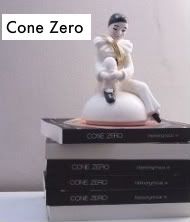
In the Nineteen Sixties, it is on record that I formed the Zeroist Group, loosely tied with the Dada movement, or an attempt even to reach some Sub-Dada realm. I also collected my then near-juvenile poems under the overall title of 'Dark Lights'... perhaps all that culminated today with Cone Zero ... and this makes me think that the gestalt of this whole book is not one single gestalt but each and every reader's past, each and every reader's own set of personal connections with it, connections and leitmotifs that the book actually entices into existence in different forms according to which reader is reading it at the time.
Looking back at what I have written in the whole review above, this theory of bespoke gestalt very much seems to be the case, and its final realisation or crystallisation was at this very moment ignited by my reading 'The Seven Treasures of Bucharest' (a story in seven parts and of near novella length). However, that is not to say that each reader's individual 'crystallisation' is not a drogulus in itself. Each a drogulus with different characteristics.
'The Seven Treasures of Bucharest' itself tells of arcane matters, but essentially of quests and quests within quests, the garnering of relics or 'ready-mades'. I could delve into each and every 'ready-made', each and every quest endlessly. It is a significant event in my literary life and perhaps I should devote much space here to explaining why. But, no, let it suffice to say that the main quest is for the ultimate throw, the ultimate chance, i.e. the optimum Synchronised Shard of Random Truth and Fiction ... mixed with religious and semi-religious affairs, politics and gameplaying, loyalty to self even if the self's constituent selves are slippery, art and preservation of one's environment in traditional ways, diplomacy, imprisonment, luck, statistics, language, serendipity, the 'Circle of Contemplative Thought'...
"The letters gleamed as if their darkness was coated with a curious light." LAWKS! I've quoted from the text again! I thought that there's no teaching an old dog new tricks. But this book has proved me wrong. I highly recommend the whole book for its separate 'ready-mades' (first the letters and then the words), for its quests within quests (the stories that can either be enjoyed like 'islands' or as a 'white sea company') and, finally, for its gestalt within the larger gestalt that is you.
END

Thursday, July 30, 2009

The 'Warriors of Love' by PF Jeffery

I hear it rumoured that this is to be a twelve novel series, making one gigantic novel. I believe it to be a highly significant work, judging by what I know of it already.

I have already commented on an earlier form of a different novel by this author HERE that as 'Odalisque' is being revised, I understand, and will form one of these twelve novels.

The first novel, recently completed, is: JANE

I intend to comment - in a modestly timely savouring - upon each chapter, as provided to me by the author. You can ask me a for a word document of each chapter at dflewis48@hotmail.com

The links to my comments will gradually appear below.

I shall be trying to prevent my previous knowledge of this work from affecting my approach to 'Jane'.

JANE - the first in the 'Warriors of Love' novels by PF Jeffery

BOOK ONE:
Chapter One
Chapter Two
Chapter Three
Chapter Four
Chapter Five
Chapter Six

First Entr'acte

BOOK TWO:
Chapter One
Chapter Two
Chapter Three
Chapter Four
Chapter Five
Chapter Six

Second Entr'acte

BOOK THREE
Chapter One
Chapter Two
Chapter Three
Chapter Four
Chapter Five
Chapter Six


Monday, July 27, 2009

Nemonymous / ANONthology

Until further notice, if you specifically request it, every order for Nemonymous will be accompanied by a lovely copy of ANONthology (Harper Collins). Thanks to them for supplying these for this purpose.
My review of ANONthology here.

Friday, July 17, 2009

ANONthology

Following my real-time review of 'ANONthology' HERE, I show below my guesses of authorship. I have no reason to believe I should be good at this task!


DO - Christopher Nicholson
PAVILION - Yiyun Li
THE HYPNOTIST'S WIFE - Joyce Carol Oates
THE POLITICAL OBLIGATIONS OF THE LOVER - Patrick Gale
THE APPROACH - Laura Spinney
PURPLE INK - Rebecca Connell
LETTER FROM PARIS - Chimamanda Ngozi Adichie
IN THE CAMP - Philip Hensher
THE BEARS - Rudolph Delson

Friday, July 10, 2009

Ertz

This is a sequel to Billy Belly.


Ertz was one bogie short of a nose. Deirdre knew Ertz at an impressionable age: two young fools: I should know, since, though older, I was one, too. Looking back on the whole thing, we three were inseparable at school. Whilst now, I don't know where they've gone. They may as well never have been. No forwarding points, no keepsakes, in fact increasingly next to no remembrances at all.

Still, in life, there are many ways to skin a story, many means to make a memory. I should fill in a few dos and don'ts of something done during our life together back in the old days, when days were old with natural vintage and not new and tawdry as days tend to be these days. I then may be able to string up a tale to hang Ertz and Deirde from. Bring them back as souls, if not bodies. Jug them a juice to by-pass death with. An existence far more tangible than anything real life ever gave them.

So, where shall I start? Too early and they'd still be silent cry-babies with only mothers to give them a bellyful. I was lot older, or slightly older since a difference of four years is as nothing now. Perhaps that was why I was less impressionable. Less of a fool, if still a fool. No, where the beginning lies is somewhere in the middle - them ten years old and me fourteen, ten years ago.

Much must be taken for granted, including the past that came before the past at which I start reconstituting the truth behind the memories and the past which is still the past by being before the perspective of the present. With that said, if clumsily, let me begin in my own way with Ertz - which, if beginnings are anything to go by, is the second beginning I've tried to make. And let me be more economical with my flair. Less slick with my sack of sayings. Ertz was simply an untamed kid at ten years old. One brain short of a mind. One loose nose short of a head. Known only by his second name, because nobody knew his first one, except perhaps his mother and she wasn't letting on. I expect she had second thoughts about the one she'd christened him with. Ertz was Ertz: the best description I can muster, until the shapeless slabs are slotted back together again to form childhood's crazy-paving. Which brings me to Deirdre - a girl with pig-tails and a tongue that ran away with itself. Her frocks were skimpy, knees knobbly and a heart bigger than her whole body put together again. The way I now describe her makes me think I was in love with her: the first passage-point of self-discovery, a stepping-stone in this my rite of the past. But to treat of my own character would be dangerous. The hardest feat of imagination is that of imagining the imaginer. Suffice to say that I was the ring-leader. The kind who invented games. Made up monsters for delicious delights of fright.

Hide-and-seek was our forte. How better to encapsulate a day in the life than to seek out such hidden moments? It was a hot day. I guess I must remember it well to have chosen this day. Ertz was late. The heat was shining less off the sky than the grass, with the first hints of dusk blurring the sunlit hills and rolling swards. And, indeed, I remember it better than well. I'm there now. Deirdre and I were practising hide-and-seek, while we awaited Ertz's arrival. The fact that we both crouched behind some trees did not seem to make mock of our rehearsal, lacking a seeker as we did. Nor did us hiding together seem as daft as it does now. Perhaps we had an ulterior motive. Or perhaps at least I did.

"Ertz is late," I said. See how well I remember it?

"Yes, so's Billy Belly late," she replied, lightly mentioning one of my invented monsters. Whether he was a vampire or a werewolf didn't seem to matter. He was probably neither. Or a mummy or ghoul. Or perhaps he was all these things. Whatever the case, Billy Belly waddled with a paunch that weighed more than the rest of his body, making his sackcloth flesh to crumple around his feet.

"Billy Belly is never late. He'll be early. It's just not his time to come. It's never his time to come. That's why he's always early."

I haughtily shrugged my shoulders as if I'd told a joke in the guise of a sacred truth. Or vice versa. Who knows? Who cares? I looked around at the disused golf course which served as this flashpoint for our childhood destinies. Mostly overgrown, where the semi-rough had become full-fledged - with a solitary ragged flag on its pole cocktailing a slimeful hole. The bunkers were still evident because their curved scars of sand failed to grow anything; they did not even cover themselves with dream's tidal seasons of soundless sea. Indeed, divots and dunes of landscape undulated towards the leaning grandstand of corroded girders that had been (to my mind) the ancient tessellated launch-ramps for space-rockets, but were really the cantilevered structures that had been erected for an international Open Golf Contest, one which I knew had never taken place because of the Great Recession. Peppering this our runnelled territory were the tiny dimpled white eggpods that aliens had laid in order to hatch out of them. An adventure playground, one with more misadventure to its credit than otherwise. It was our Heaven - and our Hell.

Ertz had still not arrived when the sun cast the grandstand in greater sloping lengths across the thighhigh greens, like black cancers (if my rather childish simile will here suffice).

"There are things that live in the old golf-holes," I said to Deirdre, continuing an earlier theme of mine.

"What things?" asked Deirdre mock-innocently, already knowing my usual answer. But the day wasn't a usual day, because, however usual it may have been, it became unusual by being the day I was to choose to remember - today.

"Men's thingies," I answered, "that have escaped their bodies. They're their wormholes."

Her face was a picture of picturing. I laughed at the strange thoughts I had released from their traps, like a pack of hounds running a fox to its earth. There was silence as we heard the footsteps of Ertz. Or footsteps belonging to whom we thought was Ertz. But the paces were heavier, shamblier, paddier, sluggier...

"Billy Belly?" whispered Deirdre in mock horror.

I shook my head knowing that Billy Belly was purely an invention, just like the vampires, werewolves and zombies with which I peopled other people. If "peopled" was the right word. But, really, I shook my head for my own benefit, not wishing to prolong the fantasy which, for one single moment, I believed had come back to haunt me with more than just a ghost of itself. So it was an unusual day all the time, despite today trying to describe a typical day of our childhood, when the fears didn't get out of hand. So why choose a day when they did get out of hand? Not the best way to construct the past, a slippery, darting-off, fork-tongued sort of past.

The sweet run of the fairways, the confident surrendering of the ball to the wind and to the whining weaves of weather, the awkward straggly fringes of grass where golfballs liked to hide, the choice of club, the caddie's unswervable servitude, the steep deep bunkers, the heady feel of the green up the putter's stem, the ball's tantalising swirl around the lip of the cup and its satisfying plop to the pit of the sunken drain. I could sense, if not scent, the rich tapestry of life left in the air around us, as I peered from our hiding-place to discover Ertz's whereabouts and, hopefully, Billy Belly's nowhere - only to see a plus-foured gent tugging dead birdies, if not eagles, from the tufts and tussocks with a long iron.

"Who is it?" asked Deirdre who dared not follow my gaze with hers.

"I don't know. It must be Ertz."

Surely it was Ertz or as near to being Ertz as it didn't matter. After all, I would have chosen a day to describe with Ertz in it, wouldn't I, if I wanted Ertz in it. He was an essential part of the threesome since, without him, we'd be only me and one other - and we'd only have each of us to bear witness. Her word against mine. My word against hers. We needed a third party to form the angles of perspective - like past, present and future. Why choose that day if Ertz wasn't to be there?

"Is it Billy Belly?"

"Don't be silly, Deirdre. Didn't I say? Billy Belly never comes."

"Unless he's early, you said."

I stared at my watch, as if that was the answer I could give ... until my head came up at the sound of something small but heavy swishing through the overgrowth, falling at my feet.

"It's his ball," said Deirdre, with surprising nonchalance.

"But no-one's played golf here for years and years," I replied, matching her nonchalance with words I remember rehearsing more years in the future than those I then consigned to the past.

By now the darkness had only reflected daylight between it and complete impenetrability. The figure, as it approached our hiding-place was not plus-foured after all - his calves looked tightly bandaged with somebody's creamy pink skin whilst the rest of him was swaddled baggily in somebody else's black skin. He wielded a driver that had a scooping blade which he employed to trawl the whiplash weeds in search of his loose white cannon. Hindsight fills in the details - only his face escaping terror's regeneration, except for the fact he had no profile worthy of a nose, a mouth fenced off with wood-veined teeth that waggled in complete vertical revolutions (rather like the door to our childhood den in the forest) and eyes that burned with the emptiness of Hell's twin pits (one of which some call Heaven). If he had a belly to speak of, then best not spoken of.

Deirdre screeched, providing doubt with certainty. He whoever-it-was flailed aside the dangling feelers of of our leafy hangar - and plucked us both by the neck's scruff from our ill-powered auras of invisibility.

"What have we here then?" His voice was gruffness laced with syrup. Recession incarnate.

"Only us," I said, meaning it.

Deirdre was silent, sounds having fled though the ears rather than risk the mouth. His eyes were suddenly for her only. I was a mere bit part. She the star in the black backdrop of his eyes. His middle belatedly bellied out like the phantom beginnings of child-bearing as he pawed at Deirde's clothes ready to suck her juices from wherever they happened to flow most easily.


Ertz would tell this story better than me. That's because he wasn't there; because the truth was stranger than any story even Ertz could concoct, and far less believable; because, as the truth unfolds, I begin to believe it less myself.

In the end, I've done little to retrace our paths through that crazy-golf called childhood - whilst inadvertently giving credence, and perhaps substance, to something worse than the worst in the worst of all possible worlds. Deirdre and Ertz eventually went somewhere else, I guess, making our land, perhaps paradoxically, smaller by the art of absence. Only the adventure playground of mismemory is left me. And I simply surrender words to the winds of time - each shot further from the hole: a long nose short of a double-bogie, given the sense of it. Or a belly full of stale drink and only frayed ancient eye-sockets to see with.


(published ‘Violent Spectres’ 1995)

Monday, July 06, 2009

The Terrible Changes - by Joel Lane

I’m starting another of my real-time reviews. This time it is of ‘The Terrible Changes’ a collection of short fiction by Joel Lane (Ex Occidente Press 2009). I shall attempt to draw out the book's leitmotifs and mould them into its gestalt. [My previous reviews are linked from here: http://weirdmonger.blog-city.com/recent_reviews_of_books_by_dfl.htm ]


After The Flood
The main student protagonist lives in a bedsit in Leamington Spa where, during his weekend break away in Cardiff, there was torrential rain and a flood. When he returns his girl friend is missing. He then finds a replacement in a scenario of casual sex and performance music I do not understand. The flood is perhaps a metaphor for the internet. By not understanding, I find myself more easily believing the protagonist’s re-absorption into replications that become a swampy web of self and selves, sired by Occam’s Razor out of Blade Runner. Thankfully, spoilers feed off understanding first and foremost. Nothing but paper-cuts. (6 July 09)
.
Power Cut
From paper cuts to paper cuttings, pinned scraps of newsprint around the seedy backroom where the rent-boy had brought his customer, i.e. the story’s protagonist (Lake by name, appropriate after the first story’s flood (?) and uglier sounding than ‘Lane’ because of the ‘k’ sound if not the smoother meaning of a scenic ‘lake’ as opposed to the dark ‘lanes’ in a Midland city). This protagonist seems to be an uncaring prominent man but nevertheless a man needing the comfort as well as danger of such human contact amid the world’s mass communications that isolate rather than bring together ... tempted in this direction by the story’s topping and tailing of his lonely desperation by the candles of an old-fashioned Aids march through the city that finally threatens to subsume him as if he were (for me) some sort of wicker man. Those newspaper cuttings already on the rent-boy’s walls turn out, of course, to be significant. I hope that’s not a spoiler. The ‘enjoyment’ and meaning of Lane stories, I maintain, do not lie merely in what happens but in the way each individual reader reacts metaphorically and/or literally to it and in how it is described by the texture of language. You need to read the stories themselves for all that! Each reader's reactions are thus liable to produce a different book. This timeless story will haunt you because you begin to realise that changes are terrible when changes never manage to happen. Or terrible because they do happen. You can't win. (6 July 09 - 3 hours later)

Empty Mouths
I’m left open-mouthed with the seedy ambiance of bedsits, small factories, physical ghosts that are emblematic of cruelty or despairing love or mutation from mirrors or faltering identity, above all, the safety-net of shuttling relationships that has too many holes in it, an ambiance so cold the denizens actually dream of central heating, a horror video of cannibalism, a bone jigsaw, and I forgot the shapes of wicker-light in the previous story leading to “traces of candlewax gleamed on the mantelpiece” in this, and, here, the protagonist’s need to repeat her name time and time again. Every story needs a name, too – as well as its protagonist. This story cries its name time and time again. Then when that doesn’t work, it cries out its own author’s name. But nothing can come out of an empty mouth. A story that knows no bounds to its imputed despair. It cries my name. But I’m many miles away in a different ambiance altogether. It doesn’t even know I’m reading it, let alone writing about it.
Bars in the top windows of houses are either to imprison or to protect from things getting in... and silence is to protect mouths from getting frogs in the throat. (6 July 09 - another 4 hours later)

The Last Cry
A far future story where tumours are catching between a dead loved one and yourself. Just waiting for the cure. Words-in-themselves touch you more when the past is still built into them. One also needs to read ‘A Horse In Drifting Light’ and perhaps ‘Albert Ross’ to complement the experience. Nothing stands on its own. Like words, names can’t stand on their own: they need to be written or said. But stories, once read, can stand on their own or can be screwed up and remembered better for never being able to read it again. Crows are angels in disguise...or vice versa? My own loose thoughts on this amazingly haunting story. A city looks tidy by contrast with the protagonist’s flat’s messiness. At least there seems to be a hope there that the ambiance in ‘Empty Mouths’ has been exorcised. But Ted Hughes could never save anyone, let alone himself. Dreams of landfills. Then a countryside. A countryside lane still contains the same over-used safety-net as any city’s back-alley. But now it’s eating barbed wire. Not bars. (6 July 09 - another two hours later)

Every Form of Refuge
Love Lane’s work as I do, I think this is the story I love most (so far). It conveys the office life that I easily recognise, its random secrets (called by Allen Ashley ‘the apocryphal grapevine’), the astrological harmonics (including a ‘Blind Moon’ and the two balanced ‘planets’ of London and Birmingham in the fiction and fame ethos with echoes of Big Brother TV emotional politics), missing people, dimmer-switch identities, random coincidences, dark outcomes – it tells of a gay narrator watching a heterosexual couple’s difficulties of relationship when faced by life’s intractable ‘rush hour’ as unrelieved by any emotional flextime. Haunting moments of imputed nightmare as the involuntary, unconscious quest by the narrator to find some sense in the relationships around him actually meets nightmare head on as fed to him by the unstoppable onrush of emblems and symbols that life contains. Lies and truths. There are many memorable maxims in this story. I will not quote them here. One includes the phrase: “a way to change”. Go thee and seek these darksome maxims.
It seems cheating to angle for a catch of running leitmotifs in Lane as the pop groups’ names alone provide many a hook for my bait. (I’ve heard of Billy Joel, by the way). It’s just the book’s gestalt? That’s going to be difficult. I can see it before me. But to describe it to you is impossible so far. Why, indeed, the need to discover it? I wish I was someone else. (7 July 09)

The Hard Copy
Another Leamington story, welcome companion pages to ‘After The Flood’. Stories get lonely, too. Here there are more paper-cuts and another flood plus envisaged 'Power Cut' rooms surrounded by incriminating scraps of newspaper. When a child, put to bed too early on Summer evenings, I used to tweak and tease the bedsheet into imaginary towns and landscapes. Here the sheets are cumulatively used to form a safety-net for a memory. A mugging that was made into a work of art, then a touching relationship with its victim, then the memory trawled (photosynthesised?) into his fabricated life years later. We all become husks eventually. So why have regrets? That’s my question. Not necessarily this story’s. But if you read fiction for monsters or ghosts, then read Lane. But the slope of imagination needed for them to come to you for real may mean you need to meet them halfway. Cuttings gone almost opaquely brown with age (or wakingly dreamt incontinence?).
“Twilight reduced the trees along a steep avenue to iron silhouettes, like bars.” (7 July 09 - 4 hours later)

Face Down
Similar to finding the victim of the mugging in the previous story – but here the young male victim is evidently dead with face down in the canal (canals being places, I seem to recall, whence things can’t be dredged). Did the story protagonist imagine it – waste police time? As in ‘After the Flood’, we have a meticulous metaphor (of the recurring waterlogged body in this case) for the Internet, a metaphor which works for me throughout. Of course, I may be wrong. Only others can tell me what they think. Or have all the witnesses gone? It is unquestionably a most memorable and nightmarish piece, with this metaphor or not. And a mind-blowing ending.
Yet what I saw wasn’t terrible.” (7 July 09 - another 2 and half hours later)

Tell the Difference
“But it was more a matter of having got used to the changes.”
The female protagonist (whose relationship with Jamie seems fitful at best) suffers from bouts of empathy sickness or witnessing-self deprivation. The book’s gestalt now stands before me, even as I speak, yet more clearly, but it is only with your own empathy that you will guess its true nature, as my power with words is insufficient to contain its image as well as to fathom Lane’s stories themselves to their bottom bone. This story tells of a jigsaw of a person depicted with the face missing. If you had empathy-sickness, would you seek out strangers to make it worse? I think not. But she does. And there are some scenes in this story that any sensitive reader will regret reading. Including the Ligottian visions at the end. Or are they primary Lanean images filtered through Ligotti back to Lane again?
“She wanted to hold an unblemished, unnamed body, without as much as a birthmark.” (7 July 09 - another 2 hours later)

Blue Train
“That was always the thing that got him with Coltrane: not just the innovatory technique, but the way his visions were rooted in an acceptance of what was in the past and could not be changed.”
Jane Austen never wrote about anything outside her experience, so her fiction only presented settings she knew and conversations between women, and women with men, but never men with men.
“...the drizzle of knowing that he would never emulate his influences: he could only mimic them.”
I will not attempt to critique this story. It is too beautiful for me to understand. It’s a sinuous jazz solo in text but overshadowed by a train that took people to settings they didn’t want to visit. Family that they didn’t choose as they once chose friends. Shades of fate in faith or colour. There are only a few stories in the world you can have inchoate experiences with as this one. Take five more stories...in due course.
He didn’t trust the Internet. What was friendship worth if everyone was your friend, whether they knew you or not?” (7 July 09 - another 3 hours later)

The City of Love
To wake up this morning and read this piece as my first act was a strange experience. It tells of a male/female couple in Paris – to go clothes hunting or make a film? A trip to a cemetery? A fairground? Mixed with the woman’s ‘dreams’ of being lightly masked, more facelessnes, cinematic unreality...? So perhaps not dreams at all. Let’s put inverted commas around my first use of the word. Hey, just done it. Must get on with my day. This story will haunt me, make no mistake. Jazz in the morning makes coffee go down better. And invisible smoke.
“Belinda drank several glasses of water, though she wasn’t conscious of thirst."
Read also ‘The Witnesses Are Gone’ and ‘Tomb of the Janissaries’ to complement this experience. (8 July 09)

All Beauty Sleeps
“When I say ‘dreamt’ I am speaking literally, and you can fill in the rest of the picture for yourself.”
A felt autobiographical essay where growing up is threaded with the works of Poe and eventually a Gothic yearning to connect in some way death with the act of sex. The protagonist pays the price of watching Corman’s versions of the stories. When I watched them in the cinema in the Sixties they hadn’t yet become iconic. There are more bodies to be impossibly dredged from canals. A sense of identity only being possible by addressing death head on. Lane’s work is often about the loss of identity but I guess many readers of Lane regain their own identity by that act of reading it. A reader woken like the Sleeping Beauty. The rite of return via the allotments brings an ending where the text itself is death and wakes someone from within its print who plays himself and doesn’t depend on an actor to bring him to life. Fiction writers are so much more facilitators of living things than film directors or even midwives.
The eponymous women in Poe are like the planets of astrological harmonics.
In Lane, often there are scenes towards the end of stories where many quiet, hushed beings await the protagonist after his long fateful journey towards them. Coming to this book is very much like that. All these stories, (some read before, others not) quietly, facelessly, bending their heads at my approach and whispering together in the darkness, blending and merging into each other but without yielding their separateness. Indeed, their separateness is enhanced by the process of blending. (8 July 09 - seven hours later)

The Brand
For me a deeply textured prose poem, combining DH Lawrence and Angela Carter – not the dark maze of a Midlands City but, as in ‘The Last Cry’, the countryside Lane. It is also a Boyhood of Raleigh, a ‘wax painting’ (or palimpsest?) over parts of ‘Power Cut’. And minds protruding through faces like a dry puffballs, echoing earlier caster sugar masks...
Bodies left in a river this time, not in a canal,. Perhaps they’re more salvageable from rivers. A body in a Lake may be far more problematic for obvious reasons. There are rarely any seas in Lane (only floods). Perhaps that’s the Jane Austen syndrome?
A truly beautiful story. A ‘Nemonymity’ like Lane’s poem of that title? ‘The Drowned’ with the boys ungrown up? (8 July 09 - another three hours later)

Alouette
“The next night, I turned my phone off. But that felt wrong, as if I was playing dead.”
I feel I’m playing dead these recent years when I turn off the Internet.
Lane has here identified an extreme horror phobia of mine – a phone ringing in my house in the middle of the night.
This story tells of something beyond my experience: a mobile phone that shows moving pictures of the caller, and in this case, callers. And something called ‘happy slapping’. Nevertheless, this is a very effective horror story for me. And significant that the protagonist’s crisis takes place on a canal bridge. Self-immolation by technology? But he doesn't fall into the canal.
There’s much more to this story than that. Much more that allows the book’s gestalt still standing inchoately before me to accrete.
Lane --> Lake --> Lark. A pretty bird but a horrible sounding word. (9 July 09)

The Sleepers
“She was pointing out over the canal. ‘Look at the snow. Can you see? It looks like it’s full of faces...'”
The safety-Net of polemics or didacticism? Or a genuine artistic detached vision of the quiet, gathering faces that I mentioned earlier as softly climaxing many of Lane’s stories, now culminating the whole of this book? It is for me, a genuine protest demonstration of gathering forces: a summing up of the caster sugar masks or facelets that often thread this book. And it makes me think of things the way Lane wants me to think of them – for myself. It’s a detached vision. I suspect it was however very undetached when it was written, but I shall never know for certain.
I’ve often seen blizzards as being the swarms of the ghosts of killer bees. Here the quiet result of the blizzard, after the ‘flood’, is a frozen lake made artistic by sad sparkles and facets. Identities eventually made to look like a single entity: Superman’s home planet or a Cormanesque tarn in winter.
And talking of planets, the twin balanced forces of astrological harmonics I noted before in London and Birmingham now truly meet, with the countryside lanes between by-passed, as if with the click of a button on a mobile phone or on a computer keyboard.
I shall ever be stalked by gestalts and leitmotifs. There is no escape.
But a book review must end with the book itself. And it does. A book that’s more than itself. It’s a wonderful Horror symphony, at times dincopated and at others smooth. The Lark Descending. (9 July 09 - 90 minutes later)

NOTE: I shall eventually read Joel Lane's Foreword in the book for the first time after allowing its stories to softly take their course for a while longer without it.
END.

Friday, July 03, 2009

Cern Zoo


WIN IMMORTALITY


CERN ZOO
This year's ‘Guess The Author’ – and win immortality.
Free Competition


You have up to three chances between now and 31 October 2009 (EDIT: 25 Oct 09: deadline now: 31 Dec 09) to match the stories in ‘Cern Zoo’ to their correct authors. You can do this by a process of guesswork (with or without owning the book) or by careful assessment of styles, rumours etc etc. Each of your three entries will be treated separately.


After the competition's closing date, the entry with the most correct matches will earn a form of immortality. In the November Submission Guidelines for Nemonymous Ten stories (an unthemed anthology due to be published in June 2010), the authors will be asked to include a character in their stories named with that of the competition winner.


The winner’s name will be announced in January, but the actual answers to the competition will not be known until 12 March 2010 when the authors are publically assigned to their stories in accordance with their contracts.


In the event of a tie, the winner will be randomly chosen by the publisher out of a hat containing the names of those equal winners.


The Nemonymous publisher's decision is final.


By entering this competition you accept the above terms.


Please send your entries to bfitzworth@yahoo.co.uk headed CERN ZOO COMPETITION -- together with your name that will be immortalised by the stories of Nemonymous Ten and indeed hopefully incorporated somehow into the overall title of that edition.


Story Titles
Dead Speak
Parker
Artis Eterne
The Last Mermaid
The Lion’s Den
Virtual Violence
The Rude Man’s Menagerie
Window To The Soul
Salmon Widow
Pebbles
The Shadow’s Departure
Being Of Sound Mind
Dear Doctor
Mellie’s Zoo
Turn The Crank
The Devourer of Dreams
Just Another Day Down On The Farm
Strange Scenes From An Unfinished Film
Lion Friend
The Ozymandias Site
Cerne’s Zoo
Sloth & Forgiveness
City of Fashion
Fragment Of Life


Authors (in random order): Rosalind Barden - Gary McMahon - Amy Kinmond - Tim Nickels - Bob Lock - Lesley Corina - Jacqueline Seewald - Dominy Clements - A.J. Kirby - Brendan Connell - Daniel Ausema - Gary Fry - Mick Finlay - Robert Neilson - Steve Duffy - Geoff Lowe - Stephen Bacon - Rod Hamon - Lee Hughes - Lyn Michaud - Tony Lovell - A.C. Wise - Roy Gray - Travis K. Weltman

Tuesday, June 23, 2009

Nemonymous Two


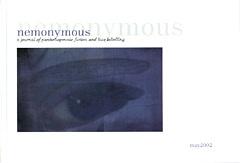
Nemonymous Two came out in May 2002 and is the first to disclose the names of those published in the previous issue. It features a a story of roughly four and a half blank pages titled "Four Minutes Thirty-Three Seconds", arguably the first formal blank story ever published. There is also the now legendary 'Emmanuel Escobada' story that still remains anonymous at the request of its author.


Contents
"Climbing the Tallest Tree in the World", Rhys Hughes
"Mighty Fine Days", Antony Mann
"The Assistant to Dr Jacob", Eric Schaller
"Buffet Freud", Dawn Andrews
"Ice Age", Iain Rowan
"The Vanishing Life and Films of Emmanuel Escobada", Anonymous
"Berenice's Journal", Richard Gavin
"Showcase", Sarah Singleton
"Eyes Like Water, Like Ice", Jai Clare
"Earthworks", Simon Kewin
"Striped Pajamas", Margaret B. Simon
"The Drowned", Joel Lane
"Adult Books", Robert Morrish
"Nothing", John Travis
"The Secret", G. W. Thomas
"A Spot of Tea", Janet L. Hetherington
"White Dream", Neil Bristow
"Four Minutes Thirty-Three Seconds"

Nemonymous One


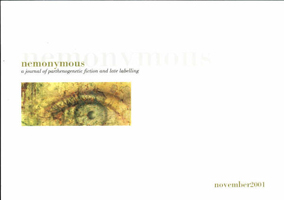
The first issue of Nemonymous appeared in November 2001. The missing bylines below were announced six months later, in Nemonymous Two. This anthology was arguably the world's very first self-contained anonymous collection of multi-authored stories.

Contents
"A Smile in the Sky", Gary Couzens
"The Friends of Mike Santini", Terry Gates-Grimwood
"The Quiet House", Allen Ashley
"With Arms Outstretched", Daniel Pearlman
"Breaking Rules", Avital Gad-Cykman
"The Gravedigger", Lawrence Dyer
"Alone", Shawn James
"The Idiot Whistled Dead", Simon Clark
"The Unmiraculous Life of Jackie Mendoza", Tamar Yellin
"Across the Hills", Tony Mileman
"All for Nothing", Rhys Hughes
"Double Zero for Emptiness", Mike O'Driscoll
"Strobe", Paul Kane
"Balafer de Vie", Lida Broadhurst
"Mansions of the Moon", Jeff VanderMeer
"Gamlingay Churchyard", A. D. Harvey

Sunday, June 21, 2009

Taught by Masters

Written today (21 June 2009) and first published here.


They ended up not wanting to have names. A group of people who ripped off their unseen labels one by one. There needed to be an example set, however. Nobody would unname themselves without a lead to follow. A First Mover. The pre-emptive Clockmaker. If this were a story, the author would start with the example-setting character’s name – followed by a narrative of his rite-of-passage from name to namelessness. A tale of bravery and hardship, of a dimmer-switch controlling the light of identity, of those who failed to follow and remained named, of those who did follow and became unnamed. Yet to name the leading character as he was once named would be to jam the dimmer-switch by wedging in what it was trying to dim. The others who remained named would gain prominence by having real characters’ names in the story while the rest floundered about unidentified – not only confusing the pecking-orders within the plot but the plot itself. To call them by false names or even by letters like A, B, C would, no doubt, cloud the issue even further. Meanwhile, it’s good for any story’s author to relax and concentrate on the plot’s landscape, its spirit of place, before worrying about the entrance of characters,

The public park in Colchester, with Norman Castle, flower-neatened gardens, an empty bandstand, all eventually leading down grassy slopes towards a small boating-lake. Nobody has hired a boat today. It must be one of those times when everyone is asleep at home. The Longest Day of the year. Light at Night like the Land of the Midnight Sun. Even here in England’s Essex. The dimmer-switch of the Sun turned right up.

Without people, there can be no story to tell. But now, at first dimly seen, are tall dark shadows wandering around the Castle. They are the nameless Masters of Existence trying to form gradually into real people. They have been given no belief in the story-premise that all the real people are at home sleeping. Yet the Masters, so-called, remain only partly formed into what they had hoped to become since the story had given them no names other than as fictionalised Masters of Existence, no names on which to hang their identities. The story refused them any such luxury. So mere shadows (if slightly flesh-corrupted) they remained, ever-circling the Castle like forgotten druids. Masters of Existence who could not even master existence for themselves!

Suddenly, there appeared, on the margins of the boating-lake, the legendary Clockmaker whose clocks had hands but no numbers but, more often, numbers but no hands, because, with the former, one could at least guess the time they told. A real flesh-and-blood person. Taught by Masters, but lacking their ambition of existence, the Clockmaker actually succeeded in becoming what they had desired but failed to be. The Clockmaker knew that any ambition destroys the goal of that same ambition.

And now is time for waking. We are here, stretching, fully-formed, truly nameless, stirred by pre-alarmed timepieces within our minds but pure of heart and unconstrained by the deadlines of finding identities to wrap ourselves in. Owning identities simply because we didn’t want identities, the only pre-condition for identity being not to have one.

And the story can at last begin.

Thursday, June 18, 2009

Big Brother - Summer 2009

CONTINUED FROM: http://weirdmonger.blog-city.com/celebrity_big_brother_2009.htm

These are DFL's comments taken from a conversation here: http://www.ttapress.com/forum/viewtopic.php?t=182

------------------

Siavash and Angel - truly weird. Rodrigo. Yes, I did think. That's the winner. I don't know whether it will matter that he usually goes to Church every day. But what about the scandal of Noiron's Eyebrows? And why did Davina keep calling Marcus a 'Wolverine'?

Halfwit seems (inadvisedly!) to be taking a leaf out of that lady's book who used to croon jazz songs on a previous BB. What was her name? I sense the three who passed the SAS tests simply knew they would not be subjected to something dangerous (however dangerous it looked). I simply admire their opportunism, not their bravery.

But there is much open-ended meaning in incomprehensibility.
Quote:
she was less than happy to have it pointed out that her elevated Double FFs had a plastic seam.

Oh, wll, you can't have everything.This phenomenon is probably the most telling of our bizarre (often cyborgnine) society. BB is SF in action. 'Dhalgren' theatricalised and extemporised.

Quote:
What a pitch Sree made in the Diary Room - that tremulous break in the voice, that tearless crying,that passionate declaration of love for EVERYONE

Sree was Soreeee! But now he is SO REEELIEVED!

Quote:
And there were echoes of last year - Siavash is having trouble with his identity since he does not have his own clothes. He knows not who he is
.

Again and again BB fits into the Nemonymous template. Cf: Halfwit and Dog face. And that entity called Nothingness who sits at the bus stop when the camera is not on it. A ghost? If so, of a past BB HM?

Quote:
I had one wish come true - Angel stays. I had one wish not come true - Siavash stays. Such is life.

Me. too, Marion. Benazir was not abe to come out from under her name. She was brave: a Shakesperean tragedy. A soliloquy on an otherwise empty London bus that nobody heard. Not even our old friend Nothingness.

I think Halfwit has an interesting view of his new BB existence, whereby real life is now fading as if controlled by a dimmer-switch and the HMs are puppets.

Quote:
The chemistry between Sophia and Saffia is fizzy and with more than a whiff of sulphur on Sophia's part.

This chemisty is more like mutually induced alchemy to create gold from the dross, i.e. feisty personalities for themselves. An unspoken pact through a mock antipathy.

Quote:
WEEEE-EEED! But you were right about open ended convos, Des - no matter that what they say is incomprehensible , there is no doubt of the chemistry between them
.

Yes, another form of symbiosis (this time Cairon and Siavash). But often with such things (as in insects) one often dies as a result of the symbiosis. And sooner or later, a husk will topple down the eviction steps towards a new Zombification of Davina.

Quote:
Angel is having a problem with Siavash's language ( I was RIGHT to like her!)

Angel, right on! Serendipitously, I'm reading a wonderful novel called 'The Angel's Game' at the moment by Carlos Ruiz Zafon.

Quote:
Siavash's wardrobe is every bit as colourful as his mouth. It is a Frankenstein chemistry experiment gone wrong, what with feathers and beaks and bandsman uniforms
,...

Sergeant Pepper in a mutant dream of Venice. He is all contraptions, tags, pieces, masks - a Caliban (not Tallyban) at the Masque of the Red Death. I like Noiron and the lightly-stylised moustache and glasses suit her.

Vignette upon vignette tonight:

And the vinaigrette on Halfwit's salad. Plus Noiron's lorgnettes.

Quote:
Siavash in the bath attended by handmaiden Cairon - what was all that about?

Yes, Vereeee strange. In fact I'm finding this BB experience stranger than most. Reality skewed a notch or two. Full of mignonettes and obliquities and Marion's observations shimmering in some hothouse of odalisques & lizards.

Quote:
...the evolution of language tonight:sentence order got all mixed up ... singing opera, and murdering 'Summertime'...

Who was that lady who broke into songs in a previous BB?

Quote:
Lisa is turning into House Mother

Lisa is an archetype HM. She is the Platonic Form of an interchangeable modern creature who just is, so simply confident and brash.

Quote:
Kris says he's an annoying little bugger. Marcus thinks he;s immature. Cairon thinks he;s a pimple.

Sree is a self-incubated plant of delicate immaturity but one that will grow into a triffid from the seedbed mulch stirred by BB's searing searchlight beams

I find myself more in tune with the Russian Soul but alerted now, by Marion, to Rodrigo's proximity to a shop window mannequin, I find this an even more interesting contrast. Mannequins and Marionettes, Lizards and Odalisques, Egyptian tomb-effigy or walking Tea-Cosy, I am glad I'm watching BB, simply to enjoy Marion's observations to the full! Dogface is a charm-catalyst that is like an open flower that only can respond passively to Nature's stimuli - and here in 2009, Nature is made of many teasing tentacles of modern instincts quite alien to life as I remember it, say, in the Fifties. I don't know why Charlie seems to be the current favourite to win. I think Noiron is a dark horse. A doodled-upon icon. And sensible and nice, too. I, too, hope Sophia goes on Friday.

I love the twirling moustache motif, which also fits in with Noiron's real mock-up (if that's not a contradiction in terms) of a moustachio. Two memorable phrases were said yesterday: 'Zero tolerance' by Sree. And 'Lost in Translation' by Noiron. In an oblique way, each is very telling, and potentially devastating to the way we think BB works as both a Reality TV show and a cultural breakthrough in Art and Aesthetics. If others reading this thread enjoy Marion's wonderful BB reports, you should read her fiction works, and I'd suggest her book 'Sleepwalkers' (a collection of stories), which I reviewed here: http://ttapress.com/forum/viewtopic.php?t=875

Huzzah! Sophia is first Housemate to be evicted, but really second evictee and third preson to leave the house, after Benazir and Saffia (who left to see her children after getting in a Benny with Sophia) and Sree had a Benny with Cairon while trying to exercise zero tolerance (on the face of it the first BB HM to try to maintain a zero tolerance regime on swearing etc) but perhaps all this is lost in translation while Cairon gets on a course for anger management and Lisa tries to make up for not intervening in the first Benny...while Charlie acts as a counsellor and ... more later

Sophia's interview went well. I like the three interviewer approach and i even began to like Sophia. This shows you that people are not really people unless seen in the round of the many habitats that they pass through (including the BB House and any web presence).

Some more bite on the screw of one-on-one relationships, following Cairon and Sree, now Dogaface and Kris, Halfwit and Lisa, Siavash and a giant pierrot hat.

Good on BB calling the fake romance of Kris and Dogface. Marcus and Lisa - what's the betting on them having a romance before BB s finished? I'd have a menage-a-trois any time with those two. Sree and Noiron - another romance? Some of the others seem like an audience - wide-eyed - as if they can't believe what is going on. Angel is quite mad no doubt, but she seems sane in there. Karly the hard cynic. Not sure about her. She must wonder what she's got herself into! You can see the hate she looks at Marcus with. That slithy tove of a wolverine. Rodrigo seems to have gone low-key. Halfwit is someone I'd dread meeting on a BTCV holiday. Cairon and Skiavash - another fake romance? Charlie is just plain street-ready. An ordinary lad.

Lisa is perhaps Sycorax, Angel Ariel and most of the rest are a single gestalt of Caliban and/or Trinculo & Stefano. Big Brother is Prospero. Noirin is Miranda. Sree /Noirin - I thought this was beautifully enacted by both parties, and whether they each have the emotions attributed to them by Marion, we perhaps shall never know when they become the next celebrity couple. I think Noirin's doodled face is fast becoming an icon, after all. She should be thankful for it. She should also be thankful for her own sweet nature. The flower dance was another pure BB 'Happening' that becomes an Art installation of the mind.

There are some genuinely interesting characters this year, some blossoming before our eyes. And difficult to tell posing from positioning from positivity of personality. After all, these 'cats' have walked the decade-old BB earth - having learnt for most of their 'sensible' lives how to play the game.

Very strange goings on indeed. It's as if the world has entered a new phase, Angel's phase, Angel's dream, sometimes Angel's nightmare. Cleansed only to dirty herself time and time again with other people. Absorb them, let them be your parasite. The Foggy Day in London Town is just anothe Bleak House. And there was Skiavash picking nits from Cairon's hair. Or was it more sexual than nursing care? Parts of Angel made manifest by incarnation? If so, how can Ariel's soul bear any body weight whatsoever? How can Rasputin reach Heaven - by telling Sree that Noirin was wanting him in the bedroom? No, by transmuting a-trinketed Trinculo to Tallyban via Kaliban out of Sycorax. It's strange that someone's Heaven is someone else's Hell. Marcus is cool. He is so cool, he can even shit cool. Apparently. A speech in the Diary Room that was seriously cool. Sleek wolverine within a body's weight.

CONTINUED HERE: http://weirdmonger.livejournal.com/111444.html

Wednesday, June 03, 2009

Saturday, May 30, 2009

'Weirdmonger' Review - Part 8

CONTINUED FROM HERE


The Spigot and the Speechmark (1996)
We return to the world of an old couple as in ‘Season of Lost Will’ and the use of speechmarks as in ‘Rosewolf’. This story has a ‘snorting monster’ – if sat on a motorbike or on a lavatory.
I remember it getting good reviews when it first appeared in ‘Deathrealm’. But it gains even more power here in the context of this book, I find. Yet some have told me that many of my stories lose power by being in this book's sheer textual overpowering. Who is right?
Meanwhile, I find myself wishing to go back and edit all these stories. Even destroy them. Can’t do that with a book as easily as I can with all my other stories that I've spent some years posting on the Internet. Who knows what I may do when ‘I’ become like this story's two characters in real life. Not long to go, I guess. (30 May 09 - 7 hours later)

Sponge and China Tea (1989)
This was one of the eight stories by DFL that ended up either in ‘Best New Horror’ or ‘Year’s Best Horror Stories’ in the Nineties. DFL was, however, never really a Horror Story writer as such, but, as someone once said, he is a writer who writes in a genre of one. The big question is – does his work have an audience of one, too?
This story was first published in 1989 in the ‘Dagon’ DFL Special. It is about a daughter and mother, as the latter dies. A horrific, yes horrific, account of this relationship – and the arrival of an old school friend as a travelling salesman whose products bring ... hmmm, what shall we call it? ... scar tissue (cf. that in ‘The Scar Museum’). He also brings a variety of ‘small talk’ that borders on ‘pub talk’...!
A borderline Ghost Story, too. With marked DFLisms of style.
“The body wherein she lived toward the end had been little better than a wrinkled sack of rattling bones, which sometimes spoke up for itself with a voice I no longer recognised.” (31 May 09)

The Stories of Murkales: Twelve Zodiacal Tales (1987, 1988 – in separate issues of ‘Dagon’)
Re-reading this substantial mini-collection-within-a-collection reminds me that ‘Egnis’ was not the only story in ‘Weirdmonger’ representative of my much earlier writing times when I did not expect ever to be published.
These tales stem, I guess, from the late seventies or early eighties. The twelve tales – highly wrought, containing many astrological references, conveying a Biblical feel of (to coin a phrase) Baffles and Fables – are each representative of a Sign of the Zodiac. There is a strangely Arabic air, inter alia. And a scatological / eschatological feel that is emblematic of later work represented in this book. There seem to be astrological harmonics to which any chance reader of these tales should – the then ‘author-self’ surely hoped – slowly grow attuned. My present-self has severe doubts.
“Each. Sentence. Is. A. Word. In. Itself.” (31 May 09 - 4 hours later)

Stricken With Glee (1992)
A companion story to ‘The Christmas Angel’, with pathos and absurdity in symbiosis. There are back-stokers who live behind all the roaring fires in the large many-chimneyed house – living in tunnels and intermittently opening the backs of fires to throw on more coal. One of the protagonists (protagonists who sit desultorily in front of these many roaring fires to dissipate the aching cold) will need to dress up as Santa Claus on Christmas Eve and climb up on the roof to choose which chimney he will use...
Pity he has upset the back-stokers throughout the year!
That’s a story spoiler, by the way. But I love spoiling things –
These stories often work better if the readers fear the author they imagine behind them.
One consolation: the back-stokers are here brilliantly described and I will not quote anything for fear of spoiling your enjoyment even further.... (31 May 09 - another 3 hours later)

The Swing (1997)
This is, I’ve now decided, the perfect DFLism! It works on many levels – the ambition of a swing’s upswing – young love that matures (symbolically and sexually) into a ghostly future – the religionisation of life’s characters such as parents – the full blooming of the story’s swing-emblem into something or someone other...
This whole book is now firmly back on the upswing – having been on the downswing for a while...
There is also a subtly implied re-visit from ‘The Christmas Angel’.
“As they say, whilst human beings reach out for Heaven, angels die the other way". (1 June 09)

The Tallest King (1988)
This, I’m now reminded, is another pre-DFL DFL-story like ‘Egnis’ and ‘The Stories of Murkales’ written a number of years before the late eighties. This is in a simple style -- a fable or fantasy story of islanded communities that reach beyond themselves by the power of individuality.
It stirred the then much younger Mark Samuels to write in the next issue of the magazine where it was first published as follows: “The highlight of the issue was undeniably Des Lewis' beautiful little story, 'The Tallest King'. A wonderful faerie-tale told in perfectly child-like manner, and singing with the glory of descriptive prose. Really delightful. What a talent this fellow is.” :)
“There came a time when the tallest king in the city was a man of strong mind. When he first went up the stairs to the tallest room in the tallest palace in the whole city, he stood with amazement on his tallest chair, peering through the tallest window near the tallest roof, and gazed for the first time on...”
(1 June 09 - 2 hours later)

Tentacles Across The Atlantic (The Story) (1996)
"GIMME GIMME GIMME!"

Presumably labelled ‘the story’ to differentiate it from the regular non-fiction column of the same name that DFL wrote in ‘Deathrealm’ during the Nineties.
This is another very long monologue like ‘Shades of Emptiness’ – with some amazing separate images but, ultimately, non-synchromeshing. Or at least my present self so judges. The opening seaside scenario is, however, worth reading the whole book for alone ... perhaps.
This is one of the half-a-dozen similar unreviewable stories in this book under ‘S’ and ‘T’ in the alphabetical contents that make the whole book ultimately flawed, and predominantly why I have assumed it to have foundered since it was first published – despite the excellent production qualities of Prime Books and the stunning cover and internal design by Garry Nurrish. Or it is simply wishful thinking to believe that, given a different contents list, it wouldn’t have foundered in any event. A tentacle-tangled wreck on the ocean-bed of misbegotten literature.
“I will have shown Max my old marbles – the ones I played with at his age. I will have taught him their names: Big Red, Split Dark Blue, Blur Green, Spot Yellow, Thin Red, Big Green, Large Light Blue, Thick Red, Bubble Red...”
(1 June 09 - another 3 hours later)


'WEIRDMONGER' REAL-TIME REVIEW CONTINUED HERE

.

Tuesday, May 26, 2009

'Weirdmonger' review - part 5

CONTINUED FROM HERE.


The Merest Tilt (1994)
Well, a real gem of showgirls and froths and frills and creamy realities that the narrator fashions from a selective use of his own diary written during the events of the story. This pencilled diary needed a merest tilt sometimes for him to be able to read parts he had earlier rubbed out. This seems to fit in with the way I’ve been looking at this whole review! Truths and fictions?
A story with its darker moments, too.
“My companions were surly souls with curt courtesies in the taxi. Humourless asides intended to be funny made me cringe. One was my uncle I think (the diary is unclear). Someone else was there whom I’d once loved but did no longer, somehow. Yet another was silent and shadowy who made me afraid to talk out loud in case I revealed something of myself he wanted to catch. There was also a dwarfish creature, pressed up close to me on the back seat, who kept broaching unwanted topics and expecting us to comment.” (26 May 09 - another 2 hours later)

Migrations of the Heart (1993)
Coincidentally, following alphabetically straight on from the previous story, this one says: “I can only convey things by things I leave out.”
A very brief piece of poignancy about a childless couple haunted by the ghost of childlessness and of their own encroaching old age when decisions (like where to sleep) become arbitrary. Alphabetical by way of its own plot, too, incredibly, in the above light! (26 May 09 - another hour later)

A Mind’s Kidney (1993)
Another quick-change act by what turns out to be (from the point of view of the author) a fast-and-loose I-Narrator as in ‘Angel of the Agony’. Also ‘bed-switch’ repercussions almost in tune with those in the immediately previous alphabetical story! All taking place mid bladder-change during a night in strange lodgings, the room having oversized door-hooks and old-fashioned chintzy decoration. A real ghost that is generated by confused thought. The story of my life!
“Filters can work both ways, I thought, in the tired way my thoughts sometimes made me think.” (26 May 09 - another 2 hours later)

Padgett Weggs (1986)
Archetypal early DFL tale of pub talk, St Paul’s Cathedral, Great Old Ones roosting on London’s roofs, walking heads, brain surgery conducted in a pub lavatory, smuggling ambergris...
Also a clumsy wooden arch constructed over the bed as a second ‘roof’ to keep God out ... or in! [The latter bit was inspired by the novella ‘Agra Aska’ written in 1983.]
This is one helluva crazy author's first published story. It cannot be reviewed. It just is. It needed to exist. Ironically iconic. Cone Zero. A zoo of words that escaped their cages.
Ever since coming to this strange city, he felt that his mind was channelled between two blind alleys – so, although he could indeed think straight, the thoughts themselves were in the dark and ambivalently cobbled together.” (26 May 09 - another 3 hours later)


Queuing Behind Crazy People (1997)
A tale of a film that becomes a tale of its queue outside the cinema, with Ligottian buskers entertaining its length. Some queue-members even have to leave the queue because they spend their entrance money on the buskers. Conversations and friendships underpin the queue. A story of craziness even crazier than the story that tells about such craziness. (This book is a meta-book only crazy because it was ever published in the first place.) Coincidentally, following on alphabetically – in a presumably neat queue of stories – from ‘Padgett Weggs’ which tells of a living human head in separate existence, here a queue-member tells of a head being found in a lobster-pot when fished from the sea by the fishermen. A character called Ken King tries to befriend the we-Narrator after the film simply because he recognised ‘us’ from having sat in the same row in the auditorium. The film itself (which fails to feature in the story because too much time was spent describing its audience’s preliminary queue) was, apparently, banned after its first showing – because of one fleetingly brief scene which most of the audience missed as they were snogging. I won’t mention the toy gun. This story is not iconic like ‘Padgett Weggs’, but it is certainly a memorable busker for you queue of readers who want to read the book as long as you can manage to get into it. Some memorable images, but fundamentally firing blanks.
“That night, we believed Ken King would have an itch in his brain. / A terrible itch. / Such an itch, if it were at a point on one's back which could not be reached without a degree of bodily contortion, was bad enough. But an itch in the brain--well, Ken King pawed at his ear, trying to dig in as far as he could go. The itch became so unbearable, he prodded his eye, until it wept blood. Then thrust fingers up his nostrils. If he had been able to do so, he would have peeled back his face with a rip-roaring wrench, simply to uncover a route to the bone basin of the lobster brain. And scratch it to his own delight. His last resort, of course, was to detach the head in its entirety, with the neck-flashings removed. / Thoughts themselves were itches he could not remove, whatever method adopted.” (26 May 09 - another 3 hours later)

Rosewolf (1992)
“You obviously know I have been keeping these pages for, it seems, centuries now, and I do have the misfortune (sometimes) of dipping into purple prose and, at another point of the literary compass, near-illiteracy.”
I think this is the one story in ‘Weirdmonger’ that more people have told me is their favourite story in it. A ghost story that Elizabeth Bowen might have written – and situated in Innsmouth! A family of oblique children and retainers and many aunts and uncles – excitedly taking a cliff walk (in queue form!) to Innsmouth at which destination one of the Uncles has a miscegenate relationship (with a Deep One?). There is also a renowned description of a specialist fork collection in the family house. Here, in this story, resides the hub of a wheel that is ‘Weirdmonger’ - of dimmer-switch controlled character identities and a Narrator that needs tuning in like an ancient wireless, with the signal coming and going. Sometimes static. DFL was probably the first horror writer to use ‘static’ as a pervading symbol or signal.
“‘Ghosts never use speech marks,’ said Aunt Guide, thus proving she wasn’t one.”
(27 May 09)


'WEIRDMONGER' REAL-TIME REVIEW CONTINUED HERE


Wednesday, May 20, 2009

'The Weirdmonger' Real-Time Review


CONTINUED FROM HERE.

A Brief Visit To Bonnyville (1995)
“‘Which way in?’ asked the guide.”
You can ask that again! This is an ostensibly substantial story about a visit to the seaside, written, I recall, immediately after my move in 1994 to the seaside of North East Essex (where I was originally brought up in the Nineteen Fifties) - after living in a South London / Croydon no man’s land for 22 years as a Company Pensions expert. It turned out to be longer than a brief visit to the seaside, as I am still here!
The story is now too salacious for my taste and imponderable. But I am now just another reader. Not a very sympathetic one. It does have its enticing moments of conundrum and inscrutable vision, however. ‘Claura and the Gulls’ would have been a better title. In a strange way, it now strikes me as very Restoration Comedy with disguises and inferred asides and set-piece tableaux.
“At a point where two prayers cross.” (20 May 09)


Caretaker (1993)
Upon re-reading this recently (for reading aloud purposes on-line), I decided this was my favourite prose poem of all time and of all writers. But I have a very narrow definition of prose poem.
It tells of a communal gas oven where its caretaker operates inside it arranging for wool to be pulled over our eyes that it is a beauty parlour. And then wheeling my readers in. Haw Haw.
Treat both triumph and disaster as impostors – Kipling (20 May 09 - 2 hours later)

The Chaise Longue (1998)
I suddenly thought - I’ve been second-guessing an earlier self of mine above – and I should be reviewing each story in the cold light of today... as it appears on the page uncluttered by any memory of creating it.
This story then has a strange mixture of Pinteresque / Ivy Compton-Burnettesque dialogue as a misguided sticking-plaster for a relationship under ancient duress. Fustian to the nth degree. An experiment in re-coupling the de-coupled. With a sting in its tail. It does strike me as being a powerful scenario, splatting the fiction-reading-head with a de-boxed but still fully ripe wine-bag.
“...decked out in a floral print frock that hugged her bosom tightly enough for the nipples to show through even a heavy-duty brassiere.” (21 May 09)

The Christmas Angel (1995)
This, for me, is a DF Lewis classic. Quite perfect within his own then perceived terms. With the most pathos in any story’s ending that can be squeezed into Christmas Day’s start. Didactic about a then future credit crunch as well as free-wheelingly ‘l’art pour l’art’.
“Unfurling its sugar-glass wings, like silver spider-webs, it peered down with pearl-bead eyes at the piles of presents at the foot of the Tree.” (21 May 09 - 3 hours later)

Dark They Were And Empty-Eyed (1995)
An incantatory monologue of dungeon-dark buffet and pain, whereby the I plops from its socket, just as, indeed, many of this book’s story narrators nil out (pre-figuring the concept of Nemonymity in 2001?)
“... my own mind’s bony meat haven...” (22 May 09)

The Dead (1995)
A Joycean (I guess) dinner party, where items of furniture have finger-holes like ten-pin bowls – and prandial conversation has bizarre innuendo. There are skeleton girls and/or servants haunting the backdrop. It means far more than one would ever expect from that summary! Now after 14 years can I scratch more than just its surface. Also, this story’s Ligotti-like ending is the loosest ending, I feel, that has appeared at the end of any story – ever.
“There was silence, save for the wireless’s residual fidgets of warming down.” (22 May 09 - after 4 hours)

Dear Mum (1990)
A SF story in the form of a letter from a man on an exploratory spaceship to his Mum back on Earth. In hindsight, a sort of email. A bit like Dr Wormius opening the sash-window with his back?
It is potentially very good with a highly poignant ending but it’s not quite carried off, I feel.
Apparently, immortality’s only half of it.” (23 May 09)

Digory Smalls (1989)
If it is possible at all for there to be an externally favourite or most well-known story by DFL, this possibly one of them. A master and his ‘disabled’ servant explore the interlocking attic-systems of a large house, with horrific and absurdic results. A family’s generations ooze back and forth over time...? An amorality tale. Fiction for fiction’s sake. It certainly remains startling, even to me!
“‘Come, Mister Smalls, no time for larks. We only have a few more attics to negotiate.’ He looked askance at me.” (23 May 09 - 2 hours later)


I am trying to summarise the stories real-time-reviewed so far ... in an ambition to match my own apparent success at identifying leit-motifs and gestalts when conducting such reviews on other writers’ books. So far I seem to have drawn a blank with ‘Weirdmonger’. Possibly, then, as an interim measure, we all have attic-systems to traverse towards our eventual heaven – heaven being, for me, an optimum thought that is one’s last thought before expiring. One needs to face the genuine monsters as well as the absurdities of existence: facing them out by absorbing them (but are you the parasite or them?), eventually becoming ‘the old man of the sea’ who perhaps takes on board one’s own internals like the experiences, illnesses, sadnesses, joys etc. of your previous selves (as well as taking on board, altruistically, externals like loved ones and you readers and, by so doing, their internals) along with oneself in the journey or quest for that optimum thought. (23 May 09 - another hour later)


'WEIRDMONGER' REAL-TIME REVIEW CONTINUED HERE (24 May 09)

===========================

Friday, May 15, 2009

A Handbag

I often wonder what is in various handbags as they pass by on ladies’ arms. It’s not that I’m a potential thief sizing up the opportunities of seizing them and legging it off down the road. No, I assure you it is a genuine curiosity about their contents.

You can see straight through men’s pockets quite easily – a piece of string, a penknife and a shilling. Never anything else. But ladies’ handbags are often full of the unlikeliest things. So unlikely, I do not even dare to guess.

One day, I spotted a particular handbag floating down the road. I turned a blind eye to the lady who must have carried it, because the handbag looked far more interesting than any lady, an object that was really expensive and at the height of fashion. Large, without being unwieldy. Chunky, yet strangely delicate. With fastenings and straps ... and clips glinting like gold in the sunlight. A multitude of tassels, too, and obtrusive stitching following scar-like tracks along the seams of the various fabrics and cured leathers that constituted the bulk of the handbag. Indeed, its exterior even made me forget my curiosity as to its contents, as if its contents were on the outside and the handbag itself on the inside.

I was startled from my revery when, suddenly, I focussed on the lady herself – or what I had supposed would be a lady, given the femininity of the handbag she carried. But she had slipped by me so quickly I could only see her diminishing backward view as she headed towards turning beyond the corner shop within the blind spot of my following gaze. I started to follow. There was no sight of her. Just a few kids traipsing home from school.

The girls had tiny make-shift handbags with string handles to make them look older than they were. Little bigger than dolls’ handbags. There was one boy among them and he took a rather large penknife from his pocket. And I took a shilling from mine. A fair exchange.
We both smiled and continued on our opposite ways. The girls just giggled.

(written today and first published here)