

www.nemonymous.com
Des Lewis - GESTALT REAL-TIME BOOK REVIEWS
A FEARLESS FAITH IN FICTION — THE PASSION OF THE READING MOMENT CRYSTALLISED — Empirical literary critiques from 2008 as based on purchased books.
Tuesday, June 21, 2011

Wednesday, June 15, 2011
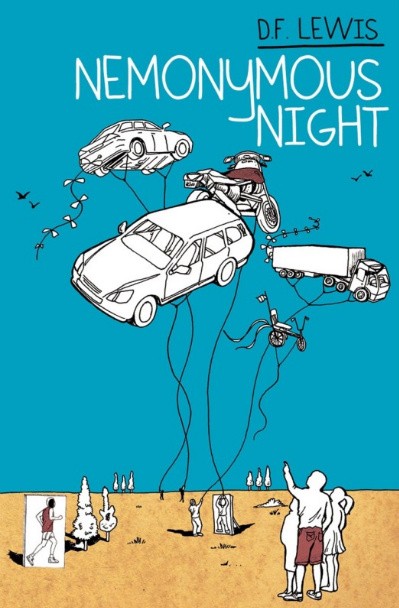
Nemonymous Night
Publication Date – 15 June 2011
Nemonymous Night is not an easy read; however—and here’s the rub—it’s entirely readable.
NEW YORK JOURNAL OF BOOKS (today)
Chomu Press: Prize Draw:-
Are you nemonymous?
“It’s the kind of work you’d like to put in the water supply of a major city, just to see what would happen.”
Publication Date of NEMONYMOUS NIGHT (Chomu Press) 15 June 2011
www.nemonymous.com
===============================
NEW YORK JOURNAL OF BOOKS (today)
Chomu Press: Prize Draw:-
Are you nemonymous?
“It’s the kind of work you’d like to put in the water supply of a major city, just to see what would happen.”
Publication Date of NEMONYMOUS NIGHT (Chomu Press) 15 June 2011
www.nemonymous.com
===============================
Tuesday, June 14, 2011
A Weird Weird Novel
Putting my brain where my mouth is:
NEMONYMOUS NIGHT:
Background: http://nullimmortalis.wordpress.com/2010/09/01/what-is-weird-literature-and-who-represents-it/

NEMONYMOUS NIGHT:
Background: http://nullimmortalis.wordpress.com/2010/09/01/what-is-weird-literature-and-who-represents-it/
Tuesday, May 31, 2011
Whirlygig (2)
“I see the sea, but can the sea see me?”
The voice sounds physically close to my ear but, when I turn to see who whispers such sweet nothings, nobody is there.
I turn the other way in case the voice’s owner has gone behind my back.
A stranger stands there with a glass of water in his hand, holding it out to me. I know it is water because strangers can only offer water to other strangers to drink. This to avoid skullduggery. Filtered clear, spring-like, untampered with.
I take the glass. He smiles as he nods me to quench my thirst. I surreptitiously sniff it a split second before I sip it. Then a gulp as the next mode of intake. Lastly, a long, breath-held quaffing. Until the glass is emptied to its last drop.
I smack my lips in satisfaction. The stranger smiles. We seem no longer strangers to each other. But friends of recent making.
He takes me by the hand towards the edge of the sea, where it can see me. The sea is short-sighted. The sand starts hard-ribbed as left by the tides, but it is soon pulpy enough to make footprints. I throw the glass into the sea.
He shouts. He is angry.
“The sea’s monocle!” I shout back, stork-legging like a latter-day Jacques Tati, as the ground surrounds me with its dizzying whirlygig of horizons, some man-made, others sea-edged.
The man makes me dig where the sand is pulpiest. Despite the light-headedness, I reach the finger-holes of a human skull.
I shrug my shoulders and try to throw this into the sea, too. But the whirlygig has made me throw it back not forward. Straight at the man’s caved-in face.
A groundswell of mixed emotions. The sea is the only witness. Unreliable, of course. The shattered ribs of a wreck poking through. History is a series of challenges and responses via a filter whose lens-baffles allow a two-way flow. Tides ebbing and flowing into each other.
I sip suspiciously, then hold my breath ready to quaff a million million spinning strangers.
Monday, May 30, 2011
The House of Mr Moses
Strange characters - Mr Superbus, Mr Bermuda, and others without names - sit around a communal lounge swallowing various tablets, comparing them, exchanging ... until someone brings a new and bigger supply. Some are pure white with designs on them, others are capsules with multicoloured contents, yet others are huge unswallowable things that have to be inserted elsewhere...
One man seems to grind various sorts into a crunchy paste... Another seems to be satisfied with a simple nose-spray. They look forward to the arrival of Mr Superbus's daughter who always visits on Thursdays. She is bosomy and chiffony but they have to refuse her gifts as they are not prescribed ones. Tablets lent and borrowed, yes, but the tablets need to be officially prescribed in the first place at least to someone in the lounge. Well, that’s the story being stuck to, despite what comes later.
You must just concentrate hard on not annoying Mr Moses (who's in charge) and await the arrival of Superbus's daughter any time soon.
****
The big problem is that by telling you about the house of Mr Moses at all, I am certain to annoy him. I am one of those to whom I’ve given no name sitting around the lounge with Mr Superbus and Mr Bermuda. My own tablet chart is kept religiously and I very rarely dabble in the medicine chests of others who live here. In fact, we rarely have access even to our own chests, because Mr Moses has the only keys. It’s just his lax care policy that allows us to picnic on stuff Mr Bermuda orders from abroad, brought here by men in hoods.
I keep telling Mr Bermuda that such tablets are not prescribed ones. But he assures us all that we are merely supplementing/mixing our official prescriptions with creative ones, home-cured ones - a bit like with the old-fashioned toy chemistry-sets that we all so much enjoyed during our childhood in the Fifties... and I suppose it’s this sort of information that would get Mr Moses into trouble, should it get out. He should have a more rigorous hands-on policy for one so much in charge of things.
Oh, I’d better shut up. Here comes Mr Moses right now. Judging by his look, he is the bearer of bad news. I watch him whisper something into Mr Superbus’s ear. I reckon Mr Superbus is his favourite here. Oh dear, Mr Superbus’s skin has gone deathly white. As Mr Moses slouches from the room, I watch Mr Superbus literally cram his mouth with a handful of ready-mulched tablets, to such an extent its surplus amounts become tantamount to a facepack.
Mr busy-body Bermuda strolls over. Trust him. He’s probably got a really special tablet or two for Mr Superbus to swallow. Yes, I can see one of them is bigger than a horse-pill. Bloody hell, I couldn’t even take that one up my back passage by the look of it!
***
Tonight, I dream about Mr Superbus’s daughter. Mr Superbus himself, I understand was once a Member of Parliament ... or have I got that wrong? Perhaps he was only a Council representative in Hastings town where we live. She often told me about how her father was big on conservation and had arranged the recycling of recent years, rather than depending on landfills. I used to work on the rubbish dump in Hastings in the Sixties when all the Mods and Rockers were about.
In the dream, I see that Mr Superbus’s daughter is in trouble. Quite nude, too, but, for shame, I can’t see her clearly enough because the whole dream itself seems choked with the chiffon blouse she usually wears on Thursdays when visiting us at Mr Moses’.
I now dream of standing on the hill looking right down over the sloping expanse of houses reaching distantly towards the sea below. The nearest house is the blue one, the House of Mr Moses. But I haven’t seen it for many years from the outside as I don’t walk about so much these days. I’m usually housebound for medicinal purposes. My whole prescription regime is strict for almost each minute of the day. My neighbours in the lounge, similarly. Only Mr Bermuda and Mr Superbus usually have the width needed to get out for breathers. They go to the pier, they say, to play on the Amusements, gawping from side to side like the clowns’ heads whose yawning mouths we once aimed balls into for cheap prizes.
I suddenly see an insect-sized speck in the distant sea. It is intuitively Mr Superbus’s daughter. She’s screaming. I’m sure she’s drowning. But I can’t do anything about it, because I know that I’m still in the blue-painted house below me, and this is only a dream of me standing above it in the open air. But how can I hear her screams? Even in real life, I wouldn’t be able to hear the screams from up here. In the old days, I couldn’t even hear the Mods and Rockers motor-biking or scootering along the prom from up here.
***
“You should keep taking the tablets,” said Mr Moses with a jokey laugh. I had evidently woken the whole house with my screams. I looked up at his benighted face. He didn’t often joke.
“How’s Mr Superbus ... after the news?” I asked. It was uncharacteristic of me to think of others before thinking of myself. But here I was showing concern for someone else. I secretly admired Mr Superbus and all he had done for the local council.
“He’s taken a sedative,” said Mr Moses. “He’ll be OK.”
Despite his earlier jokey comment, I could see he was annoyed about having to get up in the middle of night.
He lifted a glass to my lips after crushing the multicoloued contents of at least six capsules into it. I swallowed like a gurgling baby, plaintively smiling to assuage any further annoyance.
I wanted to get back to my dreams of mermaids with rocket salad.
***
Strange characters - Mr Superbus, Mr Bermuda, and others without names - sit around a communal lounge swallowing various tablets, comparing them, exchanging...
The men in hoods haven’t been here for ages. They’ll be running out of tablets soon. Even Mr Moses is taking a low profile these days. It’s Thursday again. This is a nice day. Mr Superbus’s daughter usually visits on Thursdays. She always has a kiss for each of them. Dreams are quickly forgotten. One unnamed lounge-lizard hopes to be off medication altogether soon and then – who knows? – they may allow him out for walks on the cliff. He looks through the window and sees a figure looking down at the house of Mr Moses. Oh, to be like him. He looks even older. Sixty is no age at all. Some people start a new life at sixty. Never too late.
He simply needs a suppository or enema to get him fighting fit. One that can clear his whole system out, hoover out all life’s discards. Shoot him up with a motor-bike to the upper bowels.
He watches Messrs. Bermuda and Superbus look into their pill-boxes with consternation. And then he hears the gentle flip-flop of footsteps outside the lounge door.
Thursday, May 26, 2011
Dead People Writing
Hmmm, to begin a fable ‘Hmmm’ is a little more involving than ‘Once upon a time' or ‘The night was dark’, perhaps indicating that the writer is annoyed or mystified – not by the story he is about to tell – but annoyed or mystified by the reader ... you.
How was the writer to gear the story to an unknown reader, a reader who irritatingly gave away no identification? But the ‘Hmmm’ was perhaps a sign of struggling with the thought of your writing the whole thing retrocausally.
Eventually, no longer concerned with such rarefications of the reader, he teased himself with the prescribed title: The Death and the - - -. The Death and the dash dash dash. Not the Death and the Maiden, of Schubert fame. Not the Death and the Reader. Three dashes implied three words – or one word with three letters.
He turned over his pencil as if poised to erase the three dashes and replace them with words. He decided finally to retain the three dashes in the title and he erased “Death and the” – leaving some tiny bits of used rubber residue sprinkling the paper around the three dashes.
Aflliction often preceded Death but Death in itself was not an affliction because Death had no effect. Death was the end of effects. The end of causes, too. Death and the whatever, Death and the Salesman, Death and the Heart, Death and the Blind Venetian, all good titles, but they could not mean anything even if they had fitted the three dashes. Death could accompany nothing. Death absorbed everything into itself as soon as it was known to be what it was or had been. Death possessed none of the five senses, yours or its own. It had no sense of sensing or of being sensed. It could not be coupled, therefore. Or, if coupled, coupled only with itself. Death and the Death. Never more than two Deaths because as soon as there were more than one there was simultaneously only one. Death and the One.
Dead people write in pencil. Posthmmmously.
Friday, May 20, 2011
Soaring Above
Charlie woke before the alarm.
It was a difficult time for him, what with his elderly mother often unwell and he needed to visit her regularly to change light bulbs or to open tight jars.
And he had plenty of people attacking him for equivalent problems in various public works and utilities: like town-planning applications gone astray, dustcarts disappearing before they got back to the dump, park-keepers who lost their parks, communal baths with no plugs and apprentice tighteners who tightened the tops so tight the glass cracked.
He had to walk to work because the bus-drivers avoided the route on which he lived. Once at his work station, he would sort through the morning’s postal delivery - often a month old, having been lost and found again, only for it to be lost again in some pretty sloppy filing systems that he had to maintain himself because the filing-clerks were on strike over demarcation lines set in statute as well as in common law concerning their duties he thus delegated to himself.
Walking to work, this morning, Charlie looked into the sky – knowing that any aeroplanes would be grounded by ill-tempered disputes in the Pilots’ tiny toilets at the Terminal. But, there, soaring above the grey sky, he saw a second sky leaving the first sky suffused with a beautiful shade of sunless blue, then, soaring above that eventually blended sky, a shimmer of silver as if an all-enveloping foil was slowly wrapping his world of existence like a trussed-up fowl about to be roasted. But while the so-called foil visually formed an anti-clockwise swirling – demonstrating its attempt to release what Charlie imagined to be a spiritual pressure-cooker lid screwed down upon the residual happiness left untouched by night’s anxieties – everything eventually separated out into curds of darkest emptiness, leaving him to witness, soaring above everything else, a phenomenon of which he had himself written to himself as Chief Administrator, a phenomenon he called the Rapture. A developing tsunami of synchronised cause then effect soaring above effect then cause. A Rapture about which he had warned himself by post – a letter that had been a month late then mis-filed.
And each soaring above soared above another soaring above for a skittled-out eternity of reality’s demarcations and strikes. (Only a well-aimed hammer would be able to reach the contents of the past but that needed forethought in the light of experience and training).
Charlie went to sleep before the alarm.
Sunday, May 15, 2011
Cream Cakes Two
Two cream cakes sat on the deck, uneaten, possibly untouched – and that begs the question: how did they get there? The Marie Celeste of the nice-but-naughty set.
We were the crew set to tow this craft into harbour before the storm struck. Tom and I who simply enjoyed tug-work and did it for nothing as volunteers. And when we weren’t tugging, we were in the Lifeboat under Cox Swain’s jurisdiction. Cox did not suffer fools gladly, but Tom and I were trusted crew, I’m pleased to say, woken many mornings – during the fog and its resounding horns – by the Lifeboat Cannon itself resounding in the open cavities of the grounded air and the imaginary skies beyond. We’d race into our wet-gear, then continue racing along the seagull-missing streets towards the Lifeboat Ramp. Our sight often obscured by darkness as well as fog.
Cox Swain would then set the craft slipping, sliding towards the sea, wondering what misbegotten souls had chosen these conditions for sailing through. Becalmed or sinking, we were never sure, till we found those stricken. Tom often grasped my hand as a sign of our togetherness, our spirit of doing-good and never doing bad. We’d even rescue heretics or other bereft souls rather than let them drift away forever towards invisible horizons. But there were some people Tom and I would have simply drowned so as to put them out of their spiritual misery, if not to relieve the world of their corruption. Burial at sea, you see, is just one method of cleansing existence of its foul flotsam. But Cox Swain would never allow any cherry-picking of the crews we saved. His was a simple world. Black and white. Save their souls, to save ours. SOS by mutual selfish consent. Tom once said that he thought some of the missing crews actually went missing at sea in the first place to ignite some redemption for everyone, them as well as us.
Cox Swain – an inscrutable man whom we only ever met on board his lifeboat – allowed Tom and me to moonlight on the coastal Tug, we being volunteers, not paid employees of the Lifeboat Charity. The Tug’s company didn’t pay us, either, as they considered the experience they were giving us was payment enough. Since the Government’s abolishment of apprenticeships, there was more need of apprentice ships (we laughed at that), and we were lucky enough, I suppose, to be allowed on board the Tug as it plied its towing duties from quay to oilrig, from pier to windfarm. We were eventually allowed to crew it alone together.
The stricken craft that day could be clearly seen: etched between the slowly spinning turbines. No fog that day. Just the threat of immediate rain and gales by night-time. We knew, as if instinctively, that the craft was uncrewed even when first spotting it like a dead bug balanced on the taut line of the horizon between two turbines. The swell of the undertow made it seem alive.
Which brings us full circle to the two cream cakes sitting on the deck. And the conundrum of those who had jumped overboard before eating them. Too nice to be naughty, I guess.
Tom looked doleful. I don’t know how I looked to him. The Tug ripped into an engine roar fit to burst our ear-drums as it turned – almost instantaneously – towards its tow of duty. Each turn of the nearest turbine blades punctuated the silence after the engine unexpectedly died. Swish swish. The rain started to soak through even our skinny wet-gear. We had evidently come for the cream cakes as today was someone’s birthday. As well as the day of someone else’s death. A coincidence of epochs. Each worth celebrating. Squish squish.
Tuesday, April 26, 2011
Cream Cakes
Upon the sea’s horizon – a blue, cooler-than-before, but still-warmer-than-average morning at the tail-end of April – was a Thames Barge with taut-rigged sails calmly sliding from right to left. It was accompanied by the neat parades of the Gunfleet Windfarm turbines that did their best to remain visually fixed despite their involuntary conjuring-trick of moving along with the Barge in its fast decelerating wake.
Given free rein, one might have imagined a breakfast party on board. A honeymoon couple like Kate and William. Or a group of high-flying business-people trying to emulate various alternately loyal and disloyal permutations of Kate and William while travelling on this essentially working-class craft, bringing boredom nearer the edge...
Someone among them had brought along a box of cream cakes. Containing cream that was real fresh or clotted. In contrast, those synthetic, slightly sour, vaguely discoloured or metallic consistencies of the fillings in cream horns of a 1950s childhood in Lyons Corner Houses, where cakes were delivered on silver tiers along with infusions of best tea and a Max Jaffa ensemble of musicians, were a thing of the past. Today, all is authentic, even life itself. Any suspicion of imitation cream as well as imitation human behaviour would be concealed beneath various invisible layers of veneer. Even from where one stood on the promenade, one could just hear the shriek, as one munched on a cake that squirted cream into an eye, whether the eye was someone else’s or that of oneself. And, of course, there’s always one.
Here’s one for Kate. And a cake is raised as if in toast. And here’s one for William. And another cake raised this time as a clown might raise a cake in the shape of a custard pie poised upon the edge of slapstick. One for Harry. Another for Charles and Camilla as one. And a final one for Elizabeth and Philip, but this one is one of those double cream horns that someone at least recalls from the 1930s but no-one else can. Full of real cream. The past is full of real cream. Only the memories are synthetic and slightly bitter. If death can taste of anything at all.
Later, there is one abortive suffusion of sunset sparsely striated with charcoal-sketched oars of turning air. The Thames Barge finally slides into the side of the sea as its arcs of sail are blushing blood-coloured either from the promise of a distant dawn or from more royal squirts.
Given free rein, one might have imagined a breakfast party on board. A honeymoon couple like Kate and William. Or a group of high-flying business-people trying to emulate various alternately loyal and disloyal permutations of Kate and William while travelling on this essentially working-class craft, bringing boredom nearer the edge...
Someone among them had brought along a box of cream cakes. Containing cream that was real fresh or clotted. In contrast, those synthetic, slightly sour, vaguely discoloured or metallic consistencies of the fillings in cream horns of a 1950s childhood in Lyons Corner Houses, where cakes were delivered on silver tiers along with infusions of best tea and a Max Jaffa ensemble of musicians, were a thing of the past. Today, all is authentic, even life itself. Any suspicion of imitation cream as well as imitation human behaviour would be concealed beneath various invisible layers of veneer. Even from where one stood on the promenade, one could just hear the shriek, as one munched on a cake that squirted cream into an eye, whether the eye was someone else’s or that of oneself. And, of course, there’s always one.
Here’s one for Kate. And a cake is raised as if in toast. And here’s one for William. And another cake raised this time as a clown might raise a cake in the shape of a custard pie poised upon the edge of slapstick. One for Harry. Another for Charles and Camilla as one. And a final one for Elizabeth and Philip, but this one is one of those double cream horns that someone at least recalls from the 1930s but no-one else can. Full of real cream. The past is full of real cream. Only the memories are synthetic and slightly bitter. If death can taste of anything at all.
Later, there is one abortive suffusion of sunset sparsely striated with charcoal-sketched oars of turning air. The Thames Barge finally slides into the side of the sea as its arcs of sail are blushing blood-coloured either from the promise of a distant dawn or from more royal squirts.
Saturday, April 23, 2011
The Crimson King and the Dark Tower
III. The Crimson King and the Dark Tower
“Some moments are beyond imagination.”
For me the perfect pre-Epilogue, pre-Coda ending for this book. So perfect in fact, I wonder if I shall ever forget this experience as a dark journey of self-blame or always remember it as my personal triumphant End-World, End-Life crystallisation in reading literature over 60 years? Anything else I happen to read before I die merely its coda? [It is remarkable that a book of mine that I've had on the stocks for nearly two years now (a second collection of my stories) and originally prepared for a certain Ex Occidente Press at their request: as my sort of last bow: and I then suggested to them the overall title 'The Last Balcony' that suddenly came to me on a discussion forum here. But I later erased that book unilaterally, a fact that is on record in several places.] I wonder if all great books like ‘Dark Tower’ are designed to be highly personal, highly bespoke to each reader. Also like Proust’s ‘In Search of Lost Time‘. [Which is perhaps, now, in hindsight, resonant with my Weirdtongue Palaver blog ("EEEEEEEEEEEEEE! YOU! DON'T DARE MOCK ME! YOU DON'T DARE! EEEEEEEEEEEEE!") posted by me this morning on another subject.] And the ‘Lost Time’ in Roland’s last watch. And, meanwhile, Patrick’s pencil sketch being suffused now with a plucked or dry-twisted-out rose is, as an imagination-leap, almost too sublime to bear. And, meantime, again, today, on St George’s Day, I surely can’t pass over this unexpected quote in this chapter: “It’s his eyes, Roland thought. They were wide and terrible, the eyes of a dragon in human form.” (23 Apr 11 – another 90 minutes later)
All my reviews - of DARK TOWER by Stephen King
“Some moments are beyond imagination.”
For me the perfect pre-Epilogue, pre-Coda ending for this book. So perfect in fact, I wonder if I shall ever forget this experience as a dark journey of self-blame or always remember it as my personal triumphant End-World, End-Life crystallisation in reading literature over 60 years? Anything else I happen to read before I die merely its coda? [It is remarkable that a book of mine that I've had on the stocks for nearly two years now (a second collection of my stories) and originally prepared for a certain Ex Occidente Press at their request: as my sort of last bow: and I then suggested to them the overall title 'The Last Balcony' that suddenly came to me on a discussion forum here. But I later erased that book unilaterally, a fact that is on record in several places.] I wonder if all great books like ‘Dark Tower’ are designed to be highly personal, highly bespoke to each reader. Also like Proust’s ‘In Search of Lost Time‘. [Which is perhaps, now, in hindsight, resonant with my Weirdtongue Palaver blog ("EEEEEEEEEEEEEE! YOU! DON'T DARE MOCK ME! YOU DON'T DARE! EEEEEEEEEEEEE!") posted by me this morning on another subject.] And the ‘Lost Time’ in Roland’s last watch. And, meanwhile, Patrick’s pencil sketch being suffused now with a plucked or dry-twisted-out rose is, as an imagination-leap, almost too sublime to bear. And, meantime, again, today, on St George’s Day, I surely can’t pass over this unexpected quote in this chapter: “It’s his eyes, Roland thought. They were wide and terrible, the eyes of a dragon in human form.” (23 Apr 11 – another 90 minutes later)
All my reviews - of DARK TOWER by Stephen King
Tuesday, April 19, 2011
The Tet Breaks
The Dark Tower (vol VII) by Stephen King
Part Two
XII. The Tet Breaks
Publicly reviewing piecemeal in real-time one’s first reading of a fiction book is a special experience, making the reading even more significant. I have never read The Dark Tower books before (although I have read most of its Writer’s other fiction as it came out from ‘Carrie‘ onwards). I somehow never fancied reading DT, until realising I hadn’t done so and wondering why, having just admitted this fact on the official Stephen King internet forum a few months ago, after real-time reviewing ‘Full Dark, No Stars’. The act of having now created a duty to report back here upon each of my readings (usually of whole chapters) accentuates a certain soul in these books that pre-existed (Jungianly? By todash?) a consequently discovered ‘coincidental-kindred’ soul in myself. Indeed, the sadness of this particular chapter is enhanced (made even sadder) by this actively public real-time approach. And I can empathise with the book’s next journey to find its Writer – and to preserve the Beam that brought me to this chapter today for the first time. And I can also empathise with those who have been stopped in their tracks from sending out Wolves (quite innocently?) to bring back Calla children for sucking out their brains as part of a different process to stop that very process of bringing me each day (almost religiously) to these books. I can’t explain it. Whatever the case, I shall follow the Path that Sheemie’s brave, almost kamikaze, efforts created for transporting me (in more senses of that word than one) back to the Keystone World of Writing. Leaving any residual, selfishly-unpenitent Thunderclappers on their Tea Breaks. And, meantime, from that riddling-ridiculous to a sobbing-sublime, I can now ponder upon Susannah and her own terribly mournful mission. And, so, here I am telling you about it having just pondered it for the first time in the last hour or two when absorbing the words I’d never read before today. Makes it somehow an actual experience of life shared as well as lived, rather than a lonely experience of merely reading a book or kindle quietly in my study. (19 Apr 11 – another 2 hours later)
Part Two
XII. The Tet Breaks
Publicly reviewing piecemeal in real-time one’s first reading of a fiction book is a special experience, making the reading even more significant. I have never read The Dark Tower books before (although I have read most of its Writer’s other fiction as it came out from ‘Carrie‘ onwards). I somehow never fancied reading DT, until realising I hadn’t done so and wondering why, having just admitted this fact on the official Stephen King internet forum a few months ago, after real-time reviewing ‘Full Dark, No Stars’. The act of having now created a duty to report back here upon each of my readings (usually of whole chapters) accentuates a certain soul in these books that pre-existed (Jungianly? By todash?) a consequently discovered ‘coincidental-kindred’ soul in myself. Indeed, the sadness of this particular chapter is enhanced (made even sadder) by this actively public real-time approach. And I can empathise with the book’s next journey to find its Writer – and to preserve the Beam that brought me to this chapter today for the first time. And I can also empathise with those who have been stopped in their tracks from sending out Wolves (quite innocently?) to bring back Calla children for sucking out their brains as part of a different process to stop that very process of bringing me each day (almost religiously) to these books. I can’t explain it. Whatever the case, I shall follow the Path that Sheemie’s brave, almost kamikaze, efforts created for transporting me (in more senses of that word than one) back to the Keystone World of Writing. Leaving any residual, selfishly-unpenitent Thunderclappers on their Tea Breaks. And, meantime, from that riddling-ridiculous to a sobbing-sublime, I can now ponder upon Susannah and her own terribly mournful mission. And, so, here I am telling you about it having just pondered it for the first time in the last hour or two when absorbing the words I’d never read before today. Makes it somehow an actual experience of life shared as well as lived, rather than a lonely experience of merely reading a book or kindle quietly in my study. (19 Apr 11 – another 2 hours later)
Monday, April 18, 2011
Notes from the Gingerbread House
The Dark Tower (Novel VII)
Part Two
VIII. Notes from the Gingerbread House
"It's a place outside of time, outside of reality. I know you understand a little bit about the function of the Dark Tower; you understand its unifying purpose. Well, think of Gingerbread House as a balcony on the Tower: when we come here, we're outside the Tower but still attached to the Tower."
I have, for me, some very important information to impart on a personal level and I trust you agree. This chapter ends with the significance of the Writer - of Stephen King or 'Stephen King' - and of saving him from his becoming roadkill before the Beams are Broken, i.e. to cut a long story short into words that probably don't convey the true sense of what you would gain by reading the long story itself. In any event, tied up with that (as it has been throughout all these books) is the persistence of no. 19 in various places, and in words and names. And I've just realised that my own full name DESMOND FRANCIS LEWIS on my birth certificate is made up of 19 letters! I can't explain what a striking revelation it has been in realising this today. Also, incidentally, my definitive collection of stories is THE LAST BALCONY, perhaps replete with relevant synchronicities and still semi-aborted fruition. And, so, I must don my 'thinking cap'......
My full review of all THE DARK TOWER books by Stephen King linked from here: http://nullimmortalis.wordpress.com/2011/02/18/my-real-time-reviews-of-stephen-king-the-dark-tower-etc/
Part Two
VIII. Notes from the Gingerbread House
"It's a place outside of time, outside of reality. I know you understand a little bit about the function of the Dark Tower; you understand its unifying purpose. Well, think of Gingerbread House as a balcony on the Tower: when we come here, we're outside the Tower but still attached to the Tower."
I have, for me, some very important information to impart on a personal level and I trust you agree. This chapter ends with the significance of the Writer - of Stephen King or 'Stephen King' - and of saving him from his becoming roadkill before the Beams are Broken, i.e. to cut a long story short into words that probably don't convey the true sense of what you would gain by reading the long story itself. In any event, tied up with that (as it has been throughout all these books) is the persistence of no. 19 in various places, and in words and names. And I've just realised that my own full name DESMOND FRANCIS LEWIS on my birth certificate is made up of 19 letters! I can't explain what a striking revelation it has been in realising this today. Also, incidentally, my definitive collection of stories is THE LAST BALCONY, perhaps replete with relevant synchronicities and still semi-aborted fruition. And, so, I must don my 'thinking cap'......
My full review of all THE DARK TOWER books by Stephen King linked from here: http://nullimmortalis.wordpress.com/2011/02/18/my-real-time-reviews-of-stephen-king-the-dark-tower-etc/
Saturday, March 26, 2011
Taking the Ball
My latest chapter review of the gigantic 'Wizard and Glass' by Stephen King
VII. Taking the Ball
If I could draw a crude basic eye here, I would, so as to serve as heading for this chapter’s review, a chapter concerning an ambush of our three sterling youths, and other characters fulfilling gradually their own ominous destinies, including Rhea’s: who uses the glass pink ball to watch a woman she torments through it by making that woman do her housework by getting on her hands and knees and licking into all the house’s corners with her tongue! And the author uses the book, this book, to picture tantamount the same thing: thus acting worse than Rhea: because he created Rhea. He effectively created the readers, too, by writing so damned well we cannot fail to read his work, we readers, who entice him, by our presence, to see things in his own version of a ’pink ball’ for us to see them later, readers who are effectively worse than the author by conspiring to make the events real by completing the circle of creativity, a circle that needs dependable readers or witnesses or pupils or, even, reciprocal teachers to make everything real by symbiosis, a circle representing - or soon becoming - a pink-veined eyeball. No wonder the Rheader desperately clings to the ball when others come to reclaim it. Who is the Wizard, him or us? (26 Mar 11 – three hours later)
VII. Taking the Ball
If I could draw a crude basic eye here, I would, so as to serve as heading for this chapter’s review, a chapter concerning an ambush of our three sterling youths, and other characters fulfilling gradually their own ominous destinies, including Rhea’s: who uses the glass pink ball to watch a woman she torments through it by making that woman do her housework by getting on her hands and knees and licking into all the house’s corners with her tongue! And the author uses the book, this book, to picture tantamount the same thing: thus acting worse than Rhea: because he created Rhea. He effectively created the readers, too, by writing so damned well we cannot fail to read his work, we readers, who entice him, by our presence, to see things in his own version of a ’pink ball’ for us to see them later, readers who are effectively worse than the author by conspiring to make the events real by completing the circle of creativity, a circle that needs dependable readers or witnesses or pupils or, even, reciprocal teachers to make everything real by symbiosis, a circle representing - or soon becoming - a pink-veined eyeball. No wonder the Rheader desperately clings to the ball when others come to reclaim it. Who is the Wizard, him or us? (26 Mar 11 – three hours later)
Saturday, March 19, 2011
Stubber
Claps of thunder, flaps of weather, flaps of leather, at the end of my tether. I sang to myself – out of the blue, without rhyme or reason: well, there was some sort of rhyme, but you know what I mean – as I sat on the top of the double-decker bus. I sat at the front, pretending that I was driving, holding the window safety-bar and pushing it in one direction or another but, I guess, I imagined it was a tiller of a canal-boat, because I pushed it to the left for the bus to turn right and pushed it to the right for the bus to turn left. Claps of thunder, flaps of weather, flaps of weather, at the end of my tether. Suddenly, the bus...
Before I tell you exactly what happened, let me reminiss for a while. On top of most buses in those olden days, there were signs saying things like “no spitting”, “no standing” etc. and on the back of each seat below a five-inch metal ratchment there was a sign saying “stubber”, although it acted both as a stubber and a serrated surface for red-headed lucifers. In view of that, you can assume there were no “no smoking” signs...
Also, there was a circular mirror-thing or porthole in the top right hand corner at the front. I often wondered what that was. Invariably, there were other passengers upstairs. Like today. I turned and flapped my tongue at them. I didn’t spit, though. I definitely didn’t spit, m’lord.
There was one particular man toward the back who bent forward in his seat and seemed to be rubbing the front of his forehead quite fast along the seat-back that was in front of him. Back and forth, it went. Flaps of this, flaps of that.
A few minutes later, I sensed something had happened behind me as I momentarily took my eye off the road ahead to check what that something was. A hubbub that was worthy of its name even though there was only one person who made this hubbub. The man’s head had burst into flame.
I pointed to a sign close to the ‘no spitting’ one. “No butting”, I read aloud offishushly. No butting, no cutting, no grubbing, no rubbing.
Meantime, the side of the bus had scraped sickeningly along the side of a warehouse wall. I blamed myself. But blame was irrelevant really. Blame is often a waste ‘in extreemiss’...
I thought of a demon barber stropping his blade along my tongue. And a train window that had a leather tongue inside. At least a train needn’t be driven by passengers. Trains had a man at the front to do that, a man with a huge face covering the whole front boiler. The last thing I think I thought was the circular mirror-thing in the top right hand corner of the bus's top-deck – with a single huge blinking eye filling it. Beady beady, greedy, greedy.
Suddenly, the sparks milling through the open side-window caught me alight. A pity I couldn’t spit on myself.
Epilogue: Heaven and Hell are situated on the same floor, not Heaven above and Hell below, as many seem to believe. So, for one of them you need to turn left to reach, the other right. But I did not know which was which. I hoped to strike lucky.
-----------------------------------------
written today and first published above
Before I tell you exactly what happened, let me reminiss for a while. On top of most buses in those olden days, there were signs saying things like “no spitting”, “no standing” etc. and on the back of each seat below a five-inch metal ratchment there was a sign saying “stubber”, although it acted both as a stubber and a serrated surface for red-headed lucifers. In view of that, you can assume there were no “no smoking” signs...
Also, there was a circular mirror-thing or porthole in the top right hand corner at the front. I often wondered what that was. Invariably, there were other passengers upstairs. Like today. I turned and flapped my tongue at them. I didn’t spit, though. I definitely didn’t spit, m’lord.
There was one particular man toward the back who bent forward in his seat and seemed to be rubbing the front of his forehead quite fast along the seat-back that was in front of him. Back and forth, it went. Flaps of this, flaps of that.
A few minutes later, I sensed something had happened behind me as I momentarily took my eye off the road ahead to check what that something was. A hubbub that was worthy of its name even though there was only one person who made this hubbub. The man’s head had burst into flame.
I pointed to a sign close to the ‘no spitting’ one. “No butting”, I read aloud offishushly. No butting, no cutting, no grubbing, no rubbing.
Meantime, the side of the bus had scraped sickeningly along the side of a warehouse wall. I blamed myself. But blame was irrelevant really. Blame is often a waste ‘in extreemiss’...
I thought of a demon barber stropping his blade along my tongue. And a train window that had a leather tongue inside. At least a train needn’t be driven by passengers. Trains had a man at the front to do that, a man with a huge face covering the whole front boiler. The last thing I think I thought was the circular mirror-thing in the top right hand corner of the bus's top-deck – with a single huge blinking eye filling it. Beady beady, greedy, greedy.
Suddenly, the sparks milling through the open side-window caught me alight. A pity I couldn’t spit on myself.
Epilogue: Heaven and Hell are situated on the same floor, not Heaven above and Hell below, as many seem to believe. So, for one of them you need to turn left to reach, the other right. But I did not know which was which. I hoped to strike lucky.
-----------------------------------------
written today and first published above
Wednesday, March 09, 2011
A Pallid Wave on Shores of Night by Adam S. Cantwell
A Pallid Wave on Shores of Night by Adam S. Cantwell (Passport Levant MMXI). http://www.exoccidente.com/index.html
CAVEAT: Spoilers are not intended but there may be inadvertent ones. You may wish (i) to take that risk and read my review before or during your own reading of the book, or (ii) to wait until you have finished reading it. In either case, I hope it gives a useful or interesting perspective.
All my real-time reviews are linked from here: http://dflewisreviews.wordpress.com/
All my Ex Occidente Press (Passport Levant) real-time reviews here: http://nullimmortalis.wordpress.com/2010/09/24/ex-occidente-press-real-time-reviews/
This is a beautiful sewn hardcover book of 96 pages with stiff black dust-jacket bearing an exquisite angelic harp design (Decor by Erté) , silk ribbon, red endpapers and a frontispiece by Baron George Hoyningen-Huen (Agneta Fischer). The edition limited to 100 hand numbered copies. My copy is numbered 50 and possesses exceptionally aesthetic yet heavy-duty page paper.
The black board covers beneath the dust jacket bear the words -”This physical reality contains all the miracles.” Anton von Webern - on the front, and nothing else anywhere. This is intriguing to me especially if this refers to the Anton Webern who is a serialist composer with whose music I am obsessed (among much other classical and contemporary classical music). I need my ‘fix’ of Webern each day in order to exist. (9 Mar 11)
Moonpaths of the Departed
“…the attempt to evaluate the experience and the emotions it engendered for artistic or musical correlatives. I have turned worse horrors than this into Art, …”
Judging between the correlatives of this story’s data and that of Anton Webern in words that itch to coalesce like Gothic music or Lovecraftian Zannisms-by-Zemlinsky, we have here in this substantial weird story – to my utter delight – the real Webern as protagonist and narrator, pickled by séance and an ‘Oh Whistle’ flute, by a Baron and Baroness to produce the ultimate performance music from caves, cave-art and caves’ coalescence with an otherwise Gothic building in 1914 Austria or Slovenia (or Poland if the salt-mines I visited there are anything by which to judge in proximity to the inner-cathedral images here). ‘Three Pieces for Cello & Piano’. Weird Literature of the first water – with olms and other creaturifications (Lovecraftianisms otherwise honed by another Poe), “uncongenial and alien“, miasmic, and the writer’s fingers, the composer’s fingers, the Baroness’s fingers, I sense, all “plied unheard-of chords of claustrophobic hemitones; the cello picked a twisting path with whining harmonics, as if tunneling through a solid mass”. Yet this is not just a great Horror story (which it undoubtedly is), but one imbued with a sense of European Absurdity and serial flashmobs coming up from beneath the words to get part of the atonality of action. The induced madness is perhaps not in the protagonist, but in us, “the kind of avant-gardism that looks within, …” (9 Mar 11 – four hours later)
The Kuutar Concerto
“The rest of larcenous ensemble danced along the thread of the unfamilar music like slinkers on an icy walltop, …”
The beauty of reading a real book like this one is that one cannot do ‘find’ searches to check on something. The experience is at it is. Only re-reading will enhance or spoil that experience. These real-time reviews walk that tightrope. For example, was the Baroness in the previous story called ‘Europa’? Whatever the case, this story concerns another favourite composer of mine, Wagnerian yet Baxian, the Finnish Sibelius (a favourite yet so utterly different from Webern!), a composer who, before today, I previously knew only from his music. No ‘find’ searches for gestalts or leitmotifs in his precarious life, no emotions, inspirations, either. Here, as in the previous story, he is among “lizards pickled“, tempted into creativity of that inward avant-gardism (against his nature?) by life and its own temptations, drugged or ‘sexed’ or base-lined into genius (or just minor larceny?). A sort of ‘Death in Venice’ in reverse? And that that old-fashioned genius can exist within the threads of modernity, power lines, lines of modern fiction… This is a major work (I can tell already), one that tells me that “Music was a game they played with the truth, it was the tail of a kite, it was a shadow of an ever-changing ultimate that somehow held its shape in the mind, …” Myths and legends and “gods of Antiquity“ are only half the battle. One needs more to turn ‘Kalevala’ to ‘Kuutar’. (9 Mar 11 – another 3 hours later)
I now cannot exactly recall why I mentioned ‘serial flashmobs’ rising up in connection with this book’s first story. But they sort of did rise up in this second story’s first few pages! (9 Mar 11 – another 15 minutes later)
Symphony of Sirens
“Q: You fell asleep in your … vision?”
Amazing stuff. Don’t know where to start or end. Firstly, thank you for providing a story about a composer I’ve never heard of before, although I do love the Symphony No 3 of his apparent teacher, Glier (for me, Glière). Aptly, perhaps, for this book, I see this story as a coda. I always do. Last stories in collections are invariably codas, whether the author intends or not. This one has Swiftian land on clouds (cf: the earlier caves), as told by a Q & A session between the composer as A and a woman (who turns out to have a name that perhaps answers one of my earlier questions above) as Q, following an incident on a plane. A bit LOST-like, too. It is my Klaxon City. It is a wistful jiggling with my own trip to Moscow last September. It is my potential de-coda of all the book’s previous themes of avant-gardism and Aesthetics. It’s simply wonderful. As is the whole book. [And who thought I would ever have the surprised pleasure of reading a Lovecraftian story narrated by Anton Webern?]
“Soon I overcame my fear and walked from wingtip to wingtip.” (9 Mar 11 – another hour later)
END
CAVEAT: Spoilers are not intended but there may be inadvertent ones. You may wish (i) to take that risk and read my review before or during your own reading of the book, or (ii) to wait until you have finished reading it. In either case, I hope it gives a useful or interesting perspective.
All my real-time reviews are linked from here: http://dflewisreviews.wordpress.com/
All my Ex Occidente Press (Passport Levant) real-time reviews here: http://nullimmortalis.wordpress.com/2010/09/24/ex-occidente-press-real-time-reviews/
This is a beautiful sewn hardcover book of 96 pages with stiff black dust-jacket bearing an exquisite angelic harp design (Decor by Erté) , silk ribbon, red endpapers and a frontispiece by Baron George Hoyningen-Huen (Agneta Fischer). The edition limited to 100 hand numbered copies. My copy is numbered 50 and possesses exceptionally aesthetic yet heavy-duty page paper.
The black board covers beneath the dust jacket bear the words -”This physical reality contains all the miracles.” Anton von Webern - on the front, and nothing else anywhere. This is intriguing to me especially if this refers to the Anton Webern who is a serialist composer with whose music I am obsessed (among much other classical and contemporary classical music). I need my ‘fix’ of Webern each day in order to exist. (9 Mar 11)
Moonpaths of the Departed
“…the attempt to evaluate the experience and the emotions it engendered for artistic or musical correlatives. I have turned worse horrors than this into Art, …”
Judging between the correlatives of this story’s data and that of Anton Webern in words that itch to coalesce like Gothic music or Lovecraftian Zannisms-by-Zemlinsky, we have here in this substantial weird story – to my utter delight – the real Webern as protagonist and narrator, pickled by séance and an ‘Oh Whistle’ flute, by a Baron and Baroness to produce the ultimate performance music from caves, cave-art and caves’ coalescence with an otherwise Gothic building in 1914 Austria or Slovenia (or Poland if the salt-mines I visited there are anything by which to judge in proximity to the inner-cathedral images here). ‘Three Pieces for Cello & Piano’. Weird Literature of the first water – with olms and other creaturifications (Lovecraftianisms otherwise honed by another Poe), “uncongenial and alien“, miasmic, and the writer’s fingers, the composer’s fingers, the Baroness’s fingers, I sense, all “plied unheard-of chords of claustrophobic hemitones; the cello picked a twisting path with whining harmonics, as if tunneling through a solid mass”. Yet this is not just a great Horror story (which it undoubtedly is), but one imbued with a sense of European Absurdity and serial flashmobs coming up from beneath the words to get part of the atonality of action. The induced madness is perhaps not in the protagonist, but in us, “the kind of avant-gardism that looks within, …” (9 Mar 11 – four hours later)
The Kuutar Concerto
“The rest of larcenous ensemble danced along the thread of the unfamilar music like slinkers on an icy walltop, …”
The beauty of reading a real book like this one is that one cannot do ‘find’ searches to check on something. The experience is at it is. Only re-reading will enhance or spoil that experience. These real-time reviews walk that tightrope. For example, was the Baroness in the previous story called ‘Europa’? Whatever the case, this story concerns another favourite composer of mine, Wagnerian yet Baxian, the Finnish Sibelius (a favourite yet so utterly different from Webern!), a composer who, before today, I previously knew only from his music. No ‘find’ searches for gestalts or leitmotifs in his precarious life, no emotions, inspirations, either. Here, as in the previous story, he is among “lizards pickled“, tempted into creativity of that inward avant-gardism (against his nature?) by life and its own temptations, drugged or ‘sexed’ or base-lined into genius (or just minor larceny?). A sort of ‘Death in Venice’ in reverse? And that that old-fashioned genius can exist within the threads of modernity, power lines, lines of modern fiction… This is a major work (I can tell already), one that tells me that “Music was a game they played with the truth, it was the tail of a kite, it was a shadow of an ever-changing ultimate that somehow held its shape in the mind, …” Myths and legends and “gods of Antiquity“ are only half the battle. One needs more to turn ‘Kalevala’ to ‘Kuutar’. (9 Mar 11 – another 3 hours later)
I now cannot exactly recall why I mentioned ‘serial flashmobs’ rising up in connection with this book’s first story. But they sort of did rise up in this second story’s first few pages! (9 Mar 11 – another 15 minutes later)
Symphony of Sirens
“Q: You fell asleep in your … vision?”
Amazing stuff. Don’t know where to start or end. Firstly, thank you for providing a story about a composer I’ve never heard of before, although I do love the Symphony No 3 of his apparent teacher, Glier (for me, Glière). Aptly, perhaps, for this book, I see this story as a coda. I always do. Last stories in collections are invariably codas, whether the author intends or not. This one has Swiftian land on clouds (cf: the earlier caves), as told by a Q & A session between the composer as A and a woman (who turns out to have a name that perhaps answers one of my earlier questions above) as Q, following an incident on a plane. A bit LOST-like, too. It is my Klaxon City. It is a wistful jiggling with my own trip to Moscow last September. It is my potential de-coda of all the book’s previous themes of avant-gardism and Aesthetics. It’s simply wonderful. As is the whole book. [And who thought I would ever have the surprised pleasure of reading a Lovecraftian story narrated by Anton Webern?]
“Soon I overcame my fear and walked from wingtip to wingtip.” (9 Mar 11 – another hour later)
END
Tuesday, March 08, 2011
Amerika - by Karim Ghahwagi
‘Amerika’ by Karim Ghahwagi (Passport Levant MMXI). http://www.exoccidente.com/index.html
CAVEAT: Spoilers are not intended but there may be inadvertent ones. You may wish (i) to take that risk and read my review before or during your own reading of the book, or (ii) to wait until you have finished reading it. In either case, I hope it gives a useful or interesting perspective.
All my real-time reviews are linked from here: http://dflewisreviews.wordpress.com/
All my Ex Occidente Press (Passport Levant) real-time reviews here: http://nullimmortalis.wordpress.com/2010/09/24/ex-occidente-press-real-time-reviews/
AMERIKA is a beautiful sewn hardcover book of 64 pages with stiff red dust-jacket bearing an outline of a cat, silk ribbon, endpapers and a full-colour frontispiece by Armand Henrion (Self Portrait, Clown with Monocle). The edition limited to 100 hand numbered copies. My copy is numbered 50 and possesses exceptionally aesthetic yet heavy-duty page paper. The red board covers beneath the dust jacket bear the word ‘Meow!’ on the front, and nothing else anywhere.
Pages 9 – 38
“You cannot write a sequel of The Master and Margarita! You were supposed to write a travel book about Malta!”
Two parallel scenes in an effective Absurdist mode, with some character names as names of countries leading to a Bulgakovian*-Swiftian tendency towards the Land of Lacuna (my words, not the book’s) – concerning much that is obstreperous as well as geographically laconic. I can imagine it, so far, as a stage play where I’m watching from the wings rather than the auditorium. (*I am cheating there a bit as the quote at the start of the book is from Bulgakov). (8 Mar 11)
Pages 38 – 63
Obstreperous, maybe, but in this section, “this is preposterous!”
,,,”A cartography of bewilderment”.
For me, this ends on a very personal note, and those in the know will know why (and this, rest assured, is not a spoiler for ‘Amerika’, and indeed nothing can spoil it): “How can there be a room there? It appears to be suspended beyond the outer wall of the building.”
There are anthropomorphic matters, also, that remind me of incidents in the Cern Zoo.
Above all, it is something you will either love or hate. I loved it. Its satiric-absurdism is spot on. I dare not tell you more about it, because then I would be creating spoilers. Especially about the cat. And a door like a door from King’s ‘The Dark Tower’ (something I’m coincidentally real-time reviewing at the moment).
If you want to live in a Magritte painting and its hinterland, then you will love this novellarette. (8 Mar 11 – another 3 hours later)
END
BTW, the word ‘novellarette’ has never been used before, according to Google.
CAVEAT: Spoilers are not intended but there may be inadvertent ones. You may wish (i) to take that risk and read my review before or during your own reading of the book, or (ii) to wait until you have finished reading it. In either case, I hope it gives a useful or interesting perspective.
All my real-time reviews are linked from here: http://dflewisreviews.wordpress.com/
All my Ex Occidente Press (Passport Levant) real-time reviews here: http://nullimmortalis.wordpress.com/2010/09/24/ex-occidente-press-real-time-reviews/
AMERIKA is a beautiful sewn hardcover book of 64 pages with stiff red dust-jacket bearing an outline of a cat, silk ribbon, endpapers and a full-colour frontispiece by Armand Henrion (Self Portrait, Clown with Monocle). The edition limited to 100 hand numbered copies. My copy is numbered 50 and possesses exceptionally aesthetic yet heavy-duty page paper. The red board covers beneath the dust jacket bear the word ‘Meow!’ on the front, and nothing else anywhere.
Pages 9 – 38
“You cannot write a sequel of The Master and Margarita! You were supposed to write a travel book about Malta!”
Two parallel scenes in an effective Absurdist mode, with some character names as names of countries leading to a Bulgakovian*-Swiftian tendency towards the Land of Lacuna (my words, not the book’s) – concerning much that is obstreperous as well as geographically laconic. I can imagine it, so far, as a stage play where I’m watching from the wings rather than the auditorium. (*I am cheating there a bit as the quote at the start of the book is from Bulgakov). (8 Mar 11)
Pages 38 – 63
Obstreperous, maybe, but in this section, “this is preposterous!”
,,,”A cartography of bewilderment”.
For me, this ends on a very personal note, and those in the know will know why (and this, rest assured, is not a spoiler for ‘Amerika’, and indeed nothing can spoil it): “How can there be a room there? It appears to be suspended beyond the outer wall of the building.”
There are anthropomorphic matters, also, that remind me of incidents in the Cern Zoo.
Above all, it is something you will either love or hate. I loved it. Its satiric-absurdism is spot on. I dare not tell you more about it, because then I would be creating spoilers. Especially about the cat. And a door like a door from King’s ‘The Dark Tower’ (something I’m coincidentally real-time reviewing at the moment).
If you want to live in a Magritte painting and its hinterland, then you will love this novellarette. (8 Mar 11 – another 3 hours later)
END
BTW, the word ‘novellarette’ has never been used before, according to Google.
Friday, February 18, 2011
My Last Balcony Collection
Some people have written to me showing some confusion as to the status of my LAST BALCONY collection.
Yes, it’s looking for a publisher. The contents (quite large) are shown here: http://nullimmortalis.wordpress.com/2010/09/30/the-last-balcony-list-of-contents/ including two new novellas, that were written on public blogs, but now removed.
The stories listed are currently on the Weirdmonger Wheel but can be removed from it if the book goes ahead and some were previously published in print.
SD Tullis and Slawek Wielhorski originally helped me choose some of the above contents list.
It was originally accepted by Ex Occidente Press more than a year ago but I withdrew it from them in September 2010 because they had then put a finite time on their publishing company’s life and there had already been some missed deadlines about the timing of LAST BALCONY…and I thought their ethos had changed and I wanted them to have more scope in publishing their style of books (which I thought Last Balcony now didn’t fit).
I see LB as my definitive collection. ‘Weirdmonger’ (Prime Books 2003) – that doesn’t duplicate anything in LB – is now irretrievably out of print.
I shall treat offers of publication, if any, on their merits.
Thanks for your interest.
PS: I am still enjoying Ex Occidente Press books and my RTRs of them are linked from here; http://nullimmortalis.wordpress.com/2010/09/24/ex-occidente-press-real-time-reviews/
Yes, it’s looking for a publisher. The contents (quite large) are shown here: http://nullimmortalis.wordpress.com/2010/09/30/the-last-balcony-list-of-contents/ including two new novellas, that were written on public blogs, but now removed.
The stories listed are currently on the Weirdmonger Wheel but can be removed from it if the book goes ahead and some were previously published in print.
SD Tullis and Slawek Wielhorski originally helped me choose some of the above contents list.
It was originally accepted by Ex Occidente Press more than a year ago but I withdrew it from them in September 2010 because they had then put a finite time on their publishing company’s life and there had already been some missed deadlines about the timing of LAST BALCONY…and I thought their ethos had changed and I wanted them to have more scope in publishing their style of books (which I thought Last Balcony now didn’t fit).
I see LB as my definitive collection. ‘Weirdmonger’ (Prime Books 2003) – that doesn’t duplicate anything in LB – is now irretrievably out of print.
I shall treat offers of publication, if any, on their merits.
Thanks for your interest.
PS: I am still enjoying Ex Occidente Press books and my RTRs of them are linked from here; http://nullimmortalis.wordpress.com/2010/09/24/ex-occidente-press-real-time-reviews/
Thursday, February 17, 2011
My Most Recent Real-Time Reviews
Linked from: http://dflewisreviews.wordpress.com/
(21 Jan 11): BFS Journal (Winter 2010) – My Real-Time Review
(24 Jan 11): War With The Newts – by Karel Capek
(24 Jan 11): The Dark Tower – The Gunslinger by Stephen King
(25 Jan 11): I Wonder What Human Flesh Tastes Like by Justin Isis
(1 Feb 11): The Dark Tower – The Drawing of the Three by Stephen King
(7 Feb 11): Holiday – by M. Rickert
(11 Feb 11): THE DRACULA PAPERS: Book I: The Scholar’s Tale by Reggie Oliver
(21 Jan 11): BFS Journal (Winter 2010) – My Real-Time Review
(24 Jan 11): War With The Newts – by Karel Capek
(24 Jan 11): The Dark Tower – The Gunslinger by Stephen King
(25 Jan 11): I Wonder What Human Flesh Tastes Like by Justin Isis
(1 Feb 11): The Dark Tower – The Drawing of the Three by Stephen King
(7 Feb 11): Holiday – by M. Rickert
(11 Feb 11): THE DRACULA PAPERS: Book I: The Scholar’s Tale by Reggie Oliver
Monday, January 17, 2011
Subscribe to:
Comments (Atom)