
The Big Book of Science Fiction
Part Four of my real-time review continued from HERE.
.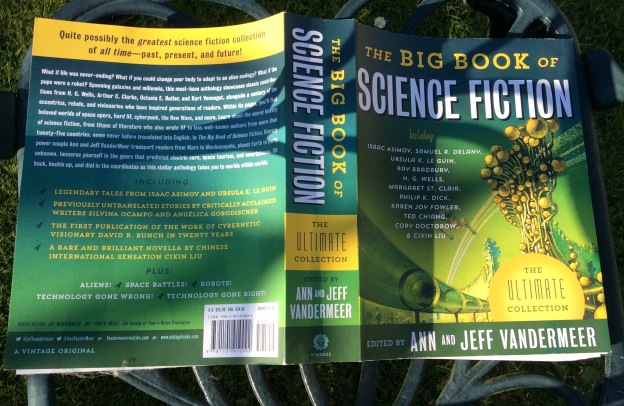
Edited by Ann and Jeff VanderMeer
Vintage Books 2016
When I real-time review this 1210 page anthology, my comments will appear in the thought stream below.
www.nemonymous.com
Des Lewis - GESTALT REAL-TIME BOOK REVIEWS
A FEARLESS FAITH IN FICTION — THE PASSION OF THE READING MOMENT CRYSTALLISED — Empirical literary critiques from 2008 as based on purchased books.


Part Four of my real-time review continued from HERE.
.REIKO’S UNIVERSE BOX by Kajio Shinji
Translated by Toyoda Takashi and Gene van Troyer
“Look! There’s a universe inside!”
That should be on the cover of this book, from emptiness came a universe, not only the Big Bang of stars, black holes, comets etc. But a greater universe of fiction that lives within and outside of the real universe’s box container only of itself. With that thought, this otherwise sad story of a gradually broken marriage, to which couple the box was given as a wedding present, would have been even sadder.
“Consider this varicose vein along my shin.”
A Trading skein of ruthful or ruthless factions and ert or inert races, converging in this para-Whovian trade upon, for me, tantamount to some case of cosmic Brexit by Alfriel, the human who studies alien linguistics and in this tale combines an eventual gestalt of ruthful, ruthless, ert and inert, a SWARM to be tapped into, making the reader’s suppurating brain feel like all parts of that experimental trade, an IRONY that starts in Afriel’s mind and eventually becomes the whole universe, when seen from the Toynbeean perspective of the theories of challenge and response in territorially terrestrial history to be transposed to cosmic history, and even within and then beyond the pheromones themselves….
(Believe it or not, within this rarefied scenario there is a love interest for Afriel, but like all love stories, it eventually ends in tears, whether tears told of or not.)
MONDOCANE by Jacques Barbéri
Translated by Brian Evenson
“The new hills are very beautiful.”
An astonishing vision in this short short of the end of the war and what it has done to the Earth and its inhabitants. Nothing can be said to convey it here other than what it is, prose conjoined to our brains like, for example, gas masks to the face. Dammit, that gives no idea nor do The Hills, The Cities…
(The gestalt of this book is beginning to get that way, too, if we are not careful enough to unstick it each night from what we stuck it to during the day.)
“Besides, I’m not saying every cell was a distinct entity. They cooperated.”
…and that may be the essence of triangulating hyper-imaginative literature, each cell of fiction, its own synchronous shard of random truth and fiction. I don’t fully understand the science in this story, but it is the inversion of earlier colonisations by mankind of space, now this is like a whole universe of cells raping you from within, becoming you as a gestalt that they create from YOU, and for themselves, and all ironically as a result of a deliberate act by one of us…. all with the sound of their music through the blood, for me, like Stockhausen. The lure of devouring love. (Not unlike cavemen with blue piss seeking a computer to mend.)
“The whole procedure was wrong, alien. I wouldn’t have thought anything about her could seem alien to me.”
Gan had a gun. That is. The crux in this internecine symbiosis between humans and aliens is that the internecine element is disguised (lovingly, if cynically, nurtured) by a birth process between them, just another pragmatic system like gynogenesis or parthenogenesis. This is macho gunogenesis, only swaddled against by provision of dead animals if it comes to term too early before the pregnant human male is eaten from within by the impregnated eggs. Otherwise a touching many-aspected relationship is depicted between the alien and her ‘godson’ berth. Or ‘gunson’. A well crafted visualisation of all the processes and the nature of the alien. And wrenching images and implications that resonate on. Like being raped from within as in Blood Music, the previous story. Racial miscegenation or a gender pecking-order or animal rights in our human world here as a fable with oblique moral as to who or what is master or mistress of – or has primacy over – whom or what. Or it is as purely story-telling and undidactic as this book will allow it to be?
“We’re hoping you’ll help him learn how to combine the various elements that make up a composer into a whole that will be greater than the sum of the parts.”
This consuming work, like the previous Blood Music and Bloodchild, throbs with ideas of being raped from within, here by a variation of one’s own subsequent Proustian self that has wiped the original or a self that someone has caused to be wiped. The protagonist narrator is a ‘pathosfinder’, employed to restore the composer Gladney – and the procedures described are hypnotically incantatory, as we follow them in this brainaltering text itself.
When this story was first published in 1984, I was just about for the first time discovering Philip Glass (today’s most successful composer) and in that year I was present at the London premiere of the masterpiece of his opera Akhenaten.
Two Gladneys make a Glass? Maybe, preternaturally?
The pathosfinder’s ‘pearlnecklacing’, if not the eye-popping, seems the optimum description of Glass’s music…”it nagged at me”. “Set it to repeat once…” The feeling of space, vertigo. A kind of survivor guilt. “the only person who’d ever met the stranger in himself.”
A kind of Glass tuning fork…
“Maybe if I’d known more about music — the real hard-core stuff, mathematics of progressions and so forth–”
‘The images began to flow more continuously from him, rolling over us in a tumbling series, gargantuan confetti.”
“The universe is movement, the movement of vibration.”
“…and allowed it to replay as the original recording without changes.”
“Each sweep of the string through space created the universe of the note anew,…”
“…the tumblers were beyond the end of the melody. But still they went on, and the music went on with them,…”
A story that still vibrates within me. As if the phenomenon of Philip Glass would never have existed without these Cadigan procedures.
“…his final days a contest to see which would kill him first — the disease or the treatment, the pain of the invading lymphocytes or the pain of the poisons that fought the cells.”
A fourth story in a row with a raping from within, here the human ontology of oncology, colonised within space cylinders as social groups immunised away with depleted blood and as found art (cancers and blood as abstract designs) paintings and sculptures, where the still healthy are just as much a disruptive cell as a sick human. While guns were illegal in Butler, here knives are banned, too, but that does not take account of broken vases sub-letting the unred streams of blood. Making this story at last, I guess, not red but read.
I’m reading while above this text instead of within it, as trying to understand it between the actual lines might subsume the reader, whose own blood sings silently, but some other readers whose blood still have secrets of potential pain, others already open declarations of it.
“The river flowed beneath low, stone arches. The street was empty. Europe was a dead museum.”
Another reader’s-hindsight-with-author’s-foresight of a metaphor for Brexit, each of us a slow-motion realtime Edge of a fast-motion hindsight-foresight of personal and industrial espionage where people you rivalled are/were the Interchangeable products of value while real products are/were the quick-out-of-time-and-out-of-use cybernetics that dot the panoplies with Ligeti/Ligotti atmospheres during Blade Runner type film scenarios run backwards globally. Not new rose, but down risen.
“Life makes life.”
A startlingly impossible story of scientists and archaeologists that blends Toynbeean challenge-and-response with time travel, but not Whovian time travel; it is more a looping of beginnings with ends, with deliberate glitches by AI robots to turn normal causality in infinite directions as seasoned by mystical reincarnation mixed with scientific cloning, and peppered with meteor or asteroid disaster scenarios or with POTS as not another STOP button like mortality but ironically as choice SKULLS waiting on shelves rather than buried in the past.
“Once, hungover in a New York hotel, watching a sudden snowfall out the immense window, she said to me, ‘Charlie, I’m going to die of fun.'”
This is a classic literary characterisation of a flighty Georgie, a fun and mirrors gal, yet there is another flighty accompaniment, a Wasp, a watcher, a pre-realityTV device, that produces a filmed memorial in the memorial Park, random and non-searchable, like this one for Georgie, events and moments in her life, for her widower to watch. A poignant metaphor for Alzheimer’s, between the ACCESS/RESET, the encroaching static of snow upon the shuttling of ‘Little/Big’, of Screen/Life, today an endemic plague foreshadowed by this text. Ingenious fiction that makes you cry over its utter truth. A reading experience to cherish, thanks to this book.
In tantalising synergy with the previous story (making each of the two stories, for me, even more powerful by this new contiguity within this anthology), and the Fowler one builds a repath to the past for a woman and her original lover before his supposedly being killed during the Viet Nam war, a repath via an over-kindness SF lucid-dreaming method of only tapping happy memories – but an experience that inadvertently morphs into undetermined real contact with the dead person by time travel? And the ending is made even more powerful and poignant by reference to Zeno’s Paradox (a paradox I have already mentioned at least three times during this real-time review, and the link for this – https://cernzoo.wordpress.com/the-big-book-of-science-fiction/ – is a better way than time travel to check it out…)
Translated by Marian Womack
This is the apotheosis of HyperNormalisation written before its time, some geographical prediction of fused borders that only Brexit broke into reality very recently, one where Russia is here called atypical, the President a bit-part actor for whom Reagan no doubt was only the ice-breaker for Trump, and Dali’s Hidden Faces came into a sort of South American existence from the only novel he managed to write, trans-sex openly spoken of, and woman the astronaut to disprove the fabrication of any set-up or set-aside world, gone to Gibson’s earlier Edge in this book, all of us gone today, we realise, as our reality enters the version that is Gorodischer’s Edge. “Women are capricious creatures….”
The Russian bear, ‘the Russian’ from Blackwood’s Centaur?
Alien possession where the alien is an owl or at least owl-like in our terms, for whatever purpose ‘riding’ this lone researcher on Bear Island, far north of Norway, with a ‘gray zone’ (gray owl?) as interface or buffer between us and the Soviets, Soviets now today’s Russia, the old ‘atypical Russia’ of the previous story, but what is this owl after, some trace element?
A Bing who never morphed into Google, sets a Google-like computer trap for the owl to release its and his (as a writer’s) human protagonist….
A fascinating preternatural retrocausality of fiction from now (today as you read it) to then (when it was written), rather than a premonition or prophecy.
This book certainly knows how to pick them! And its gestalt grows extraponentially.
Translated by Howard Scott
“There is an implied rhythm, the suggestion of a pattern in the permutations, a hint of an intention in the sequences.”
This is another literary revelation provided by this book, if books can do anything other than be print on paper. If I had sat down to extrapolate on the traditional concept of releasing a sculpture from inside a block of stone, I don’t think I would have come up with this story. It is on a roll, in overdrive, extending beyond itself, whereby the slowly obsessive procedure is not only read about but also watched from within the text, like a show or happening/art-installation. And the story’s equivalent of the sculptor has a tool-armour that divests itself as the sculpture is itself divested of material which it is sculpted away methodically, empirically, surgically, chemically, electrically, prismatically, where words are like a demonstrably scientific process of striptease, a bodily flensing and flaying, and the watchers, or at least two of them, are in some sort of loop with this process, pair with pair. We readers, too? And my gestalt real-time reviewing as a reading process, aka dreamcatching, hawling, is also such a synergous process of flensing and self-flensing. No wonder this work (to which I have been unable to do full justice in this relatively short description of it) has READERS in the title… (A synergous flensing of author by translator, too?)
“A code, or more accurately changing codes — the rhythms have rhythms. The combinations have combinations, and the law (or the laws) governing it all hides, elusively, in those converging metamorphoses.”
“I was floating on a sea of possibilities, but parched of choices.”
A gay (when gay was illegal) hitman where his hit is a phallic starship and its passengers. But there is far less to it than that; it is whether a potential suicide bomber type of our day is worse than being an emotionally and unprincipledly self-destructive hitman, without death cleansing him first. All of this is tied into Banks of Economic Communities that bring a prophetic sniff of Brexit into this complex equation. As you can see vast universal cultural schisms far less significant than the personal story itself.
I loved the chatty gun the hitman was given. A MUST read.
Translated by Sheryl Curtis
“It’s a game, you see. Draw a map and you control the territory. The more accurate your map is, the more efficient your control is.”
a story that presents another revelation for the reader, a city that is what I shall call a gaianimal, with its own interstices and partitions, one with 44 presumed glitches that are somehow perfectly identical fragments, a tale not without humour, of an oldster who prefers alcohol to the water of the living city’s sexual wiles. You actually grow to believe in this prehensile place, and it should be on google maps. I reckon. It can only be read in a lolloping book like this one, wherein I have lived and explored for a month or two already, its unmapped and mapped labyrinths of my new emerging mind’s enticed imagination….
This seems to be another dangerous vision, like AYE, AND GOMORRAH and SPORTING WITH THE CHID, but more obvious, more gratuitous, less convincing, here with the supposed aura of under-aged girls, or girls made to seem under-aged with talc etc, involving entitlement created from a form of health and climate apartheid, and the ticket, to gain shelter under the safe side of that apartheid, is such selling ‘in kind’ of sex with the young girls by their mothers to the men in the shelter. Involving the use of the word ‘cance’ as a verb from ‘cancer’…
Not sure about this one. But it is certainly worth having a view on in the context of this book’s gestalt.
“I frequently have a peculiar sense of closeness to the home planet, even though we are light-years from it.”
The diary writer is effectively writing a serialised letter to his or her lover and the fact that the gender of the writer – and of the intended recipient? – is not made known or is simply uncertain in trans terms, in a story written by an author with the name Moorcock, and a character called Helander, is not accidental, I feel, in view of the absurdist nature of the Catholic and catholic Cardinal found frozen in a an icebound world light years from Earth. And the spiritual repercussions. The rhapsodic feeling that one has come home with this story. That we are all one and for one whatever our gender, religion, and orientation-as-distance-from-Earth – Earth only one letter different from an anagram of Death. Not one with God, but with some absurdity even greater than God. An absurdity stronger than Ontology or Teleology.
And that the world light years from Earth is called Moldavia, which is on Earth, too. A classic that keeps on giving – and taking. Also treatable just as an intriguing SF adventure.
[A story written in the same diary/letter format and first published in the late 1980s, too, is my own DEAR MUM: http://www.dowse.com/fiction/Lewis.html (referred to earlier in this review) and, now in connection with the above Moorcock, it relates earlier to what I said in this real-time review about Clarke’s THE STAR https://cernzoo.wordpress.com/the-big-book-of-science-fiction/#comment-334 and Asimov’s THE LAST QUESTION https://cernzoo.wordpress.com/the-big-book-of-science-fiction/#comment-341 ]
“Rachel likes fairy tales and she likes happy endings. She has the mind of a teenage girl, but the innocent heart of a young chimp.”
This is either
A masterpiece of a tale dealing with mankind’s relationship with animals, and despite a rather unbelievable set-up for this scenario, a young girl’s view of man’s sexual nature through the eyes of a chimp.
Or
An exploitative fiction where man’s sexual nature is appeased through being allowed to peep in on these scenes, where Rachel grotesquely applies make-up to her chimp’s face, as Tanith Lee’s girl applies talc and warm showers…
Jake prefers the even more exploited women in his saucy mag…
Her hoped-for happy ending, however seems, set to appear at the end…?
A truly provocative work, in which I am severely split as to my attitude. Whether filtered through my Jekyll or my Hyde. My Paranamaco or my Vonarburg.
“; QED, they controlled the air supply.”
The critical tussle regarding startlingly hindsight didactic works — for the modern reader with modern didactic fashions — being included in any ‘best of’ sort of historic fiction anthology is whether they are great stories, too.
I believe this one arguably is. The retrocausal pre-hindsight foresight of a decades old fiction work of seeing what type of air we breathed today as a futuristic fad for people to recreate in the even further future. An arguably great story, yes, short though it is, one that hints that the future people who do NOT recreate the way we breathed today are missing out on something valuable. A diluted didacticism amid some shocking casts backwards for us today, where this germ-filled flabby lolloping book heavily laden on my lap shares the same air as me – and can then be passed around for others to use! Ah, that’s the publisher’s incentive to buy your own copy! Or even get an ebook version? (IS there an ebook version?)
The gestalt now emerging from this lolloping huggable giant is a post-religio-sex-scientific Gaia as the new age-transgressive transgender radiating more distaff than spear.
This review will now be concluded HERE.