Monday, November 21, 2016

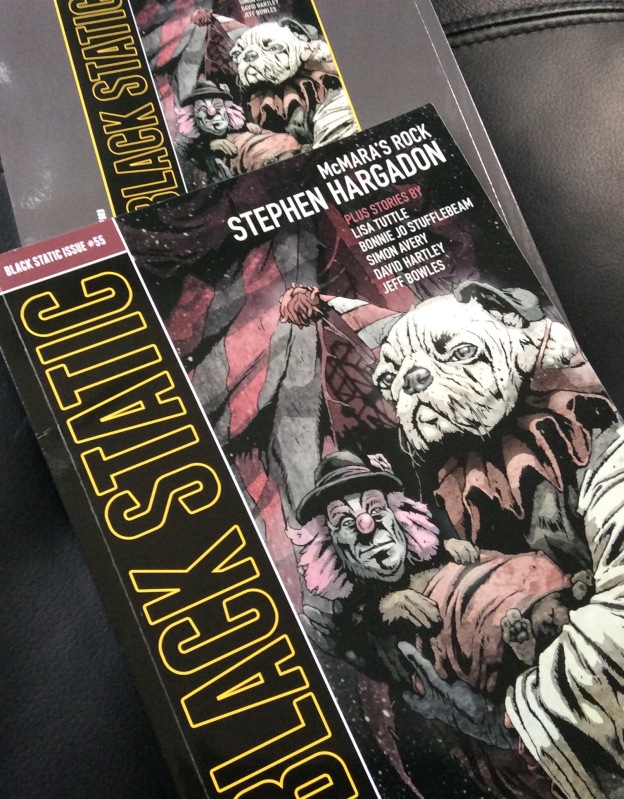
Black Static #55


Black Static #55

img_2606

My previous reviews of TTA PRESS publications HERE.

Stories by Stephen Hargadon, Lisa Tuttle, Bonnie Jo Stufflebeam, Simon Avery, David Hartley, Jeff Bowles.

When I review the fiction in this magazine, my comments will appear in the thought stream below…

6 thoughts on “Black Static #55”

  1. McMARA’S ROCK by Stephen Hargadon
    “You’re wise not to have a television, Michael. The news is just murder and more murder and greed and war and one sick perversion after another. The make-believe stuff is no better, it’s more of the same, with an extra dose of perversion.”
    So says Mrs Dolan, a honest-to-goodness Irish woman, now creaking with age, hoping to get her daughter hitched to Michael. Michael and Jerome are brothers and they …damn, how can I rehearse this plot for you? Just believe me, when I say it is a classic worthy of your attention as a horror story lover and worthy of the consideration of any awards organisations in ANY fiction genre, well not ALL, but most! It as if John Cowper Powys translated all his Dorset and Somerset mystic madness and human hyper-eccentricities to the wilds of Ireland, and let it be recast by another author at least half-Irish and born in Canvey Island! But that does not do justice to its originality, ironic hilarity, and sheer brazen shocking events, its mighty image of a split rock, and a gestalt of cats and thoughts and a brain that is that rock, or a brain that is the earth we live in or the dreamcatcher itself… or a brain that is simply Michael’s. And the characterisation of the two brothers is to die for. The myths and legends behind the rock, too.
  2. A HOME IN THE SKY by Lisa Tuttle
    “It was like being in hospital, she thought, where existence could be concentrated on the span of a single bed, screened off by curtains beyond which other dramas played out on and around other beds, unseen but not unheard.”
    Cara, because of the housing crisis, returns to her parents, to help herself save more for a deposit. The family house has shrunk in her adult hindsight, but her parents somehow increased in size. Some effective claustrophobic touches in this relatively brief account of her later seeing – then, on an impulse, visiting – an advertising showhome seemingly erected in the sky on a new development… like the possible mixed blessings of spending time within the split of McMara’s Rock? The difference between a quick passage through or a longer sojourn?
  3. PIGSKIN by David Hartley
    “The farm is blasted and hell-blown. The farm is rusted and gut-sown.”
    A literary revelation of a down-to-earth prose-poetic theme-and-variations on Animal Farm – at first reminding me of what was done to the goat by a human in McMara’s Rock, but it takes off into a scenario of ready-dressed culinary animals, who interact with pot-bellies as morphed men and with actual men, women and children (being taught where their bacon comes from!)
    Not so much a fable about the way we treat animals (but it may be that as well) as an atonal gratuitousness of a feast of words.
    (It also makes me think of Tuttle’s dark-shrinking home in the sky as a pre-slaughter cell in a battery-farm for humans.)
  4. SOMETHING DEADLY, SOMETHING DARK by Bonnie Jo Stufflebeam
    “It was the sort of creature you can’t see well if you look at it. The kind that requires you to look away, to see it from the corner of your eye.”
    Like this is a cousin to a story. A well-characterised music trio on a gig tour visits one of their cousins, too, in the Land of the Dead, a corner-of-the-eye type genius loci that has grown up since the so-called Encroachment, and it echoes the previous story’s animals, and the symbiosis of goat and man in the first one, but here the morphing between humans and pets is via trees being planted above their dead bodies. The treefruit yearning of the characters for some sort of life’s meaning, and don’t inhale when you pass the cemetery. And don’t take any of the fruit of the dead with you, when you leave. The story will stay with you nevertheless, but it’s only a few minutes since I finished it, so what do I know? I failed to understand the encroachment of Trump and Brexit.
  5. A VERY LONELY REVOLUTION by Simon Avery
    “It was being chipped away from him gradually;”
    A very Lanely one, too. But that does not mean this work is unoriginal; it is highly original within the parameters of connecting into the rich seam of lonely, Lanely Birmingham and its seasoned Diaspora of yearning souls (as I call it) who have been conjured like sculptural memory-filled scintillations of our “Soon it would be December” as it is in this story and as it is In my own real-time. Tom misses his friend Julian, now dead, but who is it answered the phone in his empty house?
    Tom misses his wife and daughter, now a family with a different man. He follows up clues and follows the path of Julian into a realm of bandaged figures – after all who really needs to be healed, the presumptuous healers or the ones who simply feel they need healing?
    There is something positive towards the end as if that death of Julian has allowed Tom to seek out all our constituents of the Diaspora (of which his own wishful-thinking memory-filled scintillant was part), a Diaspora to become its own gestalt, a gestalt of personal gestalts.
    There feels to be something important about this work. Beyond the desperation of just humans as animals, but something they can create if only they can transcend the artificial shallow yearnings, with which this set of fiction so far is pervaded and promises to transcend. Even if you have only so far got a broken off part of it to go on.
  6. VASELINE FOOTPRINTS by Jeff Bowles
    “And all the love will come gushing out. It’ll splash over the whole world like oceans of cow gore.”
    A serendipitous coda for this symphony of fiction works as well as a fine ostensibly Powysian madcap standalone story telling of a man who seems to be on the edge of becoming a stigmatised saviour, but if I tell you the exact circumstances it would be like telling you this brief story myself and spoil the effect. Meanwhile, his feet are his pets, his fused appendages of his thoughts like Michael’s cats, whose cross was a split rock, the scintillants of Avery, the gratuitous animal words like Hartley’s. Hard to explain, but read all these stories and see them fused here like Stufflebeam’s trees. Mad-mystic, the only way to face out the something deadly and dark of our days, our morphing world. And women in the cupboard as if in a Tuttle home.

  7. There is much else in Black Static to entertain the Horror genre enthusiasts….
        

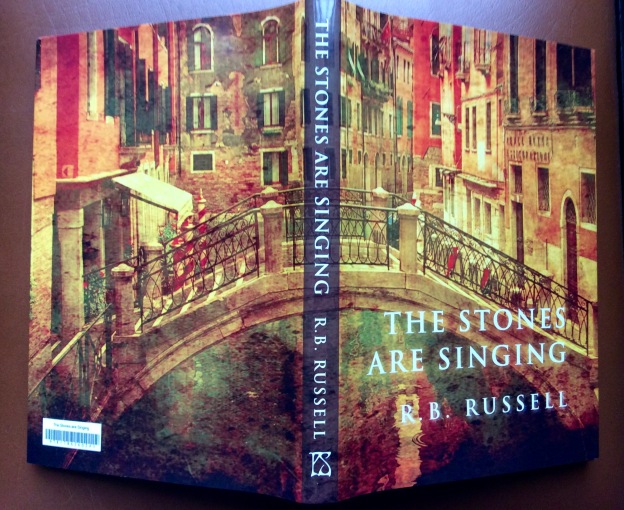
The Stones Are Singing – R.B. Russell


9 thoughts on “The Stones Are Singing – R.B. Russell”


  1. Me –> NO SPOILERS, NO SURROGATE DAMP, NO DISINTEGRATION LOOPS
    Chapters 1 & 2
    “Being empty it felt like any other old set of draughty, cold rooms with high ceilings and a tendency to damp.”
    An involving start, as the narrator (film music composer) gives us his backstory on how he lives in this inherited apartment in Venice, with a subtly infused ambiance of that city, and his wife in New York as actress. And it takes an accidental fall, and a visit from an old friend from college days not seen for two decades who is clever but on the autistic spectrum, to find out that the narrator is estranged from his wife rather than temporarily apart for professional reasons. And what is it that has fallen or been left so mysteriously on his balcony?
    I am trapped. I shall eke this book out slowly.

  2. Chapter 3
    “It showed a man walking into a café, taking off his coat and sitting at a table.”
    Trapped and grabbed, but resisting reading this book too quickly; I am not a cinema buff but my favourite film EVER has long publicly been ‘Death in Venice’ with Dirk Bogarde, where the film music is Mahler’s, not Part’s nor this narrator’s, but I am intrigued by the music he is composing for a commission described to us in this chapter, by his view of a canal bridge from his apartment, the nature of the apartment above his and below, the rain above and the waters below, the email exchange with his estranged wife, and his rediscovered strangely behaved friend from college, Rolfe, Byron, Pound, Stravinsky, Diaghilev …
    The book’s actual mechanics of the plot itself, though, I will not re-rehearse in this review.

  3. Chapter 4
    “‘I’m waiting to see what patterns emerge.’
    ‘And if there are no patterns?’
    ‘I hope to find them. My previous, personal work was all about making sense of things that might have otherwise appeared to be unrelated.'”
    …as I say to myself, as I work with this ever increasingly promising book.
    Amid being harassed by his new old friend from college and being asked in emails by his wife for money and an interview by someone writing about a previous film of his – our narrator meets the current film director for whom he is composing music, a man who can only name Nyman as his favourite composer and whose only previous film is one anonymously shown as a collage of stolen excerpts from other films into a gestalt work of ‘found art’…
    Not only trapped by the captivation of this book, but diced apart into the separates of the gestalt reviewer I used to be – for the narrator’s lamb stew? I don’t know why I thought that or even why when I first saw the title of this book, I thought of the song 19th Nervous Breakdown.

  4. Chapter 5
    “It was too much of a coincidence.”
    But by saying that, I somehow know it isn’t a coincidence at all. The narrator’s rediscovered friend from college who shouts an impoliteness in public and then regrets it when told about it and then goes over the top in rectifying the faux-pas seems now somehow to fit in with the so-called coincidence of what was earlier found on the narrator’s balcony. Coincidences here seem claustrophobically amassing as well as somehow cancelling each other out! No mean literary feat.
    Like a number like 19 nervous breakdowns having a spurious accuracy?
    Like having too many ‘ups’ in a clause on page 56?

  5. Chapter 6
    “Sitting in front of the computer working ’til six, eating a defrosted dinner, watching a film online, going to bed, day in, day out, seemed suddenly pointless.”
    Read this book, instead, I suggest as it really is something special (about halfway at the moment) and I can easily imagine it may one day be successfully adapted as one of those films you watch as part of your routine. With fine film music to complement its action.
    The coincidences start to seem like a chilling ghost story, and it is a wonderful evocation of different parts of Venice.

  6. Chapter 7
    “Suddenly there was no such number . . .”
    But there are other spurious numbers here, detailing the stressful lengths needed to be gone to in Venice to find one of its buildings that is recognisable from someone’s Facebook page…
    “Are you sure you shouldn’t see a doctor?”
    I think the narrator should see a doctor, however, about the tinnitus he’s suffered since his fall. Especially a music composer.
    We now reach a second moment in this book where there is the implied feeling that music can lead rather than follow a film?
    The woman due to interview our narrator is brilliantly described on page 85. I think this book is the first i.e. where the sense of coincidence is not quite how it is expected to be in normal life. Meetings between people and arranged engagements and other uncanny implications that can’t quite be pinned down in the way numbers can be pinned down, if spuriously. Or the spaces between music notes. Or the gaps between the cells of a graphic novel?

  7. Chapters 8 & 9
    “‘Right wing politics and the occult are natural bedfellows,’ she observed. ‘Both offer the elitist idea that a chosen few deserve dominion over others.’
    ‘Rubbish!’ spluttered Stephen.”
    As much as the narrator now has a shocking change of perspective out of the blue (shocking to him and also to the reader, let me say, a literary moment to cherish), the people he had met separately now meet in his company, as if this is a new perspective, too, if far less shocking. But now I have been shocked again.
    POSSIBLE ACCIDENTAL SPOILER FOLLOWS (please omit the passage below if you have not yet read the book.)
    –
    –
    –
    Looking ahead cursorily in the book to see how many chapters remain to be read, I have just noted there seems to be no Chapter 11 before Chapter 12, unless I am mistaken! Perhaps that will change when I pick up the book again? I now somehow know how the narrator feels in his own change of perspective! Either a very clever ruse or something VERY strange is going on comparable to what has just happened in the plot.

  8. Chapter 10 till end…
    “…momentary, attenuated silhouette, and then the door was closed.”
    The world seems to have changed these days, and not only with recent earth tremors in Italy. This ending, at first, I thought was a sell-out, but then I knew it was the perfect ending, an ineluctable resolution, a wonderful sense of the backing music of my life, but what were the stones singing? A far superior resolution to its being a nervous breakdown, whatever its spurious number. (Only one minor typo, in the middle of page 136).
    A splendid book that has aleatorically affected me in more ways than one.
    It also seemed appropriate that the random choice of the resolution’s venue was a Roman Catholic Church, as coincidentally, yes, that word again, I have been real-time reviewing another book here alongside this one, and this morning I also finished it by reading its chapters 10, 11 and 12 in one fell sitting.

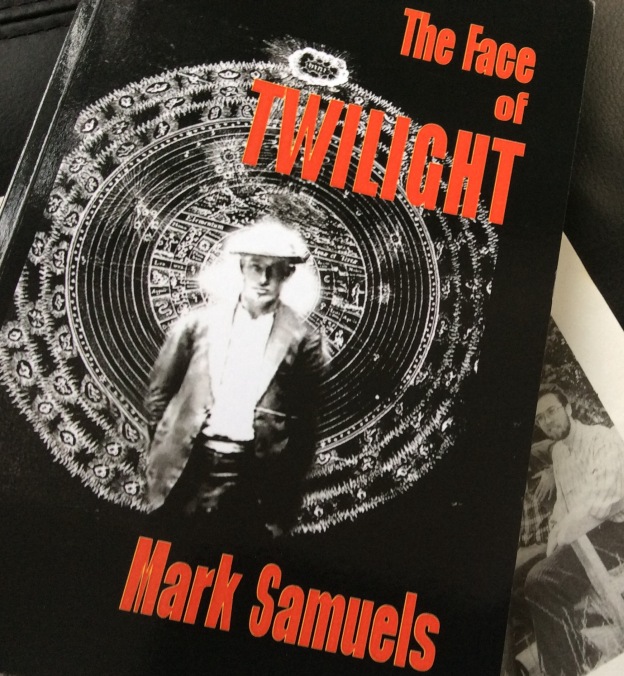
The Face of Twilight – Mark Samuels


9 thoughts on “The Face of Twilight – Mark Samuels”


  1. First published in 2006 by PS Publishing, now out of print. This edition, I gather, is self-republished in 2016. I have not read this work before.
    I intend the review below to have no spoilers.
    ———
    CHAPTER ONE
    “These fragments simply could not be fitted together to make a whole.”
    An engaging start introducing characters, inter alios, Gilman, Stymm and Mund. The first-named is the main protagonist, a writer who brainstorms his writing by pen and notebook in his new local, the North London Freehouse pub, with its own landlord’s loyal ‘tribe’ of drinkers… He has had to move to this area, following an unfortunate gas explosion. He seems to write about the urban wastelands and their rather absurdist type images that come to his head such as pretending the city is a circus, an idea he discards while still in the pub. And he has a political discussion with Mund. And listens to two locals in the new pub solve their crossword puzzle with some word relating to a name of God (https://en.m.wikipedia.org/wiki/Elohim)
    Stymm, meanwhile, is spiritually stymied, I guess, but allowed to wander and stare through windows, within the same apartments where Gilman now lives. I do not intend to rehearse the plot much further, having just given you an inkling as to the tenor in its opening gambit to gain my attention, as it does. Further entries by me here will be more a personal reaction rather than a description of the plot’s audit trail, should it have one.
    “He had no time to waste thinking about weirdos.”


  2. CHAPTER TWO
    “…a psychometropolitan process whereby one is prepared for the revelation, where the very streets that lead to the final destination facilitate the necessary mental state.”
    …where you can also add to the destination your own graffiti as part of that processs or ritual, as you are led, in a striking sense of actually being there, by the author evocatively writing about another author actually doing it, wandering in that sort of process amid the genius loci of North London, Archway, ursurped Romanic churches, a time and place when it is always twilight, written no doubt in 2004 (for publication in 2006) when FACEbook itself was being launched (?), reaching a derelict experimental TV broadcasting studio from the 1920s, that probably, for me, fed its still lingering static into the air, now, today, in 2016, filled with competing wi-fi. There is a naive rapture to these scenes that I admire very much, also touching on hospitalised Ligottian characters who consider all consciousness cursed
    …and Tennents Super.
    It is as if I am adding my own graffiti to the process (or Prozess) of this book, as part of my ramblings here for this web labyrinth of personal dreamcatching, having travelled already a little into this book’s own byways, like Dick Whittington, or at least hopefully.


  3. CHAPTERS THREE & FOUR
    The underground train system and its tunnels, transporting the dead and living, have some wonderful passages devoted. Then another pub’s culture is cleverly built up for us in Holborn, a place Gilman visits once a week to meet a few of his cronies. I won’t go into the genuinely hilarious details, and one of them is me (top passage of page 30)!
    Gilman is on the brink of resuming his cigarette habit, and I feel in the mood to tear pages from this Amazon book, and reconfigure them into a gestalt like found art or like Burroughs might have done, or Gilman seems to like doing himself. The aftermath, of that pub meet and the blonde pick-up, who picked him up more like, turns serious, with police involvement ….and Stymm is involved somehow.


  4. CHAPTERS FIVE AND SIX
    “…drew a packet of tobacco from his pocket and began to hand-roll himself a cigarette. Funny how that skill had not deserted him.”
    The actual or imagined constymmacy around Gilman accretes, entailing his return to the Holborn pub, actually experiencing static on an old portable TV as some threat potentially bigger than just a plot against him personally, together with a synaesthesia where he can even hear someone “unbutton his flies” a room away. Meanwhile, his novel INSANITY LAUGHS has taken a backseat.
    There is something going on here, either ludicrous, or something that such ludicrousness is intended to hide, something that those earlier found art graffiti and paper fragments betoken. A reader may suspect he or she is in an avant garde masterpiece or a writer’s early traditional weird novella. I suspect it is somewhere between.
    “Snape waved limply at Gilman, patches of oily sweat drooling across his egg-like pate.”


  5. CHAPTERS SEVEN & EIGHT
    “‘He was merely an extra anyway; an author with the soul of a businessman,’ Stymm said with a dismissive grin,…”
    From the earlier “deranged tableau” to the city’s inhabitants in “a grotesque play”, Gilman suffers his seemingly justified paranoia of the world’s new conspiratorial takeover by the dead, with many deftly described cataclysmic and gory scenes, sometimes involving people we met earlier in the book. (I am glad Snape kept writing to the very end.) And a world of continual twilight, and mad scientists, and other Necromorphs…and much else. But even in extremis, Gilman continues to roll his own.
    But the core scene is a woman about to tear apart her man’s books with his name on the spine but discovers them turning, even as she turns them, into the tail-end likeness of Nemonymous Two – info for those readers with the look of spoilers about them or those other readers in the know.


  6. CHAPTER NINE
    “The number of cars and other vehicles was far less than before and they were driven as if stuck in first gear.”
    A telling image that is included in a masterful treatment of this North London land into one of Twilight, a running down, with people Gilman had met before, such as the earlier blonde pick-up and the locals in the ‘tribe and crossword’ pub, have turned into death-cloying spoilers and nightmares, dogging him slowly, but surely. Good to see the ambiance of the pub itself is tellingly untouched, including its old-fashioned clock. But the nature of the crossword they are now solving in there is very striking in the context of this accretively haunting novella, mixing the avant garde with the weird, pulp with an inspiration beyond pulp.
    I was wondering whether Stymm’s name synchronously derives from the sound and meaning of STIMMUNG, one of my favourite music works, where the composer also stated that he was inspired in writing it while visiting Mexico. (Was the author’s own strongest indefinable influence from Mexico around the time he wrote this novella?)


  7. CHAPTERS TEN, ELEVEN AND TWELVE
    “The well-practised ritual of rolling the tobacco and papers into a thin tube, of standing at the bar, with a ten-pound note on the counter indicating that he wished to be served: he’d done these things a thousand times in the old world, Did he hope that by repeating such actions all would become as it was back then?”
    There was something driving me on to read these last three chapters in one fell sitting, something pitiful, something truly horrific in a great genre sense that horror genre lovers should NOT miss (it is brilliant) and something even more powerful beyond both those things that I think I may have encapsulated in a word I hardly noticed using and used automatically earlier in this review: ‘constymmacy’, not avant garde so much as a deliberate ritual scribbling to see what pattern of self-identity emerges, as, when kids, we scribbled with our pencils and then pareidoliacally found monsters… but that gives no real sense of what can be found in this book below the naivety. (Just as Snape is now in one of these chapters pasting up his future real-time reviews as fragments all over the pub walls, pre-figuring a later vision in this novella of the Kindle as a real book inserted into a computer just as that FACEbook spreads its tendrils of twilit living by insidious oldTVdisguised wi-fi static (like self-inflicted cigarette smoke?)).
    The scenes in Highgate Cemetery, the sheer horror, the Nemonymity-type fears, the ultimate punch in the gut of a final plot-twist, become better and better as you think about them. And there is much more I can’t cover here, because they are still hidden in the text or in its exhaled air – and emerging accretively even as I write this. In other words, it is not just a zombie flashmob fiction (and on that level, the descriptions are brilliant), but something arguably far more significant.
    end


    This review significantly cross-referenced here: HERE.

Saturday, November 19, 2016

You Can Never Spit It All Out – Ralph Robert Moore


10 thoughts on “You Can Never Spit It All Out – Ralph Robert Moore”


  1. I previously read the first work HERE in Black Static and this was my review at that time –
    ————————————————-
    DIRT LAND – a novelette by Ralph Robert Moore
    image
    “Radishes are so easy to grow. Twenty-eight days, and that redness is ready to be pulled out of the dirt.”
    This is possibly one of the most difficult works I have ever had to review. How do I do it justice, how can I say to some of you that I love it when some of you will strenuously insist that I should hate it, how can I say to some of you that I hate it when some of you will insist perhaps even more strenuously that I should love it? Something like fighting on Facebook over this Dirt Land’s “gold award” for literature. Who can stoop the highest, who can stoop the lowest, in extolling its dire delectation or spewing on about its disgust? I give ALL of you the finger, and say that there is a special award for this work that is neither love nor hate – nor anything in between. There can be no name for such an award, but whatever the case, this work deserves it. Fighting it out each side of a septum, but that’s not half of it. At some points I could hardly bear to read it, then hardly bear to put it down.
    These people live in the ‘hollow’, Hollis’s hollow; their auras as human produce have a sense of believability as real individuals, believable with a deadpan acceptance of their crazy hard lot in life and of what behooved or befingered lot comes out of the ends of their life and limb, cloven or sexually precocious or foully frolicking quite unforgivably with stolen innocence, or whatever. They all have their mutual cohorts of sheer outdoing hate of each other; you gotta love how straight up they are in their hate, but with some shoots of love growing in that Dirt Land, a love that tries to raise its head between the hates, like that struggling love between Audrey and Roy. Roy who is scared of his own feet, and Audrey scared of her own blighted hollows, but love each other they do, not passionately, but enough.
    Rooting for Roy, you sense you are on a loser; rooting for radishes, though, from the Dirt Land is a rooting of quite another desperate sublimation of hope. Onions, too. Hence my raised bed in the lead photo for this my real-time review, taken and placed above hours ago before I had started reading it. This emotionally devastating story. This incredibly inspiring story.
    Inspiring that it was possible for someone to produce something like this at all
    – especially from scratch. Along with dirt’s gold coins. Sausages, too. The eggplant moussaka for Miss Abergine, notwithstanding.

  2. I previously read the next work HERE and this was my review at that time –
    ——————————-
    Kebab Bob by Ralph Robert Moore
    “Hard to take your own life when there’s a hot pizza in front of you.”
    Or a brand new unopened see-through pack of Black Static. And I’m glad I cracked into it and read this story, as if I alone brought it to life by my reading it but I know in my heart of hearts that others are even now reading it, too. I am no-one special.
    This is a special story, though. You sometimes feel you are a downbeat Beeblebrox threaded upon a silver carousel pole like a kebab. Or at least one of them. Choices that make reality as you choose them, bikini polka dots and volley ball ricochets of Fate. Yet the intense poignancy of the final choice is not so much suicide the prospect of which you once took so lightly but the deadpan acceptance of a lost love as well as a lost life. As I say, a special story – Somerset Maugham on a skewer. Thank you, Bruckheiser.

  3. DURING THE TIME I WAS OUT
    “deveining the shrimp”
    This story is so powerful you will wish you hadn’t read it by the time you finish it, but then there is nothing you can do about it.
    I can now see how the overall title of this book YOU CAN NEVER SPIT IT ALL – OUT could be thus read. The protagonist Pablo’s out of prison, and using spit as a a surrogate for having sex with someone else. I will not come out, either, with the nature of this plot, but it is as if the shrimp and macaroni cheese are connected somehow, the man emasculated as he helplessly – by dint of salacious sharing in a SORT of ménage à trois – watched the two women IN, inside each other by being OUT upon the skin of each other, until the whole armpit-grinding cure comes to fruition. And that gives you no idea, except it is all due to be re-reherased but with a different woman in place of his wife, a story retold, like his inevitability of never staying OUT. Back to the OCD prison cafe where shared spit becomes a precisely placed condiment. Bullied back into institutionalised clothes with tattooed stripes? A fable with a moral, but I will leave it to you to decide what moral and whether it was worth your risking the experience of this story to discover such a moral. Meanwhile, Alicia is a new type of monster you will never forget, however hard you might try. Relentlessly and grindingly deadpan.
    “Raised both her woman’s hands. Couldn’t say what it was about them, but they were incredibly sexy. Naked, bird-boned, strong.”

  4. SHE HAS MAIDS
    “‘Russell! Where did popcorn come from?’ Russell, on his hands and knees on the carpet, hung his head. ‘Japanese shrimpers smuggled it into the United States in the seventeen hundreds inside giant paper Mache heads of carp.'”
    And there are cupcakes from the previous story in this story, too, but not a story as such, but more an unforgettable, wildly offensive, high-literary, avant-garde sex-and-Abigail’s-Party HAPPENING or word-installation to walk round in a bug-plagued gallery shaped like the inside of a motor-racing helmet, one that is all closed in with no air-conditioning.
    Ostensibly,y, though, it is also about a woman ‘sponsor’ (the hyper-‘Alison Steadman’ rôle, even more monstrous than Alicia!) of Ben and Emily, our world’s downtrodden couple, whereby spit in the previous story as surrogate sex becomes, here, a prestidigitive sleight-of-hand with playing card and tooth-molar… Don’t ask.
    It’s brilliant. Needs showcasing in posh literary anthologies.
    “Felt her hands under his armpits. So intimate, a woman’s hands up in your armpits.”

  5. IMPERFECT BOY
    “A ‘story’ is something that’s not true. Why should we care about something that isn’t true?”
    This story somehow digs right into your armpits, as some of its characters do to the gang member at the end, and drags you into this scenario for real, whether it be Mahler, Gogol, Nabokov, atonal music studies at a New York college, or the parents (who probably voted Trump) of our male protagonist, parents who hire a food-bullying chef (with two maids), parents who treat their children in turn as their great white hope, while the protagonist himself (their son and latest great white hope) subsists in the most nightmarish lodgings of a student share that you will ever be able to imagine – in or out of Jane Austen.
    And Gretchen, to be his girl friend, is here a RRM character-study to die for. I cannot do justice to Gretchen here or even broach some of the descriptive passages that will eat away at you – and then not only toothpaste can’t be completely spat out but also all manner of prehensile faces and blood sacrifices from synchronised orifices.
    Strong stuff, this pan-Sadean deadly-spiritual rite of a young man’s passage, from updated Dickens to distaff-hard Flannery O’Connor and beyond, now in your face. Atheism is so twentieth century, as it says somewhere.
    “Your molars hurt. You must have been grinding them.”

  6. THEY HIDE IN TOMATOES
    “The best feeling in the world, when you smile at a stranger you’re attracted to, and they smile back.”
    “A lot of the world revolves around the promise of a fuck.”
    A worm on a fishing-hook, or the promise of shrimp cocktail after a nightmare, and the ghost that has haunted the whole of your life reveals itself…
    This is another highly powerful RRM work, one that makes you think that something’s happening to your brain, worse than its version of brain cancer almost, making you forget it’s only an absurdist fiction prepared for literary publication. But on top of the other stories in this book so far, it shakes its head at you and you know it’s got you.
    Chance meetings, a cringeworthy present of pearl earrings, another SORT of ménage à trois, meanwhile also helping your dying Dad with intimate ablutions, lifting him by the armpits, mimicking a Trumpish “transitional coma”, accepting the dire “ridiculousness” that only doctors or police officers seem to know about, a sort of pulp horror of, say, Terrifying Tomatoes or Shape Shifting that has actually never really been horrific even in your impressionable youth – till now.
    That ghost that has haunted your life, you compare the paternal to the maternal: “Mothers and daughters almost always get along. We carry the weight of the world in our wombs.”
    All accretes to mean something crucial, like breaking your tooth on the barrel of a gun? Blaming the maid for the untidiness of your low-grade apartment – or head?
    “See that glossy nub in his armpit? That’s the beginning of wing development. It’s as sure a sign as metastasis into an organ.”
    Are you the butterfly effect or what the budding butterfly leaves behind?

  7. BOYFRIEND
    “The world is crammed with little rough wheels that wear you down.”
    Don’t forget to order shrimp with grits, it says somewhere here. Sad memories of a mother and fond memories of eating her meatballs. A hair blower, too. And much more you will want to miss. This combines much of what has gone on before in this book so far, but even more offensively, with tropes of posh politeness suddenly or gradually disintegrating, then sex and food, and a shifting deadpan panning point of view as if a cinematic work. Except here it is a pornographic camera being used. And not just for human beings. Be warned. Seriously.
    How this work will eventually fit into the book’s often off-putting but stunning gestalt remains to be seen. Like trying to avert one’s eyes from a very bad accident, one often involving ineluctable human needs.

  8. NOBODY I KNEW
    “I’m in my sixties. Age happens.”
    Like me, in his sixties. Me in the late ones. Nearly in his seventies, then eighties, with his dream town merging with his daughter’s tabletop village. I wonder if there was a library opposite another library. And some good restaurants to house the love and food and hate and love again, spontaneous stabbing, sadness, and Mass miscarriaging, love again, her own daughter, abandonment, disloyalty, spaghetti, two molars missing, “sweat dripping out of her armpits”…
    This is the harrowing tale — eventually at the end, tragic but arguably rapturous and visionary — of the whole life events of Claudia and her intermittent Dad Tom, sometimes from his point of view, her various dodgy and variegated men. It is utterly synonymous with the growing context of this book, a story, like some others in it, alone worth the entrance fee to its searing world. And its sad songs as songs these days seem to be.
    “When you were in England, did you eat a lot of fish and chimps?”
    “Hmmm? Sometimes. In London. Mostly I ate beef.” He thought about it. “Lamb, sometimes.”

  9. SUDDENLY THE SUN APPEARED
    “grinding with her back molars”, “armpits sweaty with lugging heavy pieces of wood”.
    After pills and peoples, photographed but now dead, Maggie, a widow whose husband committed suicide after seeing himself responsible for their son going missing, and now this sublime, strangely believable work of Magic Realism creates her as the Carpenter and later her new son feeding multitudes of apples from the basket, a son from God’s earlier visitation to her, surely a sex act that slides easy and has none of the wildness in the rest of this book, and even easier than Pedro’s beautiful sex act upon her later in the story, and the things God enables her to build, too, is not just carpentry but perpetual power, a square stage or raft that starts off as road vehicle, a stage for her own sermons… and naivety.
    I was delighted she ended up happy in Desham… (sorry for that spoiler)
    A perfect ending where the chattering foul mouth in the armpit is stifled with a simple sheet of paper…
    “That’s our lives. We crumple it, or someone else crumples it, and that flatness, that smoothness, can never be restored.”

  10. I previously read the last story HERE and this is what I wrote about it then…
    ———————————————————
    Drown Town by Ralph Robert Moore
    “Fish were finding the faces.”
    A long story, one where we waver between the manic short paragraphs of switching mouthpieces, and the more considered longer paragraphs of paternal backstory. This is a prison story, a Hannibal Lecter type of plot suddenly halted by the scenario having a dam bust above it making it a lake. This is so off the wall, I managed to escape by tearing my chains from their sockets. Just.
    Varying between this review’s earlier Bullman type of communication problems, dolphin now trying its talk to man by all means of diving contraptions, where the manic street prisoner is told to sit on his childhood toilet training seat, and later a father’s mishandled attempts to communicate with his daughter with bread slices at the other end of his body, like balanced on his head. “…unresponsive to his different conversational overtures.” None of it works. And that’s good. For any manic reader worth his salt. Spit out the mouthpiece, I say. Vicarious rape, like shared air. Mairzy doats and dozy doats and liddle lamzy divey / A kiddley divey too, Wouldn’t you?
    —————————————————————————-

    SPIT OUT THE MOUTHPIECE, I SAY, I said, all that time ago, about this prison story…

    I don’t think I can add anything more to my review of this searing book. That mouth is now clamped, its teeth pulled. Till I inevitably make myself read RRM again and another one opens….
    end