Monday, March 06, 2017

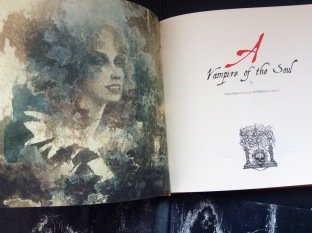
A Vampire of the Soul - by Anne-Sylvie Salzman & William Charlton


A Vampire of the Soul
IMG_2915.JPG


A Story of Psychophagia

MOUNT ABRAXAS MMXVII
Written by Anne-Sylvie Salzman & William Charlton
———————
Previous reviews of this publisher HERE.
When I review this book, probably during March, my comments will appear in the thought stream below…

20 thoughts on “A Vampire of the Soul”

  1. img_2878
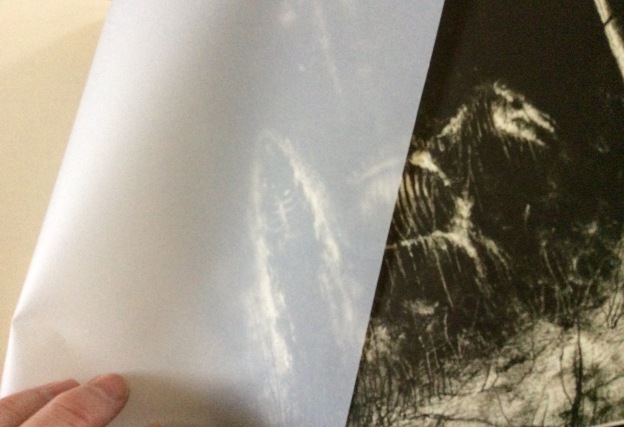
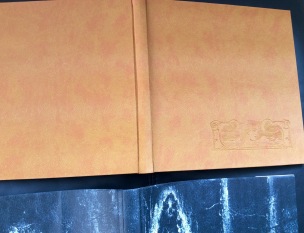
    Copy numbered 5/111. Luxuriously upholstered book with quality materials, about 10 inches square, 136 pages, marker ribbon, all beautifully designed and illustrated with dust jacket, and embossed hardback cover.

  2. PROLOGUE
    “They were moving now not with shadows but with girls, girls with solid bodies, sweating and strongly scented, smoking cigarettes or cigars;”
    I don’t know where I am, on the Turkish border or in Cancun, Mexico, or wherever, as I jealously follow Photis and Ottavio, whether I be the Dreamcatcher review merchant who I am, or a character in the book who is scrying sinkholes or cenotes and luminous butterflies devouring the carcass of a horse, and much else.
    I am captivated, whatever the case.
    Slow motion does it, though.
    Textured, visionary and poeticised.
    Font, dense but enticing.
    “‘….'”

  3. Chapter 1
    “…and was now trying to write a novel.”
    Judging by the amount of text available, this is also a novel, one that gets into its stride, from the viewpoint of a young lady named Photis, now in Scotland child-minding and renting to student lodgers, her previous partner Ian now dead, but today she thinks of Ottavio (who is about to take her out for dinner) and another previous man in her backstory… a backstory scenario full of cosmopolitan bright young things, I sense, beyond Brexit Britain, in various parts of the world, a novel’s novel, but amenable and character-building, where there is always at least one young character (here called Carmen), “now trying to write a novel.”
    I perhaps have a good idea of the scenario, and the mix of names and types of people, and I do not intend to itemise the plot — as I no doubt enjoy negotiating my forthcoming way through it alongside the novelist — but simply to speak here of my inchoate reactions to it, some reactions justified, some possibly to turn out unjustified in hindsight, as I try to build a gestalt from its already evident craft.


  4. Chapter 1 [ Ian ]
    I think I now know why I wrote ‘novel’s novel’ above. Not now in the sense I intended, of a fine traditional novel, a novel’s novel, as in a writer’s writer, but more now as novels side by side, one containing the other, here as empathic narrative ghost, the deceased Ian in tune with Ottavio and Ian, this ghost, also in sight of or in tune with Ian’s widow, all of whom know each other, an equivocal relationship between them, and Ian’s continued suspicions now…
    This is genuinely rhapsodic material, couched by the two authors immaculately, a sort of haunted, piggy-backing Proust…?
    “In Glasgow the tales it contained seemed more ancient still. The faces of my former associates appeared at my bidding in the clouds before we landed.”
    [While conducting gestalt real-time reviews over the years, I have found myself in ‘clouds’ of communication of overlapping reviews. Is this process simply lucky or preternaturally prophetic? And would it work for everyone who tried it? As it happens, I am concurrently real-time reviewing two other books alongside this one (UBO where the piggy-backing empathy of souls takes place in rôle scenarios imposed by roaches and THE MEMOIRIST where the piggy-backing of souls features Glasgow and electronic communication ‘clouds’ exponentially extrapolated…)]

  5. Chapter 2
    “It was fixed: Carmen could come –”
    The machinations of the plot build up, and it is indeed a novel’s novel and perhaps a novel about a novel, too, in all senses, combining, inter alios, Iris Murdoch, Elizabeth Bowen and AS Byatt, as Photis even somehow finds reason to question her husband Ian’s demise (that cenote, again) and we learn about the potential impact of art collection and art history in her life, and other characters in a dance of intrigue around her, as she plans to stay in the Auvergne in a house where she may child-mind, but only if they have children to mind.
    This promises to be my sort of adept novel to read, I can already tell. If so and if I were not a regular reader of this publisher’s works, I would have missed it.

  6. Chapter 2 [ Ian ]
    “; it is a place where interesting relics pass surreptitiously from hand to hand.”
    From person to person, too, even double of that person to double of the other person. I must say this is impressively rarefied material, and I shall now add May Sinclair and Frances Oliver to the growing gestalt of kindred writers. A gestalt with the unique core of its dual by-line above, as if conducting a symphony of modern, yet comfortably and rhapsodically seasoned, Proustianisms.
    Ian interleaves his posthumous witnessing of his past friends and lovers, sometimes creating doubles (as with Ottavio) to enact some rôle scenario, a permutation or Venn diagram of destinies. And building up a palimpsest for the ensuing plot in the house in the Auvergne where Photis is heading.
    As if mustering the characters, as we walk with Ian through rooms he once knew in real-time, now in a new real-time dreamcaught by this text. As if creating a Noah’s Ark for his life and loves? His dubious characteristics (like theft?) as well as his honest passions?
    I keep my powder dry.

  7. Chapter 3
    “Perhaps he was still changing. More probably it was some other Eric that was expected.”
    Whether it be ‘who’ or ‘that’ was expected, Photis arrives in the now well-characterised genius-loci of the French house, with its Attic mountains. Actually, not only is Photis employed in digging into the ‘found art’ (in the sense of finding real art and finding ‘found’ or accidental art in natural configurations such as wrongly well-founded boats in boathouses or in Eric’s boxer shorts after that boat overturns on the lake). Meanwhile, other characters accrete both in number and singular substance of each, with backstories creating tensions among them, including aspersions of the late Ian’s approach to ‘fakery’ in art, smuggling and so forth. But in fiction, some of it is fake news, some not. We just need to decide, amid the panoply of drawing-room manners and machinations. I have and am genuinely entranced into and by this novel.
    And who is that tall apparent non-gardener glimpsed at the end of the path?

  8. Chapter 3 [ Ian ]
    “We drank champagne in our red bedroom with its vast bed. I sang, horribly out of tune, my little song from Rameau, ‘Pourquoi leur envier douce recompense?'”
    I wonder if Ian is an equivalent of being Rameau’s Nephew?
    This text now takes on the high quality of a screen Poliakoff, as we follow Ian in our rummaging through his spiritual rummagings and mischievous piggy-backings as the self-narrative haunter of people he once knew in love or distaste, amid this vast house of vast beds, I sense. And items of fine art, religious or otherwise.
    Love and distaste, and sometime rage.
    And flirting through another’s eyes.
    I do not wish to overblow my own journey of rummage along with Ian, but it feels puckishly exquisite. Jacques the Fatalist, too?
    Sadly, I may need to leapfrog tomorrow before resuming this reading experience.

  9. Chapter 4
    “‘But poor Photis,’ said Irene. ‘It’s the Augean stables up in that attic. She’s heroic.'”
    …or a female Hercules, someone else suggests sarcastically.
    Having found a altarpiece up there that might indeed alter everything, fake or not, dependent on the machinations of fiction as well as its imputed truth? A magnetic heartthrob or Dolfish dolt, the biggest influence!?
    The characters dance around such matters, a choreography that none of them know they are following (unless this stiff and well-bound luxurious book’s forthcoming text changes before I get to it?), including the arrival in the dance of Photis’ mother in law, an ex-in-law by her son Ian’s death, whose Greek connection gives him a posthumous longer name, as names are indeed still worthwhile to people after they’re posthumous, I guess, in the tutelary spirit of this book. We as readers should know better than anyone in the book. But do we really?
    And this is a chapter that seems to contain literature’s first kiss-with-different-eyes above it.
    Not that I have read all literature – unless…

  10. Chapter 4 [ Ian ]
    “These incessant re-encounters will soon be the end of me, a prospect perhaps to be desired.”
    I think this fiction work is the only one (or the first one I have personally read) where it makes you believe in your own existence beyond death, or that I might already have died but I am still myself or am one of my own “silent troops” as artificial doubles or Photes, to coin my own word.
    Ian’s narration is rarefied and beautiful, especially due to his synaesthesia towards archaeological finds, towards names like Corner (later “wild cornering”) and Dolf, towards the nature of people, he once knew and may have corrupted, as Dolf claims. The machinations of the secret plans of others now are ear-wigged… But who finally is ear-wiggling whom? The mystery of who is the double of whom. Proustian selves now made tangible.
    Spying upon others as the sole possession of fiction, one that can be alchemised towards truth. Possession of or possession by?

  11. Chapter 5
    A chapter of change, other than Photis’ endemic guilt of vouching for people with names like Corner and Dolf, their complicity in something that itself does not not alter, but arrives again with solid suddenness at the end of her change to another large Gothic or chateauish house, this one in Yorkshire, for another library- or art-collation type job, making me feel she is a character from Charlotte Brontë, as well as from those other authors’ books I mentioned above. Also now a tidal bore hinting at another book, Dream of Wessex? And this change for Photis resides alongside her belief in the accretive solidity of Ian… the luxurious solidity of this book, too, with its own significantly handwritten label that I have already spotted on its last page.
    The plot continues to fascinate me, and with this latest twist and turn, the authors continue vouching (as fiction authors tend to do) for their characters, as Photis does like an author’s agent within the book, now allowing us to meet (as Photis does) Mrs Sprayne in a Golf.

  12. Chapter 5 [ Ian ]
    “And under this fake-gothic roof, I say to myself with a sigh, Photis and the St. Agnes are reunited: two beams of light…”
    At this St Agnes altar of altering.
    I am reaching the conclusion that this novel is becoming the rich apotheosis of Ghost Story literature, building upon the tradition of May Sinclair and others.
    We follow the thoughts of Ian as ghost and morally ambivalent force of our possession as well as being self-creator of our doubles, alterer, too, of our personal fates when we are undoubled. His troops and tropes.
    Pursuing Photis to her own version of cenote?
    I love, too, the character of Mrs Sprayne and the genius loci of ‘ungainly” Skirsby, this awkwardness of a house in Yorkshire.
    “And in her tight skin I should have chattered with fear, I should like her have run after shadows, chased forms half recognised.”

  13. Chapter 6
    “What’s biffsheets?”
    An enjoyable intermission of plot movement, the contrast of the matchless previous chapter’s rhapsodic rarifications now being made with the pragmatic theatric ramifications of various relationships and conspiracies, leading to many melocomedic interactions, regarding Photis and Eric in interface with the imputed Ian, Skirsby’s Duck Decoy as some potential cenote of the spirit, the land politics of the nearby university, the machinations of the St Agnes altar piece, fakery and truth at a dinner party, the names of characters still building their own traction as words, Clotty Sprayne’s crush on Photis, the cargo ship passing by the window on the Humber, Carmen’s hilarious questions about her own unfolding novel and more. You may want to decide whether this book’s inspired ghost story of Proustian selves is now damaged or enhanced by such shenanigans. I keep my own powder dry. Future context is everything. Beautifully written, in either case.

  14. img_2931Chapter 6 [ Ian ]
    “It is unknit, it is scattered, and it pains me more to bring it together again.”
    The square brackets make it seem that Ian has earphones, watching modern characters in this chapter with their mobiles, a personal space of sound as vision, as his own moral ambivalence rubs off on those he watches, they also becoming morally ambivalent, as he watches from under the dining table, or in someone’s bed, under or over them, or inside while pushing eyeballs out in his incubic rage. Or is that imagining what I just read? Death and drowning, some of his troops surviving, some not, but which counterpart of his jealous views of Photis is real and which one dead? Only [ the reader ] can judge one from the other, better than self-denigrating leasehold Ian can judge, while not even the two freehold authors can properly judge one to the other, having consigned this ambivalently allusive and elusive text for all of us others to triangulate by reading it. A triangulation of coordinates that the dreamcatching of gestalt real-time reviews has always invited since it started some years ago,

  15. Chapter 7
    “‘I don’t agree,’ said Photis. ‘Works of art aren’t the same as people; they’re just things. That’s something I learnt from my husband –‘”
    Except this book disproves that theory, the book that created herself!
    From the Humber to the Ouse (“she could not tell which way was upstream and which down”), Photis (“feeling herself again her own woman”) proceeds to another art or book job cataloging in a new Poliakoff screen, a new genius-loci, here of a Tudor house, and I continue to be entramelled by the connections between these rich, arty folk, almost an inbreeding? As the machinations continue, the backdrop of new characters in situ, others visiting or watching preternaturally or biding their time through computer or phone. A serious sense of ominousness or ianness, mixed with these new people, including the 15 or 16 year old daughter of this new location….
    The aftermath or Photis’ own ‘cenote’ syndrome by the Humber, meanwhile transcended, expect perhaps for Clotty’s clingy arrival at the new location…?

  16. Chapter 7 [ Ian ]
    “‘Risible hopes,’ I say bitterly, but at least they delude as far as the end of the path.”
    You will not easily forget this chapter, as [Ian] effectively reaches the House by the Ouse. His mischief and a salacious forbidden target for sexual lust or just dreamy liaison, his troops morphing at his whim, confused landings and “painstaking notes in the margins of words and whole phrases” like my own such in the Mount Abraxas book.
    This chapter probably represents one of the most haunting hauntings I have ever read. I do not say that lightly. Only experience of it will confirm this in your eyes or not, and exactly what I mean.

  17. Chapter 8
    “…if a dead person could be mad.”
    Paedophiles are indeed far more worrying than shady art dealers, and there is something elusive about the knowledge of unknown works of art cascading down through a family “without troubling the Capital Taxes Office.”
    The discovery of some original Chaucer manuscript. Punting. A garden party for MPs, Bishops et al. These are are accoutrements to the plot that make their own growing gestalt, to be clinched in hindsight, I wonder. To go with the dry rot of incubation. The fruiting bodies. The possible incubation, too, of a nymphet by the lagoon. A contagion of crime. Eric feeling that once he had seen Photis with another’s eyes. And an imaginary Cellini chalice. And an even more imaginary artefact in the form of a marble elephant by Leonardo. Does fiction solidify imaginary things into real things or attenuate them even further? The plot thickens…or thins.
    But there is one moment in this chapter that will perhaps stay with you more than any other. That tall Aickman-like figure again as if from some ancient Christmas-time MR James TV adaptation filmed in grey colour. This time with a dog.

  18. Chapter 8 [ Ian ]
    Epilogue
    “There runs in her nerves, thicker and thicker, something of my spirit.”
    I was probably led to read these two sections together by some preternatural version of [Ian] that sits inside this hefty tome. Or at least [Ian]’s soliloquy indicates this – as if he is ‘acting’ it towards Photis as one of his created images of her, this image as a choice between my photes I mentioned earlier, created almost by the ‘lightning’ of a camera as well that of the ‘thunderstruck’ storm that engulfed her in the environs of this book’s third genius loci of the House by the Ouse. There is a dark place to be filled, either the emptiness in this bodily version of Photis or in the cenote where Ian himself was said to have perished. An amnesia … an amnesia that makes me remember thankfully not to spoil the plot for you. We just each need to collect our bespoke gestalt for ourselves. As Photis also needs to do so, Eric believes, by being able to take the ianness of Iannis from him? From herself? The epilogue factors in renewed, often hilarious, melocomedic elements from the earlier dinner party near the Humber, as if Carmen herself has taken over this novel, describing a type of various characters’ discussion at the end of a whodunnit –
    who stole what, a piece of art or someone’s heart?
    Superbly haunting and original ghost story, if you accept it on its own terms.
    (Also I loved the burglar who failed his entrance exam. I leave you to find out about him, Clotty Sprayne’s fate and much more.)
    “…makes me think that I am dying and coming back to life myself.”
    end


Sunday, March 05, 2017

CLARK by Brendan Connell


18 thoughts on “CLARK by Brendan Connell

  1. img_2924
    1 – 3
    “…and sleepy women could be seen in well-decorated corners smoking long cigarettes.”
    Perhaps they were long, because they did not have enough puff?
    Though the start of this novel is energetic and unsleepy enough, with prostitutes showing their Italian street wares and about films in 1950s that Clark starts to build his career on. With footnotes galore about directors and co-actors and a joie d’écrivain that makes this both smoothly compelling and modernistically clipped – and perhaps with at most a tiny spark of inspiration from the SouthAmerican, ever anonymous, also footnoted ‘The Vanishing Life and Films of Emmanuel Escobada’ in Nemonymous2 (2002).
  2. 4
    “1. Whether moral or corrupt, of high or low rank, rich or poor, noble or base, all are preoccupied with their own work. — The Larger Sutra on Amitayus
    The actor’s early life in Paraguay up to 1950, involving others’ aggressive moustaches and more hints from footnotes stronger than those in the text thus footnoted. Relationship with his mother et al. The debate on whether he is a demon or angel.
    I won’t try to continue itemising the ‘plot’ of his life, but my inchoate reactions to larger tranches of its text. Not so much a plot, as a believably real life, which it is, after all. Not fake news, in any event.
    “Only lovers of fiction read the newspapers…”
  3. 5 – 13
    “One day he passed by Nabokov who was gazing at shoes in a shop window. Neither man looked at the other…”
    But something rubbed off without touching? These sections of the book represent the New York period. Early days, with chance unknown meetings and known meetings. Several moustaches I counted. A woman to wive. And clipped as well as fulsome references to the times and people, people real and false, but the false ones are truly in the book, and the real famous people just the book’s badges of honour, perhaps. Classified adverts as tokens of imputed knowledge. And a style that often seems to erupt with volcanic meanings, while other sections reside with contrastive and pent-up dormancy. And ten bullet points to die for on page 42. All of this accompanying the ‘talent’ touch of epiphany.
    It sort of touches you, too, that touch, a talent to read.
    And pretentiously to write a review in the style of the book being reviewed. Wish!
  4. 14 – 22
    “You could tell how popular a film was by how much smoke was in the cinema.”
    I remember English cinemas like that … and watching the 1960 Rome Olympics on black and white TV with David Coleman, and my first watching a Fellini…
    Ah, I mustn’t reminisce – but concentrate on this truly energetic and literary-witty novel that will become the moment which we shall all remember as when we recognised Connell fully blossomed as an author. Not that he hadn’t already.
    Firstly in Paris, José is reborn eponymously as Clark, other than the fact we already glimpsed someone calling him Clark on page 33 when he was silent. Now this book becomes his talkie.
    He has a laid-back destiny or duty to blossom in this energetic novel, to make ostensibly mediocre films greater, touched with retrocausal fame, as he proceeds exponentially through film after film. He then travels to late 1950s Italy (and what a wonderful description of it at the end of page 61.) Brushing destinies with, inter alia, Jayne Mansfield. Life compared by someone to the sun and the universe. Seeing mention of a woman with a moustache. And men with tiny moustaches. Declining even greater fame in Luke Starkiller. And more.
  5. 23 – 30
    “‘You really aren’t a very good actor.’
    He put the cigarette in his mouth and lit it with a match. ‘Maybe I just have a hard time playing myself.'”
    Well, I know this may be one of those literary passions of the moment that real-time reviewers can experience, but this novel seems exponential in getting EVEN better and better as you go along with it. People should know. The publisher should get ready for a reprint. Market it to literature outlets as well as genre. Get the film rights sorted out. Seriously.
    I really need to resist reading it too quickly. I am already a third of the way through, I guess. The rest of it might disappoint me. I don’t expect so, though.
    In these sections, Clark continues to wive and swive in almost a lackadaisical manner and he even becomes a möbius cuckold. As a smouldering South American he is already temperamentally chilled enough for Kebab Westerns as a forerunner to Spaghetti – he does do a filming stint in Turkey until a list of bullet points that crops up from time to time in the text produces an actual bullet!
    Clark may sometimes be listless, but the book is generous with lists!
    We are now in the 1960s, and we learn of actresses lean or fulsome, and there is more of epiphany’s TOUCH, as well as tantalising touches with an actress during filming, and the ineluctable yearning for renown’s touch by the book’s eponymous hero and possibly by its author in parallel.
    The ‘cul de sac of the infinite’, some title music with “rhythmic maze of blank tangle”, and many more moustaches.
  6. 31 – 37
    Both a caricature and a spiritual truth, as we follow Clark into the 1960s vogue for so-called spaghetti westerns. This is not fake news (although disguised sometimes as fake news), but a skilled and hilarious apotheosis of this cud- or cheroot-chewing, sweating, staring culture where Spain and Italy become the Wild West, with Clark as its recondite actorly apotheosis within an apotheosis, and makes a fruitful synergy with the rôle scenarios in the #UBObook I have just read and reviewed in real-time before this #CLARKbook’s “…every moment we are reborn and we live on memories of our dead selves.”
    . More bullet points and even a reference to the film ‘Bullitt.’
    . Sixteen ways to die by gunfire.
    . “A few boards nailed together and you have a town.”
    . Over 20 films made with the word ‘dollars’ in the title.
    . “But in life, you know, sometimes you must die.”
    . Music from empty holes.
    . Clark’s “epiphanies, memories.”
    . Painters like Goya and Delacroix.
    . Hypothermia and deserts.
    . Bad dudes, bad hombres.
    . A book dying to live up to its own wonderful expectations.
    . And it so far it does.
  7. 38 – 42
    “When he passed by theatres displaying posters with his own image, he smiled, glad that people were in there, watching him on screen and was like the moon which probably feels a certain amount of self-satisfaction as its face is reflected in various ponds and pails of water…”
    And Clark, like the moon, really existed and this book is his story, his history, reflected back from your eyes. And I now know more about that earlier epiphanal touch I told you about. Just imagine, as I have just done, the parallel or alternative fact of a popular singer who might have been created by a similar ‘touch’ on 3rd February 1959 instead of 30th September 1955. Clark perhaps could be said to have gone East of Eden when he followed, via Paris, the Western, followed it east to Rome. This is a strong history, so strong it has become great fiction, too. And Clark’s poignant disappointment of a short return trip to Asunción (the city as once Clark’s assumption of Eden?), to visit his father’s “giant white moustache” and to empathise with his mother’s viewpoint of another man’s “limp moustache”, represents a literary trip to die for, as is his later migration to comic westerns. With more felicitously footnoted historical and filmic facts, then hilariously removing “¿” part way in the type-setting and my sudden extramural realisation that my word ‘nemonymous’ was simply another version of ‘men without names.’ All sharing a witticised world of alternative facts and memorable connections with which this book teems. Each reader taking his or her own bespoke clinchings from some giant gestalt of mid-century grime and glitz.
  8. 43 – 47
    “He was neither temporary nor eternal and showed greed and lust with the force of a man walking through a stone wall.”
    I am pleased to report that, if anything, this book cannot resist getting even better, or it is an accumulation of context that makes it seem so, never stinting on the mid-century grime and grit, now more than glitz and glamour as we head with Clark out of the mid-century into the 1970s when he starts playing cops and others in gialli (that sound to me a bit like ice in the Italian heat.) These latest sections cover the abstract and the concrete, like that stone wall, the purpose of a Clark who knows what’s what, policemen with badges worse than those they seek, the dubbing of the world’s films into Italian, no matter the lip-synch, not men without names, anymore, as the dubbers themselves became famous, too, bullet points that I flay and flense from even the unbulleted parts of the compelling text, the anarchism and left wing aura of Clark’s parts, as interpreted by those with an eye to his actions and what is stowed in his car. How can we “discern the true and the false”, and it is a lesson for our times, too, history repeating itself, and this book needs to be read for all such lessons, subliminal or direct, as well as the sheer reading experience. A book that has ‘false-flag tactics’, as well as honest ones, a reflection of what I know about the author. But, at the end of the day, I know nothing. Except perhaps that Clark, like Escobada, is real, if not Connell.
  9. 48 – 52
    “. To say he was unsuccessful would be to calumniate him. To say he was successful would be to calumniate him.”
    . Reviews of Clark films — engagingly quoted in this book’s main text as well as in its footnotes — are now real-time reviewed here.
    . Each bullet point in the book so far is part of some larger gestalt of glitzy grime and gritty glamour towards the late 1970s.
    . Stream of conscious with some of Clark’s dreams, even though the book’s bullet points interrupt the flow of that stream as literary device.
    . Clark LIVED his characters however cardboard they were, making otherwise bad or mediocre films at least better,
    . Clark was loyal to a director with whom he had made films before, films now made for the working masses.
    ‘ Clark was also loyal to this book’s author by appearing in a cannibal film for which the latter wrote the script as inspired by his own work – a film that was banned.
    . As a stunt Clark vanished like Ambrose Bierce.
    . Clark would approve of this real-time review of effectively something in which he has appeared after his death, assuming he can now be said to have died.
    . Two of the bullet points above are apocryphal.
    . This is my second review entry about this book today.
  10. 53 – 57
    “It is impossible not to be fond of what you can never have.”
    This is a cross / between a nightmare and a film script and a page-turning experimental novel that really reads good and easy / fade / unfade / unfaze / an ex-wife / pornography and disgust / scenes that bring Clark’s skills to an adaptable low / but a jobbing actor who always acts above himself / off-kilter dubbing / like reading only the footnotes and imputing the rest / feel the degradation / ad libbing without this script / only the reader feels the tears filling the eyes not the cinema-goer who watches what the reader reads / hindsight shows Clark is a great comic actor manqué…
    My third entry today. Must take in slower motion.
  11. 58 – 61
    “He told jokes about cuckolded husbands, women with moustaches and men with limps.”
    I admire the way that Clark’s life story – told through the lens of this undeniably fine comic literary novel – has already within it the ever-arrival of new fulsome characters ready to emerge at every, potentially flagging stage of that real life’s lengthy journey. And now we have the tale of Momi, the umbrella seller, whom even I feel I have heard of through the now legendary appearances he made with Clark in 1980s films, even though at the time they only appealed to Italians in Italy, and their then rubbishy aura, but with moments of comic genius by both Momi and Clark, I feel. The former’s rotacismo, notwithstanding.
    “….the enemies of peace must be defeated even as identities are confused and reflection grows deeper.”
    . Negligible clothes and negligible money in chapter 58, the first I guess being a reference to a negligee.
    . Strange orgies and cheap strong wine.
    . The drug-induced madness of the Italian film scene.
    . Extremely thin moustaches.
    . An esoteric disco soundtrack.
    . Clark’s enjoyments of such proletariat exploits.
    . In the noughties, Connell had stories in Nemonymous.
    “…those few absurd moments when Clark overcomes his environment and says or does something so inspired as to make them immortal…”
  12. 62 – 64
    “…but simply it had become his pattern to accept any role offered, no matter what — an addiction not so much to making money, as to having himself appear on screen…”
    This and the rest of the above sentence, by the grace of God…
    These three chapters are Connell in hyperdrive, exponentially riding upon the book’s previous heights, as he reports on Clark’s now noted brush with the avant garde, part of which involves the longest footnote so far, involving a woman artist and her patron who had made his wife shoot off her ear in pursuance of that artist. Clark appears in her film, and, of course, I need not tell you anything about this film, as you already know, or merely need to read this book to find out.
    I love the avant garde; my whole life in literature and reviewing feeds off the avant garde, and its elements here in Connell’s book and the language used to describe them are the constructively optimum flaying and flensing of the avant garde I have ever experienced. Seriously.
    (This film happened in 1982 so I may have got the chronology wrong in the previous entry of my review above.)
  13. 65 – 68
    “But Clark became so involved in the role, that it seemed almost a living document, a dramatisation of angel dust to the sound of klaxons and shaken steel manes.”
    …as this book has interpreted the real Clark as a living document — is still interpreting him via a now growing poignancy of human entropy and via an account of crass films* of violence and mayhem and female nudity — as a living document represented by these pages that, come what may, you relish turning each day. The only book with footnotes that I have ever read where I look forward to reading the footnotes, sometimes even more than reading the main text itself!
    “– Jett Rink in the final stages of ‘Giant’ –”
    *many possibly with a spark of Clark magic, a magic that this book creates retrocausally?
    • This newspaper cutting turned up inexplicably today in my living-room, much to my possibly Clark-associative surprise. My wife thinks it must have fallen out of some documents that she was sifting through a day or so ago, documents that belonged to her late parents!
      img_2933
  14. 69 – 73
    “…there was something of a metaphor in this scene, primordial fear made manifest — the fear not of the unknown, but of the actual self — to find out that not only does it not exist, but, worse yet, it is nothing more than a series of masks –”
    Clark’s fragmented self is evoked via strikingly appreciable descriptions, in this book’s signature style, of his filming in the Philippines and Hong Kong, his half-baked professional strivings (that I compare, amid some epiphanal sadness, to my own pointless life-long strivings of a 1000 stories published in mostly obscure organs before the millennium, then strivings with ‘Nemonymous’ as the ultimate mask maker … and now my endlessly striven Dreamcatcher fiction reviews are evoked for me by this book’s mention of a fishing-net trying to catch the wind)
    and now this book’s references to –
    . A ‘signature moustache’
    . illicit use of Pink Floyd’s Dark Side of the Moon in interface with Clark’s earlier reflected moon as himself on a cinema screen (and TV now encroaching on him by the mid 1980s)
    . He and his fellow actors unfit and balding, using live ammunition.
    . REPLAY of scenes in life as well as on screen.
    . Permutation of self on screen by one film made into many.
    . Kicking and screaming, via drugs, against the pricks of escapism and vicariousness, a “crisis, mental, spiritual.”
    And more. This book is strongly emotionsl (but often paradoxically hilarious) stuff, and I am already convinced (however it ends hereafter) that it is a major literary work of the 21st century, but now the haystacks and needles of the Internet (the Internet being far worse than Clark’s fear of 1980s TV) now makes such deserving books as this one remain unnoticed for too long.
  15. 74 – 77
    “The moon sat like camphor in the sky.”
    The only way not to escape but to remake this world is via the preternatural power of literature. Collecting the threads together strengthens them. These are words I wrote publicly a year ago today.
    My second review entry here today.
    These chapters see Clark ‘finding himself’ in India, a cross between his native Paraguay and somewhere else, where karma is worked out in caves, with the help of a meditational spirituality as an industry. You may know already that Clark went to India at this stage of his life, but this is new to me, having not interested myself in his life story before reading this novel based on that life. This novel has indeed been the equivalent to my own ‘cave’. The instructions of CUT and FADE echoing in my ears. As, like Clark, I meet my erstwhile touch of destiny, now by unnemonymous NAME. And other folk from my so-called artistic past. And, also like Clark, I feel the magnetic pull back to my core self, my art and political beliefs, beyond karma or potential reincarnations past and future. This is not the time for retreat. Nor for premature footnotes.
  16. 78 – 87 (and the full Clark Filmography)
    “Story began to lose its importance, and films were often nothing more than a number of loosely connected set pieces.”
    …films thus yearning for the gestalt-maker?
    This book’s closing scenes to die for, if not in which to die. I am often not affected so deeply by books, but this is one where I think I have been affected more than most. This whole novel never lets up, and I am not disappointed by the ending. We all already know, of course, about Clark’s obsessive film project that he works on latterly in California and, then, Mexico, but this book gives a creative slant to the motives and repercussions. Clark’s bearing down on this film to give it difficult birth is a parallel, perhaps, with Connell’s on Clark.
    From the dying of the Italian film industry as an alternative industry for gritty escapist entertainment aimed at all those with moustaches (I counted nine different moustaches in just these closing chapters, sad, thin and otherwise), from that to the effect of Hollywood and TV, and other factors, this film project of Clark’s is literature’s golden gritty moment of glamorous grime. You will not forget it.
    A wide panoply of cinema, Errol Flynn’s last barroom, and Clark’s cinema as what it was and no more, and to what Eurotrash it might appeal. These factors are transcended by more than just the words but a welling of some undescribed spirit that comes through, say, others’ schemes of 3D westerns et al, and Clark still fulfilling “the stages of his karmic obligations”, obligations in art and politics, finding himself in real places talking to real people, beyond some invisible wall with hope on the meta-Mexican side. A “higher truth of not just his own existence, but of the entire working class,…” Clark’s hero “both noble and merciless, a poet and truly bad hombre…” Connell’s, too. “…spiced with an occasional streak of yellow as moonlight shone on a forehead or was reflected in a man’s eyes.”
    “Great films take great viewers.” Novels and their readers, too.
    “A thing happens when you get in front of my camera. A kind of Eden.”
    Eventually, a kind of ending.
    cut