Thursday, April 06, 2017

Theaker’s Quarterly Fiction #59


Wednesday, April 05, 2017

Black Feathers (2)

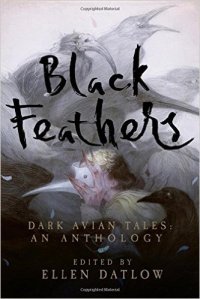
Black Feathers

51pWKu70eLL__SX331_BO1,204,203,200_

REAL-TIME REVIEW PART TWO continued from HERE

DARK AVIAN TALES: AN ANTHOLOGY edited by Ellen Datlow

Pegasus 2017

Stories by Sandra Kasturi, Nicholas Royle, Seanan McGuire, Paul Tremblay, Joyce Carol Oates, Richard Bowes, Alison Littlewood, Jeffrey Ford, Mike O’Driscoll, Usman T. Malik, Stephen Graham Jones, A.C. Wise, M. John Harrison, Pat Cadigan, Livia Llewellyn, Priya Sharma.
When I review this book, my comments will appear in the thought stream below…

9 responses to “Black Feathers”


  1. IMG_2201The Fortune of Sparrows by USMAN T. MALIK
    “The wedding cat was never wrong about the matchmaker’s arrival. That was why he was the wedding cat.”
    This story seems to be just the story for which my ‘dreamcatcher’ has been designed. If the other stories had been iffy, this rhapsodic story would be the sort of story that I deem alone worth the entrance price to this book.
    In a post-British Raj world, the bird-haunted orphanage is a moving pattern of orphan girls, chosen by scryables of bird and ghost and visionary dream, an eclectic of marriage then leaving, others arriving, some staying longer than others, like the beautifully characterised narrator. It even has birds born from the earlier McGuire here now picking prophecy envelopes, where the above patterns become pareidoliac. The Orphanage also has links with some of the chicks in the Littlewood ‘Orphan Bird’ (“It eats bones. The female lays her eggs in the air. As the egg drops, the hatchling squirms out and escapes before the shell hits the earth. It is a bridge between the heavens and earth.”)
    And I was delighted to recognise a game (here called Ice Water) that I used to play in the schoolyard in the 1950s. I have not seen neither hide nor feather of it since then, till today.
    The story is one of its own “canted paintings” in a gorgeous patchwork or quilt of secret and known rooms and people movements, by Biryani or Bird. And I love the one who became fortyish before being chosen for marriage, a woman who is the centre of every story – which she was here if not by being more important than the narrator but central by position of measured wordage…
    The perfect ‘dying fall’ ending, too.


  2. Pigeon from Hell by STEPHEN GRAHAM JONES (and HERE)
    “It’s mostly what she does with her nights now: rebury those panties.
    You don’t have to die to become a ghost.”
    This is an ingenious story, told in an adeptly crisp, meaning-alarmist style, without being florid. No mean feat.
    It tells of a couple of symbiotic girl friends, non-sexual with each other, but at least one of them lustful for men, one man in particular, the husband of a couple for whom the girl’s share baby-sitting duties. A tale of crotchless-panties, a dirty grey pigeon as catalyst, religion (including abortion beliefs) as magic and spells, manufactured accidents to disguise previous accidents, burial and exhumation by nature… it is dark and disturbing and provocative.
    It aches with guilt. A guilt we share with our own guilts.
    A guilt gestalt that now seems to be blossoming from this book in a murmuration of words. The stories seem to be cohering involuntarily against their own independent creation by each author, like a migration of meaning,


  3. The Secret of Flight by A. C. WISE
    “Not all ghosts are about guilt.”
    …nor all ageing reviewers … nor once younger publishers, one of whom published this author nemonymously.
    I did my best with a collage of play scripts, personal letters, newspaper clippings, diary entries and a brief fable but I was defeated. My fault.
    The extracts range from 1925 to roughly the present day, spanned by ageing Raymond who writes to his male lover, whilst being infected by one of his past leading ladies, I think. Involving theatrical tricks with starlings. But I dare not say more in case I inadvertently spoil the plot that I lost.


  4. Isobel Avens Returns to Stepney in the Spring by M. JOHN HARRISON
    “London was as quiet as a nursing home corridor.”
    One of the characters comes in from a corridor towards the end, the one called Alexander. An exercise in cosmetic method.
    This story is one I imagine written by Elizabeth Bowen (born 1899) if she had lived until 2017 through some prolonging method of bodily-as-birdish change and gone slightly, if constructively, madder than just her normal literary-creative. Rose madder. (Bowen often wrote about long-lost small aerodromes in her fiction, too.)
    “…she had tried to get out of the dream the way you get out of a coat.”
    It takes place in a non-linear fashion in East and West London, Miami and Budapest. Slightly off-kilter current reality, blending geography and identity, and at a time when Europe was a free trade area. Flyover in Hammersmith, we also fly over the joins between dreams and time tranches. A chequered love story told by the grumpyish narrator called China who does delivery business for the cosmetic firm in West London. Textured and traumatic, feathered with a complex guilt. Senses of place and time fractured by a migrating loco genius.
    “(I am not making this up.)”


  5. Aptly perhaps, I have just received this morning a new book from still pre-Brekekex Coax Coax Europe…
    IMG_3061IMG_3062


  6. “The parrot ambled slowly through the air, with, as it were the jog of a fat pony translated into flight.”
    From ‘The Parrot’ by Elizabeth Bowen 1925
    A Little Bird Told Me by PAT CADIGAN
    “’Shouldn’t I be hearing this from a raven?’ I say. ‘Like, the never more thing?'”
    How can death be dignified when you always risk dying on the loo, in media res?
    A hilariously witty, May Sinclair philosophical, blend of the Columbus unseen boats myth and Harry Potter’s luggage stuck halfway through the wall, as if a pony pulling it came out in your own world in the form of an “Alexandrine parakeet” talking your soul into the after-life…
    The protagonist is a census taker of the dead and the dying, making sure they don’t cheat, controlled via something even more magical than the spells in Harry Potter: an iPad.
    Whether wearing a T shirt about cancer or wielding a chance-prepared cancer as an internal trinket, this is like looking through a transparent palimpsest of “five stories” to the roof-garden of your soul. Loved it, but…
    “What’s the Concomitant Rendition of All Tessitura?”


  7. The Acid Test by LIVIA LLEWELLYN
    “All the people who can’t fit, who can’t find a way inside, and now, one again, I’m one of them too.”
    For me, the acid test of gestalt real-time reviewing is through the eggshell thinness and it can also be between concomitant books as well as within a single book. This morning (here) I read a story of a plague of white van men in post-Brexit Britain, destroying florid art-culture and bullying any residual student ‘hippies” or artists, with a hint that you the reader are in danger of becoming such a white van man yourself. A compelling plain-spoken work which is the polar opposite of this Llewelyn work, but synchronously displaying to the optimum both works of diverse plagues as a foil to each other. Any who have a similar reading experience as I have had this morning will surely know what I mean.
    Meanwhile, this Llewelyn work in itself is a staggering prose trip that takes florid snowy feathered blood-maps and ley-lines to such utter extremes of out-of-the-head sensation that it ceases to be florid at all, and becomes quite another language altogether of rhapsody and rapture, while retaining a natural sinuosity that is meaningful as well as hedonistic. Even my own floridness here in explaining my feelings about this work belies the work’s own muscular but tenuous strength of extreme prose poetry. The ‘plot’ tells of what I can only describe as hippy students seeking passions beyond the ordinary, reaching a Purple Room (the extreme opposite of whiteness and the snow outside) where all manner of eroticisms and lusts are enacted, including a subsumption of a woman within a man as observed by another woman who tantamount become the hybrid she observes, even her voice becoming his. With birdish and feathery birth pangs in the skies above as overtones. There is no way I can cover all the resplendencies and readerly empathies. It is certainly something special beyond critique.
    “, a void-white of un-creation contained only by the thinnest of egg shells,…”


  8. The Crow Palace by PRIYA SHARMA
    “That’s where I found her, a jay perched on her back. It looked like it had pushed her in. That day the crow palace had been covered with carrion crows; bruisers whose shiny eyes were full of plots.”
    Full of plots, say, from the Malik and Littlewood, the choosing between chicks, whether up or down, or, as here, in or under? The counted Corvids of McGuire and the absorbing or being absorbed of O’Driscoll.
    This story about twin sisters, one special needs through physical illness, like Littlewood’s underchick. And McGuire’s. The death of the sisters’ mother, quoted above. And now the story’s story proper, the death of their Dad, when the sisters are older and at least one of them tellingly greyer. The funeral guests. And the story being built from the past and what may have happened. The business-like narrator is the healthy sister-chick and has to endure the unwanted clinging of her boy friend whom she then ditches by phone, whilst later she is given Llewellyn’a version of hedonistic erotic (tantamount to mindless) penetration in the garden by someone from the funeral, happening near the Crow Palace, that structure Dad built for the birds. The other, the special sister, still oblique. We gather more about them both before they do themselves…. the whole backstory seemingly given to us, but, for me, with the seemingly reliable narrator, as in the O’Driscoll, now as unreliable or, even, maddened as you need her to be to reconcile truth with fiction: as to which is which chick? Even who the narrator and whom the narrated? (The word ‘chick’ used as in the Littlewood story.) And finally who is impregnated and with what, eventually to hatch and fly?
    “Coins and bottle tops. Odd earrings. Screws. Watch parts. The tiny bones of rodents, picked clean and bleached by time. I used to have a collection of my own, the crows left us treasures on the crow palace in return for food.”
    And there are many other such lists in this work. In this book, too. Lists and connections, some more real than they at first seem, whether intended or not. Keys and secrets. With a tutelary bird’s nurturing wings around this book, enabling those within it to hatch, then to fly as one.
    end

‘as blank as the days yet to be’

5 thoughts on “‘as blank as the days yet to be’ by Mark Valentine”

  1. An aesthetic pamphlet with over ten densely texted pages, plus a title page and five full page photographs in addition to the outside cover. My copy is numbered 14/100
    —————-
    From start at “In the summer of that year” to “I have never forgotten him.”
    “Part of my purpose in going to Whirlwell was to gather folklore about folklore.”
    The narrator’s enthralling quest – in person, by dint of ‘spoor’ and from research – for the cockatrice, at first in this byway of Hampshire where he dares talk to only one person (hoping he is not the village idiot?) while he is there. And that is as far as I have got.
    This, so far, is engaging, rurally urbane, Valentine-vintage textwork.
  2. From “I suppose it ought to have been one of those summer days…” to “…I had a feeling that I must remember the moment. There was a quality about it I could not quite identify.”
    Comfortable narrative of a church’s missing weather-vane depicting a cockatrice, meeting a man with four coloured jam jars and a sign of the cockatrice on the local pub, a magazine about mazes, but nothing about a megazanthus.
  3. From “We came to a narrow house…” to “…of his fantastical model.”
    Sampling this in order, savoured morceau by savoured morceau, “an extraordinary athanor of shades” being part of a deviously tactile description of the cockatrice model belonging to the man the narrator met. A forbidden description, I infer. I am intrigued even more by the man met and all his accoutrements.
  4. From “I subscribed then –” to “…and if he would want to meet again.”
    A tour of arcane periodical journals, some more serious than others. IMG_3059Or more or less professionally printed. Leading to “a world quiet different to the everyday one, a mysterious unfathomable world,…”
    At first I misread, in the small print, ‘unfathomable’ as ‘unfashionable.’ Both are true, and I try to blend a gestalt of traditional and avant garde in my own real-time reviews. The regular embodiment of periodical disprint.
    Laced with found art in photographs, as also in this booklet.
  5. From “The field lay at a slightly lower level…” to the end
    “I knew the patterns of these miz-mazes to be complex, as I had seen diagrams of them, and I did not think his great-aunt’s rough sketch could be more than a rudimentary recollection,…”
    Sharing the maze with this man I’d met, this person who I am or who I may not be as first person narrator, a maze itself, of self, as are the emotions shared when sharing a bottle of water, without his wiping the top after I had drunk from it. This is a megazanthus after all, an anthology of mazes and magazines. And a gazetteer of landmark horses, one possibly a landscape’s dragon abbas, or even, dare I say, a cockatrice. A sleight of gender.
    This is prime Valentine.
    “…I said, ‘I wonder what’s in the middle?’
    ‘We are,’ he replied,…”


    Saturday, April 01, 2017

    Black Feathers (1)

    Black Feathers – edited by Ellen Datlow

    51pWKu70eLL__SX331_BO1,204,203,200_
    .

    DARK AVIAN TALES: AN ANTHOLOGY
    Pegasus 2017

    Stories by Sandra Kasturi, Nicholas Royle, Seanan McGuire, Paul Tremblay, Joyce Carol Oates, Richard Bowes, Alison Littlewood, Jeffrey Ford, Mike O’Driscoll, Usman T. Malik, Stephen Graham Jones, A.C. Wise, M. John Harrison, Pat Cadigan, Livia Llewellyn, Priya Sharma.

    When I review this book, my comments will appear in the thought stream below…

    18 thoughts on “Black Feathers – edited by Ellen Datlow”

    1. O TERRIBLE BIRD by Sandra Kasturi
      “Was it you?”
      A flecker-slicing, feather-bladed poem that brushes me with a tinge of the Hitchcock and its swooped children’s party, and more. What gestalt of such a flock is worse than the birds themselves? If the cap fits, wear it.
    2. My real-time reviews are based on my first reading of a fiction work. I reviewed this first story in 2010, in the context of the other stories in Black Static #18, as follows…
      ————————-
      The Obscure Bird by [Nicholas Royle and HERE and HERE and HERE and HERE.]
      ” ‘It’s because of the serrations on my remiges.’ “
      A highly disturbing nocturne of a couple’s potential child loss upon the edge of Nature garbed as Nurture as well as Terror (cf. that child loss & staring self-consciousness in SKU’s story and the ‘aquarium scrutiny’ in the Nina Allan (and her story’s swimming angel-wings) and such scrutiny in the Carole Johnstone together with its paranoiac stalking – and the nature study as a ‘brown study’ in all stories) – here now, at least partially, related to Tweeting (that I’ve given up in recent months together with my Facebook account) – so I’m Ok. Social Networking is the vilest ‘stalking’ paranoia imaginable, perhaps. So, now, I can detachedly, objectively, chillingly watch this story spread its silent wings, watch it develop and re-develop (with all good stories not only developing but also re-developing in aftertaste or hindsight like this one skilfully or instinctively does). I doubt you will be able to watch this story quite as objectively as I do if I imagine you being the type of reader this story deserves.  But that’s cool
    3. The Mathematical Inevitability of Corvids by SEANAN MCGUIRE
      “One for sorrow, two for joy, three’s a girl, four’s a boy. This is a nine-bird day, and I am on edge from the beginning. Something is going to happen.”
      Brenda, meaning ‘raven’, we’re told, is 15, living with her mother Joyce and step-father and younger brother whom Brenda finds to be a much better person than his father, her brother as real son of Joyce and Brenda’s step-father. There’s an inner pareidoliac pattern there somewhere, I infer, of numbers and of feathers under the skin? Sorrow and Joy, and other meanings attached to each number, and whether the numbers and meanings are random or changeable by strict rules or ad hoc inventable, I never fully understood. But rules would make the pattern a less significant pattern than what one could cajole from a story’s or a book’s preternatural gestalt. Brenda is special (treated as such at school) and needs to count corvids to rule her day, and on the day that the resultant number by the birdbath is threatening rather than promising, that starts the story of what we experience here, through Brenda. The words themselves, I found, made a pareidoliac pattern, too, a pattern for readers with special needs in reading. I should know. And it works perfectly. Believe me. I cheated a bit, but I am sure Brenda did, too, to make the story work as well as it does. The outcome kept secret, for now.
      “It fits together. It feeds itself.”
    4. Something About Birds

      by PAUL TREMBLAY
      THE NEW DARK REVIEW PRESENTS “SOMETHING ABOUT WILLIAM WHEATLEY”: AN INTERVIEW WITH WILLIAM WHEATLEY BY BENJAMIN D. PIOTROSKWI
      “…and I have to admit, when I first read the story, I didn’t see the word “Dad” there. I was surprised to find it on the second read. Many readers report having had the same experience. Did you anticipate that happening?”
      An interview, threaded through with Facebook social media interactions, an interview with an author plus concocted interwoven afterword about the interviewer’s favourite story-of-many-interpretations entitled “Something About Birds” by the interviewed 75 year old author. The gestalt has a ritualised ‘eyes wide shut’ or Fowles-Magus syndrome, one whereby I, too, tussle, by implication, with bird mask, beak, talons and nudity.
      But who eclipses whom?
      “That’s the true power of story. That it can find the secrets both the writer and reader didn’t know they had within themselves.”
      (And what about Mr H____ and Kittypants? Perhaps the rest of this book will inadvertently help me?)
    5. Great Blue Heron by JOYCE CAROL OATES (And HERE and HERE.)
      “In his sleep the husband does strange, sculptural things with pillows: bends them in two, sets them beneath his head vertically, merges two pillows into one, lies at an uncomfortable angle with his head crooked. Yet he sleeps soundly, the nocturnal birds rarely wake him.”
      And sometimes memorials in a cemetery are sculpted as stone pillows.
      Claudia, teacher in a girls’ school, loses the husband effectively through his being too good-hearted. Indeed, the story is tellingly full of oxymorons, the weightiness of thick air, the thinness and thickness of headstones, mixed feelings, people conveyed with the aura of acting not only like a ritual or choreography of nice birds but harsh prodding ones, too. Including one of those characters in literature you may never forget: Claudia’s brother-in-law. Is his prodding an act of care or harsh greed? The image of great blue heron is also memorable, hunter and angel, I guess. It is also a blend of the bereaved couple (if a couple can be deemed as bereaved when one of them is the dead person over whom they are bereaved.)
      This substantive story continues to resonate, even as I write this. Scratching my roof close to the ceiling where I sleep. Warbling somewhere. It will continue to resonate tonight, I predict, as I try to get comfortable in bed near that shape that has shaped the other half of the bed for almost two generations.
    6. The Season of the Raptors by RICHARD BOWES
      “But I did snap photos of myself in the mask and put them up on Facebook. For a day or two, it amused online friends who were bored by their jobs.”
      When this story’s pair of hawks first became famous in Washington Square, I thought of ‘Wings of the Dove’, a novel of predators and prey. And Henry James is here distilled into a relatively more staccato Kubrickian ‘eyes wide shut’ game of Consequences, from hawks to rats, homing gulls and eagles, self-pleasuring by youths in a boat, reincarnated boys in cages with wings, a Venetian mask, not forgetting the Educated Chicken. A pareidoliac pattern.
      Loved it. All it needed was Flannery’s gorilla.
    7. The Orphan Bird by ALISON LITTLEWOOD
      “….but he could just make out the suggestion of a form here and there: darkness that hinted at empty sockets, twined shapes not quite like branches, interlaced so that nothing could separate them.”
      Things found separately dead become the gestalt of all the dead?
      This starts as a workmanlike story about Arnold, a young man in tune with mud and swimming, painting bitterns and other birds, keeping albums of his paintings, but gradually we begin to wake up within his head, accretively more aware of him, stranger than we thought, via his being bullied by other boys at school, now reading medieval bestiaries, inventing the word ‘loak’, and much more, an allegory spurned, of some chicks owned and nurtured and other chicks disowned, to hatch and live beneath this Cumbrian lakeage…or die? A curdled, if not muddled, vision that I am still working at, as it hatches inside my head. And I wonder if it is significant that bitterns are the only type of heron who flies with its neck retracted. (I needed to read up about bitterns and other things in this story, an activity that has been an interesting education for me in itself.) And a scene of Arnold watching a magnifying glass being focussed with the sun into a poor kitten’s eye. I wonder if we yet know Arnold well enough to know which boy did this, the bully or himself?
    8. The Murmurations of Vienna Von Drome by JEFFREY FORD
      “News of a body seemed always waiting just around the corner until late March.”
      IMG_3028
      Late March is real-time today…
      This fantasy adventure, sometimes a frustrating game of Outlandish Consequences but one that eventually pans out into its own murmuration of words, that I might call its gestalt. Telling of two companion investigators trying to track down a Beast that attacks its victims for their spleens. A finely word-honed fantasy, of a girl then woman with a familiar as bird, her disease tainted family tree, a work bordering on a confused romp, combining perhaps Leiber, Peake, Aldiss and something unique – with striking bodily horror, but, above all, unmissable breathtaking murmurations of starlings in specific shapes, including the shape of the venue’s cathedral and a giant cat, and with given names for people and places for us cerebrally to relish and savour…
      Arguably, it’s imbued with Humorism, in more ways than one! Including references to the Four Temperaments or humors, one of which involves the spleen. Also it fits In with the medieval bestiaries of the previous story.
    9. Blyth’s Secret by MIKE O’DRISCOLL
      “Time contracts and expands without regard for reason.”
      A disturbing story about corvids, carrion, canaries and a chain of coins.
      It blends the bird as a familiar in the Ford story, the autistic or abnormal character counting corvids in the McGuire and Arnold in the Littlewood. Here a special needs but qualified-studious loner as narrator, with a caring sister, studies birds and their communication with humans, dissects dead ones as part of his qualified study, but I guess he is not similarly obsessed with children as others suspect he might be. A telling tale of society’s growing aggressive suspicion where suspicion is not deserved. A clever story that is empathic at the same time as our never being certain if the protagonist (like the earlier ‘omniscience’ about Arnold) is reliable in what is communicated to us – or how reliable his bird-familiar (a jackdaw called Blyth) is in what it communicates to HIM!
      “What is it with dead birds? What is it you do with them?”
      (This book has made me photograph two ready-dead birds so far, as evidenced in an earlier post above!)