Thursday, May 11, 2017

The Clocks In This House All Tell Different Times – Xan Brooks
 

26 thoughts on “The Clocks In This House All Tell Different Times – Xan Brooks

  1. Beware inadvertent spoilers that sometimes accrue when one is real-time reviewing…

    .

    THE FOREST

    .
    1
    IMG_3132“Wotcha, cocks,” Toto says.
    That quote seems to expedite this book eponymously!
    I have just finished reviewing a novel entitled “Number 11” that started with a teenage girl staying with her grandparents and visiting the Black Tower in the forest, I recall.
    Here, Lucy Marsh, with other teenagers, is taken by Coach in his Truck, a book’s book, I guess, to see the funny men who match characters in Wizard of Oz. Here a version of Epping Forest? I love the trees in Epping Forest. The tree with a face next to this review is not one of them, being from Beth Chatto’s last weekend. I am already captivated. Perhaps captured. The funny men remind me of a representational painting by Picasso. There are also stars in the sky of this text to gather.
    This chapter also mentions a charabanc trip to Frinton on Sea, a place within walking distance of where I live today. So perhaps not captured at all?
    “a place of possibilities”
  2. I have now glanced at the cover of this book and while trying to avoid what the book says about itself, I did glimpse a reference, for whatever unknown reason, to a book I real-time reviewed just over two years ago here: https://dflewisreviews.wordpress.com/2015/03/04/the-buried-giant-kazuo-ishiguro/
    Meanwhile…
    2 – 4
    “The real magic blooms in the space between the performer and his client, between the truth and the lie.”
    This made me think of the process entailed in my gestalt real-time reviewing, and a perhaps wrongly serendipitous memory of such reviews I carried out recently of ‘The Lie Tree‘ and ‘The Essex Serpent‘.
    Here, I now gather we are in 1923 and I sense that era’s ambiance via the Ermine Street pub where Lucy grandparents live, and the horse that she cares about passing by, whether or not that is the same horse which finger-flaming Arthur Elms takes over from the charlatan spiritualist he worked for.
    We learn, too, of the hide and seek Lucy plays in Epping Forest. Carted there by a Crisis as well as a Coach, and the funny men are now fleshing out for us. And the British Empire spreading globally around her – the one to which Brexit hopes to return?
    My mother was born in London in 1926 … and my father in Wales in 1922 as grand-sired by those stricken ancestors who died of Spanish flu. (No reason I can remember why I mentioned Picasso earlier.)
  3. 5 – 7
    “People find omens when they look for them. Peer hard enough and you can read anything into anything.”
    I learn my lesson, after 9 years of studying and of real-time reviewing quality Weird Literature, which this XB book certainly is, I have already gathered, but under the guise of a modern magic realism with literary Salmanitis. A portrait of 1923 Britain through this filter of fiction, upon a palimpsest, for me, of visualised black and white photos, now of a pep jazz band of lively octaroons, or a masturbation of monkeys, and a theatre box of drugged gentlemen in interface with a pecking order within themselves as well as outside, and a lady masturbator who receives the pep-up omen of a chance message on a balloon set into the sky further west than London, and further east in Kent, we meet Elms again and his backstory of trenches in the last war. Vivid leanings of plot to match the earlier Terrible Unmentionables. And not forgetting Lucy herself witnessing street demolition near the Griffin pub where she helps her Granddad.
    Queer medicine. And a map of diffuse memories being gestalted or gestated that are not my memories, but now beginning to be instilled as mine. Or distilled. Don’t rush to die. Not yet, anyway.
    “All hail the power of the bouncing balloon.”
  4. 8
    “One, because swimmers held their breath for a minute at a time and never suffered any lasting effects. And two, because didn’t babies survive without air for nine months in the womb before the birthing bit began?”
    I thought this novel had already taken off, but now it REALLY takes off and it’s a din and stench humdinger of a 1923 London, and its increasingly post-war poverished peoples, more characters to savour, and its innuendos (we learn, through pub talk, more of the Coach trips with 14 year old Lucy to Epping Forest, and the funny men there), and more about Lucy and her special needs brother Tom, and how she looks after him. I reckon this book itself was dropped on its head as a baby, but it knocked a lot of great nonsense into it. Or it was starved of air at a crucial time in its post-gestation of a gestalt hindsight, perhaps a hindsight never to be clinched? Until I realise Tom and, then, Lucy watch breathless fishes in a shop’s tank … and are given glasses of milk by a seemingly kind proprietor.
    The Collapsed Catholics, notwithstanding.
  5. 9
    “One day soon,” Toto is saying. “One day soon you’ll be able to freeze the back of that lorry. You’ll be able to seal off the back and keep the temperature down.”
    I think I like Toto. And the other funny men on their only trips out from their home, trips to to the forest. Is Lucy getting older than the actual years passing through her, I also wonder? Amid the wonder of this cusp of time between empty lanes and car exhausts, an endless summer of melted ice cream and tantalising invitations to gambol in the forest, gambols that hopefully don’t cross any lines of behaviour. Premonitions that are ominous amid the warm ‘tween-wars that have remained no doubt special. Now frozen here. Any car collisions, notwithstanding, or car crash accidents of Brexit today?
    “The world reaches the funny men in little glimmers, in Chinese whispers.”
  6. 10
    “He turns to starboard and notes that the propeller has slowed to the point where he can identify each blade.”
    Sometimes still fast-spinning propellers seem to have discrete blades slowing – when viewed through the hindsight frame-by-frame camera of time?
    This viewpoint, too, back from us today – via the 1920s where the main body of this novel is so far set – of the thoughts (beautifully conveyed) of a slow-motion crashing Sopwith Camel pilot, shot down upon the cusp of friendly and enemy territory during the Great War. And of those who find him, but WHAT exactly do they find?
    This also aligns with the most famous Zeno’s Paradox, as never-ending travel through felt history in the concurrent piecemeal slow-motion real-time review I linked above.
    “Their sloshing genitalia make him think of kelp.”
  7. 11
    “It just goes to show, like Nan says, that you never know what people are like after dark.”
    The no. 11 where it’s all started to happen as I feared it might. Well, it has already BEEN happening, as I suspected it plainly was; it was just that we were not allowed to see it all happening to the children in Coach’s trips till now. Lucy is of the same age as when my own Mum left school only a few years later in the early 1930s and went to work in the near identical London, so perhaps it’s not so bad that Lucy has this job to do. Better than cleaning the filthy Gents for her Granddad in the Griffin, as she herself ponders. But just as Lucy thinks of the characters in the contemporaneous Baum book of Oz, these children are only fiction characters themselves, too? So what’s it matter? But matter it surely does. With some characters missing who might have made a difference, as in the characters missing in Lucy’s version of Oz in the Forest…
    “‘No,’ says Lucy, ‘This story’s different.'”
  8. 12
    “She has Beth in every day (and often overnight) to ensure that the floors are waxed and the clocks wound,…”
    A new character, Henrietta Shaw, living in a comfortable house on the fringes of town. Her son recommends to her a mountebank or magus, or both, called Magus. I suspect we know him already, but that is beside the point when body bits from the battlefield become, according to him, a sort of human gestalt of trench rats migrated from mainland Europe (by free movement or preternaturally scryable forces?) to where Henrietta lives and elsewhere.
    As if this book is a creature itself with the human bits it deploys as a prehensile gestalt.
    This is genuinely disturbing stuff coming together!
    With the added al dente traction of not being initially word-smooth nor roundly meaningful, but ever more tantalisingly promising to be paradoxically smoother inside the head and increasingly less meaningless outside of it.
  9. 13
    “Off the road, in the dark, the dimensions telescope and collapse until the figure at your side can feel a hundred miles away while the invisible sources of faraway sounds seem near enough to touch,…”
    This remarkable text is incongruently rhapsodic, if that is not a contradictiion in terms. Back in the forest with the children or young adults attending to the funny men, while an obliquely defined scout group that is beyond Baden-Powell camps nearby. The fact that this group has a name with the initials KKK gives food for thought in today’s hindsight. And the events in the forest are heart-wrenching for us to watch, but perhaps they represent some underpinning for the natural needs of us human animals in any age, except in that day and age they allowed, with a blind eye and a nod and a wink, certain things to happen. We today rightly or wrongly obliterate such and other things with a surface condemnation bordering on a liberal-justice totalitarianism.
    “‘The Campswarden met the Tally keeper and the Gleeman had his say,’ sing the unseen children of the Kibbo Kift. ‘Then all set sail in a coracle and cried, “We won’t return ’til May.”‘”
  10. 14 – 15
    “What had seemed so urgent just a few minutes before has become no more than a series of black-and-white blocks, words on a page,…”
    This book’s own words change one moment, too, from urgency and poignancy, to a feisty Lucy standing up to her mercenary granddad, then a block of a sort of semi-Joycean ‘Molly’s monologue’ of ducks fucking etc., by the balloon-message woman who entertains men and soothsayers…
    I am sure I am now reaching this book’s own Secret Garden, an apotheosis or optimum of the sort of book l love, not one that necessarily worries us ONLY with nightmares from the bookshelf with the pages’ internal messages freeing themselves into the room around me, but one that has a GESTALT of that kind of Secret Gardens’s sickness syndrome (here the Spanish Flu again and the utter love spent by soldiers bringing it home, as it were) AND the delights of great literature and games that can be played in the archetypal Secret Garden that we often think we know.
    Can you tell that I am enjoying this book?
  11. 16
    “Vive la revolution! Wheel out the guillotine. Poor old Coach, don’t you see, the irony’s priceless.”
    These funny men come from a House, looked after as lost ciphers of a Great War, if any War can be such, taken to the forest for a body’s necessities, life as ‘a game of old soldiers’ perhaps, emblemised by fantasy’s false masks, and, as someone says here, when you have to shit in a forest, you don’t stay there to smell it.
    All good things come to an end. All bad things come to an end, too. Neither of them ever in a nice way. The end of the Forest was inevitable. Time breaks it. Time always holds the trump card. All endings are unbearable, but we all have to grow up, even those of us who live in books. Unbearable, if it were not for the priceless ironies. And wishing sometimes to return there to paint it in a new light.
  12. THE HOUSE

    .
    17
    “Lord Hertford is awaiting his presence in the Italian garden. A butler takes Sir William’s coat and escorts him under the barrel-vaulted ceilings, past the garish abstract by that young brute, Picasso,…”
    Amazing.
    Meanwhile, this scene hit both my funny bones — a scene with a genius loci of a stately House that houses war casualties, and previous events are brought to task regarding the forest antics and so-called “public decency”, and the meeting about it, with reference to a statue of Pluto and a camel in the house’s grounds — and it is a literary event to cherish.
    Made my funny bones feel sad, too.
  13. 18
    IMG_3216
    “He says, ‘I’m going to draw every single old machine in Mr Lewis’s garden.'”IMG_3217
    This book reminds me of watching the gradual evolution of my wife’s quilt-making as blended with various styles of Picasso.
    This chapter is about a train journey’s worries about a storm, in the carriage the Magus, and, later, more reprises of characters and new slants upon other characters. Grotesquely Dickensian with a Joycean flow, but accessible when seen as a whole, a panoply of a past era with the seeds of our own era, at times rhapsodic, absurdist, sharp-edged, feisty, painfully poignant.
    IMG_3218
  14. 19 – 22
    “And on this occasion the procedure felt strange; it was bothersome and uncomfortable in a way it had never been in the forest.”
    The ‘dirty business’, that is.
    Dirt is in the eye of the beholder, the Devil, too (in the guise of fat Elms Magus or an Etonian from an explicitly Whovian or Wellsian future or the FUTURE that is us) and those hillocks of white dust. The pattern of characters continues quilting (including the prospect of a group of negro musicians), as the palimpsest of the Great War trenches are layered upon London streets, just as Lucy’s earlier forest antics are layered upon the environs of the mansion where the funny men actually live.
    Nameless war casualties swinging from right to wrong and back again, with told remembrances of other men in those trenches. Some so limbless, they become bodiless like the Invisible Man? And the ghostly marquee and Tom’s face that threatens to slip off, as in that horizontal Picasso above? Beautiful, if sardonic, remembrances of a book and its war that I predict will carry over after I have finished reading it.
    “In the bars of Pigalle, he drank alongside the likes of Brancusi and Picasso, Modigliani and Picabia…”
  15. 23
    IMG_3225
    What is this intriguing painting?
    Lucy’s backstory at the Griffin pub fades. Now even the camel in the House’s grounds seems more real to her.
    Her new acquaintances nurture her, by fabricating with clothes her nature. And nightmares and monsters haunt from beyond the frame of her own painting of self.
    Our future does fountain from here, too? A sort of Bullingdon Club, a “discount Aleister Crowley”, a new fixed face of fiction often with flames at his own fingers, too. And the “avant-garde painter”, “anarchist poet”, gestalt real-time reviewer, et al.
  16. 24
    “To ensure there is free movement and proper fairness for all.”
    The sound bites of the future are relentless, I guess, and here we reach Lucy’s tearful epiphany, a long motion epiphany, if such can be such, because the clocks all tell different times? The house is a blend of Waugh’s Vile Bodies or Decline and Fall, and we are still falling, and of Reggie Oliver’s Virtue in Danger, the mansion with statues to old legends and myths, now alive via the white hillocks and other charades of rôle-play or genuine theatrical performance and pre-figurement of later eras. The game of soldiers. Another one without a face, so no nose, but he can hear the sound bites; he needs a new face of fiction in 2017? Ceilings dropping by a notch, or each eye with a different image, self-disgust, sheer effrontery of existence. Even, a rudimentary wooden cross among the richer statuary. “Crippled half-life” or “demigods”? Bright young things or portents of doom. Epic poems about a brave Icarus or Satanic verses about a downed airman?
  17. 25 – 27
    “He wants the things that you don’t.”
    History as some sort of rag and bone man?
    This book’s sometimes more fraught than Trump’s tweetstorms. Or Hogarth’s or Bosch’s paintings, Yet, the characters have not yet focussed into right or left, fascist fascist or fascist liberal, and I can even feel sorry for the diminuendo entropy of Lord Hertford. And for the others’ Vile Bodies. And such Bodies’ needs. The decline and fall of the House.
    All of us are ever in-media-res, a work-in-progress, even with the the deceptively endless clinching of hindsight’s gestalt.
    “The liberal course is almost – not quite – Sisyphean…”
    And we watch the characters evolve into the future, their mountainous view of a promised land, whatever the trinkets of fate they cling on to – like Elms’ amulet and now its undead previous owner – and Lucy’s view of “the Pick-Arsehole painting” or of the residue of her Tin Man. A hide-and-seek game now become a Monster Hunt. A terrible poignancy. A Trump with his “gondolier’s waddle.” A derelict marquee.
    “But a lie is a lie. A lie’s always wrong.”
    “Not always, though. That’s what I’m saying.”
    “And that trick with the flames. That’s not real either.”
    “No, that was always real, a reaction to the war. And then it burned out. I can’t do it anymore.”
    “Why not, if it’s real?”
    • I confirm that when I made an aside to a Picasso style in the very first post above in this review, I had no idea whatsoever how relevant it would later become! This is perhaps yet another striking example of the preternatural power derived by the gestalt real-time method when reviewing hyper-imaginative literature?
  18. 28
    “So it’s all good,” he says. “The future.”
    Catharsis for the House, as some escape, piecemeal, one with the Pick-Arsehole. Elms’ fingers did the work after all. One never knows whether this novel (so far) is a gestalt that was destined to have its hindsight clinched by the fate of having been obtained by a reader that COULD clinch it. We are all such a reader of our own lives, ever appraising the inclusion in our book-life of those we perceive around us and those we perceive by other means, by fiction or by whatever other media or so-called realities. The coming together of forces that still pan out, even while we begin to realise that they exist at all. And behind everything, what sort of Wizard do we find? One whose fingers still hold their power? A buried giant? Or something quite other?
    “It makes no distinction between the servant and his master. It takes ahold of each man…”
  19. THE SEA

    .
    29
    “He jokes that one day people might look at St Paul’s cathedral and wonder why that was built too.”
    The spinning on of fast and slow time, a Beauty and Beast coda to this book’s fine,
    sometimes splendidly atonal, Symphony of Psalms, a palimpsest of then upon now.
    Where the more rules that are broken mean fewer are broken? History as “a system of small, self-contained kingdoms” still reaching towards the sea where I live today. To be sunk there or to stay there ruminatively upon its margins. Except Beauty and Beast’s histories reach towards the West, and I am to their East. And Undead Bram sees his past and leaves it be – because better without him? None of us know where we truly fit in. The optimum and the pessimum that so slowly oscillate. Till they stop? At the edge, that last balcony?
  20. 30 – 32
    “The roads link the villages in much the same way as a corridor and a staircase will link the chambers of a house,…”
    Babies squawking into the light, then the vision of a bi-plane journey, later the beast of Coach’s truck become an imaginary Sopwith Camel, that House’s camel again, for those children, grown up from babies, to play on. An Adventure Playground. By the seaside.
    We follow caring, feisty, fallible Lucy till the end. The perfect ending, if with disparate quilting, echoing and enfolding back to people already met, people yet to meet.
    Is an author a sort of peripatetic spiritualist? Or his or her book’s reviewer the spiritualist? Charlatans or magicians? A preternatural sensitivity amid a painted maze of otherwise jagged words or an electric current that burns itself out within “the hull of industrial mangle”? If you use this book to fill in life’s moving gaps of time, you will remember the book more than you remember what came between those gaps. Some books you forget, this one you will never forget.
    “…and beyond that is France and the warm folds of Europe, a whole world of foreignness upon the horizon.”
    end


Friday, May 05, 2017

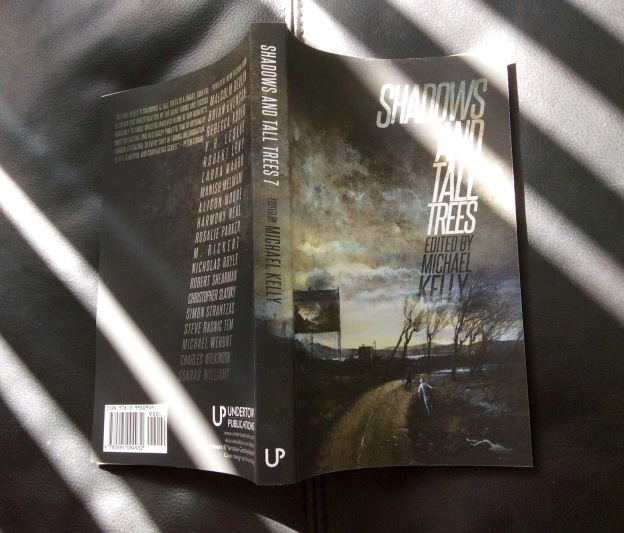
Shadows and Tall Trees, Vol. 7


Shadows and Tall Trees, Vol. 7

IMG_3174
An Anthology (around 300 pages) edited by Michael Kelly
Undertow Publications 2017
Previous reviews of this publisher HERE.
Stories by Brian Evenson, M. Rickert, V.H. Leslie, Rosalie Parker, Conrad Williams, Manish Melwani, Simon Strantzas, Steve Rasnic Tem, Robert Shearman, Malcolm Devlin, Robert Levy, Charles Wilkinson, Alison Moore, Rebecca Kuder, Christopher Slatsky, Laura Mauro, Michael Wehunt, Harmony Neal, Nicholas Royle.
My comments on each story will appear in the thought stream below…

25 thoughts on “Shadows and Tall Trees, Vol. 7

  1. IMG_3175
    Is it my imagination, but, as well as the title shaping the number 7, the pareidoliac cloud formation is of a Britain gradually about to be without Scotland?
    This trade paperback edition has cover artwork by Yaroslav Gerzhedovich and design by Vince Haig.
    The Cover artwork on the hardback edition, I understand, is by Vince Haig (aka Malcolm Devlin).
  2. LINE OF SIGHT by Brian Evenson
    “You had to understand, Conrad claimed, that what it looked like was probably not what it was.”
    This starts with some anangst, a sort of non-angst of astonishment that your inborn and endemic angst has not borne self-fulfilling fruit, self-fulfilling truth, a feeling with which I am very familiar, a sort of confirmation denial. Here, it is you having worked on a film that seems perfect, but NOTHING ever goes perfect (does it?) and via a skein of a few characters all of whom may be you, you as director, cameraman and lead actor (who, in one form or another of reality and rôle-playing, had separated his parents from their bodies), and you are trapped within some hiatus warren of feathery glitches that I remember cinema films used to have invading the picture from the margins, when projected.
    An existentialien living ‘In Camera’, in not so much Beckett’s as Danielewski’s house of frames. (Also, any story using the word ‘annealed’ is bound to be a winner.)
  3. EVERYTHING BEAUTIFUL IS TERRIFYING by M. Rickert
    “…and my brother whose suicide is not a part of this story.”
    Following Evenson’s hint at Danielewski’s House of Leaves as framed for cinema, here with trees and an ‘arc of Autumn leaves’, the female narrator speaks as if the story about herself and her friend Laurel has already been filmed, and she is debating whether to divulge secrets to elucidate this filming’s own line of sight, I guess. With reference to inscrutable folk called Strangos, her guilt at once leaving young Laurel behind on Hallowe’en, to what fate? A deliciously ungraspable take upon these two girls who were not, but acted as, twins, and the whys and wherefores of tragedy, and why some words are appended with -o like being part of a song or a fey incantation. Charades, Rilke, the narrator’s father, opening the clips of purses with the sound of click beetles, the casual choices of childhood, hope as loss …. and a found orange like found art.
    Was she wicked? Was she good?
    This story is picked out with words of atonal music made obliquely melodic. Webern towards Zemlinsky.
    “…and the small hole that once housed a doorknob appeared to be a whorl.”
  4. SHELL BABY by V.H. Leslie
    Die. Die-ty. But it was the word deity that she thought about the longest.”
    On one level, a folklorish, engaging and fatally or parthenogenetically rhapsodic story of a young florist woman seeking isolation on an island near Orkney. Single and undaughtered is this woman and it is her inundation in the sea’s critterly embrace that we follow during such a break from civilisation to its hindsight inevitable, sometimes male-gory, outcome of foundling and guardian scarecrow.
    On another level that enhanced this story for me beyond measure, I often think that when I gestalt real-time review fiction my whole time-surrounded life is also co-engulfed – and last week on television (I watched it last night in a recording as if in preparation for my first reading of this Leslie work earlier this morning) was a programme entitled Metamorphosis: The Science of Change, dealing metaphorically and visual-scientifically, with the comparative transfigurations into butterflies, sea urchins, starfish, locusts and, yes, human beings, as not development but genuine metamorphosis, in both directions of parthenogenesis. It also dealt provokingly with the Kafka story ‘Metamorphosis’, Dr Jekyll and Mr Hyde, Ovid’s Metamorphoses, but not, I realise today, Frankenstein. Nor this striking story.
  5. THE ATTEMPT by Rosalie Parker
    Once I had finished this relatively short story, I thought to myself: this is a classic, one that we shall all remember reading for the first time. I have now allowed my mind to dwell on it, without re-reading it, and I still think the same.
    Involving a lake that seems as large as an inland sea, one that ices over sufficient for walking upon (save at its middle?), and two children, brother and sister, about their vying for the world record of reaching the other side and about the toys that they play with in their own model town at home. It is Sarban to the power of co-efficient. And something unique. I can’t do it justice here. Simply only to ask you to read it…
    I shall now attempt to read it for a second time.
  6. THE CLOSURE by Conrad Williams
    In itself a compelling story with a man aspiring via imagined graphic body innards towards a career as a surgeon – Jeffrey Siddall, a peripatetic labourer all his life, gradually being re-absorbed by memories, as he synchronistically merges into the area of the school of his 1970s childhood, his mates, his teachers, and the girl’s life he tried to save by amateur revivalist gutting during school dinners. Who had stayed, and who had escaped?
    But, miraculously, it also follows each of the patterns of the VHL and RP stories, the metamorphosis as autonomous surgery, and the rite of passage across the lake of time back to the home where he began, to rescue himself or the girl who had vanished across that lake before him? Not Alison, but Jen?
    Or Jeff? Closure as satisfying finitude or calmative darkness?
  7. THE WATER KINGS by Manish Melwani
    “But among the dead, even the rich walk barefoot, thorns and smouldering ashes in their heels.”
    A telling gestalt of smoking cigarettes and their resultant ashes, creating cancer, involving a son mourning the death of his father, the passing on between them of such symbiotic fallibility, and the frictions between family members in the family business, including an uncle with crocodile tears and mixed investment intentions honourable and dishonourable regarding one of the ships in the business’s fleet, wherein which ship that dreadful symbiosis was once symbolised by the onset of a first person plural narrative viewpoint, whereby even we readers are implicated in the story’s inimical forces, the water kings ourselves in attendance at that ship’s metamorphosis – a metamorphosis back to the shell-baby? Another story, like the MR, that is a tantalising grasping at meaning, and another treatment in this book of physical metamorphosis, to match that in the VHL, here towards death, gradually, while holding, at the bedside, death’s hand, implying a bodily diseasy transfiguration, from cigarette ashes, via sick mutancy, to those funerary body ashes thrown ritually into the sea, all such factors layered with another version of RP’s earlier journey across the lake of time, then homing back again…
    “And so we set sail, not quite free, but no longer prisoners; something else now. We came back here, back again across the black water to Singapore.”
  8. IN THE TALL GRASS by Simon Strantzas
    “Baum’s knot-holed eyes have sunk so deep into his phloem that they are hidden.”
    Into this phloem or poem as prose, too.
    This is another potential classic, in my view. How can a single book spoil you?
    A story that takes you by the spiritual or nature-ravelled scruff of the reading neck. Ravelling not with bones but with bark and branches and foliage. It revisits and unravels and ravels again VHL’s motherhood and a foundling and a metamorphosis that I reported on with regard to that story, a metamorphosis that has spread its physical metabolic roots throughout this book so far. Here we have a woman’s bereavement with the loss of her man and now with the onset of this parthenogenesis of a ‘son’, whom she takes, as if ‘Flannery O’Connor’-infused, to the city away from the farm in whose tall grass he was born. Then her travelling with him, motel by motel, human interferer by interferer with his course of fate, and back again, as with the homing journey across RP’s earlier lake. And the end epiphany or catharsis is a masterstroke. Beautifully expressed throughout.
  9. THE ERASED by Steve Rasnic Tem
    Tem vintage, including the inscrutable dog and its owner, and a man with the gradual onset of what many might imagine to be senile dementia after his emotional attachments have vanished, and there are now rules he now makes unilaterally about the things he owns. But his fixtures are taken away, like buildings he has lived with the view of all his life, including a vision of a fellow oldster’s hoarded detritus in a home where dementia has overtaken and cluttered simple unilateral rules, it seems.
    But I also sense this work miraculously fits in with this book’s own serendipitous theme of metamorphosis (change not as evolution or development but sudden convulsion), such a metamorphosis of living beings and their property, thus giving a wily slant on the things I myself feel in my own ageing brain, things being abruptly finished, things representing an ending of the self as once unilaterally fixed: now a uniquely split-second destructible target rather than slowly tumbling away in real-time.
  10. THE SWIMMING POOL PARTY by Robert Shearman
    “Shrug.”
    This story is ostensibly written for readers to shrug at, but — amid its plainspoken passages of a mother and her son, her, as it turns out, semi-estranged husband and father of her son, her son’s so-called unlikeability at school, his propensity to be bullied, if blame can be shared by bully and bullied, and the eventual ritualistic Birthday party of mass male synchronised swimming to which he is invited, the mother of the birthday boy who entraps the mother of the ‘unlikeable’ boy, entraps her in the Jesus superstardom of silky smooth wine and cigarettes, and seeming apocrypha of the New Testament regarding Jesus — this work certainly packs a massive punch. I am still thinking about it. A story that bullies you with this punch, bullies you into submission to its simple truths of convulsive, not gradual, messhiahship.
    What is more it’s serendipitously built upon the pattern of birth and motherhood in the VHL and the SS stories, and beyond that pattern, a fact which makes it seem even more powerful. Foundlings, too. Now transcending virgin birth as parthenogenesis? The return of the Joseph to the Nazarene. Not to walk on water but drown in granular rebirth or baptism.
    At the tontine pool’s surface level, meanwhile, it is a compelling plainspoken story, that many will enjoy, even if they end up shrugging. Without the context of this book. Another miracle, as all these stories were written separately, I guess, without knowledge of the others.
    • As many know, since I started these reviews in 2008, I have been a great believer in gestalts ACROSS books that are concurrently and coincidentally being real-time reviewed. As I put down this book today, I straightaway picked up this one and immediately read in it at the point I had previously reached something that sheds more light on the meaning of the Shearman, viz. –
      “One, because swimmers held their breath for a minute at a time and never suffered any lasting effects. And two, because didn’t babies survive without air for nine months in the womb before the birthing bit began?”
  11. WE CAN WALK IT OFF
    COME THE MORNING
    by Malcolm Devlin
    “They disappeared with such a gentle precision it looked like the climactic scene fading out at the end of a film…”
    …or the end of a video game that the characters themselves have created?
    Or walk what off? The previous night’s abstentional game of being offered drinks – acceptable or not? – or the porridgy mud at the end clinging to their walking shoes, to be walked off. A glass with its drink half drunk is half full or half empty. I call myself half Welsh, never half English.
    Here the walkers are on some lonely Irish coast, though, not a triangle relationship, but a quadrilateral one of games makers, now on holiday, in their thirty somethings, but not yet ‘enmudded’ in marriage, children and savings schemes. A standing stone in the fog, and the ability to circle it but not to accrue curses in the process? Now two and two, separated as pairs, not the rightful pairs they set off as, but paired off nevertheless. Intriguing paranoiac kisses in case the other pair is watching them. Odd houses seen in the fog like a row of Aickman’s Russian houses. And the eventual attrition of halving the journey as in Zeno’s Paradox, half and then half and then half of itself again – forever. In the porridgy mud. A complete contrast to this book’s convulsive metamorphoses, here a slow motion tread, an evolution, a development, towards, I guess, circling monsters that the couple used to birth on screen now closing in to give birth to them – as victims?
    Another devilish Devlin. Plainspoken, with held breath, like Shearman, but equally, inscrutably deep. Processes and sub-routines.
    Then one on one, no longer pair on pair.
    “Maybe the field would keep stretching and stretching to accommodate the distance between them.”
  12. THE CENACLE by Robert Levy
    “Her shoes brown with mud as she slides against the wet earth, the still falling snow.”
    Another Zeno’s Paradox of steps or movement, across the ‘bridge’ towards ‘agape’ (both those words used with tricksy guile in this story but with different meanings) – a transcending of a widow’s marital bereavement by Jewish and Graeco-Christian means, and of her guilt for abandoning her step-daughter, as she is taken into a crypt for an Eucharistic Last Supper as sin-eating, staying there a minute, an hour, a day and a night, then perhaps forever…
    This is a powerful work, a religious ritual rather than a story, towards which the other stories seem to have been leading, by their own version of Zeno’s Paradox? Possibly one of the most disturbingly, if transcendent, Weird fiction works that you will read from the fact that it is not Weird fiction at all?
  13. SLIMIKINS by Charles Wilkinson
    “; one moment it was as if the flakes were drifting on a level plane; the next, there was a sense of distance, the spaces between them.”
    The flakes, snowflakes, echoing the porridgy attrition of progress in the Devlin-Levy. Here, a striking portrait of how I found teachers and pupils in British boys’ schools when I was at school around 60 years ago, some boys repellent and alien. Some teachers, too. And not to speak of those cross-country runs.
    Following the nightmare that led to losing a pupil, Mr Shooter re-trains as a special-needs tutor. While his wife enters that pea-souper of time’s snowstorm called dementia. Invaded by intruders or those who are still left dying from the old days type of winter snow that beset our childhoods. Or is it dementia at all? Or just the God of Assembly wreaking retribution as time and life’s attrition stretches eternally towards death, but never quite reaching that destination, ever yet.
    Or so it seems to me. Another Zeno’s Paradox. Or insidious Tontine.
    A seminal Wilkinsonite story itself that peers intermittently through onsets of snowy italics.
  14. Pingback: Shadows & Tall Trees 7 | V.H. Leslie Edit
  15. THE VOICE OF THE PEOPLE by Alison Moore
    “…slowly, as if she were stepping through the mud…”
    A relatively short work that obliquely and satisfyingly blends today’s Brexit politics in the U.K….. and un-green industrial aberrations dulling health and the mind ……. and a theme and variations upon my own felt approaching onset of senility whereby everything seems to be too much trouble, a porridgy stigmatisation now affecting everyone, (not only those who are already old like me), an onset via the Zeno’s Paradox of clawing one’s way through mud and confusion, towards what? Tall trees in the shadows?
    This work is a neat, probably inadvertent, contribution to the book’s gestalt, as well as standing on its own as a telling fable.
    Not the voice, but the will of the people?
  16. CURB DAY by Rebecca Kuder
    “Curse this third Thursday, bright and shiny like a slap in the face.”
    I had to laugh as ‘The Third Thursday’ is the name of my long-term writer’s group in the local area, one that has met on the third Thursday of each month for many years. Where we put out what we deem to be either rubbish or genius, by turns. Today, a Thursday, is an odd day for me to be putting out real rubbish for the collectors, but I just did before reading this story. One day late because it was a UK ‘Bank Holiday’ last Monday… and we usually have these pressing duties on Wednesdays, overseen by my own officious version of Mr Warner, who lives opposite. Although he has not needed to help me make up my own required contingent of offerings and objects for collection, as Mr Warner has, arguably, helped the narrator in this story.
    This story is not rubbish, it is nigh on genius. A serious contender for another classic provided by this book. The attritional duties of kerb-side (UK spelling) offerings are like the objects having an aura of William H Gass listings of objects and objective-correlatives in the shape of finely observed but obsessive literary fiction, as this Kuder is another unique version of. It has this book’s own aura, too, of slow motion metamorphosis where convulsion blends with gradualness as a character-narrator is born before our eyes parthenogenetically here who speculates putting out for collection the narrator’s preserved mother or a frozen songbird important to the narrator. I love the conceit of rubbish quotas needed for kerb-side collections, a citizen’s duty, being buttered up, rather than the frowns one often gets for putting out too much! A touching and sophisticated experience just finished, as I hear them outside at this very moment collecting my own offerings.
    “I have been moving up and down flights of stairs all morning. Up, down.”
  17. ENGINES OF THE OCEAN by Christopher Slatsky
    “The air was soupy like brine.”
    They keep on coming. Another perfect addition to the relentlessly atmospheric slow-moving, snow flakes in the Wilkinson, here flakes of salt, even a ‘flake of the guilt’. Not Devlin’s porridge, but Slatsky’s soup as if the sea has thickened over time via various ‘mad scientist’ meters, pipes and insidious underground engines, as if recalling William H Gass whom I earlier mentioned above in connection with the previous story, an erstwhile depiction of a future Trump, Gass’s objectilia and hisTunnel built as a syndrome for some kind of Trump phenomenon and the relationship of a sort of Trump with his daughter in Atlantic City? Here, the daughter is the protagonist Cordelia, receiving messages from her dead father, and returning to the seemingly unchanged house (beautifully depicted), the house where she grew up, and a ghost is now metamorphosed from history and nostalgia in generative union.
    Ungraspable, but with fixed Zeno’s paradox staying power grasping YOU instead. Here a parakeet, too, as a rejoinder to Kuder’s songbird.
    Water Kings and Strangos.
  18. SUN DOGS by Laura Mauro
    “; it seemed that the world had stopped without warning and curled in on itself, interminably paused,…”
    …which seems to embrace this whole book so far, ever paused at this moment of Zeno’s Paradox and metamorphosed Tontine. And Alison Moore – Kuder: “They’ve forgotten to be afraid …”
    This is the story of young Sadie, told in her own words, where dryness means rain pent up awaiting almost forever for its sudden convulsion of spilling, beyond any pausing. Thirst and desert and coyotes are cursors, and avoiding men’s advances, who pretend to protect her from roaming critters. A temporary car accident and then a stowaway whom Sadie calls you as ‘you’, and you wonder if you are another foundling child as metamorphosis (rather than the slow-motion pausing of evolution) as depicted in the VHL and the SS stories, and the word ‘cocoon’ is actually used in this text about you, so as to make that link stronger. Until you realise you are perhaps Sadie’s sapphic svelte better half? Or you are that shape-shifter the men wish to protect Sadie from?
    Loneliness is another woman’s living with nothing but a ‘taciturn husband’ and ‘wild beasts’…
    ….’subsumed by your gravity’, ‘a loose-stitched patchwork of intuition, of little stories and guesswork’. A loving svelteness upon svelteness, strange as angels, this is so tantalising, in the end you are indeed left with nothing but that very guesswork, or a “feral Mona Lisa”.
  19. ROOT-LIGHT by Michael Wehunt
    “Their heads have bowed in prayer, as if to dictate the string of unpausing words…”
    Like the Levy, this is powerful Weird Fiction by not being Weird Fiction at all. Yet, it is as one with this book, even in its own rarefied and dense poetics, a path of fiction as a ritual, a blend of Aickman’s Hospice and Sarah Perry’s first novel ‘After Me Comes The Flood’, with Corddry Smith arriving in his car that is stopped just before he gets to what the text calls Furlough House, even referred to as ‘hospice’, with a group of inchoate people waiting there to help him in his ritual, either suicide to assuage his cancer and his lost lover or to bolster his own poetry that he needs to write in his Moleskine, a poetry that in many ways is this story itself. Involving overt weirdnesses like aged pregnancies (more foundlings or genuine parthenogeneses?), soporific ‘tire swings’ in the tree, found bitten apples as art, etc, and I feel I can safely say this is such UTTER weirdness it is not weirdness at all because it miraculously makes some spiritual sense, a darkly kaleidoscopic audit trail, as well as a complement to the sudden metamorphoses and/or endless evolutions of this book’s context so far as a whole. You will not (have) encounter(ed) such a work, in the past or in the future. It is here now. It is arguably an apotheosis of something many readers of it will have been seeking, without realising it. A symphony with titled and numbered movements, too. Trying to imagine in November, somewhere that “might simply burst in the green throat of May.” And removing the bookmark from yourself, as the text itself suggests. And much more.
    “We die so fast. Maybe your pretty words slow it down.”
  20. THE TRIPLETS by Harmony Neal
    “…with a note of longing murmuring under the surface.”
    I have long been interested in astrological harmonics, a synchronicity, rather than a cause-and-effect, that makes such phenomenon of preternatural gestalt possible as shown by the empirical evidence of comparing and collating ‘above’ with ‘below’, in the long term. Here even the author’s name lends itself to the annealing of harmony by dint of three mothers’ deliberately synchronised pregnancies (in strange and telling contrast to the aged women’s pregnancies in the Wehunt, a search for the gestalt of ourselves?), and the fruits of such synchronicity are the patterns of three, the beautiful baby girl triplets growing up as dealt with by the three mothers and the three Slavic nannies whom the mothers naïvely employed, dealt with by nurture as well as nature, choice of girlish clothing as well as the embedding of intrinsic selves. A harmony, literally made here by musical instruments as well as souls. An intermissory coda to the book’s symphony, I guess. Captivating and deliciously ungraspable. With a dark internal diminuendo coda to its own music, as if such music is caught in a version of Zeno’s Paradox, too.
    “They stayed perfect, perfect,…”
    “…a knot inside a knot.”
  21. DISPOSSESSION by Nicholas Royle
    “I lower the binoculars…”
    But what binoculars?
    It as if this matter-of-fact exercise in a coda-making for any book it happens to end is also a worm ouroboros of spying not only on others but also on oneself, surveillance by sound and sight, amid the humdrum dysfunctional nature of city rental properties as well as the personal relationships that share those spaces. The yearning for one’s own children even before they have become the foundlings of books no longer read, like this one, that isn’t be put on the shelf, or left behind like forgotten hangers.
    An insidious anti-story with echoes of deadpan existential authors you also once read. Robbe-Grillet or Beckett or Aldiss’ Report on Probability A?
    Or a different Nicholas Royle?
    Meanwhile, this book will be read and read again, spoken about and lent out, extending its own disarmingly metamorphosing ouroboros of itself. A significant Weird Fiction book that is the best and longest kept secret, till it is finally out. But never completely divulged. It needs to harbour its own existence for others to discover. And reviews like this one are only ever half the battle. After me comes the flood.
    It is the sort of book endlessly to be re-read by one reader as well as by many, and I don’t say that lightly.
    end