Monday, September 10, 2018

Black Helicopters – Caitlín R. Kiernan

25 thoughts on “Black Helicopters – Caitlín R. Kiernan

  1. “Kiernan can write anything.” — Locus
    1. Radio Friendly Unit Shifter
    “, because how do you understand the goals of an organisation so secretive 99.9 percent of its operatives have only the faintest idea of the big picture…”
    Immediately captivated, nay, captured, by this work, as I knew I would be. I get instincts, you see. Gestalt Real-Time Reviewing would be nothing without my instincts. This initially seems to be a cross between a Joycean Dublin scenario and Robert Anton Wilson’s ILLUMINATUS! and oodles of David Mathew. Ptolema meets two other feisty women in some radio linkage or graffiti tag conspiracy of X and Y. That’s all I am going to tell you so far. If I elicit a plot spoiler, worse spoilers will get me, I sense! Or someone else will, another feisty woman, perhaps. Words read as body language, or… “, Ptolema learned to read body language like it was words on a printed page.”
  2. 2. Anybody Could Write a True Story
    “, the voyeur of utter destruction as beauty, marking micro-changes in deterministic nonlinear, nonrandom systems.”
    Marking them with this brief chapter’s earlier mentioned pencil that needs sharpening (as my pencil will need sharpening after marking this book for my real-time review), or not marking them at all but setting them in motion? This chapter is marked Stonington, Maine (Deer Isle) in 2012: the previous chapter being marked Dublin, Ireland a few days later in 2012 …. and since 2012 our world has had certain things set in motion indeed! Here the narrator addresses someone she calls “dearest Bête”, about talking with a woman called Sixty Six in the real-time of this chapter about, no doubt, things germane to this book that I have read so far (not very far, only 30 pages, now with my marginalia.) I keep my powder dry. Or at least keep my pencil lead sharp! (Truth is in the perception of a story not in the story itself, I say.)
  3. 3. A Wolf at the Door / It Girl. Rag Doll.
    “Different rhythms soothe different people,…”
    We are on the Argyle Shoestring in 2112. Near the salt marshes and ruins of Old Boston. “You have to read between the under-code,” to follow what is happening with Johnson and Ahmed on board (or not) – in teeming or datastreaming dystopia? Butterflies, chess, and a woman one of them calls a genius. I feel like its “scribble in the margin of paranoia,…”
    I also think, perhaps erroneously, of the black helicopter crowd.
  4. 4. Black Ships Seen Last Year
    South of Heaven

    Incestuous relationship of twin sisters since they were 13. Ptolema feels sick. This is Dublin again, the next day, proving this is not ULYSSES. Though there is a line from TS Eliot. This chapter a backstory and a future’s retro-infodump all wrapped into one. “Fuck me in the ear if I know what that was all about.”
  5. 5. How Ghosts Affect Relationships
    “She knows that the woman is threat and shelter, peril and deliverance. A future catalyst.”
    Not a blank chapter (the first world example of which as a discrete story I published in Nemonymous 2002), but a white one with modern art’s pickings out of the black pieces in a chess game (the squares all white), and odd features of the characters themselves. Ghosts are always all white? Just beyond the cusp of the last Millennium as this chapter’s time date. Made me wonder whether, if white is all colours, meaninglessness is all meanings.
    I have faith in this book as it is written by whom it is written. Another future catalyst?
  6. 6. Late Saturday Night Motel Signal
    “, that’s not for any brigand flensing the sky who just happens across them in hisherit’s driftnet by-catch.”
    “, hauled from out the sea, and she says hauled from out the sea off the coast…”
    2035 – off the coast near Deer Island perhaps, as I see my dreamcatching, hawling self peeking in to review things, and the narrative seems like a cross between Finnegans Wake (see my earlier review of FW here) and Under Milk Wood (the opposite of over black helicopters or chess?)….
  7. 7. The Way Out Is Through
    “She never says so, but she makes the face she makes whenever she disapproves of something I’ve said.”
    I know that paranoiac feeling, as reviewer!
    Anyway, more strong writing, more Faulkner, now, than Finnegans. 2012 again, Deer Island, Narrator and Sixty Six. “The howling,…” “…to haul away dozens of books.” Again, I know the feeling at the moment.
    Seems apt where Shoggoths roam (amid memories of scientific discoveries of these women) to mention “the Semen Sea”. Especially when the date August 20th mentioned in this chapter! ‘“Demons” with scare quotes.’
    “Yes, I do sound like a madwoman, and I don’t expect any of this will ever be made public.”
  8. 8. Golgotha Tenement Blue / Counting Zeroes
    “Our whole solar system is a living organism.”
    Nobody could say it simpler. Meanwhile, the chapter headings all sound to me like LP titles by Bob Dylan from the 1960s, and this chapter is indeed dated 1966, the year when I started University and embarked upon the road toward reading this book. Being ABLE to read this book by temperament and intellect! This chapter prepares the ground for creating characters in other chapters as parastatals of the book – by transgressing fate as well as time and by creating these characters’ mother or grandmother. I once had a jokey family catchphrase: ‘I blame the mother’. E61B18DF-F1B7-4696-ACA4-C3F727D4B66B
    “Gentlemen, we have arrived at the oneness of allness.” The mother is now truly grand. Another lesson for me along the more recent reaches of the path towards this book.
    “She names asteroids that have not yet been discovered.”
    Tracks of an LP in the sand alongside, being a photo I took yesterday.
    My short short entitled ‘I Blame the Mother’ published in Dark Fantasy Newsletter 1998: http://weirdmonger.blogspot.com/2006/03/i-blame-mother.html
  9. 9. Bury Magnets. Swallow the Rapture.
    “No one on the Nautilus-IV, no one back on Earth, no one in the scattered, hardscrabble colonies below, none of them know why she is here.”
    Nor do I, ‘the White Woman’, in 2152. Is the default time 2012 for all of us now? You need to brush up on your French to read much of this chapter.
    I see, in this work, lots of literary and other artistic connections to NOW. Now as the moment, the particle of time as you read each word and string them together hopefully into future sense. But where is the tipping-point? Not reached it yet. The triangulation to a hardcore of its magnetic lodes. Where my helipad?
  10. 10. A Plague of Snakes, Turned to Stone
    “It is difficult to believe this can continue much longer.”
    But I look at today’s date in my own real time. Will it “always now be late summer, earliest autumn,…” 2012, Dear Isle, is that still you? Just noted that Sixty-Six has the same name as the year in the Golgotha chapter! Time dilation, and a sea that is my view of what the epitome of “ichor” would be. And an ammonite that carries the patterns of this book. Unless that page has now been destroyed by its leasehold narrator? Or, even, by its freehold author? Better quote it before it vanishes, as some sentences earlier in this book have already vanished: “It begins here, and it goes round and round and round, and it’s always growing larger from the center.” The only way to help the centre hold, is to gestalt real-time review it, I guess. Make it seem like a theme and variations on Four Quartets.
  11. 11. Throwing a Donner Party at Sea
    “Yes, I am. Yes, I most surely am. But so are we all.”
    Read that quote in context and you will know where I am coming from! Or when. It is 2114, on the Argyle Shoestring again. With Johnson and Ahmed. One of them now hawled off in cuffs, the other finding in hindsight the ‘mad scientist’- type ray tube, that might explain much of what is going on? And a missing book. Not just one page missing of the book, but the book as a gestalt.
    “…dangling from the catwalk, suspended above the abyss with a wrench and a spanner.”
    “, navigated the jibboom and bowsprit, then climbed down to red tier, through the spyglass,…”
  12. 12. If I Should Fall from Grace with God
    “Men with hand trucks trundle by, hauling wooden produce crates stacked six or seven high.”
    Nora Swann (a descendant from Swann’s Way?) with special psi qualities in an Irish safehouse being debriefed by a woman from Albany, following events in Dublin a few days earlier in 2012. I am beginning to wonder what I have done to find myself deserving to read this book in the real-time of 2018. By the Grace of God, indeed, may go you. Brexit considerations regarding the Irish Border, notwithstanding!
  13. 13. Late Saturday Night Motel Signal
    “Oh, sure, the net will scream, but I do this best of all, they know that, best of anyone, and the swells won’t dare kick me.”
    Well, this swell just might. Literature is a sort of religion. You either believe in its references and shuffling futures, because you believe in its freehold author as deity behind the book, or you deem it pretentious skirmishes with good and bad, with luck and destiny, because you have never heard of the author or deem he or she a pretentious Illuminatus or even fraudulent in the concocted religion of their aspiring to literature at all. I still keep my powder dry. Remember I have real-time reviewed Finnegans Wake in detail. A review even beyond the nuke that hit St Petersburg. This chapter is back or forward to 2035.
  14. 631EE855-92EF-4B2A-9D84-76230410F01D
    “A slow sort of country. Now, here, you see, it takes all the running you can do to keep in the same place.”
    Zeno’s Paradox or Lewis Carroll? Probably both. I issued this tweet BEFORE I read this chapter:
    We are now on the cusp of a continuous sea border between the Irish mainland and Europe, that Brexit of broken promises to avoid a hard land border. But this is back in 2012 at a Dublin port of origami cranes. With many literary references to this book’s anti-references of characters, times and events.
    “She is treading ground never trod before.”
    “…but I’ve heard nonsense, compared with which that would be as sensible as a dictionary.”
    “I think perhaps you’ve got the story mixed up again, love.”
    “Don’t you think I know you’re flying blind, pretty much making it up as you go along,…”
    Pretty much.
  15. 15. The Spider’s Stratagem
    “Ptolema, my dear, no one is ever fucking certain of anything. In all the wide world, there is not a scintilla of certainty.”
    Indeed, it seems synchronous that I should read this chapter immediately after yesterday’s revelation regarding the Salisbury Novichok assassination attempt by real-time moving mugshots of two seeming obvious thugs masquerading as a State’s operatives, or vice versa, for nefarious or subtle plots of bluff and multiple bluff in the scheme of things. Meanwhile, this is London in the default year of 2012, with cigarettes and an eternal chess-player.
  16. 16. Now [here] Man Saves / Damns the World
    “The stark black hands of the round white clock hanging on his office wall, right next to a portrait of the president, say it’s twenty-five minutes until midnight.”
    Give or take a few minutes in our own real-time? This again being 2012, Albany, the equivalent Dickens’ Signalman surveying the outcome to Deer Island… and the Ant Farm of people in black suits in the sub-basement of Erastus Corning Tower who would seem likely otherwise to populate real life black helicopters as well as such helicopters’ eponymous vehicle of words…
  17. 17. Thunder Perfect Mind / Judas as a Moth
    …or Mother? “I don’t know what I mean, Mother.”
    A particle or a wave? Apparently both!
    The Waxen Men dragging her howling into Room 66 and “ragged claws” seem to be a trial gestalt for this book’s disparate times (this one “undated”) via, inter alios, a TS Eliot feel. “Europe is mad. The world is mad.” It all started with Brexit, imo. Retrocausally as well linearly.
  18. 18. Soft Black Stars
    “No one wanted to believe it would ever go this far,…”
    Ligotti or Lovecraft, notwithstanding, I know the feeling! This chapter is the book’s default of 2012 near Maine, but it is today’s tipping-point that it describes in a Joycean fashioning from our beloved Horror tropes. “…and helicopters circling the scene, this is the end, my beautiful friend, this is the end,…” “You can’t kill fuckin’ Cthulhu with a shotgun.” I say, myself, that Azathoth itself is about to transit from the Earth’s core where it has been bubbling since 2011, waiting for this tipping-point.
  19. 19. Where I End and You Begin (The Sky is Falling In) 2012
    37E7A351-949D-442A-AA8E-E8AAF4A5CD8F
    APPENDIX 9. [le remix Anglaise] Bury Magnets. Swallow the Rapture. 2152
    “Twin. It’s not a noun…”
    This gestalt real-time review is indeed my attempt at [the English Remix]. I sensed many literary and political references and links and projections back and forth. Meanwhile, though, I end by sensing overall an inspiration or influence on this book — beyond any of these imputed references — from a literary work by a third party, one that has not yet been written in linear time. So I still keep my powder dry.
    Not the end.


Monday, September 03, 2018

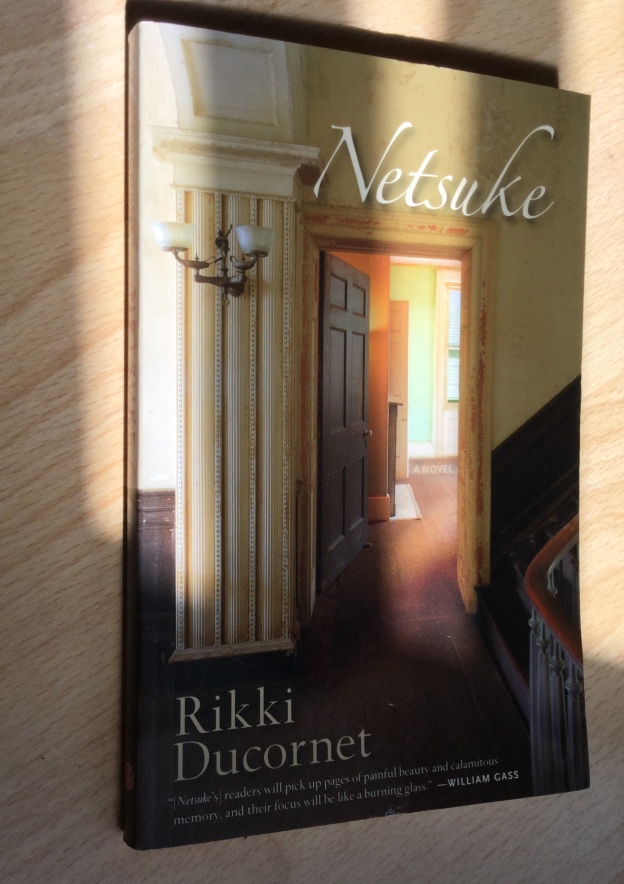
Netsuke – Rikki Ducornet

9 thoughts on “Netsuke – Rikki Ducornet

  1. So that I can concentrate on other aspects of this novel and also avoid plot spoilers by myself describing its plot, here is the cover description of the book by the book itself, as if you had picked it up in a bookshop to see if you wanted to read it…
    618CC779-01FE-4C46-A4E5-39AF3E8C4A7F
    ===================
    Page 1 – 9
    “His days are made up of what he calls ‘real time’ and the ‘interstices.’”
    We follow in the italics of real time his jog or run and the chance encounter with interstitial sex, inter-text, including lathering his own interstices, no doubt, in the shower. Running to the music of Monteverdi, here Monteverde.
    His wife Akiko, his practice as a shrink, he thinks about, and we sense his not too serious guilt, even a delight at such brinkmanship, an acquired guilt at his own behaviour with patients and strangers. As if everyone is miniaturised, I wonder? Shrunk? Thinking aloud, so far. There are far more details to his first person narration following the third person italics than I can cover here.
    =============
    As an aside, I note that there is a comment about this book by William H. Gass on its cover. My previous reviews of Gass (who seemed to have written, I discovered, in his 1960s novel ‘Omensetter’s Luck’, about a kindred spirit of Donald Trump!)
  2. 63C99039-0700-43CB-BE2F-4A892217400B
    Pages 10 – 22
    “I made it clear that our time together was possible only because of an unusual synchronicity.”
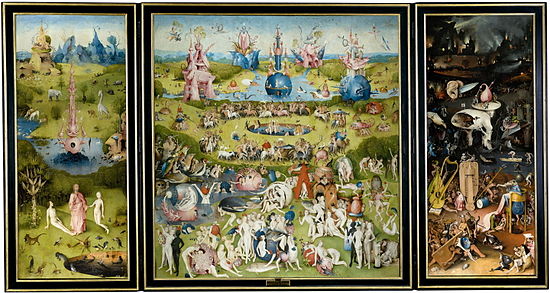
    The shrunk aspect of our ‘hero’ shrink is reflected in his two places known as ‘cabinets’ where he treats his patients, out of sight of the main house where Akiko does her artistic work. But this aspect is contrasted by the “large book” where he is ordering his notes and own reflections – and by Akiko’s collages “the size of doors.” Her new triptych, included. Marriage that is a fire in a world where everywhere is burning. Psycho-lust as therapy or risk management. He has a wench worthy of Wycherley, and did that wench break Akiko’s shell? The cad that dwells within, and he has men, too, it seems. Time to sink or swim or, rather, shrink or swell. There is much to captivate the reader dangerously here, I sense. Therapist, meanwhile, is one word, not two.
  3. Pages 23 – 37
    “Gazing out the picture window at one of Akiko’s impeccable vistas,…”
    Part way through, ‘I’ temporarily becomes ‘he’, as if someone else was suddenly turning his synaesthesia into sin-aesthesia. That psycho-lust as therapy. Revealing from under clothes shaven parts, “simultaneously glamorous and spare”, towards some pointillist rapture. A series of moments to become his need for a singular ‘edge’. A new ‘cabinet’ in town to house his more aberrant consultations with patients, away from the countrified marital home. With its own inner cabinets to house ‘netsuke’ etc, with the well-hidden collusion of Akiko? Null immoralist. Null immortalis. “…transforming it into something else, perhaps immortal, cell by cell.” And what about his childhood’s Land of Milk and Honey as an ignition towards a view of feminine plenitude? And a particular legend of an Eskimo, an image so perfect that, to describe it here, would be my own sin-aesthetic spoiler for you. To open you up. To scythe back bushes.
  4. Pages 38 – 53
    “Never have I been so taken by a creature.”
    Now we meet the creature Cutter, surely a sexually engulfing character from literature you will never forget. Potentially more engulfing than even Sarah Hall’s Evie that I read only a few days ago (reviewed here).
    “: how infinite the choreography of erotic encounter!” The Cutter who provides more edginess than the most precarious or precious edge. Threatening discovery by noise. Risking Akiko, for our hero, alongside the creature’s contrast with the cabinets and netsuke and interstices and the “world of novelties and embalmers, anesthesiologists and escalators. The world of paper, paste, and cocktail hours.” A tripswitch beyond triptych. The series of anamorphoses and their cylindrical mirrors, notwithstanding. This book’s POVs, too, authorial and narrative.
  5. Pages 54 – 67
    “Or in a risky part of town where I have engaged, if briefly, with marginalia. To be healthy one needs to bring the disparate parts of one’s puzzle together…”
    It is a risk reading this book, this review, too, as I question whether it, the book, is an apotheosis of literature depicting a man taking unnecessary risks to further excite his affairs, while assuring himself that his still deceived wife is the constant he truly cherishes, as if that assurance absolves his behaviour. “Me, too. But Akiko.” Whatever the case we learn that Akiko has a “beloved carp pond.” But is it tench? I ask. We learn, too — regarding a man called Swancourt with whom our hero consorts — that he calls him, this Swancourt, a “carp” and “curious fish!” We also learn of firefly sex in interface with the netsuke cabinet… “I have considered developing a cosmology of this ruinous eroticism.”
  6. Pages 68 – 83
    “She has become watchful, strange. She finds a fish, one of her favorites, floating belly up.”
    Akiko and our hero begin not to synchronise their moments of sexual appetite, as if splinters are being gathered and needles to extract them become needless or clumsy?
    “The world they share is seriously shrinking.”
    The rhapsodic, rapturous moment with Swancourt, meanwhile, is a more significant revelation. Like being invited into this book by the front cover’s door and turning the corner to find Swancourt. Eroticism takes on a new amorphous meaning in this book, one yet to be pinpointed. I hope its prick is never pinpointed.
    Our hero’s memory of his father’s dictum as to the wearing of nice fashionable clothes that makes later nakedness more effective; it sounds like something from Swann’s Way if not the petit Madeline cake of this book, a cake, if it were in the book at all, that would be part of eroticism itself…Let’s hope it was not left out in the rain.
    https://www.theguardian.com/culture/2010/may/29/edmund-waal-hare-amber-netsuke – an article about collecting netsuke and Charles Ephrussi who was the model for Swann in Proust.
  7. Pages 84 – 94
    “Now am I your lover or your sister?”
    Swancourt, aka Jello, almost or truly wants to be ‘fucked to oblivion’. There is also something, in its sexurious context, erotic about our hero testing, in front of Akiko, a fat fountain pen in a pen shop, the ultimate objective-correlative for this book’s own pen needing to piss or to transfuck. Somehow, the book makes such things needing saying, even (or especially?) in a review of it. 6D7C2457-5B34-4533-9328-F2BBBE889996This reviewer prefers not to become collusive with the book. But, after what I gratuitously wrote in the previous entry about the Proustian cake, can you believe there is such a cake as a Jello cake? One is shown alongside. And with Akiko set to make a ‘tagine’ at the end of this set of pages, can you believe there is also a ‘tagine cake’: https://www.bosh.tv/recipes/tagine-cake
  8. Pages 95 – 111
    “; how the world breaks apart only to reawaken, and demons cling for their lives to every star.”
    Time seems to accelerate, as our hero’s sexual emotions ebb and flow, with Akiko, with Jello, and with chance meetings, his memories of his parents who were ever in the bathroom, while Akiko’s “porcelain dolls” are in the netsuke cabinet, her fish in the carp pond now corpses, her triptych reworked an with Adam and Eve now part of this book’s oblivious fucking syndrome. Engorged prose. The Gestalt about to collapse, rather than to be gathered as I usually do at the endgames of my book reviews, our hero’s risk and danger about to be consummated, I sense.
  9. Pages 112 – 127
    2DE0DDE5-89D0-4C77-9770-CE421875D721“Write me a fucking book!”
    The pen is full of ink, after all. But the centre does not hold. The Gestalt is beyond me. A triptych of Drear, Spells and New Spells. My most strikingly failed real-time review. It needed something special to reduce the will of my own preternatural dreamcatching. The Cutter “needled after it”. Jello and Swancourt separately betrayed by their co-shrink. Other patients, too, in sudden realisation. Striking scene, indeed, of Jello/Swancourt in discrete if not schizoid recrimination. Another car crash of once reconciled polarities. Our hero, then, never was our hero after all. Akiko within the “silence of the wood” that now displays him.
    “, penetrated to the marrow, rubbed into oblivion, yes: rubbed out. No: made visible.”
    end


Sunday, September 02, 2018

Overnight – Philip Fracassi


7 thoughts on “Overnight – Philip Fracassi”


  1. 1.
    “Pete had been around enough shitheads to know a shithead when he saw one,” – yet is Pete to be sucked in by one, I ask? Fracassi is another nifty author who captures rather than captivates his reader. But he does both, of course. Here, Pete, a family man, is security guard on shiftwork at a wayside movie set, with all its gear to protect. He prefers the solitary watch. Not “overtime”, as such, that, we’re told, film companies have to pay when they don’t do the right planning of man-power, no, not overtime, but ‘overnight’. Meanwhile, I promise, no spoilers, here. Just appreciation. No need to be alarmed.

  2. 2.
    “After a while, stars, like other royalty, get used to being treated with kid gloves, and eventually they become kids.”
    Pete, our loving family man, bends rules amid the public’s attention span of celebrities’ lives, and our own attention span, too, watches him agog like baby birds in a nest, and his knowledge of the movie-set site and that “Each trailer had a hide-a-key.” Every worthy work of fiction has one, too. Meanwhile, we want a direct sample of a star, too, such as an author’s signature or saliva in a drink’s dregs. A page-turner, this book, but we are eking it out, against the grain, as it were. Slowly savouring over time, resisting it overnight.

  3. 3.
    “Uh-uh… you’re in the movie, Daddy. Like a movie star.”
    Pete’s young budding artistic daughter talking to him when he is off-duty, as it were. A lesson in what this family man is all about, when away from the Devil’s temptation or pact regarding past objectification of celebrity body-residua, residua cast back into real-time. Appropriate — when Pete is back on duty, at the overnight movie site, a tableau we all contemplate between the words describing it — that, after he daydreams overnight about his own youthful past and a crowbar’s “jimmy”, he is tempted again…this time harvesting a thong not a mug.
    “Part of him felt like he was being watched; another part of him felt like he was watching himself,…”

  4. 4.
    “The shower couldn’t get hot enough, and he stayed under the beating water ten minutes longer than usual, hoping to feel refreshed, hoping to feel himself again.”
    Amid deceptively simple, compelling narrative, of the wear and tear of family life’s accoutrements and Pete’s temptation of dilemma at work, this chapter makes me think that this book is about the ultimate Reliquary — one’s own vulnerable, unnerving body as a gestalt not as the piecemeal relics and other used or leaking accoutrements of self. Whatever one’s susceptibilities to celebrity. Straddling the night.

  5. 5.
    “Did you follow my rules? I swear to god,…”
    All formal religions — if not exactly like the cult of Hollywood, HOLLYwood depicted in these pages, but like Christianity and its Eucharist, like any belief in a Revelation or the Reliquary as the embodiment of its Star, indeed any belief in sacrifice as a way to Heaven — all have rules of sorts. On another level, this is a compelling character-driven narrative, with a manic dread and hindsight inevitability. Tell you more, and you will risk seeing below the movie set’s fabrication, I guess. Instead of the suspended disbelief of faith? Fundamentally, though, it is arguable that this book is not about religion at all! Or does not wish to be revealed as such.

    • 6.
      “But you have to get past the guilt.”
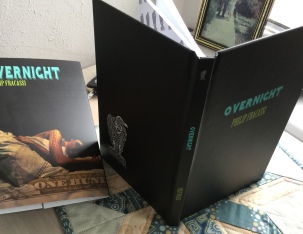
      Pete’s wife says that to him, their daughter a shared loved one. But to get past the guilt, one needs to get past the silver screen as an object-correlative, then into what sits behind it. As a coda or epilogue to the book, this chapter now represents, for me, the bespoke religion, as all formal religions are bound to become for each maturing individual, whether bespoke as fiction or truth. It also represents that manic dread now become real In real-time, an absurdist gestalt, a fine nightmarish finale to the action that makes you think about this book perhaps even more adventurously than I hoped to make you think about it. Fracassi has seen through the likes of me, perhaps. He has got past the guilt, got past not only the screen but also my dreamcatching behind it. Meanwhile, this physical Book of Holy Pete (holy as holism or gestalt) is designed like a heavy-duty prayer missal. I almost believe I shall now finger, if not lick, the relic of its author on the title page’s label! But whatever your own views, it is a great compelling read, about a family man in a manic dilemma of temptation.
      end