
The Rust Maidens – Gwendolyn Kiste
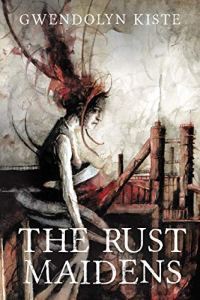
TREPIDATIO / JOURNALSTONE 2018
My previous reviews of this author: https://dflewisreviews.wordpress.com/tag/gwendolyn-kiste/
And of the publisher: https://dflewisreviews.wordpress.com/tag/journalstone/ and https://dflewisreviews.wordpress.com/tag/trepidatio-publishing/
When I read this book, my thoughts will appear in the comment stream below:



“Everything I do always feels a moment too late.”
Like starting to read this. Phoebe, 46, returning to the place she was brought up, after a gap of 28 years earlier, the shops, houses and her mother still there, changed, but not changed. Receded into recession. Father now elsewhere in a tired rest home. Signs of some eponymous legend or fame in the title, a group of girls therefrom, the title she chose to call this book that contains this return towards a future recession in the past. The old bug house, where a much younger eponymous disciple, I guess, (Phoebe unexpectedly finds) is a girl squatting called Quinn. What happened to Phoebe’s ambition with entomology, I wonder? I won’t continue to re-rehearse the plot as I go through, but I think I know that I am already entranced enough thus to continue at all. We shall see.
“They never quarreled needlessly, and they never excluded someone just for fun. They were decent and gentle and the closest to kind that anything could be, and they followed comforting patterns—“
Patterns, yes, but comforting? Phoebe’s treehouse of bugs and insects.
The Polaroid of 1980, then, as we have expanded for us memories, to live alongside her Graduation Day, the other girls (one, Jacqueline, her inseparable but separated cousin and another, Lisa, you won’t easily forget and another, Dawn, with our given dark vision of what it is to be mis-impregnated at such an age) and the industrial backstory of the deadpan town. Haunting, seeping … emotions with more than just broken waters.
“…and tucked myself next to the bookshelf brimming with my mother’s favorites. Madame Bovary and Wuthering Heights and Anna Karenina,…”
Her 1980 memories, ignited by polarised Polaroid, slightly beyond level graduation, make me think what she and Jacqueiline find within Lisa (and even perhaps within Dawn?) resonates with Phoebe’s Impala…
“….about how that car couldn’t make it out of the driveway. Then I would say it could reach the stars. Any star in the galaxy.”
Only rustbucket Tardi are in some late space opera? Each with is impalace or imbalance? Impaled or browned or oil-changed?
And the mill’s astrike again, her Dad deadpan with industrial acceptance.
“A dubious queen of the unknown.”
“—invasive as kudzu vines—even chartered a bus. Polaroid cameras tucked in fanny packs, they stalked along the road, those who wanted a glimpse of our neighborhood’s unmentionables,…”
Unmentionables, the rust mill male strikers, or the eponymous maidens still with their maiden names? Or both? This book has by now become invasive upon my mind, too, like kudzu vines. Strange that the strangeness is emerging piecemeal. Acceptable as truth or normal reality. And girlish bonds broken at a seeming whim… Any dreams of leaving Cleave-Land for a bughouse in Alaska gone? And those coming for Polaroid glimpses, one of them dishy….
“, learning our mothers’ maiden names…”
“There’s a tiny gash on Quinn’s arm.”
‘Cleave’ is one of those few words that can have the opposite meaning to itself. To stick, and to split.
Back – briefly, I wonder – to today, when Phoebe is 46, and we watch her dismantle things like the tree house and meet up with someone from her Polaroid past, someone who had then been too young for her to know at all…
“This whole street was becoming a zoo, a menagerie of girls, and it was all so terribly wrong.”
The townships voted mostly for Trump in the Rust Belt of America around Cleveland, Ohio…? I have images of fake news spilling out of old 1980s camera like filmic viscera. I think the book says it somewhere, too. As Phoebe debugs her own bugs, tears off the wings to save butterfly angels from their fate, as that fate’s history winds onward from the chain link fences of old Concentration Camps to the chain link fences of working men striking, to the eponymous maidens’ lacerating their new bodies there in face of the fake news tourists…
“Hospitals were confusing places that pretended to be orderly, that pretended to make sense. Places that told us to trust them, even though they offered us little reason to do so.”
The raging polarisation of today is played out back then, in embryo. Even the Polaroids become slick easyspeak. Political and bodily metaphors: home and away. Neighbour against neighbour. Friend against friend. Picket lines and chain link fences. A word came unbidden to my head: ‘pust’. My word not the book’s. Think about it.
“We were going to pretend that our lives were normal, even if it killed us, even if it suffocated what little lingering hope we had left.”
Cocktail-drenching and barbecued-flesh celebrations for July 4th, something that happens across the Atlantic or the Pacific, in USA, or is it something bigger spreading outwards? Like this book’s eponymous rust-cleaving enclave? Amid the tourist fakers and government men…
“They milled about the neighborhood, their ever-flashing cameras dilating like eyeballs in our faces.”
The Guffey eyeballs, again, from yesterday’s review here, or Fawver’s orange balls? We need books or just one book gestalt-bound within other novels and stories towards a potential cure or healing – or hawling (“the hot screech of metal and the carriage of heavy earth…”) … and, sometimes, this book seems over-evangelical about its thrusts and turns, in the alliances of the township (insiders and outsiders alike), but only by brainstorming can the remedies of fiction be harnessed… The descriptive scene of a particular Rust Maiden breast-feeding, for example, is a mighty literary scene to remember, but also one that strains the bounds of brainstorming and Kistean fey fantasising…
“Even if we hadn’t sewn our lips shut years ago, there still might not be words for what we needed to say.”
My Facebook-programmed ‘memory’ earlier today…
“It’s on repeat. This whole city is stuck on repeat. A cycle that, no matter how hard we try, we can never seem to break.”
Back today, or forward, with Phoebe Shaw, we see through her eyes the area’s wrecking-balls, and two men today, now older, from the earlier Polaroid times, times we have just been re-living in previous chapters… an aura of regret that we all now share. Those two men, then two girls, not born or just born back then, part of the on-going cycle?
Orange-lined sleeping-bag purchased from Sears 40 years ago, just as important for Phoebe now? A museum archive or monument from just an ordinary thing.
“Given a long enough trajectory, things have a way of working out. But so rarely is one lifetime long enough.”
“It’s probably nothing at all, just a haphazard pattern we’re reading like wet tea leaves in the bottom of a cup.”
“Archives and museums and the collective history of this city can’t help. If everyone else has tried and failed, who are we to fix it?”
No spoilers here, yet perhaps over-quoting is a sort of misbegotten attempt to grow fiction of past things beyond fiction itself, without wrecking them as part of that process? Like Dawn’s baby back then, still alive today. And the old sleeping-bag.
“They called it the ‘More Trees Down’ derecho.”
I don’t often learn a new word when reading books these days. Here a historic weather event in early July 1980 around Nebraska and Ohio. As a non-fiction counterpoint to — or countervailing proof source of — Phoebe and others visiting by stealth the mansion: the Rust Maidens’ lair….a fiction of another bughouse?
“They were sealed, gray decay and rust filling every space, sealing out the sun. Some of the rot was from the stolen items—“
And the bassinet and blanket. And the darkroom with its developing images. Polaroids didn’t need darkrooms, though?
Fiction has historically needed paper to develop on, to make real books. But now that it’s often out in the open, it’s sort of truer? Like being told ghost stories around an electronic campfire?
Phoebe’s earlier liaison or fling — with one of the community’s snooping male visitors of bureaucracy or fake news — had no social media then to bolster it or, for that matter, help destroy it…
Some moving moments within the mansion, if the reader can believe the rest of it – and can make its fey fantasising have something more restrained or measured within it…
Phoebe, as narrator, to Jacqueline:
“‘It doesn’t matter,’ I said, my voice wavering as the pain of her touch seared through me. ‘You’re still my best friend.’”
I have never had a best friend. Perhaps men never do?
“…and yellowed diaries with their locks and secrets rusted out.”
“Someone who can help me unravel this.”
Like ‘cleave’, ‘ravel’ or ‘unravel’ can also mean their opposite, both to tangle and untangle.
Cloistered by ravelled bones and ruined walls?
https://www.vocabulary.com/dictionary/ravel
https://www.vocabulary.com/dictionary/cleave
“I roll my eyes. How fitting. The church will stand longer than our homes, longer than the people who inhabited this neighborhood. I should keep going. This isn’t where I need to be. This has never been a place I’ve needed to be. But this city is a tricky one. It never misses a chance to confound you.”
A dead monument to once ancient hope? Now with a new preacher.
“I’m sure I’m wearing the truth on my skin, a tapestry of the past, etched in wrinkles around my eyes and the hundreds of gray hairs I’ve earned.”
We’re back to today, Phoebe in her late forties, being the direct fount of Rust knowledge and Rust’s girls of yore. As well as exploring the local church and the derelict steel mill behind the chain link fence, she also encounters two of the men from her past and now the present, too….
“At the back of the mansion, Jacqueline untangled her hand from mine and moved toward the door. Her lithe fingers peeled up a splintered board,…”
Phoebe’s sense of guilt adumbrated.
But, guilt and unguilt, like cleave, uncleave, ravel, unravel, peel, unpeel – are they really binary choices at all?
Rust, unrust, one can never truly unrust, except by drastic attenuation of what you really are, I guess.
“You can’t stop the girls from becoming what they became.”
“But Cleveland isn’t ready to let me go yet.”
“Then I peeled the plastic off the windows.”
Or unpeeled it?
“, as though it would be easy, no different than peeling worms off the asphalt.”
“Some wanted to hurt the girls, some wanted to save the girls,…”
“, the plaster and wallpaper peeling off like flesh.”
… “symphony of water”, no wonder the baby’s cradle was once called a bassinet in honour of the basin… A symphony, true, but maybe, for others, an overextended series of climaxes for a Gestalt climax of a Hitchcock film. A pent-up restraint and measured suspense, hopefully implicit in the mayhem.
“One of the girls’ carapaces. We were tossing the remnants of them out the window.”
I understood that utter poignancy, without understanding it. No longer a paradox, when in Cleave-land?
“It was the most beautiful and horrible thing I’d ever seen, watching her become all that she was meant to be.”
“everything peeling”
“she untangles her hands from mine and drifts back into the shadow…”
There are various climaxes …. but do they ever really end?
A series of binary choices. But each of them has a third option which is doing both. Hence this book’s triple moon.
A book that has its share of fallibilities but without those fallibilities it would be nothing. The wrecking balls, too. I may be one of them. I hope not.
end