
A Monster Calls – Patrick Ness


2011
When I read this Book of Patrickness, my thoughts will appear in the comment stream below…
www.nemonymous.com
Des Lewis - GESTALT REAL-TIME BOOK REVIEWS
A FEARLESS FAITH IN FICTION — THE PASSION OF THE READING MOMENT CRYSTALLISED — Empirical literary critiques from 2008 as based on purchased books.
2011
When I read this Book of Patrickness, my thoughts will appear in the comment stream below…
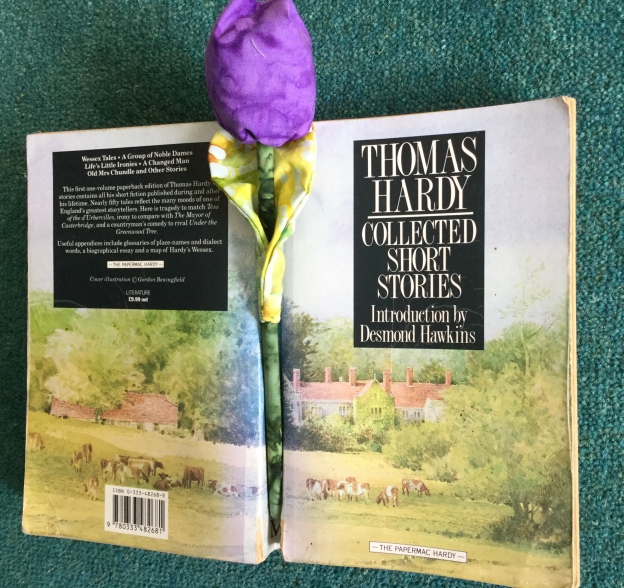
PART TWO as continued from Part One here: https://dflewisreviews.wordpress.com/2020/03/15/collected-short-stories-thomas-hardy/
When I read these stories, my thoughts will appear in the comment stream below…
(My previous stories of older or classic books: https://dflewisreviews.wordpress.com/reviews-of-older-books/)
Possible spoilers —
AN IMAGINATIVE WOMAN
“Then she scanned again by the light of the candle the half-obliterated pencillings on the wallpaper beside her head. There they were — phrases, couplets, bouts-rimés, beginnings and middles of lines, ideas in the rough, like Shelley’s scraps, and the least of them so intense, so sweet, so palpitating, that it seemed as if his very breath, warm and loving, fanned her cheeks from those walls, walls that had surrounded his head times and times as they surrounded her own now.”
A declining marriage, a busy gunsmith the husband and the eponymous woman his wife, an imaginative female force that later becomes explicitly an imaginary one in a poet’s head. This is Hardy at his most powerful, transcending some farcical turns of event. An imaginative woman, yes, but one who briefly dresses in man’s clothes to ape the poet she had fallen in love with UNSEEN and in whose rooms the married couple and their children stayed for a few weeks at the seaside. Amid the poet’s books and his poetic scraps or graffiti on the wall of beginning lines some of which we later learn are explicitly “erotic and passionate”. This turn of events lead by a circuitous audit trail to the poet’s suicide (using, ironically, a gun!)
And her new born son — via whom she died during giving birth to him — the husband later deemed was a spitting image of the dead poet, although the wife (a budding writer of poetry herself) and the poet had never met in real life!
The implications of erotic role-playing via methods of transference in the ether are manifold, as on one occasion she had kissed his photo and had at least briefly tantamount to become him, I wonder? A form of ‘trans’ behaviour still uncertain to exist, even today!
I just read somewhere about a belief that Mrs Hooper, the poet’s landlady, was masquerading as the poet himself. Or vice versa!
THE SON’S VETO
“; but she still held confused ideas on the use of ‘was’ and ‘were’…”
This intentionally dreary story is bare of plot twists and turns, a Hardy-depressing, if stylistically elegant, account of a woman’s attritional life lived lamely in London, out of her social depth having married a posh churchman and had with him an even posher, certainly much stricter, son who grew up, after his father’s death, to prevent her remarriage to the man she should have married back in her yearned-for original setting of Wessex. Her complicated hairstyle restored every morning with much effort as a metaphor of pointlessness. But a hairstyle needs no upkeep in a coffin, I guess. But the reading of books, even books written about low spirits, lasts forever in some eternal ether of a higher spirit. My conviction, if not the author’s! And the reader’s final veto.
See a story I read by chance this morning where a more modern woman yearns to leave the countryside to go to the city! — https://dflewisreviews.wordpress.com/2021/05/26/through-the-storm-rosalie-parker/#comment-21979
FOR CONSCIENCE’S SAKE
“…a house whose front, till lately of the complexion of a chimney-sweep, had been scraped to show to the surprised wayfarer the bright yellow and red brick that had lain lurking beneath the soot of fifty years.”
A man has a honourable conscience to marry the woman (who once bore his daughter) to whom he had once promised marriage many years ago but never fulfilled that promise. He seeks her out, and spies on her, till approaching this woman (masquerading as a widow) and their shared daughter. This eventually reveals features — symbolised by the above revelation of a house — into that of people’s faces below, bringing in a resemblance between them and thus a lingering scandal … and this has negative effect on his daughter’s marriage prospects. The gratuitous moral implications and repercussions are subtly tantalising. Still are, as I write this!
“The trip had not progressed far before all, except the curate, found that sailing in a breeze did not quite agree with them; but as he seemed to enjoy the experience, the other three bore their condition as well as they could without grimace or complaint, till the young man, observing their discomfort, gave immediate directions to tack about. On the way back to port they sat silent, facing each other.
Nausea in such circumstances, like midnight watching, fatigue, trouble, fright, has this marked effect upon the countenance, that it often brings out strongly the divergences of the individual from the norm of his race, accentuating superficial peculiarities to radical distinctions. Unexpected physiognomies will uncover themselves at these times in well-known faces; the aspect becomes invested with the spectral presence of entombed and forgotten ancestors; and family lineaments of special or exclusive cast, which in ordinary moments are masked by a stereotyped expression and mien, start up with crude insistence to the view.”
A TRAGEDY OF TWO AMBITIONS
“While he was patiently boring the tunnel Rosa seemed about to fly over the mountain.”
The attrition of human fate embodied in two brothers, Joshua and Cornelius, and their beautiful sister Rosa. J becomes a clergy man and C a schoolteacher, and they try to protect themselves and their sister from their drunken wastrel of a father, whom they get sent off at first to Canada with his gypsy wife, this being his first wife although it was not their mother. But he returns and, by his simple presence, threatens to blight the two brothers’ careers and also Rosa’s marriage to a Squire. But an accidental option — as abetted by their least resistance to a culvert’s weir embrace of their father — blights them instead. The duly wed Rosa is left in blissful ignorance of what they suffered.
Cross-referenced with O. Henry today here: https://nemonymousnight.wordpress.com/839-2/#comment-804
ON THE WESTERN CIRCUIT
“Then the pleasure-machine started again, and, to the light-hearted girl, the figure of the handsome young man, the market-square with its lights and crowd, the houses beyond, and the world at large, began moving round as before, countermoving in the revolving mirrors on her right hand, she being as it were the fixed point in an undulating, dazzling, lurid universe, in which loomed forward most prominently of all the form of her late interlocutor. Each time that she approached the half of her orbit that lay nearest him they gazed at each other with smiles, and with that unmistakable expression which means so little at the moment, yet so often leads up to passion, heart-ache, union, disunion, devotion, overpopulation, drudgery, content, resignation, despair.”
A most amazing story with a boring title, so nobody might have read it because they thought it something else? — unless it makes circuit with the O. Henry story (‘Each According To His Ability’) about a man called Vuyning as both parasite and host, that I just this minute coincidentally read HERE?
The story of illiterate young woman Anna who attracts a highly literate older man by his sight of her at the wondrously described carousel-circuits of the steam-circus! But he accidentally touches the hand of Anna’s older, more literate and, as it happens, married mentor called Edith, older than the man who fancies Anna.
Edith, whose marriage is fragile, later writes vicarious love letters galore to him at the request of Anna who cannot write them herself, letters that take on their own momentum, eventually without Anna’s knowledge, but letters still in Anna’s name. And so the man falls in love with Anna while, unbeknownst, actually. falling in love with Edith. The outcome is poignant and everlasting. Paradox of parasite and host making this an unknown classic perhaps written by someone else about someone else to someone else. Yet, which one is the shadowy third?
“…elbow other juniors habited like himself…”
TO PLEASE HIS WIFE
“‘The little one is Emily Hanning; the tall one Joanna Phippard.’
‘Ah! I recollect ’em now, to be sure.’
He advanced to their elbow, and genially stole a gaze at them.”
This is a story master-class in the Hardyesque by Hardy, as triggered by this elbow gaze, with a growing sense of tragic depression with disarmingly deadpan fast-moving decades (from youth to old age) passing through such depression to its ultimate inescapability. A sailor come home safe the from sea choosing a spot in the church to pray thanks for his deliverance.
Then with various misunderstandings involving the two women, and who loves whom most? — some of the three variably with good intentions, some otherwise fallible or misunderstood or even bad-intentioned, until that spot in church becomes a stain of focus for the potential widow whose husband and two sons are missing at sea, sons who did not say farewell to their mother face to face but by the transience of chalk marks.
The status of a grocery shop (“Did a customer inquire if the grocer could really recommend the wondrous substitute for eggs which a persevering bagman had forced into his stock, he would answer that ‘when you did not put eggs into a pudding it was difficult to taste them there’;”) versus a stationery shop, opposite each other in the same street, and the letters on stationery that sometimes are sent and some destroyed before they’re sent. We’re all “twopenny customers” in this world of commerce, personal, spiritual or financial commerce that ‘eats itself hollow’. And the metaphorical sea of fate washing through our “land-rust.” A love letter inside a book like this one earlier today, or chalk marks that run.
“…and she was to think of the letter as never having been written.”
THE FIDDLER OF THE REELS
This has turned out to be a truly GREAT short story, in fact unexpectedly so, as I had never heard of it before! It may even become a favourite of mine to be listed in any of my fiction legacy awards before I depart this earth! There is too much brilliant prose to quote, and thus I shall quote none! — except for the dancing witchery of “acoustic magnetism” to match the confidence-tricksy magnetism in the story by O. Henry that by chance I reviewed HERE just before reading this Hardy story, the latter conjuring up the 1851 Exhibition in London as well as the Dantean Egdon Heath where our flawed heroine Carline lived and was wooed by young Ned, but she is bewitched into dancing a different tune by a man called Mop with his devilish Paganini fiddle. So, Ned goes to London, trudging there I think, or at least he catches one of those early steam trains in those days whereby passengers suffered the elements in open carriages! Later, Carline realises Mop’s intentions were elsewhere and she travels in such open carriages to join Ned with her three year old daughter whose real father is Mop. This is more than just a sad story and I will leave the rest of this plot to you to read except for me to mention the stilts that the small girl was forced to dance on when working the streets with her real Dad in the bewitching dance of life, as they lifted, I infer, the spirits of others by such cruelly induced entertainment — also lifting, like this story itself does, our intergenerational spirits, lifting them at least temporarily within the spinning reels of fate’s own confidence trick.
And on that high note I shall leave it.
end


Author’s Note followed by two chapters…
A MONSTER CALLS
BREAKFAST
….chapters of a book that I see is taken from a dead person and revivified here even though it had never really existed at all …except in a dead mind? Till today.
Conor’s nightmare is a co-vivid dream proper, I suggest, because the monster who dares his waking fright leaves yew leaves behind, even though it was a dream. Significant that his Mum is having ‘treatments’, and I can guess what sort of treatments, and, to his chagrin, Grandma is to visit to help look after him. Brave Conor thinks they can cope without Grandma’s help, I guess. Significant, too, that his Mum has tea for breakfast, not coffee?
No spoilers ever intended except, possibly, those engendered by my passing real-time ignorances.
Not necessarily a book intended to be read by me daily, but who knows?
SCHOOL
LIFE WRITING
“…a scowl you could hang meat from.”
Being bullied, and Conor’s surrogate sister Lily he betrays on the way to school, and then given homework to write, write about himself. Everyone knows anyway why his Grandma is bringing wigs for his mother when she comes. If they but knew she was. Much of this, for me, might be a Dadless Conor’s own life writing in the guise of Patrickness. The Yew as a symbol for You, now become Me.
THREE STORIES
“Stories are the wildest things, the monster rumbled. Stories chase and bite and hunt.”
Having recently read and reviewed older stories, Joyce Marsh’s ‘The Tree’ alongside HR Wakefield’s terrifying ‘The Red Lodge’ HERE, such stories preternaturally ‘bite, hunt and chase’ me here, with the post-monster-visiting yew-berries of red in this book like blood in that other tree’s roots, its human ‘wood muscles’ and ‘spine’ with its arms outstretched, making a reader like me scared by the awesome pictures, too, shown as artwork in this book, pictures of such a monster, and I wonder how Conor dares go to meet it face to face, to receive the potential challenge of hearing the monster tree’s own threatened ‘Three Stories’ — and, later, Conor issuing his own story of truth, the true nightmare, the ultimate covivid dream that he has so far dared not issue to anyone at all, I infer, indeed not issued even to the author named on the spine. Meanwhile, his Mum’s post-‘treatments’ vomiting hints (to me at least) of a perverse version of Morning Sickness….
“Suddenly it had all become rather like a nightmare.” — Robert Aickman (The Swords)
‘Only the actual reality around you can be LIKE a nightmare. Nightmares themselves can be woken up from.’ …from my review HERE, written an hour before reading the next two chapters below:
GRANDMA
THE WILDNESS OF STORIES
“…but the only way he really knew he was asleep was when the nightmare came.
Not the tree. The nightmare.”
After we meet his modernist Grandma whom Conor seems to fear or hate more than the monster as tree. Though perhaps grandmother and monster each came to combat the other, in their respective officious ways? But which kind of monster made his mother vomit after ‘treatments’, treatments that were meant to make her better? Whatever the case, we now begin to appreciate Conor’s maturity for his age, his sensitivity to sarcasm etc. Anyway, just as the ‘monster’ came that night — an entity somehow differentiated from the ‘nightmare’ — to tell the now woken Connor its first promised story, I appreciated even more the meaning of ‘stories’ here relating to my own theories over the last 13 years of gestalt real-time reviewing, i.e. stories as the truth or even tactile actuality (!) of fiction…
“Stories are wild creatures, the monster said. When you let them loose, who knows what havoc they might wreak?”
THE FIRST TALE
THE REST OF THE FIRST TALE
“Sometimes people need to lie to themselves most of all.”
Quite a revelation this first tale told by the monster Yew to Me, as well as to Conor, the first seeming fairytale I’ve heard with a rerun or flashback of truth after believing bits that were untrue as fantasy first! A question of a reader or a listener being in denial about the deceptions played on the self by the same self — the latter as a form of Proustian self? For fear of spoilers, I do not dare rerun this first tale here, but it involves the concept of marrying one’s own step-grandmother and the machinations of a Kingdom’s statecraft, tempting the Yew to walk. I feel as a reader it tempts Me to walk, too, into this book as a sapling Yew.
Caveat: there is naked sex in this first tale.
“There is not always a good guy. Nor is there always a bad one. Most people are somewhere inbetween.”
The synergy of Proustian selves…
Cf Intrinsic Patrickness as a synergy, too … a synergy of two authors as one?
UNDERSTANDING
LITTLE TALK
“‘A bully with charisma and top marks is still a bully.’ She sighed, annoyed. ‘He’ll probably end up Prime Minister one day. God help us all.’”
For a book first published in 2011, that perhaps gives a new understanding, a new meaning to saplings that need excising at the root! Now too late.
Meanwhile, Conor faces school, and the complicated emotions of budding adolescence. And Grandma’s ‘little talk’ later issues an even more complicated emotion, his missing Dad coming to visit from his new American marriage, and Mum’s ‘treatments’ now reach toward another story’s storm? — becoming even more meaningful to me having coincidentally read about an hour ago this moving story of another woman’s cuckoo in a nest?
“No one knows about stories like Conor here.”
One of the many Jim Kay illustrations, 2011 – this one from later in this book.
Pingback: Inexcoriateable | The Des Lewis Gestalt Real-Time Reviews Edit
GRANDMA’S HOUSE
CHAMP
“His mum didn’t look great, looked even worse after five days in hospital, but she was still hopeful about the new medicine she was being given.”
… as this particular reader is hopeful, too, preparing for his own seemingly similar ‘new medicine’ in a few weeks. And I trepidatiously search my own floors for a certain knot in the wood that might betoken an accretive incipience of a visit to me, another monster calling…
My own grandma, too, was modern for her era of life in the 1950s and as a small boy, I did share a large house where she lived, after her divorce, with her then male partner who owned it. Nothing ever repeats itself exactly, I guess. There was nothing like the ‘Antiques Roadshow’ in those days, for example! Just ‘Mrs Dale’s Diary’.
The arrival of Conor’s father entails his consumption of an Americano pizza, and his hearing a fatherly fobbing-off disguised as a fatherly love….
“‘I’ll tell you something, Clara. Have you ever SEEN a minute? Have you actually had one wriggling inside your hand? Did you know if you keep your finger inside a clock for a minute, you can pick out that very minute and take it home for your own?’ So it is Paul who stealthily lifts the dome off. It is Paul who selects the finger of Clara’s that is to be guided, shrinking, then forced wincing into the works, to be wedged in them, bruised in them, bitten into and eaten up by the cogs. ‘No you have got to keep it there, or you will lose the minute. I am doing the counting – the counting up to sixty.’ . . . But there is to be no sixty. The ticking stops.”
From ‘The Inherited Clock’ (1944) by Elizabeth Bowen
AMERICANS DON’T GET MUCH HOLIDAY
THE SECOND TALE
THE REST OF THE SECOND TALE
“But then one day, the parson’s daughters fell sick. First the one, and then the other, with an infection that swept the countryside.
(The sky darkened, and Conor could hear the coughing of the daughters within the parsonage, could hear the loud praying of the parson…)”
Conor’s resentment at his father’s apparent attitude fires him up. Time will also tell what destructive forces have been set working by our co-vivid dream’s power of gestalt from each bespoke reader of this book, and from the book’s authors, and perhaps from the other authors that each reader may have read, as fiery Conor tortures a prize pendulum clock. The monster then transliterated here, with its next fabulous tale, conveying the morals of Christian parson and conscientious apothecary. An apocryphal apocalypse or something far more bespoke and targeted for the boy who created it for us by means of the authors who created him?
Each book we read a version of the monster that calls or walks.
Cross-referenced here: https://dflewisreviews.wordpress.com/2021/06/18/gluey-zenoism/
DESTRUCTION
INVISIBLE
“, the screaming, the emptiness—“
As we are here to ignore what has gone on, feeling invisible as reviewer or reader, just like Conor feels invisible, and like the girls in the schoolyard “looked at their phones as if nothing in the world was wrong,…”, a sense of in-denial about what has just happened in this book that I can’t describe to you and what might yet happen to Conor’s Mum who has had her own ‘turn’….
“Conor hadn’t written a single sentence.”
Featured snippet from the web:
‘The secret of Yew needles’
Known as taxanes, they do this by disrupting the function of microtubules in our bodies, key players in the process of cell division. This capacity is invaluable when cells are cancerous and doctors are trying to halt the growth of tumours.
YEW TREES
COULD IT BE?
NO TALE
“It’s not too late. It’s never too late. […] Conor remembered. What the monster had said. Belief is half of healing.”
No tale, no lie. Yet what of those ‘wild stories’ with their intrinsic truth?
I am moved by the hope of healing here, by accepting the monster, or fighting one monster with another monster? Horror as catharsis? See the Aickman Absolution that I posted earlier today (HERE) before reading these three chapters.
“‘Son,’ his father said, leaning forward. ‘Stories don’t always have happy endings.’”
“Because no, it would work,…”
I NO LONGER SEE YOU
THE THIRD TALE
PUNISHMENT
“The clock currently read 12.06. […]
The clock ticked over to 12.07.”
The earlier clock torture, the earlier bullying, the earlier invisibility … the earlier wild stories with the monster and Conor now one driving truth, all come to culmination…
With whom does the monster walk and talk this book into current being, which of its two authors, or both, which of its readers’ reading of it, or simply (simply?) is it today the pervasive, prevailing gestalt of our times, our current ticking-clock, our current cults of polarised belief, our current invisibilities, our current propensity to bullying tumours?
A NOTE
100 YEARS
WHAT’S THE USE OF YOU?
Of Yew?
To Croon out pleas
Or to restore storm,
To enter the nightmare of truth at last?
Conor with monster again,
Asking why no more treatments?
Who is trying to heal whom?
What is trying to heal what?
Prayer crosses prayer at the still still point.
Who passes what paper wedge of words
As in Gambier? Lily enfolded.
“As incredible as it seemed, time kept moving forward for the rest of the world.
The rest of the world that wasn’t waiting.”
…until it did start waiting? Has already started waiting, pent-up, panterrestrial?
THE FOUR LAST CHAPTERS (their names redacted by the real-time reviewer)
“You did, the monster said, but you also did not.”
How can both be right, precisely at this minute or even 24/7? This convulsively compelling book eventually allows you, whether child or adult — even if simply a child adult forever — how to transcend the bullying polarisations of inner thought as well as those thoughts exterior to you that purport to control you from some centre: the polarisations of belief, of guilt, of in-denial … taking responsibility or letting go of these culminating crystallisations of nightmare’s purging truth. Making up — as well as facing — facts. Making up (such as the monstrous creation of wild stories) but also as a form of reconciliation … reconciliation within the Proustian self as well as reconciliation between separate people, people like Conor and Grandma, forever, I hope. Transcending, too, the nature of life and death. The teetering on the cliff top fingertip to fingertip (as with Sudra in another book) or the solid ground base stretching towards the endless gluey Zenoism of real-time… and the fourth tale is yours forever. The rest of it, too. The 12.07 is halfway towards forever, I guess… think about that, whether at noon or at midnight.
end