Monday, October 04, 2021

INTO THE WOOD by Robert Aickman


I previously reviewed INTO THE WOOD in 2013: https://nullimmortalis.wordpress.com/2013/04/20/aickmann/#comment-7243

I review it again today as follows: 
772EA1C9-8150-457D-8B0E-A048B9F61F94

I recall I was earlier more interested in any comparison of the Aickman sanatorium with the sanatoriums in Thomas Mann and John Cowper Powys than with any transcending of Zeno’s Paradox as part of an acceptance of my then less apparent lingering imminence of death. More interested then, indeed, with Margaret ‘eating up her mört’, not as a complex symbol beyond any practical logic of eating fish in a hospice, but more, then,  as a clever play on words for its own sole sake. 

But today is different. 

INTO THE WOOD by Robert Aickman

“As men and women work more and more against nature, nature works more and more against men and women.”

“…with all these trees, it perhaps has no beginning or ending – at least in your sense of the words —“

This is the complex portrait of Margaret, an English woman who one moment glances at the spine of Daudet’s Sappho in the Swedish sanatorium and the next moment wanders into the Swedish wood whereunto the inmates of the rest home or sanatorium, as constantly unsleeping insomniacs, wander at night. Whether ‘vampires’ or ‘trolls.’ These excursions arguably  being various dress rehearsals for breaking the otherwise endless  circles of unsatisfactory life. She is ignited to make her first visit into that wood by following a slim young girl whose breasts are hidden away. Her husband, a JCB digger of a  nature-destroying road-maker business man,  visiting Sweden on that very business,  leaves her at the Swedish sanatorium when going to Stockholm for two nights, and he has already tellingly lost any erotic thoughts about his wife. She resists her final communion with the excursion’s maze of pathways and one wonders if she ever shall. At the end she seems prepared to do so. To find that once insufficient answer, “beyond logic, beyond words, above all beyond connection…” A marvellous work, that also involves the Aickmanly nature of gender interaction and marriage and the masculinity that poisons some of us, whether man or woman, with these following eclectic keynotes in this work of time’s own gluey resistance movement and incursions against excursions: “Don’t leave the road […] You’ll sink above your ankles.” — “People have no time for rest cures today.” — “It was along tracks such as the one below that all creation ran from darkness to darkness…” — “Marriage – anyway the usual kind of marriage – is one of the things that insomnia makes impossible.” — “to live with reality for twenty-four hours out of twenty-four…” — “…going round and round in a hopeless circle, as the lost are well known to do, owing (she had heard) to almost everybody having one leg shorter than the other.” — “…nothing but a perfume that lingers a little, as the dead linger here a little after death…”

Awaiting that ‘jolt’ of a final answer. Be you troll or not.

“The tinkling clock struck four and five and six, and Margaret never slept at all. It also struck a single, delicate not at the intermediate half-hours.”

***

All my reviews of Aickman: https://dflewisreviews.wordpress.com/robert-aickman/

EDIT: My final Aickman story review: The Hospice: https://dflewisreviews.wordpress.com/the-hospice/

Residents’ Only by Robert Aickman


My previous public review of this Aickman story in 2007 …

It is one of his longest stories. Which is sort of relevant. When I started reading it, the glanced-at length seemed about average for Aickman – but as I continued reading it, and looking, from time to time, at the pages still to read, it seemed bodily to grow, as if the act of reading made it longer. A bit like the very British committee system embodied in its plot, the cemetery committee itself that is the centrepiece, reminding me of Jarndyce & Jarndyce or of a meal at Aickman’s own Hospice. I mean this quite seriously … and this seemed to be confirmed by the story’s coda with these words: “Everyone perceived that the past should be allowed to merge into the future, with no official recognition given to an interregnum.”

Indeed Jarndyce & Jarndyce, and today I recognise this is represented by the two characters Jonas and Jarman! 

But I did not know half of of it then, I see, having just reread it in the light of all his other stories recently re-read…

RESIDENTS ONLY by Robert Aickman

“…the future would have to be left to time.”

“What I mean is we do not end the fact and responsibility of immortality by setting up a committee.”

The ultimate Null Immortalis story, of quaintly attritional entropy, when you can’t even die off from being a member of the oldest local committee of all, aptly, in this town,  the cemetery committee! You must all know this story; it’s probably been around your veins countless times, even if these veins ever carry today even more sluggish currents than heretofore. Crickmay himself, despite his initial youth, half-sees things through myopic eyes, I now realise. That may explain a lot. The Rogerson caretaker in the cemetery’s lodge, for whom Crickmay is responsible, and Rogerson is now just the smouldering red glow of a bigger fire to come if you believe in the ending or any endings at all, a red glow to show Rogerson is still there at the depths of the cemetery. This is not just a satire on the mechanics of ancient committees, and I would say it is not a satire at all, even if Aickman intended it. It is far more serious than that. It is life and death itself, whatever other ludicrous or absurdist cast you place on it. Boys will always be boys, even Murch, as they keep an eye on the cemetery but fear its ghosts.  Glad to be reminded of Mr Yarwood, who can have no imitation. Though Rogerson may have mimicked him, for all we shall ever know. 

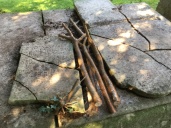
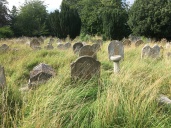
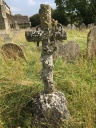
“Keep soldiering. That’s what we all have to do in our different ways.” My way is to study the minutiae of Aickman’s own stories of Null Immortalis. The actual state of this cemetery preceded today’s fashion of  rewilding policies, with long grass, masonry cracks and mis-leanings and even skeletal fingers protruding. Sleepers settled below and now some are above ground. ‘Tramping through tall, wet weeds’ like many other such gluey journeys in Aickman. Hugger-mugger as in Hamlet. The Romish shrine somehow vanishes. Do you know how? — if so, please add a comment below. Like time itself, Rogerson was bound to lock and unlock the gates forever, but time manages to continue even when he was no longer asked to do so. When will the dead outnumber the living, or vice versa? So many options the committee has to deal with the cemetery’s future, ending with residential building works in a Spanish style that fizzle out because of the too shallow graves that were part of our predecessors’ cheapskate ways. “In truth, things were going more and more slowly…”

“…history would turn itself inside out and cease to be history….” Why is it I cannot remember the character Alban Ramage from when I read this story before? He may have since been written in! — so as to learn about where he lived in Swanage, “The Strange Things on the cliff until the day he died.”: while “Crickmay had not been able to look at his watch owing to the things he was carrying.” 

The committee members inevitably become part and parcel of the dead that they have been put in care of, even while continuing on the same committee. You can’t make it up. Crickmay ‘sees’ them wandering round the derelict place at night. Local people becoming ill by living too near the cemetery. Hoping to ‘recolonise’ the cemetery? Motions carried with ‘dead eyes.’ Minutes taken. Pensioners like Rogerson ‘having their own ways with their provender’, as in this ultimate hospice of the still smouldering  glow of life. Gnawing away at Crickmay when Toller spoke? “…or a drink made from sweet orange; occasionally a few mixed biscuits” — provender for our ‘green, fleshless fingers’?

“We’re not shoving them down, mate. We’re grubbing them up.”

***

All my reviews of Aickman: https://dflewisreviews.wordpress.com/robert-aickman/

Sunday, October 03, 2021

The Fully-Conducted Tour and other stories by Robert Aickman

 Part of my tour of Aickman: https://dflewisreviews.wordpress.com/robert-aickman/


The Fully-Conducted Tour

3.Oct.21


My previous review over six years ago: 

THE FULLY-CONDUCTED TOUR by Robert Aickman

“…it is no good looking for something strange. It only happens when you’re notlooking.”

An engaging, very English, true-seeming account of touring Italy by the narrator accompanied by his debilitated wife. A man with an eye for the ladies, it seems. Leaving his wife with Jane Austen back at their small hotel, he goes off alone on a coach tour to a Gothic style villa, where something quite simple happens to the rest of the coach party, something absurd, but effective. He escapes by the skin of his eyes, as it were, without much Persuasion.

“…how much time I managed to while away just sitting outside a cafe and watching the different women and girls pass by, all walking so differently from the way they walk in England.”

Something to do with their shoes?

================================

A masculinity subsumed, the beauty of a woman making him forget his sick wife reading Emma back at the hotel…

I quote today this passage at the point of subsumption, for now you have read all his stories, and can make of it what you will… glad he escaped to write more cathartic stories?

“I continued to sit, more and more uncomfortable no doubt, but hardly noticing it; and nothing more of any kind happened. Nothing at all. / In the end, I realised, simply by lifting my arm and looking at my watch, that I had sat there alone, in front of the doors and the scattered footwear, for more than three hours.”

Footwear makes walking through time’s glue easier or more difficult, slower or quicker?

Aickman does not fully conduct us through his stories, but more provocatively only halfway towards their meaning, and we take ourselves halfway again…each of us with our own share of that half, and of half of that half….


The Flying Anglo-Dutchman


3.Oct.21

My previous review over six years ago…

THE FLYING ANGLO-DUTCHMAN by Robert Aickman 

“You know how it is. One’s womenfolk simply collapse by the wayside at four o’clock and you have to carry them home, if they can’t get their hands on and noses in a teapot.”

Once that particular paragraph is redacted, this story is unsullied joy as a piece of Aickmania. Seriously odd. But with a meaningful resonance that remembered dreams somehow have. Steeped in 1940s Britain, with evacuees, some derelict fairground amusements that were cheap and nasty at the best of times, a large Lyons Corner House for afternoon tea in the middle of nowhere reputed as serving refreshments to the many workers from the nearby canal. But what canal? A canal that seems to have long been unuseable, with a wrecked narrowboat across it that shares the name of the lady running the Lyons. With the valued first publication of this missing mini-masterpiece, I wonder if the train, too, has now not been missed!

======================================

Not much today to add to that, other than drawing attention to the “naughty nineties” and the provision of ’Meat Teas’.


The Coffin House

3.Oct.21

I reviewed this story over six years ago…

THE COFFIN HOUSE by Robert Aickman

“Even the sugar basin contained only a discoloured slime.”

Now this is embryo Aickman as the quintessential ‘Strange Story’ writer, with, for me, foreshadowing ingredients of ‘The Trains’. Two land girls lost and finding themselves in a forbidding abode, sudden change of costume…
Actually, it is rather effective and if I’d read it in ‘Aickman’s Heirs’ (an anthology I happen to be simultaneously real-time reviewing HERE alongside this review), I would have called it an excellent Aickman pastiche!

==========================

Today, it becomes even more insidious, as the two land girls seeking shelter in this woman’s house discover she is an evil policewoman (are there such?) with a whistle, and later she is dressed as a nurse with an empty syringe, with in between these events a man with a ‘coffin knife’ prepared to prepare them, but for what? — perhaps to flay and flense them, not just for the coffins straightaway, but for whatever hunger was borne for them…


A Disciple of Plato

3.Oct.21

A DISCIPLE OF PLATO by Robert Aickman

My previous review over six years ago…


“After sixty five, one remembers one’s eyes. Perhaps it was the gloom which had led the philosopher to omit the incident…”

For his posterity, his legacy? I am over 65 myself. I think it is fair to say that, so far, anyone solely after a new ‘Ringing the Changes’ or ‘Meeting Mr Millar’ will be disappointed by this book. However, it may be good if you are after the Aickman who immersed himself, I am imagining, in Thomas Mann or Henry James, and developing his puckish, sometimes surreal, humour (here ‘Santa Tomasina of the Sour Stomach’, ‘Santa Monica Long-in-the-Tooth’, ‘clodhopping brother’, ‘English breakfast,’ in Rome, ‘of bullock and pig’) and a sexual innuendo and wise asides to the reader about having doubts as to intentions. This meeting in an atmospherically described Rome of this character and a beautiful English woman on his intellectual level is couched in a prose as if Aickman is imitating, say, Henry James to a fustian nth degree, but it works, somehow, and the retrocausal nature of the revelation at the end is a masterstroke.

====================================

SPOILER, today

This Disciple turns out to be Casanova, as his wooing the Englishwoman is as much for her philosophical mind, a mind he had never met in a woman before, as part of the menu with the ’subtle mental stimulus of sex.’. The perfect gestalt. Make of that as you will, and that it took an Aickman to tell of it, not Casanova himself. I liked again the Aickman eating images too — the Sour Stomach Convent and Santa Monica Long Tooth. And the woman’s breakfast of pork and bullock. Especially now after having since learnt a lot more of this Aickman syndrome! 
And this sentence means much more to me today than six years ago, I guess… ”When there are fogs and movement is difficult, continuous night alone preserves the will to live, for the inconveniences of life are lost in dreams.”


The Whistler

3.10.21

My previous review over six years ago…

THE WHISTLER by Robert Aickman

“The sort of unpleasantness that most pleased Cave Bird was physical cruelty.”

Sometimes you touch things via Aickman fiction that you wouldn’t consider touching directly. This is a case in point, although some of the things this ‘fat’, ‘fly-blown’ man called Cave Bird touched are not necessarily bad, like quoting Oscar Wilde’s Ballad of Reading Gaol, or making references to Tale of Two Cities or to Mercutio in Romeo & Juliet, or to the raising of a flag. His nephew’s whistling was quite another thing, I guess.

“Cave Bird had had enough of boys at the moment…”

===============================

Today, I wonder what Cave Bird intends to do with the dead body upstairs? Was it his pesky whistling nephew still whistling? A fat man needs food…

Time will tell, as he quotes Wilde’s READING Gaol:

“Fingering a watch whose little ticks / Are like horrible hammer-blows.”


The Case of Wallingford’s Tiger

3.Oct.21
My previous review over six years ago…

bowen

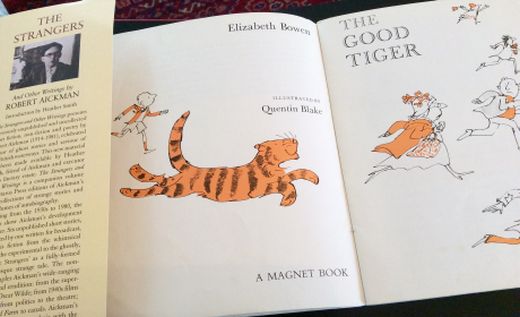
Until today, I didn’t know that my favourite authors (Robert Aickman and Elizabeth Bowen) had both written a story about a wild tiger and the middle-class machinations of gentle mischief it causes in the old-fashioned English community of the delightful Just William or Jane Turpin stories of yore.

This is Aickman’s…

THE CASE OF WALLINGFORD’S TIGER by Robert Aickman

“…leaving the search after Wallingford and his tiger to the brand new police box recently set up alongside the best esteemed of Upperwood’s public houses.”

Here a tiger is brought back to the rural town of Upperwood it seems by monied Wallingford thus creating romantic ambitions or underhand plots to disable the man’s smugness involving the RSPCA etc… Till the tiger is found dead and smelling…. With a crime suspected involving racial or perhaps liver-spotted (-striped?) repercussions? (Time for an early appearance of Dr Who to solve it?)

======================================

I have just read it again and in tune with the Insufficient Answer’s 42, this has the Whovian time paradoxes that I have since found within the Aickman fiction canon, as well as now perception of dubious man-eating by a man as well as by a tiger — obliquely, at least, part of the cannibalistic themes in that canon. Also the village’s attitude, even taking a fiancée from a fiancé, Aickman style, and perhaps the inhabitants of the village and their attitude to Wallingford puckishly parallel some readers’ attitude to Aickman himself and his work


Saturday, October 02, 2021

The Strangers by Robert Aickman


I have re-read this Aickman novelette and my review below was written before checking back to read my previous review of it.

496AB25A-D13A-4EAA-8745-FB0BB0D92E9A

THE STRANGERS by Robert Aickman

“There was nothing irrational about it, apart from the fact of its happening at all.”

A story that is both rational and irrational in equal measure, like that ‘Third Place’ it mentions towards the end, a place halfway between Life and Death, and, I guess, also halfway between Richard’s experience of Clarinda in his real life and his dreams of Clarinda. This Third Place being the so-called co-vivid dream that  we all know for better or worse today, I guess. And as I finished this work just now, I wondered why its title is what it is. I can only guess that if we are mad (and one arguable sign of madness is reading stories like this) then that madness makes otherwise strangers  co-strangers, indeed a community by paradoxical dint of being strangers, and Richard the narrator ends up concluding: “I sometimes think we’re all mad, […] Everyone in the world, I mean.” Including, I would suggest, his mother, who still calls him “my own sweet darling cuddly possum” and gives him medication the matriarchal talk  about which goes back to “the whispering sisters.” Once, mad strangers, too?

An otherwise characteristic  Aickmanly tale of gender politics and a shy man’s manoeuvres in society (and in the workplace) to sow his oats and to gain advancement. His friend Ronnie from work however seems to co-opt Richard’s well worked-for  girl called Clarinda following both men becoming part of an  audience at an evocatively housed entertainment  where a man plays a piano recital before his sister Vera Z (Z for Zeno?) plays conjuring tricks on the same stage, but perhaps  the eerie haunting shape that did actually turn out to play the tricks was the trick itself? All taking place in a house without light-fittings, if possibly foreseen to be provided with candles? Ronnie is seen later elsewhere in a room in this house by Richard; and Ronnie is seemingly canoodling with VZ while her husband watches them. This scene frightens Richard and he falls out of subsequent contact with Ronnie,  but, perhaps unconnectedly, soon after this event, Clarinda as a girl friend is taken over by Ronnie, as, even later in time, Richard discovers this very fact  by seeing them together in a restaurant, after Clarinda had dumped him. At this restaurant, Richard happened to be dating a new girl called Aster. Don’t go there! But suffice to say Richard’s later dreams of Clarinda trying to claw her way back to him through his bedroom window and her aura of dementia after she is dead will haunt me again forever. The recurrent ‘throbbing’  accompanying Richard’s dreams, the ‘clattering’ of  the piano and the sound of the old-fashioned calculating-machine belonging to Richard’s father, they also continue to haunt me again and again.  As will haunt me the stackpipes upon the house within which Richard eventually sees VZ and her brother perform again. He sees them thus perform from outside the house through the window. How many times can such scenes in stories that I obsessively re-read continue to haunt me AGAIN? Did they ever stop haunting me? It was significant that Aster once referred to Clarinda with the name Clarissa, the latter being the title of the longest novel I have ever read, too long to finish, too long to have EVER been re-read. Significant, too, that Richard first met Aster at a telephone box exactly halfway between their two workplaces, a telephone box we much later learn was a battered one.

“: the nightmare lucidity that destroys the safeguard barriers of time,…”

***

All my reviews of Aickman: https://dflewisreviews.wordpress.com/robert-aickman/

Friday, October 01, 2021

MARK INGESTRE: THE CUSTOMER’S TALE by Robert Aickman

 MARK INGESTRE: THE CUSTOMER’S TALE by Robert Aickman 

AAC9933E-1F8C-4DA4-BCC8-33377C4FBF69

…a paragraph from the opening of this truly reprehensible Aickman work… and the above paragraph is linked firmly with my reading of ‘The Empty Chair’ by Roger Keen earlier today here: https://elizabethbowensite.wordpress.com/697-2/#comment-1318.  Each fiction work’s reader and, thus, in many ways, its co-creator, is effectively also its ‘customer’. Think about it in the context of this story and in the quite different context of the Keen work.

Malcom Arnold’s 1959 ballet (mentioned in the Aickman) called SWEENEY TODD featured a character called Mark Ingestre, and I am listening to a tellingly companionable performance of the concert suite from this ballet on Spotify as I write these words. Arnold is one of my favourite composers and in fact his work was somewhat responsible in 2002 for my very first gestalt real-time review, as shown here:  https://dflewisreviews.wordpress.com/my-original-real-time-revie-2002/ .

 Now coming fully to the Aickman work itself…

A journalist in the Fleet Street area (sent to do a review of the Arnold ballet, the programme for which has an advert with the slogan: “Best English Meat Only”) re-tells to us an eccentric sounding story of that very old man who became a customer of a barber’s shop just as the the journalist becomes a co-creating customer of that very story, by re-writing it to some extent. A story where the barber shop visit by the old man, when he was 17 years old, is a scenario with razors et al, entailing a short  black man or just a man covered in hair waste or a skin disease assisting the tall barber,  and the ‘old man’ narrator ends up somehow downstairs in extreme heat near an oven, with a small girl and “a huge woman” on a sugar-box throne (as possible parallels to those similar characters mentioned  in my ‘Rosamund’s Bower’ review yesterday) and they both  strip off naked and the girl  strips him off naked, too, (earlier the storyteller cites a Byron poem Little Medora about a little girl dressed as a boy) and there is much confusion between waste hair and pubic hair or lack of pubic hair in the girl’s case, and sexual fulfilment for this virgin narrator who eventually becames the old man who told the story. But escaping by the back way, it is obvious that he, as a youthful 17 year old,  escapes being cooked into meat pies, thus fitting Aickman’s propensity for cannibalistic themes in his work that I have mentioned before. To match the psychotherapy aspect of my chance synchronicities  above with the Keen work, one wonders how much Aickman writes all his fiction works as just such a catharsis for himself. Becoming then a group therapy? A process that has the collateral of some great dark literature providing various bespoke  catharses to its reader customers as well as being great strange stories in the weird fiction genre for their own sake. In this Aickman there are many finely written  Horror genre passages.

Just a few observations along the way of the Ingestre story, which may not be one of Aickman’s best, but certainly one of his most controversially provocative…

“How did I get into the barber’s shop? I wish I could tell you.”

“Sometimes we can see more without definition than with it.”

“Probably everything in the shop was an imitation of some kind.”

Talk of singeing, hypnotism, and his body going round like a Catherine Wheel, a falling through trapdoors which brings us back to the theatrical basis for this work.

The mattress downstairs is rents and bloodstains. Is this a rat hole or a sewage-overflow chamber, he wonders. Cf such overflow with a psychotherapeutic catharsis?

The ‘drooling’ woman caresses the girl, and there are echoes of his own (sexual?) yearnings for his own mother. Just more than a usual troilism?

“I was wet and slimy as a half-skinned eel.”

Much more on the confusion of hair. Tangling hair that enabled a harder kiss? Later tearing at ‘wisps’ of hair.

Much theatrical business with the props of a massive working knife and a small pistol.

The house settling and its locks realigning, as we continue forever to resonate with the moving parts of this remarkable work. And with the rest of Aickman’s work.

“I suspect that things happen from time to time to everyone that they don’t understand, and there’s simply nothing we can do about them.”

****

All my reviews of Aickman: https://dflewisreviews.wordpress.com/robert-aickman/