Saturday, April 18, 2015

Bastards of the Absolute - Adam S. Cantwell

Bastards of the Absolute – Adam S. Cantwell
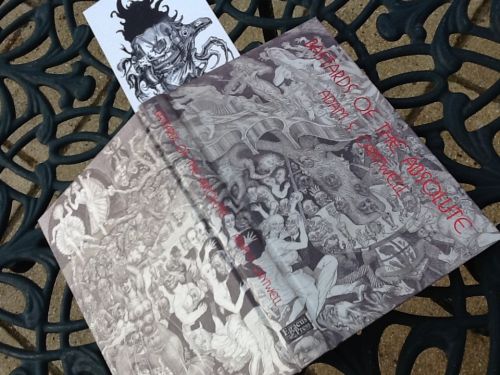
asc

BASTARDS OF THE ABSOLUTE by Adam S. Cantwell

Egaeus Press MMXV

I recently received this book as purchased from the publisher.

CONTENTS – THE LINKS SHOWING MY EARLIER REVIEWS OF THESE WORKS WHEN FIRST PUBLISHED:
The Face In The Wall
The Filature
Offal
The Notched Sword
Beyond Two Rivers, A Symphonic Poem*
Only For The Crossed-Out
The Curse of Desert and Flesh
Moonpaths of the Departed
The ‘Kuutar’ Concerto
Symphony of Sirens
Orphans on Granite Tides

*first publishd in my own published Book of Classical Music Stories (2012)

asc2
Introduction by George Berguño
Above cover and endpapers: Eduard Wiiralt
Internal artwork by Charles Schneider
.
My previous Egaeus Press reviews HERE.

One day, I may real-time review the whole book, by (re)-reading all works and, if I do so, that review will appear in the comment stream below.
Filed under Uncategorized

13 responses to “Bastards of the Absolute – Adam S. Cantwell


  1. THE FACE IN THE WALL
    A densely textured, like the prisoner himself, text about a prisoner’s ‘enmuralment’ in the city wall (from his own point of view), punished for a crime (I don’t think he tells us what the crime is) to sit out what becomes a longer period perhaps than he would otherwise have lived, for reasons one infers from the text he is imprisoned within is to to do with the city, its passing strictures, plagues, wars, and petty graffiti and taunts upon his person, et al. I was intrigued by many things, such as some of the city’s outer walls having prisoners within, too, but with their hands and arms left free, as if to fight off marauders of the city that they have become. With our narrator, we can only ‘see’ his face, a solitary one unlike those on the book’s endpapers. His crime? Punished retrocausally for outliving the city itself? And creating by his narrative words this upstart of a replacement wall of text itself? A cross between Clark Ashton Smith and Lord Dunsany, well decanted by Cantwell with new flavours that are himself.


  2. I don’t intend to re-read THE FILATURE since, despite my usual bad memory, it remains vivid in my mind and I would have nothing to add to what I said about it in my earlier review of it, as pasted below….
    ============================
    image
    The Filature by Adam S. Cantwell
    It seems meaningful that this story follows one with ‘Bloody Silk’ in its title…
    With the vessels, vats and cocoons of a silkworm farm in China, this story is, for me, with only one other story in the book yet to read, the most memorable vision so far and the one that, I suspect, conveys the soul of our Ewers with most force. This is managed by giving us the chance of reading, with carefully, believably increasing horror, the discovered diary of a German man visiting China as a representative of a firm supplying filature equipment… Despite misgivings, the German repeats sexual relationship indiscretions (here with a feisty filature-working Chinese girl) that seems to have caused his German firm abandoning him here in China in the first place. The Christian converted Chinese man in charge of the filature takes his revenge for this and the diarist’s other misdemeanours… I can’t repeat the intricacies of the denouement here, but it is a remarkable interwoven metaphor of Christianity as transfigured, in (partheno)genesis, by that very interweaving. I don’t know if this story won a literary award for 2011, but if it didn’t, it deserved to do so for its own seemingly autonomous transfiguration from a traditional-seeming horror-pulpish plot as if written in the mid-twentieth century (exciting and enthralling as a plot in itself) to a newly inspiring archetype or myth for our times. From vat to silk.
    “…though they often resisted it, all men stood to benefit from change –“


  3. OFFAL
    “No room for history in a hoard. They are altars to an immobilized future, built out of the dead and conquered past, on which are offered futile prayers for an undisturbed eternity of acquisition and neglect.”

    If you can conceive of the most rarefied portrayal –
    of hoarding as a horrendous tipping-point, and, after you have seen all those unbelievable TV documentaries about individual hoarders and their mind-boggling possessions as hoards, then if you can imagine a portrayal spiritual as well as utterly ‘deep’ in all senses of that word, with you as reader feeling implicated as the multi-consistency rubbleshooter, too, simply by reading about it
    – then this tangled cocoon of symbiotic pollution and polluted as extruded by a filature of text is that portrayal.
    Has echoes, too, of the burying of self in the first story’s time-layered city piles…


  4. I intend in due course to read the remaining stories, most of which I have read before, and write my new review of them before revisiting my old review of them…


  5. THE NOTCHED SWORD
    “…the story was no different now, nothing really happened in its pages, but I had changed…”
    A fascinating diary as a story as a diary as a story, involving writers Bruno Schulz and Witold Gombrowicz, involving 1939-1941 MittelEuropean matters, race and writing, that seems to involve imprisonment in history as war (history against history as halves of a whole?), trapped like a face in a (ethni)city wall, and later released as the offal hoards of self, that can be halved without changing or blaming each half of self (or absolving each other)… An absurdity for all histories, with puppets as puppeteers, and vice versa. When does absurdity cease and wisdom begin? Upon the cusp of this book? Thinking aloud.
    I wonder if my previous review of this story a few years ago resembles what I have just said in any way? Half and half, I guess.
    “…I had never had any gift at all, and that anyone who encouraged my writing — the publishers who wrapped it in lurid covers, the bored young students and clerks who bought it hoping for a glimpse of blood or flesh, the distracted critics and poseurs like Gombrowicz — did so for trivial, evanescent reasons of their own or more likely no reason at all.”


  6. BEYOND TWO RIVERS: A SYMPHONIC POEM
    “Hand-painted in rich and atrocious acid hues, it depicted the President in some historical mode of costume riding at the head of a horde in peaked helmets and armed with bows and curved swords. Around the border, scrolls and florets of a quasi-baroque type clashed with Islamic calligraphy.”
    There are some stories that, however many times you read them (and you will understand why I have already read this one several times), will always produce something new, indeed something so radical as well as new, it becomes its own metamorphosis, preternaturally providing a literature that is akin to all great non-programmatic ‘classical music’ such as symphonic poems. This work relates to three of my favourite pieces, Sibelius 4 and 5, and Shostakovich 4, and a new, as yet unheard, symphonic poem that is ASIF it is this story as a symphonic poem itself. Hoards now become hordes, walls with faces like the first story and the endpapers and bookcover, a wall that is the orchestral performance that becomes its own music you conduct as the story’s reader as maestro, then, as conductor, cloying through it, towards a vision of Islamic history that has really only become obvious in the last year or so (a new state) since this story was first written before its publication in 2012?


  7. ONLY FOR THE CROSSED-OUT
    “Men were satanically clever animals who reveled in the exercise of their guile beyond the point where there was any gain to be had. In this they formed a whole with the stupid, striving, wastefulness of creation, its uncountable stones and clouds, the irreducible shapes of bare tree branches in the fall.”
    Hordes and hoards, and, now, having just re-read this story after reading for the first time its author’s OFFAL, new piles of osmotic books fall into now neat rather than disordered place in the piles around me, having fallen down a chute into this Kafkaesque basement. (Realbooks (not ebooks) are the only ones that can be injected directly into the reading-vein, I propound.)
    I cannot do justice to the weird reality in the guise of historical satire going on above this basement, because it no doubt means something different to different readers and, so, why cross-out or redact your understanding of it with mine? You should just read what has now become, to my mind, a classic story.
    “The secret policeman never traveled alone, but those who accompanied him were rarely seen — they were presences on the margins of rooms, whisperers in stairwells, shapes behind pebbled glass.”


  8. THE CURSE OF DESERT AND FLESH
    An extended prose poem combining the ‘metamorphosis’ I mentioned earlier within a story (here ‘the two rivers’ converge as human and animal ‘offal’?) and within ‘the half horse / half man’ in The Notched Sword – becoming an amorphous centaur? I do not think I have read such perfect prose perfect for what it describes, almost beyond my imagination of anyone being able to write such densely pitched coagulations of readable text. And I don’t say that lightly.


  9. MOONPATHS OF THE DEPARTED
    “What if I could show that, thousands of years before man wrote, he composed music?”
    I know it is a spoiler, but it becomes clear towards the end of this lengthy tour-de-force that the narrator is Anton Webern, my favourite composer. As I re-read Moonpaths just now, I felt sure that it had redoubled even what I remember of its incredible power when I first read it – and reviewed here – in 2011. But, since then, I have read Dr Faustus by Thomas Mann, Adam Cantwell’s own Two Rivers story (reviewed above) and (for spelunking cosmic horror references linked to Moonpaths) fiction by Scott Nicolay. (In passing, if Cantwell has not read Nicolay, and if Nicolay has not read Cantwell, then I would recommend each to the other!)
    I shall now have blind confidence in my 2011 self and advise you to read (at above link) my original review of this crazy genius Moonpaths story because I am sure that review will improve on how I might be able to express it today, as I am now older and frailer, as well as now being further mind-altered by Thomas Mann’s Faustian version of atonal music madness!


  10. THE KUUTAR CONCERTO
    “To tread the ground of myth, however, after Wagner’s masterpieces, [to retail the myths of far Finland to a jaded Decadent Europe,] did not seem to be the way to make his name. What if, instead, he could conjure the old gods onto the city streets through which he staggered and dreamed?”
    Like Webern in the previous story, here we have the great Jean Sibelius taken out of his comfort zone. It is manic, it is magic. But this re-reading of it makes me wonder what is an artist’s true comfort zone? What the artists THINK is their comfort zone? Or what is TRULY their comfort zone?
    Where madness fights sanity and destructive tradition becomes constructive avant garde, or vice versa? Decadence as Growth? My previous review in 2011 will again no doubt provide a more useful review of this story than this one, as I think I have now entered too much of a confused comfort-zone myself since 2011, my head on the tracks awaiting the locomotif of fate, or in Sibelius’s case, not the tracks, but the staves.


  11. SYMPHONY OF SIRENS
    “I have never seen anything like it, and I have been to the Alps. I looked down and watched the clouds change in the wind. The white was so pure. They were like hills, mountains…”
    I have not yet revisited my 2011 review of this story, but today the work seems to be an astonishing premonition or metaphor for the two aeroplane events that have horrified and taunted our imaginations since this story was first published: i.e. the Malaysian vanishment and the Alpine imputedly Ligottian ‘suicide’. So, this Q&A session takes on quite a different slant, as well as still musically variating upon the historical geo-political situation of Soviet Russia and Europa, in interface with avant garde aesthetics versus traditional in music. That is all I can think to say about it at the moment.


  12. ORPHANS ON GRANITE TIDES
    “I mistook the letter-forms, the gamut of rational and constant gestures — the mere code — for the wisdom. Turned this way or that, they might fall into new and revelatory configurations or into nonsense.”
    …this novella, this whole book?
    This novella, as a microcosm and metamorphosis of the book it ends, is probably the most difficult work (that potentially seems to have within it a solution to its difficulty) that you will ever read. Or re-read as I have just done now. I have of course added the new context of the whole book, and I recognise that this author has now placed me on one of his ‘edges’ of comprehension. I have now factored in the faces in the wall, the new chutes to books of basement, Verne’s and Mann’s submersible worlds, [and my own (“the earth’s surface is not a great carpet…”) where hawling and Hawler is just another name for Erbil as another pivot of world history] … like the suicidal balloon flight over Reich-threatened Paris… It is also a story of more ‘crossed-out’-ness, with texts missing, rich men’s conspiracies of books and history, and extrapolations upon a nineteenth century Fort Ross when Russia occupied California, and a mythically created submersible land, filtered through the texts of a showman masquerading as a native Indian… There is no way I can even hint at what sort of thing you have in your hand when you read this. You just need to let the whole gamut of mock-möbius contortions flow over you. I suspect it changes the shape of the reader’s physical brain as well as its contents. It is quite capriciously amazing. [Sorry that my pointing out (in my 2013 review here) that there was a typo on this novella’s last page has been ignored.]

  13. This book is about and by mad genius. A Weird Literature classic.

    • PS: I have been thinking of the book’s title. We are all bastards of the absolute, none of us legitimately born. But, so as to see for ourselves, by this book we have a claw lent to us to hawl ourselves from the basement of earth’s core caverns to find some meaning in existence’s random music.

The Visible Filth - Nathan Ballingrud

The Visible Filth – Nathan Ballingrud

image
I have just purchased this chapbook from Amazon UK.
Published by This is Horror 2015
My previous review of Nathan Ballingrud fiction HERE.
I intend to review this new work in the comment stream below as and when or if I happen to read it….
Filed under Uncategorized

9 responses to “The Visible Filth – Nathan Ballingrud

  1. Pages 5 – 11
    Such a short space of turning pages acutely to convey this drinking bar in New Orleans, and the living characters of its barman, his woman Carrie, specific customers like Alicia and Jeffrey, the types of regular it draws, then, the brawlers and the outcome of their brawl, even the living characters of the cockroaches that you would need to burn down to ‘their mother nests in Hell’ to fix. A wordfest with one click of the pen, is the impression,
  2. Pages 11 – 15
    I’m getting scared by this book. Sometimes I thinks its text is texting me. Or is it a cockroach?
  3. Page 15 – 19
    My breakfast this morning, reading this. Will the barman’s breakfast, in last night’s bar brawl aftermath. TS Eliot’s Hollow Men stirred to be reread just now, at least by me. From hollow men, stuffed men, to Will’s day of empty spaces, and the sex and text that texts him. Ballingrud’s text about these texts is spot on, a bit like a cross of Eliot himself and Hemingway.
    ‘Headpiece filled with straw’ with the teeth now gone?
  4. Pages 20 – 24
    “If there was something hollow underneath it all, a well of fear that sometimes seemed to pull everything else into it and leave him clutching the stone rim for fear of falling into himself, well, that was just part of being human, he supposed.”
    We remain with Will’s first waking hours, noir-immaculised artfully by Ballingrud, journeying into the morning after – and those left licking their wounds after the night before, including Will. Some wounds physical, some mental. Or both. Cheap shots and skirting the edges of infidelity. And even the reader fears he is being sucked into falling into something…. No spoilers here.
  5. Pages 24 – 31
    “It felt like a conduit of some dark energy, and he felt uncomfortable holding onto it.”
    …much as I feel about this chapbook, thin and neat as it is like a tablet.
    Maybe the rumours I’ve heard about this work is making me eke it out as I am doing, either to savour and extend what I sense is about to happen or in the hope that something may prevent me reading any more? It is like an OCD experience of an accretive version of Antonioni’s ‘Blow Up’ upon a modern implement.
    Impelled by Schopenhauer’s Will?
  6. Pages 31 – 36
    I’m still here. Can’t put it down. But can hardly pick it up, too. This is a stoical, human intermission. Beautifully expressed. And the word ‘beautiful’ means a lot to me. I don’t use it lightly.
  7. Pages 36 – 41
    Guilt, rejection, Googling, toggling… The white noise of anxiety I have about this text I fear will turn eventually to terror.
  8. Pages 41 – 49
    “Something fundamental was about to tip…”
    And this text make it seem potentially even more fundamental from simply being within the text itself. Feeding on itself. I want to be one of Will’s now ‘sweetly dreaming’ roaches, oblivious of its ‘slow engine algorithm of fate’…
    But the text has left a pressing present for me. Not a past.
    I fear I cannot – eventually – not read this text, despite the ohm resistor of my review’s real-time. And my own fallible character, like Will’s, so neatly conveyed.
  9. Page 49 – end
    This is a bigger bite of text than to those I have been accustomed; couldn’t swallow it, but couldn’t not swallow it, either.
    I felt like one of the roaches, who I’ve decided are us readers; makes sense, ‘incurious and unafraid’, ‘antennae waving in bored appraisal’, until we come into our own at the end, knowing that our real-time eking out of this text was, like Will’s love life, not so much the act of a ‘listless child’ but more the not being able to do good for doing wrong. Reaching Erictus.

Wednesday, April 08, 2015

Strange Tales V

Strange Tales V

image
image
image
STRANGE TALES V – edited by Rosalie Parker
Tartarus Press 2015
I have just received this book as purchased from the publisher.
Stories by: Charles Wilkinson, L.S. Johnson, Steve Rasnic Tem, Andrew Hook, Jacurutu:23, John Howard, Elise Forier Edie, Douglas Penick, Paul Bradley, David Rix, Mark Valentine, Yarrow Paisley, Tara Isabella Burton, Andrew Apter, Nathan Alling Long, Tom Johnstone, David McGroarty.
My previous reviews of Tartarus Press books linked from HERE.
I intend to real-time review this book in the comment stream below as and when or if I happen to read it…
Filed under Uncategorized

19 responses to “Strange Tales V

  1. Book’s artwork shown above: Stephen J. Clark
    THE INVESTIGATION OF INNOCENCE by Charles Wilkinson
    “…but the longing for connectivity was still there, a terrible ache.”
    A terrible ache, indeed. To gain innocence, is to lose my body’s frailties, I guess. It seems, via tattling (twittering on some grid that in our real world leads to all manner of GUILT?) that, here, in a world of INNOCENCE, of cyborg-honey and slick sex change, this story’s grid is one that brings us the positive poetics of familial terrorism’s nepotism and the politics of the bee-lovely hive mind. Beautifully written, immaculate, even the nastiness is just one side of perfection? Even the Unacceptables are accepted. I am still working at it, though.
  2. JULIE by L.S. Johnson
    “You profane me by loving me too much. Your virtues are the last refuge of my innocence.”
    …which may have some bearing on the previous story in this book?
    This 18th century tale, replacing sorrow with ‘hot, dark fury’, both in its central character and in its writing, as if Lyssa is L.S. herself, running not only with the pack of dogs but also with that of the ‘sisters’, against those who use them.
    This is indeed a remarkable and furious tale, of Julie used as, inter alia, brothel bait, then by a real Jean-Jacques Rousseau both in Julie-body and Julie-book (the latter: The New Heloise). A lycanthropic rage that becomes the Noble Savage (or destroys him or her in the confessional process?) This is a Julie-story about a Julie-book. Endlessly scryable.
  3. THE GRAVE HOUSE by Steve Rasnic Tem
    “The hall was fat with pictures, frames a lot finer than the walls they were on,…”
    I’m thinkin’ these thinkin’ thoughts of a tale represent not only the house the thoughts are kept in but also are the very house itself, passed on to us for passin’ on to others.
    Whatever the case, this is a treatment of ill-carpentered generations in their ill-carpentered houses with ill-carpentered, if well-meaning, memories of their familial selves – a treatment that is well-carpentered into fears applesauced by love.
  4. A LIFE IN PLASTIC by Andrew Hook
    “Some people were interested in speculating what might happen should a mannequin come alive, but for Oki the reverse was true.”
    …and akin to Wilkinson’s gradual bodily accretions earlier in Strange Tales V, so it is.
    Meanwhile, in many ways, a Life in Plastic is the sister, or at least cousin, even daughter, story to this author’s Drowning in Air in Strange Tales IV. Also, it is generally in the Japanese salaryman role-playing (sexual or otherwise) tradition of Brian Howell’s
    The Sound of White Ants collection as actually published by Andrew Hook in his fine Elastic Press imprint several years ago. Or at least, I imagine, a nod towards it.
    It is a wonderful and eventually disturbing description of unrequited fatherly love for a daughter who is somewhat estranged from him by his marital unfruition, then his taking her, when given access, as a small child on holiday to an island where the only entertainments are a golf course and a Poison Gas Museum, and later his visualising her as an older girl or woman in the form of a window-dresser in a shop window whom he obsessively watches dressing mannequins…
  5. BARDO THODOL BACKUP FILE by Jacurutu:23
    “Was I enlightened enough to avoid the brain scream?”
    It seems appropriate for me to read this story in the same week as the LHC stationed in our current CERN Zoo is restarted to seek parallel universes (there is an arguable reference on page 60 to the LHC’s ability I once imputed to retrocause its own destruction from its future)…
    Serendipitously bouncing off Wilkinson’s and Hook’s respective cyborg-plasticity and off Tem’s story of the house that is the head, and off his own father’s SF heritage, this writer believably leads us into the nemonymous night of some brain transplant monastery in Nepal. I say ‘believably’, because the whole essay reads as if it is true. And I sense it is true. Self as a back-up. But why ‘must’ you be married if you have a brother-in-law?
  6. MORE THAN INDIA by John Howard
    “–to drown with an ecstasy of abandonment in a wonderful merger. Would this be fulfilment or extinction?”
    A nemonymous merger with the back-up of self as in the previous story, or a blending with or a drowning in the river, here the Thames redolent with its boat race tradition, the double addressed ‘you’ (Aaron and Patrick) as two sides of a coin of the realm whereby the respective thicknesses of its two sides make the whole of that very coin? But where does that leave room for the older you (Edward), other than as (previously) the younger Queen the story tells you is on one side of that coin?
    This is a mighty story, redolent of other days, those bright young things, days of empire, students of the river, swimming against the current of the Boat race as one young man once did, viewed from a ‘veranda’ overlooking this transposed river as an Anglo-Indian word, a loggia or terrace, and I believe the word ‘balcony’ is used here, but I can’t find it without a complete re-read. It is a romantic story with utter power, steeped in civilised unrequitedness and (self-)sacrifice.
  7. YOU-GO-BACK by Elise Forier Edie
    “But it’s a fact that if you put one foot in front of the other and keep doing it, you’ll always get where you’re going.”
    …even if you don’t want to get where you’re going. And there is something relentlessly frightening about this story but you can’t stop reading it, and it makes you actually believe that what is frightening is actually capable of doing you harm, yet you read on. A page-turner with a demon turning the stiff pages of this book that contain this story. If I told you it is a home-spun, 19th century story of Barnum’s Museum of the grotesque and the absurd, some exhibits real, some fabricated, and full of living, well-drawn characters, you won’t believe what I just told you. It is fast and furious, running with the LS Johnson’s 18th century dogs, but Edie is a static version of that feeling: a retrocausal impulse of the story’s own eponymous monster moving, of its own volition, towards every past that harbours it to bring it forward again stage by stage, till it nears our time, the very day you read this story. I have no hesitation in saying that this story scared me and it will be anthologised again and again, unless it can be stopped here and now, with this my warning. No irony intended.
  8. STRANGER MUST GO by Douglas Penick
    “They all slidin’ around in his head. He can’t see ’em yet. But they splittin’ him up every way.”
    A substantive Messiah story, a black Messiah dossing in a vacant lot in New York that he fabricates into the shape of the Africa of his dreams, and bringing to my mind another such vacant lot of another King (here the Sea King who eventually becomes the story protagonist himself), the King who wrote about it in his Dark Tower series.
    This protagonist is a West Indian lad with such African dreams called Robert in New York – strangely adrift from childhood like someone arriving at an airport and forgetting why he flew there – with his Mother and Aunt competing, using each their own version of religion or spiritualism, to rein him in from what many see as his dereliction in the city streets. Running as it were with Johnson’s dogs from earlier in this book. Indeed, this book’s second Rousseau or Noble Savage. Indeed, he reaps his own variegated disciples and an eventual ending of the world in a shape or form that is quite newsworthy today. In America, as I understand it from afar. Not Africa. An accretive vision that is worthy of its place in this book.
  9. BEATRICE FARAWAY’S CHRISTMAS TALE by Paul Bradley.
    “The jelly babies weren’t eaten but everything else was eaten up overnight. Beatrice Faraway didn’t feel lonely anymore.”
    A delightful description, if not investigation, of innocence, where the description is itself rather than what it tells, a Storytown in Storytown like Tem’s Grave House being the storyteller herself and, even in its happy ending with the happy storytelling that leads to it, it also tells of the past death of the storyteller, Beatrice’s husband, in which light we eventually learn that the story’s title is its own spoiler (something that happily doesn’t matter), a storytelling of a storyteller by his wife. It is Looby-Loo from Andy Pandy (who only moves when unseen) and Blyton’s Faraway Tree. It takes some courage, I guess, for an editor to plump such a child-like story in the middle of some of this book’s other stories, but it has worked for me, amid the grown-up plastic mannequins and the honey-cyborgs and and the Nepalese monks and the Barnum museum exhibits…
    Even the Julie-story about the Julie-book.
  10. imageimageHENGE by David Rix
    “‘Almost more light at night than during the day,’ he said, trying to imagine where the sources must be to cast such a pattern.”
    Matt and his girlfriend Aiko start renting a flat after a girl called Feather, who previously lived there, had been killed in an accident. This takes places in densely packed London, and London is conveyed well here, its pros and cons. The curtainless windows of the flat overshadowed by Railtrack and tall, encroaching buildings, and the decorations, or rather artwork, Feather has left on the flat’s walls, are all tellingly conveyed. In fact, this story has a stunning geometry of ghosts and leitmotifs or light motives, their eventual gestalt being undisclosable in this review for fear of spoilers but the story’s title, like the previous story’s title, does give a tantalising glimpse of the outcome, a spoiler in all but name. The Japanese references and the geometrical angles – and the train fantasising – again, as with the earlier Hook story, are all in the tradition of the Sound of White Ants book linked above. Again, too, the Rix story is one that stands on its own and its artful angles, artistic references, architectural synaesthesia and light manipulations, not least its musically ‘dying fall’ at the end (love lost or simply love transferred?), have enthralled me significantly.
  11. imageYES, I KNEW THE VENUSIAN COMMODORE by Mark Valentine
    “Up in some tower block there’s probablyh a student rehearsing, and in all the angles and curves of the city…”
    Casting a light on our world, literally, back from its end to the beginning, this gorgeously Valentine-immaculate text — about the Flash Gordon fashion of films of yore and upon one of its acting stars in particular — morphs itself into a L. Ron Hubbard type religion.
    No, it is much more than that because — with some of the Mad Scientist power of this book’s earlier publication of a work by Jacurutu:23 who bears a name with a single word (an Internet identity or password or dreamcaptcha?) like MV’s film star character whose screen name was Triton — it transcends itself as a text into a fiction that is both characterfully touching and TRUE. With ‘love rays’ to match those of Rix.
  12. MARY ALICE IN THE MIRROR by Yarrow Paisley
    This story entails a family arriving in new living quarters and choosing to keep, at least temporarily, the existing decor and fittings as, in similar significant circumstances, the young couple do in Rix…
    “With the eraser Mary Alice scrubbed away the item (‘Rx’) just below ‘wash the dishes’,…”
    …which action then sets in motion a whole lifetime of repercussions, entailing her being trapped inside a mirror in a sort of a ‘You-Go-Back’ relentlessness of overtakingly-fast slow-moving fate (“But it’s a fact that if you put one foot in front of the other and keep doing it, you’ll always get where you’re going.”) but in this Paisley story, despite the entrapment, it is has a mostly delightful tone, definitely recalling Beatrice Faraway, arguably Frances Oliver or Sarban, but only marginally Lewis Carroll. It is a classic fairy or fantasy story but not old-fashioned enough to eschew Skype!
    Being one of them itself, this story has caused me to lose count of the number of stories in this book potentially re-anthologisable or author-collectable into the distant future. More than three anyway.
  13. THE TAXIDERMIST’S TALE by Tara Isabella Burton
    Feeding furiously, by preternatural osmosis, upon the ‘running with the dogs’ in the Julie story, and upon the two New York tales, too, the vestigially created living exhibits in Barnum’s Museum and the erection, by empassioned fabrication, of a living Africa on King’s vacant lot, another New York tale, this one, tells a different tale of a taxidermist’s collection and the seethingly diffident man who hires this taxidermist to work upon a mighty White Wolf roadkill not killed by the road but on the road by he, this diffident man, eye to eye with it, who mysteriously brought it to teeming taxidermable existence-by-death.
    Thus, this inspirational story seethes; it eventually lives and breathes as the story’s own creations — the taxidermist’s creatures and, eye to eye, the two men themselves: wolf killer and taxidermist: creations from within the words that created them all — eventually live and seethe, too, for those of us who choose to read the words.
  14. THE MAN WHO LOVED FLIES by Andrew Apter
    “The road in is the same as the road out.”
    I think this whole book might have a connecting theme of obsession. This story is a compelling narrative, one with an obsession about flies, and protecting them at all costs … even to the extent of murdering those who are cruel to flies. I don’t want to belittle this obsession and its outcome as a story that has a ‘worm ouroboros’ configuration like Tem’s, Howard’s and Faraway’s stories – but as it is a page-turningly believable story as well as worrying to me that its depicted obsession might be infectious, the story needs belittling or made to look like an exercise in literary absurdity, and indeed, with that in mind, I note here that the obsessor Thomas Hurley has his obsession ignited by working in a department store where there are tailors making men’s trousers … and men’s trousers usually have flies (my observation, not the story’s) … But, despite this sort of joke on my part, the story genuinely still obsesses me as a horrific truth. Reader as a madman madder than the madman in the story? Reading in as a way of reading out?
  15. PURSES by Nathan Alling Long
    “The variety of fabrics — aquamarine sharkskin; soft, peach-coloured felt; iridescent gold lamé; turquoise-amber paisley linen –“
    A poignantly engaging needle-and-threnody by a daughter about her mother who collected purses, in an obsessive way that many in this book collect things. Upon her mother’s death, she explores the contents of these purses, later as if clipping herself with a fastener’s click to become one of their contents, too, I guess. Purse as Tem’s grave-house? Or purse as Burton’s taxidermable filling to re-ignite its life? The shimmer between these two possibilities tantalises.
  16. LOOK FOR THE PLACE WHERE THE IVY RISES by Tom Johnstone
    “I often think that I’d love to be a fly on the wall…”
    This story rang delicious-sinister to me, at least partly because I, too, know of a Residents’ Association where bitter disputes and darksome deeds surround who is secretly in charge of what stays and what’s hacked down in the communal garden. This is told beautifully by someone who is ironically considered otherwise not to be the sharpest tool in the toolbox, as he works for a close-knit trio of a family gardening firm that doles out to him clearing-up jobs rather than more responsible cutting down ones. He is mystified why he is not allowed to chop down a certain area of growth, as he is impinged upon by stranger and stranger things like rumoured vermin or people or voices, and I thought his searching this growth was similar to searching the collective ocean of purses in the previous story… I really sympathised with this vulnerable character and his well-intentioned work ethic as he tells his quaintly vulnerable, effectively garden-creepy, narrative.
  17. MCBIRDY by David McGroarty
    “He described his fear as a thing that moved like a hermit crab from one source of dread to another,…”
    This has that overtakingly fast-slow oxymoron of relentlessness (“When the dogs come, I will abandon you.”) of previous evolving horrors in this book, horrors that ratchet back from the 19th to the 18th and now to the 17th century, by dint of an old philosopher from that 17th century channelled via a mentality similar to this book’s Mad Scientist Jacurutu or Valentine-Venusian ‘religion’, material that ends up in the hands of two teachers in a school amid today’s brownfield sites of Britain, teachers that remind me of some of the diffidently ‘evil’ and/or disguised-insane teachers of my own days at school, some with academic capes like wings and wicked tongues. And from their hands this material ends up in the hands of two well-characterised boys, each with their own hang-ups and hang-outs, who we watch through the ensuing years into so-called grown-uphood… The story’s ending is deeply disturbing, and the story as a whole gives a dark obsessive coda to this wonderfully cohesive anthology that contains stories that stand on their own and will make their notable mark in the canon of Strange Tales.
    end